Mom and I had an interesting conversation this morning. She was joking about her disabilities and I was exulting how sharp she was, and credited the military-industrial complex for keeping her sane. She fights it all day, tells it to disarm. Keeps her in shape.
Meanwhile, down the hall, I'm like this pro DARPA person, because when Guido was a nobody, and brilliant (now he's a somebody, still brilliant), his bold Computer Programming for Everybody manifesto attracted DoD attention. What a boon to democracy it would be, to have Americans at least (more if willing) computer literate.
Here's an article from Salon about what happened instead: teachers actually dropped all mention of programming for the most part, and now maybe think they'll get away with blaming the PC engineers.
Sorry to disappoint, but the freedom to download and run free languages has never been greater. If your curriculum is in trouble, don't come whining to the engineers about it. They've met you more than half way. Think of some other excuse?
That being said, we have a long way to go with improving the technology. That's why we recruit so avidly, hoping to bolster the civilian sector with high caliber talent. We need next generations to help us make life better. We're not done yet, not even close.
But where will this talent come from, if we ignore golden opportunities to educate when it matters, before they've become hardened-in-their-ways adults, possibly all Eloi, hardly a Morlock among them. That'd be bad for our time, and we don't need any "time machine" to tell us that.
So anyway, Mom and I basically agreed we're working at opposite ends of the same spectrum. I deal with dark sider tooth/fang stuff all day, while she gets to work with wise women (I'm not saying which is easier). She's glad my campaigns are going well, both HP4E and 4D.
Friday, September 15, 2006
Thursday, September 14, 2006
Merging Traffic Patterns
The painters are back, doing a smart job. We're operating on schedule.
Mom's United flight from O'Hare was late, but lets face it, this many people flying around the world is a dream come true as well, a case where futurism paid off. You'll see Amish on Catalina (I did, visiting from a cruise ship), and isn't that a blessed thing. Mom's trip originated in London. Now she's back in her office, joining in conference calls.
I drove out to PDX to retrieve her. Our curved IVM archway, protecting us from the rain while suspending two bridges, is an engineering marvel. Speaking of which (rain), that's what it's doing right now (raining). And yet the painters don't care. They like living in a rainforest (our SiliconForest is one of those too).
Dawn uses the iPod to listen to dharma talks, meaning I get to lurk in from time to time. I also have Dyxy Chyx Not Ready to Make Nice music video (a strong performance) and EBN's EBCS, now a Google Video in low rez.

Mom's United flight from O'Hare was late, but lets face it, this many people flying around the world is a dream come true as well, a case where futurism paid off. You'll see Amish on Catalina (I did, visiting from a cruise ship), and isn't that a blessed thing. Mom's trip originated in London. Now she's back in her office, joining in conference calls.
I drove out to PDX to retrieve her. Our curved IVM archway, protecting us from the rain while suspending two bridges, is an engineering marvel. Speaking of which (rain), that's what it's doing right now (raining). And yet the painters don't care. They like living in a rainforest (our SiliconForest is one of those too).
Dawn uses the iPod to listen to dharma talks, meaning I get to lurk in from time to time. I also have Dyxy Chyx Not Ready to Make Nice music video (a strong performance) and EBN's EBCS, now a Google Video in low rez.


Tuesday, September 12, 2006
More on Project Earthala
From earlier today, responding to some talk about what a disaster global warming might be, in real human terms:
Re: [wwwanderers] Global warming: practical approach
This is where I usually start saying biting things about Economics as a discipline, proposing that General Systems Theory (GST) is less likely to feed a collapse, because more science-savvy in so many dimensions (ergo less prone to breakdown).
But that'd be for a whole 'nuther thread.
Anyway, I do think the ongoing high price of oil will help with my horse camps in the Arizona desert, where we do these permaculture domes and pretend we're these hippie Quakers, except with Internet and flatscreens, and biodiesel dirt bikes.
Oh, and we talk about Synergetics like it was the Bible or sumthin' sometimes quoting chapter and verse -- i.e we talk like buckaneers (even eat BBQ sometimes).
Most people just visit as tourists. We're kinda cliquey sometimes.
Kirby
There's a pun lurking here, in that such ecovillage communities might likewise occur in South Africa, home to various "click languages" such as Xhosa.
As for the Project Earthala reference, I've got lots of other posts and allusions: [1][2]... [3] (some samples).
Other recent Wanderers posts focus on Chaco Canyon, and how global warming might not have been a big crisis/calamity for the people living through it back in the 1100s.
Tourist traffic tapered off and people went on to other businesses.
Civilizations, especially highly developed ones, don't always panic and fail when the climate changes. Some smoothly transform.
I also look at the case of Holland, which has a lot at stake where sea levels are concerned. I think we should fight alongside the Dutch, if their homeland is imperiled, in as smart a way as our global climate models will allow (and then some).
Saturday, September 09, 2006
Belmont Street Fair
 electric car prototype, 1921
 more recent specimen
 proud of her dog
 the happy face of downtown
Thursday, September 07, 2006

Tuesday, September 05, 2006
Investments
 "privately enterprising"
(photo by K. Urner)
Obviously I consider my skills as a teacher bankable assets, and indirectly, so does my bank, in that they model me keeping an income sufficient to pay down the mortgage and maintain high "credit worthiness" (which computers keep track of).
My "earning capacity," along with my wife's (a dual-income household) allowed us to build equity in the house, typically the principal physical asset of a middle income family, next to the car and/or truck (no ATV or jet ski in our case).
Such physical assets are also principal assets of the neighborhood bank, which models average incomers as incapable of financing a home's purchase without credit, meaning a huge markup on the sticker price, but one you tend to not see unless you run the spreadsheets, and realize how good it is to be on the receiving end of exponential interest rates (where the "rich people" live, a lot of 'em bankers).
Banks get to mortage the same house multiple times, as people in varying financial straits assume title and secure financing. Homes are like DVDs in the video store, watched over and over and over again. It's a secure way to make a living, if you're in the business of loaning for homes.
Part of why LAWCAP fought Bucky so much is he derided this system of governance as somewhat pathetic, as it assumes dire straits for so many. But that's how LAWCAP tends to operate: overwhelming lack of life support is just a given. "We don't fight that state of affairs, we make money off it."
Not a popular strategy among the poor, and in a model democracy the government might take a different direction. That presents a puzzle: how to intimidate enough people into supporting the low living standards standard. You need a lot of ideology in overdrive, keeping people thinking straight and paying those mortgages.
Anyway, part of my responsibility as a stakeholder in this home (me and the bank share this asset), is to see to its upkeep. To that end, we just had some painters come by to make a bid. The "down to the wood" approach is the premium ten years guaranteed way to go, but most middle incomers not surprisingly go for the "feathered edge" (scape and power wash, but if the paint's tightly bonded, leave it be and paint over). The bid for the latter service was like $4,500 give or take, more like $11,500 for the former, with 10% off if we commit within the next three days (likely we will, after checking against other bids -- I liked their energy).
Now if I were a really good capitalist tool, I'd be using my intelligence to venture capitalize in various corporate ventures. By age 48 (my current age), I'd have a track record of having bet wisely and earned good returns. I might have lots of money, which I'd subtly advertise with various lifestyle cues, and various dependents, friendly companies (affiliates) would want to piggy-back their money on mine, i.e. let me manage their investments for them, so they could get rich the way I did.
What with a Princeton degree, no doubt some social connections, perhaps membership in one or more clubs, I could be living on easy street by now, with several homes, several cars, and a lot of satisfied (well off) customers.
However, I made a career building skills in the not-for-profit (aka public) sector, trying to think ahead the way Bucky did, anticipating new kinds of need, even new kinds of science. This is called "high risk" venture capitalizing, closer to what "crackpot inventors" seem to do. Some of them get rich, but mostly they end up remorseful, for having squandered so much energy on cold fusion or whatever.
But from my point of view, Synergetics was more of a "sure thing" in terms of its philosophical sophistication. I could see a bright future, if I only stuck to my guns, which is what I did, and I don't regret it. Now I'm this hot shot gnu math teacher, respected by my peers.
OK, gotta go now. Time to open a new bank account for my daughter. She had a summer job this year, earned some savings. Now I'd like to wire her account to a debit card and iTunes, so she can pay for her own music and video iPod downloads. She'll still get her allowance and all that, but I'd like her to consolidate and have a sense of managing her own affairs.
Back from the bank: snapped that cool bizmo on the way home (above picture).
Transaction: cheque from flextegrity.com pays for Portland Knowledge Lab's rent this month. I did some work on the web site (still very minimalist at this point).
Addendum: we also plunked down for two years of orthodonture for Tara; we like and trust Dr. Joe. Tonight: joining Wanderers on Barry's boat (Barry the banker).
 Barry
Sunday, September 03, 2006
The Lost City (movie review)
We gathered for BBQ with other Friends, three married couples enjoying a warm bug-free evening in the backyard. Larry and Susan went to Hollywood Video to make a selection, and came back with this R-for-violent tale of a family torn asunder by the Cuban Revolution of 1959 (about 8 months after my birth in Chicago).
Instead of the mellow "chick magnet Che" of Motorcycle Diaries, this time it's "psycho Che" already with many friends murdered. But neither he nor Fidel get much focus in this flick. The main character is a dinner jacketed Cuban on the Meyer Lansky side of the fence.
Lansky (played by Dustin Hoffman) gives our hero the creeps mind you, but as the owner of a successful music club, he has little choice but to rub elbows with organized crime which, upon being evicted from Havana, headed straight for Las Vegas (the movie alludes to this winged migration).
The pretty girl is like a Marilyn figure, wanting to use her head like a man's, to play on the world historical stage, even if only around a rotund Russian ambassador for starters. She wants to be someone in this life, not just someone's lover or wife. I respected her courage.
But the male principal, a man of principles, was not about to share her with a revolution that, from his perspective, had utterly destroyed his own family, leaving only heartbreak and remorse in its wake. Cuba as a "saxophone free zone" really sucked (and yes, so did the Belgian Congo). New York held more promise (that statue really helps).
But then, most Cubans didn't have "New York" as an option. The film isn't really focused on the lower decks of this particular Titanic.
Dawn's O2 went out half way through. She switched tanks but forgot to dial a level, and so breathed unassisted for an hour, leading to some chest pain towards the end. She enjoyed the film but, as with V for Vendetta, was put off by the violence level.
Maybe Bill Murry is what keeps this film watchable. He breezes through as the writer-comedian, perhaps emblematic of the screenwriter's viewpoint. He pokes fun at all players, out of familiarity more than fear, like some other-worldly being. He typifies high artistry, the kind of thing these high rolling bosses really traffic in anyway (all of them seek quality).
There's a lot of theater in politics, a lot of politics in theater. This film takes a raw reality and transmutes it into something worth watching, even if oft times unpleasant to contemplate.
Saturday, September 02, 2006


Thursday, August 31, 2006
Mathcasting About Phi
 The Pentagon
Google Earth
In support of the president's NCLB initiative, I cooked up what I call the "NCLB Polynomial" over on the Math Forum. I didn't invent the polynomial itself (it's very old), but came up with the name because children should be learning about it, if wanting to keep up with their studies at all (NCLB = No Child Left Behind).
Its positive geometric solution, phi (pronounced fie or fee), is the ratio of a regular pentagon's diagonal to its edge.
A symbol dance might start with a Golden Mean derivation, with a voice saying "the smaller is to the larger as the larger is to the whole" as on screen we see: smaller:larger = larger:whole, where whole = smaller + larger.
Since it's a ratio we want, it's OK to arbitrarily set the smaller segment to 1, such that 1/L = L/(1 + L) -- L for larger. Multiplying both sides by (1+L), then L, gives (1+L) = L*L or (L*L - L - 1) = 0 (the NCLB Polynomial). The positive solution is (1 + sqrt(5))/2, which is phi.
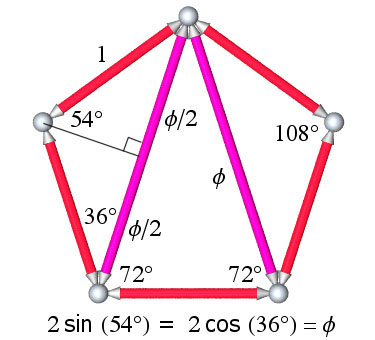 useful trig info
ray tracing by K. Urner
Over on edu-sig (a special interest group in the Python community), we've been looking at a Python generator for 1/phi (phi's reciprocal), using Fibonacci Numbers. A generator yields an interim value in response to a next() method, while remembering its internal variables between calls.
 Fibonacci Generator
Python 2.5 on Windows XP
I'm not saying we need to pack all this information into just one mathcast. The strategy is to grow a large archive of clips, so teachers can embed them within their own presentations as they see fit.
Given Fibonacci (1170-1250) depended on Iraqi intelligence for his Liber Abacci, it'd make sense to use Baghdad as a backdrop for some of these clips. Of course many of our most talented and effective math teachers are Iraqi.
Getting off the XY plane, we get to the pentagonal dodecahedron (12 pentagonal faces, 20 vertices) and its dual, the icosahedron (20 triangular faces, 12 vertices -- and buildable from three phi rectangles).
In Synergetics, we jitterbug between the icosahedron and cuboctahedron, showing both have the same number of balls in their outer shells (1, 12, 42, 92, 162...). This connects us to the geodesic spheres and domes, crystallography, virology and hexapent chemistry (see below).
Related reading:
More About Geek TV (January, 2006)
Math Wars (continued) (March, 2006)
Brute force solutions (for phi, on edu-sig)
Ayatollah of the Tetrahedron (February, 2005)
Sunday, August 27, 2006
HP4E

HP4E is a play on CP4E, Guido's DARPA-funded Computer Programming for Everybody initiative (with work, we could perhaps tie these back to HCE in Finnegans Wake, but that's for some other thread). HP = HexaPent in this namespace.
It's not really work to popularize the soccerball, already high on the recognition scale. Movies like The Cup well-document its cross-cultural appeal. But once we divide the field into soccerballs (a family) and buckyballs (another family), the game gets more technical. Here are the rules:
- Soccerball: looking over the fence from a pentagon, every neighboring lot is hexagonal; looking over the fence from a hexagon, faces alternate between pentagonal and hexagonal.
- Buckyball: all hexagons plus 12 pentagons, such that three lots (i.e. three fenced-in areas) come together at every fence post (i.e. vertex).
The buckyball stipulation (three edges must meet at each vertex) is lifted from carbon chemistry, and is characteristic of the fullerenes, i.e. the spherical hexapent carbon cages, first discovered in the 1980s and posthumously named (Fuller died on July 1, 1983).
Appropriately, three scientists shared the Nobel Prize for buckminsterfullerene's discovery: Kroto, Smalley and Curl Junior. C60, the fullerene with 60 carbon atoms, is topologically the same as the soccerball, i.e. the two above-defined sets intersect on this already-famous member. Kotschick says this is the only element common to the two sets (i.e. is their intersection).
But carbon-based chicken wire needn't be spherical. Consider the nanotubes, capped and uncapped ("buckytubes" some call 'em). Such nanotechnology is a hotly topical area for scientific research these days. When I went to Chalmers @ Gothenburg, Sweden for EuroPython in 2005, the nanotubes conference seemed to dwarf ours in size. Our populations mingled. Lots of scientists use Python, if they do any programming.
Here in Portland, we're gearing up to work on global matrix displays, meaning hexapent fly's eyes colored with global data. Whether or not these unfold into a Fuller Projection depends on the application e.g. it's protected from spoilage by war gamers preoccupied with political border disputes. The hand-held units might just show one hexagon at a time e.g. the one you're in now. Glenn also talks about logic gates and quantum computing a lot, but more with his PSU colleagues than with the Wanderers (two sets, partially overlapping).
My focus these days is the open source community and a "gnu math" curriculum, meaning in part that I want to keep the public up to date and informed about all this interesting scientific research.
Even positive developments meet with resistence, if people don't feel a democratic process has been followed, with lots of debates and town hall meetings. "Imposing from above" is not a popular style of government, and when it comes to HP4E (or CP4E for that matter), I'd like to avoid repeating some past mistakes (we learned a lot from the New Math debacle).
That being said, there're always hold-outs unwilling for change to happen, even if those changes mean higher living standards for a majority of folks. They like the advantages the status quo gives them, and believe in some foreordained right to command more than their fair share (perhaps on the basis of some religion?).
I'm not really interested in pandering to this crowd either.
The democratic process is not synonymous with the tyranny of some minority. If they don't like our global matrix hexapents or Fly's Eye dwelling machines, they shouldn't be forced to use 'em. But nor should the rest of us be denied our preferred brands of mathematics and/or science fiction on television.
 Europython conferees wandering
through a nanotubes poster session
Chalmers, 2005
photos by K. Urner
Thursday, August 24, 2006
Name Collisions
My take is the remoteness of the Synergetics vocabulary made some people nervous enough to credit Bucky with inventions he never conceived of -- although the more popular story is that he stole people's inventions (as in "pirated" them) without giving them their due.
I'm thinking of Clifford Nelson in particular. He invented some elaborate analytical apparatus involving the four planes of the tetrahedron and claimed to have found it in Bucky's corpus. But when I comb through Synergetics, I find no such Rube Goldberg contraption.
True, friends and I collaborated on Quadrays, which one might likewise liken to "4D" in some buckaneer manner (like, we've got a tetrahedron here too), but we never claimed to have found this apparatus actually lurking between the lines of Synergetics itself.
New stuff arises. Elastic Interval Geometry for example: it's not "just tensegrity". Life goes on. Snelson's model of the atom isn't "just tensegrity" either.
Had Bucky lived longer, he'd have enjoyed the collateral with us. Who knows, we might've had those ecovillages by now -- goofy parallel Universe talk, I realize, otherwise known as the subjunctive tense.
OK, now let's listen to Bucky spin it:
Related reading:
Psychology of Synergetics (January, 2000)
Synergeo #28469 (August, 2006)
I'm thinking of Clifford Nelson in particular. He invented some elaborate analytical apparatus involving the four planes of the tetrahedron and claimed to have found it in Bucky's corpus. But when I comb through Synergetics, I find no such Rube Goldberg contraption.
True, friends and I collaborated on Quadrays, which one might likewise liken to "4D" in some buckaneer manner (like, we've got a tetrahedron here too), but we never claimed to have found this apparatus actually lurking between the lines of Synergetics itself.
New stuff arises. Elastic Interval Geometry for example: it's not "just tensegrity". Life goes on. Snelson's model of the atom isn't "just tensegrity" either.
Had Bucky lived longer, he'd have enjoyed the collateral with us. Who knows, we might've had those ecovillages by now -- goofy parallel Universe talk, I realize, otherwise known as the subjunctive tense.
OK, now let's listen to Bucky spin it:
For example, quantum mechanics came many years after I did to employ the term spin. The physicists assured me that their use of the word did not involve any phenomena that truly spun. Spin was only a convenient word for accounting certain unique energy behaviors and investments. My use of the term was to describe a direct observation of an experimentally demonstrable, inherent spinnability and unique magnitudes of rotation of an actually spinning phenomenon whose next fractional rotations were induced by the always co-occurring, generalized, a priori, environmental conditions within which the spinnable phenomenon occurred. This was a case in which I assumed that I held a better claim to the scientific term spin. In recent years, spin is beginning to be recognized by the physicists themselves as also inadvertently identifying a conceptually spinnable phenomenon -- in fact, the same fundamental phenomenon I had identified much earlier when I first chose to use the word spin to describe that which was experimentally disclosed as being inherently spinnable. There appears to be an increasing convergence of scientific explorations in general, and of epistemology and semantics in particular, with my own evolutionary development. (250.31)I think you'll admit, you don't hear spinning like that every day.
Related reading:
Psychology of Synergetics (January, 2000)
Synergeo #28469 (August, 2006)
Wednesday, August 23, 2006
Adventures in ToonTown
 event log screen capture
We've set up a new workstation in the living room, using Toshiba + wireless peripherals, which is where I'm posting from, via http, to my blog. KTU2 is unusable for the moment -- a thread running through this tale...
We received an electric service interruption notice by USPO some days ago, a postcard, but I'd forgotten all about it.
Anyway, the battery backup kicked in, saving work on computers in the back office (but not Tara's Sims 2), Dawn switched to a tank for 02 (the oxygenator requires AC), and all was well.
Until the power came back on, just minutes later. Then, my troll of a computer decided to power down with short-to-no notice.
Lucky for Rybo. I was busy throwing chapter and verse at him, cutting and pasting from Synergetics on-line like some High Gothic Cleric, jealously guarding my Unorthodoxy (aka Synergetics.4D -- cite 527.712). I sometimes get into this mode contra the HyperCross Dogmatists, a competing school of thought (though containing many friends and relations, as well as bitter foes).
So lucky for Rybo the troll computer had a brain seizure and kicked over, per power outage, before I could hit the Send button. The irony is KTU2 got through the outage OK, on battery, and only died when the power returned. Fie, I say, fie.
Speaking of 4D, we were treated to a presentation by Nathaniel Bobbit from Eugene at the Pauling House last night. Here, I'll cut and paste his blurb from wwwanderers.org:
:: Tuesday ::
August 22 :: 7 pm
: : Nathaniel Bobbit : :
will present on why a new number system
Nathaniel Bobbitt’s groundbreaking work in lowering the acoustics of a flute by two octaves in 1993 resulted in an investigative method for modeling and notating nonlinear behaviors. Nathaniel Bobbitt continues research in direct models of higher dimensional spaces in his technology transfer center NABSLAB ::
Very eclectic this guy, and talented to boot. I encouraged him to go ahead and capture the Texas K-12 curriculum standards in one of his 4D fractals, so I could see what he's talking about. Or maybe we could make a science fiction short, in which his ideas went mainstream -- like I try to do around me, including on reality TV sometimes.
Once powered down, the Belkin battery stayed dead -- no blinkin lights. I unplugged it from the dusty maze of wires (AC, USB, phone) and hauled it to the kitchen. Just needed to hold down the little green button longer I guess -- still doesn't explain its going out in the first place (we probably sucked the battery dry in just those few minutes -- but so what, AC was back on so why didn't that register?).
So now he's reinstalled in his corner (Belkin battery with Bulldog for brains), but rebooting my troll computer (KTU2) takes like an hour, plus then I have to manually turn on various services (Control Panal | Administrative Tools), like Windows Audio and the Print Spooler.
Haven't gotten to it yet. Needed to clean a neighbor's C: drive (even though D: is like 99% free, every Windows game in the universe has this native C: fixation). Showed Harmony some stuff.
Whoah! was just about to Publish, when Toshiba here went into sudden hibernation. Unbeknownst to me, she'd been unplugged. Fortunately, hibernation actually works on this model, and no work was lost. Publishing now...
Appending from Synergeo #28435 (Rybo quoted in red):
> The metaphysical mathematics of XYZ 90 degree
> coordination are inherently associated to
> metaphysical mathematics of A, B, C, D 60 degree
> planes of a tetrahedron.
I'll meet you half way: IVM.4d == XYZ.3d
i.e. what we mean by Synergetics.4D is *close* to what others mean by HighSchoolMath.3D.
Then we go "4D++" to mean "instances of prefrequency concepts" while the 3D people say things like "reality is not 'just more dimensions'!" or something (except then they talk about kilowatts as dimensional, so go figure).
More re 4D++ ( = synergetics computer language):
http://worldgame.blogspot.com/2006/08/4d.html
Kirby
 :: young Nat, NYC ::
Monday, August 21, 2006
Phenomenal Photos
 disturbing bizmo on Belmont
 fission or fusion?
artist unknown
photos by Kirby Urner with thanks to Trevor Blake
Sunday, August 20, 2006
Mathcast Storyboard
Structure: split pane, left/right, two realms of action, synchronized.
Format: I'd recommend targetting HDTV's 16:9 format.
Left pane: Victorian in the movies look, pulling some leather- bound volume, perhaps fiction, off the shelf (looks like some library in Borges, or maybe @ Sunnydale High, Giles standing by).
Right pane: more futuristic graphical instrumentation, showing exploded DocBook XML in an illuminated tree diagram (more like some Klingon control panel).
Action: actor on left thumbs through book, her or his focus (sometimes 1st person) flitting to pictures, across pages; while meanwhile the illumating cursor jumps around in the scrolling XML tree to the corresponding nodes.
Audio: paper shuffle, muffled reader noises (sotto voce perhaps) mixed with electronic bling.
The point of this action: record that the parts of a book may be represented in a tree structure, and encoded in human-readable, machine-parsable XML.
Curriculum objective: gradually increase a student's comfort level with XML, with previews of and forays into such markups as SVG, XHTML, MathML, DocBook, X3D plus roll-your-own XMLs (and/or SGMLs if you must).
Obviously such a storyboard could be implemented in lots of different ways, even given these stylistic stipulations (sort of "Victorian meets Vulcan"). That's OK. A storyboard is like a class template, capable of spawning any number of special case instances.
Experiment with switched panes, top/bottom etc. Keep in mind that future includers may be looking for convenient splice points inside your segment.
Friday, August 18, 2006

Thursday, August 17, 2006
BizMo Shopping
 Showroom @ Fred's RV, near Sandy, Oregon
Mentally, I was trying to connect to Microsoft Office, OpenOffice or whatever, seeing it on a screen in the mind's eye, wireless keyboard on some surface, and surrounded by more nautical decor (I'm put off by "grandma's kitchen kitsch" (grandma'd've liked more nautical too)). I was reminded of the time we toured Orlando timeshares and then asked about wifi. They seemed so shocked we'd be into it. Plus where would we put Dawn's oxygenator, which could run off the AC? We could envision solutions.
Anyway, I didn't bother Steve with any of these fantasies (except some talk about the oxygenator). I'm clearly a special case, and he doesn't need to know about all my language game puzzles. Still, you'd think there'd be more of a market for wireless offices on wheels already. But then, I think that about eco-villages too, and I don't see many of those out there, either (at least not on the channels Comcast lets me see).
The trip was tiring for Dawn, plus the $69-85K price tag seemed out of reach, for a life style we don't really have. I'm too young to retire, average middle class. Teaching philo/math on the road might be an honest living, but as for just making oil companies rich... I'd have to sell all my stock in BP (if I had any).
So it's back to the drawing board in a way. Tara found a 1995 Tioga and gmailed a link. Dawn is thinking maybe a Eurovan, something more volksy. She just wants some place to lie down if we drive any long distances. I'm the one with the big idea of doing teacher training in these roadshow circus environments, whole caravans of us sometimes. I'd like to get lost in a crowd of bizmos, all doing basically the same kind of thing, assisting affiliates, and maybe recruiting some new ones.
 Tara liked the Tioga
Monday, August 14, 2006
Scripting a Road Show
As my wife edges into retirement, I continue nurturing the Bizmo idea. We plan to visit an RV seller this week, at least to window shop. For me, it's not just "recreational" (which is why it's a Biz-Mobile, recruiting new talent for our Silicon Forest and related ecosystems).
This idea for a road show first appeared on the Wanderers list, and on a list for community college teachers (community colleges are prime targets for this stuff).
Follow-up reading: But what about pre-calculus? (Math Forum posting); Re: The 3 R's revisited (ditto).
Talking Points:
First Principle: It's not just about numbers. Cardinality involves labeling or pairing, then using the symbols in a system of accounting that mirrors what's going on in the field. Goats and sheep figure prominently in the cartoons. Note that we needn't order the goats (Ordinality; use of greater than, less than) in order to prove we have the same number of tokens as goats, i.e. none are missing (or some are (or maybe we have extra tokens?)).
Second principle: symmetry is important yet often broken. So we start getting "mirrors" right away: left versus right, positive versus negative, and yet the mirror image world isn't indistinguishably so. Asymmetries exist. Good example: ++ = +, but -- = + as well. Physics tells us our universe exists because of various symmetries that were broken. We might throw in a Through the Looking Glass motif, or even talk about Narnia.
Then we get into a little group theory using Vegetables in place of numbers. Vegetable Soup has a neutral element, inverses, closure, associativity and, in this case, also commutativity.
We disclose, after awhile, that our vegetable soup is built on the totatives of some modulus, and so need to quickly review concepts of prime vs. composite, relatively prime, totative, and totient. None of these are hard to present or get.
Then we do it in Python (lots of handwaving) while alluding to RSA. OK if it goes over their heads in this middle part (the throwaway segment of any lecture). This was just previewing anyway. We've got oodles of Python in moodles.
And that's about it. Students get back to their daily routine and the gnu math teacher is off down the road, on to the next assignment (control room dispatcher model).
Mostly, we just show a lot of cartoons and movie excerpts (as students are getting settled, during the talk). The promise of sticking with it (the recruiter's pitch), is that you'll be developing mission-critical computer skills, especially vis-a-vis this discipline of mathcasting, as clearly the people from our studios (our faculty) are deeply involved in the making of this stuff, not just in its superficial showcasing.
Some of the cartoons may be hypertoons (my invention), which I discuss in more detail elsewhere, e.g. @ myspace/4dstudios (see 4D Studios history blog).
Kirby
[1] If there's time, I like to show Warriors of the Net, a cartoon about TCP/IP. But there isn't always time. Gnu math teachers with multi-day gigs tend to follow behind the recruiters, to those schools choosing an alliance and subscribing to a program. Recruiters haven't the luxury to dive into content as deeply (or at least not as slowly).
This idea for a road show first appeared on the Wanderers list, and on a list for community college teachers (community colleges are prime targets for this stuff).
Follow-up reading: But what about pre-calculus? (Math Forum posting); Re: The 3 R's revisited (ditto).
Gnu Math on the Road
Talking Points:
- GNU's not Unix: history of operating systems based on history of computing, tracing to Leibniz, through The Turk (beat Napoleon in chess), Ada & Babbage, Turing, von Neumann. Plus the idea of recursion (the acronym invokes itself).
- GNU vs. Linux: Linux was built on the premise of GNU. Stallman is the philosopher, Torvalds the engineer (per Revolution OS -- sometimes I screen excerpts). Both Unix and Linux (cite POSIX) were built around the premise of the Internet. Explain TCP/IP.[1]
- Linux vs. Windows: This is starting to get boring as the number of OSes is potentially endless, and we still haven't gotten to Apple's, though OS X is POSIX under the hood (and a lot FreeBSD, also not yet mentioned, but still quite important, to Windows too). We really need to be getting on with the story though. For homework: In the beginning was the command line by Neal Stephenson.
First Principle: It's not just about numbers. Cardinality involves labeling or pairing, then using the symbols in a system of accounting that mirrors what's going on in the field. Goats and sheep figure prominently in the cartoons. Note that we needn't order the goats (Ordinality; use of greater than, less than) in order to prove we have the same number of tokens as goats, i.e. none are missing (or some are (or maybe we have extra tokens?)).
Second principle: symmetry is important yet often broken. So we start getting "mirrors" right away: left versus right, positive versus negative, and yet the mirror image world isn't indistinguishably so. Asymmetries exist. Good example: ++ = +, but -- = + as well. Physics tells us our universe exists because of various symmetries that were broken. We might throw in a Through the Looking Glass motif, or even talk about Narnia.
Then we get into a little group theory using Vegetables in place of numbers. Vegetable Soup has a neutral element, inverses, closure, associativity and, in this case, also commutativity.
We disclose, after awhile, that our vegetable soup is built on the totatives of some modulus, and so need to quickly review concepts of prime vs. composite, relatively prime, totative, and totient. None of these are hard to present or get.
Then we do it in Python (lots of handwaving) while alluding to RSA. OK if it goes over their heads in this middle part (the throwaway segment of any lecture). This was just previewing anyway. We've got oodles of Python in moodles.
And that's about it. Students get back to their daily routine and the gnu math teacher is off down the road, on to the next assignment (control room dispatcher model).
Mostly, we just show a lot of cartoons and movie excerpts (as students are getting settled, during the talk). The promise of sticking with it (the recruiter's pitch), is that you'll be developing mission-critical computer skills, especially vis-a-vis this discipline of mathcasting, as clearly the people from our studios (our faculty) are deeply involved in the making of this stuff, not just in its superficial showcasing.
Some of the cartoons may be hypertoons (my invention), which I discuss in more detail elsewhere, e.g. @ myspace/4dstudios (see 4D Studios history blog).
Kirby
[1] If there's time, I like to show Warriors of the Net, a cartoon about TCP/IP. But there isn't always time. Gnu math teachers with multi-day gigs tend to follow behind the recruiters, to those schools choosing an alliance and subscribing to a program. Recruiters haven't the luxury to dive into content as deeply (or at least not as slowly).
Sunday, August 13, 2006
Burning Calories
On the food packages in Southern Africa, the energy contents are given in joules, not calories -- actually kilo- in both cases.
As such (food packages), the energy is traveling along vectors, from supermarket shelves through consumers (yes, they do have supermarkets in Africa -- I'm thinking of Maseru's in particular), and back to the ground.
The rate at which the food is consumed, calories burned, relates to power, i.e. energy per time interval (P = E/t). Energy itself may be expressed as action per time interval (E = hf), where action is always-angular momentum for a distance (mvd; f = frequency = 1/t, h = Planck's Constant).
Energy relates to events, which spend energy. The sun, our local big spender, lavishes energy throughout our solar system. Our planetary ecosystem "surfs the solar gradient," absorbing on some frequencies, and reflecting back what it doesn't use.
I've been learning through Wanderers about Tesla Motors and its new electric roadster, which accelerates quickly (lots of power). Where will the energy come from, to charge its batteries?
Initially, there won't be enough "Teslamobiles" in circulation to challenge grid capacity, but the state of the grid is something to always consider, starting in elementary school.
This morning, I'm up early to check my tires, plus otherwise get pumped for Bridge Pedal, an annual energy event in our town, catering especially to cyclists.
All 10 bridges are closed to cars, or at least some lanes or decks are reserved for cyclists and peds only, for a few hours. A couple of our bridges, Marquam and Fremont, have two decks for cars 'n trucks, one atop the other (The Steel has a lower deck just for trains and peds, with light rail and cars crossing up top).
I'll be burning a fair number of joules in a hurry this morning (I'm supposed to start around 7 AM), a measure of this 1958 body's power output abilities. I'll be on TinkerBell of course, a somewhat chunky hybrid (part mountain, part touring) that fits my large frame and somewhat prominent belly.
I'll finish this post later, and chronicle how it all went.
Later:
OK, not the energy events I'd planned. Time for a confession: TinkerBell and I have a somewhat unprofessional relationship. Yes, I can change her tubes, but only clumsily. So when the rear valve decided "no longer my problem to hold back the air" (OO: I am a valve, what do I say?), I stuck in a new tube, but then overinflated it at the 76, and then POW! I literally blew it.
I don't regret the donation to charity (Bridge Pedal is not a free event), but I'm sorry about the missed workout. The new iPod should help with that (podcasts on the treadmill). Shapewise, I'm lagging the president, look more like the veep (which probably explains the antipathy).
Maybe next year then, Insha'Allah.
Saturday, August 12, 2006

Tuesday, August 08, 2006
Wanderers 2006.8.8
 photo by Rick Grote
Allen G. Taylor is presenting Navigating by the Stars: How the Polynesians traveled to Hawai'i, an informal talk he's rehearsing for presentation aboard a cruise ship in the near future.
Simulating cruise ship behavior (per Allen's suggestion), I rudely interrupted to raise the topic of beverages. I now have some wine at my elbow and have returned to my corner, quiet for now.
Before Allen showed up, Rick and I were going to show slides of Rick's bicycle trip, and my Game of Life "cartoon". However, synching was a problem (only half my screen visible) so when Allen showed up, I stopped trying to work it. Maybe later.
Allen is positing Polynesians starting in the New Guinea area, radiating toward Tahiti, then settling Hawai'i in like the last 1K years. Perhaps a lost vessel followed the light and ash of an active volcano, once close enough to see them?
Hawai'i is still under construction: new islands expected, as the volcanic chain progresses.
Stars (their rising and setting positions), wave angle and frequency, cloud formations, bird sightings, all fed into the Polynesians' executive level decision-making process. The Etak System used a 3rd island to help point the way between origin and destination islands.
Related paper: Daiber, A. J. (1986). Significance of constellations in Carolinian navigation. Journal of the Polynesian Society, 95(3), 317-378. (PDF version).
Related memo: Urner, K. (2006). Some relevant ethnomathematics. Math-teach @ Math Forum.
 polynesians on steroids
(photo by k. urner)
Monday, August 07, 2006
Hiroshima Day
Portlanders traditionally gather on August 6th (mas o men0) to renew their commitment to fight against those who'd bring nuclear weapons into reality. Whether used or not, it's the intent behind them that exudes low living standards and foments mental squalor.
Soulless zombie wombat corporations (only fictitiously human) feed on those still living, sapping their strength and intelligence, perpetuating obsolete and irrelevant reflex-conditioning (jerky puppets, "Pinocchio syndrome").
I was doing BBQ this evening, on Kim & Jimmy's new rig (I helped them assemble it), but first drove Carol (Mom) to the event, at Waterfront Park, and got a full report afterwards (from Maureen as well).
Apparently Bucky Fuller's idea of "final exam time" was used to frame the main speaker's speech (Maureen: "he's a medical doctor"). Several hundred people turned out. The City forgot to turn off its sprinkler system, which came on towards the end of the event, but spirits were not dampened thereby, thanks to taiko drummers and company.
I've been on the phone with brother Sam this morning. Apparently Bud is willing to help back our bizmo concept from his HQS in Florida. Also, friend Kathleen sent this helpful picture. We're definitely cookin' with gas.
Also in celebration of our livingry-based global culture, I bought a used 60 gig iPod complete with iDog and extra speakers on eBay (shipper in Indiana). August 6 is a time to think ahead to a promising future, as well as to celebrate our escape from the wrong thinking of the past.
We also watched the pilot of The 4400 (on loan from Elizabeth) and some Popeye cartoons from the mid 1950s, including Parlez Vous Woo (speaking of wrong thinking see pg. 111 of Todd Schorr's Dreamland, Last Gasp Press, ISBN 0-86719-589-4).
Saturday, August 05, 2006
Buckaneers
Before our detractors get ahold of it, and say it sneeringly, lets add a Mickey Mouse Club spin and be happy for our growing ranks of Buckaneers and Buckaneer wannabes.
"Good morning boyz & girlz, and now let's see what new toyz we might share with you today" (yes, I know you're sick and tired of killer rockets, bombs in cars, but take heart: this is a livingry show).
"Buckaneer" is an alternative to "Fullerite," "Buckyophile," "Fuller devotee" and/or "disciple" (said with curled lip). Kiyoshi came back with "Adjuvant," which surprised people (hey, the guy was a genius, what can I say?).
The good thing about "Buckaneer" is it has the right light-hearted piratical flavor, complete with the informality you'd expect among swashbucklers of either sex (although he liked to be called Captain, even Admiral, I don't deny it).
It also rhymes with "engineer" (a design science connotation) and "bioneer" (a bridge to the biological sciences)).
Friday, August 04, 2006
Python Pedagogy
From today's edu-sig, typo fixed:
I don't know if I'm the first to think of this, but there's some obvious imagery to employ when teaching about the built-in overloadable Python methods, as a bridge to classes in general: they look like ribs.
Think of a Snake:
class Snake:
    __rib__
    __rib__
    __rib__
    __rib__
    __rib__
    __rib__
But the connotations run deeper. The ribs join to a backbone, which is where a lot of low level reflexes get wired, which is what built-in methods do (react as callables). So we're really building up this class/creature metaphor at the "ascii art" level, as well as conceptually: a strong mnemonic, a cornucopia of relevant associations.
Finally, there's a move characteristic of the Bucky-informed brands: we associate ribs with eaves (pun), the idea of a ceiling: on a boat flipped over. Boats are the original hulls (of sea peoples anyway), but brought up on land, and flipped over, they become houses.[1]
You may recall "the home" (as a paradigm class) is a another core feature of my emerging Pythonic pedagogy -- except we'll be branching out into DwellingMachines(maybe as a subclass of a common ancestor).[2]
Kirby
[1] R. Buckminster Fuller, Tetrascroll: A Cosmic Fairy Tale
[2] """
I think using the home as a paradigm class is propitious, as there's lots of implied complexity, especially once HVAC and AC/DC become a focus (lots of APIs). You have the media room, the pantry, the scullery -- the whole pattern language of places. The Sims gives us visuals. OO gives us implementations.
"""
http://mail.python.org/pipermail/edu-sig/2006-May/006543.html
[Edu-sig] More OO chatter from the Edubuntu box kirby urner kirby.urner at gmail.com Mon May 29 22:32:00 CEST 2006
Wednesday, August 02, 2006
Blaming Castro
I wonder if anyone else'll pick up on this remark by CBS News National Correspondent Byron Pitts last night: "and by shipping Russian missiles to Cuba in 1962, Castro took the world closer to nuclear war than it's ever been."
So it's not a nuclear war if only other countries get it in the neck? This close to the anniversary of the atom bombing of Hiroshima and Nagasaki, I think we should cop to the fact that WWII went nuclear.
I'm not surprised Israeli military spokesmen keep sounding these little brother notes, trying to act so shockingly and awesomely brutal, just like their big brother king of the kill.
It's human nature to seek the admiration of role models.
Later that same night, I caught part of 48 Hours (which I don't usually): was Marilyn Monroe murdered because of her intimate and politically sensitive relationships with the Kennedy brothers?
That would seem far-fetched. I don't believe it. Neither did the principal journalist.
"Murder Inc." had much more on its mind than maid Marilyn back then (Fidel Castro for example -- and Diem). The Kennedys could be protected in other, more benign ways (until it became their turn -- and here I do believe in a cover up, per Prouty).
Monday, July 31, 2006
Making Waves in DC
So I was living in DC, with my parents between assignments, me out of Princeton by then, looking for a life, post being a high school teacher at St. Dom's for two years. That'd been my next assignment after being this heavily-into-Wittgenstein's philosophy dude (I wore an LW T-Shirt, a gift from dear Linda, a 2D alum like dear Selma, dear Vicky, dear Tom...).
Philosophy included diving head first into est, leading to Bucky (check public records on that score) and his hot-off-the-press (St. Martin's) Critical Path. Like any good fact checker, for the New Yorker say, I was wanting to verify some apparently newly declassified details from maritime history.
I nagged at the Washington Post for a story, by sending 'em faux headlines in sort of early Comedy Central (kinda edgy). Just another guy with a typewriter in DC, trying to make a name for himself, ho hum.
Well, if you know how Washington works, you know that things don't stay simple for long. Word gets out and around, probably at those fabled cocktail parties, embassy types gossip, and before ya know it, you're getting a lot of subtle messages too. Wow, democracy in action. Kinda fun. Kinda creepy. Probably Moscow's the same way (I was through there once, but only on a short assignment, again with my family).
Sometime later (1985?) I became a Stansfield Turner devotee, having scanned his newly minted Secrecy and Democracy (I was still trying to figure out about those sea peoples and Turner was Navy). That was like my intro to the Zendo, and after that I was hooked, following other DCIs' careers both before and after, paying at least some attention to the intelligence community's kabuki dances (not all set in DC, thankfully).
Anyway, if you've read Grunch of Giants (Critical Path's sequel) you know the CIA was all over it, with Applewhite's sly blurb on the back and all kinds of weird banker talk (check out political cartoons of DCI Casey at the time, a Mr. Moneybags who was always "scalping" people (odd combo)).
[ Our dear friend Mary just called, to ask about Dawn (she's doin' OK, just printed a bunch of laser checks, bills and donations, which I've just collated, signed and mailed). Mary and Chuck are heading into the Cascades today (sounds wonderful). ]
Another angle: Bucky liked hanging out with the retired brass at the Center for Defense Information (CDI), where my buddy from high school worked as an archivist. But as any journalist knows, just because an audiotape matches a book by the same author doesn't count. The police work here was to cross-check, not prove at least minimal self-consistency (Bucky was hardly a nut case).
That first DC assignment didn't last all that long (my parents moved to Bangladesh). But I'd be back again later, in 1984, this time living on my own, and working for Americans for Civic Participation (aka Project VOTE!), trying to get USAers to believe in the whole idea of voting again (this was before private computer companies told us how we'd voted).
We worked with Jessie Jackson's group (he'd dropped out of the presidential race by then, so no 501(c)(3) problem there). Reagan won a second term (another low turnout), and I joined McGraw-Hill in New York, thanks to est buddy and Jersey City cronie Ray Simon.
And then again I was through, this time with Matt, to drop in on Ed and score a gift copy of his Synergetics Dictionary in four volumes (a treasure).
Also back in the day, when AFSC'd fly me from Portland to Philly for board meetings, I'd spend time with Chris Fearnley and Kiyoshi Kuromiya, then train down to DC for more meetings (open jaw plane ticket), culminating in our SNEC summit, hosted by Russell Chu. That was my second time to meet Joe Clinton, plus Ed's presence made it official (Bonnie's too).
Most recently, I was in DC for a Pycon @ GWU (the one before Texas), showing off my synergetics hypertoon (Python + VPython, runs on a laptop). The year before that (2004), there'd been that Bucky Symposium, also at GWU (Blaine D'Amico hosting), and a Pycon just starting when I got the news of my wife's stage 3 cancer and quickly flew home. That was the last time I'd see Ed, though we still phoned each other sometimes.
Saturday, July 29, 2006

Friday, July 28, 2006
DEQ
This Wednesday, Razz was refused a clean bill of health by DEQ because her onboard computer was reporting a faulty knock sensor. Result: I couldn't collect the colorful license plate tags proving I have my act together as a driver.
Well today, I got that silly knock sensor replaced, by Mountain Tech in historic Oregon City, a city started by Hudson's Bay Company well before Oregon herself became a Union republic (when she joined, Oregon City became her first capital -- a privilege since ceded).
While waiting for the necessary repairs, I toured the newest county Public Service Building. Tom's Transportation Reaching People (TRP), which I used to write code for, occupies space on the ground floor.[1] I was glad to see Tina again.
Alice, sometimes a volunteer driver, swung by and drove me back to my car, after which we caught up over lunch (Mexican), with Tom joining us later from work.
Alice's family visited ours in Rome, back when her dad was on sabbatical in then Yugoslavia. Our families (Pinneys, Martins, Jumps, Hazel Hemphill...) were among the original founders of the Multnomah Quakers, when they inherited the building on Stark Street from Electro-Measurements Inc.
I updated Alice some about my Qv2 work, while Tom and I talked about NavAm, a dream for a new airline. And of course we reminisced about driving Gutless to Montana that time. We also talked about Ron Braithwaite's dream to help pioneer Carewheels Canada (a misnomer I think, as "wheels" is not meant to connote driving).
Razz's repaired computer needed to go through a full drive cycle before trying again through DEQ, so I drove her all the way to Washington State, then back over the I-205 bridge to PDX (the airport), along the Columbia Slough past the Air National Guard and FedEx, ending up at the DEQ just north of Columbia Blvd. on NE 33rd.
To celebrate passing my test (yay), I joined Don on the Columbia River. We moored on the Washington side and discussed Wanderers (a favorite pass time), plus I handled family business on my cell. From that vantage point, Mts. Tabor and Scott, and Rocky Butte, are all easily visible.
 Tom
[1] I wrote the early dBase application, while my successor, Ness Mountain and company, rewrote it in Microsoft Access as a colorful GUI app. Now the county itself maintains the code. My, how the years fly by.
Thursday, July 27, 2006
Gotta Luv that GUI Goo

GUI programming is an art. You face the user like a punching bag, but instead of hunched over, like an opposing boxer, you're this super-sensitive surface, alert to every mouse motion and key press (up and down strokes separately). That sounds kinda painful, so let's tone it down: you're coding a user-friendly surface, open to unprogrammed sequences of attack (click, click, 'r','r'... etc.).
In wxPython, every wxWidget inherits from an Events-minded superclass, meaning every surface is available for signal processing. There's an implied hierarchy, where unhandled events either die unreported, or trickle up the chain of command, which is automatically searched both ancestrally (an inheritance tree) and in terms of successive containers (what widget's inside of what, out to the top frame and/or application object). The programmer needs to explicitly bind a widget's event handler to whatever types of event (not all events get treated equally).
wxWidgets is actually a C++ library, some 20 years in development, and reaches into each platform (Mac, Windows, Linux) for a native look and feel (unlike Tk, for example, which is equally strange on every OS -- which some people like). wxPython uses SWIG to wrap this library, exposing its functionality in familiar Python syntax. Plus Robin and friends add a few new bells and whistles just for those lucky snake charmers among us (other gnu languages bind to wx as well, including Ruby and Perl).
As we roll around to OSCON 2006 in Portland, gnu math teachers have a new resource to help feed those developing their appetite for facing-the-user "GUI goo", an acquired taste to be sure. The resource? wxPython in Action by Noel Rappin and Robin Dunn (Manning Publications, 2006), ISBN 1-932394-62-1.
wxPython is sponsored in part by the Open Source Applications Foundation.

Follow-up: Monday Inspiration: User Experiences of the Future, Smashing Magazine (November 26, 2007)
Wednesday, July 26, 2006
Practicing Multiculturalism
Originally posted to math-teach @ Math Forum. Copied here, and slightly edited, for an illustrated edition.
Background to teachers:
The lesson plan to which I am appending, a guided meditation and/or storyboard for sketching and transcribing to television, derives from a system of mensuration premised on the priority of the tetrahedron as our unit of volume.
The four intertangent CCP balls, mentioned in connection with their rhombic dodecahedral ball casements, define our 2R-edged tetrahedron of unit volume.

It is vis-a-vis this standard that our above-described XYZ-Coupler is likewise unit volume.
Given geometry has room for more than one model, we're not presuming any lack of familiarity with the orthonormal standard, wherein cubic mensuration reigns supreme (a convention for centuries almost unquestioned).
One convention for going back and forth between cultures is to consider the 2nd-root-of-2 edged cube, what we know as the volume-3 cube in the IVM (and/or concentric hierarchy) and 3rd power that to get its traditional volume i.e. pow(2, 0.5)**3 or 2.8284271247461907 in Python.

(pow(2,0.5)**3)/3.0 and its reciprocal are now available as conversion constants for going between namespaces. Feel free to use them as globals in your programs.
With younger kids, with no prior indoctrination in the orthonormal system, just holding up the volume-1 tetrahedron and saying its volume is enough to get started.
It's like a mixing bowl or other kitchen measuring device. In this locale (or namespace) this is just how we use it, no proof or "conversion constants" required.
Just let students know: other cooks may use different kitchen implements than we do. This doesn't mean their food is bad, although we may find their methods of preparation somewhat awkward and energy-inefficient (no need to be rude about it, remember your manners).
Background to teachers:
The lesson plan to which I am appending, a guided meditation and/or storyboard for sketching and transcribing to television, derives from a system of mensuration premised on the priority of the tetrahedron as our unit of volume.
The four intertangent CCP balls, mentioned in connection with their rhombic dodecahedral ball casements, define our 2R-edged tetrahedron of unit volume.
Fig. 411.05: Four Spheres Lock as Tetrahedron
(click image for context)
(click image for context)
It is vis-a-vis this standard that our above-described XYZ-Coupler is likewise unit volume.
Given geometry has room for more than one model, we're not presuming any lack of familiarity with the orthonormal standard, wherein cubic mensuration reigns supreme (a convention for centuries almost unquestioned).
One convention for going back and forth between cultures is to consider the 2nd-root-of-2 edged cube, what we know as the volume-3 cube in the IVM (and/or concentric hierarchy) and 3rd power that to get its traditional volume i.e. pow(2, 0.5)**3 or 2.8284271247461907 in Python.
Fig. 986.210: Diagonal of Cube as Unity in Synergetic Geometry
(click image for context)
(click image for context)
(pow(2,0.5)**3)/3.0 and its reciprocal are now available as conversion constants for going between namespaces. Feel free to use them as globals in your programs.
With younger kids, with no prior indoctrination in the orthonormal system, just holding up the volume-1 tetrahedron and saying its volume is enough to get started.
It's like a mixing bowl or other kitchen measuring device. In this locale (or namespace) this is just how we use it, no proof or "conversion constants" required.
Just let students know: other cooks may use different kitchen implements than we do. This doesn't mean their food is bad, although we may find their methods of preparation somewhat awkward and energy-inefficient (no need to be rude about it, remember your manners).
Tuesday, July 25, 2006
More Biz Talk
So according to KOIN, the Portland Tribune kingpin is urging the city towards more of a conversation about just what our job picture is going to be. How will we sustain the living standards to which we've become accustomed?
I'd urge serious attention to my ToonTown proposal, for Lower East Side (Produce Row encompassing), complete with Erik Sten's render farm.
To say "toons" isn't to deprecate the scientific seriousness of strong visualizations, and the high tech industries around here have a voracious appetite for computer graphics animations, and not just for purposes related to idle entertainment.
So there's an implied edginess to this economy, in that we're looking to support hospital systems, research laboratories, with their cutting edge research into life extension and enhancement, through medicine and sports (pro and amateur athletics), with Asian and European hemispheres finding a useful and mutually beneficial interface through our Pacific Rim knowledge-based economy.
Robotics and prosthetics (bio-engineering) form a logical complement to these industries.
Sunday, July 23, 2006
More Brainstorming about EcoVillages
Friend Wayne swung by today, using his special rig to on and offload his motorized wheelchair, himself in it, having shifted to and from a rotatable driver's seat in his van. He had no trouble navigating our lengthy driveway (somewhat steep), and we sat on the back patio, which I'd doused with H20 (we're enduring a heat wave).
Our home interior is not accessible to Wayne, at least not without splitting him from his chair and carrying him -- a process involving heavy lifting our household is not trained in doing.
Wayne, in late middle age, long stricken with muscular dystrophy, a ham radio operator and geek, dreams of communities with floorplans he could thrive in. That means room for hobbies, as well as wheel chairs.
A big mistake they make with older people is making them leave behind their hobbies and skills, often a principal means of communication with an outside world (including a community of fellow hobbiests). Wayne wants to keep operating his ham.
I told Wayne I too day dreamed of prototype communities, each an experiment in different dimensions. Like some might be exploring extremes in weather conditions, while others were more known for their internal dynamics (outwardly: nothing special).
We wouldn't guarantee ADA compliance to Wayne's level in all of the villages, but that'd be a dimension to go in with a goodly number of them, certainly. Enter your search criteria, and see what comes up. Zoom in for more details (and remember: not every village is even open to visitors, at least not in all seasons).
My advice to Wayne was to keep focusing on television, as a place to expect such prototyping to converge with reality TV. Speaking purely selfishly: I'd like to be able to watch Wayne's progress, during times when he wasn't right there in front of me, like today. At least he's thinking of starting a blog (a practice I encourage among Friends, given our tradition of keeping journals).
I told him about our pilot in CUE's heyday, directed by Melinda, which imparted TV-making skills to retired citizens, plus gave 'em a time slot on cable to share their handiwork. My work at AFSC similarly coincided with a big push into television, this time with UV/LAAP youth in the control booth.
I also suggested that some of his flexible floor plan ideas might have obvious application in the downtown skyscrapers, on those floors that scrap the cubes in favor of the lived-in work-studio dorm room approach, with shared facilities (recording studio, editing rooms, computer labs -- and of course cafeterias).
Whereas the billions we spend on military projects have to be kept secret (or even top secret), by definition, civilian projects like Wayne's are amenable to a more open source treatment.
Of course between the bright light of day and high def celebs, and the shades-drawn world of black budget secrets, lies a twilight zone of stuff we're still working on, and don't really want to be too public about yet.
This is what niche market TV is good for, like underground comix. We're not looking for big blockbuster sensations or American Idols, just real people with passion, movers and shakers like Wayne, ready to dive head first into interesting programming.

Saturday, July 22, 2006
Visitors
Les came by with family today. Master teacher that he is, he showed Tara new tricks in Sims 2 she'd never seen before, even though he'd never played. He's just a natural I guess.
Coyote Girl sure was strange lookin' (before she caught fire in the kitchen that is, and burnt to a crisp (an oven event, plus no phone)).
We also made an "epoxy lake" in my broken portable air conditioner, which really did fix the topmost squirrel cage problem (rebound it to the shaft). Unfortunately, there were other deeper problems -- so it's back to the morgue for the Daewoo.
Glenn stopped by earlier and I showed him some of the progress I've made on the open source side of things, vis-a-vis our global matrix project.
Here's the idea of "walking a hexapent" (going from cell to cell, looking at global data):
 Anyway, it's basically an "ant on a soccer ball" application, demonstrating objects atop a data structure. In future, geocachers equipped with our hand-held units will likely experience several advantages over those with only square-based models.
Les also had some good leads on how I might score a camper van, without needing to buy one.
I told him that joke making the rounds among 6th graders these days, about why an envious Bill Clinton bought himself a "nose ringy" -- because of what GWB had.
Wednesday, July 19, 2006
Wanderers 2006.7.19
I'm in and out of this Wanderers meeting, busy bee that I am. Dawn was scheduled for life extension therapies starting earlier than we'd realized, so I left my laptop running and dashed home to perform as chauffeur.
We're back to the possibility of an atmospheric meteor blast, and whether hair trigger humans would misinterpret its significance. Not that we're expecting one anytime soon or anything.
The safe handling of radioactive heavy metals is a related topic, with which some of us have had personal hands-on experience. Properly insulating future generations from recent follies will be an ongoing project.
Other science fiction: Glenn and I sketched controls for a hand- held Global Matrix unit (pretty intuitive and self centric, if I do say so myself). The related grant proposals are already in the system.
Some Wanderers-inspired writing (later same day): Outline for a Liberal Arts mathematics course.
Tuesday, July 18, 2006

Sunday, July 16, 2006
BeerFest

Matt and I checked out the Portland Tribune's international beer fest in the north park blocks today. Is that really in the Pearl district? I suppose so.
The system was similar to Octoberfest's: buy a mug (in this case a small plastic sampling cup) with redeemable tickets (I forget how many).
The bottled beers averaged at about 3 tickets a shot. I tried some Achel Trappist Extra first off, pretty stiff for a beer at over 9%, and quite sweet. Hitachino Japanese Classic (draft) was at the other end of the sweet spectrum (still strong). Jolly Pumpkin's Oro de Calabaza had a piratically themed label.
This morning on the Math Forum I described some elements of an auditioning system for teachers wanting to make the grade.
I figure Portland could be for creative teachers what Nashville is for musicians, a place to strut your stuff and maybe sign with a label, go on tours.
Saturday, July 15, 2006
Biz Talk
I tend to peruse the business pages of whatever city I'm in, looking for threads-in-common. In Boston, that might be Bechtel and the Big Dig. In Portland, it might be the Oracle of Omaha's informal lunch with the gov @ The Arlington Club (the same place Applewhites stayed, June and Ed -- Trevor has traced Bucky to a stay at the Benson (he's a good tour guide, plus he knows sign)).
Re the O-of-O, that's Warren Buffet of course, big in the news of late, given his teaming up with Microsoft, in the persons of Bill and Melinda, to pump some real money into life support. It's time for some high level business acumen, to determine what's really broken, as we know it's not an energy shortage (Welcome to Oregon: home of the busy beavers (energetic-R-us)).
So perhaps it's just a lack of smarts then? Capitalism has ways and means of addressing a falling collective IQ, sometimes through little boosts in advertising. So let's simply bypass the politicians (keeping a few good ones in the loop) and directly apply our market researching skills, to discover the secrets of effective charitable giving. We might call it "philanthropy on steroids" (might not).
Sounds like a plan.
Anyway, a lot goes by in this town, in any town, that doesn't go bleep on my radar. I make no apologies for that, other than to own up to the two way opacity of a double blind democracy.
If we were all being quality tested in black boxes, I'd have to say God's Matrix seems pretty awesomely up to the job. We're not privy to one anothers' poker hands, as sometimes seen on TV, because, in reality, we're not just spectators.
In Universe, each one of us gets a front row seat -- a privilege, not a punishment.
Friday, July 14, 2006
Gym Again
I worked out again today, battling middle age (slowly losing, but that's not the point -- it's the quality of the sport, not who wins that counts [1]).
I caught more Battle for God on the flatscreens (no sound track). However, my attention was more focused on Sparky the AIBO: Robot Dogs & Other Robotic Pets. That's an arena where Tara and I look for interesting developments, like that story about robots in Slashdot this morning, which I'm told via edu-sig relates to our Python Nation's Pyro Project.
I'm running lots of errands today, plus doing more coding for Bernie. I actually forgot to retrieve Nick from the "Go By Train" station (he came by Amtrak from Seattle, TriMet to my door). Nick is enroute to some design science workshop in North Carolina. Mom continues flitting about, internationally and domestically.
Dawn is having lots of meetings today, all of them nearby. The weather: mildly hot, traditional Portland summer.
Later that night: more curriculum writing.
Other smalltalk: that battery charger for the Olympus Stylus came thanks to eBay and an honest seller (most of them are). It even included a new battery, plus a car charging kit.
[1] link to CBS News story about the escaped pig in Texas around this time.
Subscribe to:
Posts (Atom)
