Math Forum:
Re: Problem solving with technology - TRE Study
Posted: Aug 23, 2007 1:09 PM
A traditional dynamic is students seek the endorsement, blessing, of some teacher who has a track record with other teachers and/or admissions departments. "This teacher isn't lying" is the reputation a teacher would like, about his or her students. So there's a quality control aspect to it: a teacher becomes known by the caliber of his or her students.
A factory floor approach to education tends to render this process somewhat more anonymous, in that teachers think they have ways to fade into the woodwork and not have reputations as individuals, but only as schools, as faculties. They hide behind state certification or whatever.
I think with the Internet we're moving back to an age where teachers are individually tracked and judged. You either have an impressive portfolio, and lots of stellar students claiming you as their teacher, or you don't. Publication still matters, but that's interpreted more broadly, given cyber-space and multimedia.
Many of tomorrow's teachers will begin their careers on YouTube. We see that already.
In the case of the gnu math stuff I write about, we have relatively few teachers over 30, though I think that's changing as we recruit more people from NASA and like that.
Kirby
Math Forum:
Re: More Prototyping (gnu math thread)
Posted: Aug 23, 2007 12:56 PM
A lot of this gnu math stuff works backward from what we anticipate will remain important technologies just beneath the surface in many scientific and engineering applications, namely tcp/ip and sql.
At the college level, we expect decision points leading to pure math of the type Adrian endorses. Until then, K-12 has a "keeping doors open" design, which means we have technical careers more generally in view. This low level numeracy training is not about becoming a math professor any more than teachers of the English sequences expect only professors of that discipline to emerge from the ranks of its test takers.
However, it turns out a lot of traditional topics remain key even where tcp/ip and sql are motivating elements. Graph theory, a branch of topology, and spherical geometry (displaced by Newtonian calculus in recent memory), will remain important to many high schoolers, since our network of hosts is GIS/GPS mappable, with databases supplying the storage infrastructure, including DNS lookups.
Specialization comes later, in a liberal arts context, where the faculty are supposedly at the top of their respective games and therefore recruit more effectively, as chief advocates or avatars for their respective disciplines.
Our K-12 students, in the mean time, will have developed their critical thinking skills to a point of not being easily bamboozled ("virtual presidents" metaphor), so that departments that've slipped a bit will have a market-controlled way of measuring the discrepancy, which will presumably goad at least some faculty teams into returning to former glory, whatever that means in that context.
So anyway, we'll still have lots of geometry (with geography a combined topic, as the Egyptians intended), with lots of vector algebra, lots of calculus (though more compressed, by today's languid standards).
I expect O-notation to make a bigger splash, per Knuth's suggestion.
Old text books will still be usable/minable, especially as their copyrights expire and they appear on Google. The most up-to-date frameworks for contextualizing this older content will remain cyber-spatial, as now.
This is what I anticipate in any case. I may be off base in some of the details. Venn Diagrams definitely have a bright future. Data structures, OO... I'm pretty secure in my predictions around Python, as those are already coming true in many contexts.
Gnu math isn't owned and operated by me in a vacuum. I need to pay attention to my geek peers, and I do.
That's why I think I'm safe in saying MVC is here to stay, as a key heuristic, along with SQL and TCP/IP. Authors of strong K-12 alpha-numeracy writing (which includes lots of attention to Unicode) will typically demonstrate mastery over these concepts -- a refreshing change next to most of the wimpy stuff that passes for K-12 math stuff today.
Kirby
Synergeo (#35179):
Re: Cloud Nines
Posted: Thu Aug 23, 2007 10:55 am
There's a lot of engineering testing on hold while people squander their short little lives on dead end projects for which they won't be remembered, or, if remembered, not fondly.
Reflexes have been slow to catch up with the new realities. But hey, that's the human condition according to Synergetics: slow reflexes (see "lag" in the index)
I enjoy screening the movie Idiocracy for people. Took it to Lithuania, along with Revolution OS and The Jerk starring Steve Martin.
Kirby
Showing posts sorted by relevance for query gnu math. Sort by date Show all posts
Showing posts sorted by relevance for query gnu math. Sort by date Show all posts
Thursday, August 23, 2007
Saturday, December 29, 2018
Another Math Summit
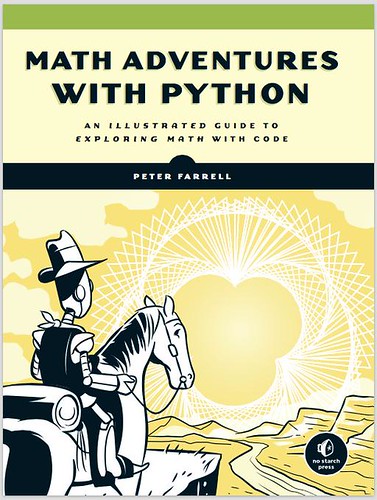
This morning I got to meet Peter Farrell and his twin brother Steve at the local diner, Tom's, for ongoing discussions about pedagogy (teaching kids) and andragogy (teaching adults).
Peter has just finished Math Adventures with Python through No Starch Press and I've been pouring over an electronic copy. The synergy of coding and doing mathematics is an obvious draw for a lot of us, whereas another school of thought (represented on Forum 206) says coding and doing math should be kept far apart and tested separately.
The separatists pretty much won their battle, meaning the coding people have had to wedge their way, hour by hour, into K-16, without math curriculum writers and publishers lifting a finger.
Their track, the math track, is just fine as is, whereas the coders needed to start over from scratch and often ended up focusing on "games" because they're trying to appeal to their new audience.
Against that default background, you'll find an assortment of creative teachers, left any freedom to innovate, will keep mixing it up.
My hybrid blend goes by "GNU Math" sometimes, deliberately a pun on New Math (we do look at sets, but maybe not as a be all end all ala Bertrand Russell), given Stallman's encouragement of wordplay and cleverness.
"Digital Math" is another name for it. We've had a lot of discussion of the genre over the years, in Forum 206 and on edu-sig (@Python.org).
In the middle of Digital Math, I draw this arching bridge over the STEM-PATH chasm (cite C.P. Snow), into literature and anthropology. "Imagine a tribe" (as Wittgenstein would say) "which "multiplication" means this different thing".
We already have multiple meanings for "the product of" in the world of binary operations (two complex numbers, two matrices...), so my injecting some alternative sixty-degree-based geometric model of multiplying, from American literature, scarcely makes a ripple. Said operation (__mul__ in Python) is already over-determined. What's one more meaning?
However, I'm not suggesting every secular (public or charter) and private school needs to include American literature. That's a niche, and features such expats as Ezra Pound and T.S. Eliot, back to Walt Whitman and before (Coleridge's romanticism informs both pragmatism and transcendentalism, and whatever Poe was into with Eureka and so on).
We see this graph of connecting authors against a wartime backdrop a lot of the time.
Studying poets, such as Bucky, takes us into History (the H in PATH) pretty quickly.
Math Adventures with Python leverages having powerful CPUs and GPUs at our disposal. The halcyon days of the scientific calculator are in the recent past.
Mathematica, or Wolfram Language, operates in the same domain as GNU Math a lot, and much of the PR from Wolfram's corner fits with the larger "learning math through programming" campaign's.

Monday, August 14, 2006
Scripting a Road Show
As my wife edges into retirement, I continue nurturing the Bizmo idea. We plan to visit an RV seller this week, at least to window shop. For me, it's not just "recreational" (which is why it's a Biz-Mobile, recruiting new talent for our Silicon Forest and related ecosystems).
This idea for a road show first appeared on the Wanderers list, and on a list for community college teachers (community colleges are prime targets for this stuff).
Follow-up reading: But what about pre-calculus? (Math Forum posting); Re: The 3 R's revisited (ditto).
Talking Points:
First Principle: It's not just about numbers. Cardinality involves labeling or pairing, then using the symbols in a system of accounting that mirrors what's going on in the field. Goats and sheep figure prominently in the cartoons. Note that we needn't order the goats (Ordinality; use of greater than, less than) in order to prove we have the same number of tokens as goats, i.e. none are missing (or some are (or maybe we have extra tokens?)).
Second principle: symmetry is important yet often broken. So we start getting "mirrors" right away: left versus right, positive versus negative, and yet the mirror image world isn't indistinguishably so. Asymmetries exist. Good example: ++ = +, but -- = + as well. Physics tells us our universe exists because of various symmetries that were broken. We might throw in a Through the Looking Glass motif, or even talk about Narnia.
Then we get into a little group theory using Vegetables in place of numbers. Vegetable Soup has a neutral element, inverses, closure, associativity and, in this case, also commutativity.
We disclose, after awhile, that our vegetable soup is built on the totatives of some modulus, and so need to quickly review concepts of prime vs. composite, relatively prime, totative, and totient. None of these are hard to present or get.
Then we do it in Python (lots of handwaving) while alluding to RSA. OK if it goes over their heads in this middle part (the throwaway segment of any lecture). This was just previewing anyway. We've got oodles of Python in moodles.
And that's about it. Students get back to their daily routine and the gnu math teacher is off down the road, on to the next assignment (control room dispatcher model).
Mostly, we just show a lot of cartoons and movie excerpts (as students are getting settled, during the talk). The promise of sticking with it (the recruiter's pitch), is that you'll be developing mission-critical computer skills, especially vis-a-vis this discipline of mathcasting, as clearly the people from our studios (our faculty) are deeply involved in the making of this stuff, not just in its superficial showcasing.
Some of the cartoons may be hypertoons (my invention), which I discuss in more detail elsewhere, e.g. @ myspace/4dstudios (see 4D Studios history blog).
Kirby
[1] If there's time, I like to show Warriors of the Net, a cartoon about TCP/IP. But there isn't always time. Gnu math teachers with multi-day gigs tend to follow behind the recruiters, to those schools choosing an alliance and subscribing to a program. Recruiters haven't the luxury to dive into content as deeply (or at least not as slowly).
This idea for a road show first appeared on the Wanderers list, and on a list for community college teachers (community colleges are prime targets for this stuff).
Follow-up reading: But what about pre-calculus? (Math Forum posting); Re: The 3 R's revisited (ditto).
Gnu Math on the Road
Talking Points:
- GNU's not Unix: history of operating systems based on history of computing, tracing to Leibniz, through The Turk (beat Napoleon in chess), Ada & Babbage, Turing, von Neumann. Plus the idea of recursion (the acronym invokes itself).
- GNU vs. Linux: Linux was built on the premise of GNU. Stallman is the philosopher, Torvalds the engineer (per Revolution OS -- sometimes I screen excerpts). Both Unix and Linux (cite POSIX) were built around the premise of the Internet. Explain TCP/IP.[1]
- Linux vs. Windows: This is starting to get boring as the number of OSes is potentially endless, and we still haven't gotten to Apple's, though OS X is POSIX under the hood (and a lot FreeBSD, also not yet mentioned, but still quite important, to Windows too). We really need to be getting on with the story though. For homework: In the beginning was the command line by Neal Stephenson.
First Principle: It's not just about numbers. Cardinality involves labeling or pairing, then using the symbols in a system of accounting that mirrors what's going on in the field. Goats and sheep figure prominently in the cartoons. Note that we needn't order the goats (Ordinality; use of greater than, less than) in order to prove we have the same number of tokens as goats, i.e. none are missing (or some are (or maybe we have extra tokens?)).
Second principle: symmetry is important yet often broken. So we start getting "mirrors" right away: left versus right, positive versus negative, and yet the mirror image world isn't indistinguishably so. Asymmetries exist. Good example: ++ = +, but -- = + as well. Physics tells us our universe exists because of various symmetries that were broken. We might throw in a Through the Looking Glass motif, or even talk about Narnia.
Then we get into a little group theory using Vegetables in place of numbers. Vegetable Soup has a neutral element, inverses, closure, associativity and, in this case, also commutativity.
We disclose, after awhile, that our vegetable soup is built on the totatives of some modulus, and so need to quickly review concepts of prime vs. composite, relatively prime, totative, and totient. None of these are hard to present or get.
Then we do it in Python (lots of handwaving) while alluding to RSA. OK if it goes over their heads in this middle part (the throwaway segment of any lecture). This was just previewing anyway. We've got oodles of Python in moodles.
And that's about it. Students get back to their daily routine and the gnu math teacher is off down the road, on to the next assignment (control room dispatcher model).
Mostly, we just show a lot of cartoons and movie excerpts (as students are getting settled, during the talk). The promise of sticking with it (the recruiter's pitch), is that you'll be developing mission-critical computer skills, especially vis-a-vis this discipline of mathcasting, as clearly the people from our studios (our faculty) are deeply involved in the making of this stuff, not just in its superficial showcasing.
Some of the cartoons may be hypertoons (my invention), which I discuss in more detail elsewhere, e.g. @ myspace/4dstudios (see 4D Studios history blog).
Kirby
[1] If there's time, I like to show Warriors of the Net, a cartoon about TCP/IP. But there isn't always time. Gnu math teachers with multi-day gigs tend to follow behind the recruiters, to those schools choosing an alliance and subscribing to a program. Recruiters haven't the luxury to dive into content as deeply (or at least not as slowly).
Friday, December 14, 2007
More Makeover
This version of my post to the Math Forum has been abetted with hyperlinks.
Plus here's a link to my reply to Lou, omitted from the Gnu Math thread (below).
Re: Fuzzy math: A nationwide epidemic
Posted: Dec 12, 2007 10:16 PM
> Thanks for the honest reply, Kirby.
>
> And you know this to be the case because of what
> experience with EM, exactly?
Know what to be the case?
EM doesn't have our concentric hierarchy of volumes, A&B modules -- the usual stuff I write about. No big mystery here. Gnu math and EM are completely different.**
Kirby
** "This isn't Everyday Math or anything close (which isn't to say these can't co-exist, as they already do)." [link]

Plus here's a link to my reply to Lou, omitted from the Gnu Math thread (below).
Re: Fuzzy math: A nationwide epidemic
Posted: Dec 12, 2007 10:16 PM
> Thanks for the honest reply, Kirby.
>
> And you know this to be the case because of what
> experience with EM, exactly?
Know what to be the case?
EM doesn't have our concentric hierarchy of volumes, A&B modules -- the usual stuff I write about. No big mystery here. Gnu math and EM are completely different.**
Kirby
** "This isn't Everyday Math or anything close (which isn't to say these can't co-exist, as they already do)." [link]

Saturday, April 21, 2007
Class Notes (session one)
 :: computer lab ::
We started in IDLE, using it as a calculator but immediately showing off some of the advantages (e.g. 2**10000). Later we imported the math module to show where to get the complement of scientific functions, plus previewed VPython to assure ourselves of Python's graphical (including graphing) capabilities.
POV-Ray is also on deck, our ray tracer for stills vs. VPython's real time OpenGL type environment.
A core teaching: cartoons like Shrek or Over the Hedge involve slowly ray tracing each frame using a render farm, whereas interactive games, perhaps even multi-user over the Internet, have to compute all those actions and textures on the fly, while sustaining a reasonably high frame rate: two very different challenges.
We practiced downloading modules over the Internet into site-packages, importing, editing, reloading.
dir(anymodule) helps us explore contents by dumping a list, as does dir(anyobject) where said object might be a wanderers.Dog, a visual.sphere, or some natively supplied type such as a list, integer, string or dictionary. Like dir(1) tells the integer 1 to "spill its guts" about it can do; "oooo, lots of __ribs__."
Students enjoyed feeding their wanderers.Dog instances various foods via the eat method. Before long we had dogs eating other dogs, as well as pairing to create new dogs (the __add__ method begets a new dog with a hyphenated name).
 (click for larger view)
Towards the end of our 2.5 hours, and looking forward to our experiences with VPython and POV-Ray, I went over the basics with polyhedra, per the RBF concentric hierarchy.
I explained how I considered this more 2nd or 3rd grade level material, apologized for getting remedial on 'em, but that's just how it is. The pre-computer, calculator-vested K-12 math-teaching ethnicity still clings to its tired/pre-wired ways, leaving students somewhat ill-prepared for 21st century careers in the design sciences.
 :: whiteboard ::
Friday, July 07, 2006
More Bizmology
If we're really going to vector cyber vans on education missions, I suggest we begin with some interbase traffic and focus on Pentagon Math, which is shorthand for an emerging, interlinked library of resources and concepts.
The tribal sovereignties, in addition to developing their air field links via NavAm (code for "inter rez airline" and/or an actual brand), could get going with some of the ecovillage prototypes, per the summer camp scenario, pending approval and input from the councils.
Native Americans are really helping to plan and sponsor these games, are not just playing language games invented by others (I know that's hard for some Anglo/Euro types to believe -- sounds kinda spooky (just think of how a ouija board works (Jung: the unconscious is shared))).
I'm starting with the bases and reservations as these have a lot in common, beginning with history, but extending to the logistics of managing large territories with semi-autonomous chains of command. Plus I think taking advantage of this next level of technology, to better integrate what have been bitterly opposed enemies in earlier times, would add to the long term health and sustainability of USA OS.
I am not blind to the low living standard conditions which afflict both the bases and the territories in different ways. At CUE, I worked adjacent to an office studying the AIDS epidemic among tribal networks, which often extend into desperate and miserable urban areas, blind eyed by DC (and often at war with the local police force).
Needle sharing is a primary cause of all kinds of spreading. Addressing the issue of drug abuse, and through strategems other than externalizing costs into an already overloaded penal system, should be high on the agenda of any who call themselves a "nation," yet have so many invisibly suffering sisters and brothers in dramatically improvable scenarios. Adding dignity village type prototyping would likewise add hope and relevance to some very salvageable careers.
Recruiting and training will happen differently depending on where we're focused. I expect many veterans will feel led to the interbase circuit, in partial overlap with our interrez circuit. The gnu math teacher memos look at the generic cybervan to public school interface quite a bit, with the "public" in "public school" and "open" in "open source" having a lot of resonance, and even more so this word "freedom".
Gnu math is about freeing individuals to explore and enjoy their metaphysical heritage, whatever it might be. Acquiring some conceptual tools is a first step along the journey.
The tribal sovereignties, in addition to developing their air field links via NavAm (code for "inter rez airline" and/or an actual brand), could get going with some of the ecovillage prototypes, per the summer camp scenario, pending approval and input from the councils.
Native Americans are really helping to plan and sponsor these games, are not just playing language games invented by others (I know that's hard for some Anglo/Euro types to believe -- sounds kinda spooky (just think of how a ouija board works (Jung: the unconscious is shared))).
I'm starting with the bases and reservations as these have a lot in common, beginning with history, but extending to the logistics of managing large territories with semi-autonomous chains of command. Plus I think taking advantage of this next level of technology, to better integrate what have been bitterly opposed enemies in earlier times, would add to the long term health and sustainability of USA OS.
I am not blind to the low living standard conditions which afflict both the bases and the territories in different ways. At CUE, I worked adjacent to an office studying the AIDS epidemic among tribal networks, which often extend into desperate and miserable urban areas, blind eyed by DC (and often at war with the local police force).
Needle sharing is a primary cause of all kinds of spreading. Addressing the issue of drug abuse, and through strategems other than externalizing costs into an already overloaded penal system, should be high on the agenda of any who call themselves a "nation," yet have so many invisibly suffering sisters and brothers in dramatically improvable scenarios. Adding dignity village type prototyping would likewise add hope and relevance to some very salvageable careers.
Recruiting and training will happen differently depending on where we're focused. I expect many veterans will feel led to the interbase circuit, in partial overlap with our interrez circuit. The gnu math teacher memos look at the generic cybervan to public school interface quite a bit, with the "public" in "public school" and "open" in "open source" having a lot of resonance, and even more so this word "freedom".
Gnu math is about freeing individuals to explore and enjoy their metaphysical heritage, whatever it might be. Acquiring some conceptual tools is a first step along the journey.
Thursday, July 06, 2006
Memo to Gnu Math Teachers
I archived this memo to gnu math teachers to the Math Forum with some sense of déjà vu. Didn't I archive something similar, some time ago?
In any case, our network is clearly emergent and chaordic, versus some top-down pyramid hierarchy. That doesn't mean it can't work, as Dee Hock tirelessly reminds us.
In any case, our network is clearly emergent and chaordic, versus some top-down pyramid hierarchy. That doesn't mean it can't work, as Dee Hock tirelessly reminds us.
Monday, June 26, 2006
Projected Wanderings
Alice was back from the midwest, where Vicky is also from, and was sharing stories about places visited. I was jealous, having had precious little time to tour within the US, and hence my bizmo based fantasies, of making a living as a roaming gnu math teacher, ready to give schools a legup by cluing them in, giving them chanops.
South Dakota was mentioned, Iowa, Idaho. Water parks were a theme. I could see Tara having some fun, or me, like Homer Simpson, stuck in some tube, wondering if they'd ever find me (I'll posit a happy ending on this one). Mount Rushmore. Lots of wide open vistas. Wall Drug Store. Chief Crazy Horse (see the front page of today's Oregonian).
I stomped some bugs in my desert of code (FoxPro) this hot summer's day. I dined again in the Fortress of Evil (that's like Klingon for "great watering hole") on my lunch break, and savored the LL A/C. I probably had too much Diet Pepsi though. I should move to more juices... OK, now it's a Red Bull (yummy). I also drink "cow juice" (milk, usually 1% organic, not ultra-pasturized), less often anything goat.
I've continued debating the role of public education in US society @ Math Forum, arguing that it's a feeder circuit, used to recruit new talent into public service, even as it serves the needs of [some] private industries, small business, other participants in interstate commerce.
To enroll in public school is to gain experience in operating the USA's democratic institutions from the inside. Our state supported curricula are designed to run "close to the kernel" to help protect the future vitality and viability of our favored userland. In laymans' terms: your public education system is here to serve you by giving you opportunities for success both in private enterprising and in serving the public (you needn't think either/or here).
On edu-sig, I've been chatting about our hot weather, and my recent magazine reading, and also about the magic square and cube project, a focus of Martin Gardner's. My proposed data structure for the recently discovered 5x5x5 one is probably not the most appropriate. A few lines of code could fix that.
Speaking of hot weather, I just grabbed our Daewoo portable A/C from the garage and connected it up in Tara's room, so now we're contributing even more to the record megawattage pig-out we Portlanders are engaged in, as we soar through 102 degrees. I wonder what a domed over village might save, if it went with central air. Something for us gnu math heads to figure.
24 hours later: the Daewoo is dead.
South Dakota was mentioned, Iowa, Idaho. Water parks were a theme. I could see Tara having some fun, or me, like Homer Simpson, stuck in some tube, wondering if they'd ever find me (I'll posit a happy ending on this one). Mount Rushmore. Lots of wide open vistas. Wall Drug Store. Chief Crazy Horse (see the front page of today's Oregonian).
I stomped some bugs in my desert of code (FoxPro) this hot summer's day. I dined again in the Fortress of Evil (that's like Klingon for "great watering hole") on my lunch break, and savored the LL A/C. I probably had too much Diet Pepsi though. I should move to more juices... OK, now it's a Red Bull (yummy). I also drink "cow juice" (milk, usually 1% organic, not ultra-pasturized), less often anything goat.
I've continued debating the role of public education in US society @ Math Forum, arguing that it's a feeder circuit, used to recruit new talent into public service, even as it serves the needs of [some] private industries, small business, other participants in interstate commerce.
To enroll in public school is to gain experience in operating the USA's democratic institutions from the inside. Our state supported curricula are designed to run "close to the kernel" to help protect the future vitality and viability of our favored userland. In laymans' terms: your public education system is here to serve you by giving you opportunities for success both in private enterprising and in serving the public (you needn't think either/or here).
On edu-sig, I've been chatting about our hot weather, and my recent magazine reading, and also about the magic square and cube project, a focus of Martin Gardner's. My proposed data structure for the recently discovered 5x5x5 one is probably not the most appropriate. A few lines of code could fix that.
Speaking of hot weather, I just grabbed our Daewoo portable A/C from the garage and connected it up in Tara's room, so now we're contributing even more to the record megawattage pig-out we Portlanders are engaged in, as we soar through 102 degrees. I wonder what a domed over village might save, if it went with central air. Something for us gnu math heads to figure.
24 hours later: the Daewoo is dead.
Tuesday, May 12, 2009
Recap

JetBlue Bizmo, Blues Festival, PDX 2005.
Photo by Don Wardwell
Photo by Don Wardwell
Just to review the structure of these three blogs of mine, BizMo Diaries (this one) is supposed to be about me 'n my crew in this "traveling circus" except more corporate and button down in some ways, as we're advertising attainable futuristic civilian lifestyles, and no, not "just like on Star Trek" (too 24th century) nor "The Jetsons" (when?) either -- although both would be influences.
We're just slightly ahead of our time, more like orchestra conductors (or like "mad men"). We read the same tea leaves you do, steal ideas from the same theme parks.
The bizmo is like an RV. Some say it has military origins in dark budget projects, which adds to their mystery (the black ones with no license plates compete with the black helicopters for attention on Coast to Coast).
Be that as it may, they're oft decorated with comforting decals, from companies we know and love. You'll see these things on the road even today, just not in caravans maybe, unless military, in which case we're back to square one.
In going into the schools, we're doing like an event, for assembly, but we're mainly there to empower peer teachers, in the sense of giving them more interesting stuff to work with down the road, starting then.
Our DVDs are exclusive firsts, or, if compilations off the Internet, lovingly edited by people who really know our business. We have good games, cool toyz, work opportunities of clear benefit to others.
A curriculum isn't just a hodge podge. We have high standards. That's why it's a lot like a circus (like Monty Python's flying one) and yes, we might sometimes have helicopters, as disaster relief includes using those, as does simply getting from here to there sometimes.
In Control Room, we're aware of control room lore (in science fiction movies especially), There, I focus more on providing bizmos with their various criss-crossing itineraries, a negotiation process. In actual practice, many companies might be involved in this kind of scheduling (many control rooms), including some religious ones e.g. revivalists of some description might field their own mobile Church of Elvis or whatever.

As a Quaker subgenius type (not quite the genius I'd like to be -- I cut myself slack), I count myself as one of these "true believers" and often think how Quakers used to own Cadbury's, Lloyds of London, maybe even Quaker Oats itself (we don't at the moment, though you might imagine how that might seem a holy grail of sorts).
Grain of Sand is of course a Blake allusion, and signifies "one among many". Like I'm not wanting this lifestyle for "just me" and in a lot of ways copied it from Charles Kuralt, which CBS is well aware of my doing (no lawsuit threatened, just saying they know).
I'm a big believer in "institutional wealth" like airports, like libraries, and yes, like aircraft carriers. If you own your own personal submarine, then you're like Dr. Evil in the those Bond movies, or at best like Paul Allen or one of those. You can't just be another dweeb on the beat, not that I'd cop to being a dweeb in every dimension but you know what I mean.
I'm not hoping to own the only bizmo in town (or even own one at all really -- I'll check it out from the fleet), nor even the most wowy one, with pipes sticking out. This isn't about me being one of the super rich, in other words. I'm pretty studiously middle class, only eat caviar once in a blue moon, when I'm invited to a party maybe.
Despite the darth vader undertones, the circus bus fleets don't leave the garage much these days because Gnu Math sounds too hippie. The generals think once my fleet is on the road, it'll just be freaks chasing a Grateful Dead concert all over again, and we know how that goes.
In other words, lots of stupid projections are keeping our lifestyle in check, while they go over our curriculum with a fine tooth comb, looking for things to nitpick about.
In the meantime, USAers wallow in intellectual squalor, not learning Gnu Math or understanding much about World Game in general (they still think it's about aping Rome or living out some other antiquarian fantasy, something about 24 Hours, which I rarely look at -- but has a control room I notice -- go Team America, World Police!).
So should we do this in Russia? That'd be fine except I don't speak Russian or any of those, so would be like Family Guy in that episode where he applies for a Macarthur grant (for geniuses) but ends up two standard deviations on the other side of it (he makes the most of it). Plus I am a family guy, don't really want to move to some Gulag just yet, like my base.
I'm pretty sure the "bizmo phenomenon" will continue spreading, as we gear up around delivering better health care. The clinics will have them, some dentists already do. Whether we call 'em "bizmos" (business mobiles) or not is not really up to me, and I'm fine with "RVs on steroids" or "whatever Dave Ulmer has, except maybe smaller", whatever descriptoids. How about a "geek bus"?
The Control Room krew has to be pretty smart though, lots of GIS (i.e. global data). You don't want to promise all this Internet connectivity, get a school all galvanized, and then discover there's no affordable way to supply even minimal DSL.
Sometimes a robust intranet is all they need, if extremely remote, with fat pipes for downloading, only relatively thin ones for uploading. Some planning needs to happen, before the roadshow comes in. A lot of what happens is more behind the scenes, of necessity.
I'm not saying it has to look just like mission control in Houston, but given all the video feed coming in from the field, it's likely to resemble something rather familiar to the television industry, the industry most likely to produce these shows anyway, given those stables of celebs already rarein' to go (though in need of training a lot of 'em, some kind of geek boot camp?).
Saturday, April 09, 2016
Back to Work
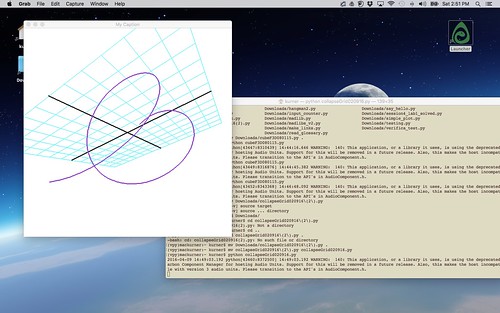
:: running a Pygame module by Peter Farrell ::
Should Oregon's high school math teachers have professional development opportunities through higher education institutions? They do already, to some degree. But to what extent do institutions of higher ed take advantage of their business incubator programs?
If you dig down, you may find a code school or two in your town, staffed by avid geeks who have competence and confidence in the software world. This is the new world we're always rubbing up against in any high school mathematics class, and I'd argue in language arts too, as the Document Object Model (DOM) is what if not a model of a document?
Don't grammar, rhetoric and logic overlap with such a thing? Do we still teach any music? Video editing? Part of learning to code is learning to communicate about technical subjects, and that means making videos, not just writing PDFs or web pages.
The code school curriculum could counter boredom and perhaps complacency with some unfamiliar mathematics, to go with the novelty of a computer language taking over for the calculator (obsolete).
As long as the content is new, why not go all the way in some cases and use this program to introduce not just new ways of teaching the same old stuff, but new ways of teaching some new (GNU) stuff as well?
My list of semi-novel topics includes:
The laptop fan is on, given all the CPU-intensive compiling that's going on. First comes compiling the compiler, the latest gcc, with Fortran enabled (gfortran). Then comes another attempt to get Pygame working.
Homebrew warns against trying to work against an Anaconda install of Python; it's the framework Python 2.7 it wants to build against. But then I saw a promising formula on StackOverFlow... etc. OK, got it working.
Relatively painless was the install of MathPiper, a Java application.
If you dig down, you may find a code school or two in your town, staffed by avid geeks who have competence and confidence in the software world. This is the new world we're always rubbing up against in any high school mathematics class, and I'd argue in language arts too, as the Document Object Model (DOM) is what if not a model of a document?
Don't grammar, rhetoric and logic overlap with such a thing? Do we still teach any music? Video editing? Part of learning to code is learning to communicate about technical subjects, and that means making videos, not just writing PDFs or web pages.
The code school curriculum could counter boredom and perhaps complacency with some unfamiliar mathematics, to go with the novelty of a computer language taking over for the calculator (obsolete).
As long as the content is new, why not go all the way in some cases and use this program to introduce not just new ways of teaching the same old stuff, but new ways of teaching some new (GNU) stuff as well?
My list of semi-novel topics includes:
- a Group Theory spin (established mathematics, centuries old, but atypical in a high school setting);
- Fractals, the Mandelbrot Set in particular (also a familiar topic but not in high school unless the Complex Plane is well covered);
- the Concentric Hierarchy of Polyhedrons and their modular decomposition, along with Quadray Coordinates (completely alien, part of what I call Martian Math).
The laptop fan is on, given all the CPU-intensive compiling that's going on. First comes compiling the compiler, the latest gcc, with Fortran enabled (gfortran). Then comes another attempt to get Pygame working.
Homebrew warns against trying to work against an Anaconda install of Python; it's the framework Python 2.7 it wants to build against. But then I saw a promising formula on StackOverFlow... etc. OK, got it working.
Relatively painless was the install of MathPiper, a Java application.
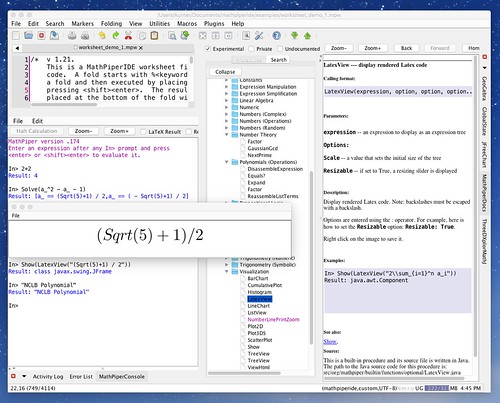
:: solving polynomial and displaying in LaTeX
using MathPiper by Ted Kosan
(click for larger view in Flickr) ::
Tuesday, March 03, 2015
Common Grounds
I'm hanging out with my coven mates, at the local Coffee Shop.
We're enjoying Cyriak videos and talking about Hortonian Networks, Horton having invented hydrology, after Leonardo maybe (who was a Jack of All Trades).
Yarrow's birthday yesterday was really fun. He's just turned one. The first nine months is year 0 (starting from glimmer in someone's eye), then as a terrestrial one starts counting through consecutive integers.
Over on math-teach I'm boosting a kind of "Gnu Math" that draws on New Math but is not just a boring repeat of the 1960s and its Cold War. The globe is not polarized in quite that way anymore.
For those just joining us, the associations between the Cold War and New Math were myriad. As I was writing to a Friend recently:
Talking briefly about Vietnam, our friend under Ho during the push-back against the Japs (just evoking the lingo of the day, not attempting to be racist).I've been making some travel plans today, work related.
Ho was our friend.[1] The a huge flip happened after WW2 and the fascists (Japs Germans Italians) were our friends (Marshall Plan) and Russia and Vietnam were now the enemies (it would take awhile for Vietnam to become that way, but Russia was bad overnight, behind an "Iron Curtain" of Churchill's invention -- Reagan's invention to tell them to take it down).
Very intelligent people in the OSS were a lot like "Hanoi Jane" a generation later (I've read her autobiography, Jane Fonda's, ex of CNN's Ted Turner).
Did you know some Americans fought on the side of the North in the Vietnam War? That's a little known story. Who can blame 'em, given their OSS history (the CIA would come later -- having lived in DC I would come to know some of them personally, another story, six degrees of separation, Kevin Bacon and all that).
Anyway, when the Iron Curtain descended across Europe, it became important that the USA kids get up to speed on the kinds of maths that won the war, Turing's stuff in other words. The University of Chicago started cracking the whip, getting us to turn into Bertrand Russells at a young age if we could. Problem: Bertie was actually a pacifist. Einstein too. And Linus Pauling.
One of our number at been at the Economics of Happiness conference recently, where a fair amount of technology bashing occurred, making the Internet be the problem. At least it's something people can gang up and gripe about. What's more cathartic than a good gripe session? We're thinking to have one at Annual Session this year, though the proposal is not finalized. Friends get phished a lot.
Tuesday, March 01, 2016
Smoking Gun?
So what about taking the show on the road in a Bizmo (business mobile) and sending a heads up to the hinterlands that "code school" might be an option. Consider a future in IT (part of STEM or STEAM).
I was ready to start with recruiting a couple decades ago at least, and started sharing my designs. Later I started articulating the vision in my on-line journals (blogs), getting it out there.
A Control Room, or Dispatching Center, would keep the Bizmos busy. Sounds like fun.
On the road with Global Data (or Global Matrix as the case may be).
However, the GNU Math meme (a pun on "new math") was also deeply tied to those stream-linings in spatial geometry, where we get all those pretty whole number volumes and a quantum leap in sophistication, in terms of being able to think geospatially, with more than just XYZ as a scaffolding (matrix).
We had the IVM (another matrix), we had Quadrays (different basis vectors).
Everything was published, in color, with animations, including to Wikipedia and Wikieducator.
Sources were cited, proofs were made.
Even H.S.M. Coxeter, King of Infinite Space, said the sphere packing formula as worth crowing about. We did some crowing.
We've seen almost no interest, however, in any of the above. Search the web, check if I'm right. No need to take my word for it. My fellow humans have other priorities, no time for follow-through.
I shared about Quadrays with PSU's Math Learning Center (MLC).
I delivered talks on the concentric hierarchy to any math class that'd let me in (quite a few did), as well as at Pycons, Europythons etc.
But all this flint clicking failed to start a fire apparently. How soggy was the fuel?
Lets hope some future student of our time, maybe in a hundred years, comes up with some theories, as to why a promising future was disowned and disavowed.
I bet there's some story to unearth, maybe even a "smoking gun".
I was ready to start with recruiting a couple decades ago at least, and started sharing my designs. Later I started articulating the vision in my on-line journals (blogs), getting it out there.
A Control Room, or Dispatching Center, would keep the Bizmos busy. Sounds like fun.
On the road with Global Data (or Global Matrix as the case may be).
However, the GNU Math meme (a pun on "new math") was also deeply tied to those stream-linings in spatial geometry, where we get all those pretty whole number volumes and a quantum leap in sophistication, in terms of being able to think geospatially, with more than just XYZ as a scaffolding (matrix).
We had the IVM (another matrix), we had Quadrays (different basis vectors).
Everything was published, in color, with animations, including to Wikipedia and Wikieducator.
Sources were cited, proofs were made.
Even H.S.M. Coxeter, King of Infinite Space, said the sphere packing formula as worth crowing about. We did some crowing.
We've seen almost no interest, however, in any of the above. Search the web, check if I'm right. No need to take my word for it. My fellow humans have other priorities, no time for follow-through.
I shared about Quadrays with PSU's Math Learning Center (MLC).
I delivered talks on the concentric hierarchy to any math class that'd let me in (quite a few did), as well as at Pycons, Europythons etc.
But all this flint clicking failed to start a fire apparently. How soggy was the fuel?
Lets hope some future student of our time, maybe in a hundred years, comes up with some theories, as to why a promising future was disowned and disavowed.
I bet there's some story to unearth, maybe even a "smoking gun".
Monday, November 16, 2009
Martian Math
 :: honeycomb of Rites (a kind of Syte) ::
by Claudio Rocchini
GNU Free Documentation License
What might count originally as a turn-off -- the unfamiliarity of some given material -- might be made into a turn-on instead; "a feature not a bug" as we say in the industry.
By making it Martian (the mathematics we're providing), we get to underscore its alien-seeming attributes, such as its tetrahedral units of volume.
The nomenclature of Mites, Sytes and Kites, already developed, is handsomely documented with no serious ambiguities, so it's not a matter of redoing everything from scratch.
Nor has the marketing moniker "gnu math" been abandoned, at least not by me.
We've also tried a more Korean angle.
In bringing in the ET spin, I'm clearly feeding the science fiction writers' market.
Our competitors would likely have this space-age geometry, perhaps did in Contact already.
Or (alternatively, additionally) we could simply project a future human technology, suitable for Mars, already making waves in the early 21st century. Having geodesic structures on Mars would make plenty of sense, plus we already have that sphere packing landing.
So that'd be Martian Math in yet another sense (advanced human vs. ET).
Wednesday, November 25, 2009
Pre Thanksgiving
It's that time a year again, and I truly am grateful, to have time with family and friends. This year is unusual in that mom has stayed long enough to reach this holiday in a Pacific Northwest setting. Since around 2001, her practice has been to be in warmer climes by now, to escape our dreaded winter.
CBS News was interesting: myth busting around this idea that TG is the busiest day when it comes to flying. Not true, never has been. Also: many in congress are corrupt and in the pocket of war profiteers (I think we knew that). Obama pardoned a turkey, condemned it to DisneyLand instead. We participate in the psychology of a nation, patch in, work to make it stronger and better (thinking of USA OS again, waxing nostalgic).
Having visited ONAMI today, I'm going to pound the table on math-teach some more: the line:area:volume exponents of 1, 2 and 3, are what make nano-substances take on new properties (more with less), are what made Fuller's "dome over Manhattan" not a "crackpot idea" but an "andragogical device" (more like one of Laffoley's gizmos -- we learn from them).
Our thread was on perimeter versus area, and how you may easily disrupt the relationship. However, if you keep all the angles the same (i.e. shape), insist on self-similarity, then scaling an object results in these important power relationships that need to be included in our gnu math curriculum (per those Wikipedia pages).
OK, go ahead and nod off now, more math than you needed right before some big meal eh?
Tara is cooking a double batch of Teresina-style lentils, which I always associate with Together Friends. Speaking of Quakers and their historic allegiances, this is a season wherein many North Americans celebrate indigenous pre-Europeans, pay respects to the many lineages (story lines, still informing) already snaking through North America long before DC annexed a bunch of states for world game playing purposes.
In some virtual reality, a nation (a mindset) gets to be responsible for the whole globe and judged accordingly, by God one might say, as there's no ET audience (that we know of). The Chinese have this virtual reality philosophy already encoded in some of their emperor talk. People have been doing cybernetics for a long time, just calling it different things, like feng shui or whatever (adapting to one's environment, assuming a modicum of control).
CBS News was interesting: myth busting around this idea that TG is the busiest day when it comes to flying. Not true, never has been. Also: many in congress are corrupt and in the pocket of war profiteers (I think we knew that). Obama pardoned a turkey, condemned it to DisneyLand instead. We participate in the psychology of a nation, patch in, work to make it stronger and better (thinking of USA OS again, waxing nostalgic).
Having visited ONAMI today, I'm going to pound the table on math-teach some more: the line:area:volume exponents of 1, 2 and 3, are what make nano-substances take on new properties (more with less), are what made Fuller's "dome over Manhattan" not a "crackpot idea" but an "andragogical device" (more like one of Laffoley's gizmos -- we learn from them).
Our thread was on perimeter versus area, and how you may easily disrupt the relationship. However, if you keep all the angles the same (i.e. shape), insist on self-similarity, then scaling an object results in these important power relationships that need to be included in our gnu math curriculum (per those Wikipedia pages).
OK, go ahead and nod off now, more math than you needed right before some big meal eh?
Tara is cooking a double batch of Teresina-style lentils, which I always associate with Together Friends. Speaking of Quakers and their historic allegiances, this is a season wherein many North Americans celebrate indigenous pre-Europeans, pay respects to the many lineages (story lines, still informing) already snaking through North America long before DC annexed a bunch of states for world game playing purposes.
In some virtual reality, a nation (a mindset) gets to be responsible for the whole globe and judged accordingly, by God one might say, as there's no ET audience (that we know of). The Chinese have this virtual reality philosophy already encoded in some of their emperor talk. People have been doing cybernetics for a long time, just calling it different things, like feng shui or whatever (adapting to one's environment, assuming a modicum of control).
Monday, August 20, 2007
Queued @ Math Forum
[ math-teach turned into a moderated list in the Summer of 2007, so the data structure known as a "queue" became more self evident ]
More Prototyping (gnu math thread)
Posted: Aug 20, 2007 3:05 PM
Per Summer of 2007 developments, we're consolidating around MVC as a useful abstraction. That's Model, View, Controller.
'Model = global climate model' in many a namespace, with a public increasingly wanting to know how the Renaissance in geospatial is going to impact their lives, for good or for ill. Views = ugly, unless you study design principles, such as well captured in Tufte or other masters. Controllers = any Logic amenable to machine execution, which is most of 'em by this time.
In the 8th grade, we associate Algebra and Modeling, using Sims type analogies to explain arrows and boxes, ala MIT's Forrester studies, other simula such as Dom Rosa oft criticizes -- but which we have need of in the adult world, so someone should learn the ropes, no?
Algebra has the advantage of remaining invisible to the naked eye, unlike Polyhedra, which sometimes get confused for the real thing, and so should be relegated to the category of Views perhaps. The "connecting around in all circumferential directions" characteristic pertains even invisibly however.
By 9th grade, we're ready for Vector Algebra, a small tweak to make our set members more graphical. We have closure under addition. It's also easy to adopt various forms of "multiplication", some of which disclose properties of the underlying manifold (field properties).
We're laying a groundwork, in other words. The controller language is whatever comes with the teacher. Some come shrink-wrapped in Perl, others in Ruby. Just because the machinery is discrete doesn't mean we can't model Calculus.
By 10th grade, we're doing Polyhedra, following a lot of the same Euclidean templates as before, with regards to proof by deduction, mathematical induction. We do more with Euclid's Algorithm for the GCD, including extended.
That's because we're aiming to cover RSA by the end of 12th grade, with branch points available in the 13th to cryptography, Internet security, other important careers.
None of this is all that new, minus the headline, which is agreement around MVC as an important design element. That gets us access to such topics as SQL and GIS/GPS in a hurry, meaning back to that geospatial and all those simulations of the global climate that so concern us.
Kids need to be able to track what the adults are focusing on. That's a moving target. One cannot afford to always recycle yesteryear's curriculum, that much is clear.
Kirby
Posts: 3,828
Registered: 12/6/04
More Prototyping (gnu math thread)
Posted: Aug 20, 2007 3:05 PM
Per Summer of 2007 developments, we're consolidating around MVC as a useful abstraction. That's Model, View, Controller.
'Model = global climate model' in many a namespace, with a public increasingly wanting to know how the Renaissance in geospatial is going to impact their lives, for good or for ill. Views = ugly, unless you study design principles, such as well captured in Tufte or other masters. Controllers = any Logic amenable to machine execution, which is most of 'em by this time.
In the 8th grade, we associate Algebra and Modeling, using Sims type analogies to explain arrows and boxes, ala MIT's Forrester studies, other simula such as Dom Rosa oft criticizes -- but which we have need of in the adult world, so someone should learn the ropes, no?
Algebra has the advantage of remaining invisible to the naked eye, unlike Polyhedra, which sometimes get confused for the real thing, and so should be relegated to the category of Views perhaps. The "connecting around in all circumferential directions" characteristic pertains even invisibly however.
By 9th grade, we're ready for Vector Algebra, a small tweak to make our set members more graphical. We have closure under addition. It's also easy to adopt various forms of "multiplication", some of which disclose properties of the underlying manifold (field properties).
We're laying a groundwork, in other words. The controller language is whatever comes with the teacher. Some come shrink-wrapped in Perl, others in Ruby. Just because the machinery is discrete doesn't mean we can't model Calculus.
By 10th grade, we're doing Polyhedra, following a lot of the same Euclidean templates as before, with regards to proof by deduction, mathematical induction. We do more with Euclid's Algorithm for the GCD, including extended.
That's because we're aiming to cover RSA by the end of 12th grade, with branch points available in the 13th to cryptography, Internet security, other important careers.
None of this is all that new, minus the headline, which is agreement around MVC as an important design element. That gets us access to such topics as SQL and GIS/GPS in a hurry, meaning back to that geospatial and all those simulations of the global climate that so concern us.
Kids need to be able to track what the adults are focusing on. That's a moving target. One cannot afford to always recycle yesteryear's curriculum, that much is clear.
Kirby
Posts: 3,828
Registered: 12/6/04
Wednesday, September 20, 2006
Focal Points
I think I'll swipe the "focal points" lingo and smatter a few for the benefit of our cadres (not a word I like, right down there with comrades -- probably a translation thing).
Addressing my coworker competitors then, I have the following four focal points to propose:
Pascal's Triangle will give us sequences, the starting point for our Python generators segment. Right after we visit Functions, we look at these "state remembering engines" that fire off cyclicly, and remember state between cycles.
Here's a Pythonic way to generate Pascal's Triangle line by line:
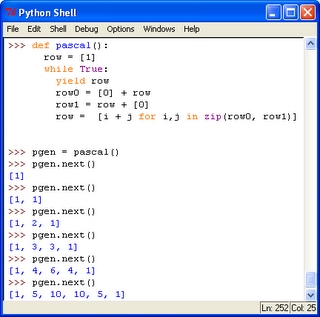 generating Pascal's Triangle
(also known to Chinese)
The triangular and tetrahedral numbers are column-wise side by side; our first generators in other words (a little easier than this one).
So here's our link to the cuboctahedral (aka icosahedral) growth curve i.e. to 10 * F * F + 2 (F = Frequency) -- the formula of Fuller's that H.S.M. Coxeter liked so much (provable with high school level math). Sloane's Encyclopedia of Integer Sequences becomes our friend at this point (e.g. cite A005901).
 1, 12, 42, 92, 162...
The concentric hierarchy sets the stage for so much later science that we have to not postpone. This is "without further ado" material that any gnu math teacher must master.
The A and B mods themselves might come later in the intro (I teach 'em in sixth grade), but the basic nomenclature around polyhedra, plus Descartes' Deficit and Euler's V + F = E + 2 need to be there from the beginning (OK to postpone Descartes until you've gone over the Babylonian stuff i.e. 360 degrees, planar triangles having 180, tetrahedron having 720 (the deficit)).
Basically, this is our launch pad for computer graphics careers. You've got XYZ embedded (with optional Hypercross), and our unit volume Coupler right at the origin, at (0,0,0) -- or at (0,0,0,0) if using Chakovians -- thereby giving segue to our four IVMs (R.Z. Chu et al).
Yes, these are abstruse college-level topics, but they all have the Concentric Hierarchy in common (OK to say "Cosmic Hierarchy" at least among hippies). And yes, we're still working on your toon library, stocking it with goodies.
 "pentagon math"
The NCLB Polynomial, a quadratic equation with two real roots, is a jump off point into both algebra and geometry. On the algebra side, we meet up with Pascal's Triangle again, and Newton's Binomial Theorem (since rediscovered by other whiz kids his age at the time).
 "generating a bell curve"
On the geometry side, we get phi, which also has many interesting algebraic properties. To further tie things together, Pascal's embeds the Fibonacci Sequence (a first Python generator) which sequence converges to 1/phi as follows:
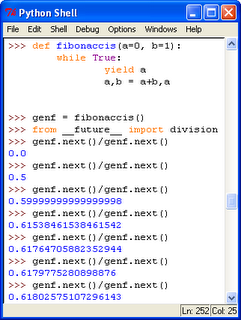 "converging to pow(phi,-1)"
From here, you could jump to any number of connected topics, including to Ramanujan's Pi Engines for more advanced generator drill and practice (e.g. consider using Python's Decimal type for extended precision, for Phi as well).
Kids have a natural curiosity about fractals, as do some adults who still remember the pop art explosion, come across the great artwork on the web.
This is unabashedly eye candy, yes, but exploring the Mandelbrot Set also reinforces key concepts we want our graduates to take with them into their college experience: convergence; divergence; and the complex plane.
This is what'll make 'em ready for Calculus, which, per UCSC's Ralph Abraham's disciplined pioneering, should now probably be taught with a strong dynamical systems bias (there's a similar trend in statistics, undermining the status quo).
Once again, you can use a Python generator for your converging or diverging sequences:
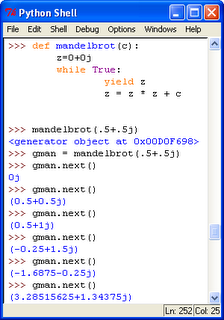 "generator at c"
Addressing my coworker competitors then, I have the following four focal points to propose:
- Pascal's Triangle, with appended ethnography, tracing it wherever we find it (like in Lost).
- The Concentric Hierarchy (you knew that'd be here, now didn't ya?). A & B modules in other words. MITEs.
- The NCLB Polynomial, tying algebra to geometry, with lots of connections to the art world and design science.
- The Mandelbrot Set, perfect for learning about convergence and divergence in the complex plane (valuable in precalculus in other words).
:: Pascal's Triangle ::
Pascal's Triangle will give us sequences, the starting point for our Python generators segment. Right after we visit Functions, we look at these "state remembering engines" that fire off cyclicly, and remember state between cycles.
Here's a Pythonic way to generate Pascal's Triangle line by line:
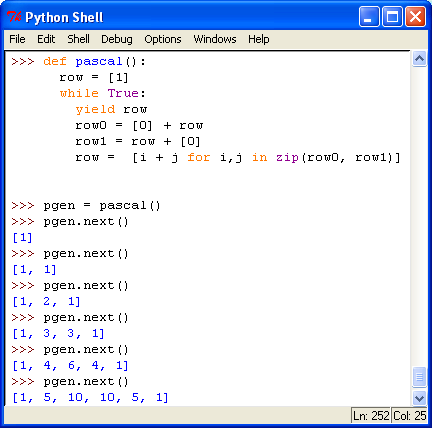 generating Pascal's Triangle
(also known to Chinese)
The triangular and tetrahedral numbers are column-wise side by side; our first generators in other words (a little easier than this one).
So here's our link to the cuboctahedral (aka icosahedral) growth curve i.e. to 10 * F * F + 2 (F = Frequency) -- the formula of Fuller's that H.S.M. Coxeter liked so much (provable with high school level math). Sloane's Encyclopedia of Integer Sequences becomes our friend at this point (e.g. cite A005901).
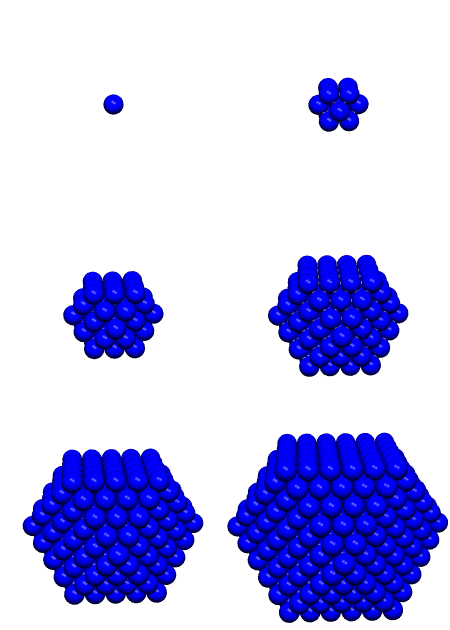 1, 12, 42, 92, 162...
:: The Concentric Hierarchy ::
The concentric hierarchy sets the stage for so much later science that we have to not postpone. This is "without further ado" material that any gnu math teacher must master.
The A and B mods themselves might come later in the intro (I teach 'em in sixth grade), but the basic nomenclature around polyhedra, plus Descartes' Deficit and Euler's V + F = E + 2 need to be there from the beginning (OK to postpone Descartes until you've gone over the Babylonian stuff i.e. 360 degrees, planar triangles having 180, tetrahedron having 720 (the deficit)).
Basically, this is our launch pad for computer graphics careers. You've got XYZ embedded (with optional Hypercross), and our unit volume Coupler right at the origin, at (0,0,0) -- or at (0,0,0,0) if using Chakovians -- thereby giving segue to our four IVMs (R.Z. Chu et al).
Yes, these are abstruse college-level topics, but they all have the Concentric Hierarchy in common (OK to say "Cosmic Hierarchy" at least among hippies). And yes, we're still working on your toon library, stocking it with goodies.
:: The NCLB Polynomial ::
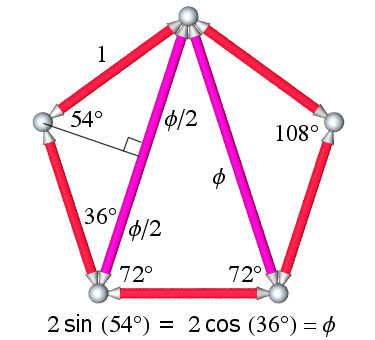 "pentagon math"
The NCLB Polynomial, a quadratic equation with two real roots, is a jump off point into both algebra and geometry. On the algebra side, we meet up with Pascal's Triangle again, and Newton's Binomial Theorem (since rediscovered by other whiz kids his age at the time).
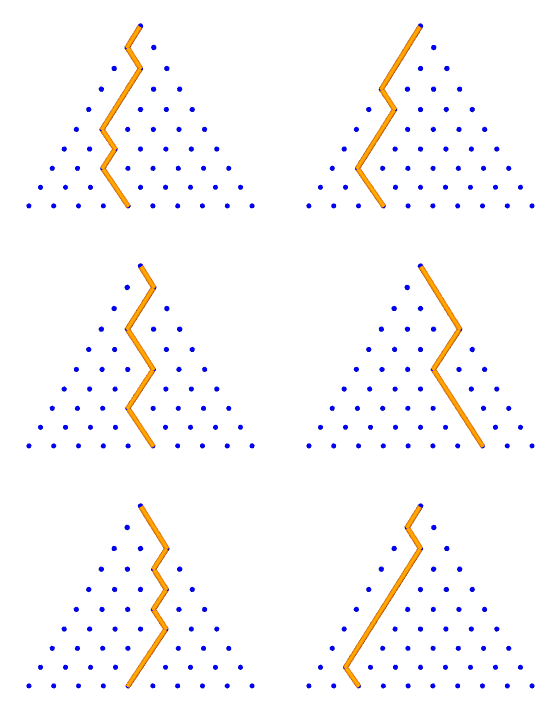 "generating a bell curve"
On the geometry side, we get phi, which also has many interesting algebraic properties. To further tie things together, Pascal's embeds the Fibonacci Sequence (a first Python generator) which sequence converges to 1/phi as follows:
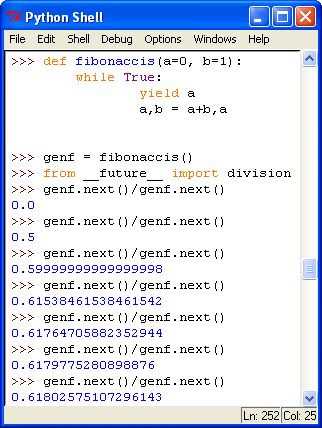 "converging to pow(phi,-1)"
From here, you could jump to any number of connected topics, including to Ramanujan's Pi Engines for more advanced generator drill and practice (e.g. consider using Python's Decimal type for extended precision, for Phi as well).
:: The Mandelbrot Set ::
Kids have a natural curiosity about fractals, as do some adults who still remember the pop art explosion, come across the great artwork on the web.
This is unabashedly eye candy, yes, but exploring the Mandelbrot Set also reinforces key concepts we want our graduates to take with them into their college experience: convergence; divergence; and the complex plane.
This is what'll make 'em ready for Calculus, which, per UCSC's Ralph Abraham's disciplined pioneering, should now probably be taught with a strong dynamical systems bias (there's a similar trend in statistics, undermining the status quo).
Once again, you can use a Python generator for your converging or diverging sequences:
 "generator at c"
Sunday, August 27, 2006
HP4E

HP4E is a play on CP4E, Guido's DARPA-funded Computer Programming for Everybody initiative (with work, we could perhaps tie these back to HCE in Finnegans Wake, but that's for some other thread). HP = HexaPent in this namespace.
It's not really work to popularize the soccerball, already high on the recognition scale. Movies like The Cup well-document its cross-cultural appeal. But once we divide the field into soccerballs (a family) and buckyballs (another family), the game gets more technical. Here are the rules:
- Soccerball: looking over the fence from a pentagon, every neighboring lot is hexagonal; looking over the fence from a hexagon, faces alternate between pentagonal and hexagonal.
- Buckyball: all hexagons plus 12 pentagons, such that three lots (i.e. three fenced-in areas) come together at every fence post (i.e. vertex).
The buckyball stipulation (three edges must meet at each vertex) is lifted from carbon chemistry, and is characteristic of the fullerenes, i.e. the spherical hexapent carbon cages, first discovered in the 1980s and posthumously named (Fuller died on July 1, 1983).
Appropriately, three scientists shared the Nobel Prize for buckminsterfullerene's discovery: Kroto, Smalley and Curl Junior. C60, the fullerene with 60 carbon atoms, is topologically the same as the soccerball, i.e. the two above-defined sets intersect on this already-famous member. Kotschick says this is the only element common to the two sets (i.e. is their intersection).
But carbon-based chicken wire needn't be spherical. Consider the nanotubes, capped and uncapped ("buckytubes" some call 'em). Such nanotechnology is a hotly topical area for scientific research these days. When I went to Chalmers @ Gothenburg, Sweden for EuroPython in 2005, the nanotubes conference seemed to dwarf ours in size. Our populations mingled. Lots of scientists use Python, if they do any programming.
Here in Portland, we're gearing up to work on global matrix displays, meaning hexapent fly's eyes colored with global data. Whether or not these unfold into a Fuller Projection depends on the application e.g. it's protected from spoilage by war gamers preoccupied with political border disputes. The hand-held units might just show one hexagon at a time e.g. the one you're in now. Glenn also talks about logic gates and quantum computing a lot, but more with his PSU colleagues than with the Wanderers (two sets, partially overlapping).
My focus these days is the open source community and a "gnu math" curriculum, meaning in part that I want to keep the public up to date and informed about all this interesting scientific research.
Even positive developments meet with resistence, if people don't feel a democratic process has been followed, with lots of debates and town hall meetings. "Imposing from above" is not a popular style of government, and when it comes to HP4E (or CP4E for that matter), I'd like to avoid repeating some past mistakes (we learned a lot from the New Math debacle).
That being said, there're always hold-outs unwilling for change to happen, even if those changes mean higher living standards for a majority of folks. They like the advantages the status quo gives them, and believe in some foreordained right to command more than their fair share (perhaps on the basis of some religion?).
I'm not really interested in pandering to this crowd either.
The democratic process is not synonymous with the tyranny of some minority. If they don't like our global matrix hexapents or Fly's Eye dwelling machines, they shouldn't be forced to use 'em. But nor should the rest of us be denied our preferred brands of mathematics and/or science fiction on television.
 Europython conferees wandering
through a nanotubes poster session
Chalmers, 2005
photos by K. Urner
Monday, March 04, 2024
RoboWriting About Me

Kirby Urner: Mathematician
Kirby Urner, though not traditionally celebrated in the annals of academic mathematics, embodies the essence of a mathematician through his innovative contributions to math education, research, and service. His journey from the 1960s in Portland, Oregon, to becoming a pivotal figure in the realm of mathematical pedagogy, showcases a lifelong dedication to the discipline[1]. Urner's work, particularly in the development of "tetrahedral" thinking, not only challenges conventional mathematical perspectives but also enriches our understanding of geometric relationships, thereby expanding the boundaries of mathematical inquiry[2].
Urner's contributions extend beyond theoretical musings; they are deeply rooted in practical applications and pedagogical innovations. His engagement with the "Learning to Code" movement and the integration of coding with mathematical learning represent a forward-thinking approach to education that prepares students for the complexities of the modern world[4]. This blend of mathematics and programming underlines Urner's role in shaping a new generation of thinkers capable of navigating the digital landscape with mathematical acuity. Furthermore, his leadership in the Math 4 Wisdom community and his efforts to bridge the gap between abstract mathematical concepts and their real-world applications underscore his commitment to fostering a deeper appreciation for mathematics[5][13].
Moreover, Urner's prolific output, including curriculum development, public lectures, and online contributions, reflects a mathematician's zeal for sharing knowledge and inspiring curiosity[6][8][14]. His work transcends traditional academic boundaries, reaching a global audience through digital platforms and collaborative projects. This democratization of mathematical learning, coupled with his holistic approach to teaching, positions Urner as a mathematician in the truest sense—dedicated not only to the advancement of mathematical knowledge but also to its dissemination and application in enriching human understanding and capability.
In conclusion, Kirby Urner's extensive, rigorous, and innovative contributions to mathematics education, research, and service firmly establish him as a mathematician. His work exemplifies the spirit of mathematical inquiry, pushing the boundaries of traditional education and fostering a global community of learners and thinkers. Through his dedication to teaching, curriculum development, and community engagement, Urner has indelibly shaped the landscape of mathematics education, making him a mathematician not just in title, but in action and impact.
Citations:
[1] https://www.linkedin.com/pulse/from-new-math-gnu-kirby-urner
[2] https://www.math4wisdom.com/wiki/Research/KirbyUrner
[4] https://www.linkedin.com/pulse/where-coding-meets-math-kirby-urner
[5] https://twitter.com/thekirbster?lang=en
[6] https://youtube.com/watch?v=Lzv30IKvfZs
[7] https://wikieducator.org/User:KirbyUrner/Autobio
[8] https://youtube.com/watch?v=g14mu4uWD4E
[9] http://www.4dsolutions.net/ocn/
[10] https://groups.google.com/g/mathfuture/c/GnK7MWT6ddg/m/6weAlQJjAwAJ
[11] https://www.academia.edu/70156799/4D_Solutions_4dsolutions_net_
[12] https://princeton.academia.edu/kirbyurner
[13] https://www.math4wisdom.com/wiki/Exposition/Welcome
[14] https://github.com/4dsolutions
[15] https://groups.google.com/g/mathfuture/c/hk9hYITu-Js/m/geFyP-sgCQAJ
Sunday, June 08, 2008
Scholars in Summer
If your students are eager to keep up and stay in shape with new topics, suggest puzzles, like from Martin Gardner books, or Godel, Escher, Bach by Douglas Hofstadter.
If looking for theme based studies, recursion is always a good one, links to fractals and phi. Puzzle: "my whole is to my longer as my longer is to my shorter, so what's my longer's length if my shorter's is one?" (provide a picture?).
But without getting so numeric, consider geek lore: GNU stands for GNU is Not Unix, so the G stands for GNU, a kind of "not joke". Likewise the Y in YAML stands for YAML, which Ain't Markup Language.
Speaking of markup languages, XML and XHTML remain hot, along with JavaScript and the DOM. I was just running these by some gnu math teachers today in fact, as more topics in ~M!.
Here's an idea: obtain Periodic Table data in YAML, either as open source or from scratch (and then share it?), or how about graph the bones of the body (which connects to which?).
The point of these projects is not to create unnecessary tedium or drudgery. Let students take a lot of time learning about the elements, about bones, including from first person experience in the great outdoors. Nature guides a big plus sometimes -- your student might become one?
Recommended chemistry readings: Uncle Tungsten by Oliver Sacks, Isaac Asimov's stuff (a chemist and fabulous writer). Biology: Lives of a Cell by Lewis Thomas. Mathematics: surf the Web for stuff on phi, fractals and Fibonacci numbers. Visit Koski's Kiosk?
Make sure your students are well briefed on bookmarking, maybe suggest Delicious as an option? I've certainly gotten value from that service.
Note to students: avail of work freely shared, while showing respect to your peers. Give back. Cultivate generosity. Study potlatch economics? Start a new blog?
If looking for theme based studies, recursion is always a good one, links to fractals and phi. Puzzle: "my whole is to my longer as my longer is to my shorter, so what's my longer's length if my shorter's is one?" (provide a picture?).
But without getting so numeric, consider geek lore: GNU stands for GNU is Not Unix, so the G stands for GNU, a kind of "not joke". Likewise the Y in YAML stands for YAML, which Ain't Markup Language.
Speaking of markup languages, XML and XHTML remain hot, along with JavaScript and the DOM. I was just running these by some gnu math teachers today in fact, as more topics in ~M!.
Here's an idea: obtain Periodic Table data in YAML, either as open source or from scratch (and then share it?), or how about graph the bones of the body (which connects to which?).
The point of these projects is not to create unnecessary tedium or drudgery. Let students take a lot of time learning about the elements, about bones, including from first person experience in the great outdoors. Nature guides a big plus sometimes -- your student might become one?
Recommended chemistry readings: Uncle Tungsten by Oliver Sacks, Isaac Asimov's stuff (a chemist and fabulous writer). Biology: Lives of a Cell by Lewis Thomas. Mathematics: surf the Web for stuff on phi, fractals and Fibonacci numbers. Visit Koski's Kiosk?
Make sure your students are well briefed on bookmarking, maybe suggest Delicious as an option? I've certainly gotten value from that service.
Note to students: avail of work freely shared, while showing respect to your peers. Give back. Cultivate generosity. Study potlatch economics? Start a new blog?
Saturday, March 29, 2008
On the Road
 :: tools of the trade ::
For example, the red tag on the right let me get up in front of the cameras in Chicago. The hand-written Portland BarCamp tag (cleverly reusable) merely announces to peer geeks that I'm interested in Python, Toons, Math e.g. my 4dstudios does mathcasting around Python quite a bit.
I don't actually encourage stuffing two CubeIts! in your carry-on, as the 24 MITEs apiece are highly magnetized, might mess with your other media.
 :: close up ::
 Happy Birthday Matt, great being included in your family, since age five or six as the neighborhood newbie. Wonderful seeing all those brothers and sisters again, plus spouses and offspring.
Subscribe to:
Posts (Atom)
