Monday, October 30, 2006

Scrapbook Memories

:: dawn's scrapbook in progress ::

:: pentahead and punxsutawney ::

Sunday, October 29, 2006

Whiteboard Doodles

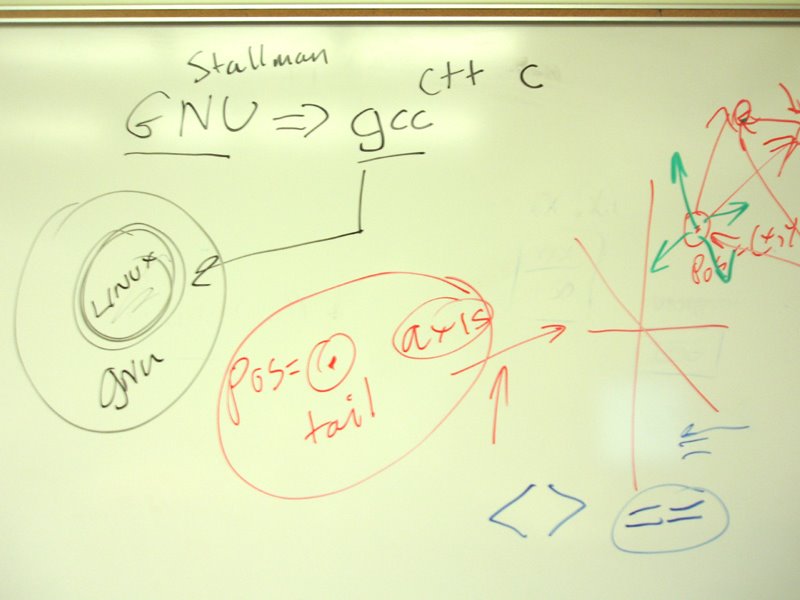
the birth of linux
A student wanted to know if Python might be used to write an operating system and, if so, what we'd use to compile it -- a kind of chicken & egg question (aside from Python not being a system language at this point).

Above you'll see my outline of a response, the real world story of how our operating system Linux (one of several) was compiled using Stallman's GNU project's capable and free gcc.

The rest of the doodling has to do with Vpython's cylinder syntax, which aims a vector from a pos in the direction of an axis. I'd thrown out the challenge to draw a tetrahedron, starting with a "make hundreds of randomly generated balls" script for clues.

accessing toyz
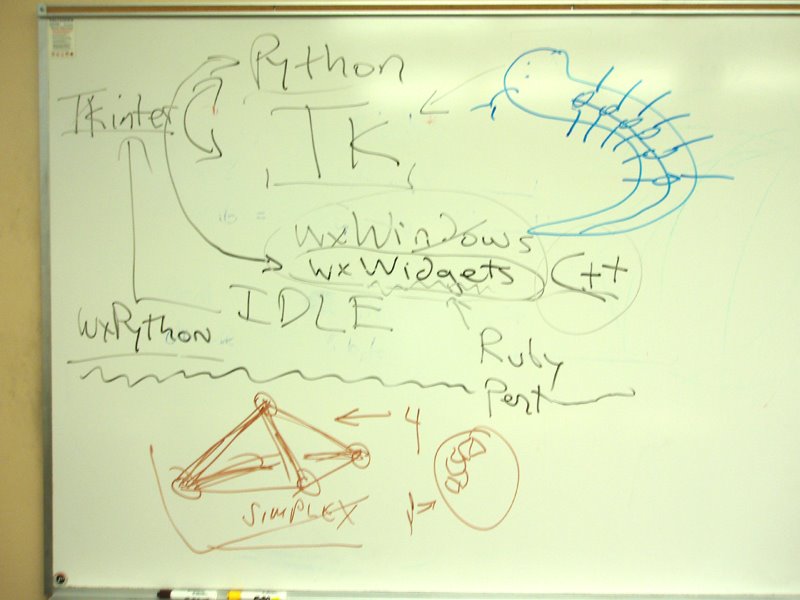
Chronologically earlier in this talk, but easily inserted later, was this overview of Python talking to graphical widgets libraries to get its windows, mouse-pressable buttons and whatnot, called "widgets" in the trade.

IDLE, our out-of-the-box offering, relies on Tk for widgets, via the Python module Tkinter.

Other shells such as PyCrust pull from wxWidgets, a C++ library accessed from Python through the module wxPython.

But keep in mind that other languages bind to these same libraries, explaining what Ruby and Perl are doing in the picture.

The blue snake icon is about "__rib__ syntax," my shorthand for Python's special name methods (e.g. __add__, __call__), which look like ribs, and snakes have lots of ribs -- a good mnemonic that helps with writing one's first classes (we did Dog and Mammal), and needing to define __init__(self).

Below that, I'm polling the class with my "simplest polyhedron?" question, getting back "three sided pyramid" and "sphere" (both good answers, though I define the latter away). Mathematicians call it a Simplex, in honor of its simplicity.

However, connecting any four randomly generated balls with six edges isn't as easy as feeding startpoint, endpoint pairs to visual.cylinder. Next week, we'll take a more formalized detour into vector arithmetic within Vpython, plus introduce some wrapper classes.

Saturday, October 28, 2006

In Favor of School Choice

I think it's definitely valid to demand choice, and a public school system is remiss if it doesn't offer much.

For example, a city the size of Portland, where I live, should have ample public schooling on the same-sex model, meaning all girls or all boys -- not exclusively, but in addition to the "more normal" (by today's standards) coed kindergarten through high schools. Based on recent government reports, I'm thinking that's actually a likely prospect.

But that's not imaginative enough. We could have public system alternatives that are radically different from the norm, to make diversity even more real. For example, what gets taught in the vicinity of tribal sovereignties aka Indian Reservations? Why shouldn't that content be altered to include optional flatscreen based math from Python Nation? That'd be a new choice for deserving, patient Americans.

Plus other public schools could subscribe as well (given we're talking cyber-assets a lot of the time, meaning duplication costs are quasi zero, and Uncle Sam likes being thrifty when the economy allows it -- this appeals to fiscal conservatives especially).

I'd prefer to see radical diversity within the public system, offered to satisfy the legitimate demand for choice, than see taxes leaking away willy-nilly, to private schools which might not have the same level of commitment to keeping the USA active and healthy over the long haul. When citizens pay taxes, it's to make our nation great, not to aid and abet raiders and looters of its treasures.

Originally published to the Math Forum.

Friday, October 27, 2006

Random Thoughts

Yes, today's high frame rate video games -- a different challenge than rendering (used in hidef cartoons) -- if T-rated, may well contain violence far above what I recall CBS decrying back in the early days of rasterized V-games.

However, if meant to stay a cartoon, wrapped in a sports ethic, forbidding of animal cruelty, then we keep the psychological elements we associate with pro ball, other high stakes sports.

We like and willingly pay for this drama, and tolerate the trade off between risk and sports injury to our egos. Even less physical injury occurs among geeks, unless we count thumb sprains.

As an alternative to war, I think violent video games do have a bright future. Hence the bumper sticker: Quakers play Quake.

Wednesday, October 25, 2006

Just for the Hard Fun of It

Now that we've let go of the math teaching cadre, when it comes to new curriculum writing, at least in a few flagship schools, at least on the drawing board, it's easier to see where we went wrong with those losers.

In English and Music, we don't say "a student should never read Shakespeare until she or he might write at that level, nor listen to Bach until he or she might sit at a piano and play like PDQ."

Yet those poor math students were shackled with this "math as a vocational subject" philosophy (hardly ever explicit), that forced one to sit through hours and hours of tedious exercises before they let one in on any secrets worth knowing.

Hardly any previewing occured. It was all "math in the rear view mirror" with a promise (often hollow) of major revelations just around the corner.

"No 'higher math' until you can do it yourself -- and that'll take years and years" was the silly premise.

Imagine if we taught English that way. It'd be laughable, a joke.

Yet that's exactly how they taught it, for the most part -- minus any really appreciative or interpretive gloss on stuff too advanced to just sit down and do, but otherwise quite accessible.

You don't have to be a circus performer to appreciate a good circus. You don't have to be a calculus whiz to get hip to a lot of what the calculus is all about, maybe starting with the ancient Greeks, not just Newton and Leibniz (the more parochial approach).

The traditionalists were just as bad. You had to follow in lockstep, with no fractals until you could do them -- and since computers were verbotten in traditionalist classrooms, that meant like never (doing fractals by hand was just a joyless waste of time, believe you me).

Another consequence of this latent vocationalism was students were only allowed to "solve problems." They were almost never invited to "just do something interesting" with their growing set of tools. Yet just playing with polyhedra is a way to exercise one's vector arithmetic abilities.

"Problem, what problem? We do math just for the hard fun of it." This attitude was practically unheard of back then. They preferred to keep you inundated with busy work, pseudo problems -- less fun than even puzzles or games.

The constructivists were a little better here, but still, very little appreciation for art or architecture, and the role of geometry through the ages, was manifest in their curricula.

History was suppressed, art was suppressed.

It was all about "weed and feed" i.e. kill off all but the die-hards, who'll be your next generation of hair-shirt killjoy.

Make them be problem-solver good doobies, never the more explorational question authority types, such as we breed in the humanities.

Math teachers worked for slave ship owners, not for freedom-loving krews.

So it's a good thing that's all so over and done with, at least in some of our better flagship USA schools.

Copyleft by Kirby Urner, Oregon Curriculum Network, feel free to republish with attribution, edit only to fix typos.

Sunday, October 22, 2006

Playing with Blocks

David Koski's dissection of a cube
into phi-scaled T-mods + remainder tets
David brought some cardboard models along for the Portland Knowledge Lab to play with, including his dissection of the cube into blue, yellow and green T-mods, plus a few remainder tets.

Scale any T-mod's edges by phi (about 1.618) to get the next larger size, or by 1/phi (about .618) to get the next smaller size. Volume changes as a third power of the scale factor, surface area as a second power.

The remainder tet is what's left when you build a T-mod recursively from phi-scaled smaller versions of itself. The T-mod is 1/120th of a rhombic triacontahedron.

Note on nomenclature: the E-mod has the same angles (shape) as the T-mod in Synergetics, but a different surface:volume ratio as it's slightly bigger. The T-mod has the same volume as the A- and B-mods in Fuller's concentric hierarchy (1/24). David does not feel bound to use this accounting system however.


a PKL tableau
From PKL we walked to nearby Lucky Lab for brews then headed back to Meliptus for a higher tide experience, which included an interesting tour of George's decommissioned army tug boat (George, a WWII pilot, is 81 and lives on this tug).

David and George discuss
mechanical matters
aboard George's tug
New Era

Thursday, October 19, 2006

Hexa-Wuh?

doh!
Ah yes, Urban Dictionary to the rescue re "wuh" (plus cite "at wuh dumb" as a reminder, to not be).

Above is what Koski just sent me, as part of an album he's compiling, of wuh-dumb soccerballs, thrown together by merchants & cartoonists who never learned about hexapents -- OK let's not all finger-point at the same time.

Kirby to Pam (from earlier today, spelling fixed):
But hey, it's a complicated challenge. Kids are drilled into thinking very qyoobishly very early, then grow up to drill their kids the same way, and so on down the line. How does one break in to something like that?

For sure you'll come off as disruptive -- yet the more global goal for the Global U is a smooth transition, not another blood 'n guts horror show (why can't we just upgrade for a change? -- I'm not going for rebooting at too low of a level (just some mo' betta television should do the trick)). [click here for more context]
My HP4E campaign, named for Guido's DARPA-funded, is going pretty well I'd say, but when are we gonna see those cartoons?

The Portland Knowledge Lab wants to know.

party favors with no pentagons

Tuesday, October 17, 2006

Wanderers 2006.10.17

Glenn Stockton is covering the basics of Sacred Geometry for a packed Pauling House, flipping through butcher paper and drawing little symbols using a purple pen. He brought a ton of books to the venue and piled them in a pyramid on the table in front of him. Terry is running a camera.

Basic SG includes using the Egyptians' golden vessels to diagram earth, water, air and fire, within their universal container, a pentagonal dodecahedron (not quite Synergetics, but that's for my talk).

By showing us all of these books, many by respectable authors (including an upcoming ISEPP speaker), he's helping us realize that this sacred geometry stuff is not too weird, not too scary. A lot of the basic math is actually very familiar and elementary.

People have forever mixed geometry with psychology (we do the same), brewing up whatever flavors of rationality.

Get a good mix, and you've got the ingredients for a flourishing civilization, weather permitting. Dumb it all down, and expect a lot of low quality trauma and drama.

Sunday, October 15, 2006

More Technoinvective

I seem to have evolved a specialized namespace for use primarily in verbal sparring, often in a public congress, such as an egroup or listserv. "Technoinvective" was Applewhite's word for it, coined almost ten years ago.

Like, today I was going off against BDTs or "big dummy textbooks," the kind you feel like a dummy for lugging around in your bag, while day after day they don't teach you about the A & B modules.
I use the A & B modules to fight the control freaks, who also don't like that the Internet (based on tcp/ip) has freed geeks of all ages, and from around the world, to collaborate on open source cyber-curricula that put our dino tree-killer BDTs to shame. [1]
And on the Synergeo list, same thing: the prospect of yet more traffic jamming in some godforsaken red light district drives me wild:
What's to be afraid of is continued dumbing down and no Synergetics in any university philosophy departments, because arrogant physics heads pose as gatekeepers and can't fathom an alternative namespace wherein "4D" would *not* be under their control. [2]
It's not like I want a career in pro wrestling, wearing some spiderman suit. There're just some corners I need to see turned, before I'll be able to simmer down and remain more quietly brand loyal.

These days I'm liking Dido's White Flag for an anthem.

Saturday, October 14, 2006

In Retrospect

John (SUNY professor),
Amelia (industrial designer),
Elizabeth (BFI director)
Noguchi Museum in Long Island City,
Queens, New York
October 8, 2006
photo by K. Urner

Thursday, October 12, 2006

Wanderers 2006.10.11

Our featured presenter needed to absent himself, owing to illness, so ISEPP president Terry Bristol, ever looking for the opening, seized the occasion to polish his talk, which he recently delivered in Salzburg (I'm not clear on the details).

For the first hour at least, he gets rapt attention from our ilk.

I only showed later, per my Wednesday morning routine, and helped out with some curious allusions to prajnaparamita (a little Sanskrit goes a long way with engineers) and Avogadro's Law (he was doing Boltzmann's), plus a few jokes.

I also milled about in the kitchen near the coffee maker, chatting up the possibility of a Wal*Mart in Pyongyang with Jon, perhaps with an announcement as early as November 2nd? Later, I made some snide and sarcastic remarks about "sitting duck" aircraft carriers like the USS Eisenhower, rumoredly preparing for battle in some dimension.

Per these sitting ducks, you have to read Critical Path to understand how we Fuller Schoolers identify them with the moronic element that makes bad policies worse out of greed and its consequents, guilt & fear e.g. we can't "cut and run" because some of these outraged civilians are justifiably angry at being murdered for their oil, and might take their beef to our highest courts and win.

More power to 'em. That'd be democracy in action.

Anyway, I'm brainstorming a movie wherein we expend unneeded cruise missiles against no-longer-relevant aircraft carriers. Why use mockups and CGI and you have a lot of spare hardware just sitting around doing nothing useful?

Terry's talk is getting a lot better. He's bascially using Chaos Theory to help the more retarded among the Physicists understand why their "fundamentalism" (aka reductionism) isn't philosophically all that interesting or alluring to big money investors any more.

Tuesday, October 10, 2006

NY Sojourn


Saturday, October 07, 2006

WQM @ Mt. Hood

Our Quaterly Meeting is in session, a little up the slope of Mt. Hood, just off 26 towards Government Camp. Kids did an easy challenge course for fun, with Tara practicing her camera skills. She took this one of Rachael.

Meanwhile, adults packed the Lodge to hear three panelists, Lisa De Vaney, Ron Marson, and Tina McMahon described their cosmic arcs against a mystics' star map. All of them learn from dreams, not all of them hear voices (except maybe in dreams).

I doodled at a table, drawing sacred geometry toons in my school notebook, using these stories for inspiration.

Dawn had meant to draw the Seven Circuit Labyrinth for Children's Program, but another guy had the skill and chose exactly the same place for it. Off that hook, we left early. We still have a long day. Dawn also found an Eleven Circuit to finger walk.

Trevor and I met at Peet's for another Grand Opening. In the change for my Pumpkin Spiced Latte, I got a half pound of Colombian beans.

Trevor updated me about Robert Anton Wilson, and the outpouring of love and support for this famous author, apparently in his final days on this particular earthly plane and/or level (Tina has questions about levels (don't we all?)).

Thursday, October 05, 2006

Forgiveness

There's a lot of televized chatter about forgiveness in the air, in the wake of that insecurity dad's taking of innocent lives, then making a cowardly exit.

Of course the hounds of hell will pursue him for an age, that can't be helped (if you think you can control the boss, good luck with that). But Amish, modeling on Jesus, have already worked through to forgiveness, thinking very much of the man's family and children (also innocent casualties in this melee).

What if this insecurity dad had been Yemeni and the school on a US military base? How quickly would the love have spread in that context? But Amish are more expendable right?

Yemen is an easy target after all, quasi-defenseless, unlike these truck-driving insecurity dads, who pretty much run the Pentagon, at least in their own minds.

In the meantime, there's a lot of energy to be had from righteous wrath (that I'll own up to), though when stupidly expressed and squandered, that energy drains away pretty quickly, perhaps taking one to a low ebb at an inconvenient time.

Vengeful anger is a high risk investment, best grounded and thereby dissipated in polemics and debate (Dixie Chix a good model, film and television among the worthy media).

Do
express yourself sufficiently effectively to distribute the load far and wide to empathetic others. Don't bottle it and sell it as self-amplifying hate literature to your self-chosen inner circle, trying to enflame them into committing atrocities, suicidal or otherwise.

So yes, I myself have invested in stridently unforgiving polemics from time to time. I let those speeches stand, as reflective of my state, and likewise pray Bob'll cut me some slack.

I'm not one to go back and censor the historical record too much, although I do assert my control over personal content (I'll rewire links, add or drop web pages -- you can check archive.org for what my stuff used to look like). Plus a lot of stuff just breaks (entropy is ongoing).

I liked the way Bucky did it: small staff, no paid publicist, directly handled the mail. Nowadays, with the Internet, I have further freedoms: world readable publishing, mail washers and spam filters -- plus a lot of the same affiliates Bucky had (even if I've managed to alienate a few).

Of course my Global Data Corporation sounds awfully big, not easily controlled. But like HP4E, it's mostly into open source business modeling, meaning we advertise our ideas, educating the public about ecosystem sciences and synergetics (e.g. my T-mods commercial).

In the literature, Global Data is a lot like the Economists' XYZ Corporation: a generic paradigm widget maker used to advertise the concepts of economists, quasi-fictional yet doing real work in the real world, as a template, usually spun as behaving innocently, if awkwardly.

Global Data is correspondingly into screen widgets for World Game players, other relevant eye candy, and advertises general systems theory (GST), in competition with the economists' less scientifically informed self-discipline. We have many enlightened sponsors.

Esoteric bumper stickers:
Global Data: an IVM Corporation (XYZers welcome to apply).
Global Data: more mirrors, less smoke.
Global Data: Better'n Enron's Bull.

Wednesday, October 04, 2006

News Article (satire)

In a newly leaked memo obtained by this news agency, we've learned of a conspiracy of silence around keeping young children from understanding spatial geometry.

"If they're that smart, that young, we'll never be able to control them later" one official is quoted as saying.

Apparently, this conspiracy stretches over several decades. The memo is on Department of Education letterhead, although it is unsigned and we're assured untracable to any particular cubicle within the building. However, forensic analysis reveals it's been in circulation since approximately the mid 1970s [editor's note: Ed.gov isn't that old, please factcheck].

Agreeing to speak off the record, an additional source in the White House provided further details about just what is being suppressed. "There's this really easy way to teach the kind of thing the Greeks were into, like polyhedrons 'n stuff, which in the current political climate are deemed just too subversive for impressionable young minds to be exposed to."

"Some even speculate over exposure to polyhedra can make you gay" he continued, "and how much is too much? -- better to err on the side of caution."

This "really easy way" another source revealed, involves dividing a regular tetrahedron (a kind of three sided pyramid with a triangular base) into various other proportional shapes with similarly greek names, and organizing everything "concentrically" (mathematical jargon for "around the same center").

Our news agency is so far unable to obtain any pictures of the geometry in question, which are apparently still deeply classified. Until further details are learned, this obscure conspiracy may continue for some time.

There's just no easy way to decipher just what these anonymous officials are really talking about. We'd really need to see something.

Oh wait, this just in: an anonymous fax from North Korea. The picture is somewhat blurry, given that nation's backwardly Stalinist phone system, but for what it's worth, here it is:

Monday, October 02, 2006

The Terminal (movie review)

A retarded guy handicapped by a war torn special case language, is in an unacceptable state, and so gets frozen into a holding pattern within the isotropic vector matrix, the realm of generalized principles, here projected as blue meanie enforcers, mostly male-hierarchical, and quasi-omniscient (lots of security cameras).

Our hero's freedoms are strictly limited. However, by working at various language games, including the solution of love triangles, he ascends in rank and worthiness, becoming more of an American icon. His war torn state is healed and the icey totalitarianism of the IVM gives way to an incommensurably free expression of personal individuality (symbolized by the jazz-playing saxophone).

Having fulfilled his destiny, our hero returns to his home country (somewhere close to Borat's no doubt), leaving behind the austere, unforgiving integrity of this alien Vulcan world and its intertwined male/female energies.

The Planters and Ramada Inn brands get the most focus, with Sbarro a distant third. New York itself remains in the background, somewhat ghostly, as do JFK airport (from the outside) and Napoleon, another retard on the eternal chessboard of life.

Wednesday, September 27, 2006

My Blue Dino


Monday, September 25, 2006

More About Santa Claus

He's been coming up a lot lately, Santa has.

One of our Wanderers isn't welcome in his daughter's home, or something like that, because he tries to disabuse his grandkids of any Santa Claus nonsense. He has that wound up with religion, and how "all twelve" (?) can't be simultaneously true.

Today at the Bagdad, Trevor was talking about this artist who planted live crabs with Barbie Doll ™ parts strapped on, in a place where kids lined up and asked for stuff from Santa. The point was to subvert the department store's moneymaking, "asking Santa" being management's clever gimmick for getting customers in the right mood for shopping.

This was considered a disruptive maneuver, even for an artist, but one bystander said "I'm glad someone is finally doing this."

I think it's the spectacle of luring we don't like (ensnaring, baiting and switching). But the truth about Santa Claus isn't supposed to be disappointing, even when we deliver the punch line, that mom and dad love you, as do your friends and relations, and they express their love through this multi-faceted story, which says more about their love than mere physical things under a dead or dying tree could really get across.

Telling stories is not in and of itself criminal, but the life blood of a culture. This is why we hate seeing children lied to, by this target of Fuller's Obnoxico meme.

Like, I understand this guy's integrity, about Santa not being real and all that. But the rejoinder is "reality isn't the whole story around here, and never has been."

So what's so "anti-science" about this attitude? Science is for compentently managing the reality part, and we take that very seriously, don't believe in being stupid about it.

We want awake and alert scientists, want to be them ourselves, doing intelligent (and we hope mostly safe) experiments that teach us important and valuable lessons. Endlessly repeating the same mistakes is not what we signed up for.

So let there be no doubt where I'm coming from at least: I think empiricism is a valuable ism.

It doesn't follow that religion needs to get in the way of this pro-sciences agenda. On the contrary, many a religion is augmented with a set of sciences and vice versa.

Our mythical awareness doesn't have to go to war with the literal truth if it doesn't want to, i.e. the operator in U = Meta*Physical (a Fuller School teaching) is meant to be both/and inclusive, not the sign of an internal contradiction.

Saturday, September 23, 2006

Yar!


photos by K. Urner,
w/ Olympus Stylus 500
click for larger views

Wednesday, September 20, 2006

Focal Points

I think I'll swipe the "focal points" lingo and smatter a few for the benefit of our cadres (not a word I like, right down there with comrades -- probably a translation thing).

Addressing my coworker competitors then, I have the following four focal points to propose:
  • Pascal's Triangle, with appended ethnography, tracing it wherever we find it (like in Lost).

  • The Concentric Hierarchy (you knew that'd be here, now didn't ya?). A & B modules in other words. MITEs.

  • The NCLB Polynomial, tying algebra to geometry, with lots of connections to the art world and design science.

  • The Mandelbrot Set, perfect for learning about convergence and divergence in the complex plane (valuable in precalculus in other words).
I realize this seems to leave a lot out, but bear with me, as I'm going to explain why this constellation will help our cause -- and forgive me for choosing Python if that's not your forte (let's get with the cross-training -- I'm always polling for high quality HDTV Rubycasts (not much of a selection these days)).

:: Pascal's Triangle ::

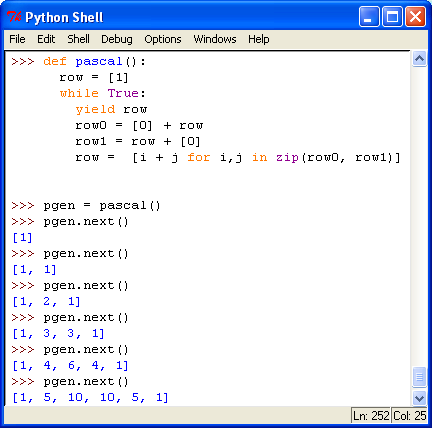
Pascal's Triangle will give us sequences, the starting point for our Python generators segment. Right after we visit Functions, we look at these "state remembering engines" that fire off cyclicly, and remember state between cycles.

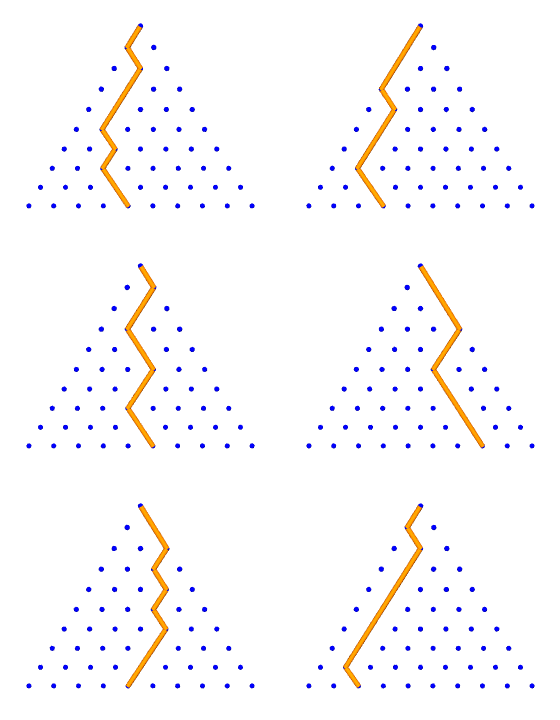
Here's a Pythonic way to generate Pascal's Triangle line by line:
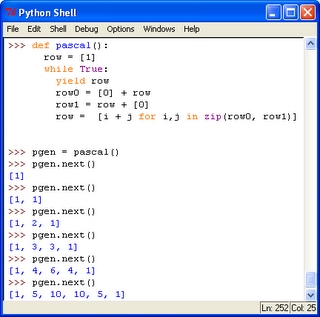
generating Pascal's Triangle
(also known to Chinese)

The triangular and tetrahedral numbers are column-wise side by side; our first generators in other words (a little easier than this one).

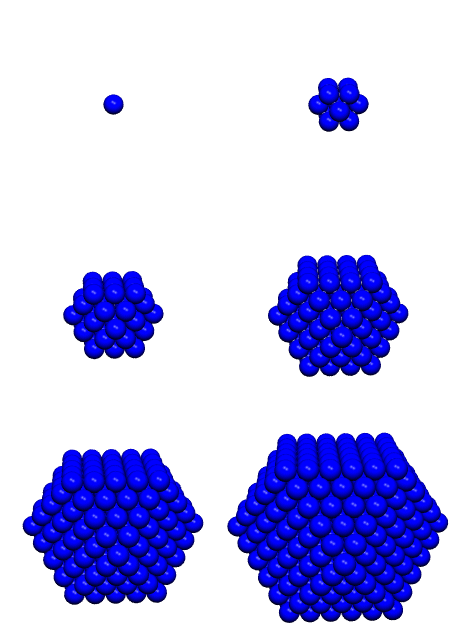
So here's our link to the cuboctahedral (aka icosahedral) growth curve i.e. to 10 * F * F + 2 (F = Frequency) -- the formula of Fuller's that H.S.M. Coxeter liked so much (provable with high school level math). Sloane's Encyclopedia of Integer Sequences becomes our friend at this point (e.g. cite A005901).

1, 12, 42, 92, 162...

:: The Concentric Hierarchy ::

The concentric hierarchy sets the stage for so much later science that we have to not postpone. This is "without further ado" material that any gnu math teacher must master.

The A and B mods themselves might come later in the intro (I teach 'em in sixth grade), but the basic nomenclature around polyhedra, plus Descartes' Deficit and Euler's V + F = E + 2 need to be there from the beginning (OK to postpone Descartes until you've gone over the Babylonian stuff i.e. 360 degrees, planar triangles having 180, tetrahedron having 720 (the deficit)).

Basically, this is our launch pad for computer graphics careers. You've got XYZ embedded (with optional Hypercross), and our unit volume Coupler right at the origin, at (0,0,0) -- or at (0,0,0,0) if using Chakovians -- thereby giving segue to our four IVMs (R.Z. Chu et al).

Yes, these are abstruse college-level topics, but they all have the Concentric Hierarchy in common (OK to say "Cosmic Hierarchy" at least among hippies). And yes, we're still working on your toon library, stocking it with goodies.

:: The NCLB Polynomial ::
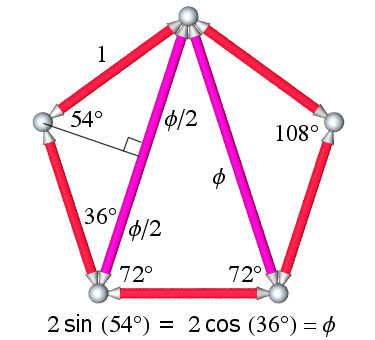
"pentagon math"

The NCLB Polynomial, a quadratic equation with two real roots, is a jump off point into both algebra and geometry. On the algebra side, we meet up with Pascal's Triangle again, and Newton's Binomial Theorem (since rediscovered by other whiz kids his age at the time).

"generating a bell curve"

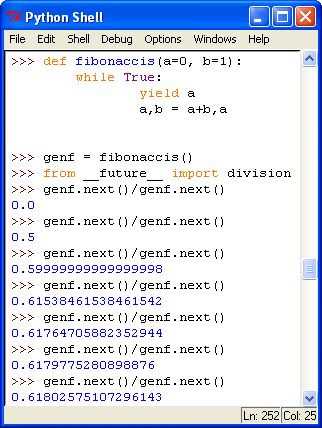
On the geometry side, we get phi, which also has many interesting algebraic properties. To further tie things together, Pascal's embeds the Fibonacci Sequence (a first Python generator) which sequence converges to 1/phi as follows:
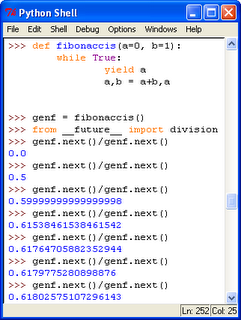
"converging to pow(phi,-1)"

From here, you could jump to any number of connected topics, including to Ramanujan's Pi Engines for more advanced generator drill and practice (e.g. consider using Python's Decimal type for extended precision, for Phi as well).

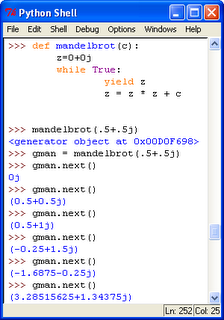
:: The Mandelbrot Set ::

Kids have a natural curiosity about fractals, as do some adults who still remember the pop art explosion, come across the great artwork on the web.

This is unabashedly eye candy, yes, but exploring the Mandelbrot Set also reinforces key concepts we want our graduates to take with them into their college experience: convergence; divergence; and the complex plane.

This is what'll make 'em ready for Calculus, which, per UCSC's Ralph Abraham's disciplined pioneering, should now probably be taught with a strong dynamical systems bias (there's a similar trend in statistics, undermining the status quo).

Once again, you can use a Python generator for your converging or diverging sequences:
"generator at c"