I showed up late to this meeting, as I'm pushing hard on a writing project having to do with the CRRs versus LMRs, clinical research records versus legal medical records. I've been in this business for fifteen years or so, have a lot of information to distill.
What neither Jason nor I realized, was the leadership for this conference is looking at filling a hotel with out-of-towners as a consequence of booking the Oregon Convention Center, on the model of OSCON.
That's a challenging prospect in today's economy as businesses are cutting back on employee enrichment (Bruce was very clear about this), even where this may be a perverse response given networking is often the lifeblood of an industry, conferencing a chief way of keeping shows on the road. Fear is unproductive.
No one needs a lecture from me on an obvious, in-our-face problem. My plan is to continue supporting OS Bridge, would hope that the City gets more involved, as we're actually talking about the economic future of our town.
At some level, "open source" is an engineering response to the challenges facing the scientific community, as it seeks to gain traction in the face of pressures to hunker down and stop sharing.
We're talking about passing on a very high civilization, not an easy job but on the other hand what else is there to do? This is the work, whether compensated or not. Passivity is not an option, especially if you're an engineer.
Showing posts sorted by relevance for query "OS Bridge". Sort by date Show all posts
Showing posts sorted by relevance for query "OS Bridge". Sort by date Show all posts
Friday, February 13, 2009
Monday, April 13, 2009
OS Bridge Meeting
I'm at Selena's with a crew of five other conference organizers (Audrey is co-chair, also Jason, Ed, Brian), wading through all these talks. We've already voted on relevance and interest, so now have an initial ranking.
I'd missed seeing mine included, think I forgot to vote on it (not out of false modesty -- I probably thought it was maybe one of the magical first cut but no, I may not make the finals, let's see what happens).
Ditto with Saturday Academy this spring, students aren't biting across the board (hey, it's spring!) and I have only the one offering. I had a good talk with an SA: staffer though, shared some follow-up with the Wanderers list.
We could branch more into teacher training, was the gist of it.
PHP has a lot more frameworks than I realized.
Co-working and hacker spaces are needed on the biz track. Doesn't have to mean hardware...
Some discussion of Scala versus Ruby, in terms of speed. This is apparently big news in the blogosphere because of that Twitter engineer, or so they tell me.
Selena is tracking everything in PostgreSQL. "I need to do an inner join", "I haven't quite memorized the schema yet".
We need my talk for long format under Culture, bridges higher and elementary ed (my focus is high school). Keith, looks like we've got yours too. Score two for ISEPP then, or at least Pauling House Wanderers.
This is good soup, thank you Selena.
I'd missed seeing mine included, think I forgot to vote on it (not out of false modesty -- I probably thought it was maybe one of the magical first cut but no, I may not make the finals, let's see what happens).
Ditto with Saturday Academy this spring, students aren't biting across the board (hey, it's spring!) and I have only the one offering. I had a good talk with an SA: staffer though, shared some follow-up with the Wanderers list.
We could branch more into teacher training, was the gist of it.
PHP has a lot more frameworks than I realized.
Co-working and hacker spaces are needed on the biz track. Doesn't have to mean hardware...
Some discussion of Scala versus Ruby, in terms of speed. This is apparently big news in the blogosphere because of that Twitter engineer, or so they tell me.
Selena is tracking everything in PostgreSQL. "I need to do an inner join", "I haven't quite memorized the schema yet".
We need my talk for long format under Culture, bridges higher and elementary ed (my focus is high school). Keith, looks like we've got yours too. Score two for ISEPP then, or at least Pauling House Wanderers.
This is good soup, thank you Selena.

Sunday, August 09, 2009
PSF Posting
[fragment of a thread on the PSF members list, hyperlinks added, posting Thu, Aug 6, 2009 at 2:13 PM ]
>> (how about sponsoring members at least get
>> a sticky decal on a Python Kingdom decal sheet,
>> like Yahoo! puts out? -- calling it a Kingdom
>> feeds the Monty Python conceit of having
>> knights, like Sir Laura (I was also suggesting
>> passports awhile back, for $9.95 from the PSF gift
>> shop, get a stamp for each Pycon and/or
>> EuroPython you attend)).
>
> Too cheesy... we have standards. ;-)
>
The Yahoo! decal sheets were pretty slick at OS Bridge, I'm uploading a picture:
http://www.flickr.com/photos/17157315@N00/3796413880/
With the passports, it'd be fun to imitate real nation state passports very closely, with similar watermarks and official-looking bling.
When this Python geek goes through passport control, it'd be fun to fumble and hand 'em the wrong one by mistake, then apologize, give 'em the "real" one (whatever that is). And don't forget to embed RFID! (see if Stallman gets mad, give him a free one).
I don't know if any of our sponsoring members are rich enough to have a fleet of Gulfstreams or LearJets, but if they wanted to take the PSF logo and apply it to the tail of one of those airplanes, I think we should seriously consider accepting that offer, unless we really think the company involved is too cheesy (but then it probably wouldn't have jets? -- not necessarily, Swiss have jets, and cheese both).
That's pie in the sky talk I realize.
Speaking of which, how about spending the money on a real flag, the kind you run up a flag pole and unfurl? Maybe at future Pycons, like at a Hyatt or whatever, we could ask 'em to fly it somewhere, maybe under the US or Georgia one, or the Italian one if this is Rome (Vatican?).
My role model is OLPC to some extent as I think G1G1 was pretty brilliant, despite the low turnout. The goal was worthy and we think spreading awareness of free tools is like offering free medicine in some situations, i.e. you don't have to take out a loan to manage your banking system, just write it in house, no "piracy" need apply.
I'm not sure I buy that the Python community is intrinsically averse to marketing. The "Python fits your brain" and "batteries included" tag lines were both worthy and effective. Congratulations to the people behind those.
The free spin Python gets from xkcd is to-die-for, all the more so because it's free. Pythons in general are good advertising (we have one, it's beautiful) and we hardly pay them a dime.
I think what turns people off is the idea of "aggressive push advertising" which stomps on sister languages i.e. we obviously love the Republic of Perl and have no interest in profiting at the expense of our close allies across the board. I'm all for a big tent approach and think my "just use it" tag line, homage to Nike's, is properly neutral in this regard ("just use something else" is equally valid).
I'd love to see Camels on some jet tails, not talking about the tobacco company's.
Hey, I realize my suggestions sound over-the-top and unrealistically expensive, but if you think of a TV show designed to teach real skills, like Sesame Street for geeks and geek wannabes, then these "world domination" memes could just become part of the woodwork, i.e. the backdrop for the show is "geeks making it happen" and guess what, it ain't so bad. Not too 'Mad Max', not too 'Blade Runner'.
Kids are really learning relevant stuff for a change in this parallel science fiction TV world (this "other tomorrow") that seems a lot less hellish -- so a good recruiting tool, for geekdom in general (the show would be more like "OSCON meets Make:" i.e. a mixture of software and hardware, device controlling by means of scripting, with lots of socially meaningful "helping people" type stuff that our women more enjoy (guys are more easily satisfied, by simple explosions, loud noises...)).
We'd want real geeks for talking heads, lots of skits like on Monty Python. Could be fun. Presumes a culture that really cares about its young people though, so maybe Japan or like Russia?
Kirby
>> (how about sponsoring members at least get
>> a sticky decal on a Python Kingdom decal sheet,
>> like Yahoo! puts out? -- calling it a Kingdom
>> feeds the Monty Python conceit of having
>> knights, like Sir Laura (I was also suggesting
>> passports awhile back, for $9.95 from the PSF gift
>> shop, get a stamp for each Pycon and/or
>> EuroPython you attend)).
>
> Too cheesy... we have standards. ;-)
>
The Yahoo! decal sheets were pretty slick at OS Bridge, I'm uploading a picture:
http://www.flickr.com/photos/
With the passports, it'd be fun to imitate real nation state passports very closely, with similar watermarks and official-looking bling.
When this Python geek goes through passport control, it'd be fun to fumble and hand 'em the wrong one by mistake, then apologize, give 'em the "real" one (whatever that is). And don't forget to embed RFID! (see if Stallman gets mad, give him a free one).
I don't know if any of our sponsoring members are rich enough to have a fleet of Gulfstreams or LearJets, but if they wanted to take the PSF logo and apply it to the tail of one of those airplanes, I think we should seriously consider accepting that offer, unless we really think the company involved is too cheesy (but then it probably wouldn't have jets? -- not necessarily, Swiss have jets, and cheese both).
That's pie in the sky talk I realize.
Speaking of which, how about spending the money on a real flag, the kind you run up a flag pole and unfurl? Maybe at future Pycons, like at a Hyatt or whatever, we could ask 'em to fly it somewhere, maybe under the US or Georgia one, or the Italian one if this is Rome (Vatican?).
My role model is OLPC to some extent as I think G1G1 was pretty brilliant, despite the low turnout. The goal was worthy and we think spreading awareness of free tools is like offering free medicine in some situations, i.e. you don't have to take out a loan to manage your banking system, just write it in house, no "piracy" need apply.
I'm not sure I buy that the Python community is intrinsically averse to marketing. The "Python fits your brain" and "batteries included" tag lines were both worthy and effective. Congratulations to the people behind those.
The free spin Python gets from xkcd is to-die-for, all the more so because it's free. Pythons in general are good advertising (we have one, it's beautiful) and we hardly pay them a dime.
I think what turns people off is the idea of "aggressive push advertising" which stomps on sister languages i.e. we obviously love the Republic of Perl and have no interest in profiting at the expense of our close allies across the board. I'm all for a big tent approach and think my "just use it" tag line, homage to Nike's, is properly neutral in this regard ("just use something else" is equally valid).
I'd love to see Camels on some jet tails, not talking about the tobacco company's.
Hey, I realize my suggestions sound over-the-top and unrealistically expensive, but if you think of a TV show designed to teach real skills, like Sesame Street for geeks and geek wannabes, then these "world domination" memes could just become part of the woodwork, i.e. the backdrop for the show is "geeks making it happen" and guess what, it ain't so bad. Not too 'Mad Max', not too 'Blade Runner'.
Kids are really learning relevant stuff for a change in this parallel science fiction TV world (this "other tomorrow") that seems a lot less hellish -- so a good recruiting tool, for geekdom in general (the show would be more like "OSCON meets Make:" i.e. a mixture of software and hardware, device controlling by means of scripting, with lots of socially meaningful "helping people" type stuff that our women more enjoy (guys are more easily satisfied, by simple explosions, loud noises...)).
We'd want real geeks for talking heads, lots of skits like on Monty Python. Could be fun. Presumes a culture that really cares about its young people though, so maybe Japan or like Russia?
Kirby
Monday, April 27, 2009
Metaphors Matter
Quoting from Chapter 2 in Code Complete: A Practical Handbook of Software Construction by Steve McConnell (Microsoft Press, 1993):
For example, one of our upcoming OS Bridge talks looks at farming. I don't know much about farming, but was thinking of this proposal when I did my imitation of David Beazley's more professional introduction to coroutines in Python.
A confusing abundance of metaphors has grown up around software development. Fred Books says that writing software is like farming, hunting werewolves, or drowning with dinosaurs in a tar pit. Paul Heckel says it's like filming Snow White and the Seven Dwarfs. David Gries says it's a science. Donald Knuth says it's an art. Watts Humphrey says it's a process. Peter Freeman says it's a system. Harlan Mills says it's like solving mathematical problems, performing surgery, or butchering hogs. Mark Spinard and Curt Abraham say it's like exploring the Wild West, bathing in cold streams, and eating beans around a campfire.I'm probably more in that Wild West school, but I'd think you'd want to use metaphors friendly to your subculture / ethnicity. There's no need to narrow it to one namespace surely.
For example, one of our upcoming OS Bridge talks looks at farming. I don't know much about farming, but was thinking of this proposal when I did my imitation of David Beazley's more professional introduction to coroutines in Python.
Tuesday, January 13, 2009
PPUG 2009.1.13
 I took a break from my spartan cube (Kermit), to join PPUG, and later OS Bridge in Roman (a room) -- long day at the office, with a lunch break at Rams Head.
Announcement: Northwest Python Day, January 31st, 9 am - 5 pm (lots of lightning talks!).
On tonight's menu: meta classes, deque, stupid dict tricks (Jason), Natural Language Processing, except John isn't here, so no meta classes, dang! We're about 30 strong.
Women are pretty much running these meetings (not always overtly), which is encouraging, especially after all that disappointing news on the Math Forum, about declining enrollment in some dying (as in withering) academic programs.
A deque (pronounced "deck" -- or "dee que" by some) is a double-ended queue, found in collections. It has a rotate method which is kinda cool. Jason also showed extendleft with rotate, "wildly faster" than extendleft with reversed.
dict.__missing__: collections.defaultdict lets you specify the type of the default "nothing" you'd like as a value -- could even be a function (any callable with no args). A newer approach is to subclass dict to gain access to __missing__, which will be called whenever __getitem__ fails.
OK, John Melesky is here (bus problems).
Python Metaclasses: never use them (opening joke). "There are parts of Python where thar be monsters." Decorators might fall into this category, descriptors... "They're not actually that bad" (pretty coherent, but unpythonic, non-obvious). Hmmmm, I'd not heard of "class decorators" before.
[ long convoluted example goes here, originally involving exec, with an environment at least -- reminds me of Foxpro's "&" i.e. macro substitution -- made less crufty by our group process, enhancing the lambdas (we rock) ]
John: "we're getting almost Perlish" (too clever by half?). I'm fairly persuaded I don't want to use metaclasses very often.
The natural language toolkit (NLTK) looks fascinating. Monica Toth knows her stuff. Here's some of what you get:
Corpus: a database of speech or writing samples intended to demonstrate how language is actually used. from ntlk.corpus import brown will give you access to the 1,161,192 words and 57,240 sentences in that collection. You can do probabilistic and statistical work against a corpus.
Wordnet: a lexical database of words and "synonym sets", or synsets. from nltk.wordnet import * gives you a relations() method on a word like "door". Get all hyponyms for door using door[0][HYPONYM] e.g. car_door, double_door...
from nltk.chat.suntsu import * gives you access to suntsu_chat(), your own personal chat buddy (a chat bot -- Eliza is there too as eliza_chat(), also nltk.chat.rude() -- fun for kids).
NLTK: The documentation lags the reality in this academic, research-oriented package. Linguists have a language all their own.
I asked a stupid question about Wsgi. Maybe we'll hear about Orange next time? We might also learn about RDF, an alternative to SQL for defining models. I signed up to yak about Vpython.
Produce Row: yes John, you're correct that "NATO professor" and "nutty professor" don't rhyme so much as alliterate. Thanks for the more detailed background on RDF, and Illinois politics.
Tuesday, November 03, 2009
Not Following Detroit
[ typos fixed, hyperlinks-enhanced version of a math-teach posting @ Math Forum ]
On Sun, Nov 1, 2009 at 7:18 AM,
Domenico Rosa wrote:
> Publisher enters new chapter in textbooks
> Houghton sells $40m high-tech teaching system
> By D.C. Denison, Globe Staff October 29, 2009
>
Whereas I agree that the mass published wood pulp textbook is no longer the most relevant distribution system for curriculum content, there's a lot of political pressure in Portland, and Oregon more generally, to "eat our own dog food" as an open source capital (Christian Science Monitor, 2005).On Sun, Nov 1, 2009 at 7:18 AM,
Domenico Rosa wrote:
> Publisher enters new chapter in textbooks
> Houghton sells $40m high-tech teaching system
> By D.C. Denison, Globe Staff October 29, 2009
>
OSCON is returning next year (Open Source Conference) and we also have OS Bridge, all thanks to the Silicon Forest serving as a champion of FOSS (or FLOSS as some call it, L for Libre or Liberal, as in Liberal Arts).
This trend extends to empowering teachers to commit to Open Education standards, ala WikiEducator and so forth. Initiatives like Maria's Math 2.0 will likely play a greater role in future curriculum writing than any dinosaur mass publishers "back east" (we tend to be snobbish out here, see "the east" as about 10 years behind the times, with California only 3 years behind).
Math Labs may use mostly recycled hardware, hand-me-down machines from the corporate sector and government agencies, although some of the more well-endowed get grants for new equipment. Mostly the money needs to go for teacher training, as math teachers especially are expected to have IT-related skills (lest their "technology in the classroom" rhetoric sound empty and hollow -- just knowing how to use a scientific calculator is no excuse for numeric literacy, or "numeracy" any more).
So I'm anticipating a lot of skepticism regarding Detroit's adoption strategies. We'll expect to learn from Detroit's mistakes perhaps?
Kirby
Tuesday, August 11, 2009
PPUG 2009.8.11
 :: bug detector (from Flickr) ::
We're on top of the world tonight, at Webtrends, top floor in a downtown Portland sky tower. This company obviously treats its people well. Michelle of Emma (her company) is treating us well as well, showing up with large numbers of gourmet Hot Lips pizzas and premium beers.
I'm glad I didn't eat supper, as this is definitely the real deal.
The FM radio stations are fussing about the cloud cover. Tonight, the Perseid meteor shower reaches a climax but no one near Portland is going to see that. We've had clear skies until today, when it's overcast and rainy.
You'd need to drive out the gorge anyway, to escape light pollution, but this weather means there's no viewpoint within a convenient driving radius (as a family, we tried Rooster Rock one year, somewhat disappointing).
We're like 40 people here tonight, including one child (she's part of the videotaping crew), at least as many as at the Ruby group the other night. I'd call this a party, although the chatter is unrelentingly technical, with some lore mixed in.
My meeting with Patrick Barton earlier today focused on simulation games as key to recruiting intelligent players into policy-making. If you want to build customer loyalty around your power company's development strategy, then have them appreciate the world you face, including their own role in that world.
Patrick, an accomplished psychometrician, is persuaded that simulations often more effectively communicate about complex, nuanced systems than any number of research papers, though it's not either/or. Kids probably learn more about urban studies from playing Sim City than from most textbooks, for better or worse.
We're not talking first person shooters here -- more like Civilization (Patrick had just been playing it, sampling the state of the art).
The military has budget for such games, aimed at recruiting, why not civilians too? Are we serious about nation-building, or just giving lip service?
If your rural high desert academy sells power to the grid from its wind farm or micro-hydel, then let's visualize that as a part of the game. If you're a water bureau encouraging conservation, share a relevant simulation with the schools.
Just before this meeting I was at Laurelhurst Rehabilitation Center visiting TC. This is one of those "as good as it gets" care centers, where most of the overworked staff don't themselves get any health coverage as a part of their low-wage jobs.
Meeting Tom's basic requirements, e.g. pain meds on time, has been an uphill slog. Most people are less effective self advocates (especially if sedated), don't like to be squeaky wheels -- and so fall through the cracks sometimes (the system encourages this).
Speaking of health care, North Americans were going berserk on TV about it, indulging in what passes for political debate around here. Intelligent discussion is not what the public airwaves are about -- more like cartoons, corporately sponsored lunacy (i.e. entertaining fluff). At least it's participatory. The town meetings have been well attended.
Mindfulness and consciousness are separable concepts (per another filing today).
As AFSC rep and liaison, I've been getting some readings from various points within the organization, helping me grok what some of the issues are. I'll write more about that in some other post. Carol (my mom) is on the board, so between the two of us, we get some good overview.
Michelle did a short talk on the optparse module (I remember exploring that on Amtrak's Coast Starlight for amusement, some years ago). She has a nice loud voice and cheerful demeanor. It's no wonder she's our leader. Her example code spits out a "Python meeting date" given a -m month and -y year. If you don't want to go, use the -e option and the Python Oracle provides an excuse.
Adam Lowry is giving a full-fledged talk, originally a candidate for OS Bridge. This is about automated testing for Python projects, e.g. unit testing, functional testing, and web testing.
The Standard Module's unittest module is fairly minimal. It's a good place to start but gets difficult. A 3rd party module called nose is Adam's preferred solution. py.test is also worth considering. Nose sniffs out any callable (e.g functions or classes) that matches a simple pattern (has the string "test" in it etc.), allows for setup and tear down. Doctest is somewhat limited. Nose will work with it though.
Fakes, dummies, stubs and mocks provide simplified behaviors, basically simulate working components. For example, the decorator @mock.patch() will replace a callable with some other callable. We call this "monkey patching". mox replays / verifies against expectations. Suppose you want to simulate a database failing or other glitch, without actually forcing that behavior for real. Testing libraries put your code in a simulator, apropos of the above.
Could high schools have simulators, like OMSI has? Patrick and I were yakking about teaching driving skills, but you could use simulators for other purposes as well.
Now we're looking at Twill, a tiny language for primitive web testing. Windmill is probably better than Selenium according to Adam. This is if your project has Javascript and requires in-browser testing.
Hey, check out Igal's write-up, quite succinct and not "all over the place" like mine.
Thursday, March 10, 2011
PPUG 2011.3.8
I got good and winded running to the bus for this one, almost door-to-door. I'd forgotten where the door was though, which added time.

I barely had time to swig a beer and grab a piece of Fat Tuesday pastry at Urban Airship before the charming Michelle hassled me to grab a nametag.
My name was spelled backwards (ala Leonardo), leading one geek to joke about his mirror iPod app (for when you need to fix your lipstick or whatever).
The main talks were by Lindsey Smith regarding feedparser, "Shmichael" about PEPs 380 & 3152, Adam Lowry about some ingenious thread tracker he'd written, and Eric Holscher on a way he could track server activity with this nifty graphic web stuff he'd put together. These were definitely "makers", creative bar none.
Will I have time to propose an OS Bridge talk this year? I don't yet have the video clips I'm looking for. We're in a holding pattern, waiting for the dominant paradigm to admit it could use some stabilizing influences.
We went to Bailey's for the after-party again. As usual, I talked with the gmpy guy from Mentor Graphics, plus someone else who wanted to talk about OpenEMR, other open source medical records initiatives.
Remember: open source doesn't mean open data. You can have all the source code published and in the clear, and still be as tight as Fort Knox in what you do with it.
Some of us are going to Pycon this weekend. Not me though, gotta work and stop traveling for awhile. I'll miss the whiskey BOF. Jason Kirtland had some cool glasses made. One is depicted below.
Wednesday, June 17, 2009
Faculty Lounge
OS Bridge is chugging along great. I caught the end of the fonts talk (typography), again continuing an ISEPP conversation. Amber is here, Gabrielle was here earlier (I told her I'd written up her talk), plus I was pleased to follow up with Sara Ford before she took off. Maybe Redmond keeps her on a short leash? I might -- running CodePlex takes a lotta web wrangling I'd think, gotta stay agile.
I should mention to Steve that Oregon Convention Center does a good job of making a small conference feel cozy. I'd been hyping the Marriott after Pycon, for the upcoming Django conference in the fall, mainly based on fond memories of early OSCONs in that venue, close to RiverPlace. Anyway, I'm not on the arrangements committee -- hard to go wrong in Portland if working with pros, lots of ways to play your cards.
There's this geek, Dave Rauchwerk, telling hilarious stories, about making a fool of himself in all these cool ways. He knows a lot of lore, and lore is important. Richard Feynman is a hero, not just Richard Stallman or that Oracle guy. Other speakers brought in boxes full of stuffed dragons, a lava lamp, other swag. I obviously missed a good talk. I also missed Assholes are Killing Your Project (so true, why that backspace button is so important (alluding to Amber's keynote)).
Now I'm in Open Source: the Dark Side, about our tribes, cults, dictatorships, fiefdoms, other anthropology. Jennifer Redmond is taking on the word "objectify", in particular with regard to women ("or even men as well", she adds). "Has anyone here read The Second Sex?" she wants to know. Not seeing a lot of hands.
 CouchDB: Perform like a pr0n star
(Golden Gate Ruby Conference)
There's this R-rated mentality etc., which feels like a loss of professionalism to our speaker. She took off for Africa (e.g. Madagascar) after the dot com bust, returning during the web framework bonanza (PHP, Python...) run by these "rock star" script kiddies who were/are actually somewhat immature, more amateurs really, doing a lot of non-scalable stuff, somewhat selfishly self-enamored. They've not been mentored in pro shops, come straight from hacking on some Linux box in the basement. How to address this?
Her answer is, appropriately, anthropological: we need more taboos. "Smack talk" on mailing lists turns people off, mostly guys being rude and crude in tiresome ways. Lots of corporate cultures just aren't that fun, kinda screwy, lotsa jerks. Language communities might get this way too, what to do?
Professionalism: dealing with people in a way that's not personal in a lot of ways, thinking more in a macro way, realizing you don't know everything, learning the basics, understanding your silo isn't the only one, has a half life. Respecting elders might be a part of it, understanding that experience counts for something.
If you ask a silly question, and get a nasty answer, that might scar you for life. This seems a lot like the same dark side we get in the closed source world -- not surprising I suppose.
Let's agree that FOSS has definitely lowered barriers to entry, so you'll get this "bratfinks with power tools" syndrome (could be in suits). True, we may have disproportionately fewer professionals as a result, but that's a welcome cost of democratization, plus cultures have their ways of adapting (this conference is a sign of that).
I think the personal tutoring model is maybe making a comeback, and this might help raise standards and/or keep standards high. Different subcultures will handle the challenges differently, so mono-culture and/or "one size fits all" isn't the answer either. The FOSS covens will have their own ways of mentoring new practitioners.
I was glad to meetup with Audrey's mom between talks, turns out we were coworkers for the ESD (Portland Public), working with TAG kids at that place on Marine Drive. Some of those grade school students are now the adults at this conference, so we should feel some sense of pride in passing the torch, was her thinking.
Open Source is old enough to be experiencing generational transitions, is part of what's going on. Geeks are learning, fairly self-consciously, what that means (means I'm an "ancestor" already, with lots of gray to prove it).
I should mention to Steve that Oregon Convention Center does a good job of making a small conference feel cozy. I'd been hyping the Marriott after Pycon, for the upcoming Django conference in the fall, mainly based on fond memories of early OSCONs in that venue, close to RiverPlace. Anyway, I'm not on the arrangements committee -- hard to go wrong in Portland if working with pros, lots of ways to play your cards.
There's this geek, Dave Rauchwerk, telling hilarious stories, about making a fool of himself in all these cool ways. He knows a lot of lore, and lore is important. Richard Feynman is a hero, not just Richard Stallman or that Oracle guy. Other speakers brought in boxes full of stuffed dragons, a lava lamp, other swag. I obviously missed a good talk. I also missed Assholes are Killing Your Project (so true, why that backspace button is so important (alluding to Amber's keynote)).
Now I'm in Open Source: the Dark Side, about our tribes, cults, dictatorships, fiefdoms, other anthropology. Jennifer Redmond is taking on the word "objectify", in particular with regard to women ("or even men as well", she adds). "Has anyone here read The Second Sex?" she wants to know. Not seeing a lot of hands.
 CouchDB: Perform like a pr0n star
 (Golden Gate Ruby Conference)
There's this R-rated mentality etc., which feels like a loss of professionalism to our speaker. She took off for Africa (e.g. Madagascar) after the dot com bust, returning during the web framework bonanza (PHP, Python...) run by these "rock star" script kiddies who were/are actually somewhat immature, more amateurs really, doing a lot of non-scalable stuff, somewhat selfishly self-enamored. They've not been mentored in pro shops, come straight from hacking on some Linux box in the basement. How to address this?
Her answer is, appropriately, anthropological: we need more taboos. "Smack talk" on mailing lists turns people off, mostly guys being rude and crude in tiresome ways. Lots of corporate cultures just aren't that fun, kinda screwy, lotsa jerks. Language communities might get this way too, what to do?
Professionalism: dealing with people in a way that's not personal in a lot of ways, thinking more in a macro way, realizing you don't know everything, learning the basics, understanding your silo isn't the only one, has a half life. Respecting elders might be a part of it, understanding that experience counts for something.
If you ask a silly question, and get a nasty answer, that might scar you for life. This seems a lot like the same dark side we get in the closed source world -- not surprising I suppose.
Let's agree that FOSS has definitely lowered barriers to entry, so you'll get this "bratfinks with power tools" syndrome (could be in suits). True, we may have disproportionately fewer professionals as a result, but that's a welcome cost of democratization, plus cultures have their ways of adapting (this conference is a sign of that).
I think the personal tutoring model is maybe making a comeback, and this might help raise standards and/or keep standards high. Different subcultures will handle the challenges differently, so mono-culture and/or "one size fits all" isn't the answer either. The FOSS covens will have their own ways of mentoring new practitioners.
I was glad to meetup with Audrey's mom between talks, turns out we were coworkers for the ESD (Portland Public), working with TAG kids at that place on Marine Drive. Some of those grade school students are now the adults at this conference, so we should feel some sense of pride in passing the torch, was her thinking.
Open Source is old enough to be experiencing generational transitions, is part of what's going on. Geeks are learning, fairly self-consciously, what that means (means I'm an "ancestor" already, with lots of gray to prove it).
Sunday, June 26, 2011
Office Reflections
I'm not too happy about Qwest changing its name to CenturyLinks, a big faux pas in my book. Anything "century" is too stale, unless grandfathered in. Purposely reverting to such retro signage is just a pale retreat, an attempt at a new wrapping. Anyway, not my problem.
I followed up on that PSF traffic regarding Python / Iran. The for-credit "truckology" degree (not its real name) could be cause enough for a convergence, with GeoDjango a theme (like at OS Bridge).
Holden and I discussed the new Hess album on Facebook, our having met at GOSCON last year.
Planning to see Source Code this evening.
I have a "commit bit" for the Wittgenstein feed. Hope Alex, Satya and company are doing well on their walk. Lots of turnover at FNB. LW enjoying Dostoevsky. Did the 14 mile loop, like in the old days with SB and friends.
I followed up on that PSF traffic regarding Python / Iran. The for-credit "truckology" degree (not its real name) could be cause enough for a convergence, with GeoDjango a theme (like at OS Bridge).
Holden and I discussed the new Hess album on Facebook, our having met at GOSCON last year.
Planning to see Source Code this evening.
I have a "commit bit" for the Wittgenstein feed. Hope Alex, Satya and company are doing well on their walk. Lots of turnover at FNB. LW enjoying Dostoevsky. Did the 14 mile loop, like in the old days with SB and friends.
Sunday, April 26, 2009
Testing Jackalope
 tutorial on gSculpt by Geoffrey French
running on mplayer in compiz cube
The screen flicker in my case maybe wasn't due to wifi and AC power concerns in the nVidia driver, but a wrong setting in the X Server settings. I'm still looking into it. At the moment, the problem seems resolved. I upgraded through Intrepid Ibex yesterday, from Hardy Heron, stopping only long enough to fix a few things. I figure my OS Bridge presentation should be state of the art.
The media has needed to see more dots connected to be able to omni- triangulate the story more clearly. Who has been resisting the design science revolution and why? Translating to FOSS terms, GNU/Linux has come out on top, but still needs to propagate. There's a lot of romance in the lore, epic sagas, that we need to keep telling (and we do). The "Bucky file" (B-File, like an X-File) adds a tremendous number of puzzle pieces, to where our geek culture is now "ready to roll". I don't think as many journalists will get side-tracked into the "Bucky as Britney" genre this time, i.e. all that "poor slob Bucky" talk is too squaresville, to qyoobist, for many readers to care anymore. He was an average joe who committed his life to healing the world, like any good medical doctor engineer. (March 7, 2009, Synergetics for Yahoos i.e. Synergeo).
 testing OpenOffice, from GIS in Action slides
Thursday, March 12, 2009
Busy Busy
I just got off the phone with someone at Yale (she called me), having placed my OS Bridge proposal in the hopper. We're looking to attract an out of town audience.
Dr. Nick scoured Powell's Books on Hawthorne last night and came up with Walking With Nobby as an ultra-cool find (I promptly bought it, so he could peruse as my guest, leave it for me). Nobby is the late Norman O. Brown, author of a kind of aphoristic glue language important in my formative years, helped tilt me towards Princeton philosophy, Dr. Kaufmann etc. Later, E.J. Applewhite showed me where he'd added Love's Body to his Georgetown apartment collection. NOB has links to Wittgenstein too.
Razz, my "welcome wagon" (for chauffering guests around Portland), is overdue for some maintenance. I'll take her out to Dick Hannah if my earmarks get through. You'd think we'd be further along by now, but big wheels turn slowly.
I was late to Oversight tonight, glad Maye thought to call me. I'm somewhat distracted. Dr. Nick is on his way, drove him to Union Station this afternoon. I'll start reading that book now.
Dr. Nick scoured Powell's Books on Hawthorne last night and came up with Walking With Nobby as an ultra-cool find (I promptly bought it, so he could peruse as my guest, leave it for me). Nobby is the late Norman O. Brown, author of a kind of aphoristic glue language important in my formative years, helped tilt me towards Princeton philosophy, Dr. Kaufmann etc. Later, E.J. Applewhite showed me where he'd added Love's Body to his Georgetown apartment collection. NOB has links to Wittgenstein too.
Razz, my "welcome wagon" (for chauffering guests around Portland), is overdue for some maintenance. I'll take her out to Dick Hannah if my earmarks get through. You'd think we'd be further along by now, but big wheels turn slowly.
I was late to Oversight tonight, glad Maye thought to call me. I'm somewhat distracted. Dr. Nick is on his way, drove him to Union Station this afternoon. I'll start reading that book now.
Tuesday, February 14, 2006
Valentine's Day 2006
 cute
cuteI'll be using the same home-brewed Pygame-based presentation manager code I wrote for OSCON 2005 to drive my presentation to Winterhaven's sixth graders on Thursday morning (soon after I teach my Python class). We've booked the auditorium -- this'll be a good test of my projector's luminosity.
I'll be taking them through Polyhedra 101: some classification schemes (e.g. Platonic and Archimedean), and a nesting scheme (which implies some relative sizing or scaling).
Of course I'm focusing on Fuller's nesting scheme, because he's the positive futurist and great American writer they need to learn about. Plus his way of doing polyhedra is pretty memorable and compact, so we'd likely cover it even if he weren't a Medal of Freedom winner.
 RBF
RBFThe CCP lattice sets the stage. Around each CCP sphere: a space-filling rhombic dodecahedron. Its long diagonals: an octahedron. Its short diagonals: a cube. Inscribed within the cube: two tetrahedra as alternate sets of face diagonals. Relative volumes: 6 : 4 : 3 : 1.
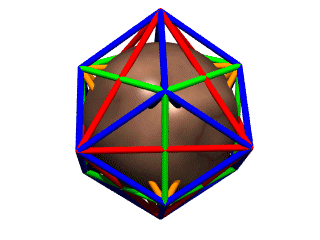
nesting scheme
Twelve CCP spheres around the nuclear sphere define the cuboctahedron, of relative volume 20. Packing outward in successive layers, we get 12, 42, 92, 162... spheres, always in a cuboctahedral conformation. CCP
CCPWe bridge to five-fold rotationally symmetric territory by crossing the "Jitterbug Bridge" -- a visual transformation taking the cuboctahedron into an icosahedron, which, along with its dual, the pentagonal dodecahedron, complete the Platonics.
This is stuff every elementary schooler should get briefed on -- or their American heritage is being denied them [visual: waving flag; sound track: patriotic fife and drum].
Today (Valentine's Day, 2006) even some top lawyers in Washington DC are ignorant of these basic math facts, which really hurts their credibility and effectiveness as potential USA OS operatives in my book, as this means they have a poor grasp of their own American History.
Friday, August 05, 2005
Last day of OSCON 2005
I grabbed the 75 bus this AM and got to OSCON early -- plenty of time for coffee and baked goods, conversation with a Perl programmer from Denmark. He asked what I spoke about (my name badge indicates I'm a speaker) and I explained about the Fuller School, how I'm a big fish in a small pond, how open source has facilitated our work enormously and on many levels.
Keynotes:
Asa Dotzler discussed a perennial topic: how Linux might do more to help Regular People on laptops and desktops, even while keeping it a kick ass system for developers.
The next keynote by Drew Endy of MIT was about programming DNA -- maybe just to insert some documentation. Yeast consists of about 12 million characters of info. Open source yeast? Problems: (1) balkanization of basic biological functions (patents widely distributed -- imagine individual coders owned each piece of punctuation in a program and needing multiple permissions to write each line) (2) quality of code (3) screwed up rights to reuse, react, reverse engineer.
Tony Gaughan (CA) talked about his experiences with Ingres (now open source). Licensing is confusing (GPL, LGPL, CDDL, CATOSL etc.).
Danny O'Brien talked about good and evil in Open Source (software patents are evil).
My favorite presentation was Saul Griffith's about Howtoons: kids hacking the physical world, using comic book instructions. Lots to learn here, about teaching software skills as well.
The panel on women in open source, and engineering more generally, provided interesting insights. Juggling time commitments and priorities -- an age-old problem (it's what operating systems do). The ability to telecommute certainly helps, especially if you're a parent (this is certainly true for me, a dad).
During the Python lightening talks I was able to squeeze in 10 minutes about hypertoons (with projected demo), a real crowd pleaser. Guido was likewise into graphics: a clock featuring multi-colored turning disks, making use of Tk.
Miguel's concluding keynote gave us a foretaste of where Novell is taking the Linux desktop: X running atop OpenGL (= xgl), meaning Gnome, with Mono at its core, will be able to keep pace with OS X (and the next Windows) when it comes to eye candy. Beagle looks like fun.
Shortly I'll be packing the car for a weekend camping trip -- time to get away from computers for awhile, unless I take the laptop to show hypertoons to Bridge City Friends.
Thanks to all for making OSCON 2005 a fantastic learning experience.
Keynotes:
Asa Dotzler discussed a perennial topic: how Linux might do more to help Regular People on laptops and desktops, even while keeping it a kick ass system for developers.
The next keynote by Drew Endy of MIT was about programming DNA -- maybe just to insert some documentation. Yeast consists of about 12 million characters of info. Open source yeast? Problems: (1) balkanization of basic biological functions (patents widely distributed -- imagine individual coders owned each piece of punctuation in a program and needing multiple permissions to write each line) (2) quality of code (3) screwed up rights to reuse, react, reverse engineer.
Tony Gaughan (CA) talked about his experiences with Ingres (now open source). Licensing is confusing (GPL, LGPL, CDDL, CATOSL etc.).
Danny O'Brien talked about good and evil in Open Source (software patents are evil).
My favorite presentation was Saul Griffith's about Howtoons: kids hacking the physical world, using comic book instructions. Lots to learn here, about teaching software skills as well.
The panel on women in open source, and engineering more generally, provided interesting insights. Juggling time commitments and priorities -- an age-old problem (it's what operating systems do). The ability to telecommute certainly helps, especially if you're a parent (this is certainly true for me, a dad).
During the Python lightening talks I was able to squeeze in 10 minutes about hypertoons (with projected demo), a real crowd pleaser. Guido was likewise into graphics: a clock featuring multi-colored turning disks, making use of Tk.
Miguel's concluding keynote gave us a foretaste of where Novell is taking the Linux desktop: X running atop OpenGL (= xgl), meaning Gnome, with Mono at its core, will be able to keep pace with OS X (and the next Windows) when it comes to eye candy. Beagle looks like fun.
Shortly I'll be packing the car for a weekend camping trip -- time to get away from computers for awhile, unless I take the laptop to show hypertoons to Bridge City Friends.
Thanks to all for making OSCON 2005 a fantastic learning experience.
Subscribe to:
Posts (Atom)
