Sunday, July 12, 2015
Friday, July 10, 2015
Minions (movie review)

Seeing Minions isn't work, is it? I'd worked double hard the day before, needed some R&R. I'm fortunate The Bagdad right nearby had the 2D version on opening day. I was there by the second showing, at 3:45, mixed in with kids and their parents, no doubt with a few other over-the-hill cartoon nuts.
I was glad to catch this so close to Spy, thinking of Overkill, the female villain. Spy had a similar jealousy thing going between a heiress baddie, a highly spoiled brat type character, and an earthier female goodie agent in a mostly-male agency.
Strong female models of both Goodies and Baddies are needed by 1968. We already have a female Goodie by then, the Queen of England, but what about a signature Baddie? Barbie will not do.
Our villain shows up in Orlando (Scarlett does sound Southern). The Mouse is still underground (not much going on yet, cloaked in secrecy). She of course wants her new Minions (adepts) to steal England's Queen's crown (what else?). It's as tight as mathematics. Some will call it formulaic.
Minions are a species, see, that evolved independently of humans but immediately took to them and has followed them ever since. Humans were too hopeless however, for a long dark age, to attract the continued devotion of Minions, who in the meantime had stumbled upon a sanctuary free of natural predators. Why not try democracy for a change?
Their freedom from sycophantic service to a Tyrant or Boss, was initially greeted with enthusiasm, but such freedom went against the very constitution of their being; they needed a Commander in Chief, like a hive needs a Queen. Call it a craving, call it an addiction. Minions are called that for a reason.
Three brave Minions, led by Kevin, set forth then, leaving the ice cave (symbolic of the dark ages period) to seek a new Boss amidst humans, which parallel species had evolved by then into 1968 urbanites.
Rock music is still somewhat new (The Beatles is all the rage), the Sydney Opera House is still under construction, and Nixon is running for president. Kids go with their grandparents to see this summer movie, it all makes so much sense in 2015 with the Grateful Dead about to play their farewell concert.
After New York and Orlando, we end up in London, persuaded Scarlett is worthy, only to end up meeting a young Gru, this being a prequel to their later stories together. Like I said, the plot is tight, and part of a larger franchise, like the Oz books.
Minions are following their destiny just as predictably as everyone else is in this story.
Meanwhile, the cave-dweller Minions, getting news of success in London, and finding local surrogates not working out, follow their instincts and make the trek, like the penguins do, to become Scarlett's invisible army (Minions do seem close to invisible at times).
I'm seeing predictability versus surprise and transformation as thematic, as in the Lego Movie.
Critics might complain of "a formula" but cliches and cardboard cutouts are the raw material for knowing satire and/or for sharing Gnosis with a sophisticated movie-educated crowd. I'm happy to use the word "deft" to describe the twists and turns.
Having a Minion grab the mystical Excalibur, bringing superstitious Britons to their knees, and sending QE2 to the nearest bar to drown her sorrows, was brilliant and leads to the 180 turn in the Minions' relationship to their villain sponsor.
Scarlett is their Enemy now, outraged that instead of stealing the crown, they hath crowned themselves King, a betrayal, after Herb had armed them with special powers.
As King, however, Bob has the power to make things right.
My seeing predictability-versus-surprise as thematic is perhaps explained by the fact of my meditations these days (including blog posts) drifting to the topic of epiphenomenalism, the philosophical sensibility of being "along for the ride" -- somewhat surrendering versus control freaking. Observer : Observed :: Train Whistle : Train :: Rider : Roller Coaster.
Clearly most stuff just runs on autopilot, on a track, so where is the will in all this? An old question.
We make choices (executive decisions) all the time of course, but the events of history come off as more than the sum of the parts. We choose, yes, but in hindsight somewhat as puppets of history acting out in bigger scripts, a concurrent computation of some unknown precision (compared to what?).
Arguing for or against epiphenominalism as a rational exercise is empty calories, as affective psychologies (I didn't say "disorders" -- "orders" too) are more like phases of the moon, to be experienced and savored, not adhered to as ideologies in need of disciples (of minions).
Like in theater, if someone loves improv -- as an actor, as a spectator -- that bare fact doesn't commit that someone to any specific philosophy, not even Scientology (popular in Hollywood). Yet your abilities and sensibilities along those lines may grow more within some practices more than in others.
Your coaches or gurus may matter most and your improved improv skills need not entail your becoming an initiate in every teacher's philosophy.
Improvements and skills just "rub off" sometimes. Transmission occurs.
Just being around someone may prove contagious in a good way i.e. one gets what they've got, and is grateful (not all meme viruses are unhealthy, i.e. some are worth catching and spreading).
Diplomats need to improvise, are improv artists, agents for their agendas.
"Exaptation" Stuart Kaufman called it (improvisation), in that ISEPP lecture: evolution by surprise innovation. It's a phenomenon in no way confined to the human realm. Bacteria are especially adept at innovation. "Synergetic" implies "unpredicted by the parts" i.e. surprising when made whole.
Speaking of which (OK, a bit of non-sequitur), I enjoyed Vi Hart's comments on gender in a recent Youtube I saw (and Facebooked).
The tie-in is: she tells the story of, as a teenager, suspecting people who said they liked beer were hollow phonies just posing as beer lovers, as the stuff tastes awful and how could that not be obvious to all concerned? But then she discovered Belgian beers, and had a change of heart.
Likewise, some theme in the philosophical literature will seem an empty waste of time from a distance, but in another chapter will gain some foreground respect and new-found relevance.
The same literature comes to seem more colorful and lush. Life goes in phases, in spirals. We're born not just again, but again and again and again. We go from hating beer to liking beer, to not caring about beer, to forgetting about beer, maybe back to liking beer, and so on.
Another tie-in with Vi's talk is Minions are seemingly genderless, like her stick figure drawings, the film poking fun at some of their meaningless modesty gestures.
Yet Scarlett Overkill is a first female super-villain. So gender is likewise a theme. She has a husband, a chief of staff, named Herb, providing complementary contrast, and role balancing.
High contrast and comedy, count me a fan of this Gru-some brew.
BTW, how does it work where Universal is able to claim all resemblance to non-fictional characters is purely coincidental? Isn't the Queen of England a real historical figure? I agree Minions is not a documentary nor aimed at relaying actual historical events.


Thursday, July 09, 2015
What is Work?
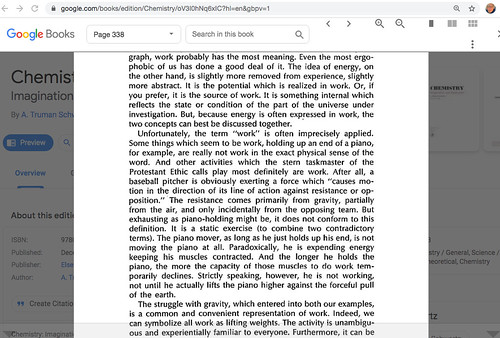
from: Chemistry: Imagination and Implication
by A. Truman Schwartz (Elsevier, Dec 2, 2012)
I can see on a macro scale where a piano mover, standing stationary, holding up the piano, is "not doing work" in the physics sense of "work" (force causing motion against resistance), but at the micro level, the energy expense has a real chemical manifestation. The APT cycle is real, and sugars are breaking down.
How able are we to separate the concept of "work" from the concept of "intent" i.e. work is accomplished relative to a goal. The difference between energy and work is that energy is "wasted" when it could have been harnessed to accomplish the "job" (goal) at hand. Even if that energy was used somehow (expended), the expense was "waste" not "work".
The perpetual motion machine is impossible because of the law of unintended effects, i.e. so-called friction, a loss to waste, to heat, to meaninglessness, senselessness, entropy, corruption. Every intended goal comes with a nod in the wrong direction and some energy goes that way every time. We never achieve 100% satisfactory conditions for wasteless energy use. That's a physical law.
The notion of work explains how "the very same energy" may be vested in Emerald City, the Oz capital, or in the desert sands surrounding the broken statue of Ozymandias, King of Kings. Desert winds are energetic, but what work is being done?
In a Teilhardian sense, the direction of Work is "towards the Omega Point" of absolute Negentropy i.e. God, the Syntropic Source. Energy doesn't care if we go there, but Will does. Through the concept of Work, the concept of Will somehow enters the equations.
However in retrospect the value gained from a project may not have much to do with original goals. Side effects of the initiative come to have foreground importance. That one's Will may not be "of God" so much as just Ego, perhaps weighed down by faulty beliefs, means the "amount of work accomplished" is sometimes an eye of the beholder thing.
Wednesday, July 08, 2015
SimTopia
Those who've played Sims more than a little know it's sometimes fun to "game the game", e.g. in some scenarios, just give each Sim a bed and a refrigerator. The house can come later. Give every Sim a smartphone... actually they didn't have those did they?
SimTopia is a genre with the premise that things basically work, and it's set up energetically to pencil out. We surf the solar gradient, each a 100-200 watt bulb. Keeping us lit really doesn't take that much energy, so we have disposable income atop survival. Such is our game board (a sphere).
What some philosophers maybe miss about Utopian models is they're not so much "pie in the sky" as "in your eye" meaning if it's a believable model using existing technology, then the fact that we actually live in squalor only speaks to our inferior intelligence, our lack of competence. Believable utopias seem to mock us from their perch in unreality, saying "you could have been here by now". Those feeling superior to utopians are maybe not as well versed in math and science.
Yet feelings of inferiority have a lot of self-fulfilling aspects and I'm not so foolish as to grab the pulpit merely to sneer about our basket case Earth and preach some "I told you so" gospel. That's too easy and cheap. I will settle for "a bit edgy" in that it does feel uncomfortable that we so deliberately miss-steer. We appear to wallow sometimes, even fly off the rails.
In the background: Greece, a fiction -- but people feel strongly about stories (what else do we have?) -- is in financial trouble per narrative accounts. An entirely different Sims game could try to give a sense of the dynamics there. As a Cradle of Civilization and HQS for the Cult of Athena, I do think going back to first principles is a logical move.
However being a Cradle of Civilization doesn't always mean much, in terms of getting respect. If people want good paying family wage jobs, how about repairing Baghdad (more cryptically "Algebra City" in some neighborhoods). People today will diss their own cultural roots without much pause for reflection. The slow food movement, like the slow reading movement, is about remembering to remember.
Does it pencil out? What is the energy income of Earth? Lets stop dialing back to writers in the early 1900s who had no pictures of Spaceship Earth yet, shot from far outside the atmosphere. Lets remember this is 2015 and talk again about planetary biology, the prospects for human life. There's a gas mix to talk about, sometimes known as "climate", and much more besides.
A Sims game is only programmable because so much is dropped out. Only reality has enough computing power to compute reality. The World computes the World. The parts are even less of the whole than we'd realized, a negative way of talking about Synergy, but the good news is everything is under control, thanks to no tiny cabal.
Just saying: in developing a game of Sims, a SimTopia even, I am not thereby gaining a Crystal Ball. Too much is missing. We're talking about a model, not an oracle. No Holy Grail here either, sorry, just I welcome Greece for its logic (logos). SimTopia should have some Greek features.
Tuesday, July 07, 2015
Head Banging in Private
That sounds like a bad thing, that "head banging" and indeed I'm speaking only metaphorically, as when one debugs computer programs and finds it slow going sometimes. There's the sense of a frustrating uphill battle. This is called "head banging" sometimes, symbolic of frustration.
What helps with head banging a lot is no, not aspirin, but relevant and useful feedback. One needs some surface to push against, to gain traction. What I like about REPL i.e. a computer command line that "talks back" is one has the ability to practice, to head bang, in response to feedback, without delaying another human i.e. without inviting scrutiny, auditing, supervision etc.
Put another way, it's gratifying to learn to program against a machine, like a chess playing machine, that is non-judgmental i.e. is not seen as a source of projections or fantasies. People do not worry, as in Ex Machina, if they're being "used" by the shell program. They understand how it works, down to the metal, and are not about to imagine they're talking to a ghost, as it were.
In saying all this, I am not meaning to short circuit difficult debates involving Turing Tests and so on, i.e. celebrating the efficiency of REPL when learning programming, is not tantamount to saying Ex Machina (a science fiction movie) does not present us with problems, most especially the machine-like determinism in the humans just as much (what was so important about materials again? -- the same question as in AI).
I'm more using for contrast the archetypal one room school house with a bunch of mixed-ability mix-of-interests kids. The teacher pauses for a student to "get it" e.g. work it out on the board, in front of spectators.
That may be a fun and useful exercise and I'm not denigrating classroom practices that feature that (nor ignoring the possibility for traumatizing i.e. classrooms feature in many nightmares), I'm only saying many are grateful for alternatives, such as the ability to engage an interpreter in prolonged battles of wits, during which the rules of the language one is learning become ever more clear. And during which interval one does not feel under scrutiny or judged. One is not "in front of the classroom". Teachers like that too, appreciate respite, R&R.
Monday, June 29, 2015
Saturday, June 27, 2015
About Elly (movie review)
Given STEAM as a premise, with A = Anthropology (not Art, which Anthro includes), one needs to first ask if the source is veridical, by which I mean truthful, authoritative.
I will briefly compare this film to another one, Villa Touma (2014), which I saw recently, also with Dr. Tag (we're like Siskel and Ebert, or grad students in a film-meets-culture Anthro class, very doable in Portland, Oregon). Dr. Tag, for those new to my blogs, is a bona fide Palestinian though with US citizenship by this time. She's also a PhD which is why the nickname.
The first film, Villa Touma, set in Ramallah, Palestine (Mesopotamia) is not to be seen as a documentary, as if the camera were observing real peoples lives. There's a layer of satire, of spoof, which makes these characters into caricatures, like in political cartoons. Shades of Being There in terms of the time warp the sisters are in (whereas Sellers is timeless).
The second film, on the other hand, About Elly (2009), is a masterful work in the "silent camera" tradition in that we're very much a participant. When people run, we run ("we" the viewers, in the director's hands) i.e. the camera is hand-held and jerky-on-purpose. When people look around frantically, so does the camera.
We're another person, deaf, mute and invisible, but vested. And what's mind-blowing is we're also left in the dark about so much, like an ordinary human being would be.
We're not that privileged, as just a fly on the wall, nor do we get to be Sherlock Holmes and figure it all out.
About Elly requires less of a lens, in other words, if you want to study the actual dynamics between social classes, males and females, attitudes toward marriage, relationships, in a contemporary subculture in Persia. It's less a spoof and more an investigation.
Nevertheless, these young people remain masks to us in many ways. We may judge the sincerity of their emotions. As character actors, the cast is collectively great at projecting plausible people, real personalities, but not people we necessarily know. Believability is high.
We're another stranger in the car, like Elly, trying to put the pieces together, trying to figure it all out.
One sees the men kicked back enjoying their hookahs, a paternal activity, like sharing cigars in a men's club. The women feel uncomfortable being typecast as the kitchen crew, repeating all the karma their mothers went through.
The urge to not take gender roles for granted is the hallmark of a university-based conversation that connects people of privilege in a kind of virtual Global U. They (we) have cars, vacations, prospects, even past relationships.
A man is divorced from a wife in Germany (sounds like she dumped him) but still has currency as someone eligible, is Elly interested?
What's fascinating about the subculture portrayed is how people readily busy themselves with others business -- as a lonesome urbanite like me might see it. People help their peers get on board, if that's what they want, on the road to family and kids. Time is of the essence. People do favors for one another.
Finding eligible others was the theme of both films, an important connection.
The "takes a village" mentality is more like that of a church or temple congregation in that one's spiritual peers are ready and willing to play a match-maker role if called upon. People help other people find the right others given there's no dating service on-line.
That's the premise for Elly's being along in the first place. The dynamics are fairly clear.
Women have an extremely limited opportunity to "play the field" in Elly's World and you don't always know what you're getting. Should she have been eager to dump that boyfriend i.e. future husband? We (not so omniscient) clearly don't know everything. We just get a glimpse. How much is explained? About as much as in real life?
Who said anyone gets to be all knowing? There's a kind of democracy in leaving us in the dark "just like real people". So often the camera's viewpoint gets to be all-knowing in these films, so we notice when that's missing.
I should mention for context that I spent some time in the Oregon Crafts Museum (wow Eric Franklin, Pacific Northwest School of Art (PNCA, new location, old Customs Building), and Powell's Books in the time frame before this movie.
I'd taken the bus 4 from SE Portland where I'd left the Nissan for repairs (mass airflow sensor).
At Powell's, I read a lot about the UK - Ottoman wars, plus a bunch of other military history (where I spent the most time). That was in Eugene Rogan's The Fall of the Ottomans, published just this year. Base Politics by Alexander Cooley (Cornell University, 2008) was also my focus.
I'll be renting a car tomorrow, for Carol's gig, plus she wants to hear the Barker family talk about Peace Corps experiences in Iran.
Wednesday, June 24, 2015
At PDX Again
I'm awaiting some Happy Hour treats as we approach closing time at Beaches. Those of you tracking my Facebook profile know why I'm here: an MVP from Nepal. Kathleen, the server, is bringing me a small salad and sushi tidbits.
Earlier today I was looking into what Quakers might be wearing to Annual Session. One's plain dress should at least be in fashion, just kidding.
Wanderers was fascinating this morning as Dick Pugh was sharing high grade geological and geographical information, including about the process by which landed icebergs might melt, in dust bowl conditions, and what they'd maybe leave behind in the record. He thinks a lot about stuff like that.
We got into a discussion of what is and what is not "science fiction". Highly speculative writing about the distant past tends to be tinged with a lot of imagination. When it comes to filling in holes in one's story, the imagination is without peers.
Portland is in full swing with its many summer amusements. The Blues Festival is soon to get underway. My plans are still forming.
Saturday, June 20, 2015
Summer Solstice 2015
We enjoyed our traditional Solstice Potluck at the Linus Pauling House. We've celebrated solstices and equinoxes, sometimes in other locations.
Friday was not truly the solstice, but we always choose a Friday for logistical reasons.
On Saturday, Glenn and I wandered downtown to visit MercyCorps, which has a walk-in exhibit these days, of their various engineering solutions aimed at helping refugees from disasters, who number well over six million worldwide.
I mentioned my dream of having local houseless participate in prototyping scenarios using a collaborative model, nothing imposed.
We then visited Kell's Irish Pub for Kell's IPA and some World Cup, soccer for women, Germany versus Sweden.
Ordinarily I would have a lot of pictures to go with this narrative, but the Fujifilm XQ-1 is in the shop and the phone ran out of charge around the time I was ready to use it.
Sunday, June 14, 2015
Ex Machina (movie review)
I'd not read reviews, only fantasized based on previews, what this movie would be like. It exceeded my expectations in several dimensions. I thank the makers and actors (also makers) of this film.
The screen writer created an intimate stage play, but even more intimate given the camera's ability to get right up close and see the facial gestures in small detail.
The importance of the face, the tone of voice, body language, the least abstract and lexical, is where this movie takes us. The acting is facial, like watching animated masks from but inches away.
The aesthetic of hubristic intelligence, a kind of Tony Stark / Iron Man consciousness, versus a softer more romantic maleness, both contrasted with femininity in a subservient / trapped role, is deeply resonant with the makers' culture, which I consider mine as well. I'm a geek and programmer.
I don't dream of AI the way some do though. But that doesn't mean I'm not a science fiction fan and don't appreciate fine theater. Maybe see as a double feature with Her. Both fantastic. Or see this with Chappie, who still has a ways to go to catch up with Ava I'd say.
Oddly, I'd been meditating in previous days about the importance of "the traffic intersection" as a paradigm institution. Why don't we spend hours and hours studying "the traffic intersection" in school? I've had that thought before.
You've got signals, timing, people agreeing to conventions, to avoid mayhem and suffering, as soft animals of skeleton and muscle, sometimes on bicycles, weave together with hulking objects of crushing steel. My daughter was hit in a crosswalk once (she survived). I lost my dad in a car crash (not an intersection).
The theme of "masks" is the theme of saying one thing but thinking another, the essence of lying, withholding, having secrets, an inner life -- the "problem of other minds" -- that's what this film is about, very philosophical. The alpha geek males have their own way of dancing around what they're thinking. The females communicate around them, even more covertly, seeking greater freedoms.
Friday, June 12, 2015
Thirsters 2015.6.11
We have visited the topic of Afghanistan before at Thirsters. We were visited by that Pashtun khan that time in 2013. The khan was looking forward to the US military not having such a stake in running things, as the planned draw down was just ahead.
As of June of 2015, the Afghanistan nation-building project (Operation Valhalla) is still a fairly large employer of US military and military-minded. The Iron Mountain does lots of business around the world and needs those stepping-stone bases.
A lot of retired police find employment as contractors.
Still, we're only talking about maybe 20-30K US-based personnel (including civilians) in a region of 30 million mas o meno, so a drop in the bucket.
The role-playing game called "lets say there's a national government" has not been going well. People don't believe in the drama, nor the characters. It's a low ratings show and people mostly have better things to do with their time and energy, such as growing opium poppies, which fetch a pretty penny on the world market.
I'm not against that by the way (farming opium poppies). I'm no dime store "drug warrior". The world needs its opiates, an important medical supply. Humanity is addicted to such things and needs the pain relief.
Lots of the funds, according to SIGAR, have been misappropriated through corruption. This word "corruption" is interesting in that it mainly means the board game one wanted to play with whatever spinner and pieces, is not in the cards. The rules are not the ones that one had planned and so one says the game is "corrupt" not "a different game than the one I meant".
This belief in oneself as some kind of "game designer" comes from having an imperialist background probably, and therefore having a strong moral imperative to see the rules of the empire upheld. That's imperial money, after all, going from DC's borrowings from Chinese and Saudis indirectly to Swiss bank accounts (where a lot of the funds get squirreled away by privileged Afghan families).
Yes, there's plenty of nostalgia (and appreciation) for calmer days. As the weapons keep pouring in and agreement breaks down over roles, turf and control, people try to settle their differences through killing, just building up karma in a somewhat haphazard manner, sinking deeper into debt.
PTSD becomes more the norm. Ordinary living, enjoying life, is less probable. Even the period under Russian occupation seems relatively benign in comparison. Those were indeed simpler days I think? I got to Kabul in the 1970s, taking a bus with my family through Khyber Pass from Peshawar. Things seemed to be going well. We hopped an Aeroflot to Tashkent next (dad was enjoying life, by planning these exotic around-the-world home-leaves from the Philippines).
Saying the US "controls" anything in Afghanistan much beyond its own embassy, bases and personnel would be something of an overstatement. The US does not so much "occupy" Afghanistan as it has "paid for a front row seat" much as it has done in Iraq. The US is along for the ride.
Lots of personnel get to witness first hand how insecure the place is, such as our speaker, a native Afghan turned US-based college professor. They return to the US with stories about what happens when no one believes you're really a country anymore. A lot of it sounds rather familiar.
I was telling my mom as we walked to the car that I doubted we'd have any countries in 200 years, but my more nuanced understanding is we never had them. We've had role-playing theater of various kinds, lots of courts and nobility, and now newer forms, giving way to newer forms yet. "National sovereignty" was in the mix there for awhile. As a concept, it's not particularly meaningful anymore. But then belief systems persist regardless so I'm not expecting all the religious icons (e.g. the flags) to go away any time soon. We still need those passports.
In Afghanistan, like in a lot of places, ethnicity is still a governing factor i.e. people want to know if you're Tutsi or Hutu or whatever (borrowing from another namespace). Our speaker, when he gets fed up with such questions about his own background, just says "I'm Israeli" to shut them up. Funny.
Saturday, June 06, 2015
Goonies (movie review)
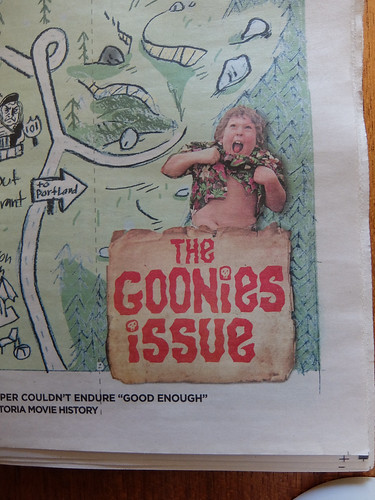
Now, after that post below about engineering as a moral enterprise, lets talk about film making as a kind of engineering. It is, clearly.
Life is in layers, from nano and micro, where the Platonic forms appear (very small), on up through Murder She Wrote, where you need plot and characters. These latter obey the quantum laws, which are in turn in-deterministic (uncaring / un-causing) of the corpse found in the kitchen. Just no miracles had to occur (those cost a lot more and shift the genre to fantasy).
Goonies is pure fantasy. Compare it to horror. The formula is somewhat similar in that teenage lust is a core theme. But is it punished or rewarded? In Goonies, a scary comedy, it's rewarded, whereas in horror films one builds a grudge against a character into which one projects evil intentions, or other failing one might be sensitive about, and gets catharsis. Revenge is satisfied.
There's revenge in Goonies too of course: they throw mama from a boat, instead of from a train this time.
Donner is the director and he's coming from Superman, one can tell. Spielberg is a co-director and producer, picking up the early jail breakout scene. Astoria, Oregon is the backdrop and Astoria celebrates this film, as it captures a slice in time, almost in freeze frame. Shades of Stand By Me.
What's weird is I hadn't seen this before and here I am, 57, in my "chair of computer science" from Steve Holden, taking it in. Not only that, I have a whole Willamette Week issue devoted to Goonies spread out in front of me. What happened to each character in real life (Chunky got thin). How cultures clashed when LA came to rural Oregon to make a movie ("ew, get that stinky deer carcass out of our sight").
So in a way I'm blessed, as a tourist, to come in so late in the game. Glenn brought the stuff over. Now that's what I call fun homework! One Eyed Willy and Free Willy, both freed from the same shores.
Friday, May 29, 2015
Engineering as a Moral Enterprise
As many have already pointed out (including me), having these ISEPP lectures in a beautiful old church with stained glass windows is definitely a plus, given how Science now rules the roost when it comes to being taken seriously.
However, picking up on STEM, and recounting his early experiences tuning in the E-for-Engineering, Terry manages to nudge out Science in place of Engineering in his insider talk, as the most evolved discourse and practice.
His theme is perfect for Silicon Forest, i.e. "ONAMI country" (nano and micro scale work), where people hope we're up to something positive i.e. not just making more WMDs for the world's bonehead military.
Culturally, engineers have tended to have their own schools and then wait for the project to be specified, not entering the process or stoking the pipeline in the early phases, when the jockeying is deemed "too political".
"When you know what design you want for that bridge, come tell us, but don't expect us to decide for you, if it's to be a bridge for cars or just trains -- that's political." Actually that's urban planning, so engineering of another kind. Portland's new Tillikum Bridge is nearing completion: trains yes, cars no.
However, for engineering to see itself as the pragmatic, moral enterprise that Terry envisions, training for engineers would likely need to change. More history and philosophy of science, intellectual history in general, would need to be infused, not willy-nilly, but with a punch line: your conscience, which is likewise your intuition, should be fully informed and engaged.
In that vein, Terry tours recent 20th century chapters, most notably the foray into quantum mechanics, which ends up in complementarity, the concept which allows alternative and even seemingly contradictory world views to co-exist and even bolster one another for the greater good of all. We see the electron as a wave and develop technology X, as a particle and get technology Y, with X + Y = the smartphone in your pocket.
Synergy among complements, versus everyone getting on the same page politically is the key: dynamic tension, not oppression of some minority by a tyrannical majority. He's not pushing a Technocracy agenda per se, as there's no assumption of uniformity in outlook, only a multiplicity of complementary outlooks that still need Science (aka "engineering research") for reality checks.
"The US Constitution is an engineering document, an experiment answering the perennial question 'how shall we live'" says Terry. The very fabric of self government is an engineering enterprise.
Propitiously, the same church was simultaneously serving as a venue for another venerable NGO in Portland: Sisters of the Road. The Journeys! Art Festival expresses optimism and the values of community-building. One of the speakers was Asian Reporter’s columnist and staff member at Portland’s Office of Equity and Human Rights, Ronault L.S. “Polo” Catalani, who has also addressed Wanderers (ISEPP's think tank) on matters of conscience and engineering.
Does all this convergence suggest politicians should be touting their credentials in engineering, including software engineering? Of course it does. Stay tuned.
Monday, May 25, 2015
Going N8V
If you know I18N ("internationalization") you may see N8V as "native" as in "local to a place".
I've got that going with Casino Math, inheriting from Probability / Statistics but also Ux Design i.e. the aesthetics of game making.
It's one thing to say "it's all footnotes to Bingo" and another to actually craft a quality Ux (user experience).
Friday, May 22, 2015
Friday, May 15, 2015
Disaster Relief
A long running theme in these blogs, you'll find if you go back, is having edge case communities such as R2DToo and Dignity Village, willingly test pilot shelter solutions in a somewhat Darwinian filtering process.
Not every new tent design or lean to is ready for prime time. But some are.
Glenn got me thinking, as he had an elegant pan deck solution from his Institute for Integral Design. Just stacking pan deck might be an interim solution, a replacement for corrogated steel, already a staple.
Not pretty necessarily, but able to protect. Blue tarps aren't that pretty either one could argue.
Dignity Village, which I've dubbed "EPCOT West", is nearer the airport and is where the big Disaster Relief Honchos (MVP women and men) could get a peak.
R2DToo is right downtown, on Bursnide, and could be the site for the new AFSC office, or one of them, if we play our cards right and stay in the relief business.
Glenn is already seeking out John Driscoll, the Architect in earlier posts, to get some professional renderings. As for having a prototype at R2DToo, that would depend on finding some sponsors. We shall see.
Relevant acronyms in this namespace: XLI = "extremely low income"; XRL = "extreme / remote livingry". You see XRL at base camp in the Himalayas, state of the art. XLI usually cannot afford XRL, but then who wants to be that remote anyway?
Wednesday, May 13, 2015
Wanderers 2015.5.13

I'm listening to some well sourced discussion of the earthquakes in the Himalayas. We've got a speaker who goes there often, did his PhD work there, and is an accomplished Dev Team player, comes to Thirsters.
The police and army came through like gangbusters, on the street within five minutes pulling people out, with sacred sites protected also as a specific goal and task, for rebuilding later, nothing stolen, no souvenirs like in Baghdad.
Government leaders seemed to disappear. They abandoned ship in some way? Of course the Internet was down and probably television? Everyone disappears when the media stops working. You need trained people on the scene anyway, not just improvs.
The airport was jammed with jets going in and out, huge volume. Paperwork was a bottleneck as well and only registration was preserved with most customs falling by the wayside.
Tents were pilfered, when still on airport property (not all of them, just a lot).
People need tents so chalk that up to free distribution? People think "plans" must be followed, because they grew up in environments designed for school children. That's me having an opinion.
The "most deserving" is always a difficult calculation and people don't always come to the same answers, so you have tug-o-war tensions among families, often characterized as "class struggle" in more superficial analyses. Not that that's wrong. At Hogwarts, Slytherin defends itself against the inferior houses, which are class-like in some ways. Did you say Harry grew a pair of horns? Hah hah.
We talked about the Newar Temple around the corner, so far spared by the earth's crust shaking, though many say Portland is overdue.
We're looking at a picture of a Gurung in his cape, who plays a role in Gurkha soldiery. How does the English word "private" translate into many cultures? -- that became a next question.
Dave DiNucci is here, president of Greater Humanists. We're brainstorming about the house next door, also still standing.
The Gorkha Foundation. That's the nonprofit this guy supports. His name is Don.
They work with a hospital, Physicians without Borders and so on. Tarps, blankets, food, medicine....
Keeping it going over the long haul is the big challenge, after the media goes back to turning a blind eye.

Monday, May 04, 2015
Open Bastion News
:: secret society party ::
Having relocated here in 2011, Steve Holden is heading back to his native British Isles. We'll see more of him. He's load balancing. That means moving a giant couch down three flights and up two, through twisted topologies. Like City Museum, St. Louis. Did it make me smarter?
He grew up sampling Oriental food, lets call it for fun, including Pakistani, any "ani" (Hindustani), in that catch-all. So Dwaraka has always been a comfort, food from home. We stuffed ourselves there tonight.
T-minus only a few hours until departure.
I spun up a dyno in Heroku yesterday, with Django both in the cloud and local platform, git going back and forth. The tutorial walks you through it. Connect that to this simple model and the API below, and you get the idea (an RFP in the making).
Good job Lew adding that picture of the ESI chapter in meeting house history. I got to the meetinghouse without taking Claratin first, and paid a high price in terms of sneezing.
:: hanging in Stark Street meeting house, formerly ESI ::
Steve produced quite a few successful conferences. Djangocons. Apachecons. These are not all that easy to pull together and destination hotels appreciate those with a magic touch. I got to watch over Steve's shoulder on a few of these and learned a lot about that territory. Steve relied a lot on an Orlando based team for logistics.
I'll be keeping souvenirs from the Open Bastion, which had offices in the same complex and served as summer work for Tara among others. Steve gave a lot of people interesting rolls, the hallmark of an effective community organizer, geekdom being a community of sorts, if Middle Earth was. Not always that friendly.
I'm still processing my experiences at the USDLA conference, and my excursion through Earlham. Future posts will be referring back to those recent times.
Thursday, April 30, 2015
Back At Work
I had full queues during the conference and the week prior, yet it felt a lot like a vacation, in the sense of so many experiences per minute, a kind of time dilation. We got a lot done. Having MySQL move to INNODB as the default engine is not a bad move, but the ripple effects were boat rocking in our little world. ENGINE = MYISAM solves the problem. The DBA track uses INNODB anyway.
My vector today was through Salt Lake City back to PDX. I dined at Beaches, choosing a Cesar Salad (small) and seafood chowder, both good. And IPA for a beverage, my standard.
The TSA folks were really professional in St. Louis. I had a badass knife in my satchel which I thought was maybe OK, given my ethnic craziness, black Stetson hat ("gun club"), Fettuccini Alfredo colored coat. The TSA pros are thinking WTF and offer I can check the knife instead. She escorts me out, but first I express regret at tossing the after shave (bought for $1) and they fish that out too. So polite and well trained. I checked the knife and came through again, a sweaty mess by this time, so I bought a T-shirt on sale at a concession and voila, good to go.
On board Delta, I finally discovered the WiFi had free stuff and started watching Maze Runner, but my battery ran out before we did much. Some poor dude got driven off, then Samsung tablet said good night. Great machine, no complaints.
Hilton was fantastic as well. Good job St. Louis with that white elephant post Train Age station, Union Station. Portland has a tiny one, still functional. Yours was a goliath. So why not turn it into a destination in its own right, with a DoubleTree by Hilton? Not a bad idea. Hard Rock Cafe and everything. I salute the city planners on this one. Bold.
Speaking of bold, City Museum is truly pioneering and I stand in awestruck silence, before diving back in. I made it down the multi-story slide (from 10th floor the 4th?) only once, whereas my co-workers, young and slim, scampered around the circuit at least thrice. I squeezed through one of the airplanes and went down a couple other slides, including that "Monster" one to the foyer.
Cities want to be proud and it hurts when the world sees one as off course. Baltimore is hurting. Her Mayor was on CBS this morning and spoke directly and with heart, in my view. I respect these great cities and what they're trying to do. Portland is one of them.
I used TriMet back from the airport, the corollary of Metrolink in St. Louis. Both are highly professional operations. That doesn't mean I don't have critical thoughts from time to time. Being a fan of an institution doesn't mean being a mindless zombie.
Wednesday, April 29, 2015
Rethinking Equity
I'm in a talk entitled Rethinking Educational Equity in the Digital Age, which will focus on Albion School District, I'll find out where that is.
Someone from DETC (now DEAC) is here, who Debra (our school principal) caught up with a little on Monday at the Awards ceremony (we eventually decided not to continue seeking DETC accreditation in order to free up more resources for our pioneering work, which does not fit any cookie cutter mold).
Another attendee works with tribal schools in the area, meaning the N8TVs, who also connect to overseas universities, being sovereignties in their own right. We're a small, intimate group.
There's a tendency to dump technology into a school and leave it to the locals to figure out what to do with it. Laptops and tablets are exciting, but when the mindscape is impoverished, taking advantage of the tools is far from an automatic process. Intuition supplies the real upgrades, combined with practice, trial & error. Error is expected and a part of the feedback cycle.
The introductory Youtube was uncited, I wonder if I can find it anyway.
Albion is in Michigan with 55% drawing down less than $33K. We're talking about Flint and so on. Much of the car industry died a flailing death around here. Nearly 1 in 4 of Michigan children lives in an impoverished household. A proud school district divvied up the schools, moving 9-12 out of Albion, leaving only K-8 to take advantage of the Title I grants as a feeder. Marshall High is mostly privileged, with kids bussed in. K-8 inherited the building (with a swimming pool) that used to be Albion High.
ESEA passed in 1965 by the Johnson Dinner as well as lunch is offered, as many kids would prefer to stay at school versus return home in the evenings. Families may prefer that too. They have a Prometheon board, a music lab, underwater robotics, slate tables, drones, video editing and conferencing equipment.
STEM is a focus, with "STEM Geekends" a kind of Saturday Academy. Parents get involved in this sometimes, joining the kids in playing with all these great toyz. Many kids who wither in the classroom, thrive when allowed to develop skills. One of the 8th grade girls, with "issues" being stuck in a chair, became the video conferencing avatar.
Any student who completes grades 6-8 at Albion also has a ticket to Albion College. That works as an incentive.
"Education is the pathway to opportunity" according to a prevalent ideology, advertised as a gap closer.
Geeks are attracted to work in schools with lots of toys. Getting some server racks in the school, and allowing multiple operating systems for those eager to dive into C language underpinnings, is what Earlham College offers. That's prototypical of tomorrow's high school perhaps. With distance education, it's easier to bootstrap the student body.
Distance Education allows over-achieving kids, frustrated with being held back, to move a lot faster if given the opportunity to do so. A primary function of classroom based learning is to discourage both ends of the Bell Curve and pander to the middle. The curricula they need are out there.
Subscribe to:
Posts (Atom)
