Tuesday, October 10, 2006

NY Sojourn


Saturday, October 07, 2006

WQM @ Mt. Hood

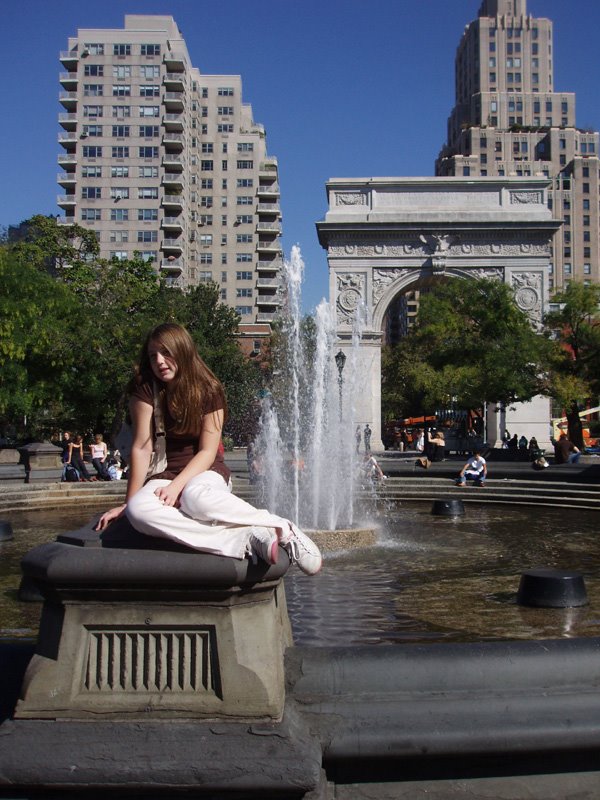
Our Quaterly Meeting is in session, a little up the slope of Mt. Hood, just off 26 towards Government Camp. Kids did an easy challenge course for fun, with Tara practicing her camera skills. She took this one of Rachael.

Meanwhile, adults packed the Lodge to hear three panelists, Lisa De Vaney, Ron Marson, and Tina McMahon described their cosmic arcs against a mystics' star map. All of them learn from dreams, not all of them hear voices (except maybe in dreams).

I doodled at a table, drawing sacred geometry toons in my school notebook, using these stories for inspiration.

Dawn had meant to draw the Seven Circuit Labyrinth for Children's Program, but another guy had the skill and chose exactly the same place for it. Off that hook, we left early. We still have a long day. Dawn also found an Eleven Circuit to finger walk.

Trevor and I met at Peet's for another Grand Opening. In the change for my Pumpkin Spiced Latte, I got a half pound of Colombian beans.

Trevor updated me about Robert Anton Wilson, and the outpouring of love and support for this famous author, apparently in his final days on this particular earthly plane and/or level (Tina has questions about levels (don't we all?)).

Thursday, October 05, 2006

Forgiveness

There's a lot of televized chatter about forgiveness in the air, in the wake of that insecurity dad's taking of innocent lives, then making a cowardly exit.

Of course the hounds of hell will pursue him for an age, that can't be helped (if you think you can control the boss, good luck with that). But Amish, modeling on Jesus, have already worked through to forgiveness, thinking very much of the man's family and children (also innocent casualties in this melee).

What if this insecurity dad had been Yemeni and the school on a US military base? How quickly would the love have spread in that context? But Amish are more expendable right?

Yemen is an easy target after all, quasi-defenseless, unlike these truck-driving insecurity dads, who pretty much run the Pentagon, at least in their own minds.

In the meantime, there's a lot of energy to be had from righteous wrath (that I'll own up to), though when stupidly expressed and squandered, that energy drains away pretty quickly, perhaps taking one to a low ebb at an inconvenient time.

Vengeful anger is a high risk investment, best grounded and thereby dissipated in polemics and debate (Dixie Chix a good model, film and television among the worthy media).

Do
express yourself sufficiently effectively to distribute the load far and wide to empathetic others. Don't bottle it and sell it as self-amplifying hate literature to your self-chosen inner circle, trying to enflame them into committing atrocities, suicidal or otherwise.

So yes, I myself have invested in stridently unforgiving polemics from time to time. I let those speeches stand, as reflective of my state, and likewise pray Bob'll cut me some slack.

I'm not one to go back and censor the historical record too much, although I do assert my control over personal content (I'll rewire links, add or drop web pages -- you can check archive.org for what my stuff used to look like). Plus a lot of stuff just breaks (entropy is ongoing).

I liked the way Bucky did it: small staff, no paid publicist, directly handled the mail. Nowadays, with the Internet, I have further freedoms: world readable publishing, mail washers and spam filters -- plus a lot of the same affiliates Bucky had (even if I've managed to alienate a few).

Of course my Global Data Corporation sounds awfully big, not easily controlled. But like HP4E, it's mostly into open source business modeling, meaning we advertise our ideas, educating the public about ecosystem sciences and synergetics (e.g. my T-mods commercial).

In the literature, Global Data is a lot like the Economists' XYZ Corporation: a generic paradigm widget maker used to advertise the concepts of economists, quasi-fictional yet doing real work in the real world, as a template, usually spun as behaving innocently, if awkwardly.

Global Data is correspondingly into screen widgets for World Game players, other relevant eye candy, and advertises general systems theory (GST), in competition with the economists' less scientifically informed self-discipline. We have many enlightened sponsors.

Esoteric bumper stickers:
Global Data: an IVM Corporation (XYZers welcome to apply).
Global Data: more mirrors, less smoke.
Global Data: Better'n Enron's Bull.

Wednesday, October 04, 2006

News Article (satire)

In a newly leaked memo obtained by this news agency, we've learned of a conspiracy of silence around keeping young children from understanding spatial geometry.

"If they're that smart, that young, we'll never be able to control them later" one official is quoted as saying.

Apparently, this conspiracy stretches over several decades. The memo is on Department of Education letterhead, although it is unsigned and we're assured untracable to any particular cubicle within the building. However, forensic analysis reveals it's been in circulation since approximately the mid 1970s [editor's note: Ed.gov isn't that old, please factcheck].

Agreeing to speak off the record, an additional source in the White House provided further details about just what is being suppressed. "There's this really easy way to teach the kind of thing the Greeks were into, like polyhedrons 'n stuff, which in the current political climate are deemed just too subversive for impressionable young minds to be exposed to."

"Some even speculate over exposure to polyhedra can make you gay" he continued, "and how much is too much? -- better to err on the side of caution."

This "really easy way" another source revealed, involves dividing a regular tetrahedron (a kind of three sided pyramid with a triangular base) into various other proportional shapes with similarly greek names, and organizing everything "concentrically" (mathematical jargon for "around the same center").

Our news agency is so far unable to obtain any pictures of the geometry in question, which are apparently still deeply classified. Until further details are learned, this obscure conspiracy may continue for some time.

There's just no easy way to decipher just what these anonymous officials are really talking about. We'd really need to see something.

Oh wait, this just in: an anonymous fax from North Korea. The picture is somewhat blurry, given that nation's backwardly Stalinist phone system, but for what it's worth, here it is:

Monday, October 02, 2006

The Terminal (movie review)

A retarded guy handicapped by a war torn special case language, is in an unacceptable state, and so gets frozen into a holding pattern within the isotropic vector matrix, the realm of generalized principles, here projected as blue meanie enforcers, mostly male-hierarchical, and quasi-omniscient (lots of security cameras).

Our hero's freedoms are strictly limited. However, by working at various language games, including the solution of love triangles, he ascends in rank and worthiness, becoming more of an American icon. His war torn state is healed and the icey totalitarianism of the IVM gives way to an incommensurably free expression of personal individuality (symbolized by the jazz-playing saxophone).

Having fulfilled his destiny, our hero returns to his home country (somewhere close to Borat's no doubt), leaving behind the austere, unforgiving integrity of this alien Vulcan world and its intertwined male/female energies.

The Planters and Ramada Inn brands get the most focus, with Sbarro a distant third. New York itself remains in the background, somewhat ghostly, as do JFK airport (from the outside) and Napoleon, another retard on the eternal chessboard of life.

Wednesday, September 27, 2006

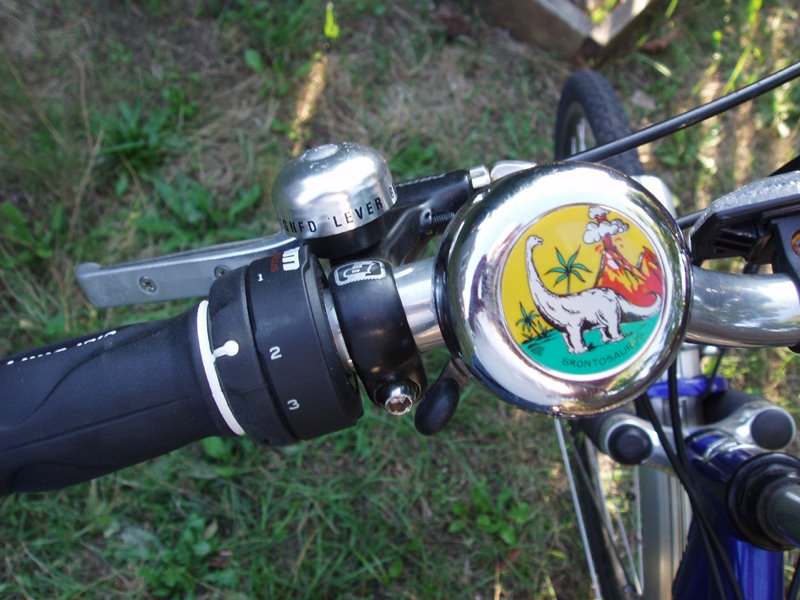
My Blue Dino


Monday, September 25, 2006

More About Santa Claus

He's been coming up a lot lately, Santa has.

One of our Wanderers isn't welcome in his daughter's home, or something like that, because he tries to disabuse his grandkids of any Santa Claus nonsense. He has that wound up with religion, and how "all twelve" (?) can't be simultaneously true.

Today at the Bagdad, Trevor was talking about this artist who planted live crabs with Barbie Doll ™ parts strapped on, in a place where kids lined up and asked for stuff from Santa. The point was to subvert the department store's moneymaking, "asking Santa" being management's clever gimmick for getting customers in the right mood for shopping.

This was considered a disruptive maneuver, even for an artist, but one bystander said "I'm glad someone is finally doing this."

I think it's the spectacle of luring we don't like (ensnaring, baiting and switching). But the truth about Santa Claus isn't supposed to be disappointing, even when we deliver the punch line, that mom and dad love you, as do your friends and relations, and they express their love through this multi-faceted story, which says more about their love than mere physical things under a dead or dying tree could really get across.

Telling stories is not in and of itself criminal, but the life blood of a culture. This is why we hate seeing children lied to, by this target of Fuller's Obnoxico meme.

Like, I understand this guy's integrity, about Santa not being real and all that. But the rejoinder is "reality isn't the whole story around here, and never has been."

So what's so "anti-science" about this attitude? Science is for compentently managing the reality part, and we take that very seriously, don't believe in being stupid about it.

We want awake and alert scientists, want to be them ourselves, doing intelligent (and we hope mostly safe) experiments that teach us important and valuable lessons. Endlessly repeating the same mistakes is not what we signed up for.

So let there be no doubt where I'm coming from at least: I think empiricism is a valuable ism.

It doesn't follow that religion needs to get in the way of this pro-sciences agenda. On the contrary, many a religion is augmented with a set of sciences and vice versa.

Our mythical awareness doesn't have to go to war with the literal truth if it doesn't want to, i.e. the operator in U = Meta*Physical (a Fuller School teaching) is meant to be both/and inclusive, not the sign of an internal contradiction.

Saturday, September 23, 2006

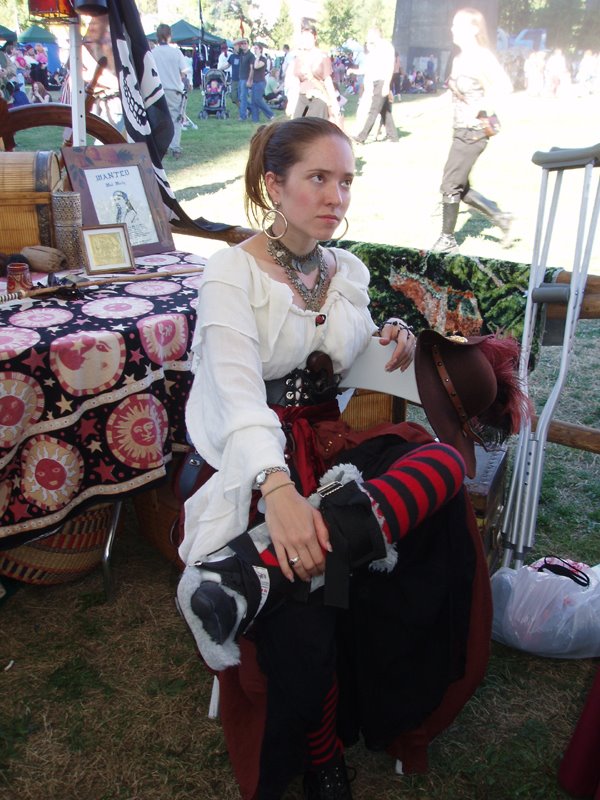
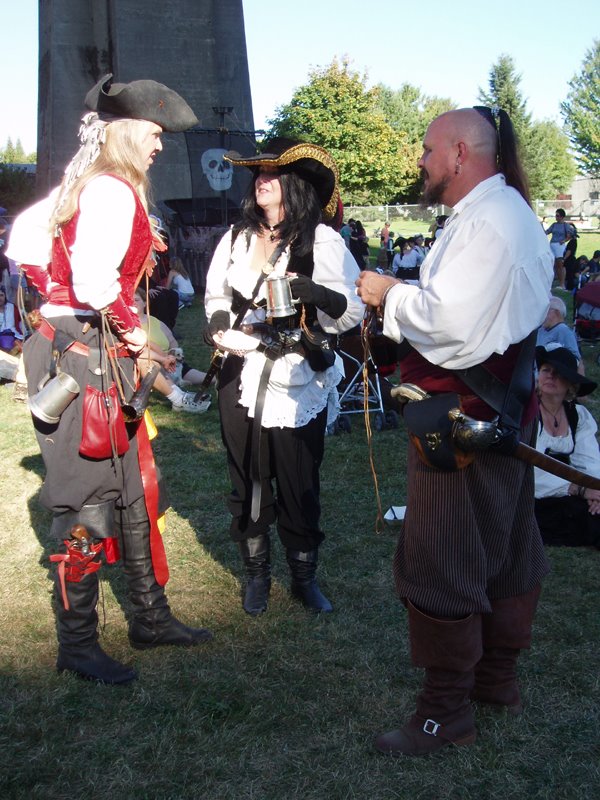
Yar!


photos by K. Urner,
w/ Olympus Stylus 500
click for larger views

Wednesday, September 20, 2006

Focal Points

I think I'll swipe the "focal points" lingo and smatter a few for the benefit of our cadres (not a word I like, right down there with comrades -- probably a translation thing).

Addressing my coworker competitors then, I have the following four focal points to propose:
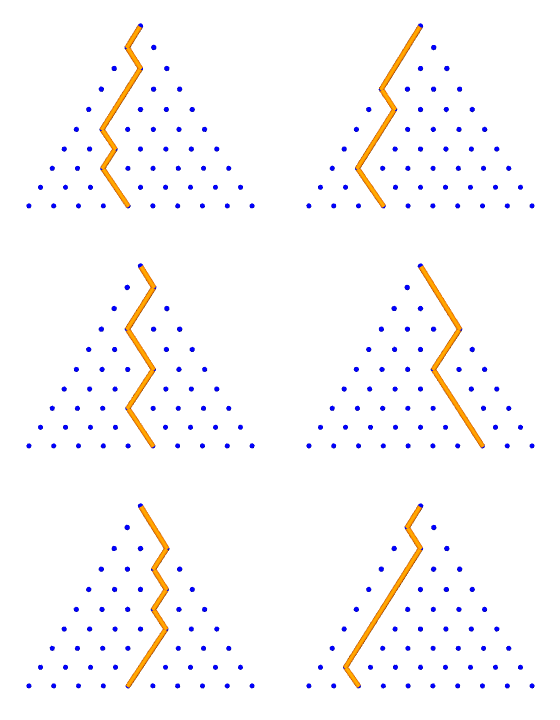
  • Pascal's Triangle, with appended ethnography, tracing it wherever we find it (like in Lost).

  • The Concentric Hierarchy (you knew that'd be here, now didn't ya?). A & B modules in other words. MITEs.

  • The NCLB Polynomial, tying algebra to geometry, with lots of connections to the art world and design science.

  • The Mandelbrot Set, perfect for learning about convergence and divergence in the complex plane (valuable in precalculus in other words).
I realize this seems to leave a lot out, but bear with me, as I'm going to explain why this constellation will help our cause -- and forgive me for choosing Python if that's not your forte (let's get with the cross-training -- I'm always polling for high quality HDTV Rubycasts (not much of a selection these days)).

:: Pascal's Triangle ::

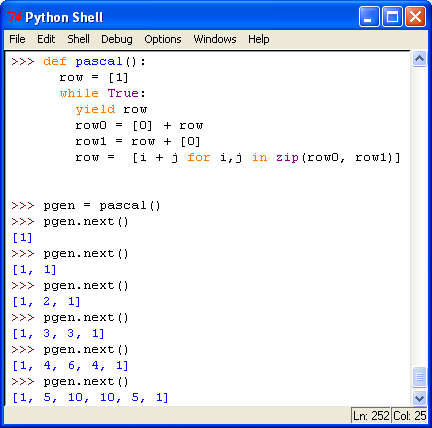
Pascal's Triangle will give us sequences, the starting point for our Python generators segment. Right after we visit Functions, we look at these "state remembering engines" that fire off cyclicly, and remember state between cycles.

Here's a Pythonic way to generate Pascal's Triangle line by line:

generating Pascal's Triangle
(also known to Chinese)

The triangular and tetrahedral numbers are column-wise side by side; our first generators in other words (a little easier than this one).

So here's our link to the cuboctahedral (aka icosahedral) growth curve i.e. to 10 * F * F + 2 (F = Frequency) -- the formula of Fuller's that H.S.M. Coxeter liked so much (provable with high school level math). Sloane's Encyclopedia of Integer Sequences becomes our friend at this point (e.g. cite A005901).

1, 12, 42, 92, 162...

:: The Concentric Hierarchy ::

The concentric hierarchy sets the stage for so much later science that we have to not postpone. This is "without further ado" material that any gnu math teacher must master.

The A and B mods themselves might come later in the intro (I teach 'em in sixth grade), but the basic nomenclature around polyhedra, plus Descartes' Deficit and Euler's V + F = E + 2 need to be there from the beginning (OK to postpone Descartes until you've gone over the Babylonian stuff i.e. 360 degrees, planar triangles having 180, tetrahedron having 720 (the deficit)).

Basically, this is our launch pad for computer graphics careers. You've got XYZ embedded (with optional Hypercross), and our unit volume Coupler right at the origin, at (0,0,0) -- or at (0,0,0,0) if using Chakovians -- thereby giving segue to our four IVMs (R.Z. Chu et al).

Yes, these are abstruse college-level topics, but they all have the Concentric Hierarchy in common (OK to say "Cosmic Hierarchy" at least among hippies). And yes, we're still working on your toon library, stocking it with goodies.

:: The NCLB Polynomial ::
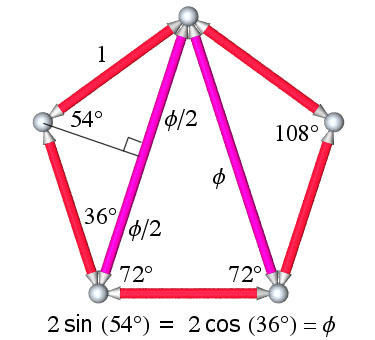
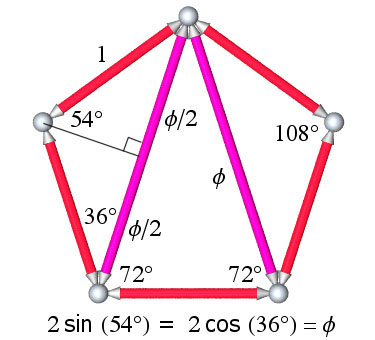
"pentagon math"

The NCLB Polynomial, a quadratic equation with two real roots, is a jump off point into both algebra and geometry. On the algebra side, we meet up with Pascal's Triangle again, and Newton's Binomial Theorem (since rediscovered by other whiz kids his age at the time).

"generating a bell curve"

On the geometry side, we get phi, which also has many interesting algebraic properties. To further tie things together, Pascal's embeds the Fibonacci Sequence (a first Python generator) which sequence converges to 1/phi as follows:

"converging to pow(phi,-1)"

From here, you could jump to any number of connected topics, including to Ramanujan's Pi Engines for more advanced generator drill and practice (e.g. consider using Python's Decimal type for extended precision, for Phi as well).

:: The Mandelbrot Set ::

Kids have a natural curiosity about fractals, as do some adults who still remember the pop art explosion, come across the great artwork on the web.

This is unabashedly eye candy, yes, but exploring the Mandelbrot Set also reinforces key concepts we want our graduates to take with them into their college experience: convergence; divergence; and the complex plane.

This is what'll make 'em ready for Calculus, which, per UCSC's Ralph Abraham's disciplined pioneering, should now probably be taught with a strong dynamical systems bias (there's a similar trend in statistics, undermining the status quo).

Once again, you can use a Python generator for your converging or diverging sequences:

"generator at c"

Tuesday, September 19, 2006

More Compositions

:: daring a candle ::


:: a coupler ::


:: low frequency bizmo ::

Monday, September 18, 2006

A Quick Account

I sampled the gym today, running in place for just 30 minutes, then whipped through a Trader Joe's in time to drop off the frozen goods (including salmon for dinner) before heading on down Division.

The new Coxeter bio arrived from Amazon, and I looked in the index for Fuller overlaps. No mention of Applewhite (part of the fullerene story). I found some juicy bits though, which I read after watching some Lost with Tara.

I can't really fault the author (to whom I apologize for earlier referring to as "he") for steering clear of Synergetics, as this is a book about H.S.M. Coxeter and his geometry, not about Bucky Fuller's philosophy, although Ludwig Wittgenstein is mentioned, even depicted (pg. 107).

Wittgenstein thought mathematicians didn't usually make strong philosophers -- true of his student Coxeter (whom he liked, plus used his room for meetings) but so what? He was a true King of Geometry and ain't that plenty?

Sunday, September 17, 2006

Sculpture (with found objects)

"some weird North American religion?"
(click for closer view)

Saturday, September 16, 2006

Edgefield: Home of the Black Rabbit

"a peaceful view"

The Water Tower

Judy, Sam, Alexia, Tara, Dawn


photos by me
and the Olympus Stylus 500

Friday, September 15, 2006

Chatting With Mom

Mom and I had an interesting conversation this morning. She was joking about her disabilities and I was exulting how sharp she was, and credited the military-industrial complex for keeping her sane. She fights it all day, tells it to disarm. Keeps her in shape.

Meanwhile, down the hall, I'm like this pro DARPA person, because when Guido was a nobody, and brilliant (now he's a somebody, still brilliant), his bold Computer Programming for Everybody manifesto attracted DoD attention. What a boon to democracy it would be, to have Americans at least (more if willing) computer literate.

Here's an article from Salon
about what happened instead: teachers actually dropped all mention of programming for the most part, and now maybe think they'll get away with blaming the PC engineers.

Sorry to disappoint
, but the freedom to download and run free languages has never been greater. If your curriculum is in trouble, don't come whining to the engineers about it. They've met you more than half way. Think of some other excuse?

That being said, we have a long way to go with improving the technology. That's why we recruit so avidly, hoping to bolster the civilian sector with high caliber talent. We need next generations to help us make life better. We're not done yet, not even close.

But where will this talent come from, if we ignore golden opportunities to educate when it matters, before they've become hardened-in-their-ways adults, possibly all Eloi, hardly a Morlock among them. That'd be bad for our time, and we don't need any "time machine" to tell us that.

So anyway, Mom and I basically agreed we're working at opposite ends of the same spectrum. I deal with dark sider tooth/fang stuff all day, while she gets to work with wise women (I'm not saying which is easier). She's glad my campaigns are going well, both HP4E and 4D.

Thursday, September 14, 2006

Merging Traffic Patterns

The painters are back, doing a smart job. We're operating on schedule.

Mom's United flight from O'Hare was late, but lets face it, this many people flying around the world is a dream come true as well, a case where futurism paid off. You'll see Amish on Catalina (I did, visiting from a cruise ship), and isn't that a blessed thing. Mom's trip originated in London. Now she's back in her office, joining in conference calls.

I drove out to PDX to retrieve her. Our curved IVM archway, protecting us from the rain while suspending two bridges, is an engineering marvel. Speaking of which (rain), that's what it's doing right now (raining). And yet the painters don't care. They like living in a rainforest (our SiliconForest is one of those too).

Dawn uses the iPod to listen to dharma talks, meaning I get to lurk in from time to time. I also have Dyxy Chyx Not Ready to Make Nice music video (a strong performance) and EBN's EBCS, now a Google Video in low rez.

Tuesday, September 12, 2006

More on Project Earthala

From earlier today, responding to some talk about what a disaster global warming might be, in real human terms:


Re: [wwwanderers] Global warming: practical approach

This is where I usually start saying biting things about Economics as a discipline, proposing that General Systems Theory (GST) is less likely to feed a collapse, because more science-savvy in so many dimensions (ergo less prone to breakdown).

But that'd be for a whole 'nuther thread.

Anyway, I do think the ongoing high price of oil will help with my horse camps in the Arizona desert, where we do these permaculture domes and pretend we're these hippie Quakers, except with Internet and flatscreens, and biodiesel dirt bikes.

Oh, and we talk about Synergetics like it was the Bible or sumthin' sometimes quoting chapter and verse -- i.e we talk like buckaneers (even eat BBQ sometimes).

Most people just visit as tourists. We're kinda cliquey sometimes.

Kirby


There's a pun lurking here, in that such ecovillage communities might likewise occur in South Africa, home to various "click languages" such as Xhosa.

As for the Project Earthala reference, I've got lots of other posts and allusions: [1][2]... [3] (some samples).

Other recent Wanderers posts focus on Chaco Canyon, and how global warming might not have been a big crisis/calamity for the people living through it back in the 1100s.

Tourist traffic tapered off and people went on to other businesses.

Civilizations, especially highly developed ones, don't always panic and fail when the climate changes. Some smoothly transform.

I also look at the case of Holland, which has a lot at stake where sea levels are concerned. I think we should fight alongside the Dutch, if their homeland is imperiled, in as smart a way as our global climate models will allow (and then some).

Saturday, September 09, 2006

Belmont Street Fair

electric car prototype, 1921

more recent specimen

proud of her dog

the happy face of downtown

Thursday, September 07, 2006

Razz

Tuesday, September 05, 2006

Investments

"privately enterprising"
(photo by K. Urner)


Obviously I consider my skills as a teacher bankable assets, and indirectly, so does my bank, in that they model me keeping an income sufficient to pay down the mortgage and maintain high "credit worthiness" (which computers keep track of).

My "earning capacity," along with my wife's (a dual-income household) allowed us to build equity in the house, typically the principal physical asset of a middle income family, next to the car and/or truck (no ATV or jet ski in our case).

Such physical assets are also principal assets of the neighborhood bank, which models average incomers as incapable of financing a home's purchase without credit, meaning a huge markup on the sticker price, but one you tend to not see unless you run the spreadsheets, and realize how good it is to be on the receiving end of exponential interest rates (where the "rich people" live, a lot of 'em bankers).

Banks get to mortage the same house multiple times, as people in varying financial straits assume title and secure financing. Homes are like DVDs in the video store, watched over and over and over again. It's a secure way to make a living, if you're in the business of loaning for homes.

Part of why LAWCAP fought Bucky so much is he derided this system of governance as somewhat pathetic, as it assumes dire straits for so many. But that's how LAWCAP tends to operate: overwhelming lack of life support is just a given. "We don't fight that state of affairs, we make money off it."

Not a popular strategy among the poor, and in a model democracy the government might take a different direction. That presents a puzzle: how to intimidate enough people into supporting the low living standards standard. You need a lot of ideology in overdrive, keeping people thinking straight and paying those mortgages.

Anyway, part of my responsibility as a stakeholder in this home (me and the bank share this asset), is to see to its upkeep. To that end, we just had some painters come by to make a bid. The "down to the wood" approach is the premium ten years guaranteed way to go, but most middle incomers not surprisingly go for the "feathered edge" (scape and power wash, but if the paint's tightly bonded, leave it be and paint over). The bid for the latter service was like $4,500 give or take, more like $11,500 for the former, with 10% off if we commit within the next three days (likely we will, after checking against other bids -- I liked their energy).

Now if I were a really good capitalist tool, I'd be using my intelligence to venture capitalize in various corporate ventures. By age 48 (my current age), I'd have a track record of having bet wisely and earned good returns. I might have lots of money, which I'd subtly advertise with various lifestyle cues, and various dependents, friendly companies (affiliates) would want to piggy-back their money on mine, i.e. let me manage their investments for them, so they could get rich the way I did.

What with a Princeton degree, no doubt some social connections, perhaps membership in one or more clubs, I could be living on easy street by now, with several homes, several cars, and a lot of satisfied (well off) customers.

However, I made a career building skills in the not-for-profit (aka public) sector, trying to think ahead the way Bucky did, anticipating new kinds of need, even new kinds of science. This is called "high risk" venture capitalizing, closer to what "crackpot inventors" seem to do. Some of them get rich, but mostly they end up remorseful, for having squandered so much energy on cold fusion or whatever.

But from my point of view, Synergetics was more of a "sure thing" in terms of its philosophical sophistication. I could see a bright future, if I only stuck to my guns, which is what I did, and I don't regret it. Now I'm this hot shot gnu math teacher, respected by my peers.

OK, gotta go now. Time to open a new bank account for my daughter. She had a summer job this year, earned some savings. Now I'd like to wire her account to a debit card and iTunes, so she can pay for her own music and video iPod downloads. She'll still get her allowance and all that, but I'd like her to consolidate and have a sense of managing her own affairs.

Back from the bank: snapped that cool bizmo on the way home (above picture).

Transaction: cheque from flextegrity.com pays for Portland Knowledge Lab's rent this month. I did some work on the web site (still very minimalist at this point).

Addendum: we also plunked down for two years of orthodonture for Tara; we like and trust Dr. Joe. Tonight: joining Wanderers on Barry's boat (Barry the banker).
Barry
Sunday, September 03, 2006

The Lost City (movie review)

We gathered for BBQ with other Friends, three married couples enjoying a warm bug-free evening in the backyard. Larry and Susan went to Hollywood Video to make a selection, and came back with this R-for-violent tale of a family torn asunder by the Cuban Revolution of 1959 (about 8 months after my birth in Chicago).

Instead of the mellow "chick magnet Che" of Motorcycle Diaries, this time it's "psycho Che" already with many friends murdered. But neither he nor Fidel get much focus in this flick. The main character is a dinner jacketed Cuban on the Meyer Lansky side of the fence.

Lansky (played by Dustin Hoffman) gives our hero the creeps mind you, but as the owner of a successful music club, he has little choice but to rub elbows with organized crime which, upon being evicted from Havana, headed straight for Las Vegas (the movie alludes to this winged migration).

The pretty girl is like a Marilyn figure, wanting to use her head like a man's, to play on the world historical stage, even if only around a rotund Russian ambassador for starters. She wants to be someone in this life, not just someone's lover or wife. I respected her courage.

But the male principal, a man of principles, was not about to share her with a revolution that, from his perspective, had utterly destroyed his own family, leaving only heartbreak and remorse in its wake. Cuba as a "saxophone free zone" really sucked (and yes, so did the Belgian Congo). New York held more promise (that statue really helps).

But then, most Cubans didn't have "New York" as an option. The film isn't really focused on the lower decks of this particular Titanic.

Dawn's O2 went out half way through. She switched tanks but forgot to dial a level, and so breathed unassisted for an hour, leading to some chest pain towards the end. She enjoyed the film but, as with V for Vendetta, was put off by the violence level.

Maybe Bill Murry is what keeps this film watchable. He breezes through as the writer-comedian, perhaps emblematic of the screenwriter's viewpoint. He pokes fun at all players, out of familiarity more than fear, like some other-worldly being. He typifies high artistry, the kind of thing these high rolling bosses really traffic in anyway (all of them seek quality).

There's a lot of theater in politics, a lot of politics in theater. This film takes a raw reality and transmutes it into something worth watching, even if oft times unpleasant to contemplate.

Saturday, September 02, 2006

Back to School

"dwelling machine rendering"
(by Andrew Owens)


"a child's workspace"
(photo by Dad)

Thursday, August 31, 2006

Mathcasting About Phi

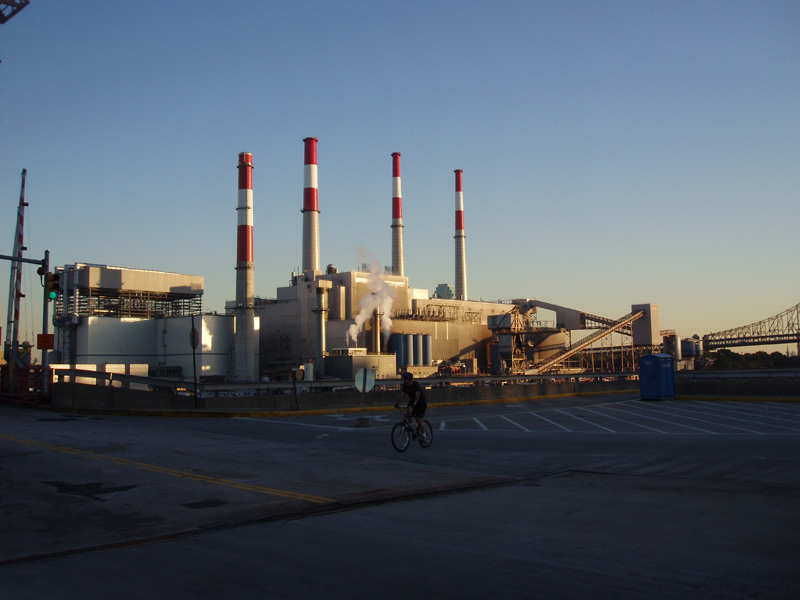
The Pentagon
Google Earth


In support of the president's NCLB initiative, I cooked up what I call the "NCLB Polynomial" over on the Math Forum. I didn't invent the polynomial itself (it's very old), but came up with the name because children should be learning about it, if wanting to keep up with their studies at all (NCLB = No Child Left Behind).

Its positive geometric solution, phi (pronounced fie or fee), is the ratio of a regular pentagon's diagonal to its edge.

A symbol dance might start with a Golden Mean derivation, with a voice saying "the smaller is to the larger as the larger is to the whole" as on screen we see: smaller:larger = larger:whole, where whole = smaller + larger.

Since it's a ratio we want, it's OK to arbitrarily set the smaller segment to 1, such that 1/L = L/(1 + L) -- L for larger. Multiplying both sides by (1+L), then L, gives (1+L) = L*L or (L*L - L - 1) = 0 (the NCLB Polynomial). The positive solution is (1 + sqrt(5))/2, which is phi.

useful trig info
ray tracing by K. Urner

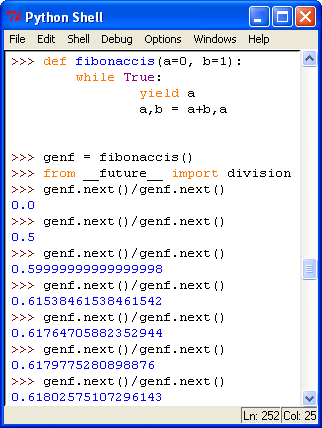
Over on edu-sig (a special interest group in the Python community), we've been looking at a Python generator for 1/phi (phi's reciprocal), using Fibonacci Numbers. A generator yields an interim value in response to a next() method, while remembering its internal variables between calls.

Fibonacci Generator
Python 2.5 on Windows XP


I'm not saying we need to pack all this information into just one mathcast. The strategy is to grow a large archive of clips, so teachers can embed them within their own presentations as they see fit.

Given Fibonacci (1170-1250) depended on Iraqi intelligence for his Liber Abacci, it'd make sense to use Baghdad as a backdrop for some of these clips. Of course many of our most talented and effective math teachers are Iraqi.

Getting off the XY plane, we get to the pentagonal dodecahedron (12 pentagonal faces, 20 vertices) and its dual, the icosahedron (20 triangular faces, 12 vertices -- and buildable from three phi rectangles).

In Synergetics, we jitterbug between the icosahedron and cuboctahedron, showing both have the same number of balls in their outer shells (1, 12, 42, 92, 162...). This connects us to the geodesic spheres and domes, crystallography, virology and hexapent chemistry (see below).

Related reading:
More About Geek TV (January, 2006)
Math Wars (continued) (March, 2006)
Brute force solutions (for phi, on edu-sig)
Ayatollah of the Tetrahedron (February, 2005)

Sunday, August 27, 2006

HP4E

Chalmers, Göteborg
site of Europython '05 and Nanotubes '05

HP4E is a play on CP4E, Guido's DARPA-funded Computer Programming for Everybody initiative (with work, we could perhaps tie these back to HCE in Finnegans Wake, but that's for some other thread). HP = HexaPent in this namespace.

It's not really work to popularize the soccerball, already high on the recognition scale. Movies like The Cup well-document its cross-cultural appeal. But once we divide the field into soccerballs (a family) and buckyballs (another family), the game gets more technical. Here are the rules:
  • Soccerball: looking over the fence from a pentagon, every neighboring lot is hexagonal; looking over the fence from a hexagon, faces alternate between pentagonal and hexagonal.
  • Buckyball: all hexagons plus 12 pentagons, such that three lots (i.e. three fenced-in areas) come together at every fence post (i.e. vertex).
I got this taxonomy from Dieter Kotschick's article, The Topology and Combinatorics of Soccer Balls, in American Scientist, Volume 94 (pg. 350) -- except I'm making "soccerball" into one word, to go with "buckyball". Dieter credits a German high school math contest for the soccerball definition, although it added a rule that the facets be regular polygons (now a topologist, Dieter doesn't need to follow that one).

The buckyball stipulation (three edges must meet at each vertex) is lifted from carbon chemistry, and is characteristic of the fullerenes, i.e. the spherical hexapent carbon cages, first discovered in the 1980s and posthumously named (Fuller died on July 1, 1983).

Appropriately, three scientists shared the Nobel Prize for buckminsterfullerene's discovery: Kroto, Smalley and Curl Junior. C60, the fullerene with 60 carbon atoms, is topologically the same as the soccerball, i.e. the two above-defined sets intersect on this already-famous member. Kotschick says this is the only element common to the two sets (i.e. is their intersection).

But carbon-based chicken wire needn't be spherical. Consider the nanotubes, capped and uncapped ("buckytubes" some call 'em). Such nanotechnology is a hotly topical area for scientific research these days. When I went to Chalmers @ Gothenburg, Sweden for EuroPython in 2005, the nanotubes conference seemed to dwarf ours in size. Our populations mingled. Lots of scientists use Python, if they do any programming.

Here in Portland, we're gearing up to work on global matrix displays, meaning hexapent fly's eyes colored with global data. Whether or not these unfold into a Fuller Projection depends on the application e.g. it's protected from spoilage by war gamers preoccupied with political border disputes. The hand-held units might just show one hexagon at a time e.g. the one you're in now. Glenn also talks about logic gates and quantum computing a lot, but more with his PSU colleagues than with the Wanderers (two sets, partially overlapping).

My focus these days is the open source community and a "gnu math" curriculum, meaning in part that I want to keep the public up to date and informed about all this interesting scientific research.

Even positive developments meet with resistence, if people don't feel a democratic process has been followed, with lots of debates and town hall meetings. "Imposing from above" is not a popular style of government, and when it comes to HP4E (or CP4E for that matter), I'd like to avoid repeating some past mistakes (we learned a lot from the New Math debacle).

That being said, there're always hold-outs unwilling for change to happen, even if those changes mean higher living standards for a majority of folks. They like the advantages the status quo gives them, and believe in some foreordained right to command more than their fair share (perhaps on the basis of some religion?).

I'm not really interested in pandering to this crowd either.

The democratic process is not synonymous with the tyranny of some minority. If they don't like our global matrix hexapents or Fly's Eye dwelling machines, they shouldn't be forced to use 'em. But nor should the rest of us be denied our preferred brands of mathematics and/or science fiction on television.

Europython conferees wandering
through a nanotubes poster session

Chalmers, 2005


photos by K. Urner

Thursday, August 24, 2006

Name Collisions

My take is the remoteness of the Synergetics vocabulary made some people nervous enough to credit Bucky with inventions he never conceived of -- although the more popular story is that he stole people's inventions (as in "pirated" them) without giving them their due.

I'm thinking of Clifford Nelson in particular. He invented some elaborate analytical apparatus involving the four planes of the tetrahedron and claimed to have found it in Bucky's corpus. But when I comb through Synergetics, I find no such Rube Goldberg contraption.

True, friends and I collaborated on Quadrays, which one might likewise liken to "4D" in some buckaneer manner (like, we've got a tetrahedron here too), but we never claimed to have found this apparatus actually lurking between the lines of Synergetics itself.

New stuff arises. Elastic Interval Geometry for example: it's not "just tensegrity". Life goes on. Snelson's model of the atom isn't "just tensegrity" either.

Had Bucky lived longer, he'd have enjoyed the collateral with us. Who knows, we might've had those ecovillages by now -- goofy parallel Universe talk, I realize, otherwise known as the subjunctive tense.

OK, now let's listen to Bucky spin it:
For example, quantum mechanics came many years after I did to employ the term spin. The physicists assured me that their use of the word did not involve any phenomena that truly spun. Spin was only a convenient word for accounting certain unique energy behaviors and investments. My use of the term was to describe a direct observation of an experimentally demonstrable, inherent spinnability and unique magnitudes of rotation of an actually spinning phenomenon whose next fractional rotations were induced by the always co-occurring, generalized, a priori, environmental conditions within which the spinnable phenomenon occurred. This was a case in which I assumed that I held a better claim to the scientific term spin. In recent years, spin is beginning to be recognized by the physicists themselves as also inadvertently identifying a conceptually spinnable phenomenon -- in fact, the same fundamental phenomenon I had identified much earlier when I first chose to use the word spin to describe that which was experimentally disclosed as being inherently spinnable. There appears to be an increasing convergence of scientific explorations in general, and of epistemology and semantics in particular, with my own evolutionary development. (250.31)
I think you'll admit, you don't hear spinning like that every day.

Related reading:
Psychology of Synergetics (January, 2000)
Synergeo #28469 (August, 2006)

Wednesday, August 23, 2006

Adventures in ToonTown

event log screen capture

We've set up a new workstation in the living room, using Toshiba + wireless peripherals, which is where I'm posting from, via http, to my blog. KTU2 is unusable for the moment -- a thread running through this tale...

We received an electric service interruption notice by USPO some days ago, a postcard, but I'd forgotten all about it.

Anyway, the battery backup kicked in, saving work on computers in the back office (but not Tara's Sims 2), Dawn switched to a tank for 02 (the oxygenator requires AC), and all was well.

Until the power came back on, just minutes later. Then, my troll of a computer decided to power down with short-to-no notice.

Lucky for Rybo. I was busy throwing chapter and verse at him, cutting and pasting from Synergetics on-line like some High Gothic Cleric, jealously guarding my Unorthodoxy (aka Synergetics.4D -- cite 527.712). I sometimes get into this mode contra the HyperCross Dogmatists, a competing school of thought (though containing many friends and relations, as well as bitter foes).

So lucky for Rybo the troll computer had a brain seizure and kicked over, per power outage, before I could hit the Send button. The irony is KTU2 got through the outage OK, on battery, and only died when the power returned. Fie, I say, fie.

Speaking of 4D, we were treated to a presentation by Nathaniel Bobbit from Eugene at the Pauling House last night. Here, I'll cut and paste his blurb from wwwanderers.org:

:: Tuesday ::
August 22 :: 7 pm

: : Nathaniel Bobbit : :
will present on why a new number system

Nathaniel Bobbitt’s groundbreaking work in lowering the acoustics of a flute by two octaves in 1993 resulted in an investigative method for modeling and notating nonlinear behaviors. Nathaniel Bobbitt continues research in direct models of higher dimensional spaces in his technology transfer center NABSLAB ::

Very eclectic this guy, and talented to boot. I encouraged him to go ahead and capture the Texas K-12 curriculum standards in one of his 4D fractals, so I could see what he's talking about. Or maybe we could make a science fiction short, in which his ideas went mainstream -- like I try to do around me, including on reality TV sometimes.

Once powered down, the Belkin battery stayed dead -- no blinkin lights. I unplugged it from the dusty maze of wires (AC, USB, phone) and hauled it to the kitchen. Just needed to hold down the little green button longer I guess -- still doesn't explain its going out in the first place (we probably sucked the battery dry in just those few minutes -- but so what, AC was back on so why didn't that register?).

So now he's reinstalled in his corner (Belkin battery with Bulldog for brains), but rebooting my troll computer (KTU2) takes like an hour, plus then I have to manually turn on various services (Control Panal | Administrative Tools), like Windows Audio and the Print Spooler.

Haven't gotten to it yet. Needed to clean a neighbor's C: drive (even though D: is like 99% free, every Windows game in the universe has this native C: fixation). Showed Harmony some stuff.

Whoah! was just about to Publish, when Toshiba here went into sudden hibernation. Unbeknownst to me, she'd been unplugged. Fortunately, hibernation actually works on this model, and no work was lost. Publishing now...

Appending from Synergeo #28435 (Rybo quoted in red):

> The metaphysical mathematics of XYZ 90 degree
> coordination are inherently associated to
> metaphysical mathematics of A, B, C, D 60 degree
> planes of a tetrahedron.

I'll meet you half way: IVM.4d == XYZ.3d

i.e. what we mean by Synergetics.4D is *close* to what others mean by HighSchoolMath.3D.

Then we go "4D++" to mean "instances of prefrequency concepts" while the 3D people say things like "reality is not 'just more dimensions'!" or something (except then they talk about kilowatts as dimensional, so go figure).

More re 4D++ ( = synergetics computer language):
http://worldgame.blogspot.com/2006/08/4d.html

Kirby
:: young Nat, NYC ::

Monday, August 21, 2006

Phenomenal Photos

disturbing bizmo on Belmont


fission or fusion?
artist unknown


photos by Kirby Urner with thanks to Trevor Blake

Sunday, August 20, 2006

Mathcast Storyboard

Structure: split pane, left/right, two realms of action, synchronized.

Format: I'd recommend targetting HDTV's 16:9 format.

Left pane: Victorian in the movies look, pulling some leather- bound volume, perhaps fiction, off the shelf (looks like some library in Borges, or maybe @ Sunnydale High, Giles standing by).

Right pane: more futuristic graphical instrumentation, showing exploded DocBook XML in an illuminated tree diagram (more like some Klingon control panel).

Action: actor on left thumbs through book, her or his focus (sometimes 1st person) flitting to pictures, across pages; while meanwhile the illumating cursor jumps around in the scrolling XML tree to the corresponding nodes.

Audio: paper shuffle, muffled reader noises (sotto voce perhaps) mixed with electronic bling.

The point of this action: record that the parts of a book may be represented in a tree structure, and encoded in human-readable, machine-parsable XML.

Curriculum objective: gradually increase a student's comfort level with XML, with previews of and forays into such markups as SVG, XHTML, MathML, DocBook, X3D plus roll-your-own XMLs (and/or SGMLs if you must).

Obviously such a storyboard could be implemented in lots of different ways, even given these stylistic stipulations (sort of "Victorian meets Vulcan"). That's OK. A storyboard is like a class template, capable of spawning any number of special case instances.

Experiment with switched panes, top/bottom etc. Keep in mind that future includers may be looking for convenient splice points inside your segment.

Friday, August 18, 2006

Master Gamer

Les with Flextegrity model

Thursday, August 17, 2006

BizMo Shopping

Showroom @ Fred's RV, near Sandy, Oregon
We drove out to Fred's on the Mt. Hood side of Sandy, Oregon, to check out the Class Bs (van body) and a few Class Cs (6 wheels), like Pleasure-Way and Kodiak. Steve steered us through the show room and to a few more in inventory. On the way out, Tara glommed on to a Tioga Montara, in-service, not for sale (she's always liked that over-the-cab feature).

Mentally, I was trying to connect to Microsoft Office, OpenOffice or whatever, seeing it on a screen in the mind's eye, wireless keyboard on some surface, and surrounded by more nautical decor (I'm put off by "grandma's kitchen kitsch" (grandma'd've liked more nautical too)). I was reminded of the time we toured Orlando timeshares and then asked about wifi. They seemed so shocked we'd be into it. Plus where would we put Dawn's oxygenator, which could run off the AC? We could envision solutions.

Anyway, I didn't bother Steve with any of these fantasies (except some talk about the oxygenator). I'm clearly a special case, and he doesn't need to know about all my language game puzzles. Still, you'd think there'd be more of a market for wireless offices on wheels already. But then, I think that about eco-villages too, and I don't see many of those out there, either (at least not on the channels Comcast lets me see).

The trip was tiring for Dawn, plus the $69-85K price tag seemed out of reach, for a life style we don't really have. I'm too young to retire, average middle class. Teaching philo/math on the road might be an honest living, but as for just making oil companies rich... I'd have to sell all my stock in BP (if I had any).

So it's back to the drawing board in a way. Tara found a 1995 Tioga and gmailed a link. Dawn is thinking maybe a Eurovan, something more volksy. She just wants some place to lie down if we drive any long distances. I'm the one with the big idea of doing teacher training in these roadshow circus environments, whole caravans of us sometimes. I'd like to get lost in a crowd of bizmos, all doing basically the same kind of thing, assisting affiliates, and maybe recruiting some new ones.

Tara liked the Tioga

Monday, August 14, 2006

Scripting a Road Show

As my wife edges into retirement, I continue nurturing the Bizmo idea. We plan to visit an RV seller this week, at least to window shop. For me, it's not just "recreational" (which is why it's a Biz-Mobile, recruiting new talent for our Silicon Forest and related ecosystems).

This idea for a road show first appeared on the Wanderers list, and on a list for community college teachers (community colleges are prime targets for this stuff).

Follow-up reading: But what about pre-calculus? (Math Forum posting); Re: The 3 R's revisited (ditto).


Gnu Math on the Road

Talking Points:

  1. GNU's not Unix: history of operating systems based on history of computing, tracing to Leibniz, through The Turk (beat Napoleon in chess), Ada & Babbage, Turing, von Neumann. Plus the idea of recursion (the acronym invokes itself).

  2. GNU vs. Linux: Linux was built on the premise of GNU. Stallman is the philosopher, Torvalds the engineer (per Revolution OS -- sometimes I screen excerpts). Both Unix and Linux (cite POSIX) were built around the premise of the Internet. Explain TCP/IP.[1]

  3. Linux vs. Windows: This is starting to get boring as the number of OSes is potentially endless, and we still haven't gotten to Apple's, though OS X is POSIX under the hood (and a lot FreeBSD, also not yet mentioned, but still quite important, to Windows too). We really need to be getting on with the story though. For homework: In the beginning was the command line by Neal Stephenson.
Now, on to the mathematics:

First Principle: It's not just about numbers. Cardinality involves labeling or pairing, then using the symbols in a system of accounting that mirrors what's going on in the field. Goats and sheep figure prominently in the cartoons. Note that we needn't order the goats (Ordinality; use of greater than, less than) in order to prove we have the same number of tokens as goats, i.e. none are missing (or some are (or maybe we have extra tokens?)).

Second principle: symmetry is important yet often broken. So we start getting "mirrors" right away: left versus right, positive versus negative, and yet the mirror image world isn't indistinguishably so. Asymmetries exist. Good example: ++ = +, but -- = + as well. Physics tells us our universe exists because of various symmetries that were broken. We might throw in a Through the Looking Glass motif, or even talk about Narnia.

Then we get into a little group theory using Vegetables in place of numbers. Vegetable Soup has a neutral element, inverses, closure, associativity and, in this case, also commutativity.

We disclose, after awhile, that our vegetable soup is built on the totatives of some modulus, and so need to quickly review concepts of prime vs. composite, relatively prime, totative, and totient. None of these are hard to present or get.

Then we do it in Python (lots of handwaving) while alluding to RSA. OK if it goes over their heads in this middle part (the throwaway segment of any lecture). This was just previewing anyway. We've got oodles of Python in moodles.

And that's about it. Students get back to their daily routine and the gnu math teacher is off down the road, on to the next assignment (control room dispatcher model).

Mostly, we just show a lot of cartoons and movie excerpts (as students are getting settled, during the talk). The promise of sticking with it (the recruiter's pitch), is that you'll be developing mission-critical computer skills, especially vis-a-vis this discipline of mathcasting, as clearly the people from our studios (our faculty) are deeply involved in the making of this stuff, not just in its superficial showcasing.

Some of the cartoons may be hypertoons (my invention), which I discuss in more detail elsewhere, e.g. @ myspace/4dstudios (see 4D Studios history blog).

Kirby

[1] If there's time, I like to show Warriors of the Net, a cartoon about TCP/IP. But there isn't always time. Gnu math teachers with multi-day gigs tend to follow behind the recruiters, to those schools choosing an alliance and subscribing to a program. Recruiters haven't the luxury to dive into content as deeply (or at least not as slowly).

Sunday, August 13, 2006

Burning Calories

On the food packages in Southern Africa, the energy contents are given in joules, not calories -- actually kilo- in both cases.

As such (food packages), the energy is traveling along vectors, from supermarket shelves through consumers (yes, they do have supermarkets in Africa -- I'm thinking of Maseru's in particular), and back to the ground.

The rate at which the food is consumed, calories burned, relates to power, i.e. energy per time interval (P = E/t). Energy itself may be expressed as action per time interval (E = hf), where action is always-angular momentum for a distance (mvd; f = frequency = 1/t, h = Planck's Constant).

Energy relates to events, which spend energy. The sun, our local big spender, lavishes energy throughout our solar system. Our planetary ecosystem "surfs the solar gradient," absorbing on some frequencies, and reflecting back what it doesn't use.

I've been learning through Wanderers about Tesla Motors and its new electric roadster, which accelerates quickly (lots of power). Where will the energy come from, to charge its batteries?

Initially, there won't be enough "Teslamobiles" in circulation to challenge grid capacity, but the state of the grid is something to always consider, starting in elementary school.

This morning, I'm up early to check my tires, plus otherwise get pumped for Bridge Pedal, an annual energy event in our town, catering especially to cyclists.

All 10 bridges are closed to cars, or at least some lanes or decks are reserved for cyclists and peds only, for a few hours. A couple of our bridges, Marquam and Fremont, have two decks for cars 'n trucks, one atop the other (The Steel has a lower deck just for trains and peds, with light rail and cars crossing up top).

I'll be burning a fair number of joules in a hurry this morning (I'm supposed to start around 7 AM), a measure of this 1958 body's power output abilities. I'll be on TinkerBell of course, a somewhat chunky hybrid (part mountain, part touring) that fits my large frame and somewhat prominent belly.

I'll finish this post later, and chronicle how it all went.

Later:

OK, not the energy events I'd planned. Time for a confession: TinkerBell and I have a somewhat unprofessional relationship. Yes, I can change her tubes, but only clumsily. So when the rear valve decided "no longer my problem to hold back the air" (OO: I am a valve, what do I say?), I stuck in a new tube, but then overinflated it at the 76, and then POW! I literally blew it.

I don't regret the donation to charity (Bridge Pedal is not a free event), but I'm sorry about the missed workout. The new iPod should help with that (podcasts on the treadmill). Shapewise, I'm lagging the president, look more like the veep (which probably explains the antipathy).

Maybe next year then, Insha'Allah.