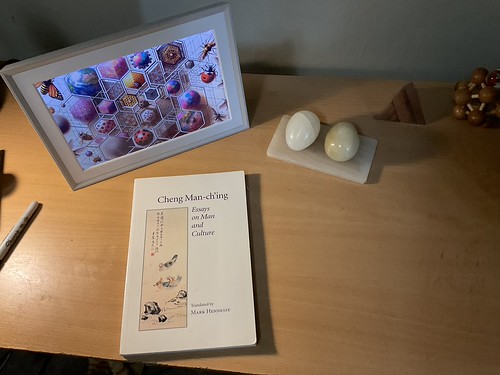
Wednesday, November 11, 2026

Dymaxion Kitchens

Dymaxion Kitchen

Given my obsession with having high schoolers learn cooking by making their own cooking shows ("as seen on TV"), it's not surprising that the next question is "what kitchen?". 

Are urban high schools set up to let the students operate the cafeteria? Of course not. Paid pros do the kitchen work, considered extracurricular from the designers' standpoint.

 
Dymaxion House

However, per Project Earthala, and drawing from my experience with (a) gatherings of young Friends and (b) Food not Bombs, I'm used to the idea that the kitchen is center stage, where the action is, the logistics on both ends, time-wise, meaning trucking the food to the prep site and then, serving the food. The final stage is likewise critical: clean-up. The kitchen should be made spic-n-span for the next scheduled event.

So in this cooking show we may be showing off new kinds of appliances, along with workflows and recipes that seem exotic and esoteric to the viewing audience. Each campus village is its own subculture of partially overlapping subcultures.
 
Dymaxion House Interior

If you're one of the teachers, maybe on the fooding side, maybe on the video production side, you'll be looked to to provide context. The "kitchen debate" is an event in history to hearken back to because (a) it's about competition in livingry (not killingry) and (b) because of the Moscow dome.

 
Manga Views

Monday, November 09, 2026

Cartographic Studies

Curated Dymaxion Projection

The documentation around the H3 global grid system is explicit about the Dymaxion Projection being an influence, on the placement of the 12 pentagons most specifically. I'd say hexapent tilings have been a contemporary standard for some time now. Even ESRI has had a Dymaxion Projection option, even if it's rarely touted.

The projection method underlying H3 is not identical with the algorithm Shoji Sadao used, is my understanding. The Dymaxion is not orthognomic. Bob Gray did a paper comparing the Fuller team's projection method with the others.

One would think though, that having the Dymaxion as a dashboard starting point, with H3 superimposed, would be typical of any world game setup. So far though, I haven't found this implemented anywhere. I've used Perplexity to do an initial sweep.

Including a Fuller (Dymaxion) Projection in the classroom, as one of the exhibited artifacts, would tend to brand a school as Fuller-friendly, which most are not these days. 

There's likely some concern that displaying the map would foster student curiosity regarding the alternative geometry for which Fuller is most famous and for which he received a Medal of Freedom. This American heritage has been effectively marginalized by LAWCAP, which controls the so-called "public" schools in this post-USA chapter.

Screen Shot 2026-11-09 at 1.15.21 PM

Friday, November 06, 2026

Visiting Faculty

Quinton Prologs

A theme in these blogs of mine is me hosting visiting faculty, which doesn't necessarily mean I put them up at Blue House. Sometimes that's how it works out, but I have limited accommodations. In this case we have a party of four and an AirBnB is involved. I was not expected to do any airport pickup at PDX this time either.

Given our shared background in computer stuff, our talk turned to FoxPro's having asynchronous event loop handling long before Python, as well as superior GUI design tools, more like Microsoft's other "Visual" products, especially Visual Basic (VB) and the full Office suite which eventually included Access. 

Microsoft Access was an ambitious project to make VB the de facto cube farm standard in the corporate Windows-colonized sector. FoxPro, originally design outside of Microsoft, as a competitor to dBase (where I come into the picture, as humble dBase programmer at Project Vote). 

dBase was bought by Borland as Microsoft thought xBase (the generic name for the dBase language) probably had a bright future, hence the strategic move to bring FoxPro inhouse and turn it into Visual FoxPro (VFP), of which I became a master (given pre-existing dBase fluency).

Project Vote, in case you're wondering, was a 501(c)(3) that carefully stayed nonpartisan even as it did outreach to specific demographic groups, mainly those disenfranchised by the pay-to-play pseudo-democracy kept alive by GRUNCH engineers. The legitimacy of the District's rule to some extent depended on people buying in, so even billionaires might see a reason to help us get more eligible voters, first through registration, and then through voter turnout (registering and exercising one's right are separate acts).

That Project Vote chapter was way back during the Reagan-Mondale race, with president Reagan winning a second term. I left the District after that, my housing having been work-related, and took up a position in a major publishing house, again leveraging my skill set as computer science savvy, and curriculum aware, having been a high school teacher since finishing my BA at Princeton (philosophy focused).

My involvement with Python came later, after years working with VFP around Greater Portland, both for state and regional governments and for NGOs, as a consultant. I was at first fielded (to clients) by the Center for Urban Education (CUE), then by Ecumenical Ministries of Oregon (EMO), then by Dawn Wicca and Associates (DWA), the partnership my future wife and I set up. Dawn was a skill bookkeeper and knew how to run our business, as well as take on fund accounting clients (nonprofits mostly). I took out the DBA of 4D Solutions and continued with the xBase programming.

Through CUE, I got into working for a vast enterprise, Sisters of Providence, or the Providence System however it currently brands. My boss, David Lansky, with a data science skill set, got me helping out with the Medical Data Research Corporation (MDRC) coding FORTRAN at first, and then Visual FoxPro, as I gradually introduced them to its benefits, and advantages over tools like Access. But Providence had a difficult hybrid environment where my applications (CLAIR and CORIS) had elaborate interfaces to other products. Yet I was merely a consultant, not a Providence employee. The ecosystem was therefore fragile even before Microsoft pulled the plug on Visual FoxPro in 2015, I was starting to see the writing on the wall.

Anyway, enough about me and my somewhat boring career compared to a lot of other people's careers that I know about. The visiting professor works with very high voltages, amps too, with a whole team of graduate students. We'll probably further engage in grid talk during the visit, although this visit is not just about talking shop. 

Today I was working with the banks I transact through to get a payment ready to the City of Portland. It's that time of year, when we're expected to give back. I still do work as a consultant but since switching to Python teaching from VFP custom applications design, I've been mostly teaching people out-of-area. I was doing this well before Covid. Right before covid though, or as the pandemic came on, I was working with a startup focused on new curriculum implementation, reminding me of work at the publishing house in New York, after the Project Vote experience. 

I consider myself a curriculum designer, and have lots of experience to back that up, including as a code school faculty member with O'Reilly for some years. I go into all that in more detail in these blogs and in my photostream on Flickr.

Tuesday, November 03, 2026

A Friend

Sydney Observes

Fortunately for Sydney's longevity, I'm supposing (I'm not a vet), she suffers from LDS (Lonely Dog Syndrome) meaning when I'm working out on the elliptical, a present from Betty Boop's grandson, she sees fit to struggle up the stairs to join me, even though she's an octogenarian in dog years. 

Actually, if we go by 1 human year = 7 dog years, she's 105 years of age. Yet still climbing stairs to my 2nd floor. I'm almost 10 in dog years. Sydney is a role model. I hope to be as fit as she is in five (dog) years. Actually it's my pet ball python that may outlive me, provided he gets good healthcare.

Monday, November 02, 2026

Climate Change

Climate Change

The huboons continue blasting apart their own infrastructure, frustrated by the impasse they've reached with their perimeter zone nation-state-based jurisdictional narratives. 

World Game is chaotic. The cost of still thinking inside the box is high. Still clinging to old ways, the oldsters hang on tightly. Skeptical youngsters wonder if there’s a better way to play.

Friday, October 30, 2026

Friendly Skies

Flying High with UA

Derivation of the UA Logo

Tuesday, October 27, 2026

Synergetics People

IMG_6245

One of the Synergetics People in our Coda had the honor of meeting Arthur Young, who helped give this younger guy a challenge and some direction: decipher Synergetics. Young had Fuller’s opus on his shelf. Like many operating in the absence of much secondary literature, he was hoping he could help us make some.

Fast foward and we’re doing a lot better where secondary literature is concerned, but we’re still weak in the animation department. Having just seen some state of the art claymation, I’m even more acutely aware of how we missed the boat with the A and B modules, the T and E modules, and the S. But like in the Pudget Sound ferry system, there’s always a next boat.

The A module is such a simple dimple concept, and has everything to do with how I implement my quadray coordinates. The 2nd root of 6 over 4 appears in Synergetics, as do a lot of mathematical expressions. 

One might suppose that a guru of the positivist futurist variety would be inspiring to would be geeks, and you’d be right. But when does anyone hear about A and B modules in elementary, middle or high school. After that, it’s prolly too late. 

One might conclude that “positive futurism” is inconsistent with a major brand of “I told you so” economics, with its self-fulfilling prophecies. Hyperstitiion they call it: the craft of making things be so. Economics is called the dismal science for a reason. To stay dismal, one needs gravitas. Short of that, one becomes merely an Eeyore, the moody donkey in Winnie the Pooh books, a burdened White Man.

Searching up Arthur Young with the gossip bot got me to thinking: could his Theory of Process connect to Arnold Mindell’s Process Work? 

I also found along the way, researching Arthur Young, that Igor Sikorsky (1889–1972), another helicopter designer, had likewise wandered off into Christo-spiritual ruminations. Could it be that smart engineers gravitate to metaphysics? Who woulda thunk it. And then there’s Wittgenstein. His first sense of a calling took him into engineering.

Quoting the bot;

Engineering to logic

The historical sequence is especially striking: while still at Manchester, the foundational issues raised by mathematics began to take hold of him. He then sought out Gottlob Frege, who directed him to Cambridge and Bertrand Russell; by 1911 he had effectively left engineering for logic and philosophy.ww1.manchester+1

It is sensible to see a continuity, not merely a biographical accident: early aeronautical research required using models, formal constraints, and relations between a physical system and its representation. Scholars have argued that this supplied an intellectual background for the Tractatus’s “picture theory,” according to which propositions model possible states of affairs—although that claimed causal connection remains an interpretation, not an established fact.direct.mit+1

The important distinction is therefore: Arthur Young designed an actual Bell helicopter; Wittgenstein investigated a propeller-tip-jet aircraft engine, a principle later reused in some rotorcraft. How do you think Wittgenstein’s engineering concern with a model representing a real mechanism might have predisposed him to make logic about propositions “picturing” reality?

Sunday, October 25, 2026

Road Trip

Road Trip!

IMG_5557

Wednesday, October 21, 2026

More About Cooking

Serious Kitchen

I was talking about Home Economics (microeconomics) and expanding that to Community Economics or call it Campus or Base Economics if you prefer. There’s a base kitchen supplied from base inventory and we make cooking shows while making recipes (following algorithms) for base personnel.

The tie-in is to First Person Physics which means doing chemistry n stuff, and cooking is nothing if not chemistry in action. We pay special attention to phase changes between the solid, liquid and gaseous forms of substances, with words for those transitions: freeze, melt, boil, condense. Bake. We have appliances to help us with all of these.

Then of course, in addition to the thermodynamics involved, we the obvious tie-in with metabolism. Food and drink is for eating and imbibing. We also inhale. Lets and hearing and smelling while we’re at it. And presentation.

In metabolic science, the chemistry gets intense, as we learn about the acids, the enzymes, the sequence of steps involved in processing whatever inputs. Cooking takes us in every direction, from micro to macro. Electricity powers the appliances, plus is generated biologically within tissues. Chemistry is electronics after all, given the role electrons play.

A next bridge is to food pods and the food trucks industry. All those skills get this new context of the food pod, which may come with some form of crypto or token for currency. Various technologies for recording transactions means “home ec” meets fintech. Simulations, as in computer games or training / rehearsal setups go here. The cast needs opportunities to practice roleplaying. Cooking is theater with a lotta props, some of them edible.

Tuesday, October 20, 2026

Cooking Class

Inventory (HAVE)

Let’s get back to some older themes in these blogs, from years ago. 

The action of following a recipe, or improvising while being influenced, relates to our computer science idea of an algorithm, a step by step procedure which, if spelled out in enough detail (whatever that means) in a translatable language (to ones and zeros prolly), will then run on a computer or other hardware.

I wasn’t just bringing forward the original Home Economics though. We’ve all grown up seeing cooking shows, meaning a cooking class is an opportunity to learn about camera work, editing, scripting, scene design. 

Schools share their best shows with a public, with raw material saved to school servers, perhaps on a temporary basis. 

Given the computer science, we’re also looking at queues, workflows, parallel processing (or asynchronous as the case may be).

Finally, we’re not just learning to cook for a nuclear family necessarily. The amounts and equipment involved may be on a more institutional scale, with a cafeteria style aspect, even of short order cooking is also supported. This course is not just for grooming stay-at-home moms, as may have been once envisioned by curriculum developers in bygone years.

Once cooking has become a focus, as well as ordering and provisioning, keeping track of costs and inventory, it’s a small step to exploring cuisines. Students learn to cook across ethnic spectra, exploring fusions, synergetic combos. Cooking is not just about imitating one’s ancestors, but nor is it about forgetting what’s known to work.

My work with Food Not Bombs was influential on my thinking here. We’d have to improvise based on what the warehouses had in excess that day, mixed with staples (dry goods we almost always had on hand). Cooks from fancy restaurants might sometimes volunteer, because they liked the challenge, of making up yummy meals for larger groups, namely those who knew which city park to visit when.

Another influence: The Gathering of Western Young Friends, which was frequented by foodies who’d truck stuff in and take over the camp’s kitchen. They’d seek out camps where such arrangements could be made, to serve ourselves versus buying into some meal plan. Camp Myrtlewood allowed this.

Sunday, October 18, 2026

Musk (movie review)

Fall Term

Since I’ve been a student of the Mark Fisher corpus to some degree, I saw this film in terms of competing futurisms, inside of which futurisms the actual artifacts (the inventions) are more like glacier-borne boulders. The glaciers are more currents in the zeitgeist than physical. We encounter these currents through the boulders and the trajectories of these inertial bodies (picture a Tesla car in orbit, and how it got there).

The film focuses on how life imitates art and vice versa: the interplay of fiction, in the form of manga, comics, and the roles we assume. The North Americans are greatly into the business tycoon role model, going back to railroad days and before. The ideology of privatization, and crediting individuals over any collective unconscious and/or sprawling bureaucracy (cube farm network) is likewise ingrained, with Khans and Kings, a few Queens, getting the lion’s share of the credit for what happens in history (“the” consensus story, of which we have many).

No hyperloop in this film. And yet hyperloop evolved from the Boring company, and the idea of fixing traffic congestion by taking the maze ways underground. The subsequent Vegas tunnel loop also fell to the cutting room floor, along with the many academic competitions around making a pneumatic tunneling system (ala hyperloop) designed to carry biological payloads (humans and their entourage of fellow traveler animals). 

The boulders (artifacts) the four hour movie manages to keep: X (public speech mixing valves; also X part 2: the Department of Government Efficiency), SpaceX (rockets and satellites), xAI (Grok: the collective unconscious again), and Tesla (cars and trucks), and “the wives” (aka “the harem” or “the breeders”). The Khans had a lotta wives too.

Back to Mark Fisher, the Anglo philosopher: he focuses on our longing (desire) and its frustration (leading to fear). How our dreams for the future get frustrated is a source of fear and fascination. How do they do that? How do they manage to subvert our visions?

Our genius for projection (model making) has us conjuring enemies we might tune in and address, the face of capitalism chief among them, but faceless socialism likewise for some. 

Seeing evil and being the hero up against it, is the human condition, Joesph Campbell might agree. 

Being pro-Musk (a fan) or anti-Musk (a critic) both qualify as heroic roles against the backdrop of wanting to make this (the world or worlds) a better place.

Is history best understood through personalities and their psychoanalysis? 

In my own thinking, I’ve somewhat shifted away from reducing anything to the one person, which isn’t to diss individuality, only to expand it to include a sense of a bigger or smaller (transcendent) self. Does one’s sense of an ego increase or decrease by that process of identification? Is one steering or steered?

Individuals motivated by a sense of destiny and/or fate are themselves more boulders (tangible personalities) in the zeitgeist, or maybe “bulls in the china shop” as many of us (me included) see business tyrant-tycoons more generally.

The director’s storyline hints at some dark plot lines we never fully see fleshed out, because they’re not fleshed out in the real world (at least not yet). Like what’s this coming civil war exactly? Our party of moviegoers (there were five of us) were all asking that question, a question the movie asks us to ask.

The movie hints darkly that at least from Grok’s Pentagon-embedded point of view (as “Mecha-Hitler”) the coming civil war is likely to be a race war of some kind, a war wherein “race” (a eugenicist concept) and “ethnicity” (a term from cultural anthropology) remain hopelessly confused, as these tend to be by many ethnicities, including by many ethno-racist types in South Africa. 

And like what exactly is the role of Starlink when it comes to the war in the borderlands, the Ukraine? Is Elon secretly or even openly a Putinist? We’ve all been warned of Trump’s proclivities in that regard. Don’t billionaires tend to see Putin was one of them; a fellow business tycoon authoritarian, a Bill Browder type? Isn’t Silicon Valley part of this neofascist post USA, this USSA?

I’m probably more of an Adam Curtis fan when it comes to sweep-of-history documentary political commentaries. This is the first Alex Gibney film I’ve taken in, I’m pretty sure [sic]. I’d like to see his one on Scientology, Going Clear. Oh wait, I’ve seen that, and blogged a review.

Curtis tends to focus more on the currents and less on the boulders, leading to a more cerebral experience and avoiding the demonization of singular neurodivergent individuals (outliers, outlaws, autists). What happens to us as a species does not all fall on the shoulders of specific Atlas types who bear the burden and responsibility. Spectators, the viewer-voyeurs, make the world go around, by lending their momentum-adding attention. I like to spread the blame (the credit) a lot more, vs lionizing this or that alpha-beta.

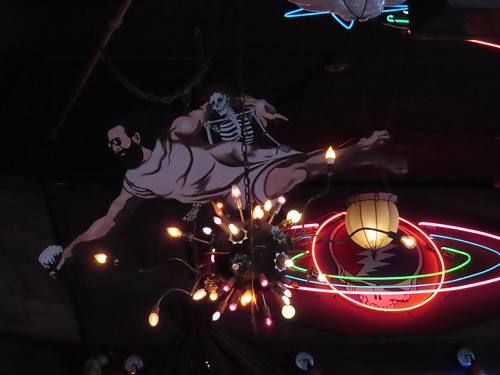
I was with my group of Wanderers, including a jovial visiting astronomer from Idaho, wearing my colorful J. Garcia tie, a Python sweater, and toting a burlap tote bag. I started out in the Egyptian coffee shop (double shot Americano) kitty-corner from The Bagdad, then took the 14 bus to lunch at the Barley Mill (meeting Richard), the first McMenamins brewpub (by now a major chain) and still center of Grateful Dead iconography.

We went from there (SE 17th and Hawthorne) on foot through the Asylum food cart area in sightseer mode (no further purchases this time), checking out the Lucky Lab (same mode) and an artist Steve Dehlinger’s open house, and over the Hawthorne Bridge, and through the No Kings throng (inflated frog costumes). I’d been to a satellite honk ‘n wave protest  earlier in the shadow of the Hawthorne Theater, after the Egyptian coffee shop. 

After the movie, our group found its way to The Flock, an indoor Asian-themed foodery, which is likewise very Portland (a first city in Asia, culturally speaking, going west), with no pun intended regarding face-recognizing cameras.

During times alone on this circuit (like when at the Egyptian coffee shop or on the FX2 bus back), I’d continue reading Meat Puppets by Hannah Smart (which I’m much enjoying).

J Garcia

Barley Mill

Friday, October 16, 2026

The Falcon and the Snowman (movie review)

MMU Vehicle

This one reminded me of the far more obscure Iron Curtain, which I’d picked out at random from MMU stacks. Both feature the spy novel trope of a Russian embassy, trying to make its way in the world (this time in Mexico), as it’s beset by weirdos who can’t resist roping them in to some spooky melodrama, pushing secrets and other adult material.

The Snowman is the pusher. He’s very pushy. And why not? He gets rewarded for it. He’s like guinea pig S (thinking of B). He burns through a lifetime of luxury living in a brief snort of time. 

The Falcon (another young white-n-nerdy guy, about the same age) has a literal pet falcon, which also symbolizes his freedom, which he has to give up (let go of) as the price of defending Australians from the machinations in the backrooms. That comes as a climax in the film, when he’s a man on the run.

The USSR embassy in question is in Mexico, and we’re thinking L.H. Oswald likely went there much like this Snowman character. Falcon and Snowman are friends going back (both altar boys), although the former’s parents try hard to extract their son from the latter’s drug dealing (pushing) reality (lifestyle). 

The Falcon’s dad is retired FBI and he’s able to provide a cushy make-me-proud path for his son, if only his son shapes himself accordingly, in the image of the dad (or call it patriarchy, pretty standard).

I liked how the novelist and screenwriters collage the satellites, the communications rooms, the excessive drinking, with the intel world. 

Having been in such communications rooms myself (I’m thinking of a specific embassy) I can confirm there’s some realism swirled in. I also liked that our young protagonist is bombarded with strong views and attitudes by his coworkers, all of whom feel free to speak their minds, especially when under the influence.

The funniest part was the inspection by the NSA agent. The CIA is known to be sloppy and full of rogue ne’er-do-wells,  whereas the NSA is the adult in the room. The suspense is high as the guy probes the shredded papers. Does he miss the hidden alcohol or does he predict and expect that it’s there (?), cuz every communications room is a carbon copy, ad infinitum in the backrooms. 

The Falcon, on the other hand, has more to lose, should the NSA guy discover he’s a spy for the Soviets. But every comm room has its Soviet spy, par for the course. 

That’s why Project Pyramid is always being photographed and sent to them (the Russian baddies, Boris and Natasha); they likely get a thousand scans a day from the thousand Falcons defending a someplace (an erehwon), if not Australia.

I did wonder why were labor unions, the target for CIA infiltration (the Falcon intercepts a misdirected communication sent by a more advanced drinker in another comm room), were what this middle-class-with-well-off-parents guy felt especially protective towards. Not that he’d be anti-union necessarily, but why choose that particular hill to die on? And who, on average, cares that much about Australia? The Aussies would get their revenge in a future chapter (thinking Rupert). 

The screenplay endeavors to answer that question: he’s in friendly competition with the Snowman to show off who is more the good Catholic kid, under it all, in the eyes of God. Meaning they both wanna be heroes, but with so much at stake, other challenges obtrude, such as paranoia. Pretty soon, even the stuffed owl is listening to your conversations.

Speaking of Eve listening in on Bob and Alice (a pattern): I enjoyed the flashback to dial phones and needing to leave the one receiver off the hook (to not hang up) then picking up in another room. If the first phone is left off the hook, there’s an opportunity for Eve to listen in. This pattern also repeats across households; families living together in intimate circumstances usually have trouble keeping secrets from one another, although full disclosure is not what usually happens either (much is left to the imagination). 

“Everything coming out in the wash” usually mostly happens, and melodramatically at that, in the movies.

The Falcon character reminded me of another middle class Catholic Republican, Brian S. Willson who believed everything his subculture believed was true, then experienced profound disillusionment. Brian is a Viet Vet who also paid a high price and now lives in Nicaragua. That guy didn’t have the same access to state secrets though, and had resorted to more ordinary labor-union-like protests and civil disobedience.

Tuesday, October 13, 2026

Electronic Tunneling

The Alleyway
:: the alleyway ::

This Fall Term I’ve been diving into stuff I might’ve read had I stayed on the philosophy track outta Princeton, vs switching to a life in the “real world” in Jersey City, where The Joker was later made (they shot Bruce Wayne’s parents getting shot in an alleyway I’d frequent, next to the Loew’s theater on Journal Square).

What “stuff” is that, that I might’ve read? A well-trodden philo path is Kant → Hegel → Marx, but then the French swapped out Hegel for Nietzsche and injected psychoanalysis into the mix, replacing Freud with Lacan and then going off the deep end with Deleuze-Guattari. That’s the rabbit hole I’ve been going down, with tools I didn’t have in the 1980s: YouTube and LLMs.

What actually happened is upon leaving Princeton I got swept up in the est stuff, Centers Network, NYC, which Dr. Kaufmann had said was interesting (he mentions est in one of his books), and it turned out Werner Erhard was following Buckminster Fuller, so I decided to look into that corpus more. As a math teacher (high school level), I found much in Synergetics (two volumes) to be valuable and useful to me (and the philosophy was pragmatic — the EPCOT buckyball, Spaceship Earth, was being built at the time).

Fast forward and I’m co-developing Cascadian Pragmatism, from Blake to Bucky, meaning we’ve absorbed William Blake’s own mythopoetic type of psychoanalysis (Swedenborg-informed) into the picture as an alternative to say Lacan’s. Kant → Swedenborg → Blake is an alternative lineage.

Bucky respected the difference Freud made in opening our minds to the invisible (the unconscious), outside the five sense, and admitted to a “subconscious demon” derailing / delaying his own holy grail quest in Synergetics, for a volume five in his pantheon.

The main benefit I’m getting from the recent epistemic foraging is I’m getting to map more “tunnels” (rabbit holes become tunnels) twixt Mark Fisher (Anglophone philo guy) and the continental stuff (postmodernism). I’m also getting more of a handle on David Foster Wallace, although admittedly that’s slow going. I just got Hannah Smart’s novel in the mail, Meat Puppets. She’s gonna be one of my guides on that score, as another YouTube influencer.

Friday, October 09, 2026

Fall Term Wandering

Bus Reading

My mission today: visit the Lost and Found window in the foyer of TriMet headquarters on SE 17th and Holgate. I took FX2 and Orange Line, following some fare checkers into the building. 

No dice on the helmet. I’d taken my clone helmet with me to show what to look for. I also took a Wanderers’ bag with a hair brush and Chinese wisdom (I’ll shoot the cover for my thumbnail).

Back in the control tower, as one might characterize any office, I was providing a runway / landing strip for a next guest (yes, metaphorically), while also coordinating with an AirBnB family expected in November. Not my AirBnB — my wife and I were not in that line of work, although we did check out time share, briefly, when in Orlando that time (how we got into EPCOT). No WiFi (those units) so we didn’t opt in.

I returned by the same two train and bus routes, with my active point and shoot camera, this time the Lumix, which I’ve been giving a rest, as I favor the Canon with it’s 40x zoom and flip screen. 

I have a backup Lumix from that time I thought I’d lost my only one (when tripping on some stones, in the dark). I procured it over eBay, then found I’d left the original one at Glenn’s, so now I had two. Then the Canon came along, a veteran of a whirlwind trip to Turkey and Egypt and places.

Are we still allowed to say “Turkey” or is is that like saying “Peking”: an antiquated spelling? I recall in high school, correcting our expat (USA) geography teacher, or was she an English teacher, when she said “Ceylon” instead of “Sri Lanka” (she gave me those dagger eyes). 

Now here I am, in my dotage, sounding all antiquarian about stuff. Next thing you know, I’ll be talking about Yugoslavia. 

Fall Term is chugging along. We kicked it off with the customary Wanderer’s gathering, me newly back from LA, and then I took off for a Cascadian tour, visiting the Smith Rock area and then Springfield, of Homer Simpson fame. We came back along I-5 (“we” being me n the dog). Had I more time, I could envision reversing my most recent coastal loop and heading up the Newport and Lincoln City that way.

Speaking of Lincoln City, last I checked in on Lincoln County, they were waiting to hear in writing from the hated Feds that they’d not be sending the ICE gestapo again for any reason. 

The first time, ICE had seized the helicopter base used to save lives at sea, for its own use, relegating the coast guard helicopter to some limbo. That angered people up and down the coast, who valued those lives being saved, more than anything ICE could do with the same resources, so they rose up and drove out the invaders. Now they’re hoping to sign a treaty of sorts, although local lawmen use different terminology. Whatever it takes to keep those bozos from coming back.

The plan here is to stay low income because I model the average World Game player who may nevertheless have access to public wealth, much as the military socialists have, when it comes to their weaponry junkyards (our shoptalk for em). You’re allowed to burn a lot of fuel in a day, flying one of those jets, without having to use your own bank account. 

Likewise with my bizmo fleet: they’re not mine, those nomadic camper-office vans, not purchased as a result of my supposedly vast income as a private sector bizmo mogul. That way, my faculty will consist mainly of ordinary joes like me, rich in what we share, in terms of access, which are more ends than means. 

Money is more a means to those ends, especially when sampling a lifestyle without wanting or being able to buy into it too completely. You want a taste.

In contrast, the navy sailors who crew those socially-owned ships (the ones “we the people” own, the one’s that the sail in the peoples’ name) are not oligarchs usually. They’re not limited liability shareholders with stock in their vessel. Indeed, their liability may be much higher than that, depending on the mission they’re sent on. If their ship goes down, they might too, although we’d expect those ships to have escape pods.

Is an astronaut a billionaire? Not likely, if a professional. A dilettante astronaut-for-a-day (or days) guy might be a billionaire, as that’s what it takes to buy the privilege, versus approaching it as an engineering practice. How do people with so little money get to play around with the LHC at CERN? By being atomic scientists, not by having fatso bank accounts.

Monday, October 05, 2026

Deterritorialization

Deterritorialization
re-readying a field

De- and Re- Territorialization
de- re- territorialization via the liminal space vestibule (line of flight)

Namespace Key:

Friday, October 02, 2026

Tractor Math

CropCircle Tractor ASCII Output

Y’all might not be familiar with my Tractors-based approach to learning Python, a portal to computer science more generally.

We start with an XY grid of addresses, called a Field, and the tractors traverse said field in a raster pattern, perhaps planting (storing) Unicode characters (or the ASCII subset) as they go. 

A real tractor wouldn’t drop off the end of a row and reappear at the start of the next, such as when reading horizontally and always starting at one end (or the other). 

In contrast, some examples of Etruscan writing show the letters marching in a zigzag pattern, reversing direction and coming back. Boustrophedon.

← ← ← ← ← ←   usual Etruscan direction

← ← ← ← ← ←

→ → → → → →   boustrophedon: alternate-line direction

Today and yesterday I was working with a real tractor, diesel powered, pulling a disc mower getting its torque, its high powered spin, from a rotating shaft designed into the tractor itself. 

The pull-behind spinning disc in a protective metal hull, is raised and lowered by a control lever at the driver’s right. I had it set to about level 3, pretty close to the ground. This John Deere tractor has cruise control. I’d set it and devote my attention to steering the thing.

I found myself doing neither a side-to-side reading pattern nor a boustrophedon pattern, but rather a surface spiral as I mowed a rectangular or other polygonal patch by shaving the outer edge, progressively reducing the surface area of the as yet un-mowed portion.

A tractor doesn’t turn on a dime, even though it has a tighter turning radius than most cars. A more experienced mower would likely avoid as many tight turns. I had several hours to contemplate the First Person Physics of it all and I believe gradually improved my performance. 

I got some tips from the owner of course. He was doing the same thing I was, but with a bigger tractor and mower combo.

I’ve been to this Willamette Valley farm, near the McKenzie (a feeder river) on previous occasions, and have engaged in a wide variety of activities as a “token” farmhand. Our joke this time was that if I do  enough hours I can take it to the next level and add the suffix “bob” to my name, as in Kirby-bob. 

Picture some guy in bib overalls with a straw hat maybe. I had sunglasses and suspenders, looking the part. The owner already goes by Jimmy-bob at Starbucks.

One might suspect I’m laying the groundwork for running for office, like by shaking hands or squeezing babies. Maybe I wanna endear myself to the voters. But that’s not it. I’m a curriculum developer not a politician. I want kids to learn Python, while learning something about farming.

Did I mention at least some versions of my Tractor type require refueling or they stop moving? Logo turtles (in the computer language Logo) don’t do that out of the box. Tractor graphics might take root in MIT Scratch first. We’d move from Scratch to Codesters at Coding with Kids. 

One of my Tractor types, a subclass of TractorWriter (the kind that plants Unicode characters), is programmed to plant a rough ASCII view of the Mandelbrot Set, kind of how Mandelbrot himself first started to see it, on a CRT at IBM.

Our Wanderer at the Etruscan dig on the Italian peninsula has returned to Cascadia.

Tuesday, September 29, 2026

Crazy Times

Monkey Face
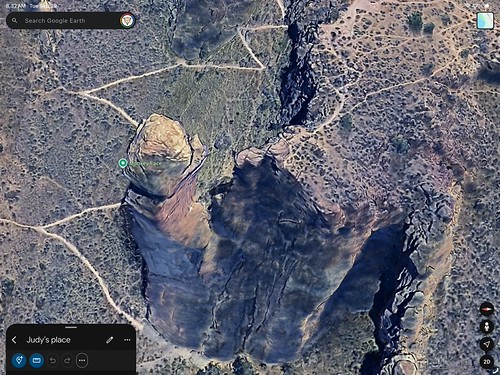
Monkey Face near Smith Rock, Oregon. Google Earth 3D View.

The DCers appear to be gearing up to send their mercenaries into Persia, even as their so-called war secretary (Peter Hegseth) faces impeachment in the so-called congress (Thomas Massie), and even while their scapegoat prez suffers from serious psycho-physiological medical conditions (exactly which ones depends on whom you ask). 

No one “in the know” sees the prez as the one calling the shots. He takes orders and/or follows cues, as a paid actor. The USA we had known was long gone by this time (see Grunch of Giants, St. Martins Press, 1983). The partisans still hope we believe in their brand of theater nonetheless (I don’t).

The Lower48ers do not support this illegal, post constitutional war by a large margin, but their vote ceased to matter when the USSA and its politburo of oligarchs was formed in its place. We live in a post USA chapter now.

“We the people” are mere spectators, trying to follow the action outside the propaganda channels, as DC’s morons force their sleazey programming down our throats via the satellite TV cables, exercising both soft and hard power against the American peoples.

I’m on vacation in the Monkey Face area. That’s a geographical feature in Central Oregon. I come here quite often and so know my way around, but that doesn’t mean I have exhaustive knowledge of the environs. On the contrary, I learn something new every time I visit. I’ll be pushing off in the morning.

Friday, September 25, 2026

The Iron Curtain (movie review)

I’m gonna recommend this one for helping us walk it back a few generations, to the 1940s, with “atomic secrets” the comic book focus, in Spy vs Spy. This one is about power dynamics among those in the know regarding fission (later fusion) as a power source, pre the whole Oppenheimer saga, or more accurately: concurrently.

I’m committing the sin of commenting before the movie is even finished, but on the other hand that’s a valid way to review a film: en progresso so to speak. I’m with the lady who just had the baby, and her wanting to blend in by being friendly with the neighbors. Doesn’t her guy know that being aloof and standoffish is a sure fire way to call attention to oneself?

I’m at the part where her guy has just come home from an emergency meeting or briefing or something, to find his wife, who has just given birth, on her feet and bustling around like nothing happened, while the nice neighbor lady cradles the newborn. The neighbor has just left and the guy is reprimanding his wife for fraternizing with the natives. He’s dumb dumb dumb. Hah hah.

Anyway, once I get this fully viewed and returned to Movie Madness I’m gonna check out what they have that’s Nepali. I have a reliable source telling me Nepali films of this era are well worth catching and I believe it. The question is: will MMU have anything that recent? Prolly not. I’m gonna have to look for a film festival for that kinda stuff.

I think what’s really confusing tongues today is the fact that the USSR is as no longer with us as MAGA isn’t. There’s this tendency to refight, or re-litigate as they say today, battles gone by. Capitalism versus Communism isn’t where the action is in this next epoch. We’re more focused on topics like climate change and global shipping. Pipelines. Grids. Satellite constellations. Global data.

Which reminds me, I haven’t seen much evidence of a United Nations in the plot so far. Not surprisingly, cuz the UN was still in the future back then, duh. 

That’s when a lot got formalized, when the UN did. People forget that Third World meant nonaligned, meaning not party to the bipolarism then gripping the bipolarites. The nonaligned intended to stay out of the whole Capitalism vs Communism drama as both were alien Euro ideologies being transplanted willy-nilly, as if no other shoptalks could possibly pertain. 

By now, most of that 1900s discourse is archival. It takes work to exhume the old mindsets and movies such as this one do an excellent job of prying open the tomb. I commend it to psychological anthropology syllabi. 

Sunday, September 20, 2026

Thinking About Deb

Deb Passing Through

I’m thinking about my friend Deb, going into hospice. She’s a medical doctor and has done her best to treat her cancer with peer professionals. She’s been getting the most out of living. 

I got to join her at the Oregon coast this April on Earth Day, where she and her dog Shelby were enjoying the scene. For me and my dog Sydney, it was a day trip, action-packed. 

She later came through Portland and we attended the Amy Goodman film (with Amy herself on stage).

Mortality has always been a big topic for me, something I ponder, as part of the life experience. I’m far from unique in this regard, hah hah. It’s the human condition.

I first met Deb through my friend Russell Chu, who was to become her husband. Our respective families developed in parallel, our kids growing into adulthood. Lots of adventures.

Tuesday, September 15, 2026

Travelogue Entry

A Random Tour

When working on a skillset, one may apply different spins: 
  • This is a rehearsal in a low risk secure environment for a future time when I'll be encountering more unknowns.

  • I'm just staying in shape, maintaining my skills at a certain level per the use it or lose it philosophy (just use it)
Having just encountered the unknowns of LAX / LA and Uptown Whittier, I could see myself in rehearsal mode. Whereas without specific plans, I'm really just being a stumblebum, per usual, or Wanderer as we like to call ourselves.

Either way, I practice being a smooth operator, like no tripping on my own shoelaces, no leaving stuff behind (I messed up on that one, see below). 

I posit a lot of us hate feeling micromanaged, like by those especially busy-body parents who think parenting means finding fault in not doing everything precisely per their specifications (I'm not saying my own parents were like this; they were not). What's more, they self-righteously believe their interventionary commentary (or worse) is helpful, making them seem even more insufferable.

Well, my antidote for that is to enjoy the benefit of your own personal bicameral mind, or I guess I should say "brain", as "bicameral" is with reference to a brain's physiological structure. 

However "bicameral mind" (Julian Jaynes) suggests something more like an internal dialog, like when the proverbial angel and devil sit on alternate shoulders and whisper persuasive arguments to some in-between Ego (an egg or "I" -- an I-egg).

Along those lines, create an observer-monitor-coach who does micro-manage, but in a way the other half (of your bicameral mind) accepts. Such an expert coach knows when to offer praise, not just criticism. 

Treat yourself right (lovingly). Create the ideal "parent" (supervisor, superego) with the goal of sharpening up your performance. Imagine a voice that offers up the right advice at the right time, reliably, and without sucking off your credit or debit card to do so. Tap into that inner wisdom, why not?

My lunch loop today started on the FX2, with a visual update on my way to the bus stop of the progress being made on the SE 38th and Division food pod. The shared interior, which these pods tend to have, is very close to completion. 

I took the bus eastward, bringing a 3-ring binder of bus reading, and a book purchased at the Clinton Street Fair. I also had along a photocopy of some handwritten notes by Gurdjieff.

I alighted from the bus at SE 113th and backtracked to Roman Market for lunch. The young woman behind the counter was patient with me, and with herself (good coaching) when she couldn't find an English description of the second soup (the first being cream of mushroom). I opted for it anyway (I'd call it potato vegetable) and consumed it along with rice pilaf and chicken schnitzel, all in all quite a large meal, something I wanna walk off. 

Roman Market is Russo-Uke-Baltic and like that, what around here we call Eastern European, but more like before NATO's divisive politics.

I retraced the route along Division, this time on foot, back under the I-205 bridge to the Max stop, Green Line, first checking out a bar I was curious about (not to drink, just to take a couple pix). 

Taking pix was on my mind the whole time, per the embedded album above.

I alighted in Hollywood, in the new Movie Madness neighborhood (it'll open there in 2027), this time to check out The Q. Dr. D. had heard from friends that The Q was worth visiting and upon looking it up I discovered the Sushi Chiyo place I already frequent is an integral part of it. Amazing. More pix.

Coming home on the 75, after briefly ducking into Trader Joe's (dried mangos, cranberry juice, cheese puffs, mints), I sat next to Paul, the owner of some of the gardening tools in my garage and on my patio, from previous enterprising. Paul and I talked about the late Glenn Stockton, our good friend in common.

Two random acts of kindness towards me:
  1. A woman at the Gateway Max stop saw me standing there waiting, and to her eye I looked distressed and she asked if I was OK, and could she do anything. She was on the older side but younger than myself, and looked athletic, with her helmet and bicycle (more like me on other days). I guess I wasn't such a smooth operator after all if just laying eyes upon me inspired concern on the part of strangers. Upon assuring her I was OK, saying "actually I'm fine, but thanks for asking" I looked up and reminded myself this was a major clinic stop and a lotta people here were suffering from medical conditions. In her professional life, this lady was maybe a doctor or nurse, trained to be concerned for possibly undiagnosed or inadequately addressed conditions.

  2. A much younger young woman ran out of Trader Joe's after me, after I'd packed my shoulder bag myself (the clerk had offered to) with the purchased items, but I inadvertently left the dried mangos behind. She (not the clerk) ran out of the store calling after me, and brought them to me. I believe she was a TJ employe. "Oh thank you, that's very kind of you" I said.
Before all this bus and train stuff, I'd done an earlier breakfast loop bike ride to Sellwood, coming back by Max and FX2, a loop I do rather frequently, weather permitting. 

I snapped a couple pictures of the miniature train at Oaks Park. And even before that, a routine Zoom meetup. I mention these details in part to explain what all is in the embedded Flickr album.

Another detail: while sitting at Roman Market, I was challenged by my "coach" (see above) to upload some just-taken pix to Facebook. 

Sounds easy right? But the pix were on a different device, the Canon PowerShot SX 740. That camera has the ability to talk by WiFi and Bluetooth to neighboring devices, such as my smartphone. 

Whereas I'd connected it with my iPad over WiFi, a task which requires downloading a Canon app, I'd never done it with my iPhone. It took awhile, but I eventually succeeded. I'd later reupload the same pictures, in full resolution vs shrunk down JPEGs, when back in my personal workspace.