Since I’ve been a student of the Mark Fisher corpus to some degree, I saw this film in terms of competing futurisms, inside of which futurisms the actual artifacts (the inventions) are more like glacier-borne boulders. The glaciers are more currents in the zeitgeist than physical. We encounter these currents through the boulders and the trajectories of these inertial bodies (picture a Tesla car in orbit, and how it got there).
The film focuses on how life imitates art and vice versa: the interplay of fiction, in the form of manga, comics, and the roles we assume. The North Americans are greatly into the business tycoon role model, going back to railroad days and before. The ideology of privatization, and crediting individuals over any collective unconscious and/or sprawling bureaucracy (cube farm network) is likewise ingrained, with Khans and Kings, a few Queens, getting the lion’s share of the credit for what happens in history (“the” consensus story, of which we have many).
No hyperloop in this film. And yet hyperloop evolved from the Boring company, and the idea of fixing traffic congestion by taking the maze ways underground. The subsequent Vegas tunnel loop also fell to the cutting room floor, along with the many academic competitions around making a pneumatic tunneling system (ala hyperloop) designed to carry biological payloads (humans and their entourage of fellow traveler animals).
The boulders (artifacts) the four hour movie manages to keep: X (public speech mixing valves; also X part 2: the Department of Government Efficiency), SpaceX (rockets and satellites), xAI (Grok: the collective unconscious again), and Tesla (cars and trucks), and “the wives” (aka “the harem” or “the breeders”). The Khans had a lotta wives too.
Back to Mark Fisher, the Anglo philosopher: he focuses on our longing (desire) and its frustration (leading to fear). How our dreams for the future get frustrated is a source of fear and fascination. How do they do that? How do they manage to subvert our visions?
Our genius for projection (model making) has us conjuring enemies we might tune in and address, the face of capitalism chief among them, but faceless socialism likewise for some.
Seeing evil and being the hero up against it, is the human condition, Joesph Campbell might agree.
Being pro-Musk (a fan) or anti-Musk (a critic) both qualify as heroic roles against the backdrop of wanting to make this (the world or worlds) a better place.
Is history best understood through personalities and their psychoanalysis?
In my own thinking, I’ve somewhat shifted away from reducing anything to the one person, which isn’t to diss individuality, only to expand it to include a sense of a bigger or smaller (transcendent) self. Does one’s sense of an ego increase or decrease by that process of identification? Is one steering or steered?
Individuals motivated by a sense of destiny and/or fate are themselves more boulders (tangible personalities) in the zeitgeist, or maybe “bulls in the china shop” as many of us (me included) see business tyrant-tycoons more generally.
The director’s storyline hints at some dark plot lines we never fully see fleshed out, because they’re not fleshed out in the real world (at least not yet). Like what’s this coming civil war exactly? Our party of moviegoers (there were five of us) were all asking that question, a question the movie asks us to ask.
The movie hints darkly that at least from Grok’s Pentagon-embedded point of view (as “Mecha-Hitler”) the coming civil war is likely to be a race war of some kind, a war wherein “race” (a eugenicist concept) and “ethnicity” (a term from cultural anthropology) remain hopelessly confused, as these tend to be by many ethnicities, including by many ethno-racist types in South Africa.
And like what exactly is the role of Starlink when it comes to the war in the borderlands, the Ukraine? Is Elon secretly or even openly a Putinist? We’ve all been warned of Trump’s proclivities in that regard. Don’t billionaires tend to see Putin was one of them; a fellow business tycoon authoritarian, a Bill Browder type? Isn’t Silicon Valley part of this neofascist post USA, this USSA?
I’m probably more of an Adam Curtis fan when it comes to sweep-of-history documentary political commentaries. This is the first Alex Gibney film I’ve taken in, I’m pretty sure [sic]. I’d like to see his one on Scientology, Going Clear. Oh wait, I’ve seen that, and blogged a review.
Curtis tends to focus more on the currents and less on the boulders, leading to a more cerebral experience and avoiding the demonization of singular neurodivergent individuals (outliers, outlaws, autists). What happens to us as a species does not all fall on the shoulders of specific Atlas types who bear the burden and responsibility. Spectators, the view-voyeurs, make the world go around, by lending their momentum-adding attention. I like to spread the blame (the credit) a lot more, vs lionizing this or that alpha-beta.
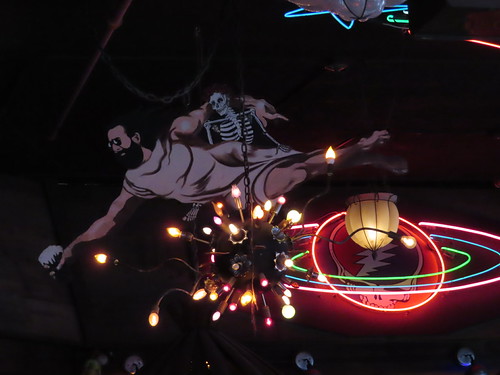
I was with my group of Wanderers, including a jovial visiting astronomer from Idaho, wearing my colorful J. Garcia tie, a Python sweater, and toting a burlap tote bag. I started out in the Egyptian coffee shop (double shot Americano) kitty-corner from The Bagdad, then took the 14 bus to lunch at the Barley Mill (meeting Richard), the first McMenamins brewpub (by now a major chain) and still center of Grateful Dead iconography.
We went from there (SE 17th and Hawthorne) on foot through the Asylum food cart area in sightseer mode (no further purchases this time), checking out the Lucky Lab (same mode) and an artist Steve Dehlinger’s open house, and over the Hawthorne Bridge, and through the No Kings throng (inflated frog costumes). I’d been to a satellite honk ‘n wave protest earlier in the shadow of the Hawthorne theater, after the Egyptian coffee shop.
After the movie, our group found its way to The Flock, an indoor Asian-themed foodery, which is likewise very Portland (a first city in Asia, culturally speaking, going west), with no pun intended regarding face-recognizing cameras.
During times alone on this circuit (like when at the Egyptian coffee shop or on the FX2 bus back), I’d continue reading Meat Puppets by Hannah Smart (which I’m much enjoying).