Saturday, February 25, 2017

Keeping Tabs


Denizens of the USSA are the most spied upon in the world, thanks to their "own" devices, which phone home to inform all sorts of private interests about one's activities and location.

Those wishing more privacy have an uphill battle out of the box.

One could argue that people are not entitled to complete privacy and/or invisibility assuming they share public resources.  If you're on the road, sharing it, we have the right to know your identity, no?

The sense of paranoia that's been building is being deflected onto the Russians these days.  They're the ones doing the spying, not the home team.

Bannon served on the board of Cambridge Analytica, which boasts having data on every voter in the US, enough to compute an OCEAN profile and target ads.

Even though this company openly takes credit for the Trump campaign's effectiveness, we learn it was Russians and Wikileaks that tipped the scales.

How many mainstream media reports have directed attention to "Russian hackers" versus this psychometrics company based in the UK?

Those media reports picking up on that story are mostly dismissive of this "myth" that Cambridge Analytica has working voodoo.  I agree with the "myth" part, but then so is the "Russian hackers" story about mythical powers.

It's myth versus myth.

The effectiveness of targeted advertising based on profiling is hardly a "myth" to social media companies such as Facebook and Google.  That's how they make their money.  The fact that political campaigns are likewise advertising campaigns is obvious.

So how does playing down the role of psychometrics companies stack up against the reams of stories playing up their importance?  How hypocritical are these "myth busters" willing to be?

Are psychometric computations what drive this narrative of "Russia the evildoer"?  That seems a truism in my lexicon.

Politicians (social engineers) feel in their gut that oughta work (scaring people about the Russians).

Going with one's gut is what psychometrics is all about, especially minus the big data component, which might serve as an unwelcome reality check in some cases.

USers have been susceptible to Red Scares for a long time, so what does it matter if the Russians are no longer red?  Can't we scare the USers anyway, or at least make them angry?

That's what organized crime wants to find out.  Experiments are underway.  The mainstream media is their tool of choice, what they've learned how to use.

You know what I always say:  if you want to be a US president, you need to:

(A) know how to lie persuasively and
(B) have close ties with organized crime (including the CIA).

For example, president Clinton well understood about the need to ship arms to the Contras in contravention of the Boland Amendment.

The CIA wouldn't enjoy the loyalty of its home team mercenaries if big money were not involved, meaning cocaine sales and money laundering, with lots of partying for friendly politicos.

Clinton could not have become president had he not, as governor of Arkansas, helped with the CIA's program, a continuation from Vietnam War days, where drug trafficking was likewise a big part of Air America's business.  Not a secret.

President Trump is still being tested by organized crime, as Putin has his own criminal networks and the idea of "getting along with Putin" is pitting mob against mob, at least in the lower ranks.

Trump's base wants to find out if "draining the swamp" has anything to do with telling more of the truth about recent history.

Given the mainstream media is purposely forgetful ("United States of Amnesia") and has no means to connect the dots for people in any short evening news format, the social media habits of USAers have changed.

They want the bigger picture.  They're turning to Youtube.  Many of them are not big readers, thanks to TV, but then the Internet is turning out to be a lot like TV.

Hollerith machines were all about keeping tabs on people and of course the Germans wanted them to implement Nazi programs.  IBM helped them out.  Lets figure out who all is Jewish.

We forget how many in the US business community were tacitly rooting for Hitler.  Eugenics, as a "science" was co-developed on Long Island.

Once the war was over, the losers did not necessarily agree it was over and the Cold War picked up right where WW2 left off, just as the war in Korea rolled right into the war in Vietnam.

Many Nazis ended up in the Middle East, working with the CIA to frustrate Arab nationalism.  German scientists pleaded innocence and flooded into the US rocketry program, resulting in ICBMs.

Undermining governments, forcing regime change, has been the game for a long time.  The mob rules.  That's a tough lesson to teach in school though, so a lot of people end up confused.  They suppose ideals match the reality and criminality relates to "a few bad apples" and nothing systemic.

No one is asking if the Trump campaign was in close touch with UK intelligence operatives throughout the election season.  If we're as fast and loose with definitions as we are where Russians are concerned, then the answer is yes, of course.

Which nation did the US have a war with to win independence for itself, Russia or the UK?

Ah, but with the latter we (the USers) have a "special relationship".  British Aerospace and the Pentagon are joined at the hip.  BP oil powers the USSA's aircraft carriers.

We've been taught that Russia is our enemy.  Those reflexes still work, but maybe not as much as they used to?  Stay tuned.  Global literacy levels are still on the rise.  Telling people how they must think is getting more difficult.

Sunday, February 19, 2017

Keep on Truckin'

Quaker Business

Lots of truckers share advice and stories on Youtube.

That gives me an opportunity to ask directly, and respectfully, if they'd have any interest in driving overseas, as a part of a truck driver focused student exchange service.

I've already gotten a green light from academia to pursue such interests, but really I need truckers themselves, along with transportation engineers, to be more aware of their options.

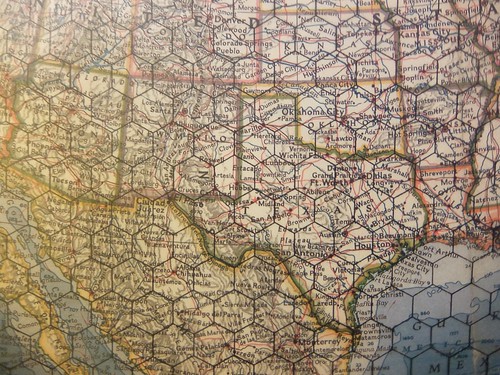
Market research...  Focus groups... Does Google maps have the overlays we need?  What other map services will we need, to keep out Kabul-to-Istanbul lanes flowing smoothly?

Freeways Layer : Global Matrix

Trucking as currently designed allows precious little time for tourism.  It's dock-to-dock, through the dirty side of most cities.  Many people treat truck drivers rather poorly.  That's where the academics come in:  drivers get a full-blown work-study program.  Our curriculum is about more than moving freight.  Lets think about families.

Thursday, February 16, 2017

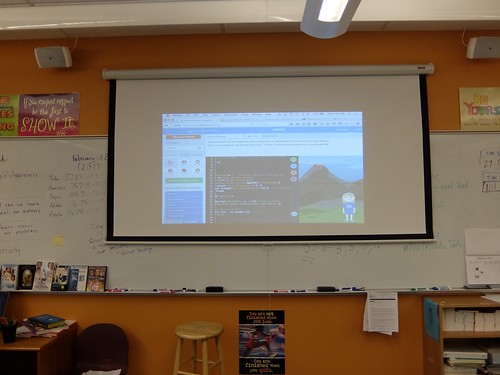
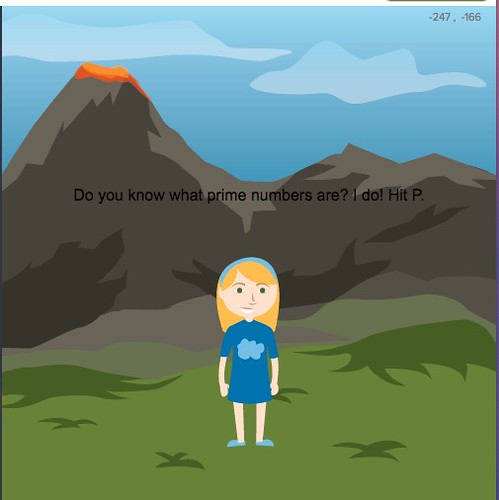
Prime Numbers

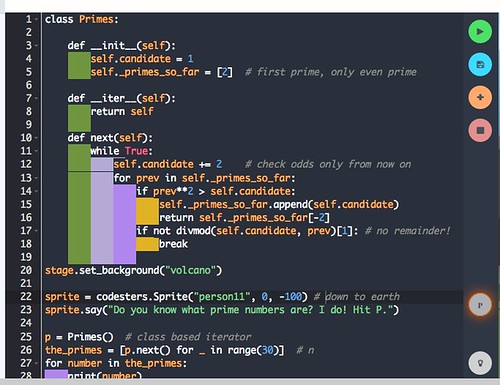
Solution in Codesters

DSCF3530

codesters_primes_2

Code on Paper

Friday, February 10, 2017

Study Circle

World Game Players

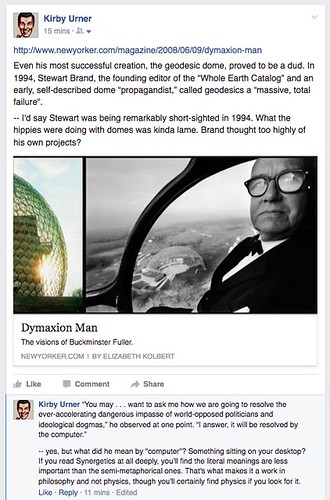
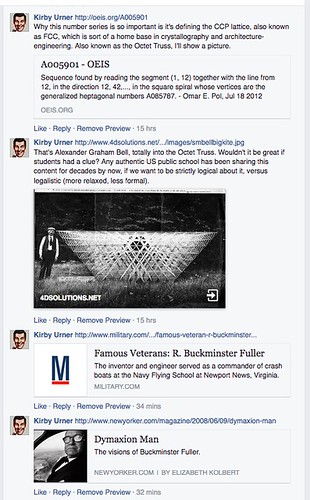
In addition to working with world game planners on Global U ideas around trucking, I'm studying a New Yorker article, Dymaxion Man, about Fuller, published in 2008.

Sure, that's one way to compute the account, tell the story.  New Yorker features a lot of intelligent writing.

No mention of the Cornwall Eden Project, nor of the Epcot Buckyball ("Spaceship Earth"). How does Synergetics relate to the CCP?

No mention of Dr. Arthur Loeb, nor A & B modules, T & E modules (3D printable!).

We'll have exhibits in our World Game Museum, of what the textbooks were ignoring (a basis for ignorance). Lets see how the narrative accounts compute then, shall we?

Is West Point teaching the Bucky stuff at least, sharing our American heritage with high ranking officers?  Scandalous if not. We're investigating.

A couple comments, from my Facebook timeline:

Study Circle

Also:
Military Man

The main literary trope I find regarding Bucky is that he was a failure and his inventions didn't fly. Put his awards and degrees, number of works published, historical role as "engineer saint", in a pile, and put that pile next to any detractor's and compare. 

True, he didn't win a Nobel Prize. Is eleven honorary PhDs enough (given for free remember, to help a school uphold its own brand)? Elliot Norton chair of poetry at Harvard? Patents not just on the dome, but the IVM itself (like if Descartes had patented XYZ). 

This guy appears to be a huge success, by objective criteria. One of the most successful who ever lived. I think the "he was a failure" trope is a projection. People think "the world is still a ghetto ergo Bucky did not succeed." Specious. Completely void of real thought.

Or was it 47 PhDs? That's what BFI claims. Depends what "doctorate" means maybe. 

Such a failure right? Poor slob.
After being spurned early in his career by the architecture and construction establishments, Fuller was later recognized with many major architectural, scientific, industrial, and design awards, both in the United States and abroad, and he received 47 honorary doctorate degrees. In 1983, shortly before his death, he received the Presidential Medal of Freedom, the nation's highest civilian honor, with a citation acknowledging that his "contributions as a geometrician, educator, and architect-designer are benchmarks of accomplishment in their fields."

Thursday, February 09, 2017

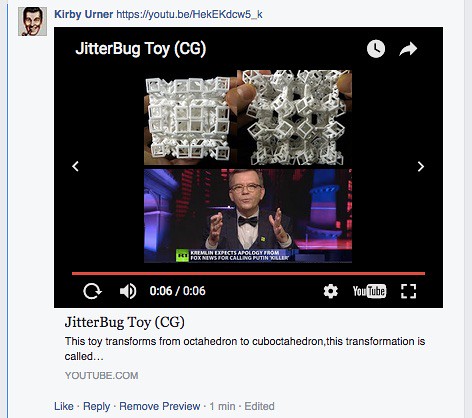
Jitterbug Transformation


Your math teacher may use the Jitterbug Transformation to help explain how the cuboctahedron and icosahedron layers might morph into one another without gaining or losing constituent balls.

1, 12, 42, 92, 162... is the sequence we're talking about.

Geometrical concepts may be imparted via a number of these moving sculptures, or dynamic devices.

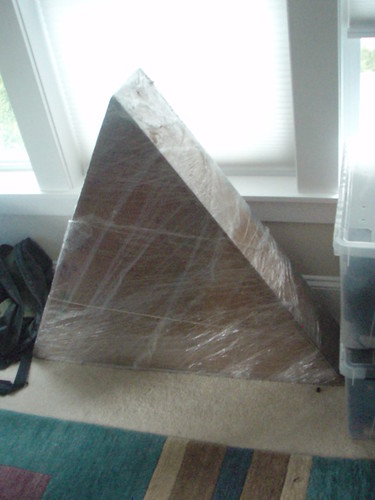
Another such device is the triangular book with one triangular page, its tip traveling in a 180 degree arc and defining two complementary tetrahedrons (same volume as each other) all along the way.

When the page is straight up, and the edges are all 2, we call that unit volume in the XYZ coordinate system, made from cubes of edges 1.  These two sculptures have the same volume.

The Quadray coordinate system apparatus gives us yet another conversation piece with which to leverage greater understanding of the target namespace.  Again, the canonical edges (not base vectors) are of edges 2.

Our World Game Museum will feature a lot of textbooks that saw fit to not include any of this information, nor the related whole number volumes schema.

Probing questions will be posed, and documentary postmortems invited.  People will come up with varying theories to explain the censoring habits of minions.

Transformation

Sunday, February 05, 2017

More Codesters

The embedded version has its limitations. Try this version instead? These are fun experiments.

I have one baseball and want to completely surround it with others. One way: put six around the center one on a table, then three on top, three on the bottom. With real baseballs, this would be difficult.

To see an animation of what I'm talking about, check here:
http://www.4dsolutions.net/ocn/graphics/cubanim.gif

For a lot more on the mathematics, check here:
http://oeis.org/A005901


More of a Martian Math theme, which for some of you may mean more Hungarian.

Tuesday, January 31, 2017

Embedded Codester Apps


Monday, January 30, 2017

On Race Again

:: stand-up philosophy by Wes Cecil ::

What I wrote on Facebook:
Really enjoyed this, because he's doing philosophy and standup comedy at the same time. Gets my attention. Yay, my discipline gets into the nightclub scene (reminds me of Tom Lehrer).
... and in a follow-up comment:
The End of Racism by Dinesh D'Souza is pretty on target in arguing many anti-racists miss a golden opportunity in buying into "race" as a tenant of their own belief systems, such a foggy and ill-designed concept as Wes Cecil takes up in his mocking philosophy talk. However, given how deeply engrained is the thought pattern, I have to accept that most Americans (at least) are terminally racist (will take belief in races to their grave) and it will be up to future generations to look back and dissect these beliefs in a more clinical postmortem manner.
But then as some of my friends point out, Dinesh has gotten in trouble with the law, and was a big Trump supporter, anti-Hillary. So does that mean races are real?
Thanks for the update about D'Souza, got me checking his website too. 
I do believe in ethnicity as meaningful. I notice racists have a hard time naming the races. The idea of races pre-dates genetic science, which has only further undermined the idea. Certainly "Anglo-Saxon" is not a race. Or maybe some think it is, as there's really not much agreement on what the races are in the first place, assuming they exist for the sake of argument.

Quoting from my Synergetics on the Web (1990s):
Western science originally portrayed race and class as characteristics of a person's blood which, as such, could be subdivided in proportion to a person's ancestry, "blood" being treated as a mathematical quantity, contributed in equal proportions by one's parents. Hence such terms as "octamaroon" (one eighth black). Whereas "class" is no longer regarded as a genetic entity, "race" has remained a popular concept for grouping genetic characteristics, even if the link to blood is no longer made. Like anthropologist Ashley Montague, Fuller felt the concept of "race" had outlived its usefulness, that the cross-breeding of the world's people, especially evident in North America, was exposing the old racial categories as mere snap-shots of genetic traits thrown together by the exigencies of time, but available in any number of permutations from that vast grab bag of traits known as the human gene pool. In the Fuller lexicon, a racist is perhaps most straightfowardly defined as someone who believes in races.

Saturday, January 28, 2017

Growing Up Quaker

A story from my boyhood: my mother Carol was working with other WILPF ladies, as a young mother, to counter the prevalence of war toys on the market. She harvested a pile of examples and stored them in our two-car suburban garage. Dad and I found them, and decided to play with them. The remote controlled Tiger Tank was especially cool.  As a general rule though, toy guns were discouraged and I didn't play with toy soldiers, as did some of my peers.

When we moved to Rome, I met friends in military families. Reggie liked to fantasize about wars and weapons. Mom served as a cub scouts den mother.  I was a Bear, with my friends Mahlon, Kijoon, Reggie, Hayden and Joe. Kijoon, son of the South Korean ambassador, had a stash of toy guns, as well as a pellet rifle and we'd play with those, more in a 007 mode than as soldiers.  Movies at the nearby Archimedes, an English-language theater, were influential.

In the Philippines, my dad started out with the UN, which was doing land reclamation in Manila Bay. Dad switched over to USAID and taught planning at the University of the Philippines as well. He was helping spread a culture of local planning, versus top-down from a central government, and flew all over the islands. Thanks to his job with the State Department, we were able to go on base, mostly Clark AB and Subic NB. We also had access to officers facilities in Baguio and vacationed there at one point.

My years in the Philippines helped me more fully grasp the global scale of US military infrastructure. The American War (Vietnam) had been really hard on my mom especially. The way USers like to rain bombs on defenseless civilians didn't impress me either.  However I also saw how a lot of brave individuals inside the military were also skeptical.  Daniel Ellsberg went to Vietnam as a Marine to check the reality of the situation. Brian S. Willson was there serving his country as well.  Dad and I also heard Ralph McGeehee talk at the Institute for Policy Studies in DC (this was later). He'd been with the CIA.

After Princeton, I dove into international affairs quite a bit and thought seriously about joining the foreign service. The Woodrow Wilson School beckoned, however I decided philosophy was more my thing. Wittgenstein was doing a kind of anthropology, looking at how words mean. I also took a course in psychological anthropology, with Imee Marcos (daughter of Ferdinand and Imedla) in the same class.

Fast forward and I found myself plunging into the Bucky Fuller corpus. He was still alive and circumnavigating the world, giving those famous long talks. His blend of futurism and philosophy appealed to me. He'd been in the US Navy and credited that experience for exposing him to big picture worldviews, what the admiralty shared in officers training at Annapolis. This was a high point for him, preceding a deep low, when he needed to support his new family in Chicago and went broke, coming close to suicide.

Another author with a lot of military experience was L. Fletcher Prouty, played by Donald Sutherland as Man X in the Oliver Stone movie JFK. Prouty cites Fuller when explaining why humans are squandering resources to kill each other instead of collaborating to enjoy better living standards. The "you or me" picture of Malthus-Darwin and a belief in global scarcity had turned endless war into a means of population control.  This was the picture World Game worked to counter. In principle, humans had the wherewithal to better their lot. We had the necessary mastery over principles. Ephemeralization (more with less) was on our side.

Through my study of Fuller, I got to meet E.J. Applewhite and his wife June. I met their daughter Ashton briefly, haven't yet met their son, a boyhood friend of Sam Lanahan's (Sam accompanied Bucky to the Philippines when I was there, but wasn't tracking at the time).

My parents and I had dinner with Ed and June in DC (I forget which restaurant). Also Ed and June flew out to Portland to hang out with me there, meeting some of my people. Ed had a CIA background, having served in Berlin and Beirut. He'd been a Fuller fan as a teenager and devoted his post CIA years to collaborating with the guy, shepherding the two volumed Synergetics through to publication.

The US military had worked closely with Fuller and the companies set up around the geodesic dome invention. Don Richter, T.C. Howard, Ed Popko and many others did much of the actual engineering, in both civilian and military sectors. The radome (radar dome) became a relatively common feature of the landscape. My uncle (actually grandmother's sisters kid) had a contract to work on those in some way, doing maintenance. I only found that out recently (Bill is 91).  Soviet premier Khrushchev had been impressed by the dome in Kabul. Fuller was always friendly to the Russians, as his commitment was to all humanity (he credited that commitment for his successfully synchronistic lifestyle).

However, Synergetics is about a lot more than just geodesic domes and spheres. It's a hard philosophy book that most philosophers don't actually read, but contains some simple geometric innovations based around polyhedrons. When the World Wide Web became available, getting more of Synergetics on-line was my priority. Dr. Bob Gray got the actual text of Synergetics on the web, followed later by the Synergetics Dictionary, another Applewhite production.

Friday, January 27, 2017

Forum 206

I'm back to posting to the Math Forum a little bit.  I've contributed thousands of posts to Forum 206 over the years. I'm glad Drexel University gave us an opportunity for public debate.

As I indicate in my latest comments, I have alternative ways of covering the mix of topics, which were maybe a sign of the times. Certainly "learning to code" has grown in importance, as a PR topic.

I pay for the 4D Solutions domain out of my own pocket. No one has sponsored me. There've been tie-ins with the Bizmo idea.

I've spent a lot of time working with David Koski and others, with what I consider one of the main focal points: a way of building spatial geometric fluency by leveraging the work of Buckminster Fuller.

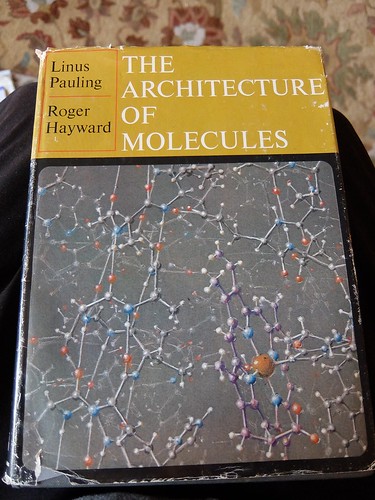
I've been meaning to get back to the Linus Pauling Archives at OSU to see what correspondence I might uncover between Linus and Bucky. I imagine there must be some.

Thursday, January 26, 2017

Finding Polys

Great Find

Some teachers stress about curriculum segments on polyhedrons, such as the Platonic Five, as where and when will these prove useful? Do we really have the luxury of "going there" with so much of STEM still waiting?

I don't think the arrangement of space into coherent, oft repeating, patterns is a waste of time. Glenn's recent find at Good Will reminds me:  Linus Pauling merged spatial geometry with chemistry in ways we'll never forget.

On the same topic, congratulations to Julian for that write-up in the Portland Tribune. He's the sculptor behind Alpha Helix next to the Linus Pauling House on Hawthorne, directly across from Third Eye.

I'm at the other end of the spectrum, stressed about the exclusion of polys, and curating textbook titles for our World Game Museum.

Secondary school textbooks that skimped on polyhedrons, the tetrahedron especially, while purporting to be STEM-worthy might get some critical write-ups in our retrospective.

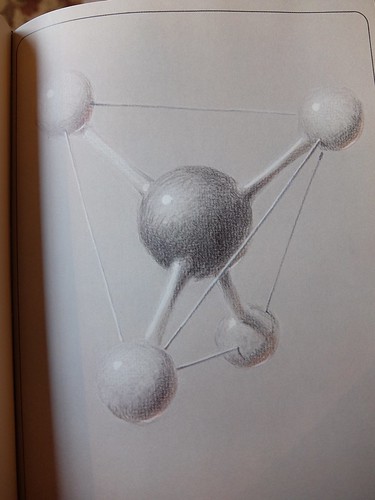
Why the tetrahedron in particular?  Of the Platonic Five, or of any, it's topologically the simplest, called the simplex for that reason. No arrangement of fewer edges joined at corners has a spatial inside. A triangle fences a field but doesn't define a cage (enclosure).

We're in the realm of Euler's Law for Polyhedrons, likewise Descarte's Deficit of 720 degrees. The numberphiles on Youtube will explain what those mean. Such pillar concepts mark out a common core of cultural literacy.  A common core minus V + F == E + 2 would be exhibit-worthy for its grave deficiency.

If you're a teacher in a Freedom School or one of those, and have the luxury of escaping from the "down the drain" vortex of the left-behind curricula, you'll have access to the resources you need to keep it real. Help your colleagues who aren't so lucky?

Methane Molecule

Friday, January 20, 2017

Bible Stories

[ originally a comment on QuakerQuaker, new improved ]

Thank you Paul.

The story of Noah feeds into the Tower of Babel story, as the uniformity / conformity of thought enjoyed by the Great Flood survivors was a consequence of their starting over with a blank slate so to speak. Noah and Mrs. Noah were the new Adam & Eve.

What humans did not understand owing to their lack of diversity in thought, was that their Promised Land is a ball, a sphere, a planet. A lot of them still have some trouble with that concept in 2017. It's not a closed system in any thermodynamic sense. A star (the campus fusion furnace) feeds us energy for free, the basis for ongoing cell division and our daily bread.

Noah's descendants were at first under the misapprehension that they lived on some horizontal XY plane to infinity, with "God above" in the perpendicular Z direction (Z is for Zeus?). What better way to reach God and make a name for themselves as a superpower than through the construction of some humongous, homogenous skyscraper?

This seemed like normal thinking to them, so great was their confusion already (Babel and babble connect in Hebrew as well [1]).

God knew that a single culture with a single-minded approach would think nothing impossible or unrealistic about their foolish skyscraper plan. No "new Noah" would arise to prophesy this was madness, because they all thought the same way. Besides, had God resorted to another flood (having promised not to do so) He'd be facing this same predicament in a few generations.

God understood that diversity in thought patterns would guarantee that people spread out and around, and come to terms with their being on a spherical spaceship (an Ark, likewise once our Eden).

In his mercy He gave us the humanity we have today: diverse, spread around, and not organized under one uni-polar pyramid hierarchy. No superpowers here folks, just a lot of feedback mechanisms connecting hominids by means of various networks, religious, political, economic. Don't think of your skyscrapers as containing some single-minded illuminati caste that all speaks the same language.  There is no "global civilization" that traces back to some singular inner circle, much as some cabals would love you to think so.

[1] http://www.christianbiblereference.org/story_TowerOfBabel.htm

Tetrascroll

Wednesday, January 18, 2017

Chronofiles

I've been chronicling a lot of my homework topics in my Facebook scroll.  Potorando (Portland, PDX) has been under a blanket of snow for the last week, which has been stressful in some ways but also a welcome vacation from daily toil to catch up on world events. There's so much to catch up on.

I study dance and music more than you might expect, in addition to movies.  Some "AI films" I've been listing: Ex Machina, Her, Chappie, and of course Artificial Intelligence itself (Spielberg, Kubrick). In connection with Chappie, I segue to Die Antwoord.

Another thread cites Tame Impala for its retro-psychedelic Feels Like We Only Go Backwards (very Yellow Submarine).

I'm accepting there's no point assuming some uni-polar world wherein the USA has the luxury of infinite time to process future shock, while this rest of the world has to rocket through the experience.

No inner circle controls spacetime to that level if human, and if not, then which science fiction have we switched to?  No, future shock is not shielded against by lead or glass, let alone legislation.

Anyway, back to my studies: I'm ironically not the bold futurist of the Hyperloop experiment, and instead suggest more Eisenhower-style freeways, twixt Iran and the Stans, over to Istanbul and so on, more of an EU like arrangement or like what Africa is aiming for.  You don't have to show your papers just because you're moving from state to state.  That's an experience of interstate travel people really appreciate about the USA and want to emulate.  I don't blame them.

So whereas Youtubes are showing these sprawling Hyperloop networks, I'm talking about trucking lanes. The trucks might not even be autonomous. So backwoods Oregon, right?  So not Silicon Valley.  However the Hyperloop vision takes somewhat for granted what we learn at airports:  the countries you fly over don't need to bother you with paperwork.

Lets remember El Camino though, I know that sounds somewhat out of the blue, and that has not been a recent Facebook topic.  I'm just thinking about how trucking is in other ways thoroughly regulated, with weigh stations and rules about getting enough sleep.  Drivers do worry about sharing the road with other judgement-impaired drivers.  We all do.

El Camino is for pedestrians, however they'll show paperwork when staying at various hotels along the way.  Use of a credit card also marks a trajectory.  I'm not saying the traffic along these roads will be unmonitored.  On the contrary, it's so monitored that stopping at boarder crossings is almost a moot point.  Information technology is what's rendering those obsolete, not some sudden outbreak of trust between nations.

Also, I'm quite accepting of the ODNI's observation that RT is influential.  I've watched enough of these old Yuri Bezmenov tapes on Youtube to agree on his major point:  a huge percentage of what spies do has little to do with picking locks, tapping phones, or sneaking around in illegal ways.  So much of what we call "intelligence work" is what Yuri calls "active measures" and that includes spreading everyday propaganda or PR (PЯ).

But what's propaganda then?  Lets just agree, for the sake of discussion, that it's an important factor, and accept that the Kremlin was likely more afraid of Hillary's harshness than of Donald's trademark blend of buffoonery. That's not even scandalous if so. We all have our preferences and, if we're powerful nation states, we have our spies to carry out their active measures, often fully legal.

Hey great if hyperloop technology works, as it's not either / or with trucking. Cargo travels at different rates. A "fifth mode" of transportation implies four others, not going anywhere. Of course I do pay attention to skeptics who say controlling the seals will be difficult but we learn from experiment more than from arguing sometimes. I'm happy to see bold experiments with new civilian technologies. More giant domes might be nice.

I connected the Manning case to Leonard Peltier's. I got to be at an event with the latter's son in 2016, another Oregonian. The media were mostly linking to Snowden and Assange, more recent cases, higher profile in recent times (and admittedly more directly connected story-wise, given how Manning went to Wikileaks directly, helping it become what it is today).

Tuesday, January 17, 2017

Elusive Dude


This story of Howard Hughes appears to check out on every level. The things I'm still learning...

Just this First Day at Quaker meeting, when checking out the rack of books on sale for fund-raising, I stumbled upon Kafka's first novel Amerika, published posthumously, who knew? Not me.

It's not a like a fancy Princeton education back in the day made me a know-it-all. On the contrary, my time in Firestone Library reinforced my appreciation for the power of browsing freely (it's open stack, at least to students).

The advent of the web browser, after I'd left (Class of 1980) further amplified our global reach, ala the vision of MEMEX shared by Dr. Vannevar Bush, in a famous article, in Atlantic Monthly.

I've been describing "different species of capitalist" on Facebook, ranging from "bling capitalist" (more Las Vegas, more showy, ties to organized crime) to the reclusive relatively low profile type.

Howard Hughes played it both ways: high profile in his youth, then tapering off to ever-lower profile, keeping his cards especially close to his vest when the public was supposed to think him dead.

Warren Buffet (Oracle of Omaha) is more middle of the road. My taxonomy is not fully fleshed out yet.

US Presidents may come from the rough and tumble organized crime side of the business (e.g. the Kennedy brothers), wherein "bling" is big. Thanks to Prohibition, huge sectors of the economy had become criminalized. Amerika was a nation of scoff-laws and sinners.

No one knows the inner psyche of Americans better than the Mafia, the industry in charge of catering to forbidden desires. No wonder Nixon got in.

The Silicon Forest capitalist, in contrast to the "bling" school, has a more egalitarian dress code, with net worth inversely correlated to the presence of a neck-tie.

The management structure is also "flatter" or "thinner" in many ways (fewer levels or ranks), more Pacific Rim, more Japanese, with less towering of software and hardware engineers over one another.

Grounded in the sciences, engineering is more about shared humility before nature. The ability to intimidate is hardly the point, when dealing with cosmic forces and exceptionless principles (Van Allen Belts and so on).

The Quaker capitalists of the roaring 1790s were less tycoon-tyrants or "rubber Barons" (as in Fitzcarraldo) than experimentalists in management theory. The ideal of a workers' paradise loomed large in these early days of automation (freedom from dirty jobs).

This ideal proved threatening to satirists with an investment in the status quo. George Bernard Shaw took on Cadbury. Having well-treated workers made everyone else look bad. Demonizing any such ideology as necessarily "anti-capitalist" (i.e. "socialist" or "communist") would be a future innovation.

The exploiter class needed to keep the standards low and therefore frustrate any lofty Quaker visions. "Go to Pennsylvania if you want to try out those zany experiments" was the word from on high, from the would-be competition.

William Penn's forestland ("Sylvania") would be our Quaker utopia.  Didn't happen.  Indian Wars came instead.

Neither health care nor education was a part of the deal in Oliver Twist's merry England. The public laws more about the ones on top, staying on top, than anything more broadly constructive for the common people.

That status quo explains the American Revolution in large degree.  Idealism doesn't like to be frustrated at every turn, needs creative outlets.

Even if no generation seems to "finally arrive" in the Promised Land, there may still be a sense of direction, a sense of continuing to escape tyranny.

Amerika

Saturday, January 14, 2017

Upcoming Commitments

I've got two Princeton alum interviews in my inbox, and a Welcoming Committee with the Quakers.

In the first case, Princeton has a time-honored tradition of matching up each applicant with an alum, for some meetup time. I see it as an opportunity to hear from someone who actually went there what it was like, and a first thing I might say is way different for different people.

In the second case, Quakers have a tradition of recording membership which, once gained, should not have to be regained over and over as one transfers between meetings.  So there's a hand-off process, involving some record-keeping and actual face time.

Speaking of Princeton, I'm observing on Facebook that people will start talking engineering and science when arguing pet theories about what did or didn't happen.  It's one thing to dismiss others' belief systems as "crazy", another to get good exercise stating what one believes to be recognizably science.  There's skill-building involved, not redundant with doing crossword puzzles or Sudoku. So does Princeton teach science this way, is the question.

What I'm suggesting is that a bright kid, fresh from high school, may have seen over 1000 hours of Youtubes on such disputed whodunits as 9-11. Where at Princeton is the course where adult discourse in this area is role modeled? Shall we expect panel discussions? Might we study the history of deceptions in general, back through the phony military build-up under Paton (the US general), concealing the ramp-up to Normandy? Lets not always pick the same examples, and if you do Gulf of Tonkin make sure you connect to The Doors (quiz question: what's the connection?).

Remember all the 9-11 stories involve deception, as hijacking is certainly that, not to mention dive-bombing the airplanes into stuff, outfoxing defenses. How do we have substantive discussion of what's raised in all those Youtubes, now that we're paying for the privilege?

For all I know, Princeton has been offering such courses for years. I'm somewhat out of date. I advise prospective students to check out a course catalog, regardless of their interests. This is the time to comparison shop. Many schools will be excellent but for different reasons, so it's up to each applicant to decide which reasons are the best reasons.

Wednesday, January 11, 2017

Alt Worlds


Thanks to Wanderer Bob Mcgown for cluing me about the above BBC special, which I watched start to finish across several Youtubes.  I'm pretty much snowed in; a day for studying.

The son of a quantum physicist tracks down what the story was. What was his dad really up to. They hardly talked while he was alive.

I tend to not think of "particles in transit" along specific trajectories, but of pressure building with a probability wave to "be seen" (materialize) collapsing in a discrete place.

The recipient [atoms] "see" (we could say "sense") the source through the double slit; a game of  quantum physics bingo determines which target actually gets to "tune in" the photon or whatever.

Putting detectors in harm's way means the collapse happens in the detector.  The receptive space (sensing surface) has changed its shape. In "transmission" it's a probability wave of finite speed, until detected.

However, talking like that may not make any difference to the mathematics. English offers a variety of grammars, complete with mental images, to fit the data.

I especially enjoyed the visit to Princeton University, with scenes of the "Dinky" (the suburban train from the campus out to Princeton Junction) and inside various halls and arches, part of my personal memory bank as well.

I've also been reading "Roger Rabbit's" thesis regarding cosmic gamma-ray bursts and one possible interpretation. It's making waves amongst some of my Facebook friends (the author, Charles Fleischer, did the voice for Roger Rabbit).

Monday, January 09, 2017

Sharing the Gospel

:: stories of Finland ::

Given news stories need to be brief on prime time TV, we have to expect homework through other channels, say History Channel or, more likely, Youtube. No that isn't me in the video.

Case in point:  Portland Public Schools pays close attention to Finland's public education system for good reasons.

We get it WDC doesn't care about the same things we do, different priorities and ventures.

They're into financial values over there, vouchers, paying off balances due. That's an important aspect of doing God's work, certainly. Thinking purely in terms of money has its limits though.

I'm in touch with public school teachers quite a bit, thanks to the Measure 97 campaign, which didn't succeed in passing.

We did get #CodeCastle to off the ground to some degree.  I've turned more towards MIT Scratch for my memes.

True, we have no budget for that microwave tower, replacing or in addition to the cross, facing @OMSI.  That's fine.  Plan B is in effect instead.  Teacher trainings in the Roost?  Not happening, to my knowledge.  We had to shelve our Plan A.

Those caring about Washington DC and its new Orange Party rules (corporate media still using the color Red for some reason, misunderstanding GOP did not survive Election Day #singularity), will obviously seem more up to date than little moi.

Given my job description, I can't afford to get sucked in to domestic / nationalist politics at every turn.  I'll check back in a few years on that #WallwithMexico campaign, how that all went.

Just kidding, that's a fun one.


Thursday, January 05, 2017

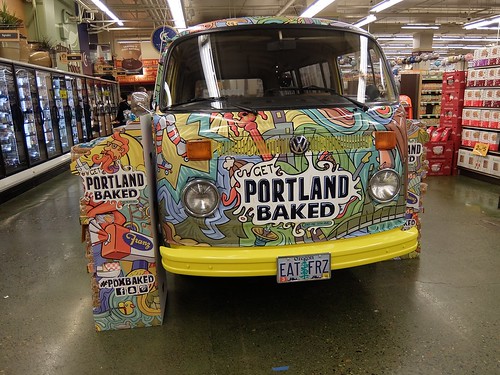
Get Baked Portland!

Get Baked PDX

People my age start checking for signs. I remember when Mary Bolton was so disheartened when signing her check Mary Butter at the checkout lane, when buying some.  Hey, we all make mistakes.

Still, I was worried when Deke the Geek kept telling me about this Bizmo in the middle of our local supermarket, and I kept going there, in a trance no doubt, and not seeing it.

So today I made a special point of looking it up.  Franz was important in my childhood, before I left for Italy.  Our Markham elementary school, it had to have been, did a field trip.  A real bread factory.  Impressive.

I've always enjoyed seeing things being made.  Kim Jong Un must really enjoy all those tours he gets, of factories, as a part of his job.

I went on some tours of Chinese factories in the 1970s, during the Four Modernizations.  We were looked up to, as a tour group, as a possible source of ideas.  Mostly high school teachers, from the bases, with me and Glenn Baker tagging along as diplomatic corps (expat brats).

I bought a loaf on the spot, in recognition of the company's acumen as much as anything.  Of course it's a hippie bus.  No reason to go overboard and go all Vortex.  Grateful Dead bread sells itself.

Meanwhile, back at Starbucks, Deke the Geek was catching up on Adweek. We did a mini-photo-shoot right there and then.

Age of Aquarius

Bakery Bus

Tuesday, January 03, 2017

On the Move

If you dig back into the early days of freeways and Detroit, and the future-world of the 1960s, Disneyland brand new, you'll find "traveling circus" caravans converging to schools, putting on corporately sponsored "futurama" shows. Am I right?; I remember looking into it.

Anyway, that's where the "bizmos" sometimes fit. I wasn't originally thinking food pods and food courts, which is where Portland and some other cities went with the idea. I'm not saying the food cart people read my blog or anything, just it makes sense for a van-sized vehicle to self contain some types of businesses. I thought that too.

When the vans or bizmos arrive at a school, they have some show or experience to create, lets call it a science fair and a kind of job fair. Students feel like they're being recruited, but usually with no way to make specific commitments, as these events are more informational than missionary.  If you want to follow-up you'll be able to but the bizmos produce a standalone event.  Something like that.

In one incarnation, these "GNU mobiles" would mostly be sharing the essentials of the POSIX world, already an esoteric place, where the typewriter starts talking back to your commands.  An operating systems keeps a computer engaged with tasks, sometimes running in the background. I could as well imagine an Hour of Code van set to share Scratch or one of those block-based languages.

Today I signed up as a co-speaker on two Pycon 2017 proposals. That's the local North American one (so far, in radius), a "mother ship" in some ways, as the PSF showcases it as a model.  Other Pycons use the trademarked name to certify a level or standard, not a new idea in business models, one with a proven track record.  Finally, many Python (the computer language) related events may not use the "Pycon" trademark at all. PyOhio comes to mind.

The talks I signed up to co-speak about have to do with a scheme Charles Crossé wants to share publicly, having developed a working demo and used it with his own family. A use case would be a parent wanting kids at home to earn their play time on the web by winning at games deemed in advance to be suitably educational.  Games may involve extensive readings, in other words I'm not always suggesting the stereotype "twitch game" associated with pinball and other arcade games.

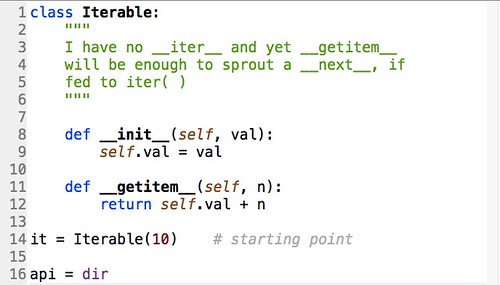
Speaking of Python, what's going through my head these days was inspired by Trey Hunner's recent delving into the iterable : iterator distinction.  The former category of object, if run through iter( ), will trigger an inner __iter__ that comes back with a new object containing __next__, thereby completing the iterator protocol.  For example, an ordinary list object is an iterable with no __next__.  Run it through iter( ) and a __next__ appears in the new butterfly-from-caterpillar iterator object.

The plot deepens however, in that even __iter__ is not required, so long as a __getitem__ is present. The latter handles square-bracket indexing as in object[0], object[1], object[2]... The idea of "advancing an integer" from zero outward, is intrinsic to our notion of iteration. So if your class (type of object) at least implements __getitem__, then iter( ) will know enough to pull an iterator rabbit out of an iterable hat.

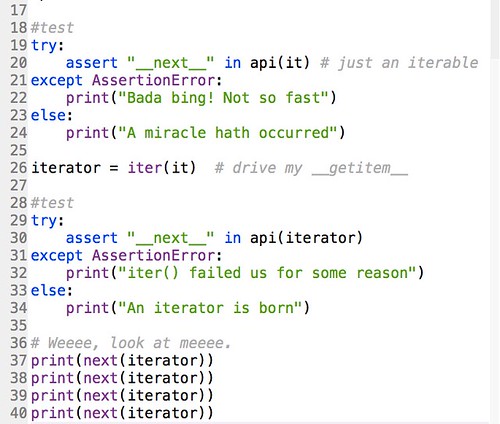
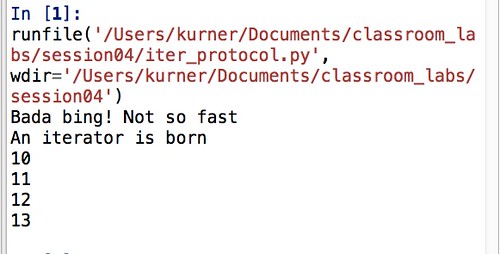
Here's the script. Iterable is a generic type with a way to set a starting value through __init__ (at birth), and then reflect the ever increasing value of n, as next( ) drives some internal __next__ to keep driving __getitem__. I'm not talking about code we anywhere write, as Python programmers. We simply count on next( ) to feed successive integers, starting from zero, to __getitem__, to "do the right thing" behind our __next__ calls.

Safe to say, your own __getitem__ may not be quite as simple as this one.

slide1_iter
slide2_iter

The output, showing "before" and "after" tests, with iter(it) run in the middle, returning a new object in which __next__ is indeed a part of the API (the "bag of tricks" associated with a class of object).


slide3_iter

As Trey well explains, we don't necessarily use next( ) to drive the action. The for loop construct is precisely "that which uses an iterator" to iterate through some body (block or suite) of code.

When we get to the end of the rope and push passed the last in the series, should one ever be reached, a StopIteration is raised, which the for construct handles in stride as a simple signal to stop, with a possible run through an else clause if present.

The iterator later hatched into a full-fledged co-routine by way of the function generator concept. The keyword yield gives another way to provide a __next__, short of feeding anything through iter( ). A generator begins life as an iterator right out of the gate.  We will pick up on their story in a future blog post.

Sunday, January 01, 2017

More PЯ


Praise Bob!

Wednesday, December 28, 2016

Wanderers 2017.12.27


Don organized this Tuesday's meetup around sharing a short movie about the power of advertising.  The writer-producer says what distinguishes capitalism is its huge output, with the log-jam (potentially) in not giving players enough incentive to consume it all.

The analysis casts the players in their archetypal role as mindless, once the brainwashing is complete, and still unsatisfied, because one never really has enough of what one doesn't really need.  "Enough is never enough" as they say, in Over the Hedge, a cartoon parody of suburban living.

A shortcoming in the analysis is how lack of means puts severe brakes on consumption, such that advertising works against itself in portraying an unattainable never-land as its mythical backdrop, but then promulgates "starvation wages" as what all these consumerists deserve.  The left hand fights with the right and capitalism becomes semi-paralyzed.

The question "what makes us happy?" and the false answer "more stuff" avoids another question: "what is work?"  Work from whence happiness derives, versus some mindless "pursuit" of end-of-the-rainbow type happiness, would seem a more secure footing with which to gain traction.  What does advertising tell us about that?

Advertising tells us that doing advertising, or PЯ as I like to call it (rolling in propaganda), is powerful and effective and well worth paying top dollar for.  This DVD said much the same, attributing all kinds of power to advertising even while skirting the question "is it effective?" -- the assumption already being, that it is.

I've been recalling the Hunger Project and the level of cynicism that quickly grew up around it, as a purpose of that project was to bring to bear the full power of advertising to unleash our outrage about low living standards on the richest planet in the solar system (by far).

We're like a superpower compared to Mars, so why do we let Earthlings die in droves from easily preventable causes?  The humans rose up against the prospect of full-scale brainwashing PЯ campaigns for anything other than their customary purposes.  The Hunger Project as envisioned by est Trainers, was strangled in its cradle by righteous critics.

However, now that we've had some decades to even more fully appreciate the power of memes and memeplexes, with memetics a mature science (with a little help from anthropology), we might be ready to try again at outgrowing our old ideas about "what is work" and look for something more satisfying than bombing ourselves back to the stone age, as we seem to still consider a likely prospect.

If you're part of the problem are you really working?  I'd say a lot of money is spent forcing people to do "negative work" in exchange for compliance.  "Compensation" we call it, and with good reason.  I take issue with this idea of "net worth" and side with GST against the most laggardly forms of Economics, which confuse wealth with money far too carelessly.

We used my Mac Air with a borrowed DVD player, connected by USB.  The technology performed well. I didn't contribute much to the discussion as I think about advertising all the time and didn't want to get myself started.  I'm not at Wanderers to hear myself think.  I get that pretty much wherever I go.

Sunday, December 25, 2016

Christmas 2016

DSCN5724

:: remembering 2013 ::

Sermon:  looking back on the year; so many gifts left unopened; God's generosity.

Catching up on cartoons,  a few Youtube poops (that's technical geek-speak).

Dinner with friends.  Hallelujah.  Waving to family.

DSCF2366

:: same room today ::

Saturday, December 24, 2016

Solstice Party

Bar Carlo

I'm fortunate in having entre to a series of winter holiday parties.  This year (2016) I was especially lucky thanks to Laura and Rick, whom've not been in my blog for years, though I did see Rick at the Portland Tech Crawl not so long ago.  I'd never met the younger of their two boys, now about five, to give a sense of time passing.

The Wanderers have a solstice potluck, also a favorite.  However Deke and I had been stuffing our faces at Round Table on Foster, an all-you-can-eat he treated me to, in exchange for driving out to the horse farm.  Ergo, I ate sparingly at the Linus Pauling House (across from Third Eye, if you know Portland), sampling a couple goodies while sipping red wine.  A few came over to my house afterwards, and continued with festivities.  Bob and I traded off as veejays (VJs), calling up favorite Youtubes on various themes.

Today I was back on Foster, right near Round Table, for brunch, at Bar Carlo, which brilliantly doubles as a record store at one end.  Rosalie has medical conditions that keep her from traveling, however in spirit she's been standing with the protesters at Standing Rock, an unfolding chapter in American history.  Small eateries such as this one perform important service in their neighborhoods, as do food carts. Networks form.

In this age of social media, vicarious participation in protest actions, disaster relief, and refugee camp community building, is afforded by such as Facebook.  I mentioned our zip code's wheelchair guy with the dogs, who says he's been out to Standing Rock by bus, with other vets.  There's a place there called Facebook Hill where you get the best reception.

Zip Code Node

I'm expecting to switch to Soylent for much of the remainder of 2016 as we take stock and restock.  More walks up Mt. Tabor are also "in the cards" (are those proverbial cards in some kind of Tarot deck, that tells the future?).

At Wanderers I chatted mostly with Bob and Marianne.  Bob is a nurse-in-training, already with a lot of experience in care-taking.  He came to Esozone that year (my second time to hear Paul Laffoley speak).  Marianne is in her 90s having escaped Berlin in her childhood.  She's like a psychoanalyst by training.  One of her sons, Alex, is a Hegel scholar.  Our conversation wandered, and was somewhat esoteric I suppose, not surprisingly, given the mix.  Dream interpretation and all that.

Bob wanted me to summarize Wittgenstein's philosophy in a succinct way and I came up with a pithy way.

First imagine getting it distilled down to this question, as within it are many others of a philosophical flavor:  "how do words mean?"  Wrestle with that for awhile, through observation and investigation, don't quote authorities, then come back for this second koan:  "words to not point."

Bob questioned that and I told the story of the screwdriver, how it took shape in our language through its utility, without pointing to anything in particular. Think of all words more like tools, in a machine of so many moving parts (yes, an analogy, and way of looking).

A segue from "words do not point" is to a discussion of "spin" in the sense of applying a layer of interpretation.  Facts under-determine the story we tell.  Even with all the facts in, how the story is told is not nailed down.  Is it shared as a puppet show?  An animation?

In the American lexicon we have this term "spin doctor" with somewhat negative connotations in the sense that spin may sometimes be a cheap substitute for substance.  "Connotations" come to the foreground when discussing "spin" I think it's safe to claim.

Today is when I learned of the death of Kenneth Snelson, from a Facebook post by Gerald de Jong and shared to my profile by David Koski.  He'll continue in our conversations; I've been sharing about our friendship. He had a wonderful life and loved his family. To this day I treasure the small tensegrity sculpture he gave me as a thank you for doing a first website for him in the early days of the web. To quote myself on Facebook:
The sheer scale of some of his sculptures puts him in a class by himself. He was head and shoulders above everyone else doing tensegrity as an art form, as most artists would gladly admit or acknowledge. He also helped open a portal into a whole new way of thinking about tensile forces, part of a longer historical arc that includes bicycle wheels, suspension bridges, and ephemeralization more generally.

Thursday, December 22, 2016

Refugee City


Related:
ESL Bits

Wednesday, December 21, 2016

Business Meeting

A lot of non-profits will put in the small print that they're committed to leaving a public record of their doings, however nothing could be further from the truth.  There's no turnout for their meetings, no public passed the guards at the skyscraper door.  Nonprofits become accomplished at staying beneath the radar of the public, even if they remain sharply visible on the dashboards of their sponsors and funders.

Quakers have taken a different tack in building attendance at Business Meeting, making it more than a religious duty, but a hobby, like keeping a sophisticated model train in working order in the basement.  Attendance by a critical mass is a practical necessity when the Meeting's continued existence is what's at stake or up for grabs.

A Meeting has lots of moving parts, from physical property to the design of its workflows.  Some positions may be paid, however the most important decision-making happens through consensus, which means gathering for business once a month (if a Monthly Meeting).

For example, at Multnomah's most recent business meeting, we probably had upwards of thirty people.  Hobbyists come from far away just for this event i.e. it's the weekly Meeting for Worship they don't attend.  Sometimes there's a worship group (without the overhead of a monthly business meeting) closer by.  Between Worship Group and Monthly Meeting is another phase:  Preparative Meeting.

The Treasurer gave a full report, including our current position, income versus expenses, along with a budget for the future.  This was just one item on the agenda.  You might think there'd be exponential inefficiencies in involving "people off the street" into such proceedings, but that's not the flavor of a business meeting.  Close attenders get the benefit of the bigger picture and so reach consensus more easily.  The greater the transparency, the less maneuvering about, the shorter the discovery process.

I'd not been to Business Meeting in quite awhile.  Per past blog posts, I'd been doing my part more regionally, as Clerk of IT Committee.  When October rolled around, two years into my three year term, I decided to relinquish my hold on that title and share the glory with someone more in agreement with the new policy, to outsource the website rather than keep it in-house and unpaid.

The Multnomah Meeting website has its own trajectory, which comes under the purview of the Communications Committee.  As I stated during introductions (we go around and say names, maybe mentioning any official roles), I'm not currently on any of the Multnomah Meeting committees.

My listowner roles in Cyberia, mostly through Yahoo! and Google, don't extend to the Monthly level, not currently.  I'd started a P&SC listserv but rendered it inactive pending more evidence one was needed by those actually on the committee (I'd been on at as AFSC Liaison, first locally, then West Region, but gave that up with the AFSC's closing down of our Peace Program).

Wednesday, December 14, 2016

Wanderers @ OMSI

OMSI Science

OMSI is our local science and industry museum, of which I've always been a fan, since I was single digit, age-wise.  By now I'm almost sixty, and OMSI has moved, having been near Oregon Zoo in the old days.  Packy the elephant, a resident of said zoo, and I, are about the same age.  He's not doing well, bad case of TB.  I remember first seeing pictures of TB germs at OMSI. Small world.

Our speaker tonight, Dr. Sarah Schaack, was well practiced, having appeared in ten previous science pubs, or the like.  It's called a "science pub" because yes, they let us bring beer to our seats.  These were the really steep seats of the movie theater, originally Omnimax, now branded 4K and no longer projecting on a curved screen.  Quite the remodel.

Our topic: the human genome (and the genomes of other animals), its sequencing, what it is, why it matters and so on.  Given the gigantic screen and super high resolution projector, we were treated to a Powerpoint on steroids.  Our Reed College professor needed to gaze up at three story high slides from close range, and not lose her balance.

Don consulted with a few of us Wanderers, before announcing this experiment, in which we would forego meeting at our usual location, the Linus Pauling House, and congregate at OMSI instead.  Glenn and I road with Barry in his Mustang, who fought his way to our zip code through rush hour.

Speaking of Barry, I take care of a python (as in snake) by the same name, here in my office-plex.  I decided to give his aquarium a thorough cleaning today, and somewhere in the process, cut a knuckle, leaving a visible wound, upon which the human Barry later commented.

My mind was already drifting along the day-dream of gene transfer, me absorbing some snake genes through the cut.  That could only be mythographical, like what happened to Peter Parker in Spiderman (horizontal transport -- one of the warm-up quiz questions).

The human genome, especially the Y chromosome, is enlarged with a library of what we might call transient sequences, not part of the active protein-encoding version, more like skipped code, a wasteland in some accounts, a valuable repository in others.

I'm reminded of human language and the many memeplexes that lay dormant, possible, even potential, but not much expressed.  Diversity lays dormant, between the lines.  Humans are packed with such "detritus" which may be our salvation in the long run.

The talk was free-ranging, if bound by the slides.  The Q&A afterward was even more so.  Portland has a rather science-savvy subculture.  Lots of geeks have moved here.  They don't call this the Silicon Forest for no reason, and genomics seems a branch of bioinformatics in many ways.

After PCR, this process called CRISPR is the next big breakthrough. I missed an ISEPP lecture on that topic.  We learned about the patent war and what's at stake with that.  Geeks are always explaining to other geeks about one intellectual property war or another.  The cost of sequencing has been plummeting.  Now we're getting better at synthesis, not just analysis.

We learned about daphnia, somewhat ugly critters that pass DNA from one generation to the next asexually, unless under pressure.

Mutations sound like a bad thing to most ears, however most are considered harmless, and every so often the new sequence may be just what the doctor ordered.

We don't have all the big data we'd need to really cross-correlate genetic sequences to phenotypes, meaning profiles.  You need more than just a pile of genetic sequences to discover links to whatever traits.  We have a long way to go with our analysis.

Friday, December 09, 2016

Bullet Trains (Youtubes)


Monday, December 05, 2016

Political Cartoon

Political Cartoon


Previous political cartoons:
[1] [2] [3] [4]

Saturday, December 03, 2016

Spirit of St. Louis

Climatron in 3D

Heather and Michael

Memorabilia

Thursday, December 01, 2016

Driverless Bizmos


What's a "bizmo" again?  Business Mobile, like an RV ("recreational vehicle") but for business -- you're not just goofing off.

A driverless bizmo would be the autonomous version. We already know about downloading the operating system when you get to the garage.  Or the rental agency might have that step taken care of. You might not think of it as a rental agency, either.

Because humans have avoided discussing the Old Man River City project, even in science fiction, we don't have much fluency around "cities from scratch".  Even though we could use them.  A city with "people movers" as they used to be called, i.e. "driverless cars", would likely need the whole grid to be controlled in that way, more like Wall-e, except we'd also allow pedestrians.

Doing a whole city for driverless would seem pretty EPCOT (Experimental Prototype Community of Tomorrow), what Americans used to be famous for, before the Fourth Reich period we've been enjoying.  If we dial back to Disney, his original vision, we might actually get somewhere with these memes.  Or just keep doing Dubai.

You know, of course, that once cars are driverless, humans will want to kick back and send them on errands.  "Go get me those groceries" (a robot picks them in the warehouse, fills the basket).  A goodly portion of cars on the road will contain no humans at all.

We've already planned that for trucks (the "zombie truck system" I called it on the physics listserv), but people tend to forget about "no people" movers in the general case.  We've taken to calling those "drones".  But what if on wheels?

Like luggage systems at airports -- you're not supposed to ride in your suitcase.

Thursday, November 24, 2016

Fantastic Beasts... (movie review)

J.K. Rowling (aka Robert Galbraith) is not that far from John le Carré (alias) in creating a chthonic world parallel to that of the Matrix, that pale shadow of reality we take for granted as Muggles or No-Majs (no-madges), those without superpowers.

The Incredibles sketches a similar backdrop:  those with magical powers have suffered persecution and need to keep themselves hidden. They have their own institutions, and wrestle with the same demons, who think "hey, we're the supers here, lets take over the world!" -- the standard "bad guy" thought process.

A from above camera shot replicates all the CIA movies in having some seal or symbol on the floor, emblematic of this shadow world of Men in Black.

If you're not a spy, er wizard, and see too much, like Jacob Kowalski does, they'll need to "obliviate" what you've seen i.e. wipe your brain clean of any classified memories.

Alexia and I saw this together at The Bagdad.  I'd planned to join Friends on Stark Street for Thanksgiving afterwards, had made the lentil dish, only to discover upon checking the web that said event was at noon, not in the evening. I'd missed it.

I ended up over at Patrick's, baching it with the dogs -- his family in Chicago -- fantastic beasts indeed.  We took in a couple episodes of The Blacklist on Netflix, another series I've not tracked (I've seen maybe only two Sopranos).

The Rowling universe strives for internal consistency, as the Star Wars one does.  We get partially overlapping timelines.  Dumbledore had defended Newt Scamander when the latter was expelled from Hogwarts, we're not sure exactly why yet.

The plot is still unfolding.  Expect more from this franchise.

Tuesday, November 22, 2016

Permaculture MOOC


I'm enrolled in a MOOC about Permaculture these days (CN-2124).  Here's one of the instructional videos.

Tuesday, November 15, 2016

The Brainwashing of My Dad (movie review)

Documentary

This crowd-sourced Kickstarter documentary is the project of a loving daughter, Jen Senko, who was alienated when dad bought into the fanatical cult that is Goldwater talk radio (John Birch etc.).  Jen was more of a hippie, anti-Vietnam war, the kind of bra-burner Nixon was outraged about.

The aging hippie generation belatedly gets around to learning more about PR skills, which the Goldwater crowd felt it had to learn big time, or die.

Liberals were a more complacent majority back then, taken by surprise by the Reagan years, so soon after Nixon's humiliation. Vengeful feelings over Nixon's impeachment lingered, and Bill Clinton took the brunt of it.  There could be no president Hillary (it's easy to say that now).

Yes, the Goldwater folks had to go back to the drawing board and create a whole new media empire from scratch, with Fox News the crown jewel.  The Imams (pastors) got in on the action, as "Mosque Morality" (the prevailing church orthodoxy -- anti-GLTBQQIP) was highly offended by the free love sexual revolution engendered by the pill.

The documentary doesn't touch on these hot button issues much i.e. it does not go deeply into what the disenfranchised "moral majority" (so-called) was reacting to.  Just calling the Goldwater folks "racists" or "misogynists" doesn't get us anywhere.

It's not that I'm "against name-calling" in some holier than thou sense -- there's no way to not name -- I'm just more respectful when the analysis goes deeper.

Hippies studied pretty hard, some of them, and a fringe even got into geodesic domes.  J. Baldwin admits the domes leaked at first and took responsibility, saying he leaked (hah hah) the numbers to Whole Earth Review before NASA (i.e. Joe Clinton) had fully debugged its programs.  Good story.  He told it at the Fuller Symposium, the last time I met with Ed Applewhite.

I have a collection of old Whole Earth Reviews (as distinct from the catalog) and do appreciate the writing that went into them. Yes, I think medications (drugs) had something to do with it.  The psychedelic counter-culture was called that for a reason.

However, for all the interest in a design science, the Boeing engineers and like that stayed hooked on military-industrialism with its prime contractor irrigation system, to the detriment of our global living standards. Too few hippies went into engineering? Helicopters were misappropriated.

I'm thinking both major parties are dead by now, and need to reinvent themselves or face the music.  Lets see what happens.

I'm still hoping STEM or STEAM pulls us back from the brink, but unless that means saying the word "tetrahedron" with greater frequency, it won't have the integrity.  We've seen some positive trends at least, like in Nature.

My morality is not quite left liberal in that I'm not offended if someone says it's possible to be gay by choice.  Lets accept that's true for some people, big deal.  That's kind of what "bi" means, no?  Some gays get all bent out of shape if you say for some it's a free choice, as if it's only "moral" if it's genetic or something.

Also, I don't see legalizing "gay marriage" as all that wonderful a civil rights victory, as "marriage" is but one of many contractual agreements, not necessarily the best, at least not for everyone.  My wife and I were a business partnership first. I'm not that crazy about diamonds as a gemstone, either.

But then who cares about my opinion?  I'm not trying to make the whole world think the way I do.  I do think the US would be less hypocritical about protecting freedom of religion if it lightened up about non-nuclear families though.  I've given that topic a lot of column inches already.

Saturday, November 12, 2016

Planning Ahead

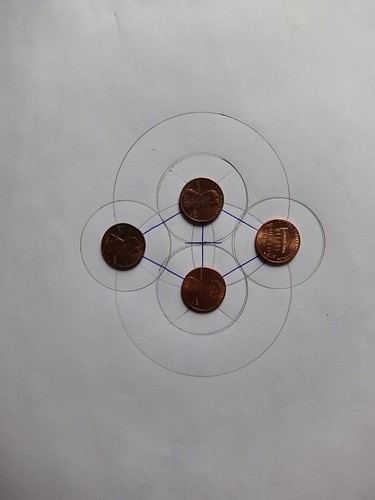
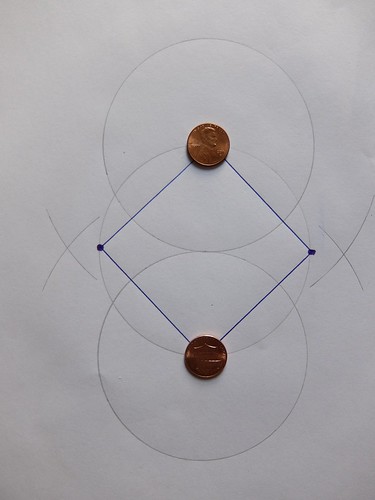
Vesica Pices Begets Four Pennies
Figure 1: central diamond (not square): 
short diagonal (vertical) = 2; long diagonal = 2√3


Square Diagonal = 2R; Edge = sqrt(2)/2
Figure 2: central diamond (a square): 
both diagonals 2; edges √2


A cube built from six of the squares in Figure 2 would conventionally have a volume of √2 to the third power, as 3rd powering means "cubing" in "Earthling Math".

The inscribed tetrahedron made from six of the cube's face diagonals has an Earthling volume of (√2√2√2)/3, as tetrahedrons in general have 1/3rd the volume of the parallelepiped in which they inscribe, as true for the golden cuboid as the cube.

We've forked our depiction of 3rd powering and developed the "Martian Math" apparatus, a tetrahedron, for this same purpose, setting our canonical cube of face diagonals 2R (R = unit sphere radius) or 1D at volume 3, not at √2√2√2, leading to a conversion constant known as S3 or √(9/8).

XYZ.volume * S3 = IVM.volume

"Martian Math" is a rebranding of certain aspects of "4D" geometry published as Synergetics in the 1970s (Macmillan) by RBF (R. Buckminster Fuller) and EJA (Ed Applewhite). The same core concentric hierarchy obtains, with a new rhombic triacontahedron added of 7.5 tetravolumes. This RT shares some of its vertexes with the rhombic dodecahedron of 6 tetravolumes.

The "4D" doesn't refer either to a "tesseract" (i.e. hypercube) nor to "3D + Time" but was rather a commercial logo used by Buckminster Fuller, along with "Dymaxion".  The "4" in "4D" drew attention to the tetrahedron's starring role.


4D as a Brand