Saturday, October 03, 2015

Oblivion (movie review)

I'll compare this movie with Zardoz right off the bat.  Tom Cruise (vs. Sean Connery) is an outlander and he has the same job Sean had:  do the bidding of the giant Sky Head and kill all the Brutals, though in this case the face of authority is not sculpted into the Sky Shape, but shows up on screen instead.

Her name is Sally and she has the same superior "I'm in charge here" attitude as Zardoz.  Our hero has a rebellious streak but it's his housemate, Victoria, who gets to deal with Sally and they get along quite well.

In both films, our hero becomes suspicious, then resentful, and through study manages to penetrate a layer of lies and deceptions that have been perpetrated against him.

The plot comes together like a puzzle, with pieces coming in out of order.

I think Bucky fans, who know of Utopia or Oblivion, will appreciate the irony of having a Tetrahedron as the symbol of the New World Order.

Mad Max, 2001 Space Odyssey, Star Trek and The Matrix, all have some themes echoed herein.

Oblivion, literally rendered as a world without personal memories, is perpetuated by a human disloyalty to the Earth and a fascination with the possibility of an off-world existence, an after life (underworld) in the realm of Saturn.

Belief in an after life makes the current tour of duty seem OK.  This world is but a doorway to the next.

Jack Harper (Tom's character) is haunted by dreams from his personal past.

As in The Matrix, he has lived many lives in some eternal return without actually solving the puzzle and realizing the nature of his imprisonment, let alone acquiring the tools and allies to attempt escape.

Events set in motion before the memory wipe are what trigger him to at least partially re-awaken.

Obviously I'm avoiding telling the whole story, in hopes of letting viewers puzzle it out themselves.

Friday, October 02, 2015

More On Gun Control


On CBS tonight, in the wake of the Roseburg Massacre, some guy in a uniform was saying he hoped we would end these "gun free zones" so that ordinary people could defend themselves.  I wasn't sure if he meant on airplanes.  A bullet through the fuselage can be a bad thing.  What do air marshals do?
But in like a Disneyland (picture a theme park), where they hope you don't bring a gun, they could escort you out if they found one, with lots of devices doing screening, even on rides.

A Donald Duck like creature (dressed up staff) might have a lethal something-or-other.  Spy cams keep a lookout.  Signs tell you the rules.

Like I'm not saying staff engineers have to be disarmed.  This is private property.  Bring a gun here, and we'll... escort you out.  Customers are not welcome to bring their own firearms.  Leave them in the parking lot?  Much better at home.

So a "gun free zone" isn't really what the uniform was saying.  Some of the authorities are armed, but they're also carefully screened.  They don't sneak around collecting armaments and plotting revenge, like the profile student shooter, or the Unabomber, another coward.

They've also trained in how to use these weapons, when forcing everyone to do so is pretty severe.  Only if you promise to also learn a computer language (yes, with tests).  Tit for tat.

I'm not for solitary confinement by the way, unless the prisoner begs for it while having viable non-tortuous alternatives, and even then only for intervals (not too long).

I think establishments should be able to advertise "gun free", conferences too.  Make it a badge (gun with a line through it) and a part of the Code of Conduct.  It's explicit.

That way, if a gun clatters to the floor, it's an embarrassment, as it should be.  You'll be a hero for turning in an illicit carrier.

In some circumstances, you should only have a gun if you have a badge (of whatever description), not a new idea.

I brought up these ideas on PSF-members, a non-public listserv, awhile back.  Engineers do think ahead, and not just at Disneyland.  I'm not saying any consensus was reached, just the topic was not verboten.

A shortcoming of media debates is it's always about "the right to own a gun" as if that were the whole topic right there.  Owning a gun doesn't mean having the right to bring it to into my house.  Property owners have rights too.  Americans worship property ownership at least as much as gun ownership, so these two should be counter-posed if the "debate" is not just filler between commercials.

Thursday, October 01, 2015

Substance Control

DSCF0932

Oregonians were in the mood to celebrate today, in Portland especially, as Prohibition notched back a bit.

I made a symbolic purchase, snapping pictures, then came home to the tragic news on the radio, about the mass killing in Roseburg, one of Oregon's towns.

There's a connecting theme:  substance control, interpreting "substance" rather generally.  Guns are a substance, but then in a way, so are states of mind.

We're instituting different substance control protocols around cannabis, will we around guns as well?

A civilization is somewhat defined by how it controls access to such and such.  That would include to information, news sources etc.

Another duh moment:  I'd been scouring the Internet for a computer monitor also able to show HDTV.  I finally realized any monitor with HDMI-in would do, and I already have one of those, so no new purchase necessary to use the CenturyLink Prism service.

Glenn talked of General Semantics and "substance control" in another sense: maintaining mindfulness, not falling victim to one's own body chemistry, i.e. not becoming only a complex of  knee-jerk responses.  Korzybski segues to Bucky at St. Quentin [ the Youtube is gone -- the warden is introducing Bucky to the prisoners, mentioning they've been studying Korzybski most lately].

Of course way more people in Syria are getting mass killed every day.  Same issue:  it's so easy to get weapons, all you need is a "just cause" and some money, or a patron with an agenda.  But then try crossing a border for the same "just cause" reason.

Saturday, September 26, 2015

Wanderers Equinox

Equinox Selfie

We're definitely in full Fall season, coming up on Halloween, is how we thought of it back then (2015).  Wanderers / Pauling House ("Dr. Phil" joining) held its customary celebration however I arrived very late.  My day had already been quite busy in many dimensions, including a follow-up visit with Dr. Bolton, this time with Deke the Geek (as I call him, also Derek).

We wound up at Humdinger which was maybe a mistake on a potluck night.  I ate next to nothing at Pauling House, not arriving until almost 8 PM.  Gus was there, from Silverton.  We joked about the parking meters and talked about what "Liberal" meant, at one time.

Dick Pugh delivered an amazing lecture about the migration west of "religious crazies" (we may afford to be affectionate, a term of endearment lets say), along Erie, down through Ohio and out west to the fork, where it was either Venture Capital (California) or fertile valleys of farm life (predictable, one hopes) in Oregon.  The names of the towns are telling.  We're talking Klan-imposed definition of "white" combined with full blown Manifest Destiny Syndrome (MDS).

Dick tells it better than I do though.  I was entertained.

The Russians did come through but mostly didn't land here:  They headed for Sebastopol, CA and the Russian River area.

Mary especially had extensive knowledge of the giant Chinese ships, that had "farms" in their holds and could trade with one another (the flotilla was a floating city).  More to learn.

We enjoyed other oral recitations I won't go into, including a battle royale twixt me and X, over some matter of logic (or illogic as the case may be).  I'd done the lentil dish.

My top story was about Micheal Sunanda (not a typo), who was on his way from Eugene.  I'd brought some copies of his most recently published issue.  Dick was prepared to argue that Azomite was not the chemical name of anything.  Micheal agreed though.  It's more a brand name, for a mixture of chemicals some have used in permaculture.

He's here now (Blue House), this being the after party at my place.  I'm downstairs for a bit, keeping a lonely dog company.  She no longer climbs stairs.

My innate "misanthropic" (?) tendencies was another topic at the meetup, somewhat customary for me at Wanderers, where I've wanted to be open to non-humans.

I said I'd had a realization that if I were super rich, I'd be donating to all these non-human causes, knowing well that humans were being taking care of by their more loyal donors.

Some need to take care outside that horizon.

Actually my viewpoint was not that controversial.  Mary seemed on my side in that way.

Her rant about the kid who couldn't work or be useful gave me food for thought for days to come I'm sure.  I pretended to be his lawyer at the meetup, but only to uphold my end of an ongoing investigation.  X said she'd dig the holes (Mary needs to plant some roses but her apartment complex can't muster the help, even given a likely candidate).

I should rejoin my party upstairs.  Thanks for listening.

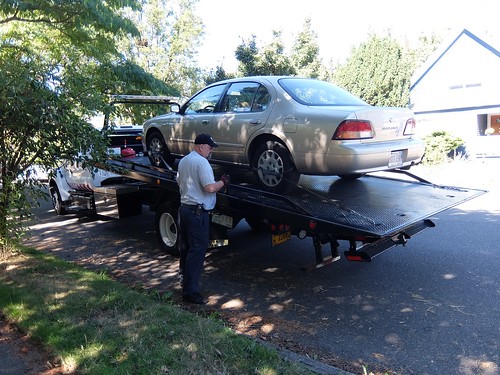
The Nissan needed a new starter and has one.  That's mostly in my Photostream, along with the parking ticket.

Friday, September 18, 2015

Car Karma

DSCF0329

When I dropped Carol downtown at Pioneer Courthouse Square the other day, the Nissan acted quite reluctant to start, but finally did.  I'm glad I didn't need roadside assistance in busy downtown, right next to the Max tracks.

Were the problem a low battery, the process of driving home should have charged it up some --that's what the alternator is for -- meaning today the start process should have been smoother.  It wasn't.  No dice.

I had a physical therapy appointment so took off at a good fast walk for the bus 14, getting to my appointment in the nick of time.  Coming home, my smartphone battery had just enough charge to show my still ticking ticket to the driver.  All good.

Fortunately, I'm all paid up with AAA.  If you flip back through my blogs you'll find my AAA stories.  A battery specialist came by and checked the car in my driveway.  The battery is almost fully charged.  The starter itself is now the chief suspect.

Will I need to rent a car next Wednesday, when Carol wants to go to Corvallis, or might it be fixed by then already?  Stay tuned.
Towing Nissan

Sunday, September 13, 2015

Citizen Diplomacy

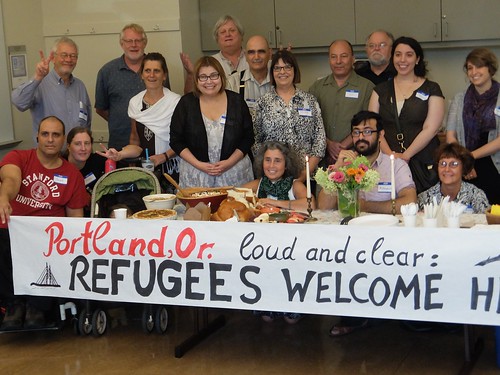
Refugees Welcome Here

The Eliot Center is well-known to those of us working alongside Unitarian Universalists, an active and populous church in Portland's downtown.

The Unitarians' Mark Slegers is a strong choral director who gets a lot of eager participation from the congregation, as Curt confirmed this evening.  He married my supervisor at CUE (Carol Slaughter, coincidentally with same last name in a different language) way back in the 1980s when I was still fairly new in Portland.

Anyway, tonight we attended (my mom and I) a celebration of the Jewish New Year (it's 5776), with citizen diplomats from Portland's Jewish and Iranian communities, with a smattering of Unitarians present.  This was not an evening for speeches, just people sitting around big tables and yakking.

Two floors down from here, Carol (mom) received a Congressional lifetime achievement award from Congressman Earl Blumenaur in recognition for her work on disarmament.

The Pacific Northwest Social Form, Econovergence... plus some Barcamps, all staged in this building.  Lots of memories...  Johnny Stallings...

All this talk of peoples needing homelands got me thinking that Quakers should talk about wanting Pennsylvania to really be a Quaker State.  What would that even mean? Quakers have a history of continuing to move west, or to Costa Rica, to escape the slave-owning militaristic yahoos that have dogged the Americas since its inception.  The Quaker utopia envisioned for Pennsylvania never materialized.

I think "demanding" a Quaker homeland is more a jokey way of saying we have a sense of independence and sovereignty too, as a Quaker Nation, and don't plan to always run or move away just because newcomer neighbors plan on being thoughtless blockheads in some way.

We look on the legacy left by the perpetrators of the Indian Wars (Andrew Jackson et al) with some skepticism.  Louisiana Purchase?  Yeah right.  From Napoleon?  Uh huh, sure.

Lets just say the United States is not entirely believable as an entity, despite all the theater, the role playing, given all the contradictions and how much we're asked to take on faith.  As science fiction, however, it has ongoing potential as a plot driver.  I've introduced USA OS (operating system) as a meme in my writings.

Mom and I were yakking about the Scottish Nationalist Party (SNP) in the car on the way over, having picked up olives on the way.  There's a lot of anti-colonialist sentiment in Scotland as well.

It's just uncool to be tainted by the WMD brush and most nations would rather not sully their image by hosting such retro barbarisms.   The nuke nations form the Nuke Nation Ghetto of less morally developed, more delinquent nations.  Scottish have national pride and want out of the ghetto.  Who can blame them?

Scots provide safe harbor to WMDs (Trident submarines) because the UK / WDC / NATO forces them to do so, not because they think it's smart or the right thing to do.

Hearts and minds have been lost, leaving hollow institutions to strut and puff on the world stage, looking foolish, clown-like, but in an ugly, not-so-funny way.  A farce in other words, neither persuasive nor convincing.

The people in the room tonight are all eager for humans to get to a next level in their evolution wherein their suicidal tendencies are less salient.  Why tempt fate with such hubris?  We've seen so many accidents already.  Why is our drive for self preservation so disengaged?

Curt, a retired neurosurgeon who worked with fish in a hospital setting, didn't have time to tell me if fish get as suicidal as humans do.  I doubt it.  The latter seem to specialize in taking stupid risks with the ecosystem and then paying for it later.  Fish seem less maladapted no?

Speaking of maladapted, I came back to a $39 ticket on my windshield, because I simply forgot the City of Portland changed its policies awhile back and now runs parking meters on Sundays.  It didn't used to be that way.

I don't know why I slipped back in time like that.  I need to get back to the future.  I'll consider it a payment to city coffers earmarked for more refugee resettlement programs (CUE used to help manage those contracts).

The Jewish story of evolution gives humanity a direction towards what's better:  the Promised Land.  The past, in contrast to the future, is a relative nightmare, a state of enslavement (metaphorically Pharaoh's Egypt, no disrespect to the Misr of today).

In heading towards the Light, towards Freedom (Liberty and Justice for all), towards a Peaceable Kingdom -- and away from the darkness of the 1900s -- Judaism and Quakerism steer together in positive synergy.
Happy New Year

Friday, September 11, 2015

Echoes

This is my wedding anniversary.  Yes, 9-11.  I'm remembering being in this very room when the planes hit, our living room in Portland, Oregon.

What else I remember was on that very day in 2001, TriMet was unveiling its new Max line, the Red line, to the airport.  Max is our light rail system.

Now, on 9-11 in 2015, Tillikum Crossing and the opening of the Orange line, is a top story.  They lit it up last night.  The actual opening is this weekend.

So far I've noticed no uptick in attention to the concerns of those unhappy with the official explanation of how those WTC buildings were destroyed.

Certainly the airplanes contributed but many architects and engineers see WTC7 at least (emptied at the time) as otherwise demolished, perhaps because although not hit directly by a plane, it had been totaled nonetheless, in an economic sense?  If not a white elephant before, it was now?

Having a system already in place to self-destruct is more than a lot of buildings can advertise.  Better to add to the rubble now by self destructing, than later when the rubble is cleared -- is that what WTC7 was thinking?

NPR takes us into an exhibit (some 911 museum), and discusses how people are reluctant to talk about those events, but without talking about what people are most reluctant to talk about.

CBS likewise:  the word "thermite" is not welcome anywhere near the Twin Towers story, not this year.

Those new to my blogs will see I'm echoing previous postings.

Monday, September 07, 2015

From the Far East

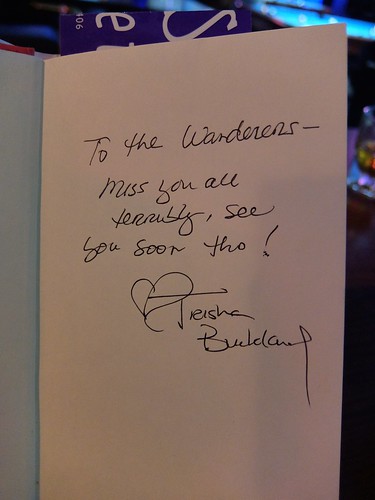
Gift from Trisha to Wanderers

DSCF0171


Far east of the Portland downtown (CBD) that is.

We talked about how "official London" is pretty small, compared to Greater London all around it. Steve Holden, whom Trisha asked about, is now working in "official London" on Christopher Street.

Trisha teaches the kind of maths needed by pharmacists, lots of measure conversions, getting amounts exactly correct, lots of stuff I don't know about.

Trisha was blown away by the poetry grand slammer below.  I'm glad she clued me in.  She introduced me to Logan and more of her extended household at a favorite neighborhood public house.

This was free pool night (as in striking a small white ball with the end of a long stick, on a green table, not swimming).

Friday, September 04, 2015

Recap

Recap

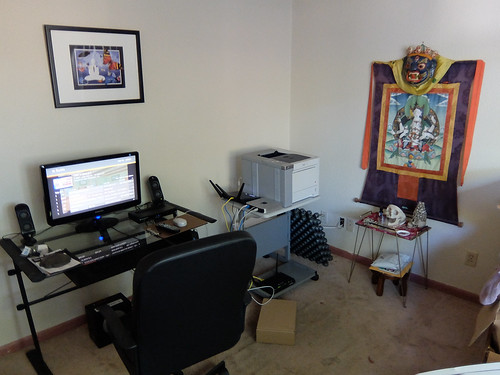
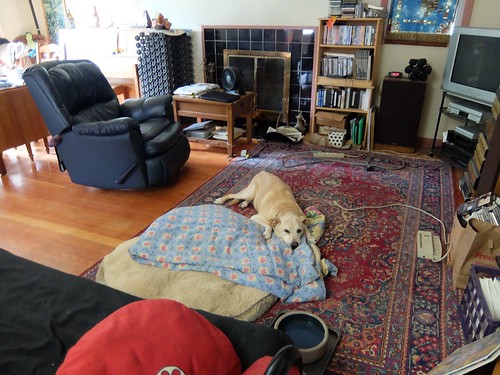
Living Room

Chair of Computer Science

Thursday, September 03, 2015

Flipped Classroom

The "flipped classroom" is not a new idea, nor need "either / or" be the logic, i.e. a school using flipped classrooms need not use them always, not even per a given subject.

Take mathematics in the context of STEM.  Some shared equipment is spendy, such as lab equipment, and team building exercises are critical anyway.  Coding, on the other hand, may require some times alone, ideal for homework, though with on-line collaboration exercises also key (coding is a highly social activity).

Learn your coding skills asynchronously through hands-on practice and give talks about your projects, recorded to the school server in some cases.  Adjourn to the lab for team work.

Does this sound like college?  The personal workspace (PWS) is not necessarily a single location, but access to undisturbed safe study spaces, privacy, time alone, is an integral part of many learning patterns.  A typical campus takes the PWS concept very seriously, from dorm to study carrel.

Lower grades, twelve and below, have historically assumed the classroom as the core learning space, but this is changing.  Depending on the region and school system, learning may look more like scouting and homeschooling, and working in a TV production studio, in addition to sitting in classrooms.

Food prep and cooking may be rescued from Home Economics and placed under STEM.  Both health and chemistry get the focus in serious food oriented courses.  Question dogmas.  The food and beverage industry comes with agendas, sometimes hidden.  Critical thinking means bringing these to the surface for analysis and open discussion.

Critical eating (studying ingredients, nutritional value, production process, environmental costs and benefits) is as important as critical consuming of any kind, including of media.  We're fighting the "mindless consumer" stereotype less so "the consumer" as we all must consume, but lets do so mindfully.

Sharing kitchen equipment, like lab equipment, and learning to cook and clean up for larger numbers, is another benefit of sharing a school.  Larger scale kitchens have equipment not needed in the home.  Food Not Bombs took me into many a church kitchen (OK, a few).  The Quaker Gathering of Western Young Friends was likewise about moving into a large camp-style kitchen and making food for each other.  2 Dickinson Street:  same deal.

Wednesday, September 02, 2015

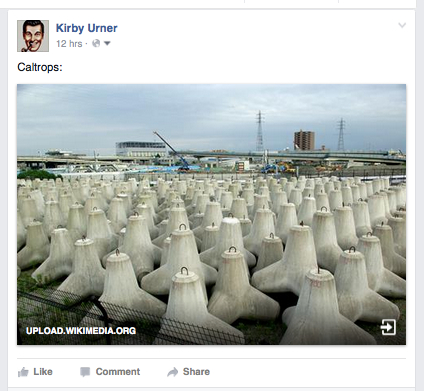
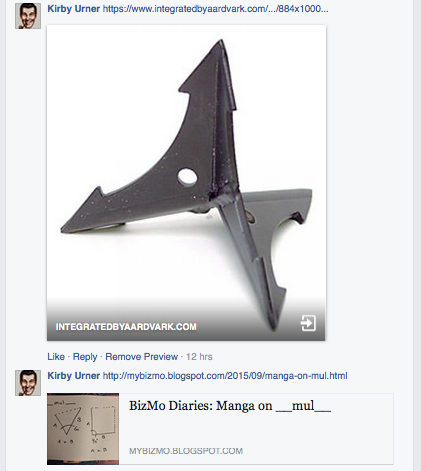
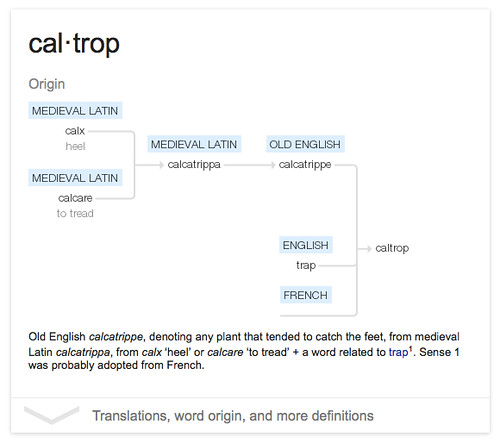
Caltrops


caltrops

caltrop2

caltrop_meaning

Tuesday, September 01, 2015

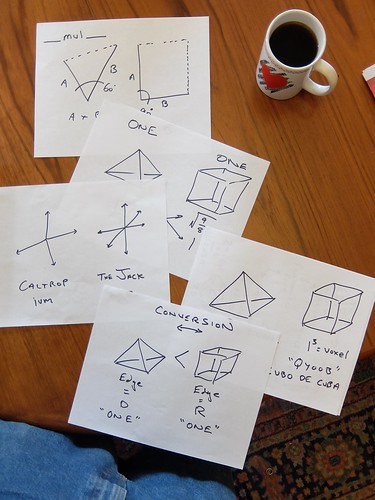
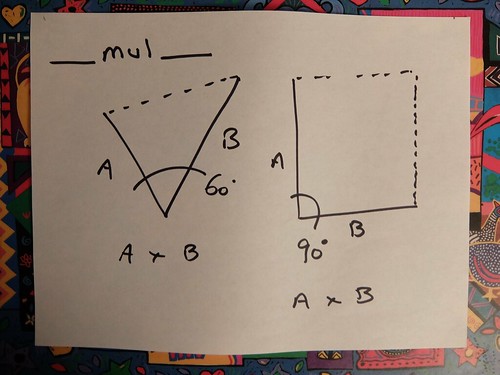
Manga on __mul__

Defining __mul__ (multiplication operation)

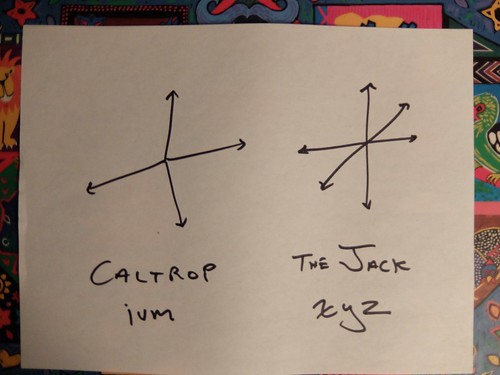
Caltrop & Jack

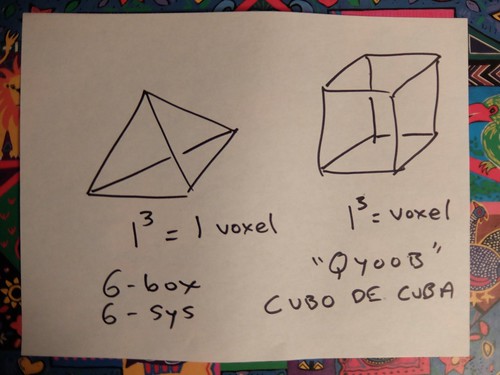
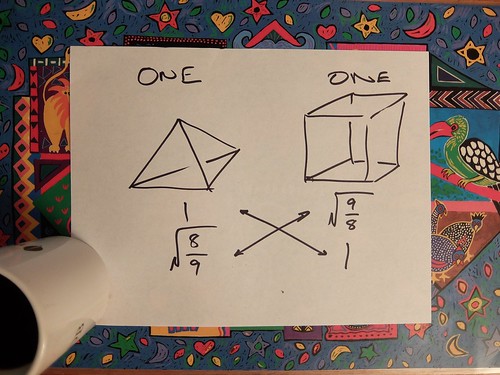
3rd Power Growth

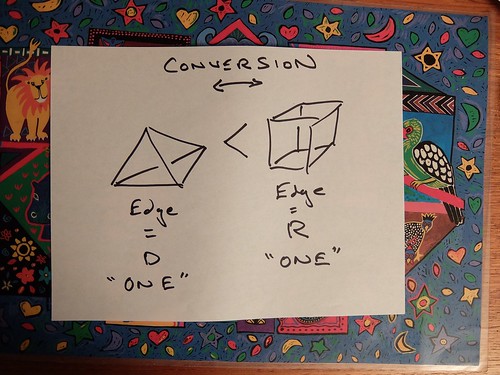
One < One

DSCF0102

Conversion Constant

For Further Reading:
Bridging XYZ and IVM Volumetric Accounting Systems with the Square Root of 9/8 by Kirby Urner

For Further Eating:
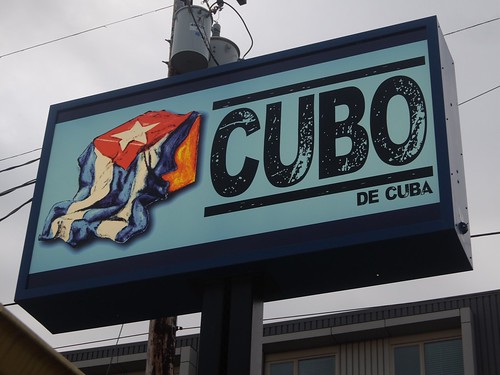
Cubo de Cuba, Asylum District, Portland, Oregon (restaurant review in WW)

Cubo Cuba... Cubs!

Monday, August 31, 2015

Commercial Product

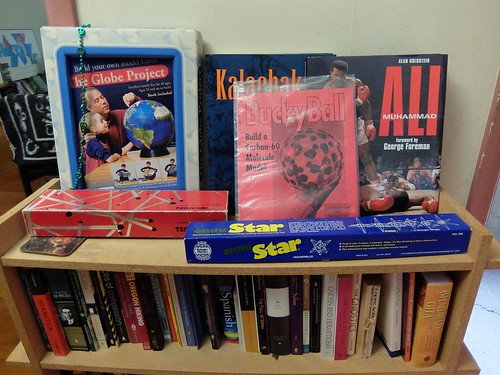
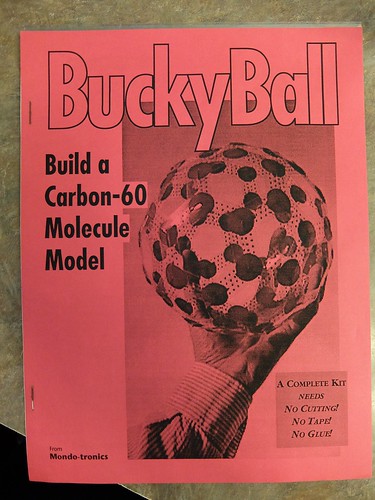
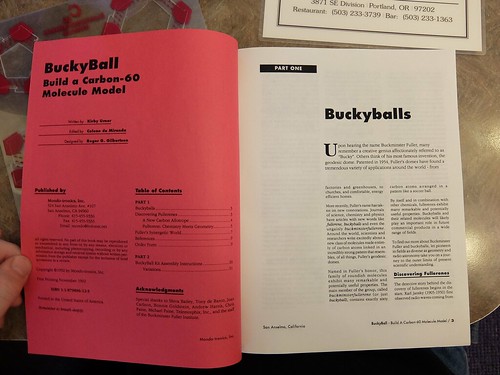
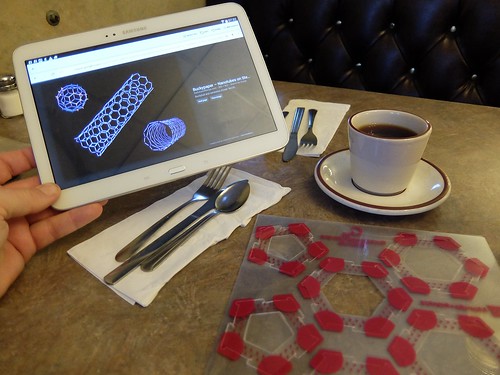
BuckyBall by Mondo-tronics

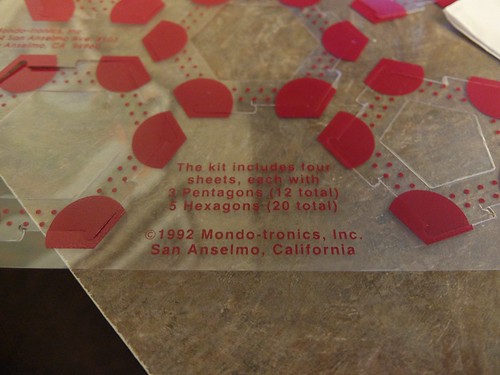
Four Sheets (each with 3 Pentagons, 5 Hexagons)

The Booklet on C60

Plastic Kit

In the early 1990s I collaborated with Mondo-tronics on this first snap-together model of the BuckyBall, complete with an explanatory notebook, written by me.

For further reading:
STEM:  Carbon as a Theme

Wednesday, August 26, 2015

Google Classroom vs ALE


Of course a lot of you loyal readers may have been wondering:  "ya'll are going on and on about ya'll's Asynchronous Learning Engine (ALE) but what about the Google Classroom API?"

Excellent question.

Google's metaphors are more staidly rooted in the idea of a brick and mortar building with classrooms, whereas ALE has more hints of travel industry thinking.  One may regard a lot of these differences as superficial, a matter of "skinning" (GUI = skin).

Having ALE and Google's classroom API both in the same genre or category is muy convenient as well, as that helps with comparing and contrasting learning engine models more generally, a discussion we need to have, as learning is now the core business of so many of us these days.

My work on ALE is influenced by years of working with Nano, an in-house solution wrapping an approach to andragogy which inherits from the DIY or "craftsman" schools, such as Make: Magazine. At the other end of the spectrum is kicked-back watching videos, passive absorption minus much kinesthetics.  Combine both modes, but definitely the "off your duff" active learning mode is not the one to sacrifice.

Differences in philosophy need not be closely followed by an API; the same classrooms and buildings get used by all manner of faculty member and student enrollee.  I'm not looking at ALE as staking philosophical turf except insofar as I've suggesting making "grading" ancillary, an add-on.  ALE should be compatible with a non-graded flex-time style (self paced) but not dictate this template as a universal format.

Testing a prototypical Python course in the Google Classroom sounds like a worthy project.  That would be hands on experience I could take to the bank when it comes to envisioning a next generation of Nano.  Y'all would benefit.

ALE is vaporware as of this writing, a stub ready for test case development, however it inherits from a working version within an operational school.  Google is ready for developers to start using its API today.

Google Classroom is an exciting reality and door-opening possibility I'm eager to explore more deeply.  I've been nudging the Quakers about it, given priority access is reserved for non-profit / non-commercial enterprises.  We could use it to conduct Interest Groups.

Saturday, August 22, 2015

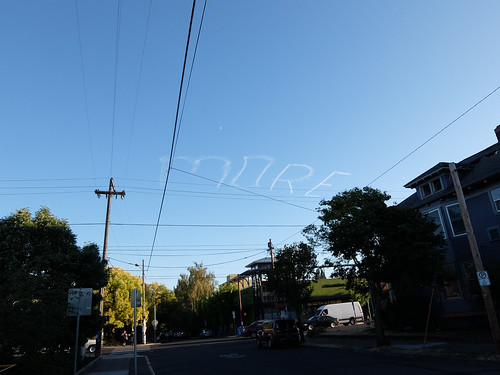
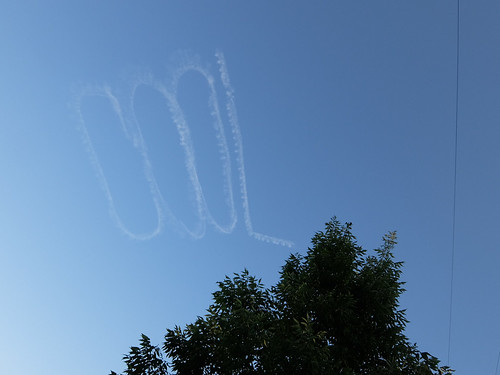
Sky Writing

DSCF9912

DSCF9908

DSCF9911

DSCF9914

DSCF9916

DSCF9917

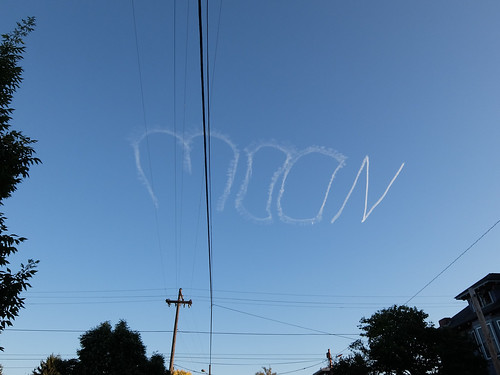
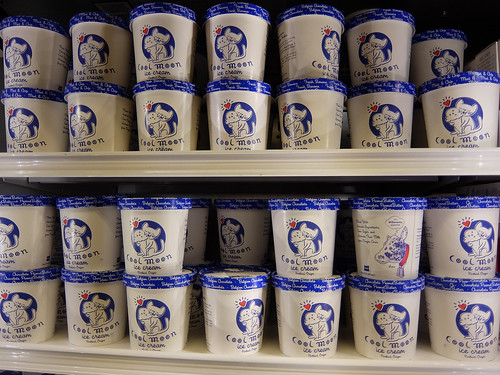
:: more cool moon ::

Thursday, August 20, 2015

The Farmer in the Dell

Lesson2.py output

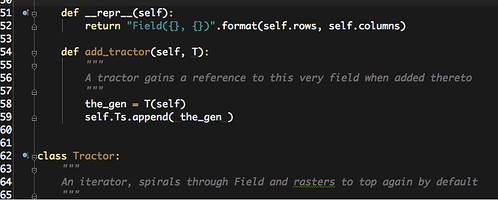
... the Dell in the Farmer.  Lets think of a farmer riding a tractor, the tractor in a field.  Yes, the farmer is in the field, but then so has the farmer internalized the field, a mental field.  People do that with fields.  In the computer language I'm learning, Python, the method for adding a Tractor to a field is a time to give the farmer, the self of the Tractor, a handle on the Field.

tractor_born
the self of "this Field" is provided to the "self" of the added Tractor

One may view that in source code at GitHub, where Lesson1.py defines the Field and Tractor, along with a subclass of Tractor for writing in the field.

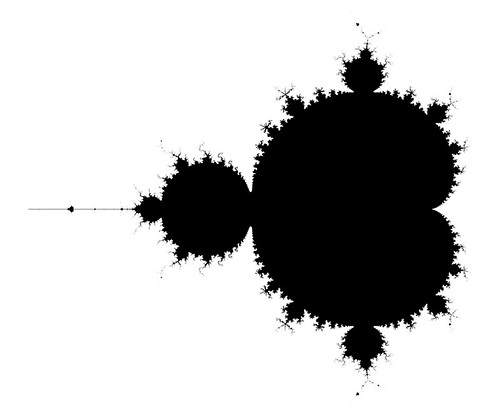
Then Lesson2.py defines another subclass of Tractor, the CropCircleTractor, that appropriately plows or plants a Mandelbrot in its Field.  The output is just a text file, ASCII art, whereas in future Lessons one might use PIL, or POV-Ray, or VRML or even Visual Python.

The Field is an XY layer, a grid of cells each addressed by two numbers, a familiar tool.  Piling up these layers, 3D Printer style, would be a way to encompass Volume which contains shapes we might address in various ways, perhaps with XYZ coordinates, adding Quadrays as a less familiar tool for contrast.  The Mandelbrot might become a Mandelbulb instead.

The Tractor comes with a TV-like raster motion.  A real tractor would turn around and come back the other way, but this one works more like a spiral, as if the end of a row connected to the beginning of the next at the other side of the field.

I_notebook_fractal

Then, having traversed the very last row and coming to the end, the Tractor magically reappears at the start again, to begin its trek all over.  What we lose in freedom, we gain in the simplicity of the code.  Provided the Tractor has enough fuel (there's a fuel_level), every cell will get visited within a circular topology.

Another subclass yet, of which I've already done some versions, plays a Game of Life using rule-governed cellular automata.

Might we alter the Field class to consist of hexagons instead? Games of Life may be played that way too, and are, quite a lot.

Could our Volume be as if filled with rhombic dodecahedra, perhaps using Quadrays again?

These vistas stretch out before us, which speaks well for the simple ladder that got us up this high, where we get lots of overview.

Using Pillow & I-Python Notebook

Tuesday, August 18, 2015

Film Theory

I'm going out on a limb here to suggest a hallmark of fictional films is they participate in the same voyeurism as fictive theater in denying there's either an audience or a point of view.  We're complicit in this mutual agreement to suspend disbelief.

To call it "voyeurism" maybe makes such outright denial sound bad or dark, however the motive is innocent enough and has to do with removing any troubling metaphysical questioning from the viewer's mind, such as "how could I, in the 21st Century, be witness to a battlefield in a war fought over a hundred, or even a thousand, years ago?"

The obvious answer, "this isn't real" just gets in the way of getting into the fantasy.  The whole point of a cave-like theater, bright screen, surrounding sound, is to "put you right there" meaning the thoughts we don't want to be pestered with are such as "I'm staring at a screen in a dark room at events that never happened."  We can think that later, after getting our money's worth.

So just don't worry that movie cameras of this quality had not been invented yet and that those awesome sweeping aerial shots would have required technology unavailable at the time, not to mention awkward to deploy in the midst of battle. Forget the fact you were not alive at the time and could not have been a direct witness.

A long time ago we theatergoers got used to omniscient narrators who have the ability to flit about seeing and knowing everything, even the secret thoughts inside people's heads, given the power of novelists to create characters straight from their own imaginations.

We're told this "choice of voice" is a matter of tense and grammar, versus an author assuming superpowers to know in ways mere mortals don't.  Again, we're complicit in wanting this omniscience and will trust our authors and directors to conjure its facsimile.

Fiction denies the camera.  On the other hand, to acknowledge both an audience and a camera is not to escape the vortex of fiction and, in fact, escaping said vortex may not be the film maker's intent. Film and theater are art forms and fiction has always been fair game, ditto stage magic.  Newsreels came later.

I have no quarrel with fiction, nor have most moviegoers as a clientele, those who are sticklers for strictly the documentary genre being a relatively small minority overall.

However, speaking of documentaries, many of those deny the camera too:  there is no film team, this is not a film, is more the attitude.   Perhaps we have an omniscient narrator, that tells us what we need to know.

Applying my criterion, I'd say such films tilt towards being fictional.  Non-fictional films include the process of making the film somehow and acknowledge the reality of an observer making a difference in some way, if only in choice of scenes.  An observer is also an editor.

Film removes two freedoms the novel reader takes pretty much for granted:  the freedom to "make the movie" in one's own mind, to imagine the action, and to create a point of view from which that action is perceived.

The theater substitutes an imagined scene for a real one, acted out with scenery, and now the points of view are limited to those within the theater. Some are in the balcony or in boxes, whereas some sit below in the orchestra section.  Buying a seat is tantamount to choosing a viewpoint, as is buying a pair of good binoculars (or opera glasses as the case may be).

The convention with film and TV is the viewpoints are chosen for us.  This becomes more clear when we consider the alternatives.  Some immersive recording devices provide a complete sphere or almost a complete sphere of action which the viewer may then swivel within, in real time, looking in different directions from a center point, as if turning one's head in all directions.
In ordinary movies, one has a choice of what part of the screen to gaze at, but even then, a director is directing attention, choosing an angle, and if engaged at all, we usually see what we're intended to see.  Providing TV viewers with a remote control and the ability to pause, go forward, go back, pick a scene, play slowly... these were new powers that early ticket-buying film viewers did not enjoy.

Now it's getting easier to quote video, to splice it in, grabbing from free and/or for-a-fee sources. Making home movies that were clearly amateur was a possibility.  Nowadays, more with less and ephemeralization have taken their course and the barriers to going pro are less physical than psychological.
Sometimes we can move between a fictional no-camera-here scenario and a more grounded one. For example, when newsworthy events occur, it becomes possible to watch the "same" event through multiple news shows.
The added realism may come less from the news shows themselves, and more from one's recognizing oneself as a chief editor, somewhere along the production pipeline.
"This is how I put it all together" one says to oneself, acknowledging one's process and assuming responsibility for a perspective.  This can be value added work, sometimes called analysis, or perhaps synthesis.  Perspectives, as much as perceptions, may be dangerously out of whack and should be tested, reality checked and reviewed.  Keeping it fictive actually keeps us out of the danger zone in the sense that we don't care if it's "actually true" or not.

One may take that approach even when many of the news sources are doing their best to erase or deflect attention from any sense of a camera with a point of view, an innate bias.  That's fine. Semi-fictionalized versions may be the best versions available.

There's no depending on any input stream to stay purely factual.  Always allow for spin rather than fight the mere fact that spin exists, then apply counter-spin if you think that's in order or a part of your work.

Saturday, August 15, 2015

High School STEM

clojure_map

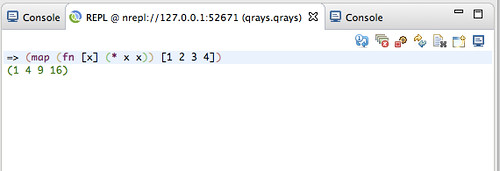
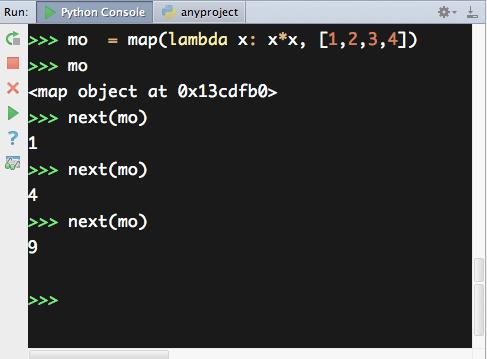
The above is from a Clojure REPL in the Eclipse environment (IDE), whereas below is pretty much the same idea in a Python REPL, in PyCharm.

The symbol 'map' is a built-in function in both languages and does the same thing:  it applies a function to each member of a collection.

How the collections are named depends on the namespace:  Python or Clojure.

The square bracket collection above [1 2 3 4] is called a vector and needs no commas as commas count as whitespace in Clojure.

Below, in Python, [1, 2, 3, 4] is called a list, though a tuple might have been used, in which case parentheses replace square brackets.  Commas would be required either way.

What Python outputs is not another list (or vector) but an iterator, named mo in the example below.  An iterator is by definition responsive to the next() function.

Each time the iterator is fed to next( ), it yields its next value in the sequence, by applying the lambda to a next element.  One might also loop over mo in a "for elem in mo:" construct.

A lambda expression in Python is a way of defining a function on the fly that need not be remembered with a name.  The Clojure function is likewise anonymous, using fn instead of defn.

python_map

Although full blown mastery of either Python or Clojure might be too much to expect of an average busy high schooler, with limited study and practice time, some exposure to both is not out of the question.

Let the spiraling begin!

A strong STEM curriculum would likely include at least some dialog with the various REPLs, with mentor guidance, and combined with self study.

Yak with Python.  Chat with Clojure.  Get used to having these tools around.  They're free for the downloading (IDEs too).  Instructional materials abound.  Get in gear!

Friday, August 14, 2015

Unicode Again

devanagari

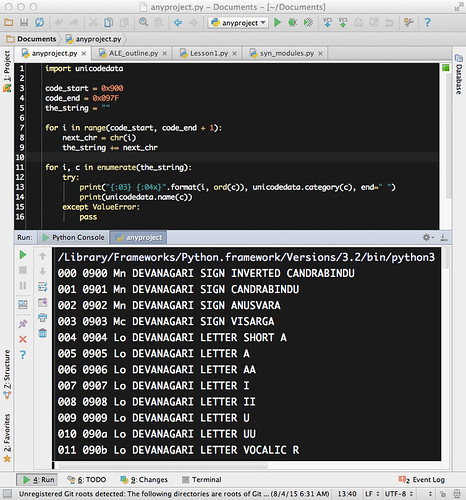
I just discovered some bogus information I'd been purveying, which is that UTF-8, a way of encoding Unicode characters (actually code points), may include up to six bytes per character.

In fact, that used to be the standard, but per RFC3629, when Unicode merged with an ISO standard, the cut off was set to 4, covering hexadecimal numbers U+0000..U+10FFFF.

The Python docs themselves give a clear, if abbreviated, introduction to the history:
There’s a related ISO standard, ISO 10646. Unicode and ISO 10646 were originally separate efforts, but the specifications were merged with the 1.1 revision of Unicode.
This featured chronology at the Unicode.org website seems to stop in 1992 and doesn't talk about the 1.1 revision.

Monday, August 10, 2015

All Math is Ethnomath

I used the saying "All math is ethno-math" almost as a slogan on math-teach, a listserv where I'd posted thousands of entries.

But what does that mantra even mean?

Well, there's this literary conceit inherited from specific cultures, wherein "our" brand of math is "universal" and in that sense, culture-free.  "We're above all that" is the attitude (snobbish).

Peoples have wanted to get "above mere culture" such that, from an Enlightened stance, they could administer justice, lord it over those more mired in their cultural milieus.  Cults assured of their "above it all" status will gladly let others know of their relative inferiority.

Mathematics, including statistics, invented by sociologists and statesmen alike (yes, mostly men back then), was to be the tool of Empire and, as such, a product of Reality Itself.

Imperial grammars all tend to assume great gravitas and may begin to exude that "sheen of eternity" -- a shiny polish or reflective veneer.

Those who speak the mainstream Mandarin will tend to impute "ethnicity" to everyone else.  "Ethnic food" is "their food" -- perhaps delicious, but the point is it belongs to a "them", some "minority".

A mainstream mathematician is perhaps not in the mood to cop to any brand of close to home math as having any "ethnic" flavor.  Babylonians and Macedonians had their quaint ways but by now our math is Universal, has conquered all corners of Planet Earth.  That's an attitude.

However, in these days of post postmodernism, I think a far greater number of academics are friendly to the view that yes, all math is indeed of some ethnic flavor.  We may and probably should study math in a cultural matrix, rather than erase or deny these special case roots.

But lets not confuse "ethnic" with "parochial" necessarily.  World-traveling pirates who put in to many ports, with crews in turnover and networks of spies and informants across the lands, would have had more opportunity to develop what I'd call "cosmopolitan" traits.  They'd be more catholic, more liberal in their outlook, one might surmise, more accepting of the diversity among the many cultures.

"Ethnicity" is one of those concepts that slices every which way.  Really one might better say "cultural currents" or "lineages" or "traditions".

One may talk about "races" but also "genders" and "social classes" and "the professions".

Think about it for awhile, and you'll come up with at least a dozen ethnicities you might go by, easily more.

In light of this backdrop in broad brush stroke, I did some work to brand specific geometrical artifacts as "Quaker".  That may seem quite weird.  The justification or thesis had to do with American Transcendentalism, New England's in particular.

The traditions feeding Quakers include some poetic currents flowing through and around Bear Island, for example.  The World Game idea, so attractive to Medard Gabel, is decidedly pacifist in competing with any War Game for attention.  GENI is about bringing power to the people -- literally, in the form of electrical distribution networks.

Once a people have banded (or branded) into a "tribe" with some currency and reputation, with some semblance of self governance, then perhaps the mathematics they pass along to their progeny, like their myths and bedtime stories, might achieve the coveted "cultural" status, i.e. some of the artifacts, the algorithms, become museum quality exhibits, like exquisite baskets or china on display.

Certainly the ethnicity of "ancient Greek"--  as in "Athenian" -- became a hallmark in the annals of Ethnic Math.  We all learned respect and admiration for those ancient Greeks and many of us gladly lay claim to that lineage.  "We too are worthy heirs".

In any case, you'd be hard pressed today, in 2015, to find many if any Quakers (besides me that is) talking about "the IVM" or "the Jitterbug Transformation".  You'll find all these terms, along with the associated mathematics, on the web, and in Wikipedia, but any adoption of such topics by Quakers is hardly on anyone's radar.  "Not just me, but still just a few" would be my assessment.

So consider you may have stumbled upon an esoteric memeplex then, possibly of some potency.  Stay tuned.