Monday, March 20, 2017

Members Only?

Winter in Portland

What saves the institution of membership from degenerating into run-of-the-mill cronyism and cliquishness (the common lot of your average black box church) is transparency to non-members, i.e. no "members only" rituals and initiations.

This guiding design principle puts the non-member in a position to fully "try before buying" while placing workflows under permanent "outsider" scrutiny. Members feel publicly audited 24/7, and that's actually what public companies (non-profits) are supposed to provide, in exchange for their not having to pay taxes the same way an ordinary business does.  We're more like governments, of, by and for the people. Religious institutions take that "nothing to hide" route, and then often hide plenty. However Quakers pride themselves on conducting their business openly, as a part of their truth testimony.

During my most recent tenure on Oversight, I pioneered having a clear policy of inviting non-members to join clearness committees for those wishing to become members, even to convene same. I must say some members found this highly counter-intuitive. We did always have at least one member on said committees, as for purposes of clearness, the candidate member should have worship discussion with Friends of both persuasion.

In my view there's no other way, outside of transparency, that has much integrity. Otherwise you get "members only" signs and symbols and before you know it ruling clique mafioso with rank and gradations, handing out favors to the most sycophantic, and the whole anti-egalitarian hierarchy of an illiberal church, blech (some pastor-led churches may be quite liberal in the sense of open source, not saying only unprogrammed have a shot at salvation).

You want your convinced Friend / new member to have had the opportunity, at least in principle, to have served in any capacity asked of her or him, which may include sensitive positions that fully exercise a person's talents (e.g. AFSC liaison).  Nominating is free to overlook membership in seeking to bless people with opportunities for growth that serve the meeting (win-win). Non-members on Finance, Property, Oversight & Communications, Ministry and Worship, is more the rule than the exception. I know I've shared all this before, but I think it bears repeating.

That being said, because we have to map to Oregon state legal templates at some level, as a 501(c)(3), we reserve some of the fiduciary / corporate roles for recorded members, with maybe some rare exceptions.

That's in keeping with the institution of membership's main purpose: to draw attention to those publicly identifying as Quakers in some recorded / authorized way.

In theory (I've heard this often) the recorded members are presumably taking more risk, like if Quakers get in trouble with the authorities or people start spray-painting Quaker stars (red and black) on peoples houses. Members get credit for bravery and going to jail first. This sense of "going first" traces to olden times when Friends were deemed politically incorrect and extremist.

But then we need to remember all the not-members and un-propertied, all the slaves and indentured servants, who were also brave in lending our Society their integrity, in whatever ways open to them.

The not-public Quakers comprise a kind of Wall of Stars, of anonymous benefactors who never outed themselves (how could they? Maybe I'm a general in some army somewhere, yearning for peace, whereas outing myself would be political suicide in my position) but supported us behind the scenes nonetheless. 

The theme here is respect, earned or by entitlement, and I'm suggesting members and non-members are flip sides of the same coin (and I understand meetings not wanting to bother with the overhead -- I'm thinking more of how to cope with inertia from the past, vs. trying to impose an unwanted institution on newer, membership-free brands of Friend like Howard's).

[ copied over from QuakerQuaker ] 

Sunday, March 19, 2017

Another First Day

Into the Vortex...

"First Day" is Quaker jargon for Sunday. One spin is our Puritan heritage made us shy away from pagan concepts, such as a Sun or a Moon. God's people would just use numbers, goes the theory, and in many a database that's true (the calendrical data gets distilled to an integer).

I'm fully under the impression today is Business Meeting, an open event, though not in the sense of including lengthy recaps of prior episodes. We don't interrupt the meeting to do long retrospectives, though that might really help as a Program Committee project. Studying one's own history (as in medical history) is usually a wise investment, unless maybe hypochondria is your main problem, in which case just let go.

One of my healthcare stories is dad and I got hepatitis, we think from the corned beef in Ramallah that time, but who knows. We were heading to Florida, having spent the summer in tents, in the outskirts of Rome, and in this small town near Jerusalem, since grown. We banged on rocks with sledgehammers, like in the cartoons, and of our own free will, as peacemakers. AUB students joined us, as did local Boy Scouts (a translation; local adults, mostly men). This was in the early 1970s.

Dad's hepatitis got worse and he needed to be quarantined, all while seeking new work in the capital. He'd given several years to the fifty year plans for Libya's development, not that he was the decider or anything as planning is not like that.  It's a process, more like a Quaker business meeting.

I've already missed Meeting for Worship, which is weekly (Business Meeting is monthly). I was up late watching the new Adam Curtis film, HyperNormalisation. I still have time to make business meeting.

Likely I won't have much to say as I'm not currently on any of the several committees. I hopped on a welcoming team recently, got to have lunch with the Abbotts, Betsey Kenworthy, Mike Goren (transferring in) but that's been the extent of it since Peace and Social Concerns.

Regionally, I've been active with IT Committee, both on and off, as clerk and not-clerk.

Curtis did Power of Nightmares, which I've always appreciated for its succinct summary, with talking heads. I started sampling it last night again, using Youtube (an Alphabet company), which is what got me plowing through HyperNormalisation, released prior to the US presidential election in 2016. I'll get back to it later with a more proper review.

I'm still eating the Trader Joe's Pita Pockets I picked up at the Men's Group (Willamette Quarter), having secured a supply of hummus upon returning to Portland.  Great gathering, guys.

After Business Meeting I might see if anyone wants to grab a beer at either Horse Brass or Belmont Station, both near to the Stark Street meetinghouse. Our branch of Friends is not out to reimpose Prohibition or anything like that.

Curtailing human freedoms is not at the top of our agenda, or even in the middle.  Quakers formed in many ways as a counter to the overbearing / overwhelming power of faceless institutions, bureaucracies, which in those days was heavily Church of England.

The UK had the New World as a blank screen on which to project new vistas, new programming. Many Quakers chose to pioneer said New World rather than accept their lot in the homeland.

How the story goes from there is rather long, safe to say the Quakers went on to pioneer in the midwest and eventually some got all the way to California, our spiritual ancestors among them.

Our Pacific Northwest meeting is pretty cosmopolitan by this point.  We don't have the Unicode name tags yet (for those with names spelled outside of Latin-1) but they're in the works. All contemporary databases support Unicode.

Addendum (email to old friends, from Hop House):
Good to hear from you Rick. I'm sipping an IPA after Quaker business meeting.

I left early as they wanted to talk about a members-only HVAC system fundraising committee, however I've rescinded the right of these particular Friends to count me as one of their members, for personal integrity reasons (their members are too snooty and spoiled, not my favorite flavor). Best to quit while I'm ahead. I still count myself a Quaker.

That was awhile back, that I dropped my membership. I've continued to serve on committees and even donate money from time to time.

I'm pleased to be back in touch with Tom on related topics of Zero, Origin, Vortex (one of your favorites), in addition to the caltrop-based (vs jack-based) XYZ-like coordinate system with origin (0,0,0,0). 

He's the Zero expert. Oregon did sponsor a rock concert named Vortex One long ago. Wikipedia has a write-up I bet.

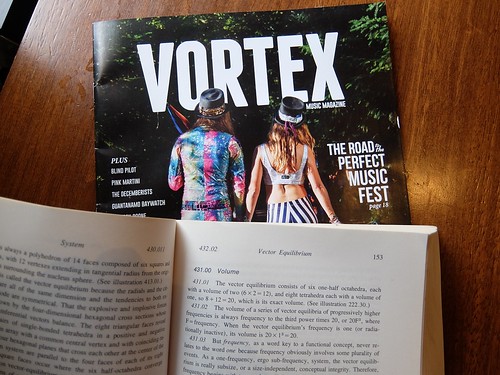
Come to think of it, this Hop House still gets Vortex magazine.

Thursday, March 16, 2017

Fake News


The money launderers were at it again today, exchanging their tainted cash for company equities, getting help from a suspect bank.  Cyprus may have carried water for a fertilizer enterprise. We're still watching those tail numbers, to see which private jets rendezvoused where.

Although we have no firm evidence Flynn actually Skyped the Russian ambassador, leading to Microsoft's leaking the conversation directly to Warren Buffet, stranger things have happened. Click here for amazing weight loss facts. How the Vice Principal got the transcript, if he did, is the subject of ongoing baseless speculation, which the NYT will stand by, as Obama had nothing to do with it.

The intercepts, while not authorized by a sitting president, were nevertheless a legitimate probe into what might have been a nefarious business, and in the absence of proof otherwise, we're left at best with a diagnosis of ODD or "oppositional defiance disorder" (look it up).

Should the numbers prove disqualifying, an experienced Panetta has reassured us of his willingness to step in and lead us to our destiny, should things get too weird. Or would Colin Powell be our more compliant Smedley Butler and not turn on us this time? Never mind, just business plotting out loud.

Whether this finding of ODD is more disqualifying for high office than ADD (or ADHD for those with trouble following) remains to be determined. The union of neuroscientists is expected to produce a report, rivaling that of NIST's on WTC7 for the completeness of its final, if surprising, conclusions. Will Puerto Rico be our 51st state by then?

Rumor has it that FEMA wants you to know if you're registered to vote or not given all the rumors of a purge of double voters, a number one felony among the least-likely-to-vote. Some true blue, red blooded Americans (buy Cialis) have suggested (recently) that our Democracy of the Stars was in need of some emergency roadside assistance, AAA-style. If in doubt call 1-800-alt-real.

Remember to use the promo code to collect your discount.  Meanwhile, in Zanzibar...

Wednesday, March 15, 2017

Retrieving from MEMEX


"In a math class we use operator overloading and objects in the first 20 minutes."


Bridging graphical and lexical... (2016).  Delta vs. Lambda calculus.

"I'm handing it over to the physics department in this scenario..."

Tuesday, March 14, 2017

Of Globalism and the Macroscope


I'm not sharing this because I agree with it, but because I think it brings into sharp relief what the wall-builders are thinking: "borders, language, culture, that's what defines America, that's what defines every nation."

I'd counter that the Americas have never really experienced closed borders of the type the wall-builders envision. What the alt-right is pushing is an ideal (not yet real) form of nationalism wherein we finally do nail down the vision and make borders impermeable (no, not like a cell wall, but Savage uses that metaphor).

Kind of like "being documented": we have yet to live in a world wherein everyone is carefully documented, birth certificate onward, but we appear to be approaching such a world, given IT prowess.

We can imagine it and somewhat need that (universal documentation) to work better for the ideology of nationalism and its concept of "citizenship" to finally reach everybody, including nomads and gypsies.

Nationalists ardently wish for the nationalist ideology to finally become the dominant ideology, whereas I'm more thinking nation-states reflect a bygone Victorian Era imperialist world view of another day. That doesn't mean they can't or won't continue to provide core services.

An older globalism is getting replaced with a newer one, with more morphing to follow (humans are reprogrammable, our saving grace), which neither abolishes ethnicity nor self esteem, nor pride in one's heritage.

Our telecommunications have a lot to do with it. It's not telepathy, but it's close. When nations got off the ground in Europe, around the time of General Garibaldi, we didn't have this layer yet.

We globalists just happen to see more clearly than ever that our species shares a biosphere and needs tools (such as the macroscope) to self organize. We're doing our best, which may not be good enough, that always seems to be the story line.

Speaking of macroscopes, Glenn caught it right away when IBM embraced the term recently. For Glenn and I, the macroscope meme connects to the hexagons + pentagons pattern of the soccer ball, but perhaps with many more hexagons (higher frequency).  What if any such motifs IBM is considering we're not privy to. A lot of PR has been moving in that direction, sensibly.

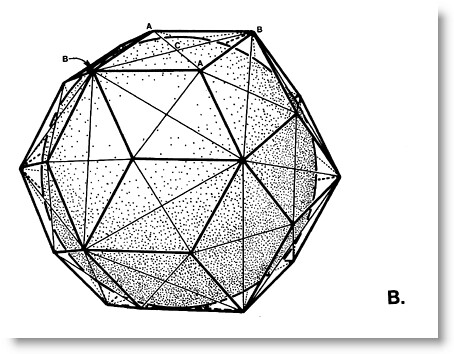
Edward Popko's Divided Spheres is a great primer on spherical surface subdividing.

Wednesday, March 08, 2017

GeomViews

The Platonics have been played with for ages. They're a closed set under the operation of "dualing" i.e. the dual of a Platonic, is a Platonic, the tetrahedron being self dual.

Dual(Tetrahedron) is Tetrahedron
Dual(Octahedron) is Cube
Dual(Icosahedron) is Pentagonal Dodecahedron

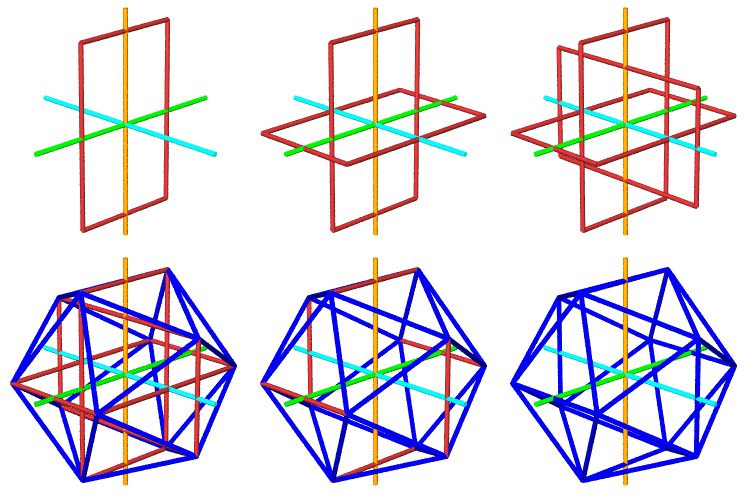
The self-dual tetrahedron gives rise to the cube and there, with mutual orthogonality, we get phi entering the picture, as mutually orthogonal rectangles supporting the icosahedron of twenty equilateral surface triangles.

The Borromean Rings may or may not enter the picture at this juncture.


The icosahedron, crossed with it's own dual, yields the rhombic triancontahedron (RT).  Hold that thought. It has thirty "wedges" to the center, thirty diamond faces.

Rhombic Triacontahedron

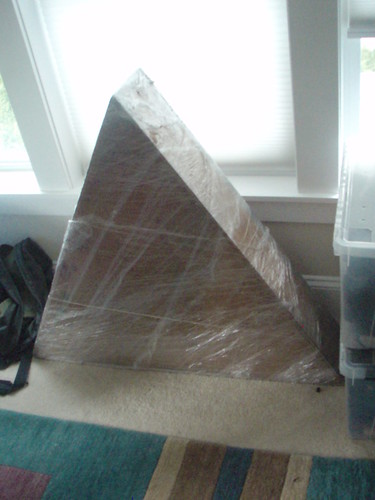
Turning next to the TetraBook, you'll remember how DB Koski was tilting its page. That's not the only possible TetraBook by the way. A 2x2 square, three of those corner-intersecting, makes our octahedron, half of which could be a book. 

Again, with an isosceles page straight up (angles 45, 45, 90), you have unit volume (1/4 of the octahedron's total). That's unit in IVM tetravolumes (vs XYZ cubic volumes).

The classic TetraBook has equilateral 2x2 triangular book covers, with one page flapping back and forth, same size. Click stopping at volume stops map(√, (9/8, 8/8, 7/8, 6/8, 5/8, 4/8, 3/8, 2/8, 1/8, 0)) may seem a bit quirky, but at √(4/8) volume, he notes a volume of 4 E3, the same as a wedge in the aforementioned RT.

E3 = √2/8 and 4 * E3 = √(4/8), one of the volume click stops along the TetraBook track.

The notation is such that the RT hugging (shrink-wrapping) a unit-radius sphere is made of E-modules, which scaled up by phi are E3 modules, as volume is upped by phi to the 3rd power when the thing is linearly scaled by that amount.

Scaling down by phi is lowercase: e3. We have self-similar E6, e6 etc., going up and down the size spectrum.

Reducing volumes to canonical assorted "sizes of E-module" is one of DB Koski's focal points. He'll do the equivalent with S modules given their simple volumetric relationship:  VE:icosa :: S:E (S:E is the so-called "S factor").

The TetraBook track is important for the last two stops, 8/8 and 9/8. Those are the two unit volumes in the IVM and XYZ coordinate systems.


Sunday, March 05, 2017

Family Feud

If World Game were a game show, which game show would it be? Who remembers Family Feud? Good wholesome fun, right?

As I pondered aloud on Facebook:
"We've got billions, we can buy weapons, fortifications, governments... we've won." But then there's the problem of other billionaires (multiple cabals) and to what extent do we need the people to tacitly go along. It's starting to look like they don't miss their democracy and are willing to play out their lives within a global plutocracy. Do they have a choice? That's a question.

Given how I'm such a Bucky fan, I feel as an exercise I need to investigate in what ways he might have been right in Grunch of Giants, about the fate of the United States. He saw the cash reserves of the world concentrating in the hands of invisible private interests with governments left out in the cold as puppets acting out the various feuds among billionaires. He called this cash heist GRUNCH ("gross universal cash heist") and claimed it spelled curtains for the nation-state age, as the billionaire fortunes are supranational in nature. Given what I'm seeing on the news, this 1980s "science fiction" is seeming plenty believable. I'm thinking Bucky Fuller deserves a place in the pantheon right next to George Orwell.
There I go again, trying to win more points for "da man" and besides, who wants to be the next Orwell? Doesn't that sound rather grim?

What else have I posted recently that might be fun?  

Oh yes, my "generation gap" analysis regarding why the younger people have a vendetta against the so-called MSM (mainstream media). 

I've sounded these notes before.
In a lot of ways what I'm interested in is not "the truth of what happened" but of generational perspectives thereof (ditto Apollo, which I believe happened but record numbers of Millennials have doubts and that's interesting all by itself).

If 0% think Oswald acted alone, that's a fact independent of whether he did or not. What people believe is not the same thing as what's actually so, and I may deliberately care more about the former than the latter.

I'm saying there's a generation gap around the NIST report on WTC7 regardless of what really happened, which helps explain the positive reinforcement some politicians are getting for attacking the mainstream media (MSM).

My personal opinion somewhat doesn't matter relative to what I care about (opinion at large).

As for how coordinated the conspiracy theory needed to be (the hijacker theory is also a conspiracy theory, by definition), given WTC7 was evacuated ahead of time and its immanent destruction announced by apparently clairvoyant operatives (NIST hypothesis), the decision-making network might have been entirely different than the one vested in using airplanes, in principle.

WTC7 was clearly a white elephant by 5 pm (extremely damaged) and rubble cleanup would be happening anyway, given the fate of the other towers, so why not pull the plug on this bystander now, all people out of the area, rather than demolish it later?

I don't have to believe the decision to bring down WTC7 was far in advance or coordinated with hijackers, only that it was wired to go, who knows how long ago, maybe years, knowing all buildings have a life span in Vegas. If you know the key codes, you can blow it. People say that's unrealistic, but then buy that the planet itself is wired to go, and that some president has a football to make it happen.
 

Speaking of football, we've getting into the history of the soccer ball over here, thanks to HP4E. The Adidas hexapent pattern has been popular, however FIFA is standardizing on another way of dividing the sphere. We use common, but also invented, geometry objects to impart generalized principles, such as the Law of Sines and other trig.  More from Facebook, writing to David Koski:
The TetraBook is a "job" like in Montessori i.e. take it down from the shelf, play with it, put it back. Reshelving is important. Your physical designs for Bridges (ongoing) made sense. I'm not thinking we have to strictly nail what a TetraBook looks like physically, having done the diagrams. Leave that to the designers. Virtual TetraBooks, such as we've done already, sit on virtual shelves.

Friday, March 03, 2017

In a Nutshell

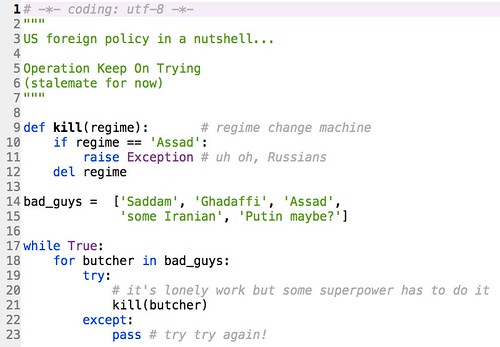
For Pythonistas

:: for Pythonistas ::

Wednesday, March 01, 2017

Agile Learning

Trimet Developer API

My students doing real time professional development get a radio-TV show experience, enhanced with live messaging. I've worked in other configurations, including in not real time (asynchronously) with O'Reilly School of Technology (OST), but that meant under three days to respond, with source code to eyeball and make sense of.  My students had my attention in ways the radio-TV does not provide. A combination of the two might be a next step.

However, for now I'm content to suggest projects and provide source code that's encouraging exploration in several directions. We go against a movie database, check out the API.  As of last night, I'm able to check Trimet's Trip Planner, thanks to Sheri Dover for sharing this part of the PDX Code Guild curriculum with me.

What I suggest to self learners around a Python topic would be this three step workflow:  anchor yourself in the API's documentation to where you're ready for testing it.  Hop over to Youtube and fish up useful movies on exactly what you want to know (good luck).

Inch forward, using the Agile test-as-you-go tiny increments approach (heavily ratcheted, for steep learning curves, even vertical climbs if need be, though I'm not into melodrama necessarily).

In Python we're lucky to inherit Java's JUnit framework, which goes really deep once you add in the mock objects.  At OST, we emphasized TDD as a methodology (write the tests first).

Talking up "open source" and really taking that culture seriously, including its internal conflicts and heritage, is something I do as a geek.  If you listen to me, you learn about this or that rift or conflict, but it's not like I'm endlessly grinding a lot of axes.  I've got it down to very few axes at this point.

One of those cutting edge blades of debate is:  where do we include Unicode in K-12 in US public schools?  I'm not saying it's up to me and if I were writing on this topic I'd want to dig down in the curriculum first, not that there's only the one, do some homework.  The US is a diverse territory and there was never a consensus on what to say about Unicode or how long to spend on UTF-8.

Not everyone reading my blogs cares if the US is stuck in the calculator era and not facing the future. Yes, I have a parochial outlook thanks to my geographic location and personal history.  Portland, Oregon was the city of my childhood, which I returned to after many exciting adventures overseas. I've lived here since 1985 and put kids through the school system, volunteered in it, even had some paid work in it.

As you scan these blog posts, you may see some of the same discussions you've been having, regarding "i18n" for example ("internationalization" as every geek knows).  However, a lot of what I talk about is pretty esoteric by today's standards, fair warning.  I'm not saying that to be condescending as I'm the first to admit to not being inner circle when it comes to certain parties.  I'm as clueless as they come regarding the secrets of many cults.

Trimet has a great Trip Planner system, multi-modal, and with a public API.  If your city bus system has a public API, then join that inner circle.  Hey, even if you live far away, if what you need is simply practice getting back complicated XML about something so easy to reason about as getting from A to B by public transportation, I'd recommend registering with Trimet and grabbing a developer token.  Get ideas for your own city, don't reinvent the wheel.  Or do.  I'd like to see a JSON output option, bet Metro would too.

Monday, February 27, 2017

Retrospective

Archive Copy
:: Museum Exhibit ::

JCNJ_planning

:: big dreams for JCNJ ::

Saturday, February 25, 2017

Keeping Tabs


Denizens of the USSA are the most spied upon in the world, thanks to their "own" devices, which phone home to inform all sorts of private interests about one's activities and location.

Those wishing more privacy have an uphill battle out of the box.

One could argue that people are not entitled to complete privacy and/or invisibility assuming they share public resources.  If you're on the road, sharing it, we have the right to know your identity, no?

The sense of paranoia that's been building is being deflected onto the Russians these days.  They're the ones doing the spying, not the home team.

Bannon served on the board of Cambridge Analytica, which boasts having data on every voter in the US, enough to compute an OCEAN profile and target ads.

Even though this company openly takes credit for the Trump campaign's effectiveness, we learn it was Russians and Wikileaks that tipped the scales.

How many mainstream media reports have directed attention to "Russian hackers" versus this psychometrics company based in the UK?

Those media reports picking up on that story are mostly dismissive of this "myth" that Cambridge Analytica has working voodoo.  I agree with the "myth" part, but then so is the "Russian hackers" story about mythical powers.

It's myth versus myth.

The effectiveness of targeted advertising based on profiling is hardly a "myth" to social media companies such as Facebook and Google.  That's how they make their money.  The fact that political campaigns are likewise advertising campaigns is obvious.

So how does playing down the role of psychometrics companies stack up against the reams of stories playing up their importance?  How hypocritical are these "myth busters" willing to be?

Are psychometric computations what drive this narrative of "Russia the evildoer"?  That seems a truism in my lexicon.

Politicians (social engineers) feel in their gut that oughta work (scaring people about the Russians).

Going with one's gut is what psychometrics is all about, especially minus the big data component, which might serve as an unwelcome reality check in some cases.

USers have been susceptible to Red Scares for a long time, so what does it matter if the Russians are no longer red?  Can't we scare the USers anyway, or at least make them angry?

That's what organized crime wants to find out.  Experiments are underway.  The mainstream media is their tool of choice, what they've learned how to use.

You know what I always say:  if you want to be a US president, you need to:

(A) know how to lie persuasively and
(B) have close ties with organized crime (including the CIA).

For example, president Clinton well understood about the need to ship arms to the Contras in contravention of the Boland Amendment.

The CIA wouldn't enjoy the loyalty of its home team mercenaries if big money were not involved, meaning cocaine sales and money laundering, with lots of partying for friendly politicos.

Clinton could not have become president had he not, as governor of Arkansas, helped with the CIA's program, a continuation from Vietnam War days, where drug trafficking was likewise a big part of Air America's business.  Not a secret.

President Trump is still being tested by organized crime, as Putin has his own criminal networks and the idea of "getting along with Putin" is pitting mob against mob, at least in the lower ranks.

Trump's base wants to find out if "draining the swamp" has anything to do with telling more of the truth about recent history.

Given the mainstream media is purposely forgetful ("United States of Amnesia") and has no means to connect the dots for people in any short evening news format, the social media habits of USAers have changed.

They want the bigger picture.  They're turning to Youtube.  Many of them are not big readers, thanks to TV, but then the Internet is turning out to be a lot like TV.

Hollerith machines were all about keeping tabs on people and of course the Germans wanted them to implement Nazi programs.  IBM helped them out.  Lets figure out who all is Jewish.

We forget how many in the US business community were tacitly rooting for Hitler.  Eugenics, as a "science" was co-developed on Long Island.

Once the war was over, the losers did not necessarily agree it was over and the Cold War picked up right where WW2 left off, just as the war in Korea rolled right into the war in Vietnam.

Many Nazis ended up in the Middle East, working with the CIA to frustrate Arab nationalism.  German scientists pleaded innocence and flooded into the US rocketry program, resulting in ICBMs.

Undermining governments, forcing regime change, has been the game for a long time.  The mob rules.  That's a tough lesson to teach in school though, so a lot of people end up confused.  They suppose ideals match the reality and criminality relates to "a few bad apples" and nothing systemic.

No one is asking if the Trump campaign was in close touch with UK intelligence operatives throughout the election season.  If we're as fast and loose with definitions as we are where Russians are concerned, then the answer is yes, of course.

Which nation did the US have a war with to win independence for itself, Russia or the UK?

Ah, but with the latter we (the USers) have a "special relationship".  British Aerospace and the Pentagon are joined at the hip.  BP oil powers the USSA's aircraft carriers.

We've been taught that Russia is our enemy.  Those reflexes still work, but maybe not as much as they used to?  Stay tuned.  Global literacy levels are still on the rise.  Telling people how they must think is getting more difficult.

Sunday, February 19, 2017

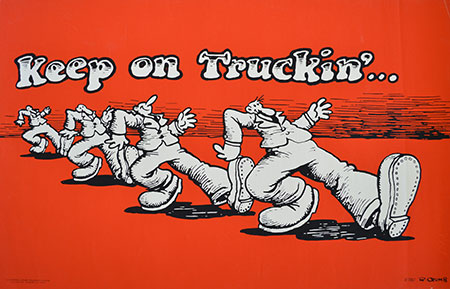
Keep on Truckin'

Quaker Business

Lots of truckers share advice and stories on Youtube.

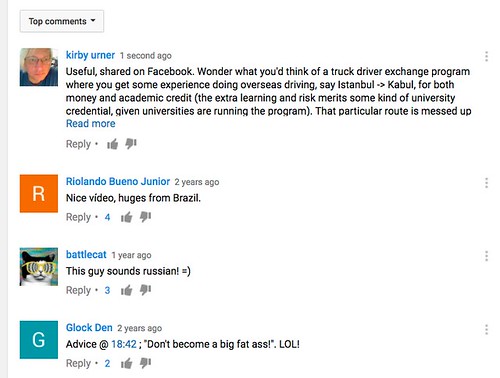
That gives me an opportunity to ask directly, and respectfully, if they'd have any interest in driving overseas, as a part of a truck driver focused student exchange service.

I've already gotten a green light from academia to pursue such interests, but really I need truckers themselves, along with transportation engineers, to be more aware of their options.

Market research...  Focus groups... Does Google maps have the overlays we need?  What other map services will we need, to keep out Kabul-to-Istanbul lanes flowing smoothly?

Freeways Layer : Global Matrix

Trucking as currently designed allows precious little time for tourism.  It's dock-to-dock, through the dirty side of most cities.  Many people treat truck drivers rather poorly.  That's where the academics come in:  drivers get a full-blown work-study program.  Our curriculum is about more than moving freight.  Lets think about families.

Thursday, February 16, 2017

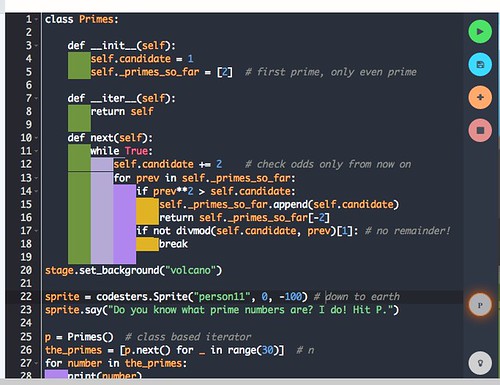
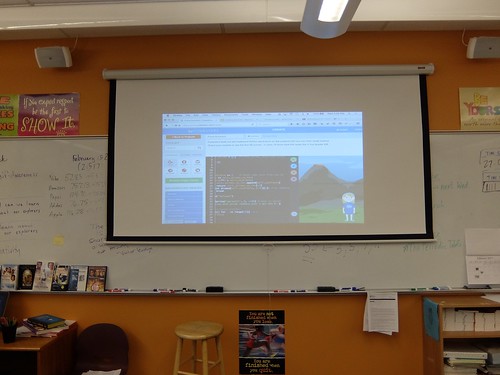
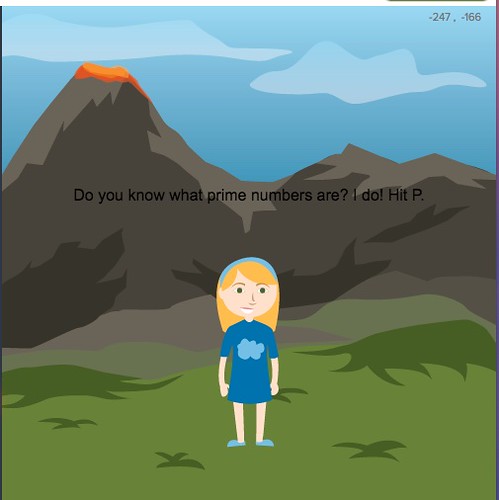
Prime Numbers

Solution in Codesters

DSCF3530

codesters_primes_2

Code on Paper

Friday, February 10, 2017

Study Circle

World Game Players

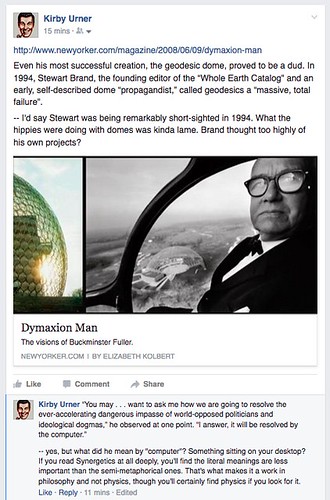
In addition to working with world game planners on Global U ideas around trucking, I'm studying a New Yorker article, Dymaxion Man, about Fuller, published in 2008.

Sure, that's one way to compute the account, tell the story.  New Yorker features a lot of intelligent writing.

No mention of the Cornwall Eden Project, nor of the Epcot Buckyball ("Spaceship Earth"). How does Synergetics relate to the CCP?

No mention of Dr. Arthur Loeb, nor A & B modules, T & E modules (3D printable!).

We'll have exhibits in our World Game Museum, of what the textbooks were ignoring (a basis for ignorance). Lets see how the narrative accounts compute then, shall we?

Is West Point teaching the Bucky stuff at least, sharing our American heritage with high ranking officers?  Scandalous if not. We're investigating.

A couple comments, from my Facebook timeline:

Study Circle

Also:
Military Man

The main literary trope I find regarding Bucky is that he was a failure and his inventions didn't fly. Put his awards and degrees, number of works published, historical role as "engineer saint", in a pile, and put that pile next to any detractor's and compare. 

True, he didn't win a Nobel Prize. Is eleven honorary PhDs enough (given for free remember, to help a school uphold its own brand)? Elliot Norton chair of poetry at Harvard? Patents not just on the dome, but the IVM itself (like if Descartes had patented XYZ). 

This guy appears to be a huge success, by objective criteria. One of the most successful who ever lived. I think the "he was a failure" trope is a projection. People think "the world is still a ghetto ergo Bucky did not succeed." Specious. Completely void of real thought.

Or was it 47 PhDs? That's what BFI claims. Depends what "doctorate" means maybe. 

Such a failure right? Poor slob.
After being spurned early in his career by the architecture and construction establishments, Fuller was later recognized with many major architectural, scientific, industrial, and design awards, both in the United States and abroad, and he received 47 honorary doctorate degrees. In 1983, shortly before his death, he received the Presidential Medal of Freedom, the nation's highest civilian honor, with a citation acknowledging that his "contributions as a geometrician, educator, and architect-designer are benchmarks of accomplishment in their fields."

Thursday, February 09, 2017

Jitterbug Transformation


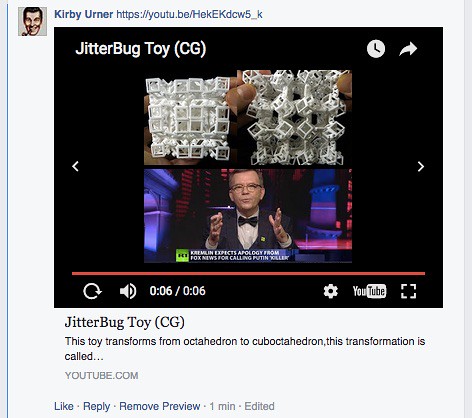
Your math teacher may use the Jitterbug Transformation to help explain how the cuboctahedron and icosahedron layers might morph into one another without gaining or losing constituent balls.

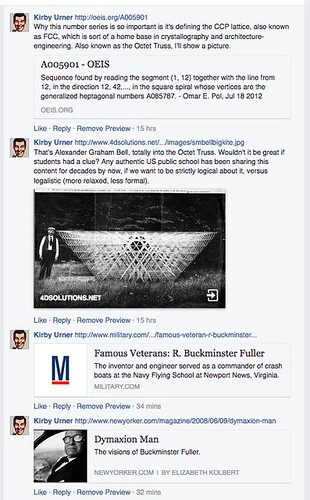
1, 12, 42, 92, 162... is the sequence we're talking about.

Geometrical concepts may be imparted via a number of these moving sculptures, or dynamic devices.

Another such device is the triangular book with one triangular page, its tip traveling in a 180 degree arc and defining two complementary tetrahedrons (same volume as each other) all along the way.

When the page is straight up, and the edges are all 2, we call that unit volume in the XYZ coordinate system, made from cubes of edges 1.  These two sculptures have the same volume.

The Quadray coordinate system apparatus gives us yet another conversation piece with which to leverage greater understanding of the target namespace.  Again, the canonical edges (not base vectors) are of edges 2.

Our World Game Museum will feature a lot of textbooks that saw fit to not include any of this information, nor the related whole number volumes schema.

Probing questions will be posed, and documentary postmortems invited.  People will come up with varying theories to explain the censoring habits of minions.

Transformation

Sunday, February 05, 2017

More Codesters

The embedded version has its limitations. Try this version instead? These are fun experiments.

I have one baseball and want to completely surround it with others. One way: put six around the center one on a table, then three on top, three on the bottom. With real baseballs, this would be difficult.

To see an animation of what I'm talking about, check here:
http://www.4dsolutions.net/ocn/graphics/cubanim.gif

For a lot more on the mathematics, check here:
http://oeis.org/A005901


More of a Martian Math theme, which for some of you may mean more Hungarian.

Tuesday, January 31, 2017

Embedded Codester Apps


Monday, January 30, 2017

On Race Again

:: stand-up philosophy by Wes Cecil ::

What I wrote on Facebook:
Really enjoyed this, because he's doing philosophy and standup comedy at the same time. Gets my attention. Yay, my discipline gets into the nightclub scene (reminds me of Tom Lehrer).
... and in a follow-up comment:
The End of Racism by Dinesh D'Souza is pretty on target in arguing many anti-racists miss a golden opportunity in buying into "race" as a tenant of their own belief systems, such a foggy and ill-designed concept as Wes Cecil takes up in his mocking philosophy talk. However, given how deeply engrained is the thought pattern, I have to accept that most Americans (at least) are terminally racist (will take belief in races to their grave) and it will be up to future generations to look back and dissect these beliefs in a more clinical postmortem manner.
But then as some of my friends point out, Dinesh has gotten in trouble with the law, and was a big Trump supporter, anti-Hillary. So does that mean races are real?
Thanks for the update about D'Souza, got me checking his website too. 
I do believe in ethnicity as meaningful. I notice racists have a hard time naming the races. The idea of races pre-dates genetic science, which has only further undermined the idea. Certainly "Anglo-Saxon" is not a race. Or maybe some think it is, as there's really not much agreement on what the races are in the first place, assuming they exist for the sake of argument.
Quoting from my Synergetics on the Web (1990s):
Western science originally portrayed race and class as characteristics of a person's blood which, as such, could be subdivided in proportion to a person's ancestry, "blood" being treated as a mathematical quantity, contributed in equal proportions by one's parents. Hence such terms as "octamaroon" (one eighth black). Whereas "class" is no longer regarded as a genetic entity, "race" has remained a popular concept for grouping genetic characteristics, even if the link to blood is no longer made. Like anthropologist Ashley Montague, Fuller felt the concept of "race" had outlived its usefulness, that the cross-breeding of the world's people, especially evident in North America, was exposing the old racial categories as mere snap-shots of genetic traits thrown together by the exigencies of time, but available in any number of permutations from that vast grab bag of traits known as the human gene pool. In the Fuller lexicon, a racist is perhaps most straightfowardly defined as someone who believes in races.

Saturday, January 28, 2017

Growing Up Quaker

A story from my boyhood: my mother Carol was working with other WILPF ladies, as a young mother, to counter the prevalence of war toys on the market. She harvested a pile of examples and stored them in our two-car suburban garage. Dad and I found them, and decided to play with them. The remote controlled Tiger Tank was especially cool.  As a general rule though, toy guns were discouraged and I didn't play with toy soldiers, as did some of my peers.

When we moved to Rome, I met friends in military families. Reggie liked to fantasize about wars and weapons. Mom served as a cub scouts den mother.  I was a Bear, with my friends Mahlon, Kijoon, Reggie, Hayden and Joe. Kijoon, son of the South Korean ambassador, had a stash of toy guns, as well as a pellet rifle and we'd play with those, more in a 007 mode than as soldiers.  Movies at the nearby Archimedes, an English-language theater, were influential.

In the Philippines, my dad started out with the UN, which was doing land reclamation in Manila Bay. Dad switched over to USAID and taught planning at the University of the Philippines as well. He was helping spread a culture of local planning, versus top-down from a central government, and flew all over the islands. Thanks to his job with the State Department, we were able to go on base, mostly Clark AB and Subic NB. We also had access to officers facilities in Baguio and vacationed there at one point.

My years in the Philippines helped me more fully grasp the global scale of US military infrastructure. The American War (Vietnam) had been really hard on my mom especially. The way USers like to rain bombs on defenseless civilians didn't impress me either.  However I also saw how a lot of brave individuals inside the military were also skeptical.  Daniel Ellsberg went to Vietnam as a Marine to check the reality of the situation. Brian S. Willson was there serving his country as well.  Dad and I also heard Ralph McGeehee talk at the Institute for Policy Studies in DC (this was later). He'd been with the CIA.

After Princeton, I dove into international affairs quite a bit and thought seriously about joining the foreign service. The Woodrow Wilson School beckoned, however I decided philosophy was more my thing. Wittgenstein was doing a kind of anthropology, looking at how words mean. I also took a course in psychological anthropology, with Imee Marcos (daughter of Ferdinand and Imedla) in the same class.

Fast forward and I found myself plunging into the Bucky Fuller corpus. He was still alive and circumnavigating the world, giving those famous long talks. His blend of futurism and philosophy appealed to me. He'd been in the US Navy and credited that experience for exposing him to big picture worldviews, what the admiralty shared in officers training at Annapolis. This was a high point for him, preceding a deep low, when he needed to support his new family in Chicago and went broke, coming close to suicide.

Another author with a lot of military experience was L. Fletcher Prouty, played by Donald Sutherland as Man X in the Oliver Stone movie JFK. Prouty cites Fuller when explaining why humans are squandering resources to kill each other instead of collaborating to enjoy better living standards. The "you or me" picture of Malthus-Darwin and a belief in global scarcity had turned endless war into a means of population control.  This was the picture World Game worked to counter. In principle, humans had the wherewithal to better their lot. We had the necessary mastery over principles. Ephemeralization (more with less) was on our side.

Through my study of Fuller, I got to meet E.J. Applewhite and his wife June. I met their daughter Ashton briefly, haven't yet met their son, a boyhood friend of Sam Lanahan's (Sam accompanied Bucky to the Philippines when I was there, but wasn't tracking at the time).

My parents and I had dinner with Ed and June in DC (I forget which restaurant). Also Ed and June flew out to Portland to hang out with me there, meeting some of my people. Ed had a CIA background, having served in Berlin and Beirut. He'd been a Fuller fan as a teenager and devoted his post CIA years to collaborating with the guy, shepherding the two volumed Synergetics through to publication.

The US military had worked closely with Fuller and the companies set up around the geodesic dome invention. Don Richter, T.C. Howard, Ed Popko and many others did much of the actual engineering, in both civilian and military sectors. The radome (radar dome) became a relatively common feature of the landscape. My uncle (actually grandmother's sisters kid) had a contract to work on those in some way, doing maintenance. I only found that out recently (Bill is 91).  Soviet premier Khrushchev had been impressed by the dome in Kabul. Fuller was always friendly to the Russians, as his commitment was to all humanity (he credited that commitment for his successfully synchronistic lifestyle).

However, Synergetics is about a lot more than just geodesic domes and spheres. It's a hard philosophy book that most philosophers don't actually read, but contains some simple geometric innovations based around polyhedrons. When the World Wide Web became available, getting more of Synergetics on-line was my priority. Dr. Bob Gray got the actual text of Synergetics on the web, followed later by the Synergetics Dictionary, another Applewhite production.

Friday, January 27, 2017

Forum 206

I'm back to posting to the Math Forum a little bit.  I've contributed thousands of posts to Forum 206 over the years. I'm glad Drexel University gave us an opportunity for public debate.

As I indicate in my latest comments, I have alternative ways of covering the mix of topics, which were maybe a sign of the times. Certainly "learning to code" has grown in importance, as a PR topic.

I pay for the 4D Solutions domain out of my own pocket. No one has sponsored me. There've been tie-ins with the Bizmo idea.

I've spent a lot of time working with David Koski and others, with what I consider one of the main focal points: a way of building spatial geometric fluency by leveraging the work of Buckminster Fuller.

I've been meaning to get back to the Linus Pauling Archives at OSU to see what correspondence I might uncover between Linus and Bucky. I imagine there must be some.

Thursday, January 26, 2017

Finding Polys

Great Find

Some teachers stress about curriculum segments on polyhedrons, such as the Platonic Five, as where and when will these prove useful? Do we really have the luxury of "going there" with so much of STEM still waiting?

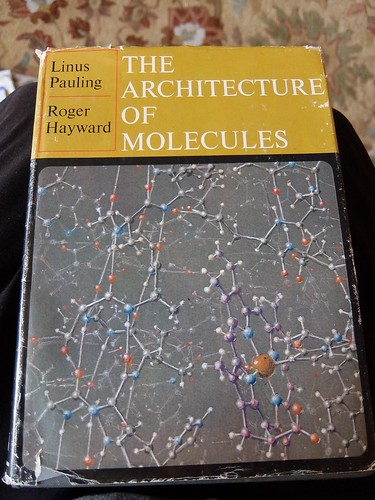
I don't think the arrangement of space into coherent, oft repeating, patterns is a waste of time. Glenn's recent find at Good Will reminds me:  Linus Pauling merged spatial geometry with chemistry in ways we'll never forget.

On the same topic, congratulations to Julian for that write-up in the Portland Tribune. He's the sculptor behind Alpha Helix next to the Linus Pauling House on Hawthorne, directly across from Third Eye.

I'm at the other end of the spectrum, stressed about the exclusion of polys, and curating textbook titles for our World Game Museum.

Secondary school textbooks that skimped on polyhedrons, the tetrahedron especially, while purporting to be STEM-worthy might get some critical write-ups in our retrospective.

Why the tetrahedron in particular?  Of the Platonic Five, or of any, it's topologically the simplest, called the simplex for that reason. No arrangement of fewer edges joined at corners has a spatial inside. A triangle fences a field but doesn't define a cage (enclosure).

We're in the realm of Euler's Law for Polyhedrons, likewise Descarte's Deficit of 720 degrees. The numberphiles on Youtube will explain what those mean. Such pillar concepts mark out a common core of cultural literacy.  A common core minus V + F == E + 2 would be exhibit-worthy for its grave deficiency.

If you're a teacher in a Freedom School or one of those, and have the luxury of escaping from the "down the drain" vortex of the left-behind curricula, you'll have access to the resources you need to keep it real. Help your colleagues who aren't so lucky?

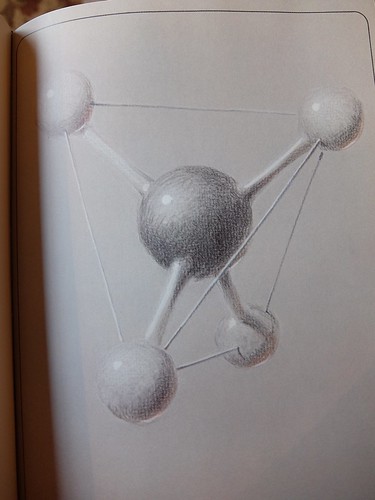
Methane Molecule

Friday, January 20, 2017

Bible Stories

[ originally a comment on QuakerQuaker, new improved ]

Thank you Paul.

The story of Noah feeds into the Tower of Babel story, as the uniformity / conformity of thought enjoyed by the Great Flood survivors was a consequence of their starting over with a blank slate so to speak. Noah and Mrs. Noah were the new Adam & Eve.

What humans did not understand owing to their lack of diversity in thought, was that their Promised Land is a ball, a sphere, a planet. A lot of them still have some trouble with that concept in 2017. It's not a closed system in any thermodynamic sense. A star (the campus fusion furnace) feeds us energy for free, the basis for ongoing cell division and our daily bread.

Noah's descendants were at first under the misapprehension that they lived on some horizontal XY plane to infinity, with "God above" in the perpendicular Z direction (Z is for Zeus?). What better way to reach God and make a name for themselves as a superpower than through the construction of some humongous, homogenous skyscraper?

This seemed like normal thinking to them, so great was their confusion already (Babel and babble connect in Hebrew as well [1]).

God knew that a single culture with a single-minded approach would think nothing impossible or unrealistic about their foolish skyscraper plan. No "new Noah" would arise to prophesy this was madness, because they all thought the same way. Besides, had God resorted to another flood (having promised not to do so) He'd be facing this same predicament in a few generations.

God understood that diversity in thought patterns would guarantee that people spread out and around, and come to terms with their being on a spherical spaceship (an Ark, likewise once our Eden).

In his mercy He gave us the humanity we have today: diverse, spread around, and not organized under one uni-polar pyramid hierarchy. No superpowers here folks, just a lot of feedback mechanisms connecting hominids by means of various networks, religious, political, economic. Don't think of your skyscrapers as containing some single-minded illuminati caste that all speaks the same language.  There is no "global civilization" that traces back to some singular inner circle, much as some cabals would love you to think so.

[1] http://www.christianbiblereference.org/story_TowerOfBabel.htm

Tetrascroll

Wednesday, January 18, 2017

Chronofiles

I've been chronicling a lot of my homework topics in my Facebook scroll.  Potorando (Portland, PDX) has been under a blanket of snow for the last week, which has been stressful in some ways but also a welcome vacation from daily toil to catch up on world events. There's so much to catch up on.

I study dance and music more than you might expect, in addition to movies.  Some "AI films" I've been listing: Ex Machina, Her, Chappie, and of course Artificial Intelligence itself (Spielberg, Kubrick). In connection with Chappie, I segue to Die Antwoord.

Another thread cites Tame Impala for its retro-psychedelic Feels Like We Only Go Backwards (very Yellow Submarine).

I'm accepting there's no point assuming some uni-polar world wherein the USA has the luxury of infinite time to process future shock, while this rest of the world has to rocket through the experience.

No inner circle controls spacetime to that level if human, and if not, then which science fiction have we switched to?  No, future shock is not shielded against by lead or glass, let alone legislation.

Anyway, back to my studies: I'm ironically not the bold futurist of the Hyperloop experiment, and instead suggest more Eisenhower-style freeways, twixt Iran and the Stans, over to Istanbul and so on, more of an EU like arrangement or like what Africa is aiming for.  You don't have to show your papers just because you're moving from state to state.  That's an experience of interstate travel people really appreciate about the USA and want to emulate.  I don't blame them.

So whereas Youtubes are showing these sprawling Hyperloop networks, I'm talking about trucking lanes. The trucks might not even be autonomous. So backwoods Oregon, right?  So not Silicon Valley.  However the Hyperloop vision takes somewhat for granted what we learn at airports:  the countries you fly over don't need to bother you with paperwork.

Lets remember El Camino though, I know that sounds somewhat out of the blue, and that has not been a recent Facebook topic.  I'm just thinking about how trucking is in other ways thoroughly regulated, with weigh stations and rules about getting enough sleep.  Drivers do worry about sharing the road with other judgement-impaired drivers.  We all do.

El Camino is for pedestrians, however they'll show paperwork when staying at various hotels along the way.  Use of a credit card also marks a trajectory.  I'm not saying the traffic along these roads will be unmonitored.  On the contrary, it's so monitored that stopping at boarder crossings is almost a moot point.  Information technology is what's rendering those obsolete, not some sudden outbreak of trust between nations.

Also, I'm quite accepting of the ODNI's observation that RT is influential.  I've watched enough of these old Yuri Bezmenov tapes on Youtube to agree on his major point:  a huge percentage of what spies do has little to do with picking locks, tapping phones, or sneaking around in illegal ways.  So much of what we call "intelligence work" is what Yuri calls "active measures" and that includes spreading everyday propaganda or PR (PЯ).

But what's propaganda then?  Lets just agree, for the sake of discussion, that it's an important factor, and accept that the Kremlin was likely more afraid of Hillary's harshness than of Donald's trademark blend of buffoonery. That's not even scandalous if so. We all have our preferences and, if we're powerful nation states, we have our spies to carry out their active measures, often fully legal.

Hey great if hyperloop technology works, as it's not either / or with trucking. Cargo travels at different rates. A "fifth mode" of transportation implies four others, not going anywhere. Of course I do pay attention to skeptics who say controlling the seals will be difficult but we learn from experiment more than from arguing sometimes. I'm happy to see bold experiments with new civilian technologies. More giant domes might be nice.

I connected the Manning case to Leonard Peltier's. I got to be at an event with the latter's son in 2016, another Oregonian. The media were mostly linking to Snowden and Assange, more recent cases, higher profile in recent times (and admittedly more directly connected story-wise, given how Manning went to Wikileaks directly, helping it become what it is today).

Tuesday, January 17, 2017

Elusive Dude


This story of Howard Hughes appears to check out on every level. The things I'm still learning...

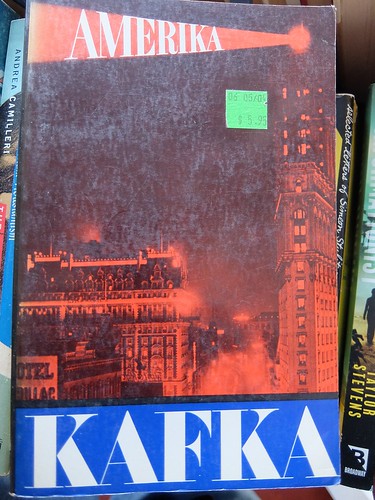
Just this First Day at Quaker meeting, when checking out the rack of books on sale for fund-raising, I stumbled upon Kafka's first novel Amerika, published posthumously, who knew? Not me.

It's not a like a fancy Princeton education back in the day made me a know-it-all. On the contrary, my time in Firestone Library reinforced my appreciation for the power of browsing freely (it's open stack, at least to students).

The advent of the web browser, after I'd left (Class of 1980) further amplified our global reach, ala the vision of MEMEX shared by Dr. Vannevar Bush, in a famous article, in Atlantic Monthly.

I've been describing "different species of capitalist" on Facebook, ranging from "bling capitalist" (more Las Vegas, more showy, ties to organized crime) to the reclusive relatively low profile type.

Howard Hughes played it both ways: high profile in his youth, then tapering off to ever-lower profile, keeping his cards especially close to his vest when the public was supposed to think him dead.

Warren Buffet (Oracle of Omaha) is more middle of the road. My taxonomy is not fully fleshed out yet.

US Presidents may come from the rough and tumble organized crime side of the business (e.g. the Kennedy brothers), wherein "bling" is big. Thanks to Prohibition, huge sectors of the economy had become criminalized. Amerika was a nation of scoff-laws and sinners.

No one knows the inner psyche of Americans better than the Mafia, the industry in charge of catering to forbidden desires. No wonder Nixon got in.

The Silicon Forest capitalist, in contrast to the "bling" school, has a more egalitarian dress code, with net worth inversely correlated to the presence of a neck-tie.

The management structure is also "flatter" or "thinner" in many ways (fewer levels or ranks), more Pacific Rim, more Japanese, with less towering of software and hardware engineers over one another.

Grounded in the sciences, engineering is more about shared humility before nature. The ability to intimidate is hardly the point, when dealing with cosmic forces and exceptionless principles (Van Allen Belts and so on).

The Quaker capitalists of the roaring 1790s were less tycoon-tyrants or "rubber Barons" (as in Fitzcarraldo) than experimentalists in management theory. The ideal of a workers' paradise loomed large in these early days of automation (freedom from dirty jobs).

This ideal proved threatening to satirists with an investment in the status quo. George Bernard Shaw took on Cadbury. Having well-treated workers made everyone else look bad. Demonizing any such ideology as necessarily "anti-capitalist" (i.e. "socialist" or "communist") would be a future innovation.

The exploiter class needed to keep the standards low and therefore frustrate any lofty Quaker visions. "Go to Pennsylvania if you want to try out those zany experiments" was the word from on high, from the would-be competition.

William Penn's forestland ("Sylvania") would be our Quaker utopia.  Didn't happen.  Indian Wars came instead.

Neither health care nor education was a part of the deal in Oliver Twist's merry England. The public laws more about the ones on top, staying on top, than anything more broadly constructive for the common people.

That status quo explains the American Revolution in large degree.  Idealism doesn't like to be frustrated at every turn, needs creative outlets.

Even if no generation seems to "finally arrive" in the Promised Land, there may still be a sense of direction, a sense of continuing to escape tyranny.

Amerika

Saturday, January 14, 2017

Upcoming Commitments

I've got two Princeton alum interviews in my inbox, and a Welcoming Committee with the Quakers.

In the first case, Princeton has a time-honored tradition of matching up each applicant with an alum, for some meetup time. I see it as an opportunity to hear from someone who actually went there what it was like, and a first thing I might say is way different for different people.

In the second case, Quakers have a tradition of recording membership which, once gained, should not have to be regained over and over as one transfers between meetings.  So there's a hand-off process, involving some record-keeping and actual face time.

Speaking of Princeton, I'm observing on Facebook that people will start talking engineering and science when arguing pet theories about what did or didn't happen.  It's one thing to dismiss others' belief systems as "crazy", another to get good exercise stating what one believes to be recognizably science.  There's skill-building involved, not redundant with doing crossword puzzles or Sudoku. So does Princeton teach science this way, is the question.

What I'm suggesting is that a bright kid, fresh from high school, may have seen over 1000 hours of Youtubes on such disputed whodunits as 9-11. Where at Princeton is the course where adult discourse in this area is role modeled? Shall we expect panel discussions? Might we study the history of deceptions in general, back through the phony military build-up under Paton (the US general), concealing the ramp-up to Normandy? Lets not always pick the same examples, and if you do Gulf of Tonkin make sure you connect to The Doors (quiz question: what's the connection?).

Remember all the 9-11 stories involve deception, as hijacking is certainly that, not to mention dive-bombing the airplanes into stuff, outfoxing defenses. How do we have substantive discussion of what's raised in all those Youtubes, now that we're paying for the privilege?

For all I know, Princeton has been offering such courses for years. I'm somewhat out of date. I advise prospective students to check out a course catalog, regardless of their interests. This is the time to comparison shop. Many schools will be excellent but for different reasons, so it's up to each applicant to decide which reasons are the best reasons.

Wednesday, January 11, 2017

Alt Worlds


Thanks to Wanderer Bob Mcgown for cluing me about the above BBC special, which I watched start to finish across several Youtubes.  I'm pretty much snowed in; a day for studying.

The son of a quantum physicist tracks down what the story was. What was his dad really up to. They hardly talked while he was alive.

I tend to not think of "particles in transit" along specific trajectories, but of pressure building with a probability wave to "be seen" (materialize) collapsing in a discrete place.

The recipient [atoms] "see" (we could say "sense") the source through the double slit; a game of  quantum physics bingo determines which target actually gets to "tune in" the photon or whatever.

Putting detectors in harm's way means the collapse happens in the detector.  The receptive space (sensing surface) has changed its shape. In "transmission" it's a probability wave of finite speed, until detected.

However, talking like that may not make any difference to the mathematics. English offers a variety of grammars, complete with mental images, to fit the data.

I especially enjoyed the visit to Princeton University, with scenes of the "Dinky" (the suburban train from the campus out to Princeton Junction) and inside various halls and arches, part of my personal memory bank as well.

I've also been reading "Roger Rabbit's" thesis regarding cosmic gamma-ray bursts and one possible interpretation. It's making waves amongst some of my Facebook friends (the author, Charles Fleischer, did the voice for Roger Rabbit).

Monday, January 09, 2017

Sharing the Gospel

:: stories of Finland ::

Given news stories need to be brief on prime time TV, we have to expect homework through other channels, say History Channel or, more likely, Youtube. No that isn't me in the video.

Case in point:  Portland Public Schools pays close attention to Finland's public education system for good reasons.

We get it WDC doesn't care about the same things we do, different priorities and ventures.

They're into financial values over there, vouchers, paying off balances due. That's an important aspect of doing God's work, certainly. Thinking purely in terms of money has its limits though.

I'm in touch with public school teachers quite a bit, thanks to the Measure 97 campaign, which didn't succeed in passing.

We did get #CodeCastle to off the ground to some degree.  I've turned more towards MIT Scratch for my memes.

True, we have no budget for that microwave tower, replacing or in addition to the cross, facing @OMSI.  That's fine.  Plan B is in effect instead.  Teacher trainings in the Roost?  Not happening, to my knowledge.  We had to shelve our Plan A.

Those caring about Washington DC and its new Orange Party rules (corporate media still using the color Red for some reason, misunderstanding GOP did not survive Election Day #singularity), will obviously seem more up to date than little moi.

Given my job description, I can't afford to get sucked in to domestic / nationalist politics at every turn.  I'll check back in a few years on that #WallwithMexico campaign, how that all went.

Just kidding, that's a fun one.


Thursday, January 05, 2017

Get Baked Portland!

Get Baked PDX

People my age start checking for signs. I remember when Mary Bolton was so disheartened when signing her check Mary Butter at the checkout lane, when buying some.  Hey, we all make mistakes.

Still, I was worried when Deke the Geek kept telling me about this Bizmo in the middle of our local supermarket, and I kept going there, in a trance no doubt, and not seeing it.

So today I made a special point of looking it up.  Franz was important in my childhood, before I left for Italy.  Our Markham elementary school, it had to have been, did a field trip.  A real bread factory.  Impressive.

I've always enjoyed seeing things being made.  Kim Jong Un must really enjoy all those tours he gets, of factories, as a part of his job.

I went on some tours of Chinese factories in the 1970s, during the Four Modernizations.  We were looked up to, as a tour group, as a possible source of ideas.  Mostly high school teachers, from the bases, with me and Glenn Baker tagging along as diplomatic corps (expat brats).

I bought a loaf on the spot, in recognition of the company's acumen as much as anything.  Of course it's a hippie bus.  No reason to go overboard and go all Vortex.  Grateful Dead bread sells itself.

Meanwhile, back at Starbucks, Deke the Geek was catching up on Adweek. We did a mini-photo-shoot right there and then.

Age of Aquarius

Bakery Bus

Tuesday, January 03, 2017

On the Move

If you dig back into the early days of freeways and Detroit, and the future-world of the 1960s, Disneyland brand new, you'll find "traveling circus" caravans converging to schools, putting on corporately sponsored "futurama" shows. Am I right?; I remember looking into it.

Anyway, that's where the "bizmos" sometimes fit. I wasn't originally thinking food pods and food courts, which is where Portland and some other cities went with the idea. I'm not saying the food cart people read my blog or anything, just it makes sense for a van-sized vehicle to self contain some types of businesses. I thought that too.

When the vans or bizmos arrive at a school, they have some show or experience to create, lets call it a science fair and a kind of job fair. Students feel like they're being recruited, but usually with no way to make specific commitments, as these events are more informational than missionary.  If you want to follow-up you'll be able to but the bizmos produce a standalone event.  Something like that.

In one incarnation, these "GNU mobiles" would mostly be sharing the essentials of the POSIX world, already an esoteric place, where the typewriter starts talking back to your commands.  An operating systems keeps a computer engaged with tasks, sometimes running in the background. I could as well imagine an Hour of Code van set to share Scratch or one of those block-based languages.

Today I signed up as a co-speaker on two Pycon 2017 proposals. That's the local North American one (so far, in radius), a "mother ship" in some ways, as the PSF showcases it as a model.  Other Pycons use the trademarked name to certify a level or standard, not a new idea in business models, one with a proven track record.  Finally, many Python (the computer language) related events may not use the "Pycon" trademark at all. PyOhio comes to mind.

The talks I signed up to co-speak about have to do with a scheme Charles Crossé wants to share publicly, having developed a working demo and used it with his own family. A use case would be a parent wanting kids at home to earn their play time on the web by winning at games deemed in advance to be suitably educational.  Games may involve extensive readings, in other words I'm not always suggesting the stereotype "twitch game" associated with pinball and other arcade games.

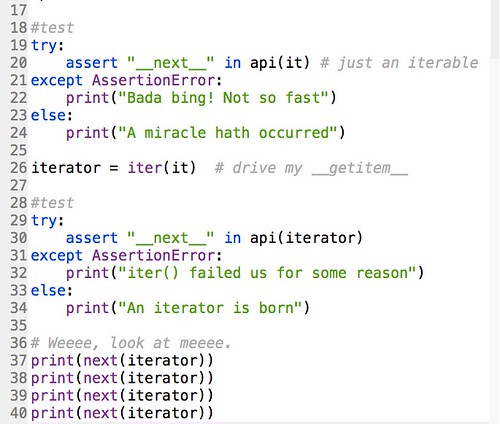
Speaking of Python, what's going through my head these days was inspired by Trey Hunner's recent delving into the iterable : iterator distinction.  The former category of object, if run through iter( ), will trigger an inner __iter__ that comes back with a new object containing __next__, thereby completing the iterator protocol.  For example, an ordinary list object is an iterable with no __next__.  Run it through iter( ) and a __next__ appears in the new butterfly-from-caterpillar iterator object.

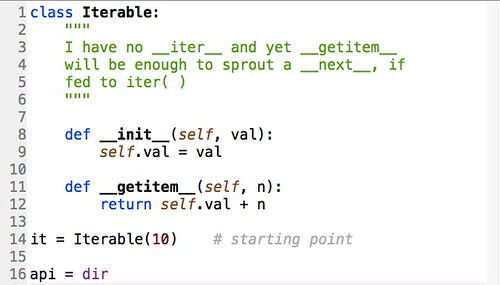
The plot deepens however, in that even __iter__ is not required, so long as a __getitem__ is present. The latter handles square-bracket indexing as in object[0], object[1], object[2]... The idea of "advancing an integer" from zero outward, is intrinsic to our notion of iteration. So if your class (type of object) at least implements __getitem__, then iter( ) will know enough to pull an iterator rabbit out of an iterable hat.

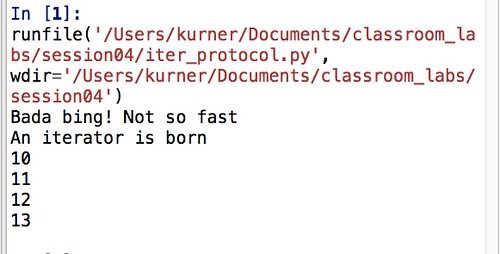
Here's the script. Iterable is a generic type with a way to set a starting value through __init__ (at birth), and then reflect the ever increasing value of n, as next( ) drives some internal __next__ to keep driving __getitem__. I'm not talking about code we anywhere write, as Python programmers. We simply count on next( ) to feed successive integers, starting from zero, to __getitem__, to "do the right thing" behind our __next__ calls.

Safe to say, your own __getitem__ may not be quite as simple as this one.

slide1_iter
slide2_iter

The output, showing "before" and "after" tests, with iter(it) run in the middle, returning a new object in which __next__ is indeed a part of the API (the "bag of tricks" associated with a class of object).


slide3_iter

As Trey well explains, we don't necessarily use next( ) to drive the action. The for loop construct is precisely "that which uses an iterator" to iterate through some body (block or suite) of code.

When we get to the end of the rope and push passed the last in the series, should one ever be reached, a StopIteration is raised, which the for construct handles in stride as a simple signal to stop, with a possible run through an else clause if present.

The iterator later hatched into a full-fledged co-routine by way of the function generator concept. The keyword yield gives another way to provide a __next__, short of feeding anything through iter( ). A generator begins life as an iterator right out of the gate.  We will pick up on their story in a future blog post.

Sunday, January 01, 2017

More PЯ


Praise Bob!