Wednesday, November 09, 2016

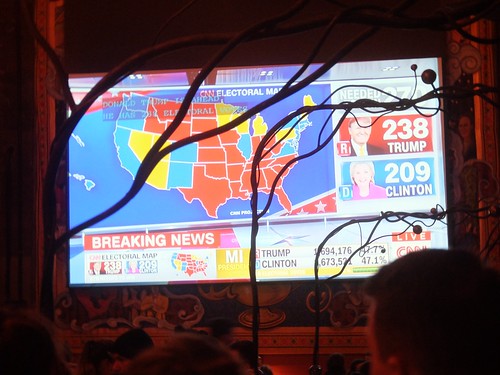
Election Postmortem

Back Stage

I heard the CBS team assert numerous times that voters had made up their minds a month ago, about whether Hillary's emails were important, and so on.  However we're also learning that the polls were way off, so any such specific polling result might get looked at with some skepticism.

As someone versed in social media, I saw a sudden surge in rumor mongering, with Wikileaks playing a central role in the narrative, lets call it science fiction for now, to avoid having to make too much of a determination.  The scandal factor was high.  Occultism, sex trafficking, everything tabloid and National Enquirer rolled into one orange pill.

If I were a political scientist, I'd at least entertain the hypothesis this "shock therapy" was effective, as enough dots seemed to be connecting to reveal a new paradigm, right on the eve of November 8, with November 5 the high tide.  Having CBS News tell us nothing 9th hour could be a factor seems too much like a cover story, to keep us thinking Weinergate was nothing, a false positive.  Not that CBS would knowingly fabricate, just "news from nowhere" gets in sometimes.

People don't like to randomly admit to strangers (pollsters) that they just came to a conviction in the last 24 hours, on a topic everyone has been discussing for months.  Reasonable?

Those supporting Hillary are indeed pointing at the FBI for adding a Weinergate wrinkle and reopening the emails issue, but how many of these true blue supporters saw the "scoops" being dished out through social media, about "orgy island" and "spirit cooking"?

People who listen to NPR aren't the same ones who ogle the tabloids in checkout lanes, necessarily, though of course there's overlap. People who doubt Barack was born in Hawaii, might also believe Michelle is a man. A little credulity may go a long way, given skilled spin doctoring.

Like I said, even without playing special prosecutor, with respect to some witch hunt, I think we might agree we don't have sophisticated enough models to reach agreement on the true impact of social media, especially of the more sensationalist genre.  We can guess, debate, but only the least of the pundits will definitively assert.

Election Day 2016


:: Carol got to vote too! ::

Saturday, November 05, 2016

Thinking Globally

Checking It Out

I probably come across as one of those "globalists" people rant about, although I'm not espousing some particular order as the new one.  I know it's not up to me, so when I ask myself what the future could be like, it's not to myself that I turn.  Yes, I'm powerless in some sense, but not in every sense, and I enjoy my freedoms.

In the 1960s we became aware of some "jet set" and young beautiful people who looked like Mary Tyler Moore and those handsome guys on Mission Impossible.  They had sideburns and wide lapels in one chapter.  Bell bottoms came and went.  I was busy growing up, a teenager, and yes, our family moved around a lot, without being military or missionary. I wore my mirror sunglasses and took pictures with my Kodak Instamatic.

I saw the inside of many jets.  For a time, we even had UN passports.  Dad was freelance, a planner, and people everywhere see there's both reason and occasion to plan.  Indeed, if governments or private enterprises want to impress upon stakeholders that they're doing something related to management, then sharing plans for the future is pretty high on that list.

Then after high school in the Philippines, at an International School (akin to Overseas School of Rome), I was privileged to attend an Ivy League university, Princeton, and absorb a lot of learning, find some role models etc.

Professor Falk was pretty enthusiastic about the ousting of the Shah of Iran.  He saw a new generation of Iranians taking over and ditching an oppressive cast of overlords, in favor of making room for an exiled government.

We were looking at ending Apartheid and as tuition-paying students we were asking how Princeton might play a productive role.  Two Dickinson Street (2D), where I lived for two years, was especially involved in that research.

I studied about world hunger at the Woodrow Wilson School, while writing a thesis on Wittgenstein's later philosophy.  I tried to take full advantage of this well endowed campus, putting a lot of my energy into computer programming.

All that added up on my end to feeling we live on a tiny dot of a planet, surrounded by empty space and places far less hospitable.

As humans in Universe, it's up to us to "save our ship" and a lot of that saving comes from thinking realistically about our place within the biosphere, and behaving accordingly.

A level of sobriety is called for.  I'm somewhat like Krishnamurti in thinking that our bigger failures trace to a lack of seriousness.

Not long ago I wrote an essay entitled Thinking Globally in 2016.  With that kind of press out there, it'd be on the foolish side for me to run from the "globalist" label.  That doesn't make me a part of the same conspiracy as everyone else so labeled.

Globalists are not all birds of a feather.  Indeed, if biology teaches us anything, it's that diversity is a positive way to work with complexity.  Yes, I consider the world to be complex.

A lot of people are suspicious of complexity, subtlety, anything they feel they don't fully understand.  I get that way too (suspicious).  On the other hand, I don't insist that I'm the bottleneck and stuff shouldn't be allowed to happen that goes over my head.  Just because I'm out of my depth about something, doesn't mean that something has to pause or slow down.

It's up to me to keep up, as best as I'm able.  Is that why it's called the human "race"? In other words, in being a "globalist" I nevertheless hope to avoid being a "know it all" and exuding some air of phoniness based on some "know it all" attitude.

I've had limited experience and was shaped by whatever adventures and misadventures. I'll share my perspective and be a star in my own little show, partially overlapping with the stardom of others.  A lot of what I do is "retweet" those I admire most. In accepting the label "globalist" I'm not thereby making some special claim to originality.

I've also talked about being "elitist" but really I'm more into "esoterica" such that I don't really believe in "elites" as comic book conceived.  Playing with a Ouija Board taught me something:  that a lot of what goes down is from a shared unconsciousness, one might say.

Yes, it always feels like "other people" are in control, but that's to some extent just a truism i.e. "there are more of them than there are of you." Duh, right?

The Reader

Friday, November 04, 2016

Geeking Out

nerds

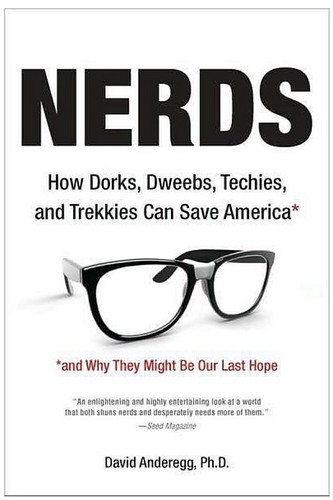
At Barnes & Noble today, I perused a book suggesting that "nerd" as a label might be part of an oppressive dominant culture's mythology, which has, in times passed, classified both homosexuality and the desire of slaves to be free as treatable mental disorders.

Actually, on further research, I see the memeplex relating autism to nerdiness is well-developed, and rubs a lot of people the wrong way.

Whereas I would agree that control over "what's a mental disorder" is a key controlling technique, I'm not persuaded:

(A) that Geek and Nerd are synonymous -- what a waste of a good word if so -- or that
(B) Geeks lack social skills.

On the contrary, geeks have collaborated to create new ways of working together on complex projects that big business is striving to emulate.  They call it Inner-Sourcing, which means using what we learned doing Open Source to do something a bit more hush hush and proprietary.

I've held in my namespace that "a nerd is actually the larval form of a geek" which I know sounds somewhat gross, which is all part of the spin.  An ugly duckling, socially speaking, may turn into a swan, given growth-fostering conditions.

Building the new software infrastructure of the planet, with open hardware and open data in the pipeline, took sociality to a higher level.

For my part, I consider myself a geek who is pretty well endowed with diplomatic skills.  I'm not especially shy nor retreating, though I'd cop to being on the quiet side.  Some might claim I was never a nerd then, and probably never bullied sufficiently.  We could argue.

I'd say these are not terms with any fixed or immutable meaning, so allow me my own dialect, how about?

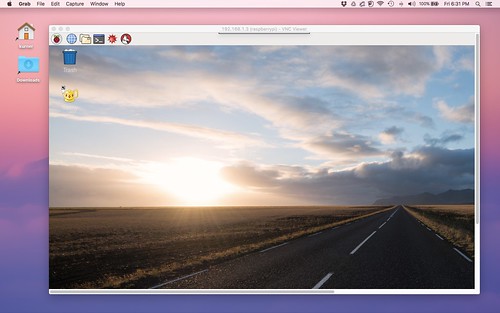
Anyway, the geeking out I did today (Walter Cronkite's 100th birthday (he died in 2009)), involved updating the Jessie distro on my Raspberry Pi 3 (R-Pi 3) to the latest version, sporting the PIXEL desktop with integrated RealVNC.

Thanks to VNC, I was able to connect to the R-Pi in my basement from the Mac Air upstairs, not just through ssh, but in such a way as to show the desktop. I can use this new capability in my upcoming classes I bet.

I also worked on a puzzle involving transportation systems and Dijkstra's algorithm for finding the shortest distance from A to B in a weighted graph.  I wasn't aiming to solve a specific puzzle, just spin my wheels a bit as a coach and mentor.

Earlier, also under the heading of geeky, I got the firmware on my Netgear router to upgrade, finally.  The "Yes" button had been obscured by a Help Bar I couldn't move out of the way, a flaw in the GUI design I finally managed to get around.

These are living standard boosts worth making.  One needs perseverance and concentration.

Why not study "the Work" as shared by Maurice Nicoll if needing more power to focus?  As disciplines go, the Fourth Way folks seem pretty reasonable.  Alex sees connections from the Ouspensky lineage to est through Silva mind control. I'd say even more directly through Mind Dynamics -- before my time really.

I do see the link in the emphasis on machine-like behavior.  In what sense is our intelligence already robotic and therefore artificial?  The esoteric religions and cults do overlap in what they preach.

In Fuller's namespace, we look at mind versus brain, meaning intuition versus conditioned reflexing.  A lack of social skills may relate to both automaticity and an inability to upgrade / reprogram.

As code schools merge with schools more generally (witness the "boot camp" phenomenon), why not look at psychology and mental discipline, in addition to physiology and working out?

Scouting was always about mind and body both, right?  But then of course many critics would share my tendency to lump a lot of these teachings together, as a prelude to tossing them out more than anything.  New Religious Movements (NRMs) definitely spawn their share of detractors, as do the older ones.


Controlling the R-Pi from Mac Air over LAN

:: R-Pi desktop in a window in the Mac Air ::

Thursday, November 03, 2016

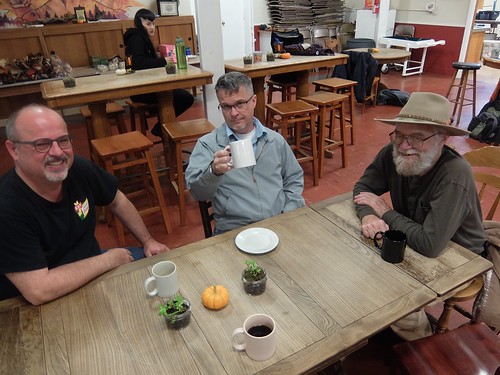
Scholars Meet

Scholars Meet @ Th'underground
:: scholars meet ::

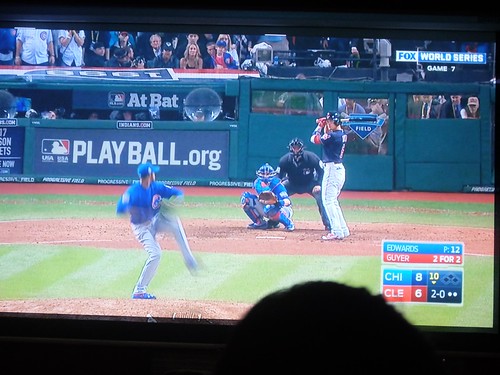
Cubs Win
:: cubs win ::

Singularity
:: life goes on ::


Thursday, October 27, 2016

New Public Schools

Old School Toys

Here in the US (a namespace) the attack against the whole idea of "charter schools" has reached a fever pitch, and the fights are along battle lines I scarcely recognize.

Years have transpired since I helped a Portland charter get off the ground, one LEP High, on East Burnside.  More recently, I've expressed my interest in the Nexus Academy model in the State of Michigan.

A recent editorial said the charters had failed in their promise to raise the test scores of poor kids.  Was that their goal then?  Was that the conversation? 

I thought the purpose of all public education, charter and non, was to save US Americans from their own brutish ignorance, their natural state.  As babies we don't know a lot.  We need an education to use a phone, engage in business activity.

Private schools share the same mission.

When did we agree on standardized tests?  Which tests?  What if they're stupid?

This bold miss-assumption that we as a nation ever agreed to anyone's standardization plan is really jumping the gun a bit I'd say.

Sure we'd like to eliminate poverty, but to really do that, we'd need to be at least twice as smart about how we spend our money, and three times as smart about what money is in the first place.

How many public schools teach anything about bitcoin I wonder, or the idea of cyber-currencies more generally?  Or about encryption?  What standardized tests ask about those topics?  None you say?  My point exactly.

In any case, civilization requires torch-passing to be ongoing, a truism, which doesn't mean it's not true.

Lets imagine a future world wherein rich spoiled US Americans are even dumber than dumb, nothing like the world of now.

Could charter schools spring up all about teaching empathy and compassion?  Could we raise their EQ just a little?  Could any public school of any type take that on?  What if some group thinks it worth a try?

What's fair about denying future generations the experience that comes with creating a new school from scratch?  Another public one, like the others.  Why should that right be denied?

Is creating new public schools that are not charter schools ever done any more? Or are all the non-charter public schools that we'll ever have, right now with us today?

Branded Boxes

Suppose a small city had ten golden keys, surrounding counties a few more, and it was up to school boards to award these to eligible grantees.  You could hold a key for thirty years, then it went back in the pool.  You'd have your school.

Schools are not the same thing as school buildings.  Any skyscraper in downtown Portland could host a school, and many do.  Code schools in some cases.  A university system might have the ten keys for code school endeavors.  Some code schools could be public, labeled either magnet or vocational.

The thirty year timeout interval was arbitrary, used to introduce an idea:  that schools could be made mortal right out of the box, and that their mortality is a good thing, a feature to be welcomed.  What a concept, right?

A broadcasting license doesn't last forever either.  Some licenses need to be renewed.  If we posit a relatively stable population for our model City and want to give people in every generation the opportunity to create schools, then a time-out for existing schools makes sense.

As a popular teacher in school X, not taking new students four years out, a high school winding down, I might be in on the planning of the next one.  The "blank canvas" feel, the innovative talents unleashed, are welcomed.

We're not mourning for the fading of twilight schools. Having had a good run, we welcome change. We learn from every generation's mistakes, or certainly hope to.  Honesty about what those mistakes were is part of the process, nothing to do with shame or blame.

Besides, a given school might standardize on something "retro", allowing thematic echoes of prior times.  Academia in the West tends to echo Greek and Roman patterns, and that's just the beginning.  In a city like Portland, West meets East.

In other words, there's plenty of thematic continuity irrespective of specific institutions, as well as opportunities to experiment with new and positively synergetic blends.

In this possible future, new public schools are simply that, neither "charter" nor "alternative" just of more recent vintage, like a car more recently off the assembly line.

"We don't make those anymore."  What a relief in some cases, right?  With more hard won experience, we have a right to expect some improvement.

Mr. Ed?

Wednesday, October 26, 2016

Science Fiction Future


We will need writers who can remember freedom. We need writers who know the difference between the production of a market commodity, and the practice of an art.  So says Ursala Le Guin, another WILPF member (like my mom).

Speaking of science fiction, the Martian Math I'm using, not unlike Tolkien's Elvyn in living internally to some "middle earth" (a virtual nation we might say), features this artifact that looks like a caltrop, if anyone knows what that is, not a jack in other words.  A jack is a six-spoked affair whereas a caltrop has only four spokes.

If you've taken linear algebra you know the 90 degree turn is into a whole other dimension, a twilight zone almost, given its 100% linear independence from the first ray in the picture.

The real estate from 0.01 degrees to 179.99 degrees is all brought into being by this Dim 2 (second dimension) but pointing 180 degrees opposite is back to Dim 1.  The clock hands lie flat, so back to one line, not a triangle anymore.

Just taking the negative of a basis vector, is not to get a new basis vector, or dimension, as we're to see only three infinite lines through a shared center, with travel in both directions a property of any line or road.

The caltrop is nonetheless fewer spokes, four is less than six, incontrovertibly.  In making all four "positive" with these labels: (1,0,0,0) (0,1,0,0) (0,0,1,0) and (0,0,0,1), we're creating canonical linear combinations, road maps of zero or forward motion along these four directions, to any point in space.

The six-spoked XYZ artifact offers the same advantages:  a unique address per every point, a distance formula, ways of computing angles.  Going back and forth between XYZ and Quadrays is what many an Earthian diplomat learns in grade school, in preparing to work with the Martians on projects.  Their unit volume is not a cube.

The XYZ vendors claim they're touting most economical warez, in that three basis vectors, mutually orthogonal, are enough for their scheme to pan out.  Yes, negative signs are needed, to show basis vector mirroring, and eight octants get created.  That does not mean we should kowtow to the Martians.  They could learn from us Earthlings.

As you can see, there's a lot going on in this science fiction, with factions right from the get go.  Having the two coordinate systems in the picture is the first step towards at least having some interesting debates and conversations, during which terminological questions are clarified, definitions more clearly cast.

However some teachers protest that linear algebra students have enough on their plates.  Martian Math may sound like fun in theory, but adulthood is calling.  We don't have time for gratuitous brain teasers.  Who ever heard of a unit volume that wasn't cube-shaped, anyway?

For my part, I think all six XYZ vectors should get equal pay for equal work and therefore -(1,0,0) i.e. (-1,0,0) is just as much a basis vector as its oppositely pointing counterpart.  That's not the official definition of course.  That's where philosophy comes in, to provide that subjunctive layer of "could have been otherwise" -- even in mathematics.

Tuesday, October 25, 2016

Ship Comes In

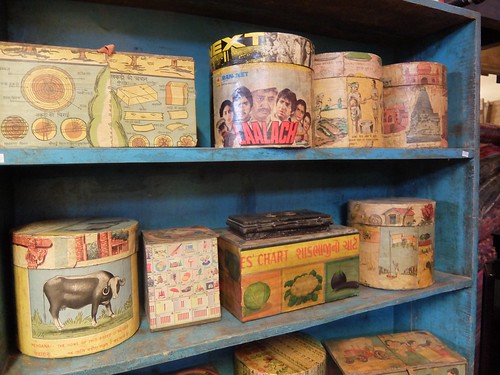
VEs from India


Zebra VEs

Saturday, October 22, 2016

Mystics


I've been revisiting the literature assembled in the wake of Russian mystics Gurdjieff and Ouspensky, having purchased in soft cover four of the published six volumes by Maurice Nicoll, which are psychological commentaries on the thinking thereof.  A book sale at the meetinghouse.

Some may dispute this label "mystics" correctly applies, as if to them, why not to Bucky Fuller, who likewise meditated on the machine-like qualities of human existence.  When it comes to machine learning by means of neural nets, no AI can hold a candle to what one brain can do, let alone many working in tandem, in parallel.

The illusion of real intelligence (RI) here is almost complete (smile).

I read on Medium that it's OK for me not to decode AI anymore, likewise CIA which some say should be AIC (Artificial Intelligence Central).  No wait, I'm wrong.  Here's the very short list of technology acronyms I don’t need to define: API, AJAX, BIOS, CPU, CSS, HTML, HTTPS, LAN, RAM, REST, USB, WWW, XML. For everything else, I should spell it out.

AI = "Artificial Intelligence" in that case.

Anyway, Bucky worked closely with Ed Applewhite, a career CIA guy, retired by the time we met, who gave us the four volume Synergetics Dictionary, and in there, we maybe find a distancing from the "mystical" as what to spend time on: 
I consider all the time spent on speculation regarding the inherently unanswerable as inherently profitless and a squandering of the opportunity to answer those questions which are inherently answerable by man.
I supposed he's taking "mystic" as somewhat akin to "obfuscator" and he preferred to be clear, about what little he knew about.  He also said "I spend every waking moment in a world of absolute mystery."

Lets agree the word "mystic" ("mystics" plural) is malleable as to its meaning and precisely to whom it applies.

My mom, Carol Urner, has tended to embrace the term as suggestive of what drives her, which many an orthodox Christian would simply call "the voice of God" (or "the Will").

However in Huxley's Perennial Philosophy, studied by many Quakers I know, the mystics frequently come off as outside the jurisdiction of any orthodoxy, as their role in their own time is to challenge some established status quo.  St. Francis of Assisi would count in that category.

No one commanded we establish a strict taxonomy in any case. I will point out, that after Fuller self-published 4D Timelock, a book on solutions for sheltering people, he had a short list of people he felt should have access to it right away, and P.D. Ouspensky was on that list.

Fuller was effusive in his admiration for Einstein and referred to peaceful uses of nuclear power (such as in the sun) in Nine Chains to the Moon.

So was Einstein a mystic? He's a source of quotes such as this one:
The most beautiful and profound emotion we can experience is the sensation of the mystical. It is the sower of all true science. He to whom this emotion is a stranger, who can no longer wonder and stand rapt in awe, is good as dead.
Wittgenstein  might question whether the mystical must really be an emotion or sensation (let alone a brain process).  Was Wittgenstein a mystic?  Obviously, we could go on and on with such queries.

Maurice is what some might call a Jungian in his outlook, a link to Gnosticism and Gnostic, which rhymes with Mysticism and myth-making.

The machine and the mechanical, and its relationship to life, is the stuff of myth as well, a source of stories.  Psychology and philosophy meet here somewhere.  We have just the one Universe after all.

DSCF0207

Thursday, October 20, 2016

Measure 97 Again

Foes of Measure 97 have cleverly portrayed it as a "tax on sales" but not a sales tax. Everyone knows Oregonians are happy to get by without a regressive sales tax.

Property taxes stay relatively high. I just got my bill today in fact, over $4K on a non-commercially zoned lot, with a house over a hundred years old on it, plus garage. Walnut tree. Rhododendron.

People like me pay for schools, not the out-of-state big guys, who just wanna make a killing.

What business can't model itself as gaining revenue from "sales" of some kind. Health care, cable TV... all end user consumer services.  It's a tax on revenue, on the bottom line, and yes, that relates to one's gross.

Therefore to be anti "tax on sales" is to be anti tax on business, period.

"We don't want to pay taxes and as big businesses you can't make us" is the attitude.  "Let us gross whatever we can and make the little guy shoulder all payments."  They do the same thing around wars.

What's a poor little US state gonna do, with the Feds run by greedy Wall Street, or LAWCAP or whatever?  Squeezing a small state is no problemo for them, given the USG has already caved.

So yeah, those hoping to improve the state's schools and other services may be disappointed come November. The outcome of the propaganda war is far from predetermined.

Maybe Oregon could run some tourist attracting passenger trains with adjoining communities in the outback?

We don't have train tracks to Breitenbush, a hot tub paradise, which is private, but you get the idea.

Institutions of higher education might get in on the campus planning. Go by train, stop off here and there to get an education.

Don't let the naysayers who won't pay their fair share advertise Project Earthala as their idea.

We have  more intelligent sponsors to boast of than Comcast.  Some of our partners behind the scenes don't mind feeding the public/private partnerships these foes of Oregon might consider inconvenient. Pleasing Obnoxico is not our priority.


Sunday, October 16, 2016

CompSci + NeuroSci

Retired Mascot

[ originally an email to Nathaniel Bobbitt, Oct 15, 2016 ]

I wonder how annoying it'll be to neuro-science types to hear me teaching compsci and saying such things as "the browser's brain is full of JavaScript whereas the server is thinking in Python."

Of course web browsers don't have "brains" and many philosophically-minded would take issue with servers doing any real "thinking" let alone in Python.

I'm not worried about it though. Language is nothing if not malleable and I'm purposeful in having students empathize with their machines as if these latter were sentient beings.

Why?

Not to encourage superstition but to bring an already richly associational matrix of key terms, a well developed namespace, into a relatively alien territory (that of machine learning -- and they need to be taught, by us).

Knowledge has always expanded thusly, i.e. empathy has always played a big role, at least for some people.

The Python language actually uses the word 'self' although it's not a keyword, more a placeholder with a conventional spelling, ditto "God" (not in Python) and like that -- kind of like how "Zero" doesn't really have to be "0" but we do need that placeholder.

When I define a type of thing, such as Airport:

class Airport:
    def __init__(self, three_letter_code):  # birth!
        self.code = three_letter_code
    def __repr__(self):
        return "Airport('{}')".format(self.code)

Interactively then: 

In [148]: portland_or = Airport("PDX")
In [149]: portland_or
Out[149]: Airport('PDX')

I then spawn many "selves" of same, e.g.

portland_or = Airport("PDX")
newark_nj = Airport("EWR")


and so on, elaborating into a full program.

A standard practice in compsci, when passing the "object oriented" torch, is to talk about "is a" and "has a" relationships e.g. a car "is a" motorized vehicle, and "has" seats for people (maybe the driverless ones don't).

I've long encouraged a parallel "am a" and "have a" grammar, such that the programmer thinks "I am an Airport, now what do I have?" "I have concourses, and luggage carousels". "OK so now I'm a concourse, what do I have?" and so on.

Changing the subject for a sec, a question I was gonna ask you at Atlas (or Bagdad or...) has to do with "autistic spectrum" -- how people talk, yes? But doesn't a "spectrum" connote basically two directions: left vs right, up vs down, in vs out (any of those)?

Probably some author has already suggested a multi-axis (i.e. higher dimensional -- more than one) "phase space" for placing autistic profiles in a taxonomic or diagnostic matrix. "Beware of spectra when phase spaces are better" might be the moral here -- degrees of freedom and all that.

Thursday, October 13, 2016

Science Fiction

Cascadia Masthead
by Zapato Produtions Intradimensional

In this telling, the US is more interested in emulating the EU than the other way around.

Each of the USA states would like to develop its own foreign policy in large degree, with the understanding that other states in the federation have automatic special standing, and share the same currency.

Once within the federation, US citizens are free to move about as usual, without harassment by border patrols.  N8V sovereignties are more likely to prosecute trespassers, especially polluters and treaty violators.

US states and territories probably don't send ambassadors to all the others.  Texas and California might, given their size.  Puerto Rico will likely exchange ambassadors with Cuba.

Oregon still proxies through DC quite a bit, not bothering with ambassadors to non-US states in every instance.  DC still has important switch boarding functions, as does the UN.

Cascadian states have a natural alliance with western Canada some other states may not enjoy.

DC still spins its wheels and attracts tourists.  The notion of "federal laws" still exists.

However, Oregonians already enjoy freedoms considered criminal by the so-called Feds, whereas for their part, the Feds engage in prurient and criminal adventures overseas most Oregonians are eager to disavow.

Tuesday, October 11, 2016

Another Honorary Wanderer?

Remote camera photo of OR7 captured on May 3, 2014, in eastern Jackson County on USFS land. 
Courtesy of USFWS

In addition to proposing Keiko as an honorary Wanderer, I'm thinking about this wolf. The ape authorities are thinking about killing him.  We allow animals to join us in death, as well as in life.

We've had numerous dogs in our midst (some now dead), welcome at the table. Yes, mostly we're comprised of [not naked] apes, par for the course in our zip code.

My reference to Ecuador in the above tweet has to do with that country encoding some rights for non-humans into law, one of the first groups of sapiens to do so.

Yes, it's true, some apes pride themselves on being "sapiens" and have invented a whole taxonomy to celebrate their supposedly exceptional superiority.

Never mind they murder one another in droves and are the laughing stock of the galaxy -- just kidding, the galaxy has more important things to think about.

However if we're allowed to call North Americans "Indians" (even in 2016!) as in "Indian reservation" then I think the "Planet of the Apes" moniker applies just as well, as a colloquialism.

"Welcome to the planet of the apes!" I'd say to the ET tourists.  The "sapien" stuff is just their vanity talking.

I'm referring to all the branches of hominid species, most of them already killed off by now. The sapiens were apparently the most vicious.

Call them "mankind" if you like, or "humans". That's the more formal term (not "vicious monkey" or simia vitiosus in Latin).

When in Rome...

Thursday, October 06, 2016

A Tipping Point

Patrick did a good job pulling together new Python teaching materials.  These are for a class he's running, completely separately from mine, though also on-line in real time.  His company wants to hand out something thick, made of paper.  Mine doesn't go there, presently.

We're both tracking the hurricane in Florida, among many catastrophes in the making.  The human-made catastrophes are even more lethal sometimes.  The wreckage around the Mediterranean, on into Mesopotamia, or "Arabia" as a former US senator from Oregon calls it, is so much worse.

I saw on Twitter about that giant Putin flag hanging off a bridge in New York City.  So how sympathetic was Kerry towards Russia keeping a base in the Mediterranean, regardless of what nations we see?

I haven't seen any nations in a long time, on the maps I'm using, but that's because I was trained in the World Game, a specialized form of modeling only a few got to study.  We look at geography, geology, ecosystems, but not the political layer as much, though we have that overlay.

NATO has a bazillion bases all over the place, we've all seen those maps, so begrudging Russia having a few outside its nominal borders, whether or not that includes Crimea, should not be that controversial.

Surely the US isn't so psychologically insecure that it can't abide even a single Russian base anywhere outside Russia.  Organizing inter-visitation might be the next confidence building measure.

I don't think "bases" in the obsolete sense are needed at all, but the infrastructure is useful, for disaster relief and human relocation.

Calling for the complete evacuation of Aleppo, as I've been doing, sounds more realistic when one has bases for the refugees to flee to.  They'd've been out long ago, like Floridians from their east coast.

However I'm just another Tweeter, these days without even a gym membership, so my views hardly register, whereas Kerry gets to set the tone.

I know a lot of people say it's about pipelines, gold, other treasure.  We all have our ways of sounding worldly, knowing.

So-called "rich people" (often among the most ignorant) like to ape one another, competing to sound "more insider".

Social media have amplified and expanded that workflow, to where now pretty much everyone gets to sound like a rich ape.  That's a shift, even a tipping point.

Tuesday, October 04, 2016

Go By Train

DSCF9667

Uncle Bill, the mining engineer turned naval historian, in his 90s now, is heading this way by Amtrak for a lunch at Ringler's or other brew pub near Union Station, before heading home two hours later.

This will be his fourth such visit with me, however he's come down independently to visit with other relatives.  He used to drive his Aztec but voluntarily quit driving after a passing mini-stroke (TIA).

Carol had hoped to join us this time, but decided getting her INR checkup (like Hillary gets) with her favorite checker would be tough to reschedule.  So I'll get her there early and she can while away the time reading her recently-acquired book by Hendrik W. van der Merwe, regarding his work to end Apartheid in South Africa, a story more USers could learn from.

South African Friends were more than a little miffed when the US-based AFSC showed up in force and presumed to advise them on how to best deal with ending Apartheid and self governance in its aftermath, given the RSA was actually overcoming racist thinking, whereas USers were still singing "we shall overcome" in some future tense.

That's a song for young people in my book.  If you haven't overcome by 58, it ain't gonna happen, is my attitude, whatever "overcoming" means to one.  YMMV.

RSA means Republic of South Africa in the above paragraph, not Rivest-Shamir-Adleman, a public key crypto system similar to Diffie-Hellman.

I recommend the movie Chappie to better appreciate the difference Ubuntu makes.  AFSC still uses Windows.  If you don't use the bash shell, you're not a real activist, is my rule of thumb (Carol an exception).

USers like to be bossy, believing themselves enlightened or ahead of the curve. Didn't Michael Moore help lay that notion to rest in his latest movie, which mom and I both want to see (I've seen the previews)? 

USers are among the more backward, culturally, adding them all up and dividing, to get an average. They have "diversity issues" in the sense of insufficient schooling in dealing with it intelligently.  Remember the people who came here were those with the most trouble fitting in (like the Quakers).

I'm teaching class tonight, really more like hosting a talk radio show, with me doing most the talking.  My listeners text message, and see each others texts.  I work their questions into my discourse.  I'm doing a highly technical talk on Python, the computer language, which I get to teach in forty hours.

Last night I was at the code school again, "the guild" as we call it, catching up with my peers and ignoring DC politics.  Oregonians live on the Pacific Rim and tend to not always share East Coast perspectives.  I brought along my XO-1 for show and tell.

Carol has a speaking engagement elsewhere tonight, which I won't make.  She's in demand as a speaker, and this year she took it on the road, riding shot gun with Ellen Thomas in rented vans, from LA to Seattle, and from Boston to Cape Code and Boston.  Most 87-year-olds wouldn't have the stamina.

Then she joined me for her granddaughter's graduation, in Richmond, Indiana, flying to Dayton from Reagan International, before packing her stuff to base herself here.  Like the Pope, she has winter and summer residences.

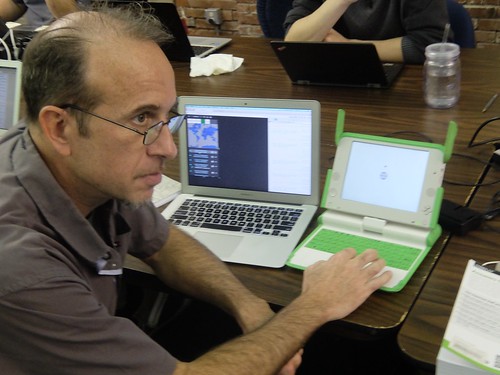
XO-1 at Code School 
Charles Cossé with OLPC XO

Friday, September 30, 2016

Whispering Campaign


Wednesday, September 28, 2016

Wanderers 2016.9.28


Pretty funny: some of our Wanderers have never seen the opening premise of the Portlandia TV comedy show.

I screened the above for their benefit, along with a short excerpt from my Nepris interview (like a TED talk).

When Bernie packed Moda Center (I missed that one), a bird landed on his microphone.  Unless you know the phrase "Put a Bird On It", you've missed something.

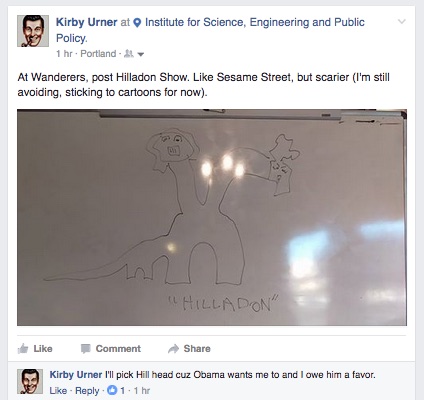
I drew a silly picture of the two-headed "Hilladon" (prehistoric) on the whiteboard and posted it to Facebook with my cellphone.

Hilladon

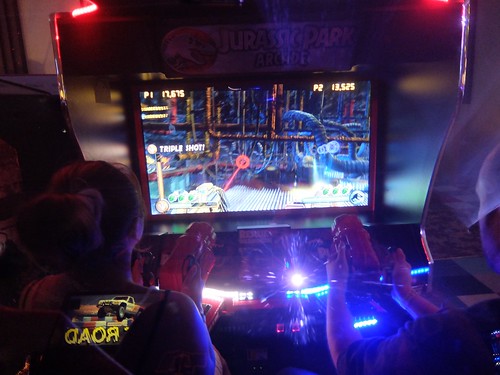
Jurassic Park

Tuesday, September 27, 2016

Bookkeeping

Bookkeeper

I can't make a ton of money without being a hypocrite. However I can commit the back office, the Centurylink / Prism room, to serving nonprofits, as a nonprofit that pays its share of expenses, especially telecomm.  That I make a meager income is tolerated, actually welcomed, as that keeps it simple.

As a trainer, I pop up, all paid for, and deliver the Python3 or whatever.  Python3 is more an ecosystem than just the one language, what with JavaScript, SQL, noSQL and all the rest of it.  Not that everyone is into web dev.  We've got Jupyter Notebooks, we've got SciPy.

I'm a big believer in institutional wealth.  I feel pampered on a big Boeing, or an Airbus, without owning stock in the company, let alone a slice of the jet.  Sailors on big Navy ships are proud of what they pilot, but it's not like any might claim title in the purely landlordist sense, not even an Admiral.  That's why I go with "military socialism" as an apropos model, of what the "bases economy" (a kind of "centers network") portends.

That's how I got my trips to Lithuania and Gothenberg:  they were paid for by sponsors, not as income to me but as an expense of doing business on their part.  My flying on an airplane somewhere is not necessarily "income" any more than shipping a book.  I'm an office supply.  Don't even send me the transaction, as it doesn't have to go through my bookkeeping at all.  Or send me some record if you like, it's not like I don't like to scrap book.

I'm happy here in Portland for the time being however, though close family stay high on my list and I'm not bed-bound or anything.  I have a current passport.  This is "back to school" season and I'm on the hook to deliver, lets put it that way.  Carol is here.  I'm her driver.  Lots of good reasons to stay put in this chapter.

Thursday, September 22, 2016

Russian Novel (interlude)

Excerpts from QuakerQuaker set to Game World tableaus from QuarterWorld...

Forrest:
I was hoping that hearing the truth of these people's words, despite their theological convictions/or-lack-of -- would serve to alert those Friends still watching this site to how sadly captive their minds have become to corporate (and governmental) manipulations & outright distortions of what's going on, how the system functions, why and how the best of us are striving desperately (seeing no hope of significant mitigation within that system) to replace its dysfunctions with social arrangements more sane and humane.
Suburbia Land

Kirby:
Translation: you're trying to reach the walking dead, affluenza victims mostly, suburbia-land or whatever. Hah, I gave up talking to them ages ago. Triage man. Oh well... back to work. They're making a video of my 15 minutes (actually 30) in Texas (Austin), which I'll post to QQ when I get a link (but not on one of your threads as "self promotion" is a big no-no for the bored guy). 
Cirqus Voltaire


Forrest:
Kirby, you should be talking to Prince Andrei, the character quoting Voltaire in your War & Peace excerpt. He was the one bored with Goethe (& poetry in general). I myself merely find some exchanges more rewarding than others...
<< snip >>
I don't see any 'overhaul' going on, certainly not down where the rubber meets the no-account people it runs over.
DSCF9543

Kirby:
By "overhaul" I didn't mean to imply "for the better". That remains to be seen. Could be that given smartphones and driverless cars, humans will only need very small brains in much tinier heads, and Zika is on the job. Planet of the Apes is not a pretty place. I wasn't promising any rose gardens or anything.

Monday, September 12, 2016

Working It

We enjoyed a Hophouse gathering I doubt will be repeated, in terms of who was there:  myself, Michael Hagmeir (now resident of St. Louis, MO), Patrick & Glenn (Asylum District, like me) and Mike (visiting from Florida).

Michael drove here in two and a half days, stopping at Carhenge in Nebraska and Craters of the Moon in Idaho.  The previous evening, I'd joined Michael and Matt for an evening together.  The car stays behind when he flies home.

Then Glenn and I grabbed a 14 to downtown, leaving time for me to get to Payless for shoes (I wore out the Mt. Tabor walking shoes again), and have a beer each at Ringler's.

Only a few blocks from there is Wieden + Kennedy.  We arrived 20 minutes early, not sure if there'd be any shortage of seating.

Given the Tech Crawl that just happened, I somewhat made myself at home and poked around in the lobby taking pictures, not really what their workflow is set up for.  The receptionist had to remind us this was a private office building.

Any problems occasioned by the arrival of the rest of our throng turned out to be self-solving given no one was wanting to be rude.  We all waited patiently for about forty minutes, after which the ball got rolling.   

PDX Maker Week is only just making its debut.  We haven't seen Maker Faire packaged in the context of a whole week before.  PSU took on promoting this new idea, as a sponsor.  OMSI took on the two day Maker Faire.  Glenn and I made it to that as well.  Thanks to workingIT, I got a press pass.

Some of my more detailed initial thoughts on Dale Dougherty's keynote went to @4DsolutionsPDX, which is where I work on a maker space known as #CodeCastle.  I tweeted as we bused back to Asylum District along Division. I was thinking back to a certain Pycon keynote, and the Stanford connection.  Making commitments ("I'll be there") is making.

Mostly I was observing how advertising involves projecting lifestyles with deliberately placed products, and that's a form of "making" some have mastery over.  Which booths teach that?  All of them?  Pretty much.

Glenn wondered if those promoting the "Maker" meme were trying too hard to encompass too many crafts outside the digital-electronic.  He's an analog craftsman going way back, but hasn't taken on "Maker" as a part of his own branding, preferring to leave that term to coders of devices.

Obviously memes are subject to regional variants, or call them dialects.

Bringing all these crafts together suggests synergies and continuity as well.

Getting out into remote villages with high tech, yet adopting somewhat "time-refined" lifestyles (a euphemism for "ancient"), requires places that continue to teach the skills associated with high tech, in addition to all the "intermediate" and "lower" tech.

Someone has to keep designing and manufacturing circuits, programming games and simulations, even if a lot of people live nowhere near a chip making facility or fab plant.

Civilization has a lot of batons to pass.  The relay race is another good metaphor.  Keeping our most advanced tech going doesn't mean we can't also have camping.  Not everyone needs to live or work in high rises either.  A wide variety of lifestyles are required, for any at all to exist.

Speaking of OMSI, I've known evening events to occur there.  PDX Maker Week 2017 might look at OMSI as a venue for some 6-10 event. I understand it's hard working with all volunteers and donated space.

Making events happen is itself a kind of making.  Earning credit in some currency of the realm, for helping to pull these events off, might make some sense, a standard pattern.

Where making meets camping is what we call scouting, already a big part of the culture here.  Living "outdoors" does not mean sans any shelter from the elements, yet "closer to nature".

Camping keeps upping the level of technology available, or at least opening the space of possibility.  We saw some interesting new camping ideas at Maker Faire. By camping I don't mean necessarily nomadic.  Farming and permaculture might go on, with sacred spaces made semi-permanent.

Where #CodeCastle "actually exists" physically is not important at this juncture, as right now it's a meme, i.e. more metaphysical, and tied into the "(High + Art + Code) * School" meme -- that's supposed to remind us of the distributive property.

Friday, September 09, 2016

Tech Crawl 2016

Tech Crawl 2016

I'd not been on one of these before and felt privileged to join Patrick in a night of hounding around inside some of the less open bastions (lots of security) in Portland's downtown:  Puppet, Aruba Networks, Mirador, Cloud Compass, iovation, New Relic.  These were the ones we got to, plus many more were participating.

We also dropped in on The Tech Academy, given we've both served as Python mentors for the O'Reilly School of Technology.  OST has closed.  I kept some of its DNA in a test tube (not literally) in the form of OCT / RU, a Flickr album of little diagrams and such, along with souvenir business cards.  None of our proprietary software leaked out.  That would all need rewriting, and would reflect lessons learned, no need for carbon copies anyway.

However, I digress.  What I was seeing were prototypical work spaces offering the kinds of roles those who study computer science and engineering hope to get for themselves.  Ample kitchens, friendly people, handsome facilities, right downtown.

What more could one hope for?  We don't have Cubby Camps yet, with people doing more async out in nature.  The corporate cube farm has evolved considerably, but still loves a good 30th floor view, more of the mountains than from the mountains.

In taking pictures of the Puppet library (on display in the foyer), I didn't come across many Python titles.  Ruby looks to be making more inroads there.  Tech Academy did have a Python course.  Mirador is more a Java shop.

We see different levels in people's willingness to be polyglot.  I'll venture into Clojure, which I admire, while coding something I've coded before in other languages, such as Quadrays, a system of 4-tuple vectors mapping the same space as XYZ but with four positive rays to the corners of a tetrahedron, old hat to my long time readers, check Wikipedia.

Why would anyone use that?  In philosophy class maybe, to introduce "language games" in mathematics, but where else?  Do any architects learn about A, B, T, E, S modules these days?  How about art school students?

These are not core questions pondered within the business sector downtown I don't think (not "CBD questions" -- except maybe at PSU, or University of Portland, in some study carrel somewhere, where following Wittgenstein links makes more sense).  I've taught the basics of "Martian Math" on both campuses, at one time or another, as well as at Reed and OGI, using Python mostly. CBD = Central Business District; OGI = Oregon Graduate Institute.

In other words (back to "polyglot"), suggesting people "language hop" as if that were some trivial jump, is often unrealistic, any more than an English speaker might simply "hop" to Japanese or vice versa.

There's not much truth in the slogan "learn one computer language, and you've learned them all".  Not really.  They come in families, like musical instruments do.  Learning Python does not make you a great J programmer (APL family), though I've found them to make a great combo.  Both feature a strong REPL (a rich interactive mode or "shell").

Geeks in this day and age will tend to identify as Front End or Back End as to their stronger skill set and area of most expertise.  If you study Twitter awhile, you can pick up more buzz words, like Data Scientist and Machine Learning (additional skill sets, mostly back end, except the front end is about visualization and so is data science also).

Front End means HTML / CSS and Javascript.

Back End means what happens to those HTTP / HTTPS requests once received.  Is the front end a smartphone app?  Java, Ruby, PHP... Python.  Many more languages play in this space, or define the frameworks that provide yet more layers of shared person-hours.  Why reinvent every wheel?  Speaking of which, I met an old colleague from Plone days (still a popular Python CMS), still with CD Baby.

Patrick and I went by bus (4 going, 14 returning) and wound up at Hophouse with our visiting friend Mike, in his later fifties like Patrick and I.  We've already enjoyed technology careers, against the backdrop of the PC to Open Source to smartphone revolutions.  I've spent a lot of time in cube farms, often in hospitals, or other client offices, staring at screens.  I'm still into staring at screens.

Those initial waves of technology were sufficient to change the guts of Portland's economy in some ways, while in other ways much stays the same.  I'm not the expert, but I've seen quite a bit of water under the bridge, had a front row seat on some of the action.

Some of my journal entries from years gone by somewhat bemoan the loss of CubeSpace, a US Bank building facility on the east side (not the USB Tower) that helped with cross-pollination, important when wanting to help geeks not fall into over-isolating silos.  Reinventing the same wheels over and over costs everybody.

However the code schools, especially the ones hosting regular meetups, have helped provide synergy, in tandem with the user groups layer.  The Meetup culture has taken hold. People from different walks of life discuss their projects and share skills.

Without a "public square" mentality, specialized knowledge becomes over-specialized to the point of semi-paralysis.

A Renaissance fizzles into yet another Dark Age (YADA) when the kind of liberal sharing encouraged by academia (traditionally) goes away.  The Free and Open Source movement was a direct extension of that tradition, per Richard Stallman at MIT, and the birth of GNU.

On a final note, I'd just been reading Quincy Larson's impassioned plea for "more async" i.e. less interrupt-driven open office plan setups.  He's talking about what we call Personal Workspaces (PWSs) in the GST namespace.  Study carrels.  Cubes.  Sometimes it's just office culture though, that needs to be addressed, if the floor plan is already fixed.

OST was all about async and PWSs.  Mentors gave focused attention to student programs, but not in real time while looking over their shoulders.  Diagnosing program bugs on the fly is not typically how it's done.  We'd encourage unit tests, and lots of them.  I continue to work that in.

"Too much task switching results in lost productivity" -- that sounds easy enough a proposition for the workflow architects to get.  Human beings are not ARM chips; they have their own specs.

Tech work sometimes means getting into a flow, almost a trance, like a novelist does.  I good novelist is a first reader to get the story, concentration is required.  Many novelists move to a beach cabin or some such, to get more work done.

"We need our software to work for us, not make us slaves to our machines" -- another good one.

I met up with PDX Code Guilders in one of the towers.  I'm expecting to cross paths again at the upcoming Maker Fair.

Tuesday, September 06, 2016

A Short Presentation

Code School

A student I met in Afghanistan (I was in Portland, we were working together over the Internet), showed up in a "bizmo" of sorts -- if you think para-gliding has a business angle (to me it does) -- and chauffeured me to the code school.  "Bizmo" means "business mobile" in contrast to the "RV" or "recreational vehicle". Will's bizmo is right hand drive, a Mitsubishi built for Japan's roads.

I was the guest host this Labor Day, as the enterprise was otherwise closed and paid staff were catching up on gardening and such. I'd signed up to talk about my tiny Flask application, and to introduce the idea of Lightning Talks, which go for no more than five minutes.  My talk was not billed as a lightning talk, however we're encouraging more presentations at Flying Circus and foresee when that might be the best choice of format.  Geeks need opportunities to practice the skill of presenting in five or less minutes.

I probably talked for closer to ten minutes, presenting to an audience where many had deep experience with Angular, React (frameworks), JavaScript, Java and Python (languages).  Ben is writing embedded C these days.

My talk inspired a next geek to jump up and share his Anagram Finder, a Flask app deployed in Heroku, likewise open source.  In looking over his routing module, I could see right away where I might want to make some changes to mine.  On the other hand, I'm aiming to stay pretty close to "just out of the box" i.e. Flask with few frills.  I'm glad my talk led to a follow-on talk.

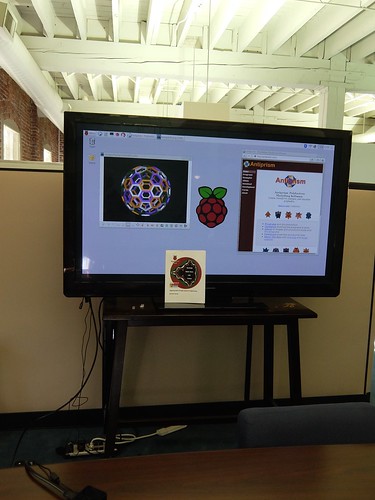
As I was getting things set up, plugging in the HDTV etc., I got a call from David Feinstein, whom I've been thinking about lately, and a film festival invite from a Palestinian-American I know. The ride from Will had also been unexpected (my original plan was to use the bus, holiday schedule).  In other words, events conspired.  I almost succeeded in roping Patrick into the event (he and another consultant were hoofing it to the zoo for exercise).

Speaking of exercise, it's the morning after, wet but not at the moment raining.  Mt. Tabor beckons.

I'll just mention what my Flask application actually does:  it simply connects an API of URLs to GET and POST request handlers, against three databases:  a Periodic Table, a Glossary of Geek Terms, and a Shapes listing (polyhedrons). These are simple SQLlite tables, not even relational in the current version, though the Shapes table has gone deeper, down to specific vertex coordinates, in related projects. /glossary/AJAX pulls up a definition in HTML (not that I'm using any AJAX) whereas /api/glossary?term=AJAX would pull up the same fill-in-the-template info in pure JSON.

When you look at the raw JSON info behind the more cosmetically enhanced view (the HTML), you'll see two additional fields I don't share through the template:  some initials and a large (multi-digit) decimal integer.  This models keeping track of whom and when a record was created.  The integer is actually the number of seconds since the start of the "unix epoch" on January 1, 1970.

Bizmo

Sunday, September 04, 2016

Rock Out as a Politician!


Saturday, September 03, 2016

Raspbian Affairs

Making Waves

I'm heartened by various blogs telling of the Raspbian subculture getting shared.  The Raspberry Pi is not exactly on offshoot of One Laptop per Child (OLPC).  On the contrary, it's not a laptop, just a relatively inexpensive machine with an ARM chip and GPU that doubles as the boot code runner.  I'm not the expert, more a hobbyist.

If you've checked @4DsolutionsPDX you'll find where I was politically active around Measure 97, a ballot measure in Oregon designed to administer some stimulus (we don't use the word "shock therapy") to Oregon's failing schools.  This might have been a last ditch effort, time will tell.  However, the obstacles are not primarily monetary.

Given the "stay home and learn" movement has gathered some steam (pun intended), I'm expecting more of a boom in the personal tutoring business, often a virtual gig.  I've participated in these kinds of interactions myself.  I'm sometimes tutored, not always in the teacher role.  My sense is a 50-50 mix works through adulthood: 50-percent student / 50-percent teacher.  Stay limber in both roles.

The "device wars" cannot be solved with United Methodists taking the brunt. They owe a lot to Texas Instruments, at least in some zip codes.  Why put them in a corner with the #CodeCastle concept?


Quakers have fewer ties.  I think I've been blinded by the obvious in some ways.

These powerful Raspbian devices, if openly flaunting their relevance to math learning, will not be accepted with open arms in many schools, where entrenched interests call the shots.  They'll be perceived as a threat. We need to stay polite and conforming, non-confrontational.

Therefore I'm recommending going with the flow, buying the TI calculator for math tests, and studying the Pi stuff in a PWS (personal work studio) if you can find one.  Not the Pi stuff necessarily (a fun option), more the GNU World, including serious "hard fun" coding, with Euclid's Method and all the rest of it (SQL... regular expressions).

Maybe learn about RSA from some old Linux hobbyist magazines to get the flavor, or look for translated Manga.  Stores around Portland have made those Linux mags harder to find lately, and if that's happening in Portland you can bet the dumbing down is even further advanced in the heartland.

Remember, if they really wanted you to have the skills to which they give lip service (e.g. "learning to code"), you wouldn't be commanded to buy a Texas Instruments graphing calculator.  You might be introduced to the Anaconda distro instead (from Continuum Analytics), and Jupyter Notebooks.  Not that it's either / or necessarily.  Maybe your school has both the delta and lambda tracks.

Remember to look up Mathematics for the Digital Age sometime, by the Litvins (Skylit Press).  You already know about Hacking Math Class, the Pi based classic by Peter Farrell.  Both high school level.

Fortunately, we have Champaign-Urbana and the University of Illinois, and of course Wolfram, to keep at least a few lights burning in that neck of the woods.  North America may indeed be dark with ignorance, but the Internet is ablaze with lots of new and interesting information.  Raspbians find one another.  Ubuntu is real.

You'll find Wolfram Language on many Raspbian distros, such as on the Jessie distro I'm using (runs Docker).  Yes, it could be faster, this is a training wheels computer in some ways, but that's better than no bicycle at all, right?  The process is one of bootstrapping.

Maybe you'll have several cloud computers in addition. Your school might spin those up for you, customized per course.  We did that at the O'Reilly School of Technology, simulating a client-side Windows pointed at a Linux server (a typical setup back in the day).

I'm still to this day using Eclipse for my tiny Flask application, even on El Capitan.  What can I say?  It grew on me. I came to like the dog food we served.

DSCF8210

Friday, September 02, 2016

Logan's Run (movie review)

Author Interview

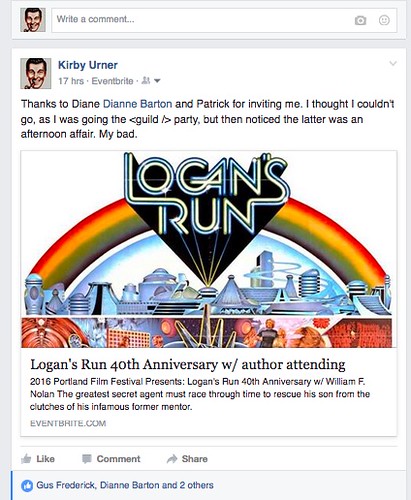
I'd already turned down a generous invitation from the Barton family to jump in on this one, thinking the 3rd Anniversary birthday party for PDX Code Guild was an evening soiree.  That was more my over-clocked imagination, misassuming, and if I'd read the Eventbrite invite more closely, or even looked more closely at my own slides, I'd have noticed the 1:30 - 4:30 PM as the timeframe.

By the time I'd figured out my faux pas, it was too late, however a side-effect was I was free in the evening after all, so jumped in at the last minute, buying a ticket from, you guessed it, Eventbrite.

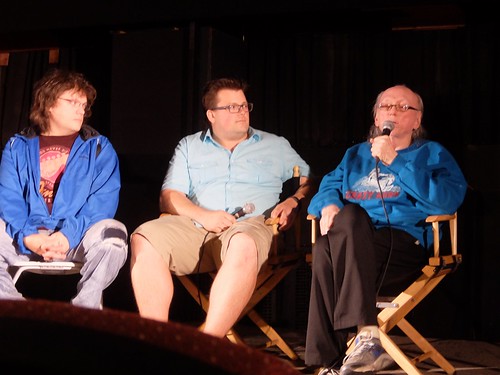
We're in the middle of the Portland Film Festival and Logan's Run, an old classic, was billed as just that, with the added bonus of the book's co-author on stage, both before and after, an old guy by now, in keeping with the theme of the movie (they AI-bot running the place kills the humans at age thirty).

In the book, the co-author told us, for the benefit of those who'd only just seen the movie, did have a place called Sanctuary that was more welcoming than an over-grown, in-ruins District of Columbia. The movie is more like Planet of the Apes outside (with Lincoln in place of the Statue of Liberty), with one aging ape, Peter Ustinov.  The escaping humanoids (the AI programmed quasi-humans) find the old guy and use that to myth-bust back in the bubble.

What's intriguing about the myth-busting is it doesn't work on the AI-programmed, only at the bot itself, probably a Docker application by the looks of it, running Ubuntu (for irony).  Humans are easy to program so a world like theirs looks fairly doable.  We have the prototype bioshelter in Cornwall (UK).

As for the spacey electronic music, that stuff's old hat by now (but really well done here -- the Lego slash Disney World is clearly a model, but with little people on the walkways and in the tubes, so persuasive enough for folk music).

The beautiful people are coyly modest and have their main party times off camera, a lot like Idiocracy in that way (another tasteful film).  In the book, they were all under 21 but that might have changed the rating. The handsome Michael York was already in his early 30s by then, and the lovely Jenny Agutter in her mid 20s.

There's lots more back story to share about the surrounding drama, outside the movie.  The Screen Actors Guild (or something like it) was meeting at our restaurant location.  I noticed more gesticulating and posing than usual, nice costumes.  These people were used to being "on" (or "in") camera (or "room").  Patrick and Mike had walked to Hollywood Theater before realizing their mistake.  Other details.

Speaking of Docker, I've got my head in that silo this morning, seeing how it's available for the Pi.  I'll probably end up adding it to my Mac Air as well, but lets explore the Pi first, as it's more purely a Linux box and that's the most native environment for Docker.

The actual images and containers needed to program sandmen, those who "put you to sleep" if you don't want to gamble on the carousel working (highly speculative), would include such procedures as we saw Logan Five put through.

We're led to think by the ambient lore that "sandmen never run" however the 1.5K unaccounted for may indeed have included sandmen.  Keeping secrets from the quasi-humans is not a problem for this bot.  We're not actually privileged to this private container ourselves, omniscient camera notwithstanding.

We're also led to think none of this 1.5K got passed Box.  That's more believable. Thinking outside the box is indeed hard to do.

That's another wrinkle I'll leave you with:  Box in the movie looks like an easy push-over.  The Box in the book as a truly worthy adversary.

The co-writer, William F. Nolan (George Clayton Johnson died last Christmas) ridiculed the movie version of his character, saying he'd witnessed them filming that part with Ray Bradbury who asked him "who's that?" upon which replied "I have no idea" (oh yeah, Box).

Another factoid:  the book was dashed out in just three weeks, an intensive marathon process.  A standard criticism is books splatted out that fast tend to be still-born, however these particular co-authors had done about a decade of preparation beforehand, so when it came time to commit to paper, they had an established base on which to build.

logans_run