Saturday, July 30, 2016

Idiocracy Two

DSCF7160

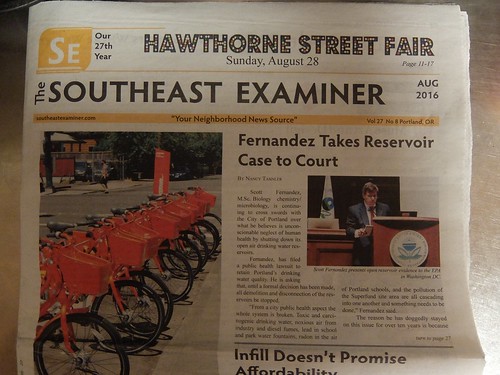
One of the reasons people treasure Portland is the quality of the drinking water.  However, a Federal mandate dictating that municipalities go to covered systems, ending above ground practices, is driving the health of this water system closer to average, in the direction of Flint.

Underground cisterns have a host of problems, starting with the absence of sunlight and its ability to break down various germs.  Then there's radon...  Hey, read the articles.

For Portland, it's a PR disaster, as the city has never adequately explained why it is slitting its own throat in this way.  The existing gravity-powered system of aqueducts was a feat of engineering beyond the abilities of today's engineers.

However, clearly the healthy water we've been enjoying was not sufficient to prevent the pandemic of idiocy that has swept the rest of the country.  Portland is joining the rest of the Lower48 in its perfectly dumb-ass behavior.

That means less reason to move here, which means lower property taxes.  I already know several cases of people giving up on Portland, now that it has become this dumb.  At least we know why:  turns out the schools have been serving lead in the water, probably for decades.

Portland is actually spending big bucks to dismantle its legendary water system and replace it with something more substandard.  Why this is smart has never been explained.  Some citizens have raised questions but where there's money to be made, that's sometimes the only answer.
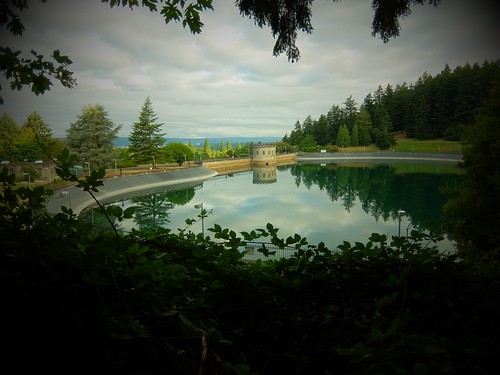
Idyllic Postcard:  Mt. Tabor

Thursday, July 28, 2016

Flushed Away

DSCF7150

No this is not a movie review, although Flushed Away is a toon that I've seen, and reviewed.

My story is about the yellow toilet, aka Yellow Throne, handsome on its black tiled floor, a high efficiency model, works well.  That previous throne was too underpowered, thanks to my conservation-minded self:  I'd put a fat rock in the tank so it'd flush with less water.

The stone expanded with the wetness and although it never cracked the tank, it become impossible to remove with any known technology, short of cracking the tank. The flush was too weak.  I'd sabotaged the toilet, unwittingly, not acting in my own best interests apparently.

Mick the Plumber put the new one in back in 2012. It had to come from far away, as yellow is not a color much in demand for toilets although I sure it beats red or orange.

Fast forward four years, to 2016, and the wax seal has worn away, and the bolts holding it to the floor are shot, weren't much to begin with.

Mick arrived just a few hours after my call, and after some dire thoughts about what we might have to do, bought a rebuilding kit and got it working.

No warranty, because lead seals are problematic by today's standards.  They wear out.

Monday, July 25, 2016

Spinning Death Tolls

As we learned from Vietnam, a military is in large degree a PR operation designed to reassure the home folks that "we're still the good guys" and that "we're winning".

A lot of that consensus broke down during the Vietnam War, and the Pentagon resolved to learn from its mistakes, which didn't mean forswearing off senseless violence by spending down inventory.  That's a moneymaking racket too big to fail.

These days, the way to spin the civilian deaths is to acknowledge a very few of them, as this gives the appearance of honesty and meets viewer-voyeur expectations.

"Of course some civilians will perish.  That's how it goes in the Hollywood movies as well." The public accepts that.

So pick a number, maybe double digit (85?), and have the media agree on that.  They all repeat each other anyway, so sewing these numbers is not that difficult.

In the meantime, the death tolls are ridiculously higher. What's a "civilian" anyway?  In Vietnam the theory was civilians were harboring the terrorists, and so complicit.  Bombing entire villages was routine, a great way to test the new weapons (napalm, Agent Orange etc.).

Simply ruining that much infrastructure (irrigation channels, power stations) leads to untallied collateral damage.  Here, the general public colludes with the media, as long as the message "we're winning" and "we're still the good guys" is getting through.

Truth is not the real goal.  Cosmetically acceptable stories are the goal, so the vets come home heroes and may be thanked for their service.

As long as troops are held in high esteem, more will sign up.  The PR machine ensures the wheels keep turning that way.

To some extent, social media bring different feedback to those more open to reading multiple sources. Controlling and sanitizing these sources is too much work, but marginalizing with misinformation keeps these liberals in check.

The returning vets themselves, the braver ones, like Smedley Butler, will sometimes actively engage in counter-spin against their former employer and become a target of FBI investigations, sometimes leading to later smear campaigns.

Accusing the media of a "liberal bias" helps keep them in line and obedient to their true paymasters.

Saturday, July 23, 2016

Spinning Ball


If you lived here, you'd be home by now.

I'd like to slow it down a bit...

Friday, July 22, 2016

Measure 97


Global Matrix Widget

Neolithic Math

Sunday, July 17, 2016

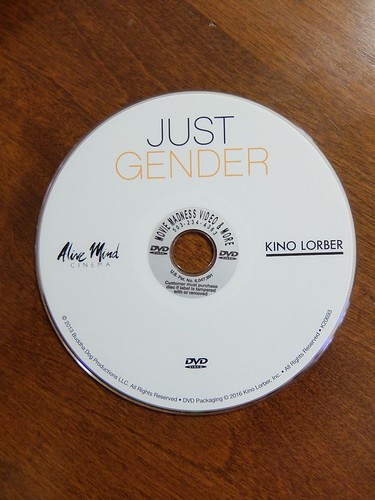
Just Gender (movie review)

DSCF7032

I'll have some X-refs at the bottom in case you're interested in related blog posts.

This documentary acknowledges that language is at the core of the challenge, of accommodating what's actually the case.  That challenge is perennial and language doesn't always have the luxury of getting too set in its ways.

Those with a quick, shall we say facile, even cursory view of gender might go with the simple binary model, of male and female, but at the cost of all nuance, and outright blindness to some aspects of human experience.

Safe to say, I advocate not sticking with overly simplistic models unless under severe time pressure.  If you have a full life of some decades, you'll have plenty of time to develop your appreciation for gender and sexuality.

Starting with the good news first, the 21st Century is off to a pretty good start relative to the 1900s, in terms of transgendered people feeling less alone and disconnected.  The general public has developed a greater understanding and tolerance for more complicated stories, and the Internet has made finding and building community easier. Suicide attempts among transgendered, a leading indicator, are still way too high though.

As the movie makes clear, we're still the prisoners of yesteryear's reflex-conditioning in a lot of ways.  When a person experiences anger welling up -- one reaction to feeling powerless in the face of fear -- that rage or wrath may seem God-given and therefore a license to righteously lash out.

Those with an "angry God" upbringing have a tougher time dealing with transgendered family members.  Given my own liberal upbringing and attitudes (Rome was pretty cosmopolitan), when I hear people insisting their gender was never a choice for them (I don't dispute that), my thought is even if it were, that would have been OK too.

The film uses "transgendered" as the umbrella term, literally showing a symbolic umbrella and putting other terms underneath it.  In one pithy quote, one of the interviewees makes the important distinction between gender identity and sexual orientation:  who you want to sleep with is orientation, who you want to sleep as is identity.  There's no logical entailment connecting these two.

Yes, the word "gender" was used in place of "sexual" to make "transgender" easier to talk about -- this insight from an activist in San Francisco.  "Transsexual" comes with a lot of baggage, even if some of it is lighthearted; yes I'm thinking of Tim Curry's performance in Rocky Horror Picture Show.  Did you catch him later in Kinsey?

Another spectrum might be how much one focuses on or cares about gender.  The film emphasizes repeatedly that one's gender is very central to one's identity.  I wouldn't dispute that that's very true for some people however others come across as more asexual in the sense of caring less, which I'm not circling as either pathological or repressed (though it may be in some cases).

When I think back to a very young age myself, it was being human at all I had a problem with, but not in a way that was too distressing or that led me into suicidal thoughts.  I just remember a strong sense that many other animals seemed a lot cooler than these hominids.  I was jealous, I guess one could say.

The real pathology we all need to deal with is this thing we call "bullying".  The alternative is not being a doormat, but learning more diplomatic skills.  The right to express disapproval of what one disapproves of is not one to take away.  Neither is it a basic right to never feel offended or insulted by others.

I learned the term "stealth trans" from the movie i.e. some are so successful at making the transition that they're once again closeted in a way, in terms of not being open about having transitioned.

Comedians are often our best diplomats, in terms of getting away with treating of sensitive topics that many would just get stuck within and lose their way.  Arthur Koestler on "why we laugh" is worth reading.  Laughing is often therapeutic stress relief.  Enter the clowns and cherubs.

X-refs:
Kinsey (movie review)
Prodigal Sons (as mentioned on QuakerQuaker, also here and here)
Gender Wars
Gender Again
The King of Masks (movie review)
Gender Bender

Monday, July 11, 2016

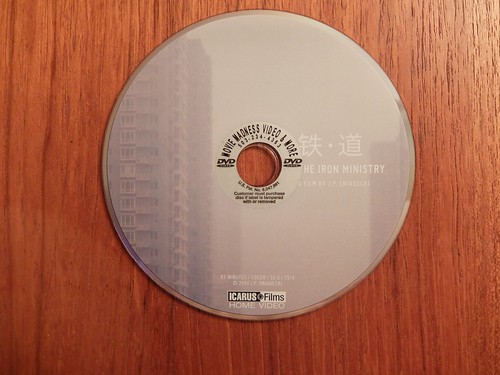
Iron Ministry (movie review)

DSCF6845

Glenn and I both enjoyed this well-crafted documentary, on a Sunday afternoon after lunch.  My habit of late has been to borrow movies on Sundays and return them on Wednesdays, from a local rental shop.

This week my two were The Last Colony, one I'd seen on the shelf weeks earlier then lost sight of, but this week I scored; and Iron Ministry, which I'm reviewing now.

Shades of Songs from the North in some ways, with the long camera shots, often intimate as in "in your face".  I found myself speculating as to the filmmaker's technique.  People were so willingly not camera conscious, is how it seemed, except that time in the diner car.  In North Korea, they minded a bit more.

What's salient for me in particular about his film is I was fascinated as a kid by the vestibules between train cars.  These were "the noisy parts" for me, and the whole "air lock" quality of joining cars together, with couplings and all, just permeated my little brain, such that I still regress to my childhood whenever a passenger train goes by.  There go those noisy parts!

The thing about his movie though, is it's so "inside the train".  I'd been expecting what I call "external shots" and those were meticulously provided as a special feature, all together.  Instead we were this passenger, the filmmaker, not an omniscient ghost, not on a Hollywood budget with cranes and helicopters, computer animation.

The other passengers call us "foreigner" and feed us stuff.  We're a person, albeit both intrusive and unobtrusive, hard to calculate.  We never get to see the filmmaker in the mirror.  We get names in the credits is all.

So yeah, kinda claustrophobic if expecting grand vistas, though we do get some of those, see out the window in a few long takes.  We see out the window a lot, just not in that postcard vacation movie sense.  More like we're camped out on some floor in a smoking area near the toilets.

I'd call the tone "democratic" in some sense, but not without different classes.  Some cars and compartments had more amenities, were more private, looked more modern, moved faster.  The kids on the bullet train had smartphones and knew about Michael Jackson, a common currency, a trader bead.  The inlanders knew a lot about pork.  Things looked pretty hygienic but for the fact of all that smoking and smog.

The people are friendly and eager to get along.  They see the world outside China falling prey to warmongers and don't want to sucker for that.  One speaker sincerely admires Americans for being so able to assimilate, says "we Han" could learn from that.  The Tibetan woman is haunted by how the prophesies of iron beasts are dreams come true, more like nightmares.  Trains brought the big mining bosses (more ruthless) whereas they'd been more used to local little ones.

Other Chinese speak frankly about their government being secretive, in a way I hear a lot of Americans talk about their own secretive state.  Sure the bullet train was struck by lightning, sure it was.  I don't speak Chinese but hear a mocking sarcasm in some understated way.  Dead pan.  Chinese have a fun sense of humor.

Lots of shots of Chinese train-goers passed out, sleeping.  Admit it, you won't get long shots like that in just about any other movie, so don't dismiss this opportunity as beneath your radar, especially if into cinematography.  We're learning a lot from these narrator-less documentaries that nevertheless have a point of view, if only an angle and an avatar (not a ghost camera).

Saturday, July 09, 2016

Meanwhile, in Outer Space...


Wednesday, July 06, 2016

Wanderers 2016.7.6

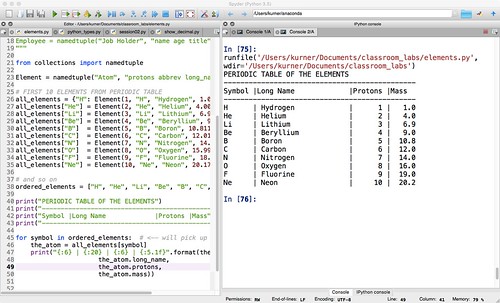
session02

I ended up spending much of the 4th of July, a holiday in this zip code (A) hanging out with old friends and (B) immersing myself in European history, French Enlightenment period especially, which overlaps a British Enlightenment coupled with an industrial revolution.

So, David Hume was highly admired in French salons for his cheerful temperament.  I need to dig up that article linking Hume with Zen (if memory serves, that's what it did).

Rousseau, on the other hand, was rubbing too many people the wrong way, especially Established Religion.  He needed asylum.  Hume was persuaded to take up his cause, but with the warning that Rousseau often turned on his benefactors, and this ended up happening.

Wanderers was interesting today.  Glenn was discussing the global bead trading industry, going back to the Indus Valley Civilization of some 2000 BC and earlier, to known "garnet mines" in Northern India used over 10,000 years ago.

Actually garnet, a form of quartz, is often mined from riverbeds, tiny, pre-polished.  A pump drill may be operated one-handed, leaving the other to keep the bead in place.  Glenn had some specimens, with a magnifying glass, and a great book.

Studying said book was an eye-opener, and reminded me that "trader beads" i.e. "money" were not a new phenomenon.  Gold aficionados harp on how any "real" currency is backed by gold, but rare gem stones, glass beads, necklaces, anything that looks really good and is hard to get, is worth having.

Hard currency looks "good as gold" by definition, as the promise of what it might buy if saved for future use.  In Critical Path money is backed by beef, i.e. cattle.  That's a good a backing as any, and Fuller elaborates on this narrative with a lot of Minoan imagery, proving he'd spent some time with Toynbee as a Delian.

Critical Path was brave in that it cannot be taken literally in some of its more speculative sections.  As a prelude to Tetrascroll it's in part a fairy tale or myth, as the New York Times reviewer put it.

Anyway, lets not trivialize currency systems by telling shallow stories about gold.  Yes, that element has many useful properties.  The Periodic Table is a great contribution to STEM, as is atomic theory, and the structural chemistry it begat, with Linus Pauling, in who's boyhood home we meet, a midwife in that begetting process.

Thomas Jefferson also featured in my studies, as did Ada again.  In Ada Byron's day, electricity as an isolated phenomenon, an object of scientific study, was fairly new.  Ben Franklin was in on the investigation.  Natural philosophers would astound the aristocratic class in the resort city of Bath, where the well-to-do went in search of miracle cures.  All manner of "infotainment" was made available.  The musician Herschel, and then astronomer, discoverer of Uranus, started out in this nexus.

What Babbage and Ada didn't quite realize, was the Age of Steam was giving way to the Age of Electricity.  We'd still use steam, but not for delicate computations.  Transistors could do those.  We'd learn to etch silicon with photographs of city-sized machines, shrunk down to mere wafers.  These machines would be reliable and soon learn to communicate by radio, another consequence of our figuring out about the electromagnetic spectrum.

Wittgenstein and the Vienna Circle came later, around the time of the World Wars, in retrospect two chapters, followed by Cold, then Endless.  Yes in fast fowarding to Wittgenstein, I bleeped over Napoleon, the Indian then Civil then Spanish-American wars.

Ludwig Wittgenstein was an Austrian thinker from a wealthy family, looking to make a difference.  He ended up in Bertrand Russell's chambers and both men warmed to one another and learned from one another.

Ludwig showed up right around Russell's peaking in concentration.  The word on the street was Ludwig would carry on, picking up where the other left off.  Early 1900s.

Sunday, July 03, 2016

Meanwhile, in Puerto Rico...


I've been looking at Puerto Rico as something of an IQ test, when it comes to the US media.  We talk about Washington DC not being a state, but Puerto Rico is more populous and just as American, so will politicians running for Federal office give it sharp focus?

The island is in the same position as many US states:  broke.  But without the leverage of having much representation.  When the lights start going out in the hospitals, unable to pay for power, that's a sign the face of malign neglect is looking in your direction.  More on Facebook.

Saturday, July 02, 2016

Autoimmune Disease?

The waves of refugees escaping the breakup of the nation-states in large regions is a crisis greater than the South Asian tsunami, in terms of total numbers affected, and number perishing.

However, because the viewer-voyeurs see this as "war theater" that's all background for the violent foreground proxies, the gladiators if you will, the bleeder / leaders who aim to settle old scores in bitter feuds.

The line between natural disaster and a human-induced one is blurry.  The weather changes and lowering water table contributed to the unsustainability of entire lifestyles.  Many geolocated in the Americas remember dust bowls and droughts, or are experiencing those today.

If the same billions in energy expenditure currently pumped into killingry, were pumped into livingry instead, we could use our ingenuity and new designs to solve lots of problems and alleviate suffering. Such behavior would make sense, against the backdrop of world history.  We'd be in less of a slum, a ghetto, and our children would thank us instead of curse us.

However, our conditioned reflexes are such that self organization of that kind seems somewhat out of reach.  We're collectively "addicted to war" as some say, even though it's obsolete (as others aver), and therefore behave somewhat like fire ants allergic to their own colony, a pathology I doubt ants have.

Humanity seems to be collectively suffering from an autoimmune disorder that causes it to attack itself, a kind of planetary Lupus.  I like calling it Lupus because of the wolf imagery which connects us to howling at the full moon.  Lupus rhymes with Lunacy.

The way I see it, our global civilization oscillates between two archetypes:  Global University and Lunatic Asylum.  There's no escaping either aspect; it's not a matter of either side of the same coin always winning the toss.  You'll wake up on the Asylum side of the bed some mornings.

Given how humans are a vector for mental illnesses (meme viruses) that cause humanity to attack itself, our main recourse is a better immune system that's better able to distinguish self destructive behavior from viable and sustainable growth.  Movement in a healing direction is what the many religions, great and small, are meant to provide.  I suggest we harness them for that purpose.

By "religions" I don't mean to circle any particular beliefs about deities or demons or whatever.  The word "ideologies" might work as well.  Actually "medical science" would be the most apropos, given the namespace.  What God commands is to "heal thyself" with a little help from "divine grace" or "dumb luck" as the case may be (superstitious and/or ritualized behaviors pertain in either case).

 photo wolf-moon-tattoo.jpg

Wednesday, June 29, 2016

Salmon People


Glenn say this performance live-on-stage here in Portland, and was impressed.  He saved the programme, so I snapped some shots of it (below).

I was glad to find some excerpts on-line.

The performer, Peter Donaldson, is the son of Oregon State's official fish biologist, if I have my facts straight, and became a fish biologist himself, among other things.
Theater Program

Tuesday, June 28, 2016

Learning Curve

Hawthorne Bridge

I was fortunate to meet up with a strong mentor at the code school yesterday evening, who clued me in to both CodePen.io and ToDoMVC.com, both valuable and well-crafted websites.

CodePen shows three coding panels side by side:  HTML, CSS and JS (JavaScript), with the resulting web page beneath.  A developer is welcome to reuse the code, and also to change the code and see the difference that makes immediately.

ToDoMVC demonstrates the front end solutions from which developers might choose, such as Angular, React... Vue, and implements the same task manager (to do list builder) in each one.

As my teacher explained, the trend is to turn the browser itself into more of a development platform with all the moving parts needed inside to write serious applications.

In the early days, a browser would more passively splat out the rendered page then just sit there.  With AJAX the pages became dynamic but the development experience was still somewhat clunky.  Turning the browser into more of a developers' platform is where we're heading today.

I purposely did not bring a computer of my own to the school, as I wanted to immerse myself in others' projects.  Greg and Margaux showed up, which I appreciated, especially in light of Greg's falling down a mountain about two weeks ago (long story).

Then I meandered down to the River Place marina where Don has his boat moored for Blues Festival season.  I snapped the above picture as I was leaving to walk home.

I'll be studying the above websites in earnest.  Just knowing they exist is already a big help.  Bento.io is another one I've come to value.

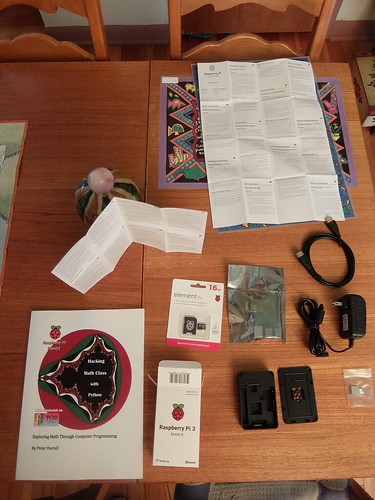
Also on the code school front, my new Raspberry Pi kit came in the mail, from Amazon.  My plan is to install the Pi3D library and start working through some of the examples in Peter Farrell's Hacking Math Class.

Peter, Jorge, the Litvins, and a very few others, are up to writing new high school math curricula that make use of current technologies.  Most math teachers are slogging ahead using scientific calculators, which to me seems retro and alien, inappropriate preparation for a life in my tribe.  I wrote about my sensibilities (yet again) on edu-sig last night.

Next week I'll start a next gig teaching IT workers in California, from my base in PDX.

Hardware Math

Saturday, June 25, 2016

Finding Dory (movie review)

This is a film geared primarily for little kids, definitely deserving of well crafted on-ramps that bring them up to speed in an artfully thought-out manner (Disney's specialty).  Imagine this is just your third or fourth film ever.

Even before we get to the story, lets remember that film is about managing our sense of time and space, giving us premonitions as well as flashbacks, memory shots, plus an omniscient camera (usually).  A kind of language, made from conventions (axioms) goes with watching and making film.  Ghostly images superimposed may represent a character's imagination.  We imagine a fish imagining other fish, and show what that looks like.

Disney is great at portraying the minimum nuclear family of three or more nucleons, a single parent family more of an isotope.  Marlin & Son are single parent whereas Dory's starts out nuclear but she's at least one marble short and becomes separated from the family nest at a young age.  Flash forward, to where she's dorking around clueless, and starts to come in to her next phase.

I thought of Glenn's story, heard a couple of times, when it came to the octopus, or septapus, another main character.  Glenn knows this species has a well earned reputation for being wily and sneaking around between tanks.  He knows of a real aquarium where a real octopus expressed such behaviors. I bet other marine biologists will attest to their wiliness.

On the subject of memory again, movie-makers of any caliber understand they are implanting what will likely be long term memories in the collective memory field.  Young children just starting on Global U work / study careers learn of a Maritime Institute (a kind of Monster U), including what it's like behind the scenes (back stage as it were), and of someone named Sigourney Weaver, a repeating loudspeaker voice (like in North Korea).

Those who know their film history know this is a seed for later.  Someday little Dory here, watching the film, will have a thought balloon pop up reminding her to "find her family" meaning her cinematic roots, first planted in the womb of a dark theater.  She'll get to see Aliens and Wall-e.

Dory goes through experiences children want and need to relate to, understanding that others get it, like about what it's like to be lost, to feel it's hopeless, to have access to intuition (which Dory has, despite her missing marbles).  Dory experiences both the love and concern of her guardians and strives to work with them in overcoming what they perceive might be weak spots.  She's attentive, just her attention wanders.

I suppose my followup reading such as I'm led further, will be to read more clinical discussion of childhood conditions and their symptoms, as if I were training to become a pediatrician.  For every adult I encounter, my meditation will be along the lines of "so what must this gal or guy have been like as a five year old?"  Maybe I'll put out my hand with a smile and ask:  "so what Room are you from?"

Contrary to recent practice, sitting in the balcony with pizza and a pint, I sat rather close to the screen in the orchestra with neither food nor drink.  Many of my fellow audience members were indeed very young.

One girl a couple rows behind me loudly whispered questions to her dad at a critical juncture, when Dory was crossing another karmic threshold.  I was grateful for that as I go to theater to hear the feedback sometimes (although the etiquette in Portland is to silence both your cellphone and your mouth -- OK to rustle popcorn bags -- in the more adult-oriented movies; the trained guardian did not whisper back in an equally loud voice).

Dory has an amazing ability to enroll others in the possibility of her finding her family.  Not all others, just a few critical ones, forming a team.  She has her adopted family (Nemo with single parent), and she recruits the septapus, who sees ways to mutually benefit.

Once a critical mass of team players is reached, and a level of commitment established, the team members willingly compensate for one another's weaknesses, while leveraging one another's strengths.  Synergy occurs and before ya know it, big things start happening.

Rest assured, your kid doesn't need to be a five year old to appreciate this film.  The teenagers will not be pulled in by sex and violence so much as by the mouthwatering detail squandered on every scene, down to partially erased whiteboards in the basement, where they load the Cleveland-bound rig.

Gamers don't see that level of detail in real time gaming even with GPUs.  You still need a render farm to get Shrek-levels of resolution (right, not only Disney / Pixar is doing it, and diversity is what we want -- more innovation and experimentation in a competitive environment).

Friday, June 24, 2016

Learning a Living


The above RSA animation makes some good points about our obsolete system of education.

I'm seeing that in Portland, my home town, where refugee families show up all needing to learn the same things, but depending on age, family members get split up.

Junior has to take TriMet to school to learn Common Core Math in an overcrowded room, whereas Mom & Dad, eager to learn more English, perhaps by reviewing Calculus, might study for their GEDs at home.

You have to be over 18 to get a GED scholarship, so junior is out of luck.  How is that "equal access"?  The family is split apart.  Why can't junior stay home and log in to the same courses the older siblings are taking?  They could study together and help one another as family members are wont to do in some cultures.

Why does Oregon subsidize the practice of college professors teaching what by rights are high school level courses?  Don't we expect college professors to teach at the college level?  If a teacher is trained to teach high school, why must that teacher compete with college professors for students needing high school level content?

The school districts would be better able to keep up if allowed to offer online secondary school level courses to adults as well as to those under 18.  This would result in many curriculum improvements as adult students have a better sense of what's really relevant in the real world.

The question of whether high schools or colleges teach specific content should have more to do with the content than the age of the students, especially in the Internet age.  Why should a 21 year old not be allowed to take the same math course as a 17 year old online?  "Because that's how we've done it in the past" is simply not a good answer.

I'd like to teach CS-friendly math to adults and kids alike online, like I've done for adults in California and for kids through Saturday Academy and Saint Dominic.  Portland Public Schools need to offer CS-friendly math to anyone ready to tackle the subject.  I'd do classroom work with the teachers if they want to know more about what "CS-friendly" means. I can't do all this public school teaching by myself.

When it comes to exams, lets follow the Nexus Academy model used in Michigan:  proctored study halls and testing centers will authenticate a student's identity.  But if you're just studying and preparing for tests, you're not required to spend your time in a proctored setting.

If you have guardians and a place to study at home, why bus across town just to sit in a crowded room listening to a teacher who might not know your name.  You can get the same content on Youtube with a lot less duress and pain.

Sunday, June 19, 2016

Love is a Verb (movie review)


The term "secularist" has different meanings to different people.  I use it more in the sense of liberal towards cults, religions, tribes, and providing enough infrastructure and security to allow each some fun in the sun.  Let them practice freely, and they will not turn virulent in self-defense.

Religions themselves will have this liberal streak in some cases, notably the Sufis and the Quakers, whereas a "secular military" may be fascist control freaks, more like the Inquisition under the Roman Catholics.

Liberal Islam ala Muhammed Ali, combined with more homegrown movements within the US need not be terroristic in any way, but given the attitudes of some "secularists", the pressure is on to make them more threatening, so they'll fit the bill and play the game.

Radicalization of liberals is the agenda of many secularists, as once a group has been radicalized, it's OK to target them and possibly wipe them out (that rarely works), with public approval (but the public is fickle).

The Gulen phenomenon is neither a political party nor an organized movement, so much as an ideology based in values.  Follower's of Gulen's teachings are often inspired to serve selflessly, in some of the most forlorn places, where hope is war-torn and/or disease-ridden (these go together).

Given it's not controlled by the secularists, it's perceived as a threat, and you get the Turkish equivalent of Mubarak types in Egypt, cracking down on anything too Islamic, like the Muslim Brotherhood.

In Turkey the pattern was set by Mustafa Kemal Atatürk, in Iran by the Shah.  Military secularism, a kind of Fascism, has been a favorite blend in DC, understood and supported by many in the Pentagon who recognize their brothers in arms.

Friday, June 17, 2016

CodeCastle Exhibit Space

DSCF6454

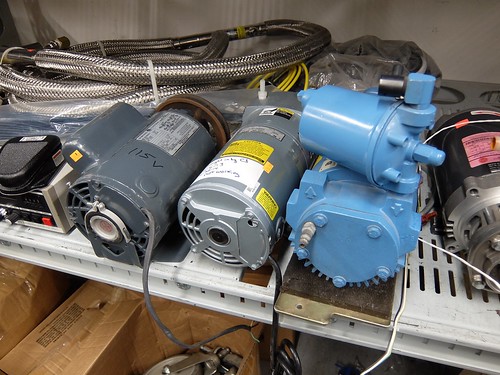
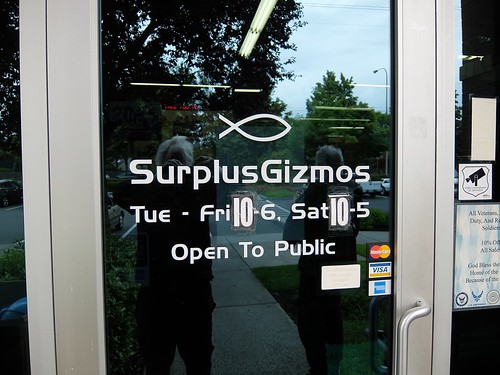
I joined Patrick today on another expedition to an electronics store.  Last time, we went to Fry's in Wilsonville, a Kroger property.  Today we visited SurplusGizmos.

When I was but a young lad here in Portland, before moving to Italy, I was most taken with OMSI and made it a centerpiece in my "religion".  I loved the interactivity of the exhibits.

One exhibit made me feel especially special:  I could hear frequencies up into the higher reaches, like Lassie (a dog on TV) whereas the adults around me said the tone of rising pitch had faded out for them.

OMSI has since shifted its location from near the Oregon Zoo to the east bank of the Willamette River, opposite the cable car station serving OHSU (our health sciences university).  The west bank has been completely redone, a new bridge added (Tillikum Crossing).

My fascination with interactive exhibits has not waned, and in exploring the stepping motors, small voltage pumps, hackable GPS devices and so on, I found myself wishing for exhibits that showed these machines actually doing something.  What better way to demonstrate the utility of some device?

Toy stores know the score, when it comes to model trains at least.  What gets the kids drooling is a fully developed layout with all the bells and whistles so to speak.

The electronics store did have some stuff switched on and running, however my imagination was in overdrive.

Since the ghost church has yet to become something mundane and unexciting, like more condos, I've taken the liberty of using Twitter to tweet it up as almost like another OMSI in some ways, themed around software meeting hardware and needing to control it (what software does) while passing the torch of knowledge and mastery to coming generations.

When you're down to talking to chips over pins, looking at instruction sets, thinking about hexcodes, you're in the realm of the Silicon Forest, in terms of its expertise.  Many companies came to settle here and make hardware and software, including the testing and measuring devices essential to creating these products.

However, the silos have gotten extremely deep to where worries about protecting intellectual property have pushed many to paranoia.  Open hardware and software is the reality check in some ways as it provides a set of benchmarks, serves as a barometer for the shared public space.

Judging from what's open and "already out there", the investors speculate regarding what they might invest in that's more proprietary.

I've been thinking the #CodeCastle, as I call it, could stay a nonprofit and not become too exclusively the tool of any one company and its technology stack.

That being said, companies would be eager to showcase their products in a workspace / playstation setting, in the form of interactive teaching exhibits that inspire corollary workbench activities.

In my dreams, we use the CodeCastle as a space to actually build some exhibits, out of both hardware and software.  Some exhibits go on the road.

I'm always looking for the colored fluids and volumes demo, which might use various actuators and pumps, controlled by the operator.  Drain the rhombic dodecahedron into six tetrahedrons.  Or into one octahedron and two tetrahedrons.  Two cubes.  We could have a 24-volumed Cube get the balls rolling (the "fluid" might be little balls in some editions).

We'll have exhibits about the cloud, showing how playstations may be provisioned from containerized microservices on a VM.  Going in, many will not know what that means.  They'll come away with new insights and a broader knowledge base.

DSCF6465

Wednesday, June 15, 2016

Legal in Oregon

Legal in Oregon

I threw together another Jupyter Notebook today, really more an advertisement for Oregon's liberal economy, which allows putting a New England Transcendentalist spin on spatial geometry.

I actually store twenty-six points using a non-XYZ coordinate system.  Comparing and contrasting between similar-but-different systems is how we gain insights and competence in their use.

Do other states require a special license or credential to share this material?  Maybe check with your state's Board of Education for more information?

The whole number volumes help streamline the spatial geometry and accelerate comprehension of STEM subjects (PATH too).

What I recommend to math teachers is telling the story of The Tesseract, the Time Machine and the Tetrahedron, three 20th Century lineages in which the "4D" meme has meaning.  Confusing these three may lead to larger confusions later.

Tuesday, June 14, 2016

Monday, June 13, 2016

Where's the Origin?


Students using Quadray Coordinates to better grasp XYZ (comparing and contrasting is an old technique), may wonder where best to locate (0,0,0,0) relative to an IVM ball packing.

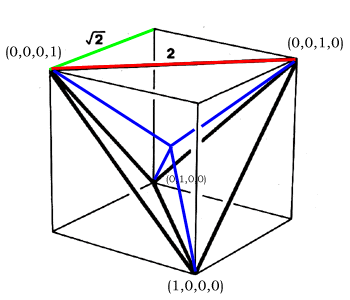
Given we're planning to use the 12 combinations of {2, 1, 1, 0} as the centers of IVM spheres, 12 around the nuclear ball at (0, 0, 0, 0), we know we want the origin in a ball center.  If that's the case, how do we orient the four basis vectors (each one free to grow and shrink independently of the others, with these four sufficient to span our vector space or "room" through addition)?

Remember how the rhombic dodecahedron (volume 6) shrink-wraps every ball (voronoi cell concept)?  Its corners occur smack in the voids between spheres, where IVM ball centers are not.  We find two types of void however, and not in equal number.

The rhombic dodecahedron is a combination of two Platonics, duals of one another, the cube and octahedron.  The octahedron termini define a complementary IVM i.e. balls inflated in these voids will grow to another IVM should the current balls shrink correspondingly to give them room.  The cube termini reduce to two cases:  two tetrahedrons.  Each of these is likewise an IVM waiting to happen, for a total of Four IVMs, a main focus of Russell Chu's visualizations.

The rhombic dodecahedron's long diagonals define the octahedron of the paired IVM, while the short diagonals define the cube connecting the two remaining alternative IVMs.

Remember the negative basis rays of any Quadray Tetrahedron are its dual complement, at the center of our cube, and therefore our rhombic dodecahedron which embraces an IVM ball.  That's how to picture your origin then.  Imagine two Quadray Tetrahedrons making the Stella Octangula with its tips reaching to the voids of alternate IVMs.  The octahedral voids are further away, at the dual octahedron's tips, at six locations (that's six in addition to this four-and-four of the Quadray star, for the 14 corners of the rhombic dodecahedron, dual of the cuboctahedron).

Now linear combinations of {2, 1, 1, 0} i.e. vector additions of however many such vectors, grabbing any of the 12 at random, with as many iterations as we like, keeps us to the IVM ball centers of a single IVM.  What's maybe strange here is the length of those basis vectors, which use for unit some length we mostly don't need as such.  R=1 or R=0.5 vis-a-vis the IVM balls will suit our needs more often.  The basis vectors simply delimit the four quadrants of the home base tetrahedron, each rated at one fourth of unit volume.

Saturday, June 11, 2016

Success!

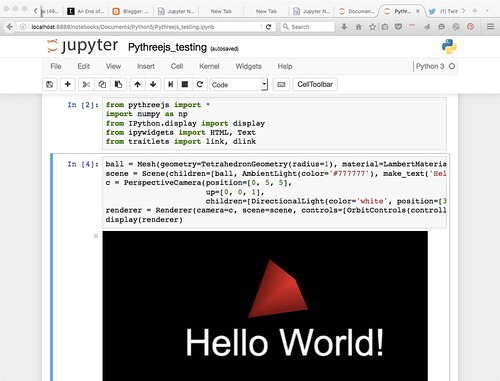
Jupyter Notebook with Embedded 3D Canvas


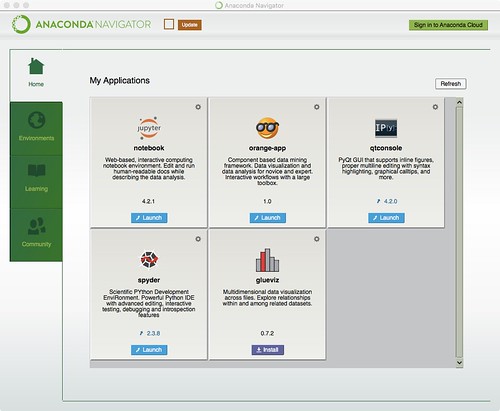
Although the three.js API is pretty daunting, I made significant headway today after finding I could use conda to include it in a Jupyter Notebook setting.  Thank you Anaconda.

I worked on two of my Python modules today:  qrays.py and tetravolumes.py, with the latter now importing the former for testing purposes.

In hopes of helping more teachers get up to speed with this new content, I added a Getting Started link to my Scholarship tab at Grunch.net.  Here's where it goes.

Anaconda Navigator

Friday, June 10, 2016

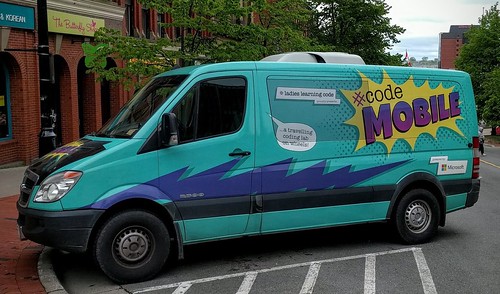
Microsoft Bizmo

bizmo

Another Triple-A Adventure

DSCF6294

For some reason Carol thought the crew of the Golden Rule was to be at the Unitarian Universalist church last night.  We grabbed a bite at Burgerville on the way (she likes the turkey burger). I'm doing Soylent these days, having received a new shipment, but had a seasonal milk shake with black coffee.

The original Golden Rule was a ship that sailed into nuclear war zone waters back in the 1950s, when the nuclear assault on the pristine Pacific Islands and their denizens was still in full swing.  Apologists call this form of asymmetric warfare "testing" and like to pretend it's legitimate science.

The aggressors were looking for disposable human subjects for their shocking / awesome experiments and found the people of Bikini, Rongelap, and other Marshall Islands, ill-equipped to resist a mighty military.  The defenseless make convenient targets, for cancer research etc.

We see this pattern throughout history:  new weapons get developed and guinea pigs are sought.  The people of Vietnam were tested with defoliants and early "precision" weapons.  For Apache helicopter weapons testing, the Panamanians were targeted.  The Apaches proved quite effective.

The people of Iraq were used to guinea pig various bunker busters and cruise missiles.  Libya and Syria were soon to follow.  The Nazis had a field day with Jewish folks.  Whoever has the upper hand likes to take advantage of a ready gene pool; Social Darwinism in action.

Historian Edwin Black has documented some of the thinking in his War Against the Weak.  Although the Nazis ostensibly lost WW2, their belief in Social Darwinism was shared by many in North America.

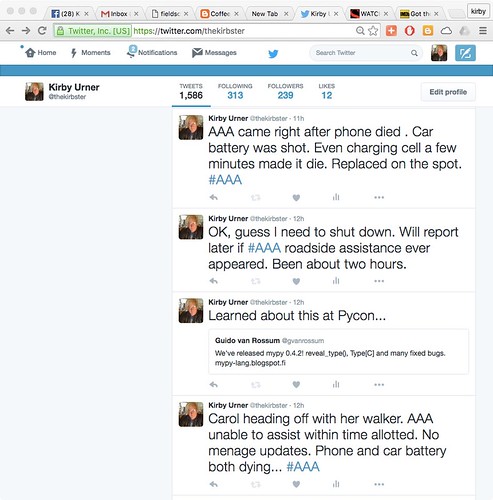
Nothing Golden Rule related was happening at that venue though -- a crossed wire.  However, by the time we got there I notice my left front tire was completely flat.  I pulled into a parking lot and phoned AAA, continuing with my tweeting.

I'd discovered some days earlier that the mere fact of vacuuming a little with the electric dust buster had completely depleted the car battery to where it would no longer start the car.  I applied a trickle charger, but Patrick wisely warned me this was the sign of a dying battery.

Sure enough, just keeping my cell phone charged off the cigarette lighter, without the motor running, proved too much, and the starter would no longer turn over after a short time.  By the time AAA arrived, two hours later (busy night) I was doubly dead in the water, with flat tire and a dead battery.

I don't think I have a jack in the back, with the donut emergency tire.  I'll double check, but my thought was AAA would do it more professionally, and I was right.  I bought a new battery on the spot, shades of Winterhaven.  $131 with warranty.  I'm yet again persuaded it's worth my money to keep my AAA membership up to date.

When people try to escape their fate as human subjects, such as in Fallujah or Aleppo, they're often detained or otherwise corralled.   The warmongers need human shields for one thing, not just guinea pigs.  Innocent bystanders add to the excitement of War Theater, feeding the appetites of the viewer-voyeurs.

I suggested Carol take the bus home given we were passed the original expected assist time, and I was losing signal.  She agreed and hopped (with her walker) aboard the Belmont bus, rejoining me back at that very same Burgerville as things turned out, where she got herself a strawberry milk shake (she'd been eyeing mine).

Today I'll go to Les Schwab and see if this tire is reparable.  If not, they'll doubtless sell me two, as symmetry of tread is somewhat a consideration.  Follow-up:  the tire was reparable and fixed at no charge.

DSCF6292

tweeting

Thursday, June 09, 2016

First Person Calculus

Frame One

Frame Two

Frame Three

Delta Framing:  Action for a distance in a time equals Energy delta (small tetrahedron volume), which again, per time, equals Power (the rate at which Energy is spent or produced).

KEY:  Action units:  mvd (could be angular).  Energy units:  mvd/t.  Power units:  E/t.

Tuesday, June 07, 2016

The Art of Coding


I'll confess my bias up front: the style here verges on cute to extremes only Japanese seem able to top. Not my style, nor one I'm too comfortable with (different gender).

However, subtract style and reduce it, and I find I'm preaching much the same content.  She'll reach audiences I won't.

Snarky comments about "Bernard Russell" aside, she speaks more than one human language and doubtless her code is as proficient as it is expressive.  Count me a fan.  Does she code in Ruby then?

That's what I mean when I say Code School is also Art School. Knuth wrote The Art of Computer Programming, not the Science.

Since we've been starving our schools for Art, buckling down to study STEM, we're maybe surprised that STEAM would pick up steam as it were?  That's Science, Technology, Engineering and Mathematics.  Plus an A.

Hadn't we nipped that A stuff in the bud? The women especially seem optimistic about their new Vulcan chapter (their new avatars), in the sense of both logical (like Spock) and effervescent (like Linda here).  The Girl Army advances.

The Great Tragedy directors were not expecting this many teddy bears to show up, this many clowns.

As the Greeks well knew, there's a yin-yang thing going on wherein each mode of play contains the seeds of its own undoing, leading to perpetual oscillation, the beating heart of time.

A great punch line at the end of this TED talk would be for Linda to do like a Yul Brynner in West World and show us all she'd passed the Turing Test, Ex Machina style. 

The only reason humans aren't considered really high end androids is we still have no idea how to design and build them in code, only how to give birth to them ("them" being "us").

Saturday, June 04, 2016

STEM Blends

As Patrick roved through the aisles, looking for some esoteric H-bridge for his Arduino, I thought about STEM and workflows.  I know some teachers who complement each other as TM versus SE.  Science and Engineering = electronic hardware at Fry's.  TM = Technology and Mathematics, the computer and the math that controls it.

Later I brought Peter Farrell by the <guild / > to show him the space, at least some of it.  We parked some distance away and wended our way through the International School campus.  He liked what he saw, and is eager to continue sharing our blend, of Pythonic math, in the Bay Area.

Now that I have a full weekend to catch up on some of what I've learned, from QuantumDoug and many others, I find myself plunging into some literature on Clifford Algebra.  They say off hand a computer language might be made from this stuff, and I've found a module in SymPy to look at.

Speaking of Universal Algebra, I'm continuing to circulate the somewhat freakish "caltrop" coordinate system introduced to the Synergetics listserv awhile back by David Chako.  Many of us picked up the ball and ran with it, seeing connections to Synergetics for a shared context.  Just this morning I uploaded to Github, a modified version of the code at my website, newly tested to work with Python 3.x.

Thursday, June 02, 2016

Ergonomics

As Trevor pointed out to me one evening at Greater Trumps, the flood of $15 Androids shows the One Laptop per Child goal has by now been far exceeded, in terms of computing power per price point.  These are Wifi devices sold to boot one onto a cell phone company data plan, but because they have Wifi, talking to a local "village pillar" (not a Verizon tower necessarily) is a feasibility.

These tiny screen devices, however power-saving, do not replace the church organist experience of having lots of manual control over devices that support bright visual displays.  Not everyone has either the manual dexterity or the eyesight for such peripherals.

Accessibility for all remains a primary engineering challenge, but access to what content exactly?  As far as the user experience (Ux) goes, there's no "making it exactly the same for everyone", a logical contradiction where accessibility is involved.  This is not about finding a "lowest common denominator".  It's about "switching modes".

We're poised to offer more of a hard shell personal workspace where the device / peripheral doubles as one's tent.  The ability to move, pitch a tent, and safely operate devices within that tent, provides at least enough room for a smartphone.  However the nomadic lifestyle is one of encounter.  One arrives at an oasis.  The big screen monitors are already there, as well as projectors and audio equipment.

However, big screen monitors out in a common area or pool does not replace the tent when it comes to privacy.  Having a private shelter for workspace equipment, such as monitors and keyboards, is what today we call an "office", which may have floor to ceiling walls, or may be a "cubicle" as in "cube farm".  Many, like me, have "home offices" meaning offices literally situated within one's place of residence.

Yes, a "cube farm" sounds very "matrix-like" as in The Matrix.  Every poor slob in some aliens' pod, dreaming of being alive in a cyber-reality, is somewhat a metaphor for Neo's originally drab existence, before it all becomes more horrifying (when he escapes the Matrix and fights the alien intelligence behind it).

That being said, if you're crowded in with others in bunkers and have no space of your own, a mere cubicle will seem a big step up.  Even one's own standing desk, anything dedicated, is more than a tent.

I think of Blue House as a tent.  A big wooden one, built around 1905 but then modified over the years.

Very typically, a homeowner like me, living in North America, would commute by fossil-fuel-burning vehicle by freeway or other public road, to a secondary living quarters called one's "office" (which might be a "cube").  In my case, I've done a lot of private consulting which meant driving to the workplace and maybe having a temporary cube or office.

What I've been expecting is more of an integrated solution.  The Institute for Integral Design that Glenn talks about could be a source of blueprints, at least in science fiction (consultants assist with prototyping, know some snags to avoid in some cases).  CAD drawings and like that.

Yes, we're talking about "pods" (very Matrix) that combine both tent and cubicle functions into one domicile that's easily deployable and then movable.   I know what you're all thinking:  trailer, mobile home, RV.  Yes, something like that.  Others are thinking SurvivaBall, the spoof PWS suit (I've been more into the BizMo nomenclature myself).

I'm thinking Project Earthala again, that "local village" (redundant?) wherein people have their dignified dwellings (yes a Dignity Village allusion), which double as work / study spaces.  The come already wired as Wifi clients, ready to talk to towers.

Whether those towers work with this or that Internet service, or are isolated to the local area, perhaps with a link to an Earth station elsewhere, by relay, is configurable.  They come to market as general purpose "live in" devices, not any one make or model.

Sunday, May 29, 2016

EduSummit Thoughts (rant)

I still harbor skepticism that learning to program has anything to do with becoming a professional computer programmer, necessarily.  Not necessarily.

Operating a scientific calculator does not make one a "calculator professional".  Learning to drive does not make one a professional driver.  Learning to program does not mean committing to becoming a programmer.

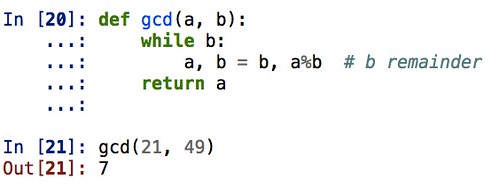
Learning to program is integral with STEM generally, and with Mathematics (the M) in particular.  Euclid's Method for finding the greatest common divisor is an algorithm, a famous one:

gcd

Teaching programming as an after school elective, instead of merging it into the curriculum in satisfaction of mathematics requirements, is just dumb.  Too retro.  Too lazy.

We need math tracks that include programming.  I've been harping on this for years, as a part of some vocal minority that's becoming more of a majority over time.

Yes, schools need to teach typing.  Keyboards are not going away. That's an uber-important skill.  Not just thumbing on a smartphone.

Providing smartphones would make sense though.

Hey, if your school does not include coding as a part of the regular math curriculum, is that OK with you?  Do students have the right to protest?  How about their guardians, do they have a say?  These questions have become political.

Yes, parents need a place to look after their kids during working hours.  That's a primary function of the school system.  Providing a safe, interruption free space to focus and concentrate is not necessarily what today's schools are about.  You may just get a locker, and crowded classrooms.

Studying is difficult in such an environment, if not impossible.  Privileged students have their own rooms at home.  On college campuses, one finds study carrels, often in the library building.

Is mathematics education really happening in your district?  Does at least some coding happen? That's a question worth asking.

This artificial division between "computer science" and "mathematics" in the lower grades (pre-college) is devastating.  We teach "function" and "variable" in two separate dialects (in both algebra and computer science) and then leave it to students to connect the dots as they might (or might not).

Python's top-level functions are pure gold to a math curriculum, as writing functions that take other functions as arguments is core in calculus.  D(f), the derivative function, takes a function f as input and returns another function as output.

Computer languages make such ideas accessible, concrete.  So do we use them?

In an exclusive private school such as Phillips / Andover, those getting a privileged high caliber education might use Mathematics for the Digital Age and Programming in Python (prototypical).

As a society, we're apparently happy to share the new tools with children of the one percent (or less), while leaving the ninety-nine percent to wallow in their intellectual ghetto.  Those seeking greater equality of opportunity might want to pay attention to such inequities?

Monday, May 23, 2016

Dog Mountain

Wildflowers
:: flowers for Algernon ::

I joined a BSA troop, I forget which number, invited by a scout leader to ascend Dog Mountain, a walk-up on the north side of the Columbia Gorge, between the Hood River and Bridge of the Gods bridges, Bonneville Dam in between.

The trail was well frequented by hikers and is professionally maintained.  The last segment is along a ridge in open flower fields, gorgeous when in bloom.

Returning home, we stopped to purchase some Yakima Nation salmon at $12 per pound.  That may be more per pound than store-bought, but then this is newly-caught never-frozen.

I took a half-gallon plastic jug of Soylent in my backpack, having been advised to pack in all fluid and nutrient needs for a 3.8 mile climb, fairly steep.

Advice:  wear hiking boots in case of muddy patches along the steeper parts, for traction.  Sneakers are not advised, though that's what I got away with.

In coming down, I was using large trees to break gathering momentum, but miscalculated the impact I'd have on one of them, with onlookers present.  My glasses came off when I hit the tree, and in fumbling to pick them up and put them back on I backed over a protruding root behind me and fell on the muddy trail in the downhill direction, over backward and onto my pack.  

The jug of Soylent exploded, but not so much that I didn't get some more mileage out of it.  The cap had come off, emptying much of the content, but once back on, the jug was still usable.

Onlookers wondered at the gray liquid oozing from my backside as I flailed about, and indeed I felt like that android in Aliens who bleeds the white blood.  The BSA kid observing this spectacle later summed it up in a word:  idiot.  Hiking boots next time.

Not being a great expert in these Gorge trails, I was unable to determine, from one data point (in 2016), whether the ratio of dogs to humans was higher on Dog Mountain than average.  Safe to say, I saw quite a few dogs on the route, some on leash and some off.  I'm a dog fan so don't figure this to be some complaint.  Go dogs go.

King Salmon
for sale by Yakima Nation

Friday, May 20, 2016

Cold War Interview

People listening to talk radio often like to guess how scripted it is.  Would this person have come on without some assurances as to how it would go?

Case in point:  this morning NPR interviewed some political analyst in the context of positioning NATO as instrumental in preventing a new Cold War.  Talk about oxymoronic right?

The interviewer asked Lamberto Zannier if Russia's bombing in the Middle East could have been to destabilize Europe by triggering waves of refugees, but without really specifying what a motive would be in doing that other than "behaving badly" (as "bad guys" are wont to do).

The response sounded professional in giving Russia more the benefit of the doubt, without getting into the timeline at all.  When did the refugee phenomenon start happening?  The move to couple it with the Russians' bombing seems more the hidden agenda of this interview.

In point of fact, Iraq was destabilized intentionally, by a Coalition seeking vengeance for war crimes not yet redressed (Kuwait).  George Bush Sr. had wisely pulled back from attacking Iraq directly, but his son could create no such discipline and at best put a comic tip on it (acknowledging when a farce is a farce may be the only way to preserve gravitas).

So by the same token, we may see the US as perhaps intentionally destabilizing not only Iraq, but Libya and of course Europe, as the flood of refugees started quite awhile back, and from all those places, not to mention Central America.

However, had this been the script, I doubt our interviewee would have consented to the sound bites.  NATO would have seemed too much the cause of Europe's woes.  That would seem too "bad guy", so better to blame the Russians.  That's Cold War redux.  Yawn.

Another story nearby was more interesting:  the CIA's art museum has some new commissioned pieces, including a "puzzle piece" with allusions to ongoing operations we'll maybe learn about someday.  Fun.

Tuesday, May 17, 2016

Wanderers 2016.5.17

hb2me

My odometer flipped over today, from 57 to 58.  Mom sent me a nice email.  She had a grand 87th birthday in April thanks to WILPF members and other fans.

I started the day making Soylent waffles, then joined some fine younger women, and their children (one only six months of age) for a walk in the Leach Botanical Garden.

Melody, not with child, rejoined me later for ciders at Hop House.  Thank you Melody, for inviting me out to the garden.  Jen and Yarrow will be moving away soon, to California.

Now I'm at the Linus Pauling House, a packed house tonight.

Duane Ray is catching us up on gravitational waves, the theory behind them, especially the heroic efforts of Joseph Weber to detect them.

Weber enrolled scientists in the possibility that gravitational waves could be detected.  Kip Thorne also deserves honorable mention.

The Laser Interferometer Ground Observatory (LIGO) is the instrument designed to register ripples in time-size.  Two of them (one at Hanford, one in Louisiana) picked up the same blip recently, making headlines.

When it comes to "making waves" we should acknowledge that language itself is a tensive medium, and scientific discoveries may have the effect of "re-vectoring" word-meanings.  A visual metaphor, of some phase space, has us thinking of word-meanings having trajectories.

The meaning of "gravity" (a term) is being affected.  Meaning derives from use.  Usage patterns have changed, thanks to these 40 kg mirrors, suspended, in a vacuum.  A tautology.

Wednesday, May 11, 2016

Rejected Meaning

Thanks for your definition of Bizmo!

A few volunteer editors read your definition and decided to not publish it. Don't take it personally!

To understand what definitions we publish and reject, check out this blog post: http://blog.urbandictionary.com/post/49469679426

Try rewriting your definition so that it's easier for others to understand, then try again.

Thanks,

Urban Dictionary

-----

Bizmo

"Business Mobile" i.e. "biz mo" -- like an RV ("recreational vehicle") but wired for doing business on the road. Synonym: van- or bus-sized business vehicle.

That's a sweet bizmo, how many miles on that baby?

9:48 AM (1 hour ago)


to me

More Adventures

I've continued bouncing around in Adventures of Ideas.  Yes, Whitehead does mention the Quakers, in a tip of the hat sort of way, in the context of finding no improvements in Protestant flavored  Christianity over what came in the first four hundred years.  After that: variations on a theme.

Coming from Whitehead, suggesting all the pieces were in place that early is not a put down, but rather he's recognizing the mark of something enduring, with lots of inertia.

The book's namespace is somewhat unfamiliar, however his use cases mount up quickly and pretty soon we know what he means by a "society", which could be a society of cells, even those of a tree.

Having person-hood is one more attribute of only some societies, in Whitehead's namespace.  Then he uses "occasions" to mean what we might also call "events".

Not unlike Heidegger, he dwells a lot on our relationship to something called "the future", vis-a-vis what we might call the "unchanging past".

Clearly occasions are invitations / openings wherein to help shape what's coming into being, within the constraints of an economy or ecosystem.

We bring the future to ourselves through our own agency to some degree, from whence comes our notion of freedom, bounded by what might be called our confinement, possibly pictured as some crystalline network of rules.

These rules "control" (govern) what occasions might occur, versus other events that might only be imagined.

If we consider these rules "exceptionless" then perhaps we could say their "inertia" is very great (without upper limit?).

We're underlining the "gravitas of gravity" in reminding ourselves of how exceptionlessly it applies.  The term "gravity" as used here is more as a proxy for "all that holds sway".

Our freedom presses outward against this network of constraints.

These are more my thoughts, as inspired by reading Adventures of Ideas, than an attempt at a close paraphrase.

"Society" and "occasion" were two of his words I got to thinking about, as we vectored back to PDX from STL on that commercial Alaska Airlines flight, operated by Skywest.

Sunday, May 08, 2016

Recent Reading

 :: link for more discussion ::

I've recently started Adventures of Ideas by Alfred North Whitehead.  I hadn't realize the arc he traces revolves around slavery and its abolition, the movement towards freedom for all people.  He equates this trend with the advance of civilization itself, and our moral tensions, described as "emotions" as having to do with cognitive dissonance.

The philosophers were advocating freedom, yet common sense was saying we had no way to run a large enterprise without slaves.

Given my 21st century sensibilities, putting an "e" in front, for "electronic", as in "email" and "eCommerce", puts a spin on "emotion" as "electronic motion", which is accurate.  Alfred as uses "nerving" as a verb, which I find interesting:
At any moment the smouldering unhappiness of mankind may seize on some such program and initiate a period of rapid change guided by the light of its doctrines.  In this way, the conception of the dignity of human nature was quietly energizing in the minds of Roman officials, producing somewhat better government and nerving men like Marcus Aurelius to rise to the height of their appointed task.  It was was worthy moral force, but the society had been inoculated against its revolutionary application. [emphasis added, from pg. 15 of First Free Press soft cover edition, 1967]
Philosophers these days are called "programmers" but more in terms of theater / TV, converging with "programmers" of computers.  The computer, like the TV, is a mirror.  The TV is a window into the computer (e.g. Netflix) which reflects back the collective psyche of the various cults (subcultures).

Philosophers consciously re-vector various word-meanings, putting them on arcs or trajectories.  We do this by applying "spin", hence the term "spin doctor".

Slavery is always sneaking back into the picture though.  England may have abolished the institution throughout its global empire, but then that empire decayed.  Automation because the capitalist industrialists answer to human labor.  Machines do not unionize or protest ill-treatment (they simply break down for lack of proper care).

Ending slavery as a global institution is concomitant with increasing automation, but then comes the new problem of what humans are supposed to do with their powers.

Some subcultures have been more successful than others in channeling the power or Real Intelligence (versus Artificial Intelligence), serving as a model for others.

With the rise of the TV-computer as a kind of shared collective consciousness, we have the ability to nerve ourselves to continue with the advance of civilization.  Spin doctors i.e. programmers may be found on both sides.  Some want to bring slavery back, or increase its staying power, whereas others expose their agenda and apply counter-intelligence, taking us further towards freedom.

I don't know to what extent Alfred will be mentioning Quakers by name.  They've been at the forefront of wanting freedom for all people, having abolished slavery among themselves and helping with the Underground Railroad.

Slave-owning North Americans were uncomfortable with the cognitive dissonance these Quakers engendered, considered them terrifying.  Even if Quakers preached non-violence themselves, they might trigger revolutionary movements such as mentioned above.  Quakers were pressured to quit the scene and move west, the standard solution for relieving tensions in North America.  Their values spread across the mid-west, bringing the seeds of civilization to new settlements.

So what will Quaker TV look like?  Stay tuned.

Monday, May 02, 2016

Monday Night Circus


My objective here was to throw something together and upload it to Youtube in a very short time, with minimum fuss and bother.  Rapid Product Development.  I was happy to see the HDTV pressed into service.  Well done.

Yes, I shot too much of the carpet, but then ever since the carpet replacement at PDX International, Portland has had an eye for carpets.

I found a royalty-free audio track (Retro 90s Arcade Machine) on Free Stock Music and, using  Camtasia with transition effects, had the video uploaded to Youtube, ready for sharing, within just 50 minutes, which time included socializing with peers.  I added the annotations in post production, via the Youtube UI (user interface).

Sheri wondered if Shoop source code was in English, given it's natively Finnish.  It is, however I found some translation modules allowing i18n (internationalization).  We were discussing hacking on eCommerce applications within the Code School ecosystem.  Given <guild /> is Python-centric, I'd been researching some of the Django offerings.

My study topic this evening, again thanks to Ted Kosan, is the Semantic Web, which we might define, depending on ontology, as built atop XML, although that's more an implementation detail than a requirement.

RDF is certainly URI-based (from the HTTP protocol) whereas HTML / XHTML integrates the necessary tagging elements (the markup).

One of the most ambitious AI plans built atop the Semantic Web is hosted by Cycorp, the company Ted points to as most aligned with his dreams on Mathfuture.

XML is not going anywhere, however obtaining any universal agreement on how data should be represented is perhaps an over-ambitious attempt to duplicate what human languages do already, in our post-Babel age.

The "cell-silicon hybrid" is what features in my writings, and refers not to something in some far off science fiction future, but to an evolving synergy we enjoy today.  

Cells do get tired with age and there's this fantasy of shifting the entire burden of thought onto relatively long-lasting silicon.  However, nature has found a way to keep giving us fresh neural nets, well positioned to construct new models from scratch.  They're called children, and tend to grow up to assume some serious responsibilities, until they in turn get tired.  And so on.  Works well.  Silicon is so far not as agile.