This Khan Academy classic is worth projecting in a
classroom. I know I would be eager to share it, if back in high school
teaching, like in the good old days
I'm not suggesting I'd turn my whole curriculum over to Sal, just that I'm
up for sampling choice pieces by authors I admire, Vi Hart another one
(good at math video as
an art form). This retrospective by Khan,
combined with a polemic at the end, seems a great high point to cite.
The
math classroom of the future, in one of its many forms, casts the
teacher in the role of VJ (video DJ) in a lot of ways.
Most clips might
be of lesser length than Khan's average, although some teachers might
invest in a full series of something, with their own time at the podium,
as emcee and expert, to apply local spin, relate it to actual students
more directly (personalize, make it real, take questions).
It's
up to the teachers and lesson planners to glue the samplings into
coherent pathways that come together to produce whole concepts. The
teacher may improvise a good portion of the presentation, yet there's a
known terrain, the school's agreed-upon curriculum, what it's known for.
The fact remains that "citing video" is a lot like a VJ's job and editing
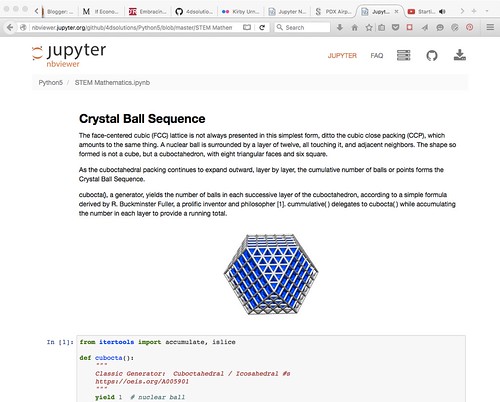
video is the "anime" equivalent of doing "manga" or "stills" (picture
Jupyter Notebooks with still graphics courtesy of matplotlib).
In the
graphical arts, manga equals comic books, anime equals cartoons.
In
mathematics, one needs both.
Sal covers a lot of ground in the above video, looking back, reviewing trig functions, radians, the whole idea of pi.
Then comes his impassioned defense of tau (as 2 pi). He uses tau's
appearance on the stage as an excuse to quickly review the whole board
once again, having set us up the first time with a critique of Euler's
Formula, arguably the most beautiful in math, but having a flaw, a
blemish.
I don't see any either/or here really. Use tau in place of pi when it's prettier. Why not?
However
at this juncture it's worth mentioning another low intensity tug-o-war
in which tau is involved. Versus Phi. There's been some debate about
whether tau stands for .618... i.e. the reciprocal of 1.618...
Some authors use tau for the latter, however the convention I'm most
familiar with assigns Greek letter phi to 1.618... and tau to its
reciprocal (0.618...). In English or other romanized ("ascii-fied")
texts, we may use phi in place of the Greek letter. Then comes the low
intensity debate whether to pronounce it "fee" or "fie". A contingent
says it both ways. Maybe one should say "fee" on odd days of the week?
Quoting
from Wikipedia:
Since
the 20th century, the golden ratio has been represented by the Greek
letter φ (phi, after Phidias, a sculptor who is said to have employed
it) or less commonly by τ (tau, the first letter of the ancient Greek
root τομή—meaning cut).
What I suggest coming
from a liberal arts background is we remind students of mathematics
that debate is a feature (not a bug) of their discipline and circle
these simple examples, in preparation for investigating bigger debates
in lessons to come.
When Sal comes back around again, reviewing the board, the trig functions, the unit circle, he shows that
Euler's formula may be made even more beautiful. By that time some of
us are ready to vote for Sal's argument, especially with the caveat that
pi is not hereby banned. These constants do not compete so much as
reinforce one another.
As for phi versus tau, I think we've pretty much settled on tau being the reciprocal of the golden
mean, which golden mean is itself > 1, i.e. is 1.618... or (1 +
rt2(5))/2 -- note that I sometimes replace sqrt() with rt2() as I don't
want to push the mental model to favor "squares" too prejudicially,
given the triangle-friendly balance of this curriculum (Martian Math
inspired)).
Especially if tau is going of to do
yeoman's service as 2 pi, replacing 2 pi r with tau r in many a Jupyter
Notebook, all the more reason, then, to not force it to do double duty
as the golden ratio as well.
That'd only add to the post Babel
confusion, not that I expect any posting by me to serve as an edict.
The post Babel confusion (not everyone on the same page) is more what
I'm drawing attention to, as another lens for viewing math.
Tune in the
debates for a change. Listen to arguments.
Kirby
Additional reading / links
[originally a post to mathfuture, a Google Group]