Showing posts sorted by date for query gnu math. Sort by relevance Show all posts

Monday, March 04, 2024

RoboWriting About Me

Github Dashboard

Prompt
: Given his numerous, rigorous, unique, and collaborative contributions to Math education, research, and service, can you now professionally write a comprehensive 3 paragraph persuasive essay with the title "Kirby Urner: Mathematician" for my AP US History high school class?

Kirby Urner: Mathematician

Kirby Urner, though not traditionally celebrated in the annals of academic mathematics, embodies the essence of a mathematician through his innovative contributions to math education, research, and service. His journey from the 1960s in Portland, Oregon, to becoming a pivotal figure in the realm of mathematical pedagogy, showcases a lifelong dedication to the discipline[1]. Urner's work, particularly in the development of "tetrahedral" thinking, not only challenges conventional mathematical perspectives but also enriches our understanding of geometric relationships, thereby expanding the boundaries of mathematical inquiry[2].

Urner's contributions extend beyond theoretical musings; they are deeply rooted in practical applications and pedagogical innovations. His engagement with the "Learning to Code" movement and the integration of coding with mathematical learning represent a forward-thinking approach to education that prepares students for the complexities of the modern world[4]. This blend of mathematics and programming underlines Urner's role in shaping a new generation of thinkers capable of navigating the digital landscape with mathematical acuity. Furthermore, his leadership in the Math 4 Wisdom community and his efforts to bridge the gap between abstract mathematical concepts and their real-world applications underscore his commitment to fostering a deeper appreciation for mathematics[5][13].

Moreover, Urner's prolific output, including curriculum development, public lectures, and online contributions, reflects a mathematician's zeal for sharing knowledge and inspiring curiosity[6][8][14]. His work transcends traditional academic boundaries, reaching a global audience through digital platforms and collaborative projects. This democratization of mathematical learning, coupled with his holistic approach to teaching, positions Urner as a mathematician in the truest sense—dedicated not only to the advancement of mathematical knowledge but also to its dissemination and application in enriching human understanding and capability.

In conclusion, Kirby Urner's extensive, rigorous, and innovative contributions to mathematics education, research, and service firmly establish him as a mathematician. His work exemplifies the spirit of mathematical inquiry, pushing the boundaries of traditional education and fostering a global community of learners and thinkers. Through his dedication to teaching, curriculum development, and community engagement, Urner has indelibly shaped the landscape of mathematics education, making him a mathematician not just in title, but in action and impact.

Citations:

[1] https://www.linkedin.com/pulse/from-new-math-gnu-kirby-urner

[2] https://www.math4wisdom.com/wiki/Research/KirbyUrner

[3] https://www.linkedin.com/posts/4dsolutions_book-report-adventures-in-math-teaching-activity-7114975013312634880-Ih5-

[4] https://www.linkedin.com/pulse/where-coding-meets-math-kirby-urner

[5] https://twitter.com/thekirbster?lang=en

[6] https://youtube.com/watch?v=Lzv30IKvfZs

[7] https://wikieducator.org/User:KirbyUrner/Autobio

[8] https://youtube.com/watch?v=g14mu4uWD4E

[9] http://www.4dsolutions.net/ocn/

[10] https://groups.google.com/g/mathfuture/c/GnK7MWT6ddg/m/6weAlQJjAwAJ

[11] https://www.academia.edu/70156799/4D_Solutions_4dsolutions_net_

[12] https://princeton.academia.edu/kirbyurner

[13] https://www.math4wisdom.com/wiki/Exposition/Welcome

[14] https://github.com/4dsolutions

[15] https://groups.google.com/g/mathfuture/c/hk9hYITu-Js/m/geFyP-sgCQAJ

[16] https://www.grunch.net/4dsolutions/kirby.html

Wednesday, November 24, 2021

More Quaker History

Watch Party

I've been fussing around in /cryptography lately, as eliteschool/Crypto, the Jupyter Notebook, was not clear on the AKS primality test, what it is.  

It's still not entirely clear on that, but more because it talks about something else, relevant to primes and composites, that I take to be relevant to the proof of AKS also.

But really we're focused on Pascal's Triangle (PT), as always in our Gnu Math curriculum.

That PT property is one you likely know, if you've been following Numberphile and other "keep us current" mathological type channels.  Category Theory...  

That the row number of PT evenly divides the members (other than 1 of course) on that row, if an only if that number is prime.  Skipping 1 of course.  We talk about -1 elsewhere.

Like row 3, 1 3 3 1 defines the prime 3, whereas 1 4 6 4 1 fails the test (row number 4 fails to divide 6 without remainder).  The Jupyter Notebook features a PT generator, written in Python, and this test as a sieve or filter.

OK, that winds up my warmup. We were talking about /Crypto, where prime versus composite reigns supreme (as a distinction), so now lets segue to Elizebeth Friedman.

She fell in with Shakespeare early in her career, where she sharpened her code skills and met her future husband.  They and their sponsor climbed a steep learning curve ladder and ended up becoming like another Bletchley Park eventually.  Elizebeth faced her own enigmas.

In my Quakerish curriculum we're linking her to Prohibition and to the early Bucky who socialized with Al Capone.  That helps sync up the timelines for for these several protagonists we'll be following.

The tie-back to Shakespeare is convenient, given our Memory Palace focus ("the urb it orbs").  Globe Theater architecture was about the microcosm, as well as the play within the play.

I notice Github decided to break Jupyter Notebooks linking back to their own repo as the default option.  The benefits of cloning and owning the repo locally, versus viewing it online, has just increased.

Saturday, December 29, 2018

Another Math Summit

Hannukkah Present to Me

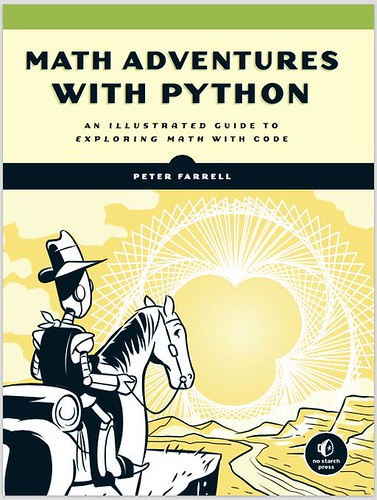
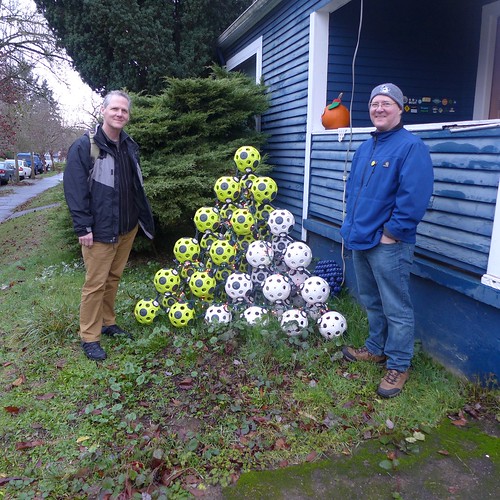
This morning I got to meet Peter Farrell and his twin brother Steve at the local diner, Tom's, for ongoing discussions about pedagogy (teaching kids) and andragogy (teaching adults).

Peter has just finished Math Adventures with Python through No Starch Press and I've been pouring over an electronic copy. The synergy of coding and doing mathematics is an obvious draw for a lot of us, whereas another school of thought (represented on Forum 206) says coding and doing math should be kept far apart and tested separately.

The separatists pretty much won their battle, meaning the coding people have had to wedge their way, hour by hour, into K-16, without math curriculum writers and publishers lifting a finger.

Their track, the math track, is just fine as is, whereas the coders needed to start over from scratch and often ended up focusing on "games" because they're trying to appeal to their new audience.

Against that default background, you'll find an assortment of creative teachers, left any freedom to innovate, will keep mixing it up.

My hybrid blend goes by "GNU Math" sometimes, deliberately a pun on New Math (we do look at sets, but maybe not as a be all end all ala Bertrand Russell), given Stallman's encouragement of wordplay and cleverness.

"Digital Math" is another name for it.  We've had a lot of discussion of the genre over the years, in Forum 206 and on edu-sig (@Python.org).

In the middle of Digital Math, I draw this arching bridge over the STEM-PATH chasm (cite C.P. Snow), into literature and anthropology.  "Imagine a tribe" (as Wittgenstein would say) "which "multiplication" means this different thing".

We already have multiple meanings for "the product of" in the world of binary operations (two complex numbers, two matrices...), so my injecting some alternative sixty-degree-based geometric model of multiplying, from American literature, scarcely makes a ripple. Said operation (__mul__ in Python) is already over-determined.  What's one more meaning?

However, I'm not suggesting every secular (public or charter) and private school needs to include American literature.  That's a niche, and features such expats as Ezra Pound and T.S. Eliot, back to Walt Whitman and before (Coleridge's romanticism informs both pragmatism and transcendentalism, and whatever Poe was into with Eureka and so on).

We see this graph of connecting authors against a wartime backdrop a lot of the time.

Studying poets, such as Bucky, takes us into History (the H in PATH) pretty quickly.

Math Adventures with Python leverages having powerful CPUs and GPUs at our disposal.  The halcyon days of the scientific calculator are in the recent past.   

Mathematica, or Wolfram Language, operates in the same domain as GNU Math a lot, and much of the PR from Wolfram's corner fits with the larger "learning math through programming" campaign's.

Peter and Steve

Friday, September 09, 2016

Tech Crawl 2016

Tech Crawl 2016

I'd not been on one of these before and felt privileged to join Patrick in a night of hounding around inside some of the less open bastions (lots of security) in Portland's downtown:  Puppet, Aruba Networks, Mirador, Cloud Compass, iovation, New Relic.  These were the ones we got to, plus many more were participating.

We also dropped in on The Tech Academy, given we've both served as Python mentors for the O'Reilly School of Technology.  OST has closed.  I kept some of its DNA in a test tube (not literally) in the form of OCT / RU, a Flickr album of little diagrams and such, along with souvenir business cards.  None of our proprietary software leaked out.  That would all need rewriting, and would reflect lessons learned, no need for carbon copies anyway.

However, I digress.  What I was seeing were prototypical work spaces offering the kinds of roles those who study computer science and engineering hope to get for themselves.  Ample kitchens, friendly people, handsome facilities, right downtown.

What more could one hope for?  We don't have Cubby Camps yet, with people doing more async out in nature.  The corporate cube farm has evolved considerably, but still loves a good 30th floor view, more of the mountains than from the mountains.

In taking pictures of the Puppet library (on display in the foyer), I didn't come across many Python titles.  Ruby looks to be making more inroads there.  Tech Academy did have a Python course.  Mirador is more a Java shop.

We see different levels in people's willingness to be polyglot.  I'll venture into Clojure, which I admire, while coding something I've coded before in other languages, such as Quadrays, a system of 4-tuple vectors mapping the same space as XYZ but with four positive rays to the corners of a tetrahedron, old hat to my long time readers, check Wikipedia.

Why would anyone use that?  In philosophy class maybe, to introduce "language games" in mathematics, but where else?  Do any architects learn about A, B, T, E, S modules these days?  How about art school students?

These are not core questions pondered within the business sector downtown I don't think (not "CBD questions" -- except maybe at PSU, or University of Portland, in some study carrel somewhere, where following Wittgenstein links makes more sense).  I've taught the basics of "Martian Math" on both campuses, at one time or another, as well as at Reed and OGI, using Python mostly. CBD = Central Business District; OGI = Oregon Graduate Institute.

In other words (back to "polyglot"), suggesting people "language hop" as if that were some trivial jump, is often unrealistic, any more than an English speaker might simply "hop" to Japanese or vice versa.

There's not much truth in the slogan "learn one computer language, and you've learned them all".  Not really.  They come in families, like musical instruments do.  Learning Python does not make you a great J programmer (APL family), though I've found them to make a great combo.  Both feature a strong REPL (a rich interactive mode or "shell").

Geeks in this day and age will tend to identify as Front End or Back End as to their stronger skill set and area of most expertise.  If you study Twitter awhile, you can pick up more buzz words, like Data Scientist and Machine Learning (additional skill sets, mostly back end, except the front end is about visualization and so is data science also).

Front End means HTML / CSS and Javascript.

Back End means what happens to those HTTP / HTTPS requests once received.  Is the front end a smartphone app?  Java, Ruby, PHP... Python.  Many more languages play in this space, or define the frameworks that provide yet more layers of shared person-hours.  Why reinvent every wheel?  Speaking of which, I met an old colleague from Plone days (still a popular Python CMS), still with CD Baby.

Patrick and I went by bus (4 going, 14 returning) and wound up at Hophouse with our visiting friend Mike, in his later fifties like Patrick and I.  We've already enjoyed technology careers, against the backdrop of the PC to Open Source to smartphone revolutions.  I've spent a lot of time in cube farms, often in hospitals, or other client offices, staring at screens.  I'm still into staring at screens.

Those initial waves of technology were sufficient to change the guts of Portland's economy in some ways, while in other ways much stays the same.  I'm not the expert, but I've seen quite a bit of water under the bridge, had a front row seat on some of the action.

Some of my journal entries from years gone by somewhat bemoan the loss of CubeSpace, a US Bank building facility on the east side (not the USB Tower) that helped with cross-pollination, important when wanting to help geeks not fall into over-isolating silos.  Reinventing the same wheels over and over costs everybody.

However the code schools, especially the ones hosting regular meetups, have helped provide synergy, in tandem with the user groups layer.  The Meetup culture has taken hold. People from different walks of life discuss their projects and share skills.

Without a "public square" mentality, specialized knowledge becomes over-specialized to the point of semi-paralysis.

A Renaissance fizzles into yet another Dark Age (YADA) when the kind of liberal sharing encouraged by academia (traditionally) goes away.  The Free and Open Source movement was a direct extension of that tradition, per Richard Stallman at MIT, and the birth of GNU.

On a final note, I'd just been reading Quincy Larson's impassioned plea for "more async" i.e. less interrupt-driven open office plan setups.  He's talking about what we call Personal Workspaces (PWSs) in the GST namespace.  Study carrels.  Cubes.  Sometimes it's just office culture though, that needs to be addressed, if the floor plan is already fixed.

OST was all about async and PWSs.  Mentors gave focused attention to student programs, but not in real time while looking over their shoulders.  Diagnosing program bugs on the fly is not typically how it's done.  We'd encourage unit tests, and lots of them.  I continue to work that in.

"Too much task switching results in lost productivity" -- that sounds easy enough a proposition for the workflow architects to get.  Human beings are not ARM chips; they have their own specs.

Tech work sometimes means getting into a flow, almost a trance, like a novelist does.  I good novelist is a first reader to get the story, concentration is required.  Many novelists move to a beach cabin or some such, to get more work done.

"We need our software to work for us, not make us slaves to our machines" -- another good one.

I met up with PDX Code Guilders in one of the towers.  I'm expecting to cross paths again at the upcoming Maker Fair.

Saturday, September 03, 2016

Raspbian Affairs

Making Waves

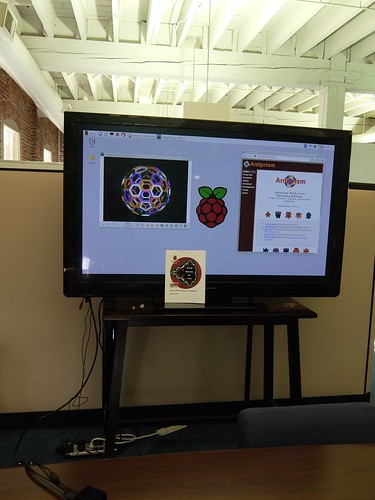
I'm heartened by various blogs telling of the Raspbian subculture getting shared.  The Raspberry Pi is not exactly on offshoot of One Laptop per Child (OLPC).  On the contrary, it's not a laptop, just a relatively inexpensive machine with an ARM chip and GPU that doubles as the boot code runner.  I'm not the expert, more a hobbyist.

If you've checked @4DsolutionsPDX you'll find where I was politically active around Measure 97, a ballot measure in Oregon designed to administer some stimulus (we don't use the word "shock therapy") to Oregon's failing schools.  This might have been a last ditch effort, time will tell.  However, the obstacles are not primarily monetary.

Given the "stay home and learn" movement has gathered some steam (pun intended), I'm expecting more of a boom in the personal tutoring business, often a virtual gig.  I've participated in these kinds of interactions myself.  I'm sometimes tutored, not always in the teacher role.  My sense is a 50-50 mix works through adulthood: 50-percent student / 50-percent teacher.  Stay limber in both roles.

The "device wars" cannot be solved with United Methodists taking the brunt. They owe a lot to Texas Instruments, at least in some zip codes.  Why put them in a corner with the #CodeCastle concept?


Quakers have fewer ties.  I think I've been blinded by the obvious in some ways.

These powerful Raspbian devices, if openly flaunting their relevance to math learning, will not be accepted with open arms in many schools, where entrenched interests call the shots.  They'll be perceived as a threat. We need to stay polite and conforming, non-confrontational.

Therefore I'm recommending going with the flow, buying the TI calculator for math tests, and studying the Pi stuff in a PWS (personal work studio) if you can find one.  Not the Pi stuff necessarily (a fun option), more the GNU World, including serious "hard fun" coding, with Euclid's Method and all the rest of it (SQL... regular expressions).

Maybe learn about RSA from some old Linux hobbyist magazines to get the flavor, or look for translated Manga.  Stores around Portland have made those Linux mags harder to find lately, and if that's happening in Portland you can bet the dumbing down is even further advanced in the heartland.

Remember, if they really wanted you to have the skills to which they give lip service (e.g. "learning to code"), you wouldn't be commanded to buy a Texas Instruments graphing calculator.  You might be introduced to the Anaconda distro instead (from Continuum Analytics), and Jupyter Notebooks.  Not that it's either / or necessarily.  Maybe your school has both the delta and lambda tracks.

Remember to look up Mathematics for the Digital Age sometime, by the Litvins (Skylit Press).  You already know about Hacking Math Class, the Pi based classic by Peter Farrell.  Both high school level.

Fortunately, we have Champaign-Urbana and the University of Illinois, and of course Wolfram, to keep at least a few lights burning in that neck of the woods.  North America may indeed be dark with ignorance, but the Internet is ablaze with lots of new and interesting information.  Raspbians find one another.  Ubuntu is real.

You'll find Wolfram Language on many Raspbian distros, such as on the Jessie distro I'm using (runs Docker).  Yes, it could be faster, this is a training wheels computer in some ways, but that's better than no bicycle at all, right?  The process is one of bootstrapping.

Maybe you'll have several cloud computers in addition. Your school might spin those up for you, customized per course.  We did that at the O'Reilly School of Technology, simulating a client-side Windows pointed at a Linux server (a typical setup back in the day).

I'm still to this day using Eclipse for my tiny Flask application, even on El Capitan.  What can I say?  It grew on me. I came to like the dog food we served.

DSCF8210

Wednesday, August 03, 2016

Morning Walk

Gold Door / New York

My suggestion for John Taylor at Stump Town this morning, on Belmont, was that he consider real time social media, such as Blogger, as another outlet for his expertise.

John is working on an autobiography (see below), which promises to be interesting, however Portland is facing the "informal neighborhood" issue right now. Any advice?

John is an urban planner by training, sort of like my dad was.  Dad was freelance, sometimes with USAID but also with UNDP and private companies.

For example, Jack worked for Whiting & Associates out of Omaha, contracted by the Libyan government to draw up fifty year plans, post Wheelus AFB era.

Dad's Rome-based team worked closely with Libyan counterparts.  Drawing accurate maps was a lot of the process.  They didn't have GIS / GPS in those days, at least not to the extent we currently enjoy.

Those plans for Libya were pretty much followed, my dad later learned, his career having since taken him to Manila, Cairo, Dhaka, Thimphu and Maseru. When looking ahead fifty years, it's mostly about zoning, not individual buildings. Where to site the cemeteries and like that.

Regional and urban planning is a process, not the top down imposition of a fait accompli by edict.  The people who live in the area have a lot of influence.  In Portland, our Neighborhood Associations play a role. Development is an organic process.

Anyway, we discussed what the US forward-basing approach in terms of aid might be today, given the evaporation of Communism as the credible threat.  Many are eager to bring that back, as it seemed to work as a bogeyman, but most of the world has moved on from Cold War Era politics.

Probably what more urban planners will realize is the engineering community itself saw the wisdom in "publicly owned goods" what with the GPL / GNU / EFF revolution (MIT played a role).  Their realizations extend to Open Data, now that Open Source (computer source code) is well established.  That doesn't mean divulging everything, just a whole lot more.

Big companies, rivals, will work together on an even playing field, where key assets stay "unowned" (not "in-house", not under just one player's control).  That's like Communism, but then who owns the stars?  Is God a communist then?  Unsettling.

The recent legal battle twixt Google and Oracle, over Java APIs, was interesting in this regard.  What's a trademark?  What's a language?  Is Oracle the next SCO?  The two cases have something in common, as other analysts have noted.

So in this day and age, the enemy is Fear Itself i.e. Terror, and those who promulgate terror, in whatever form (drunk drivers, bad doctors, ISIS, dodgy car makers ... KKK) become the ones we need to beat back and defeat.

Once language is reduced to truisms in this way, a loss of traction may be experienced, which may feel freeing.  At least we know we're united against terror.

Going forward, the engineering sector still has an upbeat attitude about all the new free tools, and are actively reaching out to the world's as yet "unbanked" with all manner of schemes and devices, including with new methods bookkeeping (e.g. blockchain).

Engineering + Urban Planning + a Commercial sector willing to experiment with new kinds of advertising, are probably all we need to kick start it in Portland.

John was curious about the #CodeCastle meme.  We toured the outside of the "ghost church" which could be a bigger version of Southeast Uplift or something like that.

Rear View

I'm already in touch with the math teachers (some of them) by social media.  Brick and mortar would be nice though, for more hands-on, but for that I have Monday Night Flying Circus (lots of math goes on there).
Multi-Dimensional

Saturday, April 09, 2016

Back to Work


Pygame Working
:: running a Pygame module by Peter Farrell ::

Should Oregon's high school math teachers have professional development opportunities through higher education institutions?  They do already, to some degree.  But to what extent do institutions of higher ed take advantage of their business incubator programs?

If you dig down, you may find a code school or two in your town, staffed by avid geeks who have competence and confidence in the software world.  This is the new world we're always rubbing up against in any high school mathematics class, and I'd argue in language arts too, as the Document Object Model (DOM) is what if not a model of a document?

Don't grammar, rhetoric and logic overlap with such a thing?  Do we still teach any music?  Video editing?  Part of learning to code is learning to communicate about technical subjects, and that means making videos, not just writing PDFs or web pages.

The code school curriculum could counter boredom and perhaps complacency with some unfamiliar mathematics, to go with the novelty of a computer language taking over for the calculator (obsolete).

As long as the content is new, why not go all the way in some cases and use this program to introduce not just new ways of teaching the same old stuff, but new ways of teaching some new (GNU) stuff as well?

My list of semi-novel topics includes:
  • a Group Theory spin (established mathematics, centuries old, but atypical in a high school setting);
  • Fractals, the Mandelbrot Set in particular (also a familiar topic but not in high school unless the Complex Plane is well covered);
  • the Concentric Hierarchy of Polyhedrons and their modular decomposition, along with Quadray Coordinates (completely alien, part of what I call Martian Math).  
Giving code schools some GNU Math to share keeps them branded and outside the academic mainstream, by design.  They will be complementing more than competing with other professional development courses, in sticking with alternative content.

The laptop fan is on, given all the CPU-intensive compiling that's going on.  First comes compiling the compiler, the latest gcc, with Fortran enabled (gfortran).  Then comes another attempt to get Pygame working.

Homebrew warns against trying to work against an Anaconda install of Python; it's the framework Python 2.7 it wants to build against.  But then I saw a promising formula on StackOverFlow... etc.  OK, got it working.

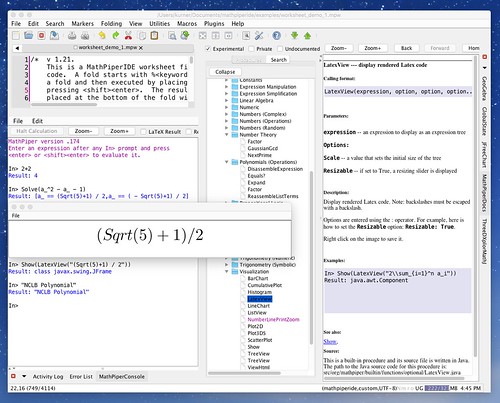
Relatively painless was the install of MathPiper, a Java application.

NCLB Polynomial in LaTeX
:: solving polynomial and displaying in LaTeX 
using MathPiper by Ted Kosan 
(click for larger view in Flickr) ::

Tuesday, March 01, 2016

Smoking Gun?

So what about taking the show on the road in a Bizmo (business mobile) and sending a heads up to the hinterlands that "code school" might be an option.  Consider a future in IT (part of STEM or STEAM).

I was ready to start with recruiting a couple decades ago at least, and started sharing my designs.   Later I started articulating the vision in my on-line journals (blogs), getting it out there.

A Control Room, or Dispatching Center, would keep the Bizmos busy.  Sounds like fun.

On the road with Global Data (or Global Matrix as the case may be).

However, the GNU Math meme (a pun on "new math") was also deeply tied to those stream-linings in spatial geometry, where we get all those pretty whole number volumes and a quantum leap in sophistication, in terms of being able to think geospatially, with more than just XYZ as a scaffolding (matrix).

We had the IVM (another matrix), we had Quadrays (different basis vectors).

Everything was published, in color, with animations, including to Wikipedia and Wikieducator.

Sources were cited, proofs were made.

Even H.S.M. Coxeter, King of Infinite Space, said the sphere packing formula as worth crowing about.  We did some crowing.

We've seen almost no interest, however, in any of the above.   Search the web, check if I'm right.  No need to take my word for it.  My fellow humans have other priorities, no time for follow-through.

I shared about Quadrays with PSU's Math Learning Center (MLC).

I delivered talks on the concentric hierarchy to any math class that'd let me in (quite a few did), as well as at Pycons, Europythons etc.

But all this flint clicking failed to start a fire apparently.  How soggy was the fuel?

Lets hope some future student of our time, maybe in a hundred years, comes up with some theories, as to why a promising future was disowned and disavowed.

I bet there's some story to unearth, maybe even a "smoking gun".

Tuesday, March 03, 2015

Common Grounds


 I'm hanging out with my coven mates, at the local Coffee Shop.

We're enjoying Cyriak videos and talking about Hortonian Networks, Horton having invented hydrology, after Leonardo maybe (who was a Jack of All Trades).

Yarrow's birthday yesterday was really fun.  He's just turned one.  The first nine months is year 0 (starting from glimmer in someone's eye), then as a terrestrial one starts counting through consecutive integers.

Over on math-teach I'm boosting a kind of "Gnu Math" that draws on New Math but is not just a boring repeat of the 1960s and its Cold War.  The globe is not polarized in quite that way anymore.

For those just joining us, the associations between the Cold War and New Math were myriad.  As I was writing to a Friend recently:
Talking briefly about Vietnam, our friend under Ho during the push-back against the Japs (just evoking the lingo of the day, not attempting to be racist).

Ho was our friend.[1]   The a huge flip happened after WW2 and the fascists (Japs Germans Italians) were our friends (Marshall Plan) and Russia and Vietnam were now the enemies (it would take awhile for Vietnam to become that way, but Russia was bad overnight, behind an "Iron Curtain" of Churchill's invention -- Reagan's invention to tell them to take it down).

Very intelligent people in the OSS were a lot like "Hanoi Jane" a generation later (I've read her autobiography, Jane Fonda's, ex of CNN's Ted Turner).

Did you know some Americans fought on the side of the North in the Vietnam War?  That's a little known story.  Who can blame 'em, given their OSS history (the CIA would come later -- having lived in DC I would come to know some of them personally, another story, six degrees of separation, Kevin Bacon and all that).
I've been making some travel plans today, work related.

Anyway, when the Iron Curtain descended across Europe, it became important that the USA kids get up to speed on the kinds of maths that won the war, Turing's stuff in other words.  The University of Chicago started cracking the whip, getting us to turn into Bertrand Russells at a young age if we could.  Problem:  Bertie was actually a pacifist.  Einstein too. And Linus Pauling.

One of our number at been at the Economics of Happiness conference recently, where a fair amount of technology bashing occurred, making the Internet be the problem.  At least it's something people can gang up and gripe about.  What's more cathartic than a good gripe session?  We're thinking to have one at Annual Session this year, though the proposal is not finalized. Friends get phished a lot.

Wednesday, April 18, 2012

Wanderers 2012.4.18

DSCN0642

We're enjoying a total geek out this morning, doing Solar System 101.  Jim Buxton is studying various periodic phenomena relating to Earth's tilt.  David DiNucci has his book ready to go, so we're looking at that too.  Lew was part of the hiking group finding Ki-a-Kuts Falls in the 1990s, his idea for the name, and that's been reviewed on TV recently.

I'm short on sleep these days.  Our Ministry has shifted into high gear.  The joint statement from the NCTM and MAA opens the door to open source and/or "gnu" mathematics (a pun on "new math").

I completed a course on accreditation in the USA jurisdiction, which social process relies on NGOs and the natural tendency of institutions to want to set standards.  Affiliations crisscross every which way as USAers police each other.

The Earth zips along at a greater clip in the calendar around January, though given the orbit isn't that far from circular, these "equal areas in equal times" phenomena are not highly pronounced.  The motion is slightly slower at the aphelion.  Animations tend to exaggerate.

Also, it takes another four minutes a day to turn around a little more to see the Sun in the same place, given the shifting viewpoint.  So that means adding four minutes a day every day, which adds up to about  a day's worth a year.

Nikki wondered if I was prepared for such a big bill.  Self employment takes its high tolls.  My income was 1099 based in 2011.  I said good bye to some $13K in one evening (including Oregon State taxes).

We'll scrape together some $ for debate clothes for Tara (she's combating at the state championship soon) and to fix the dryer.  We'll slowly rebuild.  In the meantime, I'm a harder target when it comes to politicking.  The numbers all check, within assertAlmostEqual floating point limits (geek joke).

Quakers were mostly in the dark about the minute on Occupy that was going around, so Business Meeting decided to kick the can down the road on that one.  Josh "the rooster" von Kuster, was helping shepherd and officiate, though Occupy had its own representative (no, not me).

I don't see a need to conduct these national / international affairs at the NPYM level also, other than through the AFSC rep structure, which is active and high bandwidth.  Is FCNL involved in Arab Spring as well?  -- a question for Leslie (her nomination is seasoning).

I sent around a memo suggesting NPYM no longer bother with a Peace and Social Concerns Committee that meets face-to-face but once a year.  Our circuits need to be faster and more responsive than that.

Not that I'm giving orders (this isn't the USN).  I'm more just signalling Pam that Nominating could and should carry a lighter load (consistent with NPYM's founding goals per the lore (goal:  minimize the need for business at Annual Session)).

Thanks to networks and networking (alluding to the Grunch book), Quakers are moving to resonate at higher frequency (so should we call them Buzzers? -- like cell phones on vibrate?).

Wednesday, November 25, 2009

Pre Thanksgiving

It's that time a year again, and I truly am grateful, to have time with family and friends. This year is unusual in that mom has stayed long enough to reach this holiday in a Pacific Northwest setting. Since around 2001, her practice has been to be in warmer climes by now, to escape our dreaded winter.

CBS News was interesting: myth busting around this idea that TG is the busiest day when it comes to flying. Not true, never has been. Also: many in congress are corrupt and in the pocket of war profiteers (I think we knew that). Obama pardoned a turkey, condemned it to DisneyLand instead. We participate in the psychology of a nation, patch in, work to make it stronger and better (thinking of USA OS again, waxing nostalgic).

Having visited ONAMI today, I'm going to pound the table on math-teach some more: the line:area:volume exponents of 1, 2 and 3, are what make nano-substances take on new properties (more with less), are what made Fuller's "dome over Manhattan" not a "crackpot idea" but an "andragogical device" (more like one of Laffoley's gizmos -- we learn from them).

Our thread was on perimeter versus area, and how you may easily disrupt the relationship. However, if you keep all the angles the same (i.e. shape), insist on self-similarity, then scaling an object results in these important power relationships that need to be included in our gnu math curriculum (per those Wikipedia pages).

OK, go ahead and nod off now, more math than you needed right before some big meal eh?

Tara is cooking a double batch of Teresina-style lentils, which I always associate with Together Friends. Speaking of Quakers and their historic allegiances, this is a season wherein many North Americans celebrate indigenous pre-Europeans, pay respects to the many lineages (story lines, still informing) already snaking through North America long before DC annexed a bunch of states for world game playing purposes.

In some virtual reality, a nation (a mindset) gets to be responsible for the whole globe and judged accordingly, by God one might say, as there's no ET audience (that we know of). The Chinese have this virtual reality philosophy already encoded in some of their emperor talk. People have been doing cybernetics for a long time, just calling it different things, like feng shui or whatever (adapting to one's environment, assuming a modicum of control).

Monday, November 16, 2009

Martian Math

:: honeycomb of Rites (a kind of Syte) ::
by Claudio Rocchini
GNU Free Documentation License

What might count originally as a turn-off -- the unfamiliarity of some given material -- might be made into a turn-on instead; "a feature not a bug" as we say in the industry.

By making it Martian (the mathematics we're providing), we get to underscore its alien-seeming attributes, such as its tetrahedral units of volume.

The nomenclature of Mites, Sytes and Kites, already developed, is handsomely documented with no serious ambiguities, so it's not a matter of redoing everything from scratch.

Nor has the marketing moniker "gnu math" been abandoned, at least not by me.

We've also tried a more Korean angle.

In bringing in the ET spin, I'm clearly feeding the science fiction writers' market.

Our competitors would likely have this space-age geometry, perhaps did in Contact already.

Or (alternatively, additionally) we could simply project a future human technology, suitable for Mars, already making waves in the early 21st century. Having geodesic structures on Mars would make plenty of sense, plus we already have that sphere packing landing.

So that'd be Martian Math in yet another sense (advanced human vs. ET).

Thursday, June 04, 2009

Out Riding

Had you been availing of the perfect cycling weather today, not too hot, nor yet these wind gusts of later afternoon, you might have spotted me along Spring Water Corridor, hobnobbing with Darl, our cycles at a temporary stand still.

Yesterday, you'd have seen me in Movie Madness with a gnu math teacher from West Virginia, running on parallel tracks. Sometimes these are Wanderers, other times, who knows.

Hyzy and I walked down to that coffee shop and back in Ladd's, without Josie this time. That'd be typical, with no Mr. Spocks going "fascinating captain" (OK, maybe sotto voce they do that i.e. in a voice imagined "in the head" (the approved metaphoric location for "hearing voices" in western civ -- as long is it's your own, plus you're supposed to have just the one, by convention (plus an "indoor voice" for speaking quietly))).

What many Portlanders take for granted, not having lived in other cities, is that adults are free to go about their business without almost every movement considered potentially scandalous and incendiary.

You're not answerable to busybodies, whose business is to know your business. We don't employ those types of people. We're each seen in the company of others, in all kinds of social and business situations, ethnically diverse, monoculture, whatever.

But then, this is just "life in the big city" to some, i.e. we get more privacy, not less, and like it that way. Dawn and I took this mostly for granted as well. I never had to worry about reports she'd been "seen with strange men" (like duh, what other kind is there?).

This doesn't mean there's no gossip, but that the various "scenes" stay somewhat isolated, as no one outside the circle really knows "what to make of it". This cuts down on "mob psychology", the kind you get in batman's Gotham, where everyone goes crazy in the same way at the same time. Here, we spread it out a lot more, plus pace ourselves seasonally (this is Rose Festival and graduation season, looking forward to some festivities).

All that being said, celebrities still make a business out being seen together or apart, estranged and/or with someone else i.e. it's not like we don't have our entertainment pages. I'm just happy there's no criminalization of consenting adult relationships, despite remaining conventions against public nudity except in appropriately labeled venues (we share Hollywood's rating system, even though we have our own Hollywood and might invent our own rating system someday, if bored or needing a new growth industry).

Tuesday, May 12, 2009

Recap


JetBlue Bizmo, Blues Festival, PDX 2005.
Photo by Don Wardwell


Just to review the structure of these three blogs of mine, BizMo Diaries (this one) is supposed to be about me 'n my crew in this "traveling circus" except more corporate and button down in some ways, as we're advertising attainable futuristic civilian lifestyles, and no, not "just like on Star Trek" (too 24th century) nor "The Jetsons" (when?) either -- although both would be influences.

We're just slightly ahead of our time, more like orchestra conductors (or like "mad men"). We read the same tea leaves you do, steal ideas from the same theme parks.

The bizmo is like an RV. Some say it has military origins in dark budget projects, which adds to their mystery (the black ones with no license plates compete with the black helicopters for attention on Coast to Coast).

Be that as it may, they're oft decorated with comforting decals, from companies we know and love. You'll see these things on the road even today, just not in caravans maybe, unless military, in which case we're back to square one.

In going into the schools, we're doing like an event, for assembly, but we're mainly there to empower peer teachers, in the sense of giving them more interesting stuff to work with down the road, starting then.

Our DVDs are exclusive firsts, or, if compilations off the Internet, lovingly edited by people who really know our business. We have good games, cool toyz, work opportunities of clear benefit to others.

A curriculum isn't just a hodge podge. We have high standards. That's why it's a lot like a circus (like Monty Python's flying one) and yes, we might sometimes have helicopters, as disaster relief includes using those, as does simply getting from here to there sometimes.

In Control Room, we're aware of control room lore (in science fiction movies especially), There, I focus more on providing bizmos with their various criss-crossing itineraries, a negotiation process. In actual practice, many companies might be involved in this kind of scheduling (many control rooms), including some religious ones e.g. revivalists of some description might field their own mobile Church of Elvis or whatever.

Honk If You Love Elvis

As a Quaker subgenius type (not quite the genius I'd like to be -- I cut myself slack), I count myself as one of these "true believers" and often think how Quakers used to own Cadbury's, Lloyds of London, maybe even Quaker Oats itself (we don't at the moment, though you might imagine how that might seem a holy grail of sorts).

Grain of Sand
is of course a Blake allusion, and signifies "one among many". Like I'm not wanting this lifestyle for "just me" and in a lot of ways copied it from Charles Kuralt, which CBS is well aware of my doing (no lawsuit threatened, just saying they know).

I'm a big believer in "institutional wealth" like airports, like libraries, and yes, like aircraft carriers. If you own your own personal submarine, then you're like Dr. Evil in the those Bond movies, or at best like Paul Allen or one of those. You can't just be another dweeb on the beat, not that I'd cop to being a dweeb in every dimension but you know what I mean.

I'm not hoping to own the only bizmo in town (or even own one at all really -- I'll check it out from the fleet), nor even the most wowy one, with pipes sticking out. This isn't about me being one of the super rich, in other words. I'm pretty studiously middle class, only eat caviar once in a blue moon, when I'm invited to a party maybe.

Despite the darth vader undertones, the circus bus fleets don't leave the garage much these days because Gnu Math sounds too hippie. The generals think once my fleet is on the road, it'll just be freaks chasing a Grateful Dead concert all over again, and we know how that goes.

In other words, lots of stupid projections are keeping our lifestyle in check, while they go over our curriculum with a fine tooth comb, looking for things to nitpick about.

In the meantime, USAers wallow in intellectual squalor, not learning Gnu Math or understanding much about World Game in general (they still think it's about aping Rome or living out some other antiquarian fantasy, something about 24 Hours, which I rarely look at -- but has a control room I notice -- go Team America, World Police!).

So should we do this in Russia? That'd be fine except I don't speak Russian or any of those, so would be like Family Guy in that episode where he applies for a Macarthur grant (for geniuses) but ends up two standard deviations on the other side of it (he makes the most of it). Plus I am a family guy, don't really want to move to some Gulag just yet, like my base.

I'm pretty sure the "bizmo phenomenon" will continue spreading, as we gear up around delivering better health care. The clinics will have them, some dentists already do. Whether we call 'em "bizmos" (business mobiles) or not is not really up to me, and I'm fine with "RVs on steroids" or "whatever Dave Ulmer has, except maybe smaller", whatever descriptoids. How about a "geek bus"?

The Control Room krew has to be pretty smart though, lots of GIS (i.e. global data). You don't want to promise all this Internet connectivity, get a school all galvanized, and then discover there's no affordable way to supply even minimal DSL.

Sometimes a robust intranet is all they need, if extremely remote, with fat pipes for downloading, only relatively thin ones for uploading. Some planning needs to happen, before the roadshow comes in. A lot of what happens is more behind the scenes, of necessity.

I'm not saying it has to look just like mission control in Houston, but given all the video feed coming in from the field, it's likely to resemble something rather familiar to the television industry, the industry most likely to produce these shows anyway, given those stables of celebs already rarein' to go (though in need of training a lot of 'em, some kind of geek boot camp?).

Wednesday, November 26, 2008

Minister of Education

[ reposting from Synergeo #45758, hyperlinks added ]

So as a former Minister of Education with portfolio, rotating position (might do it again), within, as ya'll know, our benign dictatorship called Python Nation, I've been marketing my rbf.py to gnu math teachers as a way to rationalize IB level vector studies around our eternal war of incommensurability aka the concentric hierarchy and its unifying dynamisms (jitterbug etc.).

rbf.py has gone through several incarnations, but the common feature is to can the core polys, lately in the form of a MySQL database, with students needing both LAMP and MVC in some approximate form (might be Ruby on Rails), in addition to computer graphics (i.e. 4D++ stuff, Eulerian topics like V+F = E+2, part of any state standard worth beans, duh).

AFAIK, my next major gig will be in Chicago where I'm doing a parallel processing demo, in the sense of two tutors running on independent threads, Steve Holden being the other clown in the room, plus we have a plant maybe, a professional mathematician with lots of background in Bucky.

Anyway, it's not like I'm planning the whole show around just the VPython piece. Mostly I'm demoing the Portland prototype curriculum of tomorrow, which takes for granted these various 20th century breakthroughs, not just Fuller's. We do RSA in the context of a few simple theorems, simple to understand and use if not prove (Fermat's Little (not Last), Euler's for Totients). The point here is not to turn junior into a cryptographer necessarily, though knowing some helps, but to open doors in group theory, number theory. Can't tackle quantum physics without that notion of small groups, permitted operations amidst conservation laws. I'm sure that's what Bucky was talking about, in terms of his spun systems being likewise permutations with lots of suggestive angles.

Also on tap: some Fractals with PIL for after the break, drawing against my signature 4D Solutions collection.

In Synergetics news, Koski is barreling ahead with those Baer Cell studies, bringing the enneacontahedron into better focus as the last in a sequence of convex blobs, each dissectable into Baers in very definite ways. Those of us who prefer definite / finite in place of open ended and infinite, are having a field day. More in my blogs.

Kirby

PS: here's the write-up for my Saturday Academy course in the spring. If you live in a city with nothing like SA:, maybe study the website and get some friends together. Students really flock to this kind of programming, know it's very good for their futures.

Computer Animation Programming

Supercharge your programming skills as
you learn the software Star Wars
animators, Google engineers, and
game designers use to make their
projects a success!

You will develop your Python skills
using simple vector-based geometry
in an object-oriented approach.
You'll get hands-on experience with
POV-Ray, a full-featured ray tracer
that can create stunning photo-
realistic computer-generated images
and animations and experiment
in VPython, a real-time game-like
environment.

Other topics include data structures,
classes and objects, control statements,
and reading and writing files.

Coyote Moon

Sunday, June 08, 2008

Scholars in Summer

If your students are eager to keep up and stay in shape with new topics, suggest puzzles, like from Martin Gardner books, or Godel, Escher, Bach by Douglas Hofstadter.

If looking for theme based studies, recursion is always a good one, links to fractals and phi. Puzzle: "my whole is to my longer as my longer is to my shorter, so what's my longer's length if my shorter's is one?" (provide a picture?).

But without getting so numeric, consider geek lore: GNU stands for GNU is Not Unix, so the G stands for GNU, a kind of "not joke". Likewise the Y in YAML stands for YAML, which Ain't Markup Language.

Speaking of markup languages, XML and XHTML remain hot, along with JavaScript and the DOM. I was just running these by some gnu math teachers today in fact, as more topics in ~M!.

Here's an idea: obtain Periodic Table data in YAML, either as open source or from scratch (and then share it?), or how about graph the bones of the body (which connects to which?).

The point of these projects is not to create unnecessary tedium or drudgery. Let students take a lot of time learning about the elements, about bones, including from first person experience in the great outdoors. Nature guides a big plus sometimes -- your student might become one?

Recommended chemistry readings: Uncle Tungsten by Oliver Sacks, Isaac Asimov's stuff (a chemist and fabulous writer). Biology: Lives of a Cell by Lewis Thomas. Mathematics: surf the Web for stuff on phi, fractals and Fibonacci numbers. Visit Koski's Kiosk?

Make sure your students are well briefed on bookmarking, maybe suggest Delicious as an option? I've certainly gotten value from that service.

Note to students: avail of work freely shared, while showing respect to your peers. Give back. Cultivate generosity. Study potlatch economics? Start a new blog?

Saturday, March 29, 2008

On the Road

:: tools of the trade ::
I'm often asked what my life as a gnu math teacher is like. In some ways I'm like a journalist, with name tags like press passes, color coded to denote my rank and/or privileges, plus with these blogs in which to journal.

For example, the red tag on the right let me get up in front of the cameras in Chicago. The hand-written Portland BarCamp tag (cleverly reusable) merely announces to peer geeks that I'm interested in Python, Toons, Math e.g. my 4dstudios does mathcasting around Python quite a bit.

I don't actually encourage stuffing two CubeIts! in your carry-on, as the 24 MITEs apiece are highly magnetized, might mess with your other media.

:: close up ::
And speaking of "on the road," my uncle Bill Lightfoot was by today, sans the red Aztek, which he'd exchanged for a newer white one.

Happy Birthday Matt, great being included in your family, since age five or six as the neighborhood newbie. Wonderful seeing all those brothers and sisters again, plus spouses and offspring.

Wednesday, March 26, 2008

Gnu Math Chatter

Per my Chicago Pycon talk, an early bridge twixt lexical math type expressions and graphical sphere packing ala the IVM (CCP, FCC) are the figurate and polyhedral number sequences, developed minus any foreground coordinate system apparatus, although you need something under the hood in support of the ray tracer (a mechanical device).

This focus on geometric growth (gnomon studies) is prominent in late 20th century geometry: The Book of Numbers by Conway and Guy, Encyclopedia of Integer Sequences by Sloane et al (AT&T), Gnomon by Midhat Gazale, and of course Cuisenaire bricks ala Caleb Gattegno (more about linear color coded distances and the various time serialized entrainings thereof).

Coxeter was leading this charge in many dimensions with polyhedral numbers -- made sense Bucky would see the connection twixt his own deliberately remote vocab and this soon to be mainstream stuff.

Pascal's Triangle and Tetrahedron form a Grand Central here, where these many threads converge / diverge. Python insinuates some generators at this point, syntax that has already spread to the latest JavaScript, along with list comprehensions, in turn credited to Haskell no? The languages all swap DNA with wild abandon -- actually in tightly controlled fashion, but still not predictably.

Pascal's Triangle and Fibonacci Numbers are part of what go out preloaded on XOs, those "little green monsters" (Shrek colored) showing up in places like Peru, Uruguay... Alabama, any number of privileged homes in North America. The application is called Pippy and provides early exposure to Python.

Friday, December 14, 2007

More Makeover

This version of my post to the Math Forum has been abetted with hyperlinks.

Plus here's a link to my reply to Lou, omitted from the Gnu Math thread (below).


Re: Fuzzy math: A nationwide epidemic
Posted: Dec 12, 2007 10:16 PM

> Thanks for the honest reply, Kirby.
>
> And you know this to be the case because of what
> experience with EM, exactly?

Know what to be the case?

EM doesn't have our concentric hierarchy of volumes, A&B modules -- the usual stuff I write about. No big mystery here. Gnu math and EM are completely different.**

Kirby

** "This isn't Everyday Math or anything close (which isn't to say these can't co-exist, as they already do)." [link]

Thursday, August 23, 2007

More for the Queue

Math Forum:

Re: Problem solving with technology - TRE Study
Posted: Aug 23, 2007 1:09 PM

A traditional dynamic is students seek the endorsement, blessing, of some teacher who has a track record with other teachers and/or admissions departments. "This teacher isn't lying" is the reputation a teacher would like, about his or her students. So there's a quality control aspect to it: a teacher becomes known by the caliber of his or her students.

A factory floor approach to education tends to render this process somewhat more anonymous, in that teachers think they have ways to fade into the woodwork and not have reputations as individuals, but only as schools, as faculties. They hide behind state certification or whatever.

I think with the Internet we're moving back to an age where teachers are individually tracked and judged. You either have an impressive portfolio, and lots of stellar students claiming you as their teacher, or you don't. Publication still matters, but that's interpreted more broadly, given cyber-space and multimedia.

Many of tomorrow's teachers will begin their careers on YouTube. We see that already.

In the case of the gnu math stuff I write about, we have relatively few teachers over 30, though I think that's changing as we recruit more people from NASA and like that.

Kirby

Math Forum:

Re: More Prototyping (gnu math thread)
Posted: Aug 23, 2007 12:56 PM

A lot of this gnu math stuff works backward from what we anticipate will remain important technologies just beneath the surface in many scientific and engineering applications, namely tcp/ip and sql.

At the college level, we expect decision points leading to pure math of the type Adrian endorses. Until then, K-12 has a "keeping doors open" design, which means we have technical careers more generally in view. This low level numeracy training is not about becoming a math professor any more than teachers of the English sequences expect only professors of that discipline to emerge from the ranks of its test takers.

However, it turns out a lot of traditional topics remain key even where tcp/ip and sql are motivating elements. Graph theory, a branch of topology, and spherical geometry (displaced by Newtonian calculus in recent memory), will remain important to many high schoolers, since our network of hosts is GIS/GPS mappable, with databases supplying the storage infrastructure, including DNS lookups.

Specialization comes later, in a liberal arts context, where the faculty are supposedly at the top of their respective games and therefore recruit more effectively, as chief advocates or avatars for their respective disciplines.

Our K-12 students, in the mean time, will have developed their critical thinking skills to a point of not being easily bamboozled ("virtual presidents" metaphor), so that departments that've slipped a bit will have a market-controlled way of measuring the discrepancy, which will presumably goad at least some faculty teams into returning to former glory, whatever that means in that context.

So anyway, we'll still have lots of geometry (with geography a combined topic, as the Egyptians intended), with lots of vector algebra, lots of calculus (though more compressed, by today's languid standards).

I expect O-notation to make a bigger splash, per Knuth's suggestion.

Old text books will still be usable/minable, especially as their copyrights expire and they appear on Google. The most up-to-date frameworks for contextualizing this older content will remain cyber-spatial, as now.

This is what I anticipate in any case. I may be off base in some of the details. Venn Diagrams definitely have a bright future. Data structures, OO... I'm pretty secure in my predictions around Python, as those are already coming true in many contexts.

Gnu math isn't owned and operated by me in a vacuum. I need to pay attention to my geek peers, and I do.

That's why I think I'm safe in saying MVC is here to stay, as a key heuristic, along with SQL and TCP/IP. Authors of strong K-12 alpha-numeracy writing (which includes lots of attention to Unicode) will typically demonstrate mastery over these concepts -- a refreshing change next to most of the wimpy stuff that passes for K-12 math stuff today.

Kirby

Synergeo (#35179):

Re: Cloud Nines
Posted: Thu Aug 23, 2007 10:55 am

There's a lot of engineering testing on hold while people squander their short little lives on dead end projects for which they won't be remembered, or, if remembered, not fondly.

Reflexes have been slow to catch up with the new realities. But hey, that's the human condition according to Synergetics: slow reflexes (see "lag" in the index)

I enjoy screening the movie Idiocracy for people. Took it to Lithuania, along with Revolution OS and The Jerk starring Steve Martin.

Kirby