Showing posts sorted by relevance for query tetrahedron. Sort by date Show all posts

Tuesday, December 30, 2014

Convergent Friends

:: seasons greetings ::

Some may find the title misleading as there's a Martian Math spin to this post, by which I mean I'm blending in some of what I also call Quaker geometry in posts gone by.

Given the primacy of the tetrahedron in New England Transcendentalist late 1900s poetics, aka 4D per Bucky Fuller, we have some obligation, in Quakerism, to sustain the inertia (our heritage, after all).

So the teaching is this:  at the XYZ origin, instead of something boring like a bowling ball with hooks, the XYZ vectors stretching away at right angles, we substitute a wrought iron tetrahedron, hooking our six vectors to that, reinforcing the understanding the opposite edge pairs are mutually perpendicular.

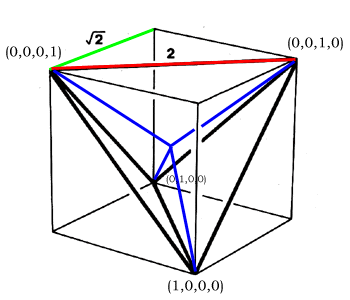
Inscribing a tetrahedron as face diagonals in a cube is an easy way to demonstrate this fact, plus to allow for an inverse tetrahedron (the dual in the "duo-tet cube", Bucky's 3-volume).

I imagine a clear plastic cube of beveled faces, six squares glued, with chains pulling hard against the tetrahedron in the middle, in the XYZ directions.


:: model by Skip ::

Monday, December 16, 2024

More Curriculum Notes

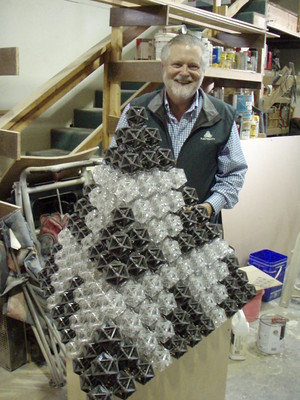
TetraBook in Balls Format
:: photo by DBK ::

We have an army of geeks with M4 Mac Minis this Xmas, extrapolating from YouTubes, and a goodly number of them are running Blender. Some would like to break into Python teaching. I have some recommendations.

If you're a new kid on the block and want a ground floor entrance to an express freight elevator to the top, figuratively speaking, you might want to visit my latest Lesson Plan featuring S3, a number I was promoting to Epistemologists recently, at least to their admins.  S3 = 1.06066...

Polyhedrons may be related to one another versus studied only as individuals. For example, how the cube (3) and its dual (4) both nest, as short and long diagonals respectively, within the twelve diamond faces of the rhombic dodecahedron (6), should not come across as ungraspable mumbo-jumbo known only to esoteric clerics.

whole_number_volumes
V + F == E + 2

We're talking common knowledge on the level of ABCs. The dual of the cube being the octahedron.

However just reading such stuff isn't to get the visualization necessarily and for that we could use Blender. I date myself with my POV-Ray based approach, but the final rendering step isn't as critical as the guts, which is where S3 comes in, in our computations of volume.

Dabbling in Blender
1, 12, 42, 92, 162...

Since Piero della Francesca at least, in the 1400s, we've had a way to derive a tetrahedron's volume from its edges. Other such algorithms, starting from the six edges, have come along since. 

These formulae need to make a come back, as short computer programs, as we present an alternative to the XYZ approach vs-a-vs the tetrahedron's volume in our new paradigm, the one with the unit edge D, the unit volume tetrahedron. 

We may use the "from edges" approach instead, with S3 as a modifier, and/or use Gerald de Jong's method, which had no XYZ version in the first place.

Computer Volume

We have two principal targets after establishing the new volumes table: great circle networks and sphere packing. Of course the two interrelate and of course both have multiplicitous applications within geography, computer games, and crystallography, even psychology.

We spin our cuboctahedron and icosahedron, for example, to net great circle networks of 25 and 31 great circle networks respectively, and we juxtapose them. 

The sphere packing starts with our D-edged tetrahedron itself (D = ball diameter). The CCP, with D-edged tetrahedral and octahedral voids, is our Matrix home base.

How we got here though, was over the S3 bridge, and in Silicon Forest Martian Math, in the context of Sapiens coming to better understand an ET intelligence.

Wikipedia Volumes Table

The Mac Mini army has the compute to bring this literature into the foreground, perhaps in the form of anime. 

Sapiens and ETs meet on some Mesa and learn to collaborate on hydropower projects. The relationship is non-adversarial.

The lesson here is for those succumbing to phobias.

Humans have a track record of working together, and the global grids are what we're working on now, much to the chagrin of the phobia-ridden politicians who can't envision a world they don't control.

The attack on Nord Stream was an expression of the fearful reflex-conditioning of the more robotic lower half of the Bell Curve (less mindful), pampered juveniles groomed to feel entitled to management positions.

TetraBook Toy

Wednesday, March 08, 2017

GeomViews

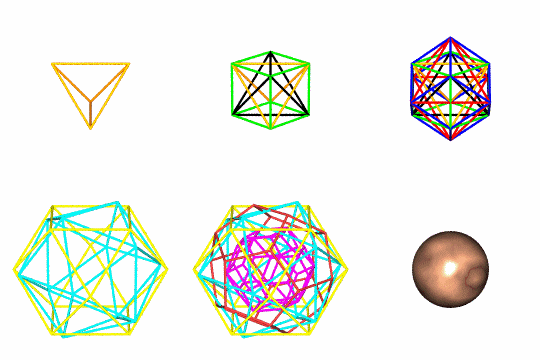
The Platonics have been played with for ages. They're a closed set under the operation of "dualing" i.e. the dual of a Platonic, is a Platonic, the tetrahedron being self dual.

Dual(Tetrahedron) is Tetrahedron
Dual(Octahedron) is Cube
Dual(Icosahedron) is Pentagonal Dodecahedron

The self-dual tetrahedron gives rise to the cube and there, with mutual orthogonality, we get phi entering the picture, as mutually orthogonal rectangles supporting the icosahedron of twenty equilateral surface triangles.

The Borromean Rings may or may not enter the picture at this juncture.


The icosahedron, crossed with it's own dual, yields the rhombic triancontahedron (RT).  Hold that thought. It has thirty "wedges" to the center, thirty diamond faces.

Rhombic Triacontahedron

Turning next to the TetraBook, you'll remember how DB Koski was tilting its page. That's not the only possible TetraBook by the way. A 2x2 square, three of those corner-intersecting, makes our octahedron, half of which could be a book. 

Again, with an isosceles page straight up (angles 45, 45, 90), you have unit volume (1/4 of the octahedron's total). That's unit in IVM tetravolumes (vs XYZ cubic volumes).

The classic TetraBook has equilateral 2x2 triangular book covers, with one page flapping back and forth, same size. Click stopping at volume stops map(√, (9/8, 8/8, 7/8, 6/8, 5/8, 4/8, 3/8, 2/8, 1/8, 0)) may seem a bit quirky, but at √(4/8) volume, he notes a volume of 4 E3, the same as a wedge in the aforementioned RT.

E3 = √2/8 and 4 * E3 = √(4/8), one of the volume click stops along the TetraBook track.

The notation is such that the RT hugging (shrink-wrapping) a unit-radius sphere is made of E-modules, which scaled up by phi are E3 modules, as volume is upped by phi to the 3rd power when the thing is linearly scaled by that amount.

Scaling down by phi is lowercase: e3. We have self-similar E6, e6 etc., going up and down the size spectrum.

Reducing volumes to canonical assorted "sizes of E-module" is one of DB Koski's focal points. He'll do the equivalent with S modules given their simple volumetric relationship:  VE:icosa :: S:E (S:E is the so-called "S factor").

The TetraBook track is important for the last two stops, 8/8 and 9/8. Those are the two unit volumes in the IVM and XYZ coordinate systems.


Wednesday, July 26, 2006

Practicing Multiculturalism

Originally posted to math-teach @ Math Forum. Copied here, and slightly edited, for an illustrated edition.


Background to teachers:

The lesson plan to which I am appending, a guided meditation and/or storyboard for sketching and transcribing to television, derives from a system of mensuration premised on the priority of the tetrahedron as our unit of volume.

The four intertangent CCP balls, mentioned in connection with their rhombic dodecahedral ball casements, define our 2R-edged tetrahedron of unit volume.


Fig. 411.05: Four Spheres Lock as Tetrahedron
(click image for context)

It is vis-a-vis this standard that our above-described XYZ-Coupler is likewise unit volume.

Given geometry has room for more than one model, we're not presuming any lack of familiarity with the orthonormal standard, wherein cubic mensuration reigns supreme (a convention for centuries almost unquestioned).

One convention for going back and forth between cultures is to consider the 2nd-root-of-2 edged cube, what we know as the volume-3 cube in the IVM (and/or concentric hierarchy) and 3rd power that to get its traditional volume i.e. pow(2, 0.5)**3 or 2.8284271247461907 in Python.


Fig. 986.210: Diagonal of Cube as Unity in Synergetic Geometry
(click image for context)

(pow(2,0.5)**3)/3.0 and its reciprocal are now available as conversion constants for going between namespaces. Feel free to use them as globals in your programs.

With younger kids, with no prior indoctrination in the orthonormal system, just holding up the volume-1 tetrahedron and saying its volume is enough to get started.

It's like a mixing bowl or other kitchen measuring device. In this locale (or namespace) this is just how we use it, no proof or "conversion constants" required.

Just let students know: other cooks may use different kitchen implements than we do. This doesn't mean their food is bad, although we may find their methods of preparation somewhat awkward and energy-inefficient (no need to be rude about it, remember your manners).

Thursday, December 17, 2009

Hammering on Synergetics

--- In synergeo@yahoogroups.com, "John Brawley" wrote:

<<>>

> > It's an alliance with XYZ that we're forming,
> > I think that's what you'll find. There's no
> > either/or, and both together is going to
> > take us further than either alone. That's
> > Synergetics for ya!
>
> That'd be the best of all worlds. Good luck to ya'.
> Be sure to hide your roaches.
>

OK, funny response.

Let's make this easier and just work with a triangle.

Here's an equilateral triangle, call it empty.

A turtle at the lower left corner is going to climb along an edge, up towards the apex, call it climbing the mountain.

As the turtle moves up the mountain, a ray from said turtle to the opposite base vertex is drawn. The slope of this ray increases as the turtle climbs to the apex.

The area under the sloping ray is colored red.

Question: is the linear motion of the turtle paired with an areal change that reflects the phenomenon A x B? Answer: Yes.

By that I mean: the conventional picture of a line going across a square, showing a larger and larger rectangle (becoming a square), matches a sweeping motion causing the angle between two rays to widen, as the gap between their tips grows to complete an equiangular triangle. Either model is adequate for showing A x B, but the triangle does so with fewer edges.

Consider said equilateral triangle to be 100 x 100. If you crosshatch with 3 sets of parallel lines (multiplication by division), you get the right number of little triangles (10000).

As the turtle climbs the mountain, the right number of little triangles turn red (picture pixels). Maybe increase the resolution? Make it all smooth.

So this is a picture of T x B, where T is Turtle position up the mountain and B is Base. Say B = 100. Then if T is 43, we're saying the red triangle of 43 x 100 has just the right area, in triangular units. Could we vary B as well as T? Sure.

This whole thought experiment works again with the tetrahedron, add another turtle, so the important thing to realize is we have a model of A x B x C. They (the three edges) don't have to be the same length. The answers come out the same. The numbers don't change. It's the visualization that changes, leaving the numbers alone.

This is a freedom we choose to exercise without breaking any rules. The use of a square and cube is by convention. Triangles and tetrahedra have a lot going for 'em. "Teach the controversy"(threw that in just to irk ya). Once you're acculturated, then you have all these other whole number volumes to be excited about, as you visit our core sculpture (middle of the castle atrium, right this way folks, watch your step and watch out for treacherous qyoobists, insecure about others visiting here).

The idea of a conversion constant is somewhat by convention. One makes choices. Bucky is saying to the cube guy: what you call 2, I call 1. There's this unity-2 thing going on, where he deliberately does that. Your two radii are my 1 diameter, so my 1 x 1 x 1 = 1 model is a regular tetrahedron, but from your point of view, given these are radii, 2 long, it's like 2 x 2 x 2, except that you, being a Cartesian, fixate on three cube orthogonals and inter-multiply those, so sqrt(2) x sqrt(2) x sqrt(2) where we're seeing 3. His way of doing this gives us a modestly close-to-one constant. I'm not saying one couldn't conceive of it differently. There's a utilitarian aspect to his design.

[ Now you come along and choose a camp, but don't like the pronouns. "You sir, say I should want two, but I want a one, Coke better than Pepsi". So you're not playing a straight Cartesian the way Bucky would. What can we do about it? Nothing. What should we do about it? Just let the cameras roll. ]

Anyway, my point is squares and cubes really aren't as economical, when it comes to modeling A x B and A x B x C. Our civilization could have taken a different turn, and it's not too late to imagine the ETs enjoying this other way of thinking, even if we find it alien.

You can always think of A x B x C as red water in the regular tetrahedron, partially filling it (A, B and C are up to and including the entire edge of what begins as an empty "cup"). As you tilt the thing, the water line changes. The total volume stays the same. If you point it straight down, the water level will be even along all three edges so read off the 3rd root of your original product A x B x C. Like if you had 3 x 2 x 5 for 30 inside a 1000 volume total (10 every edge), and tilt it, you could have 3rd root of 30 at the bottom of your cup, a little more than 3 (a tick mark on 3 edges radiating from a common apex).

Why say "cube root" in the caption? All our angles are 60 degrees (Cheese Tetrahedron scenario).

1 x 3 x 10 would be another way to tilt it, different read-outs (1 x 3 footprint, fourth point at the apex -- same volume still).

Think of Synergetics as a standalone ride at the amusement park. It's from Mars, from the future, and there's no way you could live on it 24/7, especially if you're an old fart or boomer. You ride it, are amazed, and go back to what you were doing. Such is Synergetics, a place to visit. Now, some people, such as myself, have spent more time in that arena. But I'm not denying myself access to all the math I knew before, am still learning, will learn. I'm not steam rolling myself. I like my conventional math as much as the next guy, am a product of my century (the last one).

Synergetics is like hot sauce. Use sparingly. But use it, as it definitely has some of the right stuff. We could use a lot more of it in this day and age. We'll tell kids it's a different sandcastle. We'll show how internally consistent it is, give 'em a whirl wind tour. That's what the gypsies will do, or the Martians or whatever. Call it "being abducted" if you like, but it's not that melodramatic. You go back to whatever you were doing, but find yourself somehow thinking more like a Martian. Call it brainwashing, or call it getting your money's worth.

I always feel smarter in Windows (XYZ) when I work in Linux for awhile, like working out at the gym (IVM). Martian Math might contain our usual XYZ vectors, trig, some Coxeter type polytopes. We could talk about some different meanings of 4D. Philosophy for Children is not a bad idea. We have namespaces, even in math. It's not monolithic. We have different ethnicities. In this case, we're forming an alliance, between IVM and XYZ mathematicians, so that both will come out stronger, have more clout in the classroom, thanks to a more relevant curriculum.

Kirby

PS: thinking back
http://en.wikipedia.org/wiki/Caltrop

Saturday, January 27, 2018

More Thinking about AI


I've done something to my FireFox, to where the Twitter stuff doesn't come through all fancily formatted, like in the post below. Or maybe your browser doesn't render it either. I'm still seeing the tweet content at least.  Even that might go away, right?

The hope is our committed records will have some permanence but that's all presuming it makes sense to keep all the server farms running.  A sense of heritage might fuel that, but will that be sufficient?  They say server farms are already eating 2% of the grid's energy.  Good thing President Trump is committing through Twitter, for Twitter.  Historians will want to keep that set of records.

Not that Trump is the only tweeter the curators treasure, just he paves the way for Federal funding or something similar to keep universities training up new breeds of engineer, ready to tackle the challenge of keeping history plugged in.

There's a technical challenge in not overwhelming ourselves with more information than we're prepared to handle, even power-wise.

Going back to recent themes...

The invocation of Kant in connection with Abbott:  was the latter breaking any rules in conceiving of beasts of fewer dimension?  We suppose that three dimensions "encompass" two, one, zero and none.

That volume goes up as a 3rd power seems ipso facto the key argument for dim 3 terminology, whereas 3rd powering as a rate of growth (or shrinkage) gets shoved on to Frequency in Synergetics, which is about subdividing.  We have 3rd powering against a backdrop of a Fourness in pure shape, all change rates aside.  That was the 4D.  The F took the 3rd powering.
These shifts in meaning mostly serve a practical objective of making it OK for a cube of face diagonals 2, to have a volume of 3.  That works out when the shape of 3rd powering is either of the duo-tet's tetrahedrons.  With the cube-based model of 3rd powering, you have an edge of pow(2, 1/2) and therefore a cube of volume 2.828427..., not 3.  From this ratio comes S3.

I watched the video below today, as well as the one above. The below one is about brain power and what the chemistry might be, whereas the one above is about electronic circuits learning from feedback to ape, match or exceed human abilities.  AlphaGo.

Lets hope Google stays in business and our blogs live on.  Ditto Facebook and all that.  Scientific literacy means having the ability to grapple with issues while maintaining a cool head and a solutions focused mindset, even in the face of problems that seem insoluble.

A tetrahedron inscribed in any parallelepiped, any hexahedron with oppositely parallel faces, is going to have one third said hexa's volume.  In the case of the cube, the inscribed regular tetrahedron is complemented by four regions comprising the remaining 2/3rds i.e. 1/4 of 2/3 or 2/12 = 1/6.

The regular octahedron that complements the regular tetrahedron to fill space, has volume ratio 4:1, meaning the 1/8th octahedron corners that pack out from the reg-tet, each have volume 1/2. Four corners have volume 2, adding reg-tet gives 3, the cube's overall volume.  One half is one sixth of three.

These simple fractions work best when we give ourselves permission to have such a cube of volume 3, yet with edges that would normally not give that.  The shift is in making 3rd powering a Frequency operation inside an initially "4D" framework, the reg-tet itself, Unit Volume, edges 2R.

Once the logical path is established, go ahead and throw away the ladder and go back to "space is 3D" with an XYZ orientation.  When in Rome.  You've got your touch stones, a way to your favorite garden, but go ahead and surround it with a more conventional brick and mortar wall.

Rather than fight tooth and nail for anything, we're motivated to continue our investigation. When did we come up with height, width and breadth as the names of three dimensions and to what extent do each of these partake of self nature?  A somewhat esoteric question perhaps.

The neural nets that program neural nets get credit for refining their art.  I'm talking about the humans, however quantum minded.  They needed a way to make trial and error count for something. Figure out a feedback loop that continues to fine tune in the face of consistent feedback regarding performance.  As long as the game holds still for awhile...  fortunately chess and Go do.

The sense that AI is "winning" is an over-collapse of an either-or logic, whereas the cell-silicon hybrid is on both sides of the fence.  We encounter our ancestors in the codes they embedded, as silicon learns to echo our sense of music, even logic.  Mutual recognition. A mix meets a mix.

We want to think what we consider thinking has held constant, with maybe machines catching up, but that's not it.  Machines have already changed what we consider thinking.  We needed that word ("thinking") to stay up to date, and so we've somewhat lost our sense of what it meant -- through the ages. Not a constant. What was thinking before electronics closed so many gaps? What was thinking before reading?

Wandering back around...

Keeping a large lawn watered is a chore, but humans have undertaken such duties long term and considered them a privilege to perform.  I'm thinking about servers again, and the spinning water wheels, the hydro-dams. When humans insist on sticking their nose in one another's business, is when many problems arise.  Yet closeness is a fact of life.

Sometimes we're not prying into others' business so much as shielding ourselves from becoming inundated in too many details about affairs we can do nothing about.  The marriage of focus and attention with what's necessary work would need to have divine grace behind it, or some other extra human principle, as we have no idea how to go about consciously designing a reality to work that way.

Probably there's a sense of keeping a safe distance from what might get ugly, that pervades many disciplines.  Altercations you don't want to have to witness tend to drive behavior.  The train wrecks may never happen, and perhaps our avoidance maneuvers were actually constructive?

Sunday, April 11, 2021

The Algorithm

compute a tetrahedron's tetravolume given its six edge lengths

I'm pretty sure the first time I saw Gerald's algorithm it was already expressed in source code, Java no doubt. I've also implemented it in Clojure just for fun and suggest on my Youtube channel that students use whatever language currently interests them, i.e. use it as a Rosetta Stone entry.

The constant e.g. 288 or 144 (a 2nd root thereof) was already absent from Gerald's version, and returning in tetravolumes was already the goal. I don't claim that wrinkle came in with the Python.

Given Python's "duck typing" it's easy enough to use the same source code to use arbitrary precision inputs (way beyond floating points in precision) and to use such as the plane nets for A, B, T, E, S modules in Synergetics to get these volumes and to interconvert their expression with Koski's versions, involving Phi (Fuller avoided using both Phi and Pi in his invented language of Synergetics, whereas adding Phi back in simplifies a lot of the dimensions).

I've also been frequenting a certain Wayne Roberts Principles of Nature website wherein he proves how the area of what he calls a "eutrigon" (one or three angles set to 60 degrees) is A x B where A, B are the lengths including the 60 degree angle, and C is the opposite edge connecting A to B. Multiplication is a matter of specifying the two sides and "closing the lid" (adding C). Lengths 4, 3 would give area of 12 etc.

area in ETUs

Using the same volume formula and treating the unit tetrahedron as analogous to Wayne's "ETU" (equilateral triangular unit), I show the model is entirely analogous i.e. lengths A, B, C from a common corner (picture XYZ corner as analog) give A x B x C as the corresponding volume, once again with a "closing the lid" operation, this time on a tetrahedron vs. a triangle.

2 x 2 x 5 = 20

Given the fixed angle of the ABC corner (that of a regular tet), the remaining three lengths are already determined and easy to obtain, for the purpose of feeding into the 6-edge-eating formula above.

I personally don't need a whole worked out math textbook with proofs + index in order to encourage developing coding skills while imagining a reference "sculpture" namely the concentric hierarchy from Synergetics. Your typical arts and design academy, where fluency with computers is baked into the curriculum, would have reasons to include this segment.

concentric hierarchy

Saturday, November 12, 2016

Planning Ahead

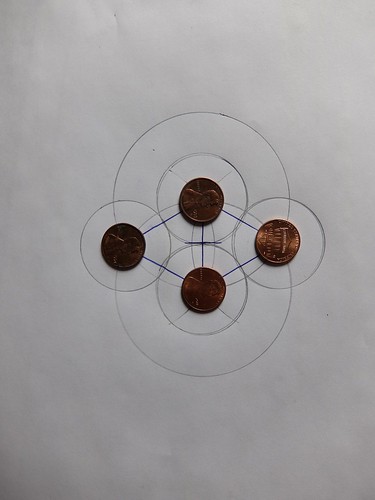
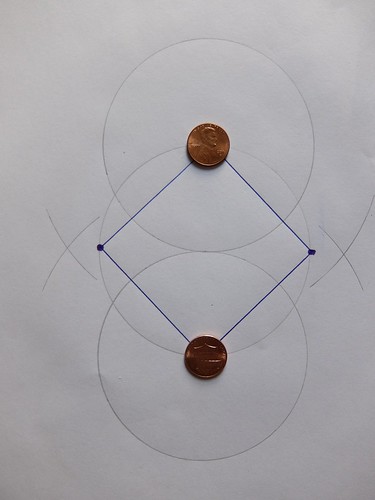
Vesica Pices Begets Four Pennies
Figure 1: central diamond (not square): 
short diagonal (vertical) = 2; long diagonal = 2√3


Square Diagonal = 2R; Edge = sqrt(2)/2
Figure 2: central diamond (a square): 
both diagonals 2; edges √2


A cube built from six of the squares in Figure 2 would conventionally have a volume of √2 to the third power, as 3rd powering means "cubing" in "Earthling Math".

The inscribed tetrahedron made from six of the cube's face diagonals has an Earthling volume of (√2√2√2)/3, as tetrahedrons in general have 1/3rd the volume of the parallelepiped in which they inscribe, as true for the golden cuboid as the cube.

We've forked our depiction of 3rd powering and developed the "Martian Math" apparatus, a tetrahedron, for this same purpose, setting our canonical cube of face diagonals 2R (R = unit sphere radius) or 1D at volume 3, not at √2√2√2, leading to a conversion constant known as S3 or √(9/8).

XYZ.volume * S3 = IVM.volume

"Martian Math" is a rebranding of certain aspects of "4D" geometry published as Synergetics in the 1970s (Macmillan) by RBF (R. Buckminster Fuller) and EJA (Ed Applewhite). The same core concentric hierarchy obtains, with a new rhombic triacontahedron added of 7.5 tetravolumes. This RT shares some of its vertexes with the rhombic dodecahedron of 6 tetravolumes.

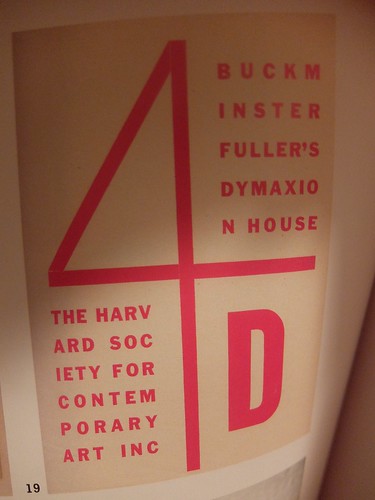
The "4D" doesn't refer either to a "tesseract" (i.e. hypercube) nor to "3D + Time" but was rather a commercial logo used by Buckminster Fuller, along with "Dymaxion".  The "4" in "4D" drew attention to the tetrahedron's starring role.


4D as a Brand

Saturday, January 11, 2025

Surely You're Joking Mr. Fuller

Two Ways of Looking

In culty backwaters, or call it a swamp, where the sausage gets made, we have our little niche controversies. 

Perhaps goaded by Braingate, the controversy swirling around the two elderly gangsta presidents (were their faculties still intact? Not really, at least in Biden's case), and the subsequent coverup, some latecomers to our party have decided to retell the story around Bucky. 

According to them, our guy was too Alzheimery by the 1970s to really know what he meant in Synergetics, which means the rest of us have been engaged in a coverup, trying to make Synergetics seem more coherent than it really is.

This new "Bucky was senile" faction wants to purge S3 (an important constant) from the future curriculum, to spare people the need to understand what it's all about. 

They say because Bucky was close to senile by the time those two volumes were published, he was able to confuse himself about this nonsensical number (~1.06066... or 2nd root of 9/8).

But was he really that confused? We're talking about two conceptions of unit volume and comparing them. Both the cube and the tetrahedron will need to be sized, when the other is unit. We'll need a conversion constant in other words, like a currency conversion constant, between Tetrahedron Dollars and Cube Dollars.

If a tetrahedron's six edges are all twice that of a cube, then that difference in volume, one of proportion between them, is S3. The difference is only about 6%.

I think what makes readers doubt the sense of Synergetics is that what it does to the cube seems too drastic: a cube of edges 1 no longer has a whole number volume of 1, but of 1.06066...

That can't seem right to anyone already brainwashed to think "right angles rule" and "cube is king", the predominant orthodoxy. 

Surely you're joking Mr. Fuller!

Monday, October 07, 2013

Multiplication

5 x 6 = 30

:: 5 x 6 = 30 ::

This is not such a hard way to multiply.

So what that we do it against a backdrop of triangles instead of squares?

Triangles are simpler and we're allowing for all edges the same length, same as squares, so that's no advantage on the square's side. 

Take your two lengths, A and B, and just connect a line across, and you're done.  That's your area, in equilateral triangular units.

An interesting feature of pouring fluids into such containers is you may tilt it to have the water level connect A and B.

 When filling a tetrahedron, your corners A, B and C may be independently reached as well.

So if the goal is to measure out a number that's factorable, into two or three terms, you've got a way of tilting to get that:  get the fluid to hit all the factors in the flask, as calibrated along the edges.

Think of it as a kind of beaker, amidst other lab equipment. Tilt the tetrahedron to 4 x 5 x 3 for 60 tetrahedron's worth of liquid.  Scale those unit tetrahedrons to be milliliters if you like, no one's stopping you.

DSCN4605

Monday, March 05, 2007

Synergetics Dictionary

The four volume Synergetics Dictionary: The Mind of Buckminster Fuller, created by E.J. Applewhite, is an inventory of Fuller's precise usage patterns around sometimes familiar words (but here with a new spin).

Fuller attached a lot of importance to clear communication, saying he'd rather be not understood than misunderstood.

Depicted above is the beginning of a multi-panel foldout at the beginning of the first volume (A-E).
Here Fuller is noting that the number of ways n random experiences completely interconnect is the triangular number (n+1)*n/2 or 0, 1, 3, 6, 10, 15..., which triangles may be stacked into a growing tetrahedron of experiences -- a primitive model of Universe in Synergetics.
"I am not a creator, I am a swimmer, a dismisser of irrelevances" J. Baldwin quotes from the dictionary, in his blurb for the Whole Earth Review (Summer, 1987).

Applewhite uses this motif, of six relationships among four experiences, as a graph (the "linear tetrahedron"), and explicitly as a tetrahedron, as a colophon to the dictionary (Garland Publishing, New York and London, 1986).

This fold-out illustration by Fuller (Sept 11, 1963) is double sided, so what's shown above is only the 2nd half of it.
My copy was a gift from Ed himself, retrieved from the attic of his Georgetown apartment that time Matt and I visited, enroute from Montclair, NJ to Whittier, CA, driving my sister's car (she'd moved across country). This treasure made it home safely and I've consulted it ever since.

Thursday, July 08, 2021

Canonical Lesson Plan

Sometimes I get a request for a canonical lesson plan, one that will capture the flavor and style of Synergetics, by which they mean the Bucky stuff.

What I'm coming to on that score is the four random walkers starting from the same lamp post in the CCP (=IVM), and wandering for t time cycles.  

The four randomly arrived at balls define the corners of a tetrahedron which, upon having its six edge lengths get run through our volume computer, will turn out to always have a whole number volume.  In tetravolumes, that is. Four CCP balls define our D-for-diameter-edged tetrahedron of volume one.

In order to calculate the random walks, we use Quadrays as syntactic sugar.  The IVM ball packing is their sweet spot, which is why they're "IVM coordinates" by some accounts (including mine), in contrast to XYZ.

In order to calculate the sixth edge lengths, we simply perform vector subtraction between adjacent corners. Quadrays have essentially the same vector algebra as XYZ when it comes to adding, subtracting, and scaling.

Finally, in order to calculate the tetrahedron's volume, we use Gerald de Jong's formula, even though he has lost his derivation.  There's no denying it works well.  

Six edge lengths go in, fanning out from any apex and circuiting the opposite base, and the tetravolume comes out, natively, with no need for a modifying constant.  

The corresponding XYZ volume is computed accordingly, as IVM volume times 1/S3 (S3 being the Synergetics Constant for converting volumes).

In sum, we needed to learn what the IVM was, and to visualize movement within it as a process of hopping in one of twelve directions, by distance D, at each turn to play.  Then we needed to absorb the concept of tetravolumes.  

Getting whole number tetravolumes for the tetrahedra helps shock us into a mindset that might be open to the concentric hierarchy, wherein those rhombic dodecahedral cells around each sphere, each have a volume of six.

All of the above, along with figurate and polyhedral numbers more generally, including kissing point counts, form our IVM-XYZ bridge over troubled waters, the C.P. Snow chasm.

Tuesday, February 09, 2010

Disconnecting the Dots

I believe I have found the one lesson plan, in all the math-related lesson plans officially blessed by the National Council of Teachers of Mathematics (NCTM), which introduces measuring volume with a unit tetrahedron.

The author of this lesson plan is following a template, considered illustrative of best practices, so my remarks below should not be construed as a critique of one writer. Rather, I am pointing out what I think is broken about math teaching: it is deliberately bereft of an historical dimension, is divorced from any storytelling, any lore. As such, the math is missing a Z axis, a depth dimension. The math is flat (as in beer).

There's a stated goal of studying the relationship between edges, surface area and volume, when the angles remain constant (when the shapes grow and shrink while remaining self similar).

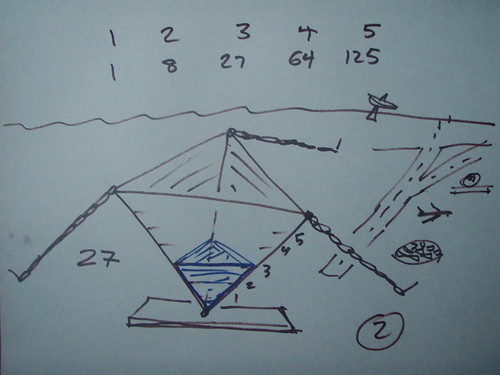
A tetrahedron is constructed, then doubled in length along each edge through a process of stacking four of them corner-to-corner, leaving the octahedral void of the octet truss at the center. Welcome to the CCP (IVM, FCC).

This octahedral void is then made into a shape (not illustrated) and dissected into pieces according to the sequence below, to show that its volume is 4x that of any of the original tetrahedra.


from Synergetics Folio

The volume 8, 2-frequency tetrahedron assembled from 1 + 1 + 1 + 1 + 4 is called a Kite for some reason, perhaps because kite string is used (or crotchet thread). Those familiar with the lore know that Alexander Graham Bell created kites of this nature, but his name is not mentioned. The teacher may know. The storytelling is left to the teacher.

So now you have some story. Discover more. Encourage your students to do likewise. Lots to learn. And the math topics will keep weaving in.

Once you learn about hexadecimals and Unicode, you will be ready to think about bracelets, like you might receive upon check in to a Club Med resort. Do these show your name in your native Chinese or Thai, or do they just show bar codes or what? Likewise in hospital work: how much of your own language will you get to see on the monitors? Unicode helps, but the mathematics is complicated, lots of trade offs to consider (like why retire perfectly good equipment even if the newer stuff has more bells and whistles?).

LW was on KBOO (FM radio) tonight briefly, abiding by all the rules (Portland's left is highly professional). I was getting my shoes on for PPUG when she came on. Then I decided I needed to blog about this lesson plan, and how difficult it is for storytellers to make up for all the missing storytelling.

Having more literate well-read mathematics-aware students and teachers is always a godsend. That's why we form schools, user groups, collectives, clubs. We look for good company.

Anyway, not to pick on the NCTM too much, but I do find it ironic that they're building their old logo here, the one their lawyers told them to back away from. There's a story there too.

Just call me old skool.

Tuesday, December 20, 2011

Jitterbug Party

Syngeom Pow Wow
:: jitterbug party, 2011 ::

One can't but help feel one's cult or club member like status in a room full of people who speak the shop talk of Synergetics to some degree.  The lineage is still somewhat obscure and esoteric.

There's a crystallographic flavor, which brings in the more classically trained chemists such as Steve Mastin.

We had some bona fide Silicon Foresters in our midst (at least two folks from Intel).

Our guest of honor was James Nystrom, a computer geek and professor, with lots of overlapping interests in physics and so on.  John Driscoll picked up on a lot of the jargon from his Systems angle.

The event was orchestrated by Sam Lanahan, with Wardwell and myself assisting with the guest list.  Having Trevor Blake, Glenn Stockton and Nick Consoletti in the maxi taxi was a privilege.  Good seeing LaJean again, as well as meeting these new people.

Interesting to me was how the night before we'd been looking at a picture of a younger Alex, accepting the Nobel Prize on behalf of his mom, and now tonight John was boasting (in a self-humbling not too self-serious way) about delivering a talk on the physics of consciousness from that very same famous podium / stage.  A nice segue between consecutive dinner parties, both of the highest caliber.  The projected synergy is already kicking in it seems.

What I found gratifying is that a gent was applying differential and integral calculus to a cuboctahedron and coming up with some interesting properties, and was also playing cellular automaton games with the tetrahedron, random walking it, per a rule set, within the IVM.

He wants to tackle A & B modules maybe.  He gets some of his graphics from Bob Gray.

The back story here is Sam and his 10-frequency flextegrity tetrahedron made their debut at the Rhode Island School of Design for the annual SNEC-organized Synergetics shindig, where he met this fellow Nystrom (Pearce was there too).

The fact that Dr. Nystrom talked Jitterbug and IVM and knew differential calculus made him the ideal resource to pair up with Mark Martin, who has been sweating the details of a Flextegrity computer model based in differential equations for springs.

Nystrom is one of those who takes seriously Fuller's pulsating vector field concepts, as articulated by the Jitterbug sending ripple effects through the IVM.  There's a Negative Universe aspect.

Since he asked, whether we thought "IVM" or "octet-truss" would be best, I argued for IVM in the more theoretical context, as it makes a better dramatic foil for XYZ (also three letters).  "Octet truss" refers to the more times-size realized versions, the less abstract.  Bell's kites come to mind immediately, for many of us.

Saving the best for last in some ways:  Nystrom mentioned using quadrays in one of his academic papers.  I'd not heard of anyone doing that besides me in FoxPro Advisor, March 1999 (more an industry trade mag than an academic journal for sure).  Wow.  If there's a citation to track down here, I should do so.

Trevor and I played at the dinner table with BuckyBalls that he'd brought (the magnetic balls, so simple).  Even though they're polarized, they'll come together in a tetrahedron.

Holiday shopping... must do some.  But work has me pinned to the laptop.  Boat ride with Barry coming up.  Wish Tara could go but she'd probably be the only girl.  Nirel has the same consideration.  Sam suggested I invite Dondi to his event but I don't know her well enough, speaking of woman Wanderers I admire.  Maybe Trish and her son will join us on the boat.

Sunday, March 26, 2017

Student Reading


At the university level, we might introduce tetravolumes in a philosophy of mathematics class, as a good example of how different language games suggest different axioms.

Imagine a tribe in which multiplication were presented differently. That's hard to "imagine" without some concrete example. This Tropical Math YT is the precursor to using three poles, say X, Y and Z. but no longer mutually perpendicular.

Non-Euclidean geometries have already legitimized branching away from Mother Goose Math into alternative territory. This might also be an Art History class where we look at Non-Euclidean geometry in Modern Art.

Remember, the meaning of '4D' depends on the namespace:
  • 4D as Time: time machine physics ala Einstein / Minkowski
  • 4D as Spatial in nD Euclidean Geometry: polytope math ala H.S.M. Coxeter
  • 4D as primitively Four Directional (tetrahedron = 4 arrow heads) in pre-Frequency a priori res extensa (American Transcendentalist with Lakota influence) 
On a plane (plain), we divide the unit circle into four quadrants with reference to the four compass directions.

In zero-G space (an ideal conceptualization) we have four directions of the tetrahedron and the four quadrants of space, per IVM "caltrop" coordinate system (so "4D" in the Lakota medicine wheel sense).

For hexahedronists, it's the three-also-six directions of the cube that make the six-spoked XYZ "jack" (so in the XYZ namespace we say space is "3D").

Storing Liquid

Monday, June 13, 2016

Where's the Origin?


Students using Quadray Coordinates to better grasp XYZ (comparing and contrasting is an old technique), may wonder where best to locate (0,0,0,0) relative to an IVM ball packing.

Given we're planning to use the 12 combinations of {2, 1, 1, 0} as the centers of IVM spheres, 12 around the nuclear ball at (0, 0, 0, 0), we know we want the origin in a ball center.  If that's the case, how do we orient the four basis vectors (each one free to grow and shrink independently of the others, with these four sufficient to span our vector space or "room" through addition)?

Remember how the rhombic dodecahedron (volume 6) shrink-wraps every ball (voronoi cell concept)?  Its corners occur smack in the voids between spheres, where IVM ball centers are not.  We find two types of void however, and not in equal number.

The rhombic dodecahedron is a combination of two Platonics, duals of one another, the cube and octahedron.  The octahedron termini define a complementary IVM i.e. balls inflated in these voids will grow to another IVM should the current balls shrink correspondingly to give them room.  The cube termini reduce to two cases:  two tetrahedrons.  Each of these is likewise an IVM waiting to happen, for a total of Four IVMs, a main focus of Russell Chu's visualizations.

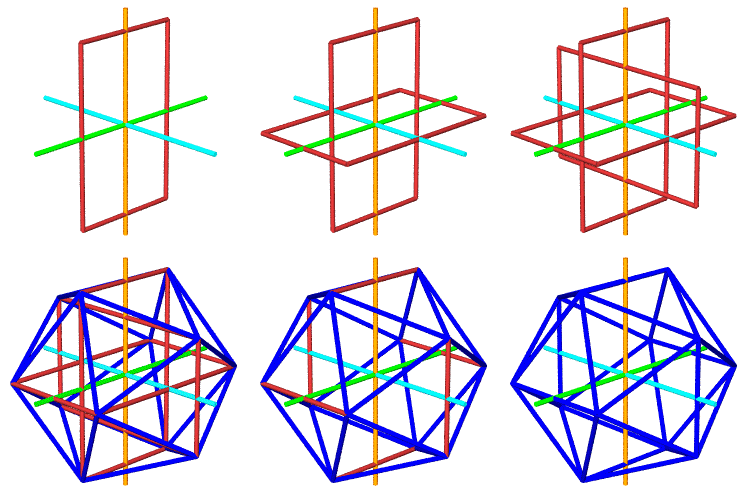
The rhombic dodecahedron's long diagonals define the octahedron of the paired IVM, while the short diagonals define the cube connecting the two remaining alternative IVMs.

Remember the negative basis rays of any Quadray Tetrahedron are its dual complement, at the center of our cube, and therefore our rhombic dodecahedron which embraces an IVM ball.  That's how to picture your origin then.  Imagine two Quadray Tetrahedrons making the Stella Octangula with its tips reaching to the voids of alternate IVMs.  The octahedral voids are further away, at the dual octahedron's tips, at six locations (that's six in addition to this four-and-four of the Quadray star, for the 14 corners of the rhombic dodecahedron, dual of the cuboctahedron).

Now linear combinations of {2, 1, 1, 0} i.e. vector additions of however many such vectors, grabbing any of the 12 at random, with as many iterations as we like, keeps us to the IVM ball centers of a single IVM.  What's maybe strange here is the length of those basis vectors, which use for unit some length we mostly don't need as such.  R=1 or R=0.5 vis-a-vis the IVM balls will suit our needs more often.  The basis vectors simply delimit the four quadrants of the home base tetrahedron, each rated at one fourth of unit volume.

Tuesday, February 26, 2008

Quaker Geometry

[ quirky: making XYZ vs. Quadrays seem like a bone of contention among religious denominations, a different angle for sure! -- KTU ]

So most Anglicans, if pressed for how many directions in space, will think back to schooling and some chatter about three dimensional. "If by directions you mean dimensions, then space has three" the proud Anglo might say.

The graphic behind this is the six-sided die or hexahedron aka "qyoob."

Alternatively, take three BBQ skewers and intersect them in a mutually perpendicular arrangement, binding at mid-points with leather thong or whatever. Stabilizing the tips with fishing line might be good, in which case you'll get an octahedron of sorts.

In Quakerdom, some of us learn from Lakota about the four directions, typically designed for planar applications (the Lakota being a plains people), but with a corresponding four sided, four tipped arrowhead, or tetrahedron in Greek.

To morph the four-square into an arrowhead-tetrahedron, skew it and crease along the short diagonal, then fold the tips to within unit-edge distance (Richard Hawkins and I implemented this transformation in ClockTet awhile back).

You can see why the "4 directions of space" answer might be appealing: a minimal four vectors splay outward from a common origin, dividing space into four identical quadrants. The Anglican cubists introduce three more negative vectors starting with their positive three, creating an 8-fold partition for their so-called Cartesian coordinate system.

Using quadray coordinates, or Chakovians, as they're sometimes called, we address all the same points with only positives along each arm, starting from (0,0,0,0) at the origin, thereby saving the negatives for some inside-out dual or mirror space.

Of course nothing prevents us from inter-converting 3D XYZ coordinates with their 4D IVM counterparts, nor are Quakers raised without the usual XYZ savvy. These language games are not mutually exclusive obviously. Like, the calculus cookie doesn't now suddenly crumble, any more than it already did.

Anyway, we teach multiple meanings of 4D in some of our schools, gleaning from such excellent books as The Fourth Dimension and Non-Euclidean Geometry in Modern Art by Linda Dalrymple Henderson (ISBN 0691101426).

Like Coxeter's adding a fourth axis, turning a cube into a tesseract, was not the same move as Einstein's when adding a fourth "time dimension" (see Regular Polytopes page 119). Our Quaker 4D, inherited from American Transcendentalism and medicine wheel shamanism, is a move by yet different rules again. That's why Anglos call it "maths" (plural form), because of all this diversity lurking just beneath the surface.

Friday, June 18, 2010

Synergeo 60786 re: Martian Math

"all math is ethno-math"

One of the bright ideas Dick came up with recently (seriously folks!) was the idea of Martians making a delivery, of a tetrahedral yard of concrete. Just making it a yard was in itself brilliant, as that term contains "thirding" as a concept, which'll get us to 2-frequency (where concrete is born! (joke)).

So what are Earthlings to do, to get ready for the delivery? Make a mold for the receptacle, using root2(2) on every edge (of a cube). Carve out that internal tetrahedron, like in a dug-out canoe, and have the Martians fill that up. That'll be your yard of concrete. That's about 1.414 yards to each edge.

Those who didn't "get" Synergetics don't understand the Martian instructions and build a "cube root of 3" cube instead, with edges about 1.44 yards. That cube is too big and they're wasting materials. From a Martian perspective, these people have a mental disability. In the Martian equivalent of the DSM, there's an entry XYZ (let's call it) that gives a more spelled out version of the diagnosis / prognosis.

Now some sticklers might come along and say our cube is two half-yards on a diagonal, and since 2*2*2 = 8, this must be a 2-frequency cube. If the tetrahedron is 8, the cube itself must be 24. At this point, you get an argument between the two Earthling camps: should the edges be 2*root2(2) or 2*root3(3)?

There's another sect in this picture, with yet another interpretation of the Martians' instructions. What do they think? We might have to wait until a next episode to discover that.

Kirby

Wednesday, March 10, 2010

Radical Math Planning

a 10-frequency flextegrity tetrahedron

Fortunately for our latest media campaign, "radical" has a conservative, established meaning in mathematics. The radical sign designates the nth root of a number, by default its second.

Our zip code area, 97214, is cram packed with talent. The TV series would be fantastic, but off beat, more underground comic than Hollywood blockbuster. The birthplace of the Silicon Forest has its attractions. Hawthorne Boulevard used to be named Asylum Avenue according to the tableau at Fred Meyers.

Glenn Stockton has assembled the simple ways to come up with the key edge lengths you'll need, using just a compass on paper, to construct such as the unit-edge cube with body and face diagonals, of radical(3) and radical(2) respectively. The unit-edge tetrahedron slips right in, a smooth segue to our Concentric Hierarchy, core to our curriculum in 97214.

Tuesday, February 06, 2024

Slinging Jargon

Screen Shot 2024-02-06 at 9.28.31 AM
RBF, Synergetics, Fig. 988.00 Polyhedral Evolution: 
S Quanta Module: 
Comparisons of skew polyhedra

I get flak sometimes for being such a Platonist, meaning what exactly? I'm OK with contemplating pure patterns of no obvious significance in terms of paying bills or putting food on the table. I'm simply pleased they exist. This is one way I pursue (and sometimes attain) a level of happiness.

For example, I'm assured by reasonable math-oriented folks that it's perfectly meaningless that the following ratios hold true:

  • S Factor: S : E :: CO(D) : Icosa(D)
  • S3: SuperRT : CO(D) :: Cube(R) : Tetra(D)
First: what does it all mean? and second: who cares?

S and E are two of the Synergetics BEAST modules, irregular tetrahedrons defined in terms of the concentric hierarchy (CH). 

The CH is the geometric centerpiece of Synergetics, R. Buckminster Fuller's transcendentalist geometry (i.e. philosophy).

The S modules, 12 left and 12 right handed, brick in the difference twixt an Icosahedron of edges S Factor (about 1.08), and its faces-flush nest, an Octahedron of edges D (2R) and volume 4. 

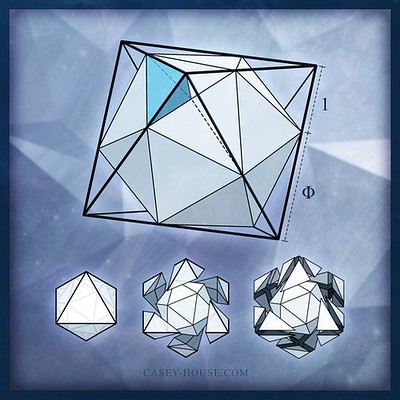
Here's a poster showing an S mod from Syn-U by Casey House:

S Mods by Casey House

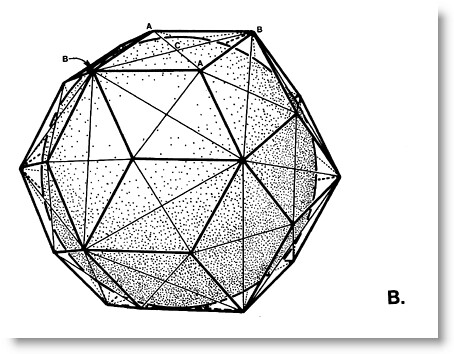
The phi cut is along an edge of 2R (D). The IcosaWithin -- as David Koski and I call it -- with eight faces flush to those of the Octahedron, has edges S Factor, and a volume of about 2.92. 

$$S Factor = 2\sqrt{7 - 3\sqrt{5}}$$ (using MathJax)

All volumes are in tetravolumes i.e. the volume of the D-edged tetrahedron is our unit.

D is for diameter, R is for radius (1/2 the diameter). Icosa(D) is an icosahedron with edges D or 2R. Its volume is about 18.51.

Screen Shot 2024-02-06 at 8.27.30 AM

Cube(R)/Tetra(D) is known as S3, or "Synergetics Constant", and it relates the respective unit volumes within the XYZ and IVM contexts (namespaces) respectively. In the XYZ context, we take the R-edged cube for a unit, whereas in the IVM context, a corresponding unit of volume is a D-edged tetrahedron, a little less. S3 is about 1.06066.

The SuperRT is a Rhombic Triacontahedron, a triac, with long face diagonals equal to the edges of Icosa(D). Its short diagonals form a pentagonal dodecahedron (PD). The two combined give the SuperRT, which is phi-up from the RT of 120 E modules. S:E is our S Factor.

The SuperRT : CO(D) ratio is the same as the Cube(R) : Tetra(D) ratio.

Who cares? Those of us wanting to get our heads around the Concentric Hierarchy, the centerpiece of (backbone of) Synergetics.


See: Polyhedron Play section of this Jupyter Notebook Polyhedrons Я Objects