The King and the Mockingbird (English title for a film from France), is really not that old: 1980, my year to finish a four year college.
And yet I'd not heard of it until now, a missing puzzle piece in some ways.
The mockingbird, a caring father of baby birds, speaks truth to power, an insufferable King who has a crush on a much younger woman who's already Facebook Friends with a chimney sweep (read: lower class dude) her own age (and type).
The King plans on asserting white privilege in true royal style, only to be stymied by a bunch of sensitive lions riled to rebellion by a blind yet hope-filled musician, moved by the mockingbird's sly tale telling.
The world Paul Grimault creates is awesome, complete with improbable elevators and a giant robot, shades of Code Guardian, all in a swoopy "New Swine-stein" castle-like setting (with allusions to Mad King Ludwig cite Royal Babylon).
It's a modern police state in a nutshell, with a dictator run amuk.
What a great anthropological study (and spoof) of a theoretical ant hill (of the kind humans build). I'm so glad I got to view this restored (and dubbed) version.
Saturday, January 31, 2015
Sunday, January 25, 2015
The Throwaways (movie review)
I learned a lot this evening, from the documentary certainly, but also from the intro and Q&A. The Clinton Street Theater has gotten more active and into a groove with KBOO, which is groovy, no complaints from my corner.
I don't go to that theater as often as John Waters says I should (fun clip), but Alexia's loyal participation in Rocky Horror on Saturdays maybe counts towards my good will karma.
We were fortunate to have one of the co-directors, the behind-the-camera guy who films Ira, the big affable gent on the system's throwaway list, as the system has no need for talented documentary makers with prison records.
Cable TV, on the other hand, does, and Ira is a poster child for those 1980s and onward public access studios the cable companies were asked to make, in exchange for mining the populace. I've availed of the same resource, as did my co-workers at CUE.
Ira did exactly what sociologists who envisioned this symbiosis imagined should happen: he turned his camera on the surrounding social ills and produced content for a concerned community audience.
The film poses some serious questions.
What is the fate of those decrepit city neighborhoods, with every child left behind? Do those face gentrification, demolition, or the continuing malign neglect?
Art colonies, connected with universities or not, sometimes do wonders for a neighborhood I don't deny it, so I'm not saying one scenario fits all, yet I think brand new cities, such as Old Man River (OMR), deserve their day in the sun, so our generation might lay claim to some bold experiments, not just dreary wars.
Let a lot of people start over, build it in to our workflows that they can.
The days of exporting your loose ends to Australia or North America are at an end.
Ira's story tells of the new Jim Crow laws, which stigmatize him as a felon who keeps paying his "debt to society" long after the years in the Staten Island prison have been served.
Denied food stamps. Ineligible for most work. He's a throwaway on paper. He doesn't buy that though. He gets local cable station training in video making and now his award winning collaboration is traveling the country.
In Portland, the movie got itself a packed house, thanks to KBOO and its affiliates doing a good job of spreading the word.
As students of the Civil War well know, making slaves and later corporations into persons might happen in legal language, but society is often slow to see the benefits of following rules.
After the war, many slaves continued working the same property not as slaves, technically, but as serfs. Slavery became feudalism. Keeping the old apartheid system going was the name of the game.
Denying former slaves the vote became the object of an intimidation campaign with the KKK an overt symbol. The movie Selma recapitulates that chapter.
Fast forward to 2015 and the old trigger-happy conditioned reflexes remain, possibly senseless but still engrained.
Jo Ann Hardesty played a leading role in introducing the night's program and clearly had many fans in the audience. She hosts a regular show on KBOO.
A grass roots health care initiative aiming to cover Oregonians with something more coherent than the usual patchwork invited us to a rally in Salem.
I was encouraged to see people exercising their prerogatives as bona fide stakeholders in ongoing community debates, and perhaps plans for a more democratic tomorrow.

Thursday, January 22, 2015
Shared Calendar
Any member of MMM-PSC may share a calendar with it. Group participants still need to decide how to organize sharing information amongst themselves. Just because we all have a calendar doesn't decide which one we share publicly. Here's one I'm sharing:
Don't be concerned if you don't see much happening. The Google Calendar and the whole idea of a listserv where just proposals in an environment with already-established practices around sharing calendars. Quakers go back to the 1600s.
A lot of generational torch passing was going on, plus some Friends were even leery of Google. What can I say.
Wednesday, January 14, 2015
Wanderers 2015.1.13
I came straight from some AFSC work (May Day planning) and got in a bit late. Skip was already into it, packed house. I had laptop business to manage so ending up way in the back in a comfy chair was optimum. The response was enthusiastic although a lot of braininess makes for some frustration. People move at different rates. Skip left best for last: the actual physical models, which were quite large and interesting to view.
Tuesday, January 06, 2015
Oregon History and Steam Power
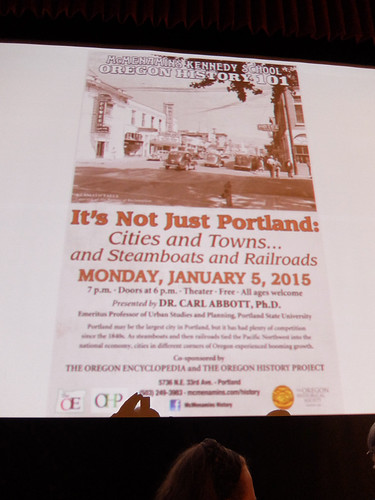
Dr. Carl Abbott of PSU's urban studies program delivered a next-in-series presentation on Oregon's history at McMenamin's Kennedy School last night. The theater was packed with some standing or sitting on the floor. People were eager to learn this information, which is not usually shared on television. The Oregon Encyclopedia and Oregon Historical Society are sponsoring this ongoing series of talks.
River boats helped network and grow the cities and towns together along the Willamette and Columbia Rivers, and Portland came into the foreground early as a port city. St. Helens was an early rival, as was Astoria, and even Milwaukie.
However the plank road out to Washington County and a newspaper gave the city its sustenance and identity. Milwaukie had the shallow sandbars around Ross Island to contend with and Astoria was still too far from the inland action.
Trains supplied the next layer of infrastructure, replacing wagon trains. At the local level this helped economies like Hood River's as trains now hauled produce from that ecology's lush orchards.
Portland joined the transcontinental network with much fanfare (parades and speeches) in the mid 1800s. The city far outgrew the others in the state and only now in 2015 are we seeing some signs of better balance, with Portland still the biggest, but not dwarfing the others so completely.
Carl did not have time to explore the road networks in detail, nor the building of the dams and the consequences of electricity for the region. He was looking mostly at 1850-1950 whereas Oregon's importance as an electrical power source was a story for later. Aluminum factories and later server farms would take advantage, with California plugging in via HVDC.
Sam Hill features in the road building story, as does Columbia Gorge tourism, photographers especially, which Carl alluded to in his "weekend corner" description of a scenic area suitable for weekend drives. Carl did mention Les Schwab and his signature chain of vehicle maintenance facilities.
The audience asked lots of questions. I attended with Denny, a member of Multnomah Meeting, like Carl is, resuming his life in Portland after a stint in Shanghai. Many other Quakers were there as well.
Carl tells me Dan Pope from the U of Oregon will be covering more of the Silicon Forest chapter. They're doing a chronological series and Carl was doing mostly steam and some fossil fuel, with electricity to follow. I have a standing engagement first Mondays with Dr. Bolton, also of PSU (emeritus) so may not make another of these. I'm glad I at least got to this one.
Saturday, January 03, 2015
Donuts Visit
Sitting in Heavenly Donuts awaiting a verdict on a car problem, you'd be expecting an ironic outcome, and maybe that's what this is: clogged air flow meter, a $900+ item, merely clogged, so take her away for all of $76.
Plus I got worked done while I bit down.
Can you top it? Yay Nissan.
Tuesday, December 30, 2014
Convergent Friends
:: seasons greetings ::
Some may find the title misleading as there's a Martian Math spin to this post, by which I mean I'm blending in some of what I also call Quaker geometry in posts gone by.
Given the primacy of the tetrahedron in New England Transcendentalist late 1900s poetics, aka 4D per Bucky Fuller, we have some obligation, in Quakerism, to sustain the inertia (our heritage, after all).
So the teaching is this: at the XYZ origin, instead of something boring like a bowling ball with hooks, the XYZ vectors stretching away at right angles, we substitute a wrought iron tetrahedron, hooking our six vectors to that, reinforcing the understanding the opposite edge pairs are mutually perpendicular.
Inscribing a tetrahedron as face diagonals in a cube is an easy way to demonstrate this fact, plus to allow for an inverse tetrahedron (the dual in the "duo-tet cube", Bucky's 3-volume).
I imagine a clear plastic cube of beveled faces, six squares glued, with chains pulling hard against the tetrahedron in the middle, in the XYZ directions.
:: model by Skip ::
Thursday, December 25, 2014
Wild (movie review)
Maybe because a guy at the Christmas Party at the FCNL liaison's house was decrying the liberties The Exodus had taken with history (wrong swords, flags, camels...), that I wondered if that rusted tank without water was really the real one, if there is one, twenty miles on from wherever.
I'll have to wait for the DVD "making of" feature to find that out, and if the fox was CG. Bridge of the Gods was certainly real, though I didn't realize hobos on foot were allowed over. Makes sense that they should be.
Strayed is a pun, as she's strayed, and wants to get to know her own bizmo better. That's "slang" for one's own body, built for business / IT. "Slang" in quotes because I'm like the only one using "bizmo" for "business mobile" in the first place, let alone for our bodies. But this is BizMo Diaries after all, so you'd expect these memes here.
The roller coaster of life gets some safe predictability for awhile (about a hundred days worth, in under two hours), as one trudges the PCT rehashing through experiences and recovering from PTSD. The security of having things in flashback is what keeps them from being a near death experience, which isn't to say Cheryl doesn't have heart pounding encounters: with a rattler; with scary males.
I went from the Christmas Party in North Portland directly to Lloyd Center, the big outdoor theaters, built at a time when I used to walk to work (CUE) through what's now the parking lot (the one Robin Egg was stolen from, our blue Subaru -- while I watched the movie Troy). Speaking of which, I renewed my Triple-A membership yesterday. These blogs, if they still exist, have some fun AAA stories (battery repair, losing keys, other excitement). Razz was our next car.
Anyway, she stumbles along, doing an REI commercial along the way. I don't think hikers begrudge that commercial and I'm a champion of product placement as a legit way to sell people on a lifestyle, and hiking the PCT is definitely an acquired taste. You need companies to support athletes, and that's why we have athletic brands. We didn't get what brand of condom that was, but this wasn't really that kind of movie.
She's a mature and intelligent woman at this point in her life with flashbacks through her younger years. The audience is willing to take this as a study in empathy once it's clear we're not bracing for horror. Hitchcock tricked us with a flashback once, but we're trusting the ride here.
There's a happy end feel to it too, but also that sense of an observer (a big movie-going audience, and TIME) changing the observed (a private campfire "true story", not a novel). Will we have more tourists now, looking for Jerry Garcia festivals?
In some ways I was reminded of Prodigal Sons in how we dive into a family's dynamics and explore them, finding the usual good stuff: our mortality and humanity. Prodigal Sons was more the documentary, with people starring themselves, whereas this is a "stage play" (with the "great outdoors" for a backdrop) with actors.
I was also reminded of Roz Savage and her lonely journey amidst the elements as one of the greatest ocean-going rowers of all time. She has also written deeply and reflectively. She's someone I've met in person, though not in a way she'd remember.
Then of course there's Lindsey Walker, just back from a very long walk (not a trek) in Nepal, getting down to tattered sandals like Strayed's at one point, after a bicycle trip to California.
We're getting into Everyman / Everywoman territory here, El Camino, the pilgrimage, the great way. Each one of us is a scenario, a dharma tube, partially overlapping with others. My wife Dawn died on St. Patrick's Day so I got her sense of loss and separation and not being in a party mood in that scene from her life.
Pacific Coast Trail itself is the unsung star of this film in some ways, a symbol of the roller coaster that is life, with the markings left by the many who've gone before.
Update: Glenn reminded me coming down from Mt. Tabor this morning that Cinema 21 hosted the gala event with the original author and actress both on stage. Big news at the time.
Sunday, December 21, 2014
Reconnecting
Deke, aka Lawn Mower Man, aka @dekebridges, with 117K Twitter followers (on that account), very kindly called me up and followed through on an offer to let me use his digital broadcast receiving equipment.
For the first time in like years, I'm getting the channels in real time. I'd ditched those for satellite, but then in the great downturn cut all my expenses, while living on credit and the generosity of others.
Since then, I've regained an income and (a) restored the gym membership and (b) started treating myself a little more.
I'm still at the frugal end of the spectrum, for a Hawthornite, but not complaining. Quakers are supposed to cultivate "plain and simple" as virtues. The house (aka Blue House) is fully mine, thanks greatly to Dawn's planning.
So I'll be watching more CBS Evening News, just like old times.
In other upgrades: fitted purple sheets, found in storage, and new speaker wire for the two dad bought me many Xmases ago. He got us the TV then too. I'm in no hurry to go flat screen. I get LCDs and HDTVs everywhere I go, so don't mind sticking with my antiques.
I need to return the audio cable though as the phonograph comes with a fixed length white and red. I don't know what I was thinking buying the six foot cabling. Fortunately, I still have the receipt.
Wednesday, December 17, 2014
Summer Camp
I was back to my "boot camps for teachers" meme today, this time including their families. Glenn and I had been talking about publicly funded boarding schools, pre-college, of which there are very few. However teachers are not "pre-college" in that sense, so the topics were loosely connected. The bridge or glue language was Quakers, and public-private collaborations, more like in the old days.
Of course I'm back to my Project Earthala imagery, those elusive Fly's Eye Domes and other gear, perhaps deployed only for the semester, then packed up and returned to the giant warehouse somewhere. Humans getting better at not leaving that much of a footprint. OK to stake something for the GIS record but we're not wanting to harm the pre-existing ecosystem. The eco-village comes and goes.
Although I mentioned helicopters, something of a cliche in Fuller School circles, Glenn emphasized their danger. If the property in question is accessible by container truck... I'm just not into building lots of roads (defeats the purpose), more into making do and/or letting roads go back to nature (some counties over-built, lets face it). Anyway it's not up to me to make the site-specific recommendations, not when summarizing the network.
Some of these might be closer to "call centers" as in "places of employment" than training centers or schools. People have already trained in order to get here. I'm not insisting on pegging the stereotypes, and draw on the variety / diversity in summer camp experiences already, including reminding myself that cold weather conditions may obtain, as I've not specified a hemisphere (above or below the equator).
Speaking of which, we're coming up on Winter Solstice. Best wishes to travelers.
Monday, December 15, 2014
Seven Year Itch (movie review)

A friend who especially enjoys older films, with less swoopy computer effects, recommended this 1955 classic, directed by Billy Wilder and co-starring Marilyn Monroe.
The backdrop premise is the married men bid their families adieu in the heat of the summer, this being a privileged class with summer digs. Yet even the janitor has manged to send his next of kin off Manhattan.
Which reminds me, the film opens in a light-hearted parody of the annual ritual to set the tone, set 500 years ago, using stock / stereotype Hollywood imagery.
Our anti-hero, Richard Sherman by Tom Ewell, free of his family, and enjoying air conditioning, has an eerie habit you'd think he'd lose, of talking out loud at the top of his voice, committing his thoughts to the air waves (literal air in this case, not the "air" waves of radio).
You'd think a family man of some maturity would not be in the habit of voicing his thoughts like that, a first step down the slippery slope. No doubt the director chose to ignore the "inner voice" option for comic effect, and it works.
Probably the best moments are in the office when our star, having accosted Marilyn Monroe outside the boundaries of fantasy, suffers a paranoid backlash right when the psychiatrist walks in, to talk about the slenderized (sensationalized) version of his book. This film is it (dry psychoanalysis compressed for mass public consumption), one could say, appropriately slapstick (almost), with Marilyn upholding the "dumb blond" stereotype.
The protagonist is not just afraid his wife will barge in and want a divorce, or that his reputation will be sullied. He's concerned about his own evident lack of will power and by his wife's infidelity as an echo of his own.
He makes the mistake of misidentifying fantasy with reality more than once, as the audience is given to know. As onlookers privy to intimate fantasy, through the "miracle" of film, we know our guinea pig gets lost in the maze, not knowing what's real. We see ourselves in his woes.
One of the funniest lines is when he defensively asks "who do you think I've got in there, Marilyn Monroe?" The film reaches out to engulf itself here, like an Escher print containing its own canvas.
As I'm reading some books about the infusion of quantum mechanics through metaphors, I'll say Richard Sherman is a probability wave with fantasies tilting him this way and that, to where he intersects consensus reality in comical ways.
He's often dizzy with all the self-particle ("me ball") spinning he does, a symptom of having an active imagination.
Monday, December 08, 2014
Hotel Room Tableu
:: from Pycon 2009 ::
[ posting on math-teach ]
On Sun, Dec 7, 2014 at 7:18 PM, Robert HansenX-ref:wrote:
> We analyzed math circles here several years ago, including Kaplan's?
>
> http://mathforum.org/kb/message.jspa?messageID=7030630
>
> Bob Hansen
>
I don't know about "analyzed" but in this Hotel Room Tableau from Pycon 2009 Chicago you'll see Kaplans' 'Out of the Labyrinth' in the upper right, a gift from Steve Holden, then chairman of the Python Software Foundation.
https://flic.kr/p/6bgS5e
(I miss that hat, had my name in it, a Paul Kaufman original)
If you zoom out and check the full Album, you'll see the "Bucky stuff"
figures prominently:
https://www.flickr.com/photos/kirbyurner/sets/72157616066135225/
(who's the first to spot Guido, our benevolent dictator in Pythonia?).
Kirby
Kitchen Tableau
More Developments
Sunday, December 07, 2014
Thursday, December 04, 2014
Tuesday, December 02, 2014
Wanderers 2014.12.2
One of our topics tonight: where does "hippie" come from?


In Greenwich Village, New York City by the end of the 1950s, young counterculture advocates were widely called hips because they were considered "in the know" or "cool", as opposed to being square. One of the earliest attestations of the term hippy is found in the "Dictionary of Hip Words and Phrases" included in the liner notes for the 1959 comedy album How to Speak Hip, a parody based on the burgeoning Greenwich Village scene. As opposed to the hipster, defined as "A fully paid-up member of Hip society", a hippy is "A junior member of Hip society, who may know the words, but hasn't fully assimilated the proper attitude." It also defines hippie-dip as "Derogatory word for hippy." [ source ]Also: was Thomas Edison really trying to invent a device to communicate with the dead?
Regardless of Thomas Edison’s misinformed understanding of biology, he was inventive genius who was astoundingly capable of developing devices to serve a purpose. During the last decade of his life, he turned to inventing a device that would be capable of communicating with any sentience that existed beyond the grave. In “Spiritualism,” written in 1920, Edison postulated that, “For my part, I am inclined to believe that our personality hereafter will be able to affect matter. If this reasoning be correct, then, if we can evolve an instrument so delicate as to be affected, or moved, or manipulated – whichever term you want to use – by our personality as it survives in the next life, such an instrument, when made available, ought to record something.” Edison continued an attempt to develop this device. He continued in this essay: “I have been at work for sometime building an apparatus to see if it is possible for personalities which have left this earth to communicate with us.” [ source ]Yeah, sometimes we sit there looking up stuff on our computers, comparing notes. Why not? It's called "studying".
Monday, December 01, 2014
A PhD in Truckology
Of course truckology is not a real discipline, though you wouldn't know that visiting my Uncle Howard's place. One could swear a truckologist worked here.
Then there's routing the trucks, assigning them lanes, a software-intensive endeavor.
I met a master craftsman in that business and know a PhD in Truckology, were Teamsters U to have one, would be no joke and command a good income.
I'd been thinking Harvard Business School might work on scholarships for truckers already plying the Tehran to Istanbul highways, on westward into Europe and eastward to Kabul, the old spice routes, newly paved.
It'd be a treat to drive that, were it safe enough, but for now the academic credit is due to those currently braving these wilds.
Making it safer, recruiting more students, would be the hard work of some dean.
Wednesday, November 26, 2014
Wanderers 2014.11.26
We had one of our best turnouts ever today, with people we practically never see. Coffee was in high demand. I said I'd be more like a photographer at a wedding and move about, then fade away as my day job is peaking. Just getting to join was a privilege, with family and friends.
Our topic was Matriarchy, beginning with concerns about definition and semantics. Matriarchy is not "just the opposite" of Patriarchy, but then what's the latter? Matrilineal is easier to define. In Patriarchy, the fathers have a stronger "need to know" regarding the paternity of children, as property passes father to sons, or any offspring per King Lear. In Matriarchy, paternity doesn't matter as much and the mother's brother may be head of household, with her husband the head of another household.
Constance Tippett Chandler was our presenter. She's an artist who shapes a concept of history as from clay, with attention to detail and scholarship. Matriarchy is less concerned about gender, though patterns around gender may well develop. "Whoever is most fit for the job" was her response to division of labor questions. Creating the ethics in the moment as a way of unearthing a distant culture in the past may seem like undue editorializing, but as performance-based conceptual art, it makes sense.
Given circumstances, looming work-related tasks, I took my leave somewhat early and missed a lot of the discussion. Do we really find evidence of a Matriarchal layer in Old Europe circa 7500 BC? We do find a lot of sophistication about time and cycles back then, astounding pottery, evidence of successful civilization. But what do we know about the social order?
In Connie's telling, that layer of history, or prehistory, is buried with the invasion of the Kurgans, after which the archeological record shows plentiful weapons cluttering up the landfill, up until our day. We're still the war-prone heirs of the horse-mounted bullies who imposed far stricter rules to the point of enslavement. Patriarchy is a lot about asceticism, rank, policing others. More fascist.
Obviously much discussion could flow from such a storytelling. The Confederated Tribes of the Iroquois, by some accounts a model for the Federation of States branding as "USA" in later chapters, was Matriarchal. In Connie's telling, the patriarchy reached a corrupt phase and downward spiral out of which the matriarchy then emerged. Could this happen again?
Sunday, November 23, 2014
Recapping a Story
When Lindsey Walker was with IT for CSC for GulfStream, a subsidiary of General Dynamics, she had the savings to (a) follow the band Weezer to Japan and (b) scope out Portland for its reputed Portlandia scene (this was before the TV show). She ended her IT lifestyle in Savannah and made a bee line in her Nissan, with Titty the cat, to Asylum District (Hawthorne) there to start a new life as a rock star and revolutionary.
In the meantime Tara and I had done some desert driving lessons that ended when Razz the Subaru bumped over some floor-piercing rocks. Walker had forsaken driving as something less ethical folks do and become more ascetic, a cyclist and pedestrian. Result: given I had a spare space and she had a spare car, tit for tat: she got the space, I got the Nissan.
I'd also been experiencing dire straits in the wartime economy (fewer good options for civilians) and welcomed Lindsey's exciting foray into pioneering an ascetic lifestyle. She got us into the FNB network at a critical time when free food in exchange for labor and logistics, was a welcome opportunity.
Fast forward: Lindsey discovered Newar Buddhism through the one temple in that tradition anywhere in the Pacific Northwest, and it just happens to be around the corner from the Linus Pauling House, through which Lindsey and I first met, thanks to Patrick.
Lindsey is now interested in becoming a serious student of the Newar Buddhist tradition, with another year of training in Nepal to follow her recent three-month sojourn there.
Monday, November 17, 2014
The Exorcist (movie review)
I'd not seen this one since the Philippines, when priests came on TV and told us it was just a movie, which made it worse. My girlfriend at the time soured on Ouija Boards but warmed up to priests, so impactful was this celluloid-saved scenario.
When it opened to some beautiful call to prayer music, showing scenes in Iraq, where apparently the Christians had found a hell mouth (cite Buffy), that finally made it click for me, why the Catholics felt compelled to invade.
But wait, no, they didn't, that was a Neocon thing, not a drop of pure Christian blood in it, except at the Monster U fringes, with imam-rabbis Falwell & Robertson types flaming them on. The Pope was against bullying Iraqis in the name of ousting a Noriega type the US had been supporting just prior, in some "balance of terror" you should ask Kissinger about, I'm no authority. I was in Tehran once, fun place.
Anyway, the girl's mom is a total Georgetown power-nester, a socialite par excellance, the dad gone, with a new loser boyfriend, and a teenage girl hoping to practice some real girl talk. Mom isn't up to it though and projects this whole shrieking journey on her daughter, while mom sits it out in the mental hospital, doing unspeakable things in her mind with those priests. It's all a flash back you see. Mom got better. That's the uncut version (laugh track), my spin.
So the audience is immediately jealous this mom has servants to boss around and fawning admirers and thinks it probably serves her right her darling daughter is such a potty mouth (like Nixon) who makes salon party social errors beneath those of most socialite amateurs, like peeing on the rug. Hah hah, mommy doesn't get a Barbie, mommy gets a Chuckie. [ This is the version where more dolls were used, with the coming-downstairs scene, belly-up on all fours. Only very athletic girls should even attempt such a thing. ]
The hero-priest is racked with guilt and needs a way out himself. What better way than down those same steps the loser boyfriend took, the now-famous "Exorcist steps" of Georgetown, one of my favorite necks of the woods, used to visit friends there, had a job there, even lived there for a spell, working for a pro-democracy group while staying with a partisan supporter of same (WDC is riddled with partisans, like Rome in that way).
The main tension in this film is the triangle between a raving mom, doctors, and the church. The doctors and church are all men, vying for this woman's allegiance and respect. The church plays especially "hard to get" where exorcisms are concerned as belief in the supernatural is no longer cool except when practiced with true believers (the devil himself the archetypal original-sinner in-self believer).
Today's priests do nuclear physics and teach astronomy and stuff and don't get involved with demonic possession cases. Leave that to the con artists and filmmakers (symbolized by the movie-fan detective, professionally skeptical of everyone). On the other hand, they have a reputation to live up to, and so don't want to disappoint when cornered by Satan. Their profession gains credibility through this work, as it does from Buffy the Vampire Slayer.
Tuesday, November 11, 2014
Out of the Clear Blue Sky (movie review)
I picked this up from Movie Madness to continue on the topic of 911, taken up at Wanderers last week by David Chandler. He invited myself and a friend to watch it at his house, given his own focus on this topic and the fact that we're all friends anyway, through Quakers.
As I expected from reading the dust jacket, this is not a film about the whys, hows or wherefores. It's about a group of families connected to a company that lost all 650+ co-workers who went in to work that day at North Tower, right near the top, where one could feel the building sway and see water slosh back and forth in the sink.
When the plane hit, all access to the ground was lost and the physics was lethal. The CEO, who was enjoying his son's first day of kindergarten, understood the situation and grappled with it as best he could. At first he was the human face of the 911 victims, but then the media turned on him when rumors spread that his company was not planning to make good on its promises.
The arc of the film is a lot about the exoneration of the CEO, who lost his brother in the attack, as well as about the nightmare the victims have endured since 911. The film makers also lost family members and friends in the attack. The suffering of the victims is mixed with that sense of the surreality of these horrific events, a reminder that reality need not be believable.
David thinks any notion I may have that these buildings could have been pre-wired for demolition for benign reasons, namely to get rid of them when they proved to be white elephants, is highly unrealistic and thinks it far more likely that the wiring was premeditated and coordinated with the airplane attacks.
That's assuming a demolition occurred, in addition to the airplane hits, which many architects and engineers argue is likely, given eyewitness accounts, analysis of the video, and of the chemical residue from the dust.
Adding a button to the picture and a decision to press it, does not in itself point to who the decider was as a matter of logic, at least not in my mind.
I'm willing to add a button (e.g. to explain WTC 7's fall "at the speed of gravity" -- not 40% slower as the draft NIST report alleged) but that's about as far as I go in my own analysis of what happened. I have no special insider knowledge I'm withholding at this time.
Subscribe to:
Posts (Atom)
