Sunday, June 27, 2010

Rules of the Road

Re: rules

--- In synergeo@yahoogroups.com, "coyote_starship" wrote:
The theft of livelihoods from hoi-polloi by roadway bandits to fatten their Baal is tantamount to child sacrifice, as president Eisenhower so eloquently stated. If ending world hunger is not on your agenda, then I'm curious what tops your list instead. Usually advocacy of some kind of veiled culling is encrypted in the platform, an unconscionable eugenics, a war against the weak. Rather than "feed the hungry" it's "feed only the right hungry (right in my judgment)."
Hyperlinks added by Alan and myself.

Wednesday, June 23, 2010

Working with vZome


vZome is Scott Vorthmann's virtualization of ZomeTool, an ingenious geometrical supply built around this injection molded hub and plastic rods of variable length. Ideally, students would have ample access to this building supply. However, it's not necessarily practical to be assembling a rhombic triacontahedron in your airplane seat on some jet ride to Tokyo. For times like those, you have vZome. For other times too.

As of this writing, we do not have a corresponding tool for Flextegrity, and could use one. The Elastic Interval Geometry genre (EIG), starting with Struck, then Springdance, Springie, and Darwin @ Home, has taken us a long way in the right direction. The Flextegrity application would likely be in this EIG lineage.

vZome rods are not springs, but are of fixed length and color-coded. The hub's angles are also fixed. These constraints constitute a self-auditing aspect to vZome constructions, which its power-users come to appreciate.

My project is to take some recent Koski vZomes and pull them up in Scott's Java app (vZome). Next, I will boot up Camtasia Studio and see to what degree I am able to faithfully capture the live operation of vZome on screen, for saving to disk in some movie format, suitable for uploading to Youtube.

This is the kind of thing we could be doing in Canada, trying to get around the Qyooban Embargo (long story). Some of the vZomes show off Verboten Math (e.g the 7.5 RT and 6.0 RD inter-twining), stuff not usually made available in the USA, especially not in high schools -- unless you're lucky enough to have a RadMathNet household in your zip code area (97214 has a few).

Monday, June 21, 2010

Hunger Project on Synergeo

Per Diet for a Small Planet, if you want to feed more humans a healthy diet, you need to not run so much feed through cattle on their way to the dinner plate. Bucky ate a lot of steak, and spinach. Some people crave meat. I'm not saying to not be a meat craver. But if you're not one, and not a smoker, then why start? Eat lower on the food chain if you can afford to. You will be popular and score lots of dates (if that matters to you).

The word on the street in Havana should not surprise you: no McDonalds and no Burger King. How about Ben and Jerry's, in the Unilever portfolio? That might be different, in terms of floating the decor and best product (minus any notion of "corporate personhood" of course -- that stays within USA borders, where they seem to know what it means (the Supreme Court does at least, right?)). No, I'm not suggesting a "cigar flavored" ice cream.

Getting the concentric hierarchy as an OLPC app is at least as important as the iPad / iPhone and other versions. I've got it on iPod, podcast downloadable (see Synergetics on the Web).

Around here, we're close to zero meat, except mom is a meat craver sometimes, and we don't blame her. Actually, we all eat some meat, given the opportunity. But when we buy, it's usually more like rice and beans. As a "radmath" house in the Pauling Campus network (one of several), we have plans for rain barrels, solar panels and such, right down to the trim color.

That's what home economics class is all about, whether offered at a book store, Washington School or wherever.

What we don't have is a huge budget as Havana is poor. Showcase homes, with appliances by Google (control panel connected to house meter), other sponsors, are not out of the question, once the embargo against Bucky is lifted against the United States (there's a ring of oil companies trying to fence her in, other obnoxicists).

Where there's excess food available, there's no excuse for people not having food. Where there's no excess, there's a transportation problem or a transit problem, or the potential for more farming. Portland's neighborhoods maybe don't have the vegetables Havana's do, but there's lots of emphasis on urbanites doing some of their own food raising. Chickens are permitted etc. I don't actually know all the rules (just that we're well within them).

For how long this ban on high fat fast food? Fast Food Nation is a popular film in Cuba they tell me, as it provides a fairly bleak analysis of the North American "paradiso". Lets not say I'm the expert. Couldn't tell ya. Maybe a long time, as tourists want and expect that "commercial free" atmosphere, something they can't get at home, and often crave with a vengeance. Keeping Cuba pretty commercial free might just be the ticket. That doesn't mean no interesting work. S3 cartoons require lots of computers and studio time, maybe in cahoots with University of Toronto?

Kirby

Friday, June 18, 2010

Synergeo 60786 re: Martian Math

"all math is ethno-math"

One of the bright ideas Dick came up with recently (seriously folks!) was the idea of Martians making a delivery, of a tetrahedral yard of concrete. Just making it a yard was in itself brilliant, as that term contains "thirding" as a concept, which'll get us to 2-frequency (where concrete is born! (joke)).

So what are Earthlings to do, to get ready for the delivery? Make a mold for the receptacle, using root2(2) on every edge (of a cube). Carve out that internal tetrahedron, like in a dug-out canoe, and have the Martians fill that up. That'll be your yard of concrete. That's about 1.414 yards to each edge.

Those who didn't "get" Synergetics don't understand the Martian instructions and build a "cube root of 3" cube instead, with edges about 1.44 yards. That cube is too big and they're wasting materials. From a Martian perspective, these people have a mental disability. In the Martian equivalent of the DSM, there's an entry XYZ (let's call it) that gives a more spelled out version of the diagnosis / prognosis.

Now some sticklers might come along and say our cube is two half-yards on a diagonal, and since 2*2*2 = 8, this must be a 2-frequency cube. If the tetrahedron is 8, the cube itself must be 24. At this point, you get an argument between the two Earthling camps: should the edges be 2*root2(2) or 2*root3(3)?

There's another sect in this picture, with yet another interpretation of the Martians' instructions. What do they think? We might have to wait until a next episode to discover that.

Kirby

Tuesday, June 08, 2010

Moratorium Proposal (Synergeo)

I like the idea of a moratorium on new PhDs until we deal with the Bucky stuff with more integrity. It's a philosophy department thing. Unless you're up to date at least a little, how can you be a "doctor" thereof?

Princeton should announce this. Small grad school as it is. Turns out it's just a gesture, as it takes about 30 minutes to screen the concentric hierarchy in a way people get, especially with 4D IMAX [tm].

I also think it'd be worthwhile to padlock all the public high schools for a day, another token gesture, underlining the fact that this funny business of denying students access to their heritage has gone on long enough -- so stay home and watch Youtubes, like what they show in the military ("off your duff math").

Operation Padlock could be carried out by the National Guard, as it's their job to protect security at home. The governors could order the action. Students would mostly love it of course, as it's another day off from the holding tank prison. Great recruiting tool for the Guard, probably double its popularity overnight, especially when people understood the motives.

We need to turn some North American bases into Reboot City operations, where people get some new skills, train in logistics. People will call these brainwashing camps (which they are already) but ultimately will feel more secure if there's some continuity with the decals. If we reskin everything to look "UN", the neo-Nazis will go crazy (as if they weren't already). These should be run by civilians though (as the military already supposedly is).

Lets see which service, Army, Air Force or Navy (or Marines) is the first to have cool concentric hierarchy cartoons in its officer trainings, along with all the positive futurism attendant thereto. I.e. lets see which service is the least cowardly.

My guess is the Navy will be first, even though the radomes were mostly an Air Force thing. Clearly you can't be a legitimate Admiral or General and not know about World Game etc. (unless you're in some mercenary-moron outfit, wearing a clown costume).

Probably sounds weird for a Quaker to be wanting the military to shape up and make sense. You go with the army you've got...

Also, nix on paying the debt for all those weapons. Those were LAWCAP's idea. Citigroup can pay for 'em with all that laundered drug money eh? Uncle Sam doesn't have any nukes either -- those are criminal and therefore belong to organized crime syndicates (terrorist networks). That's why we need the IAEA, FBI and other police, to put the spotlight on those criminals. Plenty of bad guys to go after.

Kirby

Monday, June 07, 2010

Learning Reading

[ from Math Forum, fixed some typos ]

On Sat, Jun 5, 2010 at 12:48 PM, Robert Hansen wrote:
> Landmark School
>
> $45,000.00 per year.
>
> It would take some time to study the ramifications
> of that one fact.
>
> Also, they tutor (I should hope so at that price).
>
> I am less than convinced now than when we started
> this debate.
>


I've been perusing this whole thread. I liked the part where Pam talked about decoding words, not just getting stuck on trying to memorize a whole bunch. You need good mnemonics, which requires delving into heritage, roots (root = radical).

So, for example, we delve into ancient Greek for our hedra, our polyhedra. Tetra, Penta, Hexa, Septa, Octa, Nona, Deca and so forth. Ennea. Triaconta. Icosa. Building these associations takes time and is an exercise in reading. People who think mathematics is just noodling iconic symbols around, while never reading or writing anything polysyllabic, have another thing coming.

One curriculum segment I've worked on takes us to Kanji i.e. Japanese characters heisted from Chinese and repurposed in many cases. We study the Kanji for polyhedra (such as rhombic dodecahedron) while learning about Unicode, the binary basis for encoding all these symbols (including a lot of the math noodling symbols from Iraqi math (aka algebra)).

Spatial geometry tends to be polysyllabic as well as cram packed with acronyms and abbreviations. That's just like the IT world in some ways (although here we find an emphasis on single syllable posix commands, many quite alien by today's standards, yet fun to learn about in math class). Ergo, it's good training for 3rd graders to learn about these space-filling tessellations that'll be on the test.

Q1: the [depicted Schlafli orthoscheme of the cube]
fills space with itself and a mirror image
(a) true
(b) false

Q2: [picture] fills space with:
(a) [picture]
(b) [picture]
(c) [picture]
(d) none of the above.

However, in place of [picture] think of something more like LiveGraphics3D (per Math World) or VRML / x3D. The "textbooks" are online, ergo at least five times more colorful and interactive, less than half as expensive, and not made of dead trees trucked from distant factories using peak oil. A win all around.

They're also quickly fixable, when mistakes are discovered, provided we have a responsive publisher.

The spacefillers are starting to get simpler names in some curricula. Let me preview:

Minimum spacefiller: mite

Mite face-combines with another mite to make: rite, lite, bite -- three species of syte.

Two sytes make a kite, of we now have three: kit, kat and kate.

2F and 1F Mite (1 and 1/8)

Some old skool geometers may object that these naming conventions are incompatible with what's on the books, in terms of the tri-rectangular disphenoid tetrahedron (the rite) already having a name on wikipedia (which is editable by people just doing their jobs).

The point is to jump in and out of namespaces. These are local variables more than permanent assignments. When you tour in a new country, all the food names are changed, but it's the same foods (at a primitive level -- the recipes may vary wildly). Likewise, no matter what you call it, a Smite or a Schlafli orthoscheme of a cube, you'll need that mirror image to complete your space-filling tessellation. We have a toy to help and to provide more tactile understanding. It's not all about visualization. Kinematics enters in.

Cube Orthoschemes

[I think reading specialists know the importance of body language. Learning to crawl (before walking) is a good precursor to left/right differentiation. Don't just sit 'em in front of the TV if you want 'em to be highly coordinated). Crawl before you walk, walk before you run (and don't forget to "toddle" some)]

This thing about price tag is a no-winner, as the minute something worthwhile shows up, you set it out of reach. I don't think I should discuss my pricing, as that'll immediately be used to prove that my approach cannot succeed, because we do not have the resources. Actually, we have plenty of people willing to tutor the young, and it's actually part of human biology to look for opportunities along those lines, as teaching others, not just the young, is self-reinforcement, is a way to stay in shape yourself. What a civilization is is people always teaching one another (a life long process).

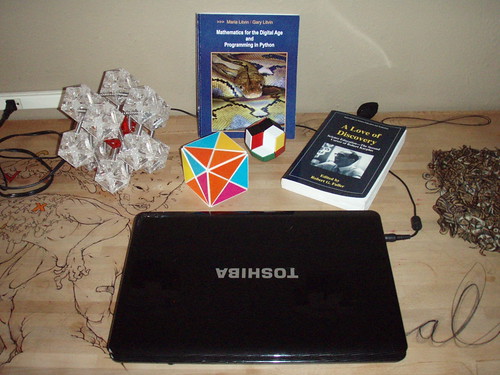
Like, suppose we say we use Mathematics for the Digital Age and Programming in Python. Someone comes back with the fact that some schools already using it cost $xx * 10**x per year, so why bother? The public schools will just never have that kind of money. Do you see the complete non sequitur here? This is an argument completely without logic. Maybe the Russians gave us the copyleft rights for free electronic alternatives and we're doing more with OO right out of the box. So what? It's not about the economics, it's about pedagogy. Lets give them all scholarships in our mental models at least, and then talk about "what and how should it be?" not just "how much will it cost?".

I've proposed the following state standard: kids need x number of nights when they get to view the stars "live" i.e. under a naked night sky minus light pollution, such that the stars are directly and brightly visible. Exceptions apply, but the whole middle of the Bell Curve is expected to meet this requirement or... no high school degree. Period. A culture that can't pay for that, can't organize night sky experiences for millions of kids, is just too dumb for the history books. Lets get some new managers.

The next best thing: a planetarium for every high school and/or elementary school. Not that expensive. Any civilization worth beans would do that, I'm sorry. We have the technology. We just don't have the smarts (a self reinforcing cycle, as people with no clue end up just talking about money (the great cop out)).

There have been no substantive economic arguments on math-teach to date that I'm aware of, e.g. explaining why we skipped a whole generation. The Idiocracy ("Ed Mafia" per Haim) has other explanations (they're rewriting the DSM as we speak, so I'm thinking we should contribute new edu-speak in terms of psychological complexes. What led people down this path in the first place? I have my theories, similar to president Eisenhower's in some ways).

People forget that blitting pixels to multiple screens is dirt cheap, likewise sound waves to speakers. There's a whole new distribution architecture already in place, yet the food fighters in Math Wars are still thinking in terms of truck and train loads of physical wood pulp textbooks. This is too retro for words really. Can we even talk to these people? Stone Age prehistoric, these math warriors.

That's why I like the One Laptop Per Child campaign, which actually doesn't depend exclusively on the XO line to get the word out. "Adults will just hold you back, as they impose the patterns of their own childhoods. What else do they know?" Sure, some kept up, pioneered, but there's a Bell Curve.

You get too many old guys remembering their glory days and wanting to help little Johnny learn how to swing that bat. No contemporary skills. Skipped generation types. Don't even know what the minimum space-filler is. Good thing you've got a way around 'em then (those boomer-geezers). So lets rock.

Saturday, June 05, 2010

Rad Portland

Free Skool (Duke's)
Duke's Landing on Belmont


Laughing Horse Books

Tuesday, June 01, 2010

Outlining

  • GEOMETRY BASICS

    • Rhombic Dodecahedron (starting point)
      • inscribed cube
      • inscribed octahedron
    • Concept of Dual
      • cube - octahedron
      • cuboctahedron
    • Angle versus Frequency
      • 12-around-1: 10 * F * F + 2 (cuboctahedral numbers)
      • 12-around-0: 10 * F * F + 2 (icosahedral numbers)
      • virus morphology
      • geodesic domes and spheres
      • buckminsterfullerene
    • VE <--> Icosa (Jitterbug)
    • 25 Great Circles (VE)
    • 31 Great Circles (Icosa)
    • LCD triangles
    • Spherical Networks
      • vertex, face, mid-edge axes
      • poles as +2
      • 2*P*F*F + 2 (Coxeter paper)
    • Concentric Hierarchy
      • A & B modules
      • Mite, Sytes, Kites
      • Coupler (1)
      • Rhombic Dodecahedron and the Coupler
      • Coupler in XYZ
    • Rhombic Triacontahedron
      • toy: Ball of Whacks
      • T-E modules
      • RT volume 5
      • RT volume 7.5 (K)
      • RT volume 15 * root(2)
    • RT / RD relationship
    • Tetrahedron as Unit
      • 24 A modules
    • Unity-2
    • IVM (toothpicks)
      • two kinds of voids
      • 4 IVMs
    • Dimensions
      • 4D / 4D+


  • GEOGRAPHY BASICS

    • Time (space-time)
      • clocks
      • time-lines
      • time codes
    • adding into the future, subtracting into the past
    • time scales (geological vs. human vs. pico)
    • rates of change (ratios)
    • Space
      • Coordinate systems (including latitude/longitude, degrees)
      • Girding/griding the planet (GIS/GPS)
      • Mapping/addressing schemes
      • Length and number (ratios)
      • Area and volume
    • Objects
      • Shapes
        • spatial networks (polyhedra)
        • plane figures (triangles especially)
      • Objects organized in sets
        • types of number
        • operations with number types
        • permutations and combinations (DNA)
      • Objects organized in hierarchies
        • subtypes (rationals a subtype of real a subtype of complex)
        • geometric hierarchies
        • biological taxonomies
    • APIs: exposing objects to users
      • Fractions, Decimals, Percents (rational number type)
      • Polynomials (solving, graphing)
      • Vectors
        • adding and subtracting
        • scalar multiplication
        • dot and cross products
      • Matrices (translation, rotation, scaling)
    • Events
      • Communications
        • Symbol systems and codes
      • Energy
        • kinetic energy (units, dimensions)
        • heat energy and temperature (conversion constants)
      • Frequency (links to time)
        • color / optics (the spectrum, visible and not)
      • Rates of Change
        • velocity vectors, acceleration, slope, gradient
        • derivative
        • anti-derivative (integral)
      • Event-triggered objects
        • mouse clicks and key presses
      • Probability and Permutations

Saturday, May 29, 2010

Trekking Onward in Weirder Portland

Philosophy of Mathematics

In light of the many math-related posts below, you'd think I'd be working full time on those video clips, looking over the shoulders of skilled professionals of various stripes and spots, a zoo of "cool cats" in beatnik terms (a bi-gender appellation, and not one of opprobrium).

However, the MITE fights rage on, with the ortho-scheme of the cube considered a primitive but for its handedness, which puts it more in the category of an A, B or T module. Maybe talk to Frank Zubek about it?

The Hall Tetrahedron reduces to Q, the Schlafli shape. How does "handedness" relate to "congruence" in these cases?

Either way, the MITE is original for its own left / right dissection, which has non-overt characteristics: talking about those A & B modules again.

Isn't it interesting to find a thirding of so basic a nature? I'm on record suggesting Synergetics is non-trinitarian (thinking of unity-2), however the Mite is somewhat evidence to the contrary.

Stories and Exercises

In another window, I'm connecting with Python's tempfile module, useful for setting up test fixtures in unittest.

My questions are again regarding the technical skills versus lore axes, their relative mix in curriculum writing. What's the right mix of stories and exercises? One needs those stories to give the exercises meaning, whereas the latter give substance to the stories.

Designing Applications

Regarding software development, like at PSU and places, it's not bad workflow to imagine some "pie in the sky" version of in-house software, as a way of projecting the "what's so" of current best practices. Envisioned software, aka vapor-ware, serves a real management purpose, as it helps people mentally codify what they're doing, even if the application is never committed to silicon.

However, it might be implemented in some cases i.e. inheriting an office already steeped in ideas of some dream application, if guided by realism in some crucial respects, is what application developers much appreciate.

A lot of the hard part is already done at that point. The workers have developed the details, and, being closest to the job, are likely among the best qualified to have done so, so a win.

But then how much did the teams learn in high school about HTML, CSS, JavaScript, AJAX, SQL, ORM, MVC, XML, DOM. Getting this computer science stuff into more common use is a challenge.

I'm eying making an end run through the humanities, not waiting for math teachers to catch up. The DOM (Document Object Model) is the kind of structure we encounter in Rhetoric, and XML is but Punctuation of a new kind (per Gene Fowler of Waking the Poet fame -- rolled his own XML editor in Delphi).

I tend to blend the computer science stuff with the spatial geometry stuff. I have a lexical-graphical bridge through Geography one might say, a sometimes fantastic domain (like a Wonderland, or Narnia... an Uru) which maps data in theater (as in Globe Theater).

The Geoscope

Google Earth is a good example, though here with a realistic vista: a virtual Geoscope, ready for overlays of whatever data layers. Then check Google Mars and Google Moon (both available in 2010).

ESRI provides a lot of capability to professional cartographers and geo-scientists. I've seen some of those tools in action.

Whereas high schools can't be expected to always afford the latest high end equipment, in demand by career professionals, the open source commons has already provided some strong capabilities adequate at least wrangle the concepts.

The GIS features in PostgreSQL, coupled with GeoDjango's ORM, are more examples of a tool sets able to supply maps to end users. Exercises involving geo-caching, including in metropolitan areas, also wilderness, will perhaps take advantage of these tools.

Is this a school server? Then perhaps the local environment is already modeled in some detail (say the Mt. Tabor area in Weirder Portland). Students gain a feel for that overview perspective.

Friday, May 28, 2010

Math Reform

Xref (May 2010):

The Elements of Algebra -- Groves responding to Urner
The Deprecation of Algebra -- Urner responding to Niederberger
The Elements of Algebra -- Urner responding to Bishop
The Elements of Algebra -- Urner responding to Groves
Re: The complexity of multiplication -- Urner responding to Hansen
Complex numbers: how early? (Urner)
Popping in re mathematics foundations (Urner) -- Wittgenstein list [Wittrs]
Four Axes for Reformers (Urner) -- with 2nd edition to Synergeo
Posting up a Storm (Urner) -- thread on mathfuture
Re: the complexity of multiplication -- Urner responding to Niederberger
Topic: The complexity of multiplication (with correction) -- Urner responding to Niederberger
Re: What math is, or was! -- Urner responding to Haim (pseudonym)
Re: What math is, or was! -- Urner responding to Haim again
Re: Challenge to Haim -- Urner responds
Re: What math is, or was! -- Urner responding to GS Chandy
Space-filling Tessellations -- Urner responding to Ihor
Rhombic Triacontahedra etc. (Synergetics list) -- Urner
[Edu-sig] Factory functions: synthesizing top-level names -- Urner / Python Nation
[Synergeo ] Re: RadMath Update -- Urner responding to Fischbeck
Re: Different Classes of Geometries -- Urner responds to Tim

Saturday, May 15, 2010

Cold War Operations

Last night we screened a bunch of videos. I came in late from my meeting with Patrick.

I saw one on UFOs / Area 51 (the usual aggrandizement of the Air Force, which gets to network with aliens pre American Dad), and another on the Federal Reserve. In between we screened The Men Who Killed Kennedy: The Truth Shall Set You Free, apparently recorded off The History Channel.

I'd seen this very same JFK video years ago, having rented it from Movie Madness. I thought it was one of the more cogent in this genre. There's an interview with the special forces guy, the guy who studies gray scale photography, the retired FBI guy... Lee Harvey Oswald's wife Marina.

Coincidentally, I was revisiting the Prouty web site at the time, maybe tracking down some UFO reference. Or was it the U2? Yeah, I was revisiting the U2 again.

Watching conspiratorial videos while having a searchable Internet handy is a different kind of experience.

Allen Dulles wanted to bully the Russians with the U2 right up to the summit with Eisenhower, even though the USA prez had requested a halt to those overflights.

Prouty is consistently adamant that Gary Powers was not "shot down" and even suggests that the plane, previously damaged, had belly-landed (again) safely, with a payload of non-regulation incriminating evidence. Allen Dulles agreed the U2 could not have survived a direct hit (was he talking to Prouty?).

Certainly Gary himself survived, although the Eisenhower administration didn't know this at first, and so was caught red handed telling a number of bald face lies. These embarrassing developments derailed the summit, with Khrushchev coming across as anything but compliant following this (24th?) flagrant violation of Soviet airspace. This U2 incident had perhaps sabotaged early plans to "win" the Cold War. Theories abound, questions remain.

What's poignant about this 1995 JFK movie is how the interviewees feel they're finally going public with some deep secrets, perhaps at some peril to themselves -- but does anyone really notice or care anymore? Here we are in 2010, with a gaping hole in the history, a seemingly indecipherable knot it's perhaps easier to just walk away from.

People are used to the idea of an official story of what happened, surrounded by a plethora of wacko theories. End of story. There's a three story geodesic ball to look out through (Reunion Tower, rotating restaurant), if you want to study Dealey Plaza as a casual tourist.

I fall into the tourist category myself, as I don't boast any special credentials as a student of this event. Thom Hartmann, interviewed for this film, is way ahead of me. I was but a few years old, living in Portland, when this event occurred. I've studied the Prouty materials in some depth though, in part because of my interest in Asia (I grew up in the Philippines for most of my high school years).

Indications at Col. Fletcher Prouty's web site are that neither President Lyndon Johnson (part of the motorcade) nor Bobby Kennedy saw the assassination as the deranged actions of a crazy loner. Prouty never implicated Johnson in the assassination in any way, which I gather a subsequent episode of this documentary film series eventually did (I've not seen that episode).

Subsequent to the Bay of Pigs fiasco, attempts against Castro's life were ongoing out of the Attorney General's office, despite an agreement with Khrushchev to stop acting like the Mafia.

Diem, a fellow Catholic, was still alive at this time. JFK wanted to get all USA personnel out of Vietnam by 1965, which might've sounded like an admission of defeat unless some other shoe was to drop. Ed Lansdale, the original quiet American, wanted to return there, though not in the capacity of assassin (McNamara, then defense secretary, considered him willfully insubordinate in that respect, per A.J. Langguth's book Our Vietnam: The War 1954-1975).

Given these behind-the-scenes machinations, blowback of some kind was anticipated, though perhaps not at this high of a level, and contingency plans had already been drawn up to prevent the spread of panic, in the event of retaliation.

The cover-up described in the film has to do with the size and nature of the wound, and of course where the bullets might have come from (the under street drainage system provides a new angle). Someone else who saw the original autopsy photos confirms the gaping hole etc. These images were then doctored to match the official story (analysis from the gray scale guy). Divulging this information at the time was strictly verboten (special forces guy).

That Prouty was at the South Pole during the assassination suggests he could be the innocent insider (the tour guide) who would gradually help us understand what had really happened. He points to his friend Ed Lansdale, with a corroborating second opinion, as presumably present on the scene. He writes to Jim Garrison, appears with Oliver Stone, and tries to make himself understood as the real "Man X" -- played by Donald Sutherland in the Oliver Stone film JFK, with Kevin Costner as Jim Garrison.

Prouty fingers Social Darwinism (aka Malthusianism) as driving the "make-war" policies of the post WW2 military-industrial complex. He quotes Bucky Fuller in this regard (in JFK). This was also the Nazi ideology (eugenics), which not surprisingly had (has) many adherents among the moneyed, per War Against the Weak by Edwin Black.

These "not enough to go around" philosophies are self-fulfilling prophecies in that way, as squandering resources on killingry is a sure fire way to assure that there isn't enough livingry. GST takes a look at this trade-off, known to classical economists as "guns versus butter."

Followup: Trevor reminded me that he has some archived correspondence with Lee Oswald's ex-Marine friend Kerry Thornley, hauled before the Warren Commission because of their earlier association in the military. This encounter left lasting scars, as Kerry concluded he was "the next patsy in line" if the LHO story fell through. Trevor, fine with believing the lone gunman theory, hosts Kerry's The Dreadlock Recollections online. Trevor also showed me a copy of Drawing Down the Moon at Powell's, wherein Thornley gets credit for The Discordia papers, prototypical of Subgenius writings in some dimensions.

Saturday, May 08, 2010

Surplus (movie review)

Stop

Surplus: Terrorized into Being Consumers, chronicles the descent into irrationality occasioned by the industrial revolution.

Unable to tear away from "earning a living" models, humans endlessly churned out more and more of what they already had too much of, while neglecting their own basic needs.

Future shock apparently involved acknowledging our need to radically improve our cognitive approach to "the economy". Was it really all about shopping until we dropped? Could there have been other answers?

Questioning materialism used to be the quaintly anachronistic job of various once-a-week religions and had a "tsk tsk" neo-Victorian and/or Puritanical flavor. As that questioning has become more urgently existential, much of the religious response has converged with philosophical and scientific investigations.

Instead of the fires of hell, we have global warming to contemplate and/or thermonuclear war followed by nuclear winter. A sense of human culpability keeps us in the game as having agency. We seem to have a steering function, even engineers think so. This keeps a flavor of "testing" in our Global U (Spaceship Earth).

We Can Fix This is exemplary of a more hopeful, less purely destructive, response (a road show, coming soon to The Bagdad). The Coffee Shops Network idea was likewise an attempt to harness our best impulses to support the front lines.

The film uses mockumentary techniques similar to those of Emergency Broadcasting Network in Electronic Behavior Control System for example. Multiple talking head shots, mostly of media personalities and authority figures, get spliced together to mouth some of the film's biting commentary.

One of the longest takes, and most eerie, is in a sex doll factory. These are among the best money can by. We get the grand tour, and learn how body type, head, skin color etc., might be mixed and matched per patient tastes (one could view these as medical devices, akin to prosthetics, and therefore covered by insurance). Shades of AI. Factory and cubicle workers doing calisthenics in unison, inter-spliced with the sex dolls, provide an Orwellian commentary on the dehumanizing effects of the matrix.

George Bush insisting we fight terror by shopping (our "way of life" after all), and Steve Balmer whooping it up for Microsoft, come across as twin icons of some kind of hypertrophic global materialism.

Both are reflective more than instigative, doing their jobs as jester archetypes, properly suited for the masquerade. Anonymous spectators take comfort from the hype, as they do from televangelists, shock jocks, other colorful clowns.

"Know your audience" is the dictum for commercial advertisers, as well as for filmmakers.

One might easily come to see rampant materialism as "the matrix" which traps us in unfulfilling and dehumanizing scenarios. Experiencing said "matrix" as imprisoning is a first step toward liberation in that case, and is an awareness this film seeks to foment.

In the foreground and haunting the sound track: our token "terrorist" who wants to fight back without being too tame about it. Smashing a few windows is civil disobedience in his book, not violence against persons.

Violence against persons, on the other hand, is what matrix shoppers tend to consider a "divine right" in contrast (including by proxy, against strangers in distant lands). Their sense of security and right to over-consume go hand in hand.

This film was released in 2003 and is a part of the Laughing Horse collection. Thanks to recent reorganization, these films are getting more opportunities to circulate beyond just those few radical households that know about them.

Private parties, teach-ins, networking salons etc., with music, presentations, and projected films, are not in violation of copyright, even where covers get played. Fair use rights pertain.

Movie Madness on SE Belmont may have some hard to find videos (and it does), but some of those at Laughing Horse (10th & SE Burnside) are next to impossible to obtain.

Saturday, May 01, 2010

Surveying History

Webster Tarpley was being sharply critical of Freedom House on Russia Today (RT), making fun of the Bush Institute's workshop on cyber-freedoms. This led me into reading up on Freedom House, which took me (again) to Bayard Rustin, a gay activist Quaker and former chairman of said NGO.

Tarpley wrote George Bush: the Unauthorized Biography (about Bush Sr.) a book our resident Lyndon LaRouche afficionado Brian Hutchings used to cite often on Geodesic and Synergetics-L, the latter being the precursor the Synergeo. Tarpley has his share of detractors, such as among Noam Chomsky admirers.

I ended up reading the Tarpley bio of Bush Sr. a long time ago. The section on Leo Cherne is especially apropos per Tarpley's remarks on the RT Youtube.

The Tarpley investigation of Nazi connections was more tempered and balanced in Kitty Kelly's book I thought. Per War Against the Weak, the USA's aristocratic intelligentsia was pretty much across the board into Social Darwinism and eugenics in those days, feeding a Hitleresque mindset.

Now I'm curious whether Kiyoshi Kuromiya, a gay activist associated with the MLK campaign, might have known and/or worked with Bayard Rustin.

I've been reading the Speak Truth to Power document again, which agonizes about the erosion of freedoms in America thanks to its new post-WWII wartime economy. The Cold War proved somewhat devastating to personal freedoms, much as the War on Terror has. Freedom House was a staunch foe of McCarthyism I notice.

James Woolsey, of Who Killed the Electric Car? fame, is also a past chairman of the Freedom House board of trustees, a fact Tarpley also mentions on Russia Today.

Here's mention of Kiyoshi, from Smash the Church, Smash the State, edited by Tommi Avicolli Mecca:
At antiwar protests, gay men used campy new tactics to fend off cops and defuse tensions. As Kiyoshi Kuromiya relates in City of Sisterly and Brotherly Love (Marc Stein, Univ. of Chicago Press, 2000), “We’d go up to a line of cops with tear gas grenades and horses and clubs. And link arms and do a can-can. Really threw them off guard.”

Wednesday, April 28, 2010

Again at Lyrik

Some of my most important meetings happen in this "corner office". She used to be named Fine Grind, likewise a worthy little establishment. I named my Fine Grind Productions in her honor.

Today it's about university-based software systems and to what extent one should outsource, versus eat one's own dog food.

There's a bias in geek culture towards doing the latter, but of course one imports the libraries one does not write (the wheels one does not reinvent), such as NumPy or the new Decimal module (to use the Python namespace as an example).

I've reinstalled the Cortona viewer for scoping VRML files (.wrl is the MIME type). The Synergeo list is proving a strong source of some new ones. Figuring out clear screen animations for projecting to LCDs, in the Coffee Shops Network for example, requires storyboarding in advance. My primitive two-threaded hypertoons generator, written in Python + VPython, performs much the same prototyping purpose.

PSU is committed to civic service, a quality experience for its students, ways to reduce xenophobia, good town-gown relations. That's a tall order for a rapidly expanding academic program. Student housing may result in more campus households such as mine, which I connect to the Pauling Campus in 97214. Portland also hosts the University of Portland and many excellent community colleges. When it comes to private institutions, Reed College and Lewis & Clark College are especially well known.

Tuesday, April 27, 2010

First Person Physics

028


027
montage @ lyrik

Friday, April 23, 2010

HB2H & HB2M

Gig in Baltimore
:: baltimore gig ::


Happy Birthday to Hubble (HB2H).

I wasn't at the Space Telescope Science Institute (STScI) today, where I understand they were having cake.

The free beer on Wednesday was most welcome, on the occasion of someone's contract getting renewed. Ray Lucas regaled me with stories, about his trip to Alaska north of the Arctic circle, about galaxy morphology, about the intricacies of Hubble management and scheduling.

The space telescope turns 20 today. I celebrated by going to the Maryland Science Center and watching Hubble 3D, the Imax film, with about 15 other mostly graying folks.

I'm able to blend right in as an old man, a boomer / senior as we're now known.

Kenneth Snelson's Easy Landing stood out dramatically in front of the museum. I took a lot of pictures, one of which I posted to his Facebook wall.

Kenneth and I go back. We used to correspond a lot more. I've stayed with him and his dear wife in downtown NYC a couple times, hung out in his studio. He is a kind and brilliant guy.

I was glad to see Women in Black at Baltimore harbor.

Bill Mahrer is interviewing Jack Kevorkian on HBO on Real Time as I write this. Bill is a long time Kevorkian fan. The movie You Don't Know Jack, with Al Pacino playing Dr. K, debuts on HBO tomorrow.

"I'm Blogging This" says my T-shirt.


I'm flying back to Portland tomorrow.

Happy birthday to my dear mother (HB2M), peace activist par excellence. She turned 81 the day before yesterday.

Bill isn't a big fan of funding a colony on Mars (has that been proposed?), thinks we need to set an example of belt tightening. He wants the USA to get rid of its "big stupid boat" i.e. its "empire".


picture by Julie

Thursday, April 15, 2010

Flextegrity Sales

Still Life

Given the limited stash of V.3, our initial thought was to host these diplomatic /MVP events without any promise of getting to haul some away. Wandereres already does a lot of events of this nature, with visiting dignitaries, cognoscenti and technorati, so this workshop model represents an extension of pre-existing practices.

The price of admission might include some Flextegrity though. With enough draw to these workshops, we could justify more production on the back end. A waiting list of queued participants would be sufficient to suggest triggering a shipment. We also discussed the possibility of moving production on-shore. Ejection molding costs might be higher in Washington and/or Oregon, but transportation costs would be lower.

The initial workshops would often involve training new workshop leaders in turn prepared to train additional workshop leaders: the usual exponential fanning-out one expects from a startup, with the possibility to taper off after an initial growth spurt, in order to stay relatively manageable ("uncontrolled growth" or "big for the sake of big" are not Quaker business values, so I tend to steer clear of those when sketching a business plan).

The currently envisioned workshops are about applied materials more generally. Glenn has inventory of leather, antler, shell... stone, many of the raw materials for tool making. Gaining proficiency in some art or craft is not a threat to one's resume, if seeking knowledge worker training in software tools, television production, chip design or other high technology skills. Neolithic and Martian Math go together, per Oregon Curriculum Network heuristics.

More recently however, the studio has gone back to a $3/ball figure, including springs. A kit featuring 12-around-1 would go for about $39, rounding to $40, then adding $10 for shipping and handling, perhaps already assembled. $50 for a cool cuboctahedron made of 13 icosahedra, held in stasis by springs: you'd be the only kid on your block to have one, at least for awhile yet.

We have a rather short list of customers for whom this offer might be available. In these initial stages, they would rank as co-investors, in on the ground floor of an art and/or engineering school supply business. Developing these kits in earnest would only happen if we went back to the factory and asked for a new shipment. Given the currently soft market for anything so avant-garde and futuristic, we're not inclined to build inventory at too high a rate. Patrick has been sharing some simulations.

These are classic problems such as Harvard Business School types need to face every day. In place of widgets, we have Flextegrity. Other future products might include packaged tours of duty, work / study opportunities around Oregon. Not every good or service is salable by mail order.

Friday, April 09, 2010

Smart Mobs

Smart Mobs is the title of one of Howard Rheingold's several timely tomes.

He regaled us with stories at the Arlene Schnitzer Concert Hall last night, his name in lights.

Then a few of us adjourned to the nearby Heathman for a quiet dinner in his honor. Lynne Taylor praised his multi-colored jacket whereas I had been noticing the shoes.

The idea of a "smart mob" may sound oxymoronic, or at least to me it does. Mobs are notoriously stupid, get stampeded into war by pundits, then get stuck in the ensuing quagmire. Mobs beget mob psychologies, mob violence.

Howard copped to the fact that he'd wanted an "edgy" term in that title, as he shares this same ambivalence about mobs. With SMS messages, tweets, or through the blogosphere, humans are newly able to trigger avalanche-like political phenomena, either for better or for worse.

We're of course hoping for better, for alternatives to violence.

For that to happen, we need to tell ourselves different stories than the old "competition is everything" story the Social Darwinists concocted, mostly to rationalize and justify an insane level of selfishness.

The Prisoner's Dilemma and The Tragedy of the Commons are among the corollary narratives that academia uses, to keep our economists on the same page. But what says empirical science about such narratives? We're free to question them, discover exceptions. Lynn Margulis helped unveil the deeper roots of biological processes: cooperation, collaboration and what Stuart Kaufman calls exaptation.

If we're technologically enabling ourselves to act in concert, to self-organize on an even greater scale, then we had better evidence some benign and philanthropic intentions towards our thronging environment.

Upgrading our programming beyond these old social mores is both scientifically sound and in our own best interest. Altruism and selfishness are not always that counter-posed. Sometimes what's best for you is also what's best for me. As GWB once put it, in words we could all understand: the game is not "zero sum".

Howard began his lecture by stepping through the "fourth wall" and saying directly to his audience how much he appreciated Portland, Oregon. He'd won a National Merit Scholarship in the 1960s and had picked Reed College as the most alluring. He has not regretted this decision, admires Reed to this day.

The audience was rather intimate, as this was a re-scheduled talk and not heavily advertised. When it came time for Q&A, practically no one left. The audience was enthralled with Howard and his topic, wanted to learn more.

The Wanderers were present to help keep wheels turning. Allen Taylor joined us. I praised him on his blog, specifically the account of the plane crash he'd experienced.

Howard spends enormous amounts of time in Cyberia, is one of its more gifted citizens. He'd been our guest ISEPP speaker back in 1993, showing us The Well on his 2400 baud modem, working off some Apple Macintosh or something. Don Wardwell remarked later that this had been one of the more pivotal and important talks in his career, as he was just on his way to Anaheim to deliver a key speech, and Howard's anticipating the Internet had made a big impression, informed what he spoke about.

I'm pretty sure I was in the audience for that talk as well, remember the jacket.

The Tragedy of the Commons for example: you need not believe that it's true in all cases. The man pushing this story was fanatical about birth control, had an agenda. In fact, according to recent research by Elinor Ostrom, a Nobel prize winner (economics), a commons will sometimes be governed through social networking, a set of relationships, possibly non-contractual yet pegged to reputation, a kind of currency.

A smart mob, not necessarily litigious, will evolve a faith and practice that begets long term viability. True, outsiders may crash the party and break the rules, over fish, take too many lobsters. Conflicts and competition are not just things of the past. Defending a commons from interlopers may sound oxymoronic, yet consider open source software, free to everyone, yet protected from corruption by various mechanisms, by hackers, by security measures.

Like, you don't want your factory-fresh copy of Python from Python.org to "phone home" -- which it may appear to be doing when IDLE boots with a cryptic message, but that's all 127.0.0.1 stuff, no yakking with some server farm, no trojan horse.

"What's a wiki?" Joe Arnold wanted to know after the lecture. I explained about Ward Cunningham's invention, about WikiWords, as well as the etymological roots of the word among the Maori.

During the dinner, I met up with an Airstreamer and we yakked about eclipse chasing and matters bizmotic. We're both bloggers.

Everyone I overheard expressed satisfaction with Rheingold's talk. I like the fact that he's teaching young people some serious Internet skills. There's this stereotype of young people somehow taking to new technologies like fish to water, without having to work at it, while the older folk are off the hook, because novelty is not for them.

In some subcultures, the oldsters work at staying one step ahead and actually get to teach useful stuff to those with less real time experience.

Howard typifies such an oldster. When a student freaks out that she'll never be able to keep up with all these Twitter and Facebook people, he reminds her that some of these media are not "queues" not in-boxes. They're more like fast moving rivers, are designed to be sampled. Reel in some fish maybe, but don't feel obligated to read every tweet. It's not one human's responsibility to be omniscient, even if the technology supports moving in that direction.

He teaches about RSS (i.e. how to subscribe to notifications of changes, rather than having to check if something has changed). Maybe learn about "de-tagging" if you think that's a step towards your career goal (one of his stories).

No, young people have to work at it too. Some just stumble around in Second Life, feel foolish and unproductive. A lot of these toys are just that: toys.

On the other hand, serious events have been triggered thanks to this new found ability of networked technologies to trigger smart mobs. In the Philippines, the Ukraine, Korea...

I also thought of Carrot Mob closer to home, a consciously designed institution with clear positive intent. We could use some more designs of that nature.

Monday, April 05, 2010

Movie Madness in Portland

Greetings from Missile Street is another video about the devastating effects of economic sanctions on the peoples of the Persian Gulf. Check for downloads.

This documentary was made before 911 and the subsequent invasion and occupation by the so-called Coalition.

Fuller's declaration that "the USA we have known is now bankrupt and extinct" in Grunch of Giants, just prior to receiving the Medal of Freedom from president Ronald Reagan, was a defensive maneuver, as no conventional sovereignty could survive this kind of negative publicity over the long haul.

He put his Grunch and its CIA out in front as the hated foe, in an attempt to spare the innocent American people, buying them some time. That was over twenty five years ago.

Earlier, in Critical Path, he set up some poker hands, suggesting some bluffing might be going on. Bucky himself was something of a wild card (a joker).

He placed himself in the USA's hand, to counter-balance the Russians, who might otherwise rake it all in as erstwhile winners of the superpower sweepstakes. In so doing, he played to one of America's strengths: the freedom of its most pioneering to follow their own hearts, to take the initiative.

He said he was confidant the Russians wanted Mir. Once again: a defensive maneuver.

Desovereignization was not a direct result of any UN declarations, new treaties or protocols. Humans were outgrowing an earlier consciousness, as they had done in previous chapters. They were starting to think in new ways.

Emerging technologies had a lot to do with the new networks and networking, the dot connecting.

Accelerating acceleration had been anticipated by Alvin Toffler, other thinkers. Like them, Fuller was somewhat prescient if not outright clairvoyant.

Thanks to hypertext and its ability to integrate information while countering misinformation, coming generations would not be so hobbled by some "military industrial complex," a debilitating psychological condition president Eisenhower had diagnosed and prognosticated about.

Global university submarines
, packed with weapons of mass suicide (WMSs), plied the world's waters, in case humans could no longer live with themselves.

The crew members of Spaceship Earth had but the one tiny planet to gamble with, and free will, a steering function. What future would they choose? Did they still have an option to succeed?

Friday, April 02, 2010

Good Friday

I'm heading off to a psychotherapy session with H&R Block shortly, should be enlightening.

Alexia came by to look at old pictures with Tara. They took a trip down memory lane in Carol's office, which is part of the work flow as I wrestle with housekeeping. Single dads sometimes have a poor track record in this regard.

I canceled a credit card this morning, one I don't use. Then I met with a client at Lyrik. I sent off a deliverable just a few minutes ago, on the clock as it were.

Alan is goading me
to do more with this MathWorld thread. I've added a post to the Math Forum about it, will link from here when it goes through.

Talked to mom in Whittier.

Lindsey has been working on new songs.

The Lotts left us some spare groceries on the porch, much appreciated. Frugality is certainly a theme these days.

April showers are the reality in Portland, lots of rain.

Our Easter egg hunt will move indoors this year, at a new venue.