A playful romp through modern Gotham, wherein fathers rape, imprison and/or kill their own daughters -- or simply steal, write trashy fiction, and make movies. The loser anti-hero, a thief, bad in bed and at math, pursues the slinky, funny girl of his boyhood dreams. She cuts him some slack, thinking he's really a detective who might help solve a loved one's murder. He pulls off some magic and saves the day. Heart warming.
Matt and I retired to Leaky Roof (new owners) for some dinner, where I discovered I'd lost my free movie ticket (I'm a card carrying Regal Cinemas goer). That bummed me out. Plus I get tired of Gotham sometimes and wonder why Batman tried so hard to save it. The answer is Biblical I suppose: just one or two worth saving is enough to tip the scales. But I get tired of the Bible too. Maybe the real reason to keep saving the world is simpler: women.
Sunday, December 04, 2005
Friday, December 02, 2005
Movie Making
Stallings saw Mindwalk again recently, liked it better than What the Bleep. My Dinner With Andre falls into the same category (Nick made this connection), plus that animated Waking Life.
All of these flicks are heavy on the chit chat, low in the action department. But still, people like to listen in on intelligent conversations, a kind of healthy voyeurism we learn as children, perhaps riding in the back seat, listening to pilot/co-pilot banter.
In my Project Earthala scenario, Grunch.net affiliates showcase promising new technologies, using real prototypes, not just phony stuff. Lots of strategic product placement and brand repositioning is going on, both behind the scenes and in front of the camera.
Our Reality TV stars have a lot of interesting lines however, so the genre isn't that far from the above philosophical films. Characters take strong positions. For example, I'm clearly wanting to keep our Fuller Projection nation-free at the base level, even if we allow such political data in overlays.
Others might take objection. Bohmian Dialogue ensues.

Saturday, November 26, 2005

Baroque Cycle Manuscript
 Neal Stephenson's original
hand-written manuscript
for the Baroque Cycle
SciFi Museum, Seattle, WA
(photo by K. Urner)
Friday, November 25, 2005
Post Thanksgiving
So it's the day after Thanksgiving. I'm using Mary's iMac and missing those Blogger interface controls in Safari. Tara is on the treadmill behind me, watching the first Smallville episode with headphones on big plasma. Dawn is in the kitchen, teaching Mary about Buddhism's Four Noble Truths. Mary is an ER physician, and is the daughter of my grandmother Esther's sister Elsie's daughter Eve. We'll be taking off here shortly. The plan is to head for that Paul Allen rock and roll museum at Seattle Center, near the Space Needle. I expect it'll be crowded. None of us has ever been before. I uploaded my Thanksgiving pix via USB to iPhoto.
I spent much of the morning browsing Norm Stamper's Breaking Rank, his autobiographical insider analysis of policing in turn-of-the-century Gotham (e.g. Seattle, San Diego). He gives the unions some heat for shielding incompetence. If our society had a stronger homeschooling and community college safety net, i.e. if job loss weren't such a threat to basic survival, then it'd be easier to let go of those most in need of a new profession (many politicians included). A lot of people end up in jobs for which they're ill suited, and society pays a high price for that. I expect it'd be worth the collective costs to purge ranks in many walks of life -- think of it as a vast student exchange program. Unions would be more like professional guilds of old, upholding high standards and keeping their reputations for excellence well deserved.
Later the same day: At EMP, I learned Jimi Hendrix attended the same high school as Mom (Garfield High in Seattle). The SciFi museum was pretty good, especially if you're able to read English, but even if not. I'm home after driving about 600 miles since Tuesday. We reunited with our pets, I unpacked and installed the new Qwest modem for faster DSL. Dawn and Tara, inspired by the museum, are watching Star Wars V. Catching up on snailmail, email (over 3.4K spams) and news.
Wednesday, November 23, 2005
Posting via Modem
So we're in our favorite hotel in Bellingham, WA, the one with the spooky aviators hanging from the ceiling, over the indoor pool.
We met a dad in the jacuzzi, a local. His house had caught fire a couple days ago. Insurance services showed up to collect their clothing (for cleaning), and possessions (for storing), plus picked up the tab for some time in a hotel. His family was enjoying the facilities. The house was to be repaired.
Over dinner at Boundary Bay Brewery and Bistro we discussed Buddhist precepts, Dawn's cancer treatment, tragic deaths, pain, suffering, enlightenment. I'd just learned about Douglas Hofstadter's suffering, from the preface of Fluid Concepts and Creative Analogies (my reading of late). His story reminded me of William Wharton's, and of Ken Wilber's.
Tara remarked how kind it would be if death were not so hard, as in "see you in a next life sometime." I remarked that if I died tomorrow (not my plan of course), no one should get too bent out of shape over it. I've had a wonderful time and I'm grateful.
Posting via Satellite
Again I've joined my fellow North Americans for ritual travel and consumption of mass quantities. Aside from the jam up around Lynnwood WA, the driving was pleasant enough. We retrieved Dawn from her retreat center (a five day, no talking, meditation around metta), and continued on through Seattle in the HOV lane (the express lanes also saved time).
I helped Tara stuff an MP3 player with some favorite tunes before we left, plus she had a hand-drawn coloring book from Micheal Sunanda (in Costa Rica these days) but once we slowed to around 15-20 mph she got bored and started categorizing trucks by wheel count (most had 6 or 18, a few had 22, one had 34).
Last night, Les showed me some pix of Tsingdao, China, from whence he'd recently returned. I encouraged him to upload a short clip of a local traffic pattern: a bus turns onto a four lane thoroughfare and simply chooses the nearest lane -- against oncoming traffic! Tsingdao has seen an explosion in vehicular traffic in the past few years (several doublings) and many of the new drivers learned their skills second or third hand.
Another story: back when command economists were at their apex in China, wooden fishing boats were banned, the theory being that upgrading to metal hulls would force modernization. However, the traditional craft were built to last and now, a half-century later, a few have come out of retirement, long after the upstart metal ones have turned to rust. But these relics of a bygone era are themselves in disrepair, as many of the supporting practices, such as cultivating trees in pre-designed shapes, have been unlearned.
Les has a long history working with watercraft, so of course the boat stories especially interested him. He also tried many of the local foods (caterpillars and such). This was his first trip to China (with a multi-hour layover in Seoul each way), a big eye-opener for him, and a wonderful adventure.
Sunday, November 20, 2005
Another Outing

The above image is from inside a 1966 LIFE magazine (Feb 18, pg. 56). The virus model on the cover is far less sophisticated, but this one suggests a dawning awareness of "the geometry of nature" as Fuller called it, although carbon chemists had long known it as simply "organic" (lots of hexagons).
When Scientific American popularized the new understanding, Fuller's name was cut from the final writeup, in part because editors didn't think their readers were quite ready to grapple with Bucky's unsettling A and B module talk. That was like forty years ago.
I purchased my copy of the aforementioned magazine from a local mom and pop books and periodicals store. I made an extra trip to get cash and spare them the surcharge (also to buy pie and walk Sarah).
I recognize the plastic card system gives merchants a way to share the costs of making travel safer and more convenient, bringing more tourism to local establishments. But when shopping close to home, the locals may use a more traditional currency. That's certainly true here in the Hawthorne District.
Friday, November 18, 2005
Parked in PDX
Mom got her nine packages today, sent UPS ground in some other blog post.
Ulmer and I (likely to be confused by some misspellers) shot the breeze on Google Talk this afternoon (he's in a desert bizmo, I'm somewhere in the Hawthorne matrix -- lots of wireless coffee shops).
Yes, other Wanderers besides Dave and I use IM clients, blogs and so on. This might help us recruit among a broader demographic, as young folk today seem born with IM skills and can't fathom why adults wouldn't have 'em.
Sunday, November 13, 2005
Sunday @ Meeting
Quakers of the past reputedly didn't say "Sunday" -- and in some cases this was true -- as "Sun Day" has a pagan sound, as if we really needed to name days for obvious Sesame Street figures or whatever. Let's just call it "First Day" and be done with it. That way, if we exit the solar system, and lose track of the sun... Anyway, it's not true. I say Sunday all the time, never think twice about it.
Anyway, I was at Quaker Meeting today, wearing my Quaker hat (Paul Kaufman styled it, with a Chicago-style band). Actually, I flung the hat onto the raised platform on the north side of the room and worshipped hatless, as is our custom. I even shared from the heart, but didn't physically rise to my feet, as our group is still small enough to make standing optional. I told some stories from what I called my "ecumenical weekend" (Catholics and Unitarians, mostly -- I think of Wanderers as more Science than Religion, though it does phase into Philosophy on occasion).
Back at the ranch (not really -- no horses), we had guests over for homework. Our children are studying a combination of topics: coal, fossils, geological columns, layers of sediment. The local Max station under the Zoo has some amazing geological columns, tipped sideways, but going back in time in one direction. Long ago, this area was under a lot of water. A great flood happened, after some giant lake in Montana took off towards the ocean, leaving behind what we later called the Columbia River Gorge (a major feature of our landscape around here -- upriver was ground zero for the Manhatten Project, and OMSI teaches how important it is that we don't let groundwater fallout percolate out to our river (a lot of radioactive waste was just dumped or poorly contained, because there was a big war going on, and everyone was in a frenetic hurry -- no time for proper planning, and we're paying for that now)).
Ways to mine coal (from the homework project): strip, surface, slope, shaft. Katrina and Rita hurt coal making they say. That explains the higher prices. Sounds reasonable. Coal types: anthracite, bituminous, lignite, sub-bituminous. "Coal is a solid fossil fuel, it forms from decomposed swamp plants." Yep, that sounds believable.

Friday, November 11, 2005
Friday @ Matt's
I'm at Matt's place checking Google videos. I enjoyed this quick tour of a newspaper production facility.
The IE interface to my control panel for blogging @ Google really sucks on this OS X box -- no editing controls. No wonder Nick is dead in the water (he's packing an iBook or something). I'll continue polishing this posting when I get access to a more usable interface. I don't know if Safari is any better... Nope, sucks as well (not user-friendly).
My own video upload is still in verification.
Why am I at Matt's place? Time for the annual gutter cleaning, followed by the ritual meal.
It's Veterans' Day today. The flags are in place up and down Hawthorne.
Wednesday, November 09, 2005
Wednesday @ Pauling House
Setting: two tapes filled, camera now rewinding (I was cameraman, made lots of mistakes); participants are right now discussing funereal customs, cemetery design and so on, having already covered transportation, economic and social rules, many other matters -- all this in the context of Guatemala, per Don's slide show.
On break, Dick Pugh offered to do similar travelogues (Trans-Siberian railroad for example). We're Wanderers, so yeah, this makes some sense. On the other hand, we've typically integrated more science-minded analysis, dealt less in raw intelligence. What's the status of Guatemala's electrical grid I wonder. Or we could just lighten up and do more anthro -- more philo too while we're at it.
Don was embedded with a former student and family, Don being retired faculty, Mt. Hood Community College. His student runs a restaurant serving USA-style dishes (pizza and such). Don learned a great deal on this three week sojourn, his first foray outside El Norte. He performed marvelously, and brought back a ton of interesting insights and information. Guatemala is definitely a happening place. I was especially taken with Chenté, a street smart dog in the family.
I've got a bid request in with Bullseyedisc to see if our tape collection might be transcribed to DVD at an affordable cost. We'll recycle the Hi-8 tapes, minting 3 DVDs per talk to start: copy to the presenter(s) of a talk; copy to the in-house library; copy for off-site backup, Iron Mountain style. We may take up a collection, once the bid is in (likely the $80 or so in the coffee fund won't cover it -- I've got a stash of like 25 tapes by this time, including the two of Doug Strain).
Nancy joined Don and I for lunch on the boat where I got cell calls from France (school business) and from Mom in Washington, DC (I dropped her at the airport before Wanderers).
Tonight I met up with Dick Pugh again, also Wanderers McCarty and McGown, at the Sigma Xi meeting at PSU (Brother Guy for the Vatican re Pluto et al (hey, I vote we name this new 10th planet, grain of sand thingy Diana -- or maybe Coyote after some Native American)).
Monday, November 07, 2005
Monday @ Pauling House
Wardwell is burning CD-Rs with pictures taken in Guatemala on his Canon. We just purchased those from Fred Meyer's, with a parking lot on the roof (Google Earth shows it clearly -- across from the red-roofed Jiffy Lube, 39th and Hawthorne). We also bought an extension cord (8') to go from the wall to the power strip (grounded outlet), into which strip are plugged: Don's iMac laptop, my Toshiba running WinXP, my Optoma small footprint projector. We're running routine tests to make sure we're ready for his presentations. Don and Patrick (works here) are chatting in another room. Outside: dusk, still pretty light, 4:39 PM.
Friday, November 04, 2005
Physics Emergent (ISEPP lecture)
Physicist and Nobel laureate Dr. Robert Laughlin delivered the kickoff ISEPP lecture at the Schnitz last night. He projected a series of hand drawings (he's pretty good -- plans to take up color in a next life if he gets one) and talked about The Frontier (archetype) in science: yes there is one, but a lot of times we look for it in the wrong direction.
The word "law" has two connotations in English: physical laws that set the stage, and social agreements that govern the acting. Laws of the first type get ascribed to God, at least in Judeo-Christian thinking, and so we get the picture that God supplies the foundations or fundamentals, and complex life forms such as ourselves build atop this set-in-stone framework.
However, what's becoming more apparent in science is that physical laws may be emergent in the sense that their formulation and description only makes sense in the context of complex aggregates, assemblies or "piles" (Laughlin showed a pile of apples -- the picture had other plot elements I won't go into). The phenomena these rules describe simply vanish at more inward levels. So we get this hierarchy of "grammars" [my word choice].
Later, after dinner at the Heathman, I stepped out from behind the camera to propose this analogy: say a novelist is bound to follow all the rules of grammar [I'll add proper spelling], but in order to sell books, knows to incorporate suspense, to follow other rules for strong plot development; nothing about the rules of grammar predict or force a novel to be any good (that's up to the writer) i.e. these higher order rules are emergent.
Laughlin found this a pretty good analogy with the following caveat: he doesn't see any need to complement the mindless automaticity of quantum mechanics with some new principle of Agency (the writer). He's OK having his Universe run on autopilot, with emergent/synergetic behaviors, yes, but still a machine in the final analysis (Occam's Razor at work).
One practical consequence of emergent law (in physics, not just in biology and society) is we can't advance science through thought experiment alone. Measurement remains a primary source of new discoveries, and this feeds our appetite for new and better instruments (e.g. earth-focused satellites). Our sphere of scientific relevance, at any frequency, is bounded by our ability to measure.
For this reason, Laughlin sees string theory (about the very small) as only quasi-scientific, given it hasn't yet given us doable experiments that would make it falsifiable. A lot of cosmology (about the very large) is like that too. A chief purpose and benefit of such twilight zone science fiction is it helps us raise funds for new machinery so that the horizons of real science might be expanded to new frontiers.
Speaking of Nobel laureates, we remember Dr. Richard Smalley, a co-discoverer of fullerene, who died recently. And speaking of scientists who have died recently, we remember Dr. George S. Hammond, chemist par excellance, and a Wanderer.
Sunday, October 30, 2005
Good Night and Good Luck (movie review)
George Clooney, writer and director, and Fred Friendly in this film, takes us back to a world of monochrome TV, excessive smoking, and people trying to stay sane (which is why the film is timely, and why the packed audience applauded at the end). It's a film about courage and integrity. Mom loved it.
A theme here is television might be used more effectively to wake people from their soaps and sitcoms and give them a bigger dose of reality. However, those trafficing in "reality" seem prone to paranoia and keep taking us into nightmarish episodes. Maybe more politicians should be watching Rome or Extras on HBO, instead of inflicting their twisted brand of theater on the rest of us. Maybe we need more quality fiction, not less. We could make it "reality fiction" -- like this film.
A couple years ago I rented the Ed Murrow vs. Joe McCarthy tapes from Movie Madness, having been too young to appreciate these events at the time. Last night I took the new projector over to Larry's house, where he shared Thirteen Days, about the Cuban missile crisis, one of his favorite films (I shared eXistenZ, one of mine). My reaction to these "great game" scenarios (ongoing): why should such a tiny cast get to arrogate so much power to script world events?
If an apocalyptic showdown between "great powers" is what turns you on, just rent the DVD. Either that, or think of some better role playing games, with more interesting and constructive props.
Wednesday, October 26, 2005
Rambling On
I missed much of the Wanderers meeting today at the Linus Pauling house, as I had a routine doc appointment (my annual physical). I got back for the tail end of a rambling discussion of the Israel-Palestine situation, the Canadian health care system, the tax advantages of S- corporations and so on.
We didn't have an organized presentation today.
Jim brought fresh-picked chantrelles again, $15/lb. at the local grocery store. I reported on Don's communications from Guatemala (so far so good). Patrick's wife might present on supercomputer applications in a few weeks (she used to work for Sandia).
In today's Oregonian (page D1): Google gives a $350K grant to PSU-OSU to for development of open source software (Google uses a lot of it, including Linux, Apache, Python and more).
This evening, I drove mom down to the AFSC-organized reading of soldier and civilian names, American and Iraqi war dead. I was glad to reconnect (however briefly) with local staff I've worked with (Alice, Marco, Pam). I brought some decaf to the Metcalfs, MMM stalwarts, who were holding the Quaker sign. Bruce Huntwork sat next to me for awhile. A few hundred showed up, in the park between City Hall and the Federal Building. My camera fell out of its case onto the bricks, but didn't break (yay).
I'm making rather slow headway in Quake 4. Les, recently back from China and Korea, would no doubt have finished it by now.
Saturday, October 22, 2005
Shopping Trip
Friend Andy Cross of MMM invited me to join him on a trip to Fry's Electronics this Friday morning, a big box vendor in Wilsonville that used to be named Incredible Universe when owned by Tandy (Radio Shack). I sometimes call it Mecca, given its importance in my reality, and how often I make the pilgrimage. That no doubt sounds sacrilegious to some, but I figure electronics engineers have done God's will at least as effectively as priests (not that these are mutually exclusive occupations).
Andy was picking up a whole new system (a Sony desktop). I grabbed an internal DVD burner (16x +/- R, 4x DL, 5x DVD-RAM) for like $45 including mail-in rebate. My first backup was only 1x (very slow) but I don't think the new device was to blame (I was off having a beer -- next time I'll monitor more closely). I considered the more expensive Plextor, a brand with a loyal following, but unlike some Pentagoners I don't insist on gold plating.
I also bought Quake 4 for $37.99, a choice some Quakers will question. Like, what's a pacifist like me doing with an M-rated game ("Blood and Gore, Intense Violence, Strong Language")? I'm actually OK with mythical mayhem. I'm this Marine fighting Strogg, with all humanity united behind me and my buddies depending on my prowess in battle. Thankfully it's only a simulation, as I die often.
Wednesday, October 19, 2005
Back to Work
Following that fun vacation to McMinnville and environs, I needed to get back to various projects simmering on my metaphorical stove (my real electric one has 4 burners, only 3 usable, plus a working oven).
Front burner: Sam Lanahan would like to meet Ken Snelson, given Flextegrity is entering the patent literature in close proximity to Ken's and Bucky's work As a software engineer, I'm suspicious patent abuse will gum up the works, but that doesn't mean I don't recognize good literature. Patent libraries are goldmines for historians of engineering.
Ken phoned me re my recent email proposing Sam and I fly out for a visit, just as I was going into a meeting on another high priority project: keeping the flow of clinical data to my health mission client uninterrupted, as we transition from vendor A to vendor B in the cath labs over the next few months.
Project 3: the RBF-LW bridge, a work in progress in philosophy world (I'm a critical path manager on this one).
Project 4: wiring more synergetics into K-12 CS-informed math (CS = computer science). I need more help from television on this front. Geometry lends itself to communication by that medium -- looking forward to more in high def TV and DVD. My work with Russ (he just sent some new EIG files) comes under this heading.
And last but not least, Project 5: preparing to teach Python in a Portland Public School (a 9 week stint, not counting school holidays and vacations).
... other projects, too numerous to mention, will need to go unlisted at this juncture (I read a lot of blogs, journalism and stuff, watch some TV, but that's more play than work, plus doesn't pay the bills).
Precessionally (tangentially, thinking more in terms of side effects), the above projects are also about putting 4D Solutions on wheels, in a bizmo, e.g. when I go on the road more, I'll still need to VPN into client networks, do source code editing and such (which reminds me, I need to stop writing in my blog and do some more POV-Ray renderings for Sam 'n LaJean).
Saturday, October 15, 2005
From Evergreen's Airplane Collection
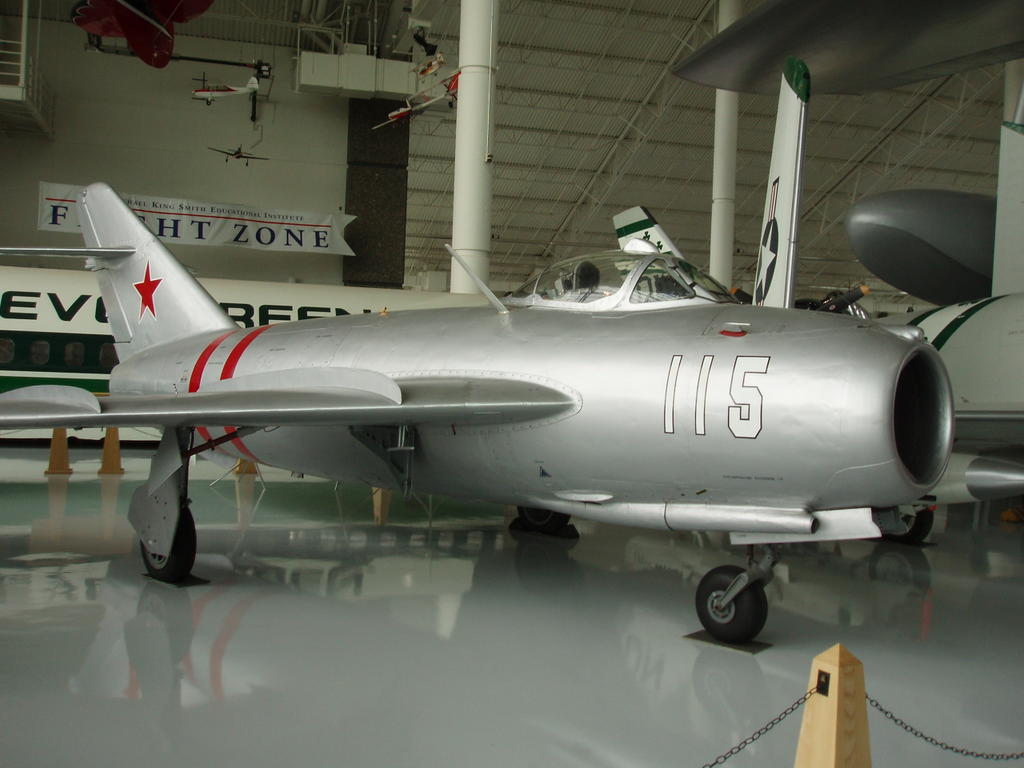 A MiG
Photo by K. Urner
Per our tour guide: the MiG's guns pointed upward 15 degrees for some reason, so the way to avoid being shot at was to fly very close to the ground. If you were shot at anyway, because the MiG was chasing you upside down, the pilot was probably Russian.
Subscribe to:
Posts (Atom)
