Showing posts sorted by date for query tetrahedron. Sort by relevance Show all posts

Sunday, June 28, 2026

Avogadro’s Drones

BRYG RGYB

In a recent thread on Synergeo, kicked off by one of the members, someone I’ve collaborated with on a specific color coding, in itself a kind of social engineering if one expects a standard to gain agreement. Tech standards such as USB depend on agreement on specs.

I talked about the drone swarms we might use in formation to create an n-frequency tetrahedron, meaning the drones would follow the CCP pattern known to the crystallographers. Check the thread for more details.

Friday, May 29, 2026

GitHub Borked Again

Borked
“notorious”

Important Followup: School of Tomorrow Notice
Prompt
An icosahedron face-inscribes in an octahedron. when do we first find depictions of this in civilization? 
Google in AI mode
The first known depictions and mathematical descriptions of an icosahedron inscribed inside an octahedron appear during the Italian Renaissance in the late 15th century, specifically in the works of the painter and mathematician Piero della Francesca. [1] 
While the ancient Greeks discovered the Platonic solids individually—and Euclid's Elements investigated nesting relationships like a cube inside a dodecahedron—the specific relationship of a regular icosahedron sharing faces with an enclosing octahedron was not detailed until the Renaissance revival of geometry. [1, 2, 3]

Wow, Piero della Francesca! He's already a superstar in our School of Tomorrow curriculum as he came up with that nifty formula for deriving the volume of a tetrahedron from its six edges. 

Put in any six edges in the right order, that make a legal tetrahedron (any of the BEAST mods for example) and out comes the corresponding volume.

What we did in the Python version is add in S3 and simplify the computations accordingly.

I'd link to the relevant Notebook(s) now but GitHub seems to have borked its notebook display function, we hope temporarily, thereby making my million dollar curriculum (free to clone) inaccessible to the casual viewer.

Borked

Let's hope they fix the bug, as a great many peeps use Jupyter Notebooks to share curriculum.

I recommend such Notebooks to anyone into showing computations alongside text and figures, along with version control more generally.

I know what I can do instead: pull it up in colab.research.google and save it in my Google Drive:

https://colab.research.google.com/drive/16Q85p4YU4f5AsA2L65ypMQJSHqyBprEl?usp=sharing

There's lots more info in the saved query BTW:

https://share.google/aimode/VA68IqZjF3cMIDwx5

[ Source: a Synergeo topic ]

Thursday, February 19, 2026

Reflecting on POVs

4D Arena
Alternative Closeup Vistas
(click through to Flickr for magnified view options)

One might imagine I’m some kind of super-nerd when it comes to POV-Ray, which I take credit for compiling on my Raspberry Pi long ago, and for getting to run well on a Mac, whereas its most-developed-for platform was Windows.

However when it comes to scene description language, used internally to that ray-tracer, I don’t consider myself an uber-master by a long shot. I might have benefitted from some patient teachers but having these tools at home made self-study an easy prospect to realize.

So it sort of came to me recently, that I’ve been too rigid in how I place the camera. I’ve been struggling with showing BRYG the way we want to: Blue to my left, Red to my right, Yellow behind those two, in the middle, but in the distance, and Green up above, at the apex, the eye in the sky so to speak. Like the BRY triangle on the ground is the base, the tripod, and they come together at a center (I make it Orange for origin) to support a mast, a flagpole pointing up, to the green orb glowing at the apex.

To be more specific, I was using rotation parameters over simply taking control of initial positioning. Rotating the camera involves orbiting around the origin on a great circle defined by the existing radius. But why mess with that so exclusively, just look from a different angle and rotate from there.

Why worry about all this stuff and what does it have to do with POV-Ray?  Well, put on a computer game developer hat and you will see right away that some in-common orientation makes sense if a team plans to play by some set of rules, usually necessary for a real game. Call them conventions. Call them axioms. Call them definitions. The terminology varies.

Again, my “insight” was I can render my scene with the camera looking at the origin from any location, and I have control over that location by means of XYZ coordinates, in the world coordinate system that comes with POV-Ray, the one native to its arena (or vista if you prefer). 

I’ll call my insight a “duh moment” as even putting it into words makes it sound so obvious, so how could it possibly be a breakthrough? Some breakthroughs are like that: you see the obvious (unobvious to you, hitherto).

But that’s just an example of how below the bell, to the left of the peak I mean, I am, when it comes to my POV-Ray (Persistence of Vision is what POV means, but also Point of View in the art world) skill set. I’m not confessing some great weakness. My French sucks even worse than my Arabic, which is saying something. I’m not a master of every skill set I’ve acquired. That’s really par for the course, nothing to exude shame over.

I’ve also played around with spawning a process from Python and running POV-Ray within that. However most of my experiments were of a different sort. Since the pipeline begins in Pylandia, and outputs in POV-Ray scene description language, why not output in something else? 

VRML was a first realized prospect, but browsers moved away from VRML (remember VRML? Virtual Reality Markup Language). 

What else? Why Visual Python of course, an API to 3D World mere mortals (like me) could master. I swapped out POV-Ray output for real time control of OpenGL (3D rendering). In Python that might mean talking to a different module. I did my original Hypertoons by this means.

The computer game I imagine we were working on (there’s a Made in Mexico angle) features a POV (point of view) that starts out looking at what I’ll call the TV Tower. 

A tetrahedron defines it. In some versions, three taut cables tether it tightly in its vertical state, pillar vertical, no matter high winds. In other versions, it looks more like a camera tripod with legs Red, Blue and Yellow. Yellow is in the back from our home position angle, staring at said tripod, and looking up the mast it supports, to the Green ball, which might be programmed. They all could be programmed. 

The lights at the corners could maybe exchange information (flora, fauna…) through the six edges defining the home base tetrahedron (HBT or HB4). This could be the premise of many a game.

Games conventionally come in levels and the game of “levels” comes in categories. 

Most commonly, the pyramid, narrowing towards the top and usually presented as 2D-flat, so we don’t have to worry whether its a half-octahedron or true 4eyes (a shoptalk) in this picture (3D-sculpture talk would take us there, is what we use here in QuadCraft). 

Alternatively: concentric circles, with “more inward” levels usually the more desirable direction. Percolating to a surface and breaking free, escaping, in any direction, is less commonly the story-driver meme, but “uncommon” is no put-down. Bell curves are what they are.

As readers here know, I think it’s low-IQ to think in terms of “races” in the first place, so asking how the races rank IQ-wise kind of puts one in a subculture, simply from asking. My subculture wouldn’t pose the question using obsolete eugenics concepts. We’re not kooks.

Saturday, February 07, 2026

Synergetic Arcana

In the backroom faculty lounge area, where Synergetics folks hang out, Syn-U folks for example, we're yakking about our lesson plans, curriculum segments, syllabus readings. I've been hammering out new ways to connect to BASKET from Quadrays, such as via this term "vane". The "vane" comes from windmill terminology; wind-driven surfaces, like propellor blades.

In this namespace, a vane is an isosceles triangle; six of them appear in our home base tetrahedron (HBT), our D-edged unit volume. Each is comprised by two caltrop spokes of length sqrt(6)/4 and an opposite edge of D. The Synergetics A module has a half-vane face, a right triangle. We have our segue.

As we start seeing more implementations of Quadrays, in alignment with our QuadCraft Project, how they're calibrated vs-a-vs XYZ becomes a topic, as do volume computations. My computer language encoded framework is one possible solution, already field-tested. 

I'm continuing to propagate it, by just using it.

Python:  Just Use It
just use it

Another isosceles triangle we want to promote, in the sense of analyze, is somewhat similarly shaped in having a wide angle, 108 degrees versus ~109.47 degrees. The two sides may be set to unit this time, or use the letter D, to remind of both IVM ball diameter, and of cube face diagonal (our volume 3). The opposite edge length is now phi.

Friday, May 30, 2025

Quadrays History


This account will be neither exhaustive nor objective in that I’m only able to define a puzzle piece within the limitations of my scope. I’ll say up front, though, that I cop to “running with them” in that US American football sense of heading for a touchdown, once in possession.

Here’s the gist of it: when Synergetics came out in two volumes, Macmillan the publisher, a lot of intrigued readers flocked to it, as many do to this day. They’d pick up on the critique of XYZ i.e. overly rectilinear thinking, but those already steeped in XYZ lore were seeing nothing number crunchy enough to take its place. Any computer graphics involving the so-called IVM (octet-truss or CCP by other accounts) would have to use XYZ coordinates to specify it. QED. Case closed. Synergetics is bunk.

Enter Clifford Nelson. He’d served in the US military and could program in ADA, the US DoD language named for Ada Byron (aka Countess Lovelace), who I introduce in my Graph Theory slide deck. She’s considered the first computer programmer, a title I defend. She lived in the first half of the 1800s, as a contemporary of another high caliber intellectual: Margaret Fuller. Margaret’s grand nephew was the author of those Synergetics books I’ve mentioned.

In my estimation, Clifford was a huge Bucky fan, as am I, and he wanted to fill this gap in Synergetics by retroactively retrofitting it with a non-XYZ alternative apparatus. He came up with something, coded it in ADA, and promulgated it as Synergetics Coordinates, almost as if Fuller himself had designed this new gizmo.

When I encountered Nelson’s work, I was already steeped in yet another alternative: Quadray Coordinates. This is back in the 1990s. Instead of ADA, Gerald was using Pascal, I was using Python and Visual FoxPro, and we were following along with David Chako, who had introduced us to Quadrays on what we called Syn-L, a listserv. I’m not sure to what extent the archives would be recoverable. John Brawley (different from John Braley) was on the list as well. David Koski joined us briefly.

I believe I was using Eudora on Windows as my email client back in those days. 

Somewhere in there, Darrel Jarmusch made himself known to us as the true inventor of the Quadrays and he had the web pages to prove it.

We weren’t really focused on any priority struggles regarding Quadrays though. Seeing their utility vs-a-vs Synergetics, I was doing essentially the same thing Clifford Nelson was doing, meaning we somewhat collided in our efforts. I kept pointing out that his Synergetic Coordinates were nowhere in Synergetics itself, nor were Quadrays. 

I the wanted newcomers to take responsibility for their own work and not try to “blend in” anonymously, as if our contributions had been there all along.

To this day I don’t really understand how Nelson’s stuff works and for all I know that work is still being developed by other developer teams. In ADA? That’s a language I don’t know how to read. 

My own Python codebase for Quadrays has gotten pretty mature in the meantime, but nevertheless let’s remember that:

(a) I am not the inventor of quadrays and 
(b) the code wouldn’t be that mature without contributions from many others

Others such as Tom Ace. Tom developed 4x4 rotation matrices and showed how we could produce the tetravolume of any tetrahedron using the determinant of a matrix comprised of quadrays to its corners.
 

He did all this while remaining skeptical of the Fuller corpus. He wasn’t motivated by the same motives as Clifford and I were.

By the way, if you’re knew to all this, maybe coming from a chatbot, don’t mistake Clifford Nelson for the Clifford behind Clifford Algebra. At least early versions of LLMs seemed to be making that identification, i.e. they were “hallucinating” as it were.

I’ve also had a lot of help more recently from faculty who insist on clarity and won’t accept overly hand-wavy answers as sufficient. Thanks to such peer review, I’ve been challenged to get even more precise and specific with the designs, which is not saying other developer teams are bound by the same decisions I’ve made. Where Quadrays go from here is not entirely up to me, but I expect my framework will be influential. Already, the Crescent City campus is commissioning a Quadrays for JavaScript (and other languages) endeavor. See Project QuadCraft.

What really drove my particular implementation of Quadray Coordinates was POV-Ray, a free open source ray tracer available over CompuServ since even before the GNU GPL had been invented. I’d taken to using that pretty early in my career as a personal computer (PC) programmer. Starting with Visual FoxPro, I would do my computations in terms of quadrays and then write out instructions using XYZ coordinates. Sharply rendered graphics were my reward.


Friday, May 23, 2025

IVM FM


These two images are meant to rhyme, visually. Let me give you some background.

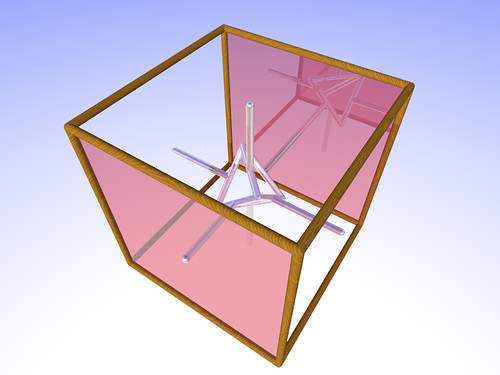
One of our teachers has occasion to make the origin of our Caltrop Coordinate System (CCS) not its center of gravity, but one of its tetra tips, call it Blue. Blue origin. 

We also want to orient our tripod tower vis-a-vis the Earth in an obvious way, akin to that of a radio broadcasting antenna. Call that vertical spoke Green. That leaves two more feet on the ground, aside from Blue. 

Looking from Blue, with Green vertical, have Yellow be on the left, Red on the right. We call this "the bridge" or BRYG tetrahedron (or 4eyes).

The idea is Blue is the actual point of origin, where the record gets played as it were, after which it gets pumped out through the Green tip, high in the sky. Yellow and Red anchor with Blue.

Naturally the two below rhyme as well, and sound the same themes. The camera angle is looking down a little, from a drone point of view. The background is not Earth's surface unless we see that as ice, 


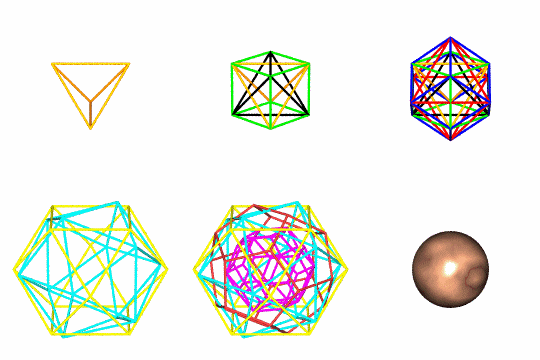
In terms of the CCP, closest cubic packing, there's the question of how we want it centered, on a ball or on a void. 

Where six balls hug a central void, the CCP might be anchored. Likewise the voids at the centers of four balls form two interwoven CCPs. That's four CCPs in all: ball centered, or void centered in three alternate, not-overlapping patterns. 

By "not-overlapping" we mean none of the four IVMs share balls with one another, even as they co-define their shared lattice.

We say Yellow stands for Sun, in the background, providing power, while Red could stand for blood and what's biological (burning, metabolic), the life that covers our Blue ocean planet and turns it Green.

Thursday, May 22, 2025

Ball Packing

Screen Shot 2025-05-22 at 6.10.52 AM

After developing the QuadCraft Project Jupyter Notebook, I turned my attention back to the Esteban-Struppi collaboration. 

Esteban is someone I met on the Metaphysics group on Facebook, where I unsuccessfully tried to drum up interest in 1.06066 (the Synergetics Constant) and the role this number plays in bridging the C.P. Snow two-cultures chasm. The kids on Metaphysics tended not to remember such a chasm and had little patience for my STEM-looking esoterica.

Esteban, on the other hand, turned out to share my obsession with geometric visualizations and we stayed in touch. Even if he was suspicious of Synergetics, he was fun to try explaining things to. He was engaged. I started sharing snippets of our Facebook dialog to the more publicly archived Synergeo.

Struppi is an established Synergetics shaman with a strong focus on specific hands-on crafts, useful for making lasting educational toys, a continuing source of insights. 

I enrolled in one of his workshops, long distance, after he caught my most recent video. I'd learned from our Telegram conversations that he'd kept up the dialog of Esteban and together they'd been going down a certain rabbit hole and wouldn't I like to go down it too?

I went down it to some extent, turning back around where the color coding got too intricate for my Python framework to follow, even if I was able to follow along conceptually, minus the coding component.  Struppi uses wooden balls, string, and drinking straws, not Python and a raytracer.


What I got out of the session was how one might prefer, when making animated GIFs, to pack from an apex ball to form a growing tetrahedron, with layers having successive triangular numbers of balls.  

Not only that, if one orients a quadrays caltrop (basis of a specific coordinate system) within the context of a tiny human observer standing on planet Earth, then that "apex" might not be defined by the vertical quadray (or call it the radio tower) but the radio station itself, the Blue ball in the foreground. 

Think of blue, yellow and red balls resting on the earth. Maybe imagine the sky and clouds as white and blue ice in arctic conditions.


Below, the packing starts in the Blue position on the BRYG tetrapod (caltrop), and marches rightward, aligning with Red, Yellow and Green in a 1st layer.


I compared these two ways of packing, center-out and apex-out, in a new Jupyter Notebook entitled Building the CCP: Apex-Outward vs Center-Outward Packing.

Saturday, March 22, 2025

Polys Framework

:: python source ::

In titling this blog entry Polys Framework I'm not meaning to impose restrictions on the name of said package.  Let's take a look at a script, the above snippet. Better form would be to explicitly close the file at the end.  Better yet, I could use a with statement (Pythonistas take note). OK, fixed it in the source (see test32).

What's interesting is each poly, out of the gate, at birth, has a default canonical volume. The Cube weighs in at 3, its dual Octahedron as 4. Tetrahedron is 1 and so on. Points A-Z have been defined, IVM lattice points, to which the five-fold poly skeletons will be added (Icosahedron, RT, PD). 

Right on the same line even, at the moment of birth, you may rescale all the edges and thereby scale the volume. Grow or shrink the new poly to any relative size, given its starting point. The concentric hierarchy is a static structure of default starting points, polys already inter-sized, with further action to follow from there.

In this case, we scale down the canonical volume 4 Octahedron to 3/4 of its usual edge lengths. The resulting red octahedron pokes out of the green cube's six face centers, whereas if unscaled by (3/4) it would have intersected the cube's mid-edges with its own mid-edges. 

David Koski did a lot of studies for this one, breaking it down further. My script was a zoomed-out treatment, in terms of details. Here's one of the vZome's he shared over Telegram:

:: Truncated Octahedron, vZome treatment, D. Koski ::

Below is the corresponding rendering, achieved from running the above Python source code within a framework which, behind the scenes, causes scene description language to be written, for POV-Ray, which then renders the described output as a PNG file (by default).

:: ray-traced rendering ::

Saturday, January 11, 2025

Surely You're Joking Mr. Fuller

Two Ways of Looking

In culty backwaters, or call it a swamp, where the sausage gets made, we have our little niche controversies. 

Perhaps goaded by Braingate, the controversy swirling around the two elderly gangsta presidents (were their faculties still intact? Not really, at least in Biden's case), and the subsequent coverup, some latecomers to our party have decided to retell the story around Bucky. 

According to them, our guy was too Alzheimery by the 1970s to really know what he meant in Synergetics, which means the rest of us have been engaged in a coverup, trying to make Synergetics seem more coherent than it really is.

This new "Bucky was senile" faction wants to purge S3 (an important constant) from the future curriculum, to spare people the need to understand what it's all about. 

They say because Bucky was close to senile by the time those two volumes were published, he was able to confuse himself about this nonsensical number (~1.06066... or 2nd root of 9/8).

But was he really that confused? We're talking about two conceptions of unit volume and comparing them. Both the cube and the tetrahedron will need to be sized, when the other is unit. We'll need a conversion constant in other words, like a currency conversion constant, between Tetrahedron Dollars and Cube Dollars.

If a tetrahedron's six edges are all twice that of a cube, then that difference in volume, one of proportion between them, is S3. The difference is only about 6%.

I think what makes readers doubt the sense of Synergetics is that what it does to the cube seems too drastic: a cube of edges 1 no longer has a whole number volume of 1, but of 1.06066...

That can't seem right to anyone already brainwashed to think "right angles rule" and "cube is king", the predominant orthodoxy. 

Surely you're joking Mr. Fuller!

Monday, December 16, 2024

More Curriculum Notes

TetraBook in Balls Format
:: photo by DBK ::

We have an army of geeks with M4 Mac Minis this Xmas, extrapolating from YouTubes, and a goodly number of them are running Blender. Some would like to break into Python teaching. I have some recommendations.

If you're a new kid on the block and want a ground floor entrance to an express freight elevator to the top, figuratively speaking, you might want to visit my latest Lesson Plan featuring S3, a number I was promoting to Epistemologists recently, at least to their admins.  S3 = 1.06066...

Polyhedrons may be related to one another versus studied only as individuals. For example, how the cube (3) and its dual (4) both nest, as short and long diagonals respectively, within the twelve diamond faces of the rhombic dodecahedron (6), should not come across as ungraspable mumbo-jumbo known only to esoteric clerics.

whole_number_volumes
V + F == E + 2

We're talking common knowledge on the level of ABCs. The dual of the cube being the octahedron.

However just reading such stuff isn't to get the visualization necessarily and for that we could use Blender. I date myself with my POV-Ray based approach, but the final rendering step isn't as critical as the guts, which is where S3 comes in, in our computations of volume.

Dabbling in Blender
1, 12, 42, 92, 162...

Since Piero della Francesca at least, in the 1400s, we've had a way to derive a tetrahedron's volume from its edges. Other such algorithms, starting from the six edges, have come along since. 

These formulae need to make a come back, as short computer programs, as we present an alternative to the XYZ approach vs-a-vs the tetrahedron's volume in our new paradigm, the one with the unit edge D, the unit volume tetrahedron. 

We may use the "from edges" approach instead, with S3 as a modifier, and/or use Gerald de Jong's method, which had no XYZ version in the first place.

Computer Volume

We have two principal targets after establishing the new volumes table: great circle networks and sphere packing. Of course the two interrelate and of course both have multiplicitous applications within geography, computer games, and crystallography, even psychology.

We spin our cuboctahedron and icosahedron, for example, to net great circle networks of 25 and 31 great circle networks respectively, and we juxtapose them. 

The sphere packing starts with our D-edged tetrahedron itself (D = ball diameter). The CCP, with D-edged tetrahedral and octahedral voids, is our Matrix home base.

How we got here though, was over the S3 bridge, and in Silicon Forest Martian Math, in the context of Sapiens coming to better understand an ET intelligence.

Wikipedia Volumes Table

The Mac Mini army has the compute to bring this literature into the foreground, perhaps in the form of anime. 

Sapiens and ETs meet on some Mesa and learn to collaborate on hydropower projects. The relationship is non-adversarial.

The lesson here is for those succumbing to phobias.

Humans have a track record of working together, and the global grids are what we're working on now, much to the chagrin of the phobia-ridden politicians who can't envision a world they don't control.

The attack on Nord Stream was an expression of the fearful reflex-conditioning of the more robotic lower half of the Bell Curve (less mindful), pampered juveniles groomed to feel entitled to management positions.

TetraBook Toy

Tuesday, February 06, 2024

Slinging Jargon

Screen Shot 2024-02-06 at 9.28.31 AM
RBF, Synergetics, Fig. 988.00 Polyhedral Evolution: 
S Quanta Module: 
Comparisons of skew polyhedra

I get flak sometimes for being such a Platonist, meaning what exactly? I'm OK with contemplating pure patterns of no obvious significance in terms of paying bills or putting food on the table. I'm simply pleased they exist. This is one way I pursue (and sometimes attain) a level of happiness.

For example, I'm assured by reasonable math-oriented folks that it's perfectly meaningless that the following ratios hold true:

  • S Factor: S : E :: CO(D) : Icosa(D)
  • S3: SuperRT : CO(D) :: Cube(R) : Tetra(D)
First: what does it all mean? and second: who cares?

S and E are two of the Synergetics BEAST modules, irregular tetrahedrons defined in terms of the concentric hierarchy (CH). 

The CH is the geometric centerpiece of Synergetics, R. Buckminster Fuller's transcendentalist geometry (i.e. philosophy).

The S modules, 12 left and 12 right handed, brick in the difference twixt an Icosahedron of edges S Factor (about 1.08), and its faces-flush nest, an Octahedron of edges D (2R) and volume 4. 

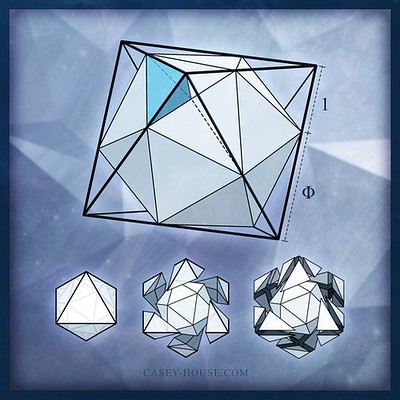
Here's a poster showing an S mod from Syn-U by Casey House:

S Mods by Casey House

The phi cut is along an edge of 2R (D). The IcosaWithin -- as David Koski and I call it -- with eight faces flush to those of the Octahedron, has edges S Factor, and a volume of about 2.92. 

$$S Factor = 2\sqrt{7 - 3\sqrt{5}}$$ (using MathJax)

All volumes are in tetravolumes i.e. the volume of the D-edged tetrahedron is our unit.

D is for diameter, R is for radius (1/2 the diameter). Icosa(D) is an icosahedron with edges D or 2R. Its volume is about 18.51.

Screen Shot 2024-02-06 at 8.27.30 AM

Cube(R)/Tetra(D) is known as S3, or "Synergetics Constant", and it relates the respective unit volumes within the XYZ and IVM contexts (namespaces) respectively. In the XYZ context, we take the R-edged cube for a unit, whereas in the IVM context, a corresponding unit of volume is a D-edged tetrahedron, a little less. S3 is about 1.06066.

The SuperRT is a Rhombic Triacontahedron, a triac, with long face diagonals equal to the edges of Icosa(D). Its short diagonals form a pentagonal dodecahedron (PD). The two combined give the SuperRT, which is phi-up from the RT of 120 E modules. S:E is our S Factor.

The SuperRT : CO(D) ratio is the same as the Cube(R) : Tetra(D) ratio.

Who cares? Those of us wanting to get our heads around the Concentric Hierarchy, the centerpiece of (backbone of) Synergetics.


See: Polyhedron Play section of this Jupyter Notebook Polyhedrons Я Objects

Sunday, October 15, 2023

Curriculum Queries


I do not boast lots of boots on the ground, inventing tests and tallying data. I might welcome such an army, using Python and Jupyter Notebooks perhaps. I share about pyplot and plotly.

I'm speaking with reference to such queries as where best to introduce figurate numbers, such as triangular and square, if we do, and when to make those polyhedral (icosahedral, cuboctahedral, tetrahedral...). I'm eyeing alternative vocabs. Sometimes it's the animation that matters, more than the script rendering language, a namespace.

What am I talking about pray tell? Like the numbers that go 1, 2, 3, 4, 5... then keep accumulating: 1, 3, 6, 10, 15... it's like scooping up the snow: all the layers of balls (if we think in balls) make us a growing triangle.  The triangular numbers: 1, 3, 6, 10, 15... Then we have the squares: 1, 4, 9, 16, 25... You know the ones, right?

We've got that going on, and then we layer-pack around a nuclear ball, per a cuboctahedral shape (cube of sawed-off corners), thereby getting our famous "successive layers" sequence: 1, 12, 42, 92, 162... I say "famous" because it literally is in the center of our neighborhood (along with the cumulative Crystal Ball sequence). "We have statues dedicated to it" one could claim, especially if coining an idiom. So where does all that fit in?

"Nowhere!" comes the resounding (highly opinionated) voice from some quarters. Curriculum developers don't just accept these queries lying down, without some furious debate. 

I point to The Book of Numbers by Conway and Guy and maybe that mollifies some (ah, mainstream). I reassure teachers that we're connecting right brained shapes with left brain numbers even earlier than by means of coordinate framework addressing ala XYZ. 

We haven't even come to XYZ coordinates yet and we're already getting rhombic dodecahedra in their space-filling role. "Are we to expect IVM coordinates then?" sounds sardonic but yes, we have those for you, why not be curious?

Then finally comes this question whether we want to not only disclose the ratios here, but harp on them, taking sphere packing as a home base worth fighting for. We shift our balance from the XYZ to IVM framework for a change. What change? That remains to be beholden, for the most part, but as someone shifting my balance, I'm suggesting it's not that hard, nor some kind of one way street.  You're free to switch back and forth. I do, routinely.

What am I talking about again, am I making any kind of sense? That depends to some degree on what archeological layer you're reading from. 

Those in the immediate radius of Buckminster Fuller (not me, I came later), in his role as academic, would recognize "isotropic vector matrix" in many cases, especially in the late 1970s after Synergetics was published. I became aware of Fuller's philosophical language in the early 1980s, as I switched gears from being a philosophy major at Princeton (Rorty, Kaufmann... other stars), to being a high school teacher in a private school in Jersey City (not that far from Princeton actually, by dinky, Amtrak and PATH).

The idea is one of scaffolding or tiling in space. The all-cubes way of filling space is well known and isn't going anywhere. The next step, if starting there is to supplement. XYZ and IVM co-exist in a healthy manner. Imagine filling every other box with a growing sphere, a 3D checkerboard. Each ball, fully expanded, touches 12 neighbors as 12 mid-edges.

"All fine and good" you're thinking, "but the hypnotic brainwashing animations described here sounds a lot more like rave party projections, too hallucinogenic for a math-minded audience."  

I'd say fair enough to speculate in that direction, but you really don't have to carry it that far. Surely you too know what it means to daydream in a classroom. 

That's a form of right brain engagement. 

To encourage this faculty is to constructively entrain the imagination, as we do when teaching the value reading in fiction (which is not to "push drugs" (as if any talk of "the imagination" were dangerous witchcraft)) i.e. "you get to watch movies in your head" as a grownup might put it, promising payoff (I understand why watching adults just staring at print, with no pictures, is a turn off until experienced in the first person).

The ratios of which I speak have to do with the so-called voronoi cell encasings around each IVM ball. Every IVM center has its "domain" is another way to but it. These are not Platonics in the strict sense of meeting the "all corners identical" criterion; the faces are diamonds and meet in threes and fours around two sets of corners: those at the corners of a cube (shallow, 3 facets) and those at the corners of an octahedron (sharp, 4 facets). Volume ratios: RD (rhombic dodeca) : Octahedron : Cube :: 6 : 4 : 3.

Why don't those ratios seem as familiar as rain already? Maybe to some of us they do, but the answer is the cube of volume 3, not its canonical most regal volume in the orthodox hierarchy. What dares take its place? A tetrahedron? Heresy!

That's the crack in the pavement a lot of storytellers keep tripping over, in wanting to make believe it's not there. Those of us in the curriculum design business can't deny that tetravolumes are tempting, in some contexts, especially knowing we're not admitting anything. We never have to say "XYZ was wrong" or anything like that. So what's the issue? Descartes is still a hero. We also study his Deficit (720 degrees).

I'm anticipating comments (perhaps by email) that I'm wrestling with ghosts, as none of the MineCraft literature ever talks about "another paradigm" i.e. a space-filling pattern of tetrahedrons and octahedrons. What would that world look like? Now we're talking (and maybe even imagining).

Sunday, April 23, 2023

Downtown Meetup

Richard's Award Address

One of my better decisions, in retrospect, and assuming this is something for which I might take credit (should I chalk everything up to fate?), was to get involved with the network of people friendly to Bucky Fuller's enterprise, including with Bucky himself (we exchanged communications).

I wouldn't stop there though.  

Getting mixed up with the Pythonistas was also a positive move, and so was mixing it up with the Centers Network (est), which gave me a boost, not financially so much as psychologically.  Going to Princeton and studying philosophy there:  also a good move.  

However it's up to me to turn all these developments into assets i.e. it's my own powers of transformation that turn shit into gold and gold into shit, both of which substances should be taken as metaphoric in this rendering of deeper alchemy.

Fuller's role as a steersman (cybernetician, trimtabber) involved getting people into networking.  Grunch of Giants is all about networks and networking, nowadays more structured thanks to social media, but still not in the mold of the LAWCAP corporation (LAWCAP being Fuller's coin, for "lawyer-capitalism").

Today I got to meet in person with another trimtabber, a member of the TrimTab Book Club no less, as I am.  Richard Ramsay was in Portland for an annual conference he's been attending for decades.  This time, he got an award from the chair for lifetime achievement, like an Academy Award in that discipline, of suicidology.

Richard was already an admirer of Bucky's, having heard him speak, and early on started phasing in some design science at the meme level e.g. by introducing the tetrahedron as a conceptual diagram.  He's well known in his social circles, and appreciated by many, for being quirky and innovative in this way.  

When Richard later found out how Fuller himself had been suicidal, and continued weaving that theme into his own autobiographical storytelling, the puzzle pieces fell into place.

I've been apprenticing in the field myself (informally, as someone with a longstanding interest in sociology and anthropology, and without seeking certification or credentials), since getting to know Richard and realizing its up to me to make the most of this opportunity.  

Social mores (customs) around suicide vary by ethnicity and continue to morph.  Richard has worked for decades with LivingWorks to help shape a consistent and constructive institutional response, at the global level, to this dire need for a social service.

In the fifty states the 988 help line has been inaugurated.  Canada hopes to someday follow suit.  The idea of a lifeline, a way to restart, is archetypal, embedded in lore, but how does it all work in practice?

We met in the hotel lobby and went out for pizza downtown.  Richard had kindly assembled some conference materials (program, decals, even a pen) on my request, so that I might continue to study this emergent subculture.  I learned a lot over our couple hours together.

P1340512

Monday, January 10, 2022

Four Directions


A lot of bellyaching goes on with regards to this concept of "cultural appropriation". I do agree that one culture may seize upon the memes of another, and from the standpoint of the originator, the new uses may come across as abuses.  "Are they mocking us?"  Maybe.  I'm not denying the "reality" of "culture wars" per se.

In my ethnicity, we have this idea of "class extends" as in Java.  The equivalent notion of "subclass" gives rise to different mental pictures.  The "extend" is to expand into a wide open space, it seems, wheres "to subclass" since like going inward to create yet a more specialized version of something.  Both connotations have their echo in actual computer programming.

Having done the Wy'East Lakota-based training, with sweat lodges, talking sticks, other accoutrements, especially the Medicine Wheel, I'm thinking to extend it (not steal it) to mean what it already means:  the four directions.  This is not a new thought for me, but perhaps my powers to propagate have amplified over time.

By "four directions" though, I mean "in space".  Paint the four faces of a tetrahedron:  yellow, white, black, red.  Four faces face the fullness of space by dividing it into four quadrants.  We might call this "the arrowhead" and its four points are likewise four pointers, indicative of space's 4Dness.

Wherever three face colors meet, the vertex might be of the missing color.

If made of stretched skin or hide, you'll have the connotation of "drum" and also "resonance".

Thursday, July 08, 2021

Canonical Lesson Plan

Sometimes I get a request for a canonical lesson plan, one that will capture the flavor and style of Synergetics, by which they mean the Bucky stuff.

What I'm coming to on that score is the four random walkers starting from the same lamp post in the CCP (=IVM), and wandering for t time cycles.  

The four randomly arrived at balls define the corners of a tetrahedron which, upon having its six edge lengths get run through our volume computer, will turn out to always have a whole number volume.  In tetravolumes, that is. Four CCP balls define our D-for-diameter-edged tetrahedron of volume one.

In order to calculate the random walks, we use Quadrays as syntactic sugar.  The IVM ball packing is their sweet spot, which is why they're "IVM coordinates" by some accounts (including mine), in contrast to XYZ.

In order to calculate the sixth edge lengths, we simply perform vector subtraction between adjacent corners. Quadrays have essentially the same vector algebra as XYZ when it comes to adding, subtracting, and scaling.

Finally, in order to calculate the tetrahedron's volume, we use Gerald de Jong's formula, even though he has lost his derivation.  There's no denying it works well.  

Six edge lengths go in, fanning out from any apex and circuiting the opposite base, and the tetravolume comes out, natively, with no need for a modifying constant.  

The corresponding XYZ volume is computed accordingly, as IVM volume times 1/S3 (S3 being the Synergetics Constant for converting volumes).

In sum, we needed to learn what the IVM was, and to visualize movement within it as a process of hopping in one of twelve directions, by distance D, at each turn to play.  Then we needed to absorb the concept of tetravolumes.  

Getting whole number tetravolumes for the tetrahedra helps shock us into a mindset that might be open to the concentric hierarchy, wherein those rhombic dodecahedral cells around each sphere, each have a volume of six.

All of the above, along with figurate and polyhedral numbers more generally, including kissing point counts, form our IVM-XYZ bridge over troubled waters, the C.P. Snow chasm.

Sunday, April 11, 2021

The Algorithm

compute a tetrahedron's tetravolume given its six edge lengths

I'm pretty sure the first time I saw Gerald's algorithm it was already expressed in source code, Java no doubt. I've also implemented it in Clojure just for fun and suggest on my Youtube channel that students use whatever language currently interests them, i.e. use it as a Rosetta Stone entry.

The constant e.g. 288 or 144 (a 2nd root thereof) was already absent from Gerald's version, and returning in tetravolumes was already the goal. I don't claim that wrinkle came in with the Python.

Given Python's "duck typing" it's easy enough to use the same source code to use arbitrary precision inputs (way beyond floating points in precision) and to use such as the plane nets for A, B, T, E, S modules in Synergetics to get these volumes and to interconvert their expression with Koski's versions, involving Phi (Fuller avoided using both Phi and Pi in his invented language of Synergetics, whereas adding Phi back in simplifies a lot of the dimensions).

I've also been frequenting a certain Wayne Roberts Principles of Nature website wherein he proves how the area of what he calls a "eutrigon" (one or three angles set to 60 degrees) is A x B where A, B are the lengths including the 60 degree angle, and C is the opposite edge connecting A to B. Multiplication is a matter of specifying the two sides and "closing the lid" (adding C). Lengths 4, 3 would give area of 12 etc.

area in ETUs

Using the same volume formula and treating the unit tetrahedron as analogous to Wayne's "ETU" (equilateral triangular unit), I show the model is entirely analogous i.e. lengths A, B, C from a common corner (picture XYZ corner as analog) give A x B x C as the corresponding volume, once again with a "closing the lid" operation, this time on a tetrahedron vs. a triangle.

2 x 2 x 5 = 20

Given the fixed angle of the ABC corner (that of a regular tet), the remaining three lengths are already determined and easy to obtain, for the purpose of feeding into the 6-edge-eating formula above.

I personally don't need a whole worked out math textbook with proofs + index in order to encourage developing coding skills while imagining a reference "sculpture" namely the concentric hierarchy from Synergetics. Your typical arts and design academy, where fluency with computers is baked into the curriculum, would have reasons to include this segment.

concentric hierarchy

Monday, January 14, 2019

Making Math at the Library

Phi Scaled S Module

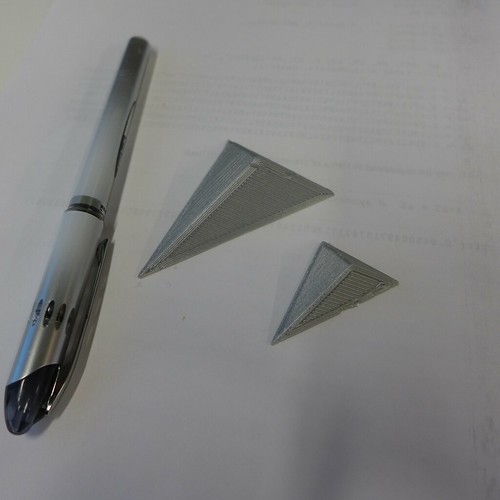
Unaffected, at least superficially, by the partial government shutdown, is the Multnomah County Library system.  Portlanders prize their public library infrastructure and it does offer some gems, such as this maker space in the Rockwood neighborhood.  I drove out there on Sunday for some free assistance with my 3D printing project:  to create three sizes of S module (S, S phi up, and S phi down).

Starting with a professionally developed CAD file donated by a Flextegrity developer, we printed a left-handed S-module shell + lid, at 50% scale, as the first 3D printer we tried would not have been able to accommodate the 100% scale version.

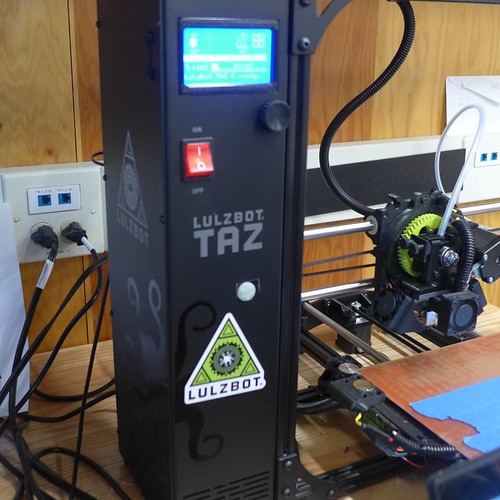
Then, even after switching to a Lulzbot Taz with a bigger bed, we stuck with 50% as the home position.  From there, phi down is about 30.9% (50% times 0.618) while phi up is about 80.9% (50% times 1.618) of the original size.

Lulzbot Taz

As the Youtubes explained, I'd be going from STL files to slicer software such as Cura, which would create the route for the nozzle to squirt its goo.

The smaller Lulzbot was loaded with glow-in-the-dark filament, which might've been cool, however I was happy to go with the silver metallic look and the bigger bed.

Slicer Software

In case you're hazy about the so-called "S module", that's a tetrahedron defined in Synergetics: Explorations in the Geometry of Thinking by R. Buckminster Fuller, which occupies a corner in American Literature.

Sunday, November 04, 2018

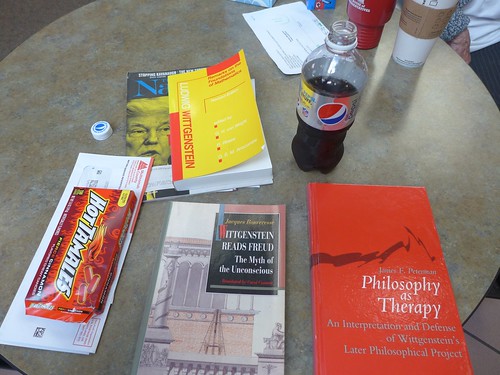
Philosophy as Therapy

P1070284

Adding to this medical theme, of therapy, is the fact that this photograph was taken in a hospital, in one of the cafeterias. This is actually in the adjoining medical offices building, adjacent the hospital proper.  Both Carol and I had appointments there.

Lacking any informative dialog with ETs in this chapter, we resorted to inventing them, or extending anthropology towards science fiction.  "Imagine a tribe..." is how Wittgenstein would start a scenario. "... that multiples differently" I'm adding.  Then I go into a riff on tetravolumes.

The point was to demonstrate "paradigm shift" in a simple way.  The duckrabbit type gestalt switches convey one aspect of meaning, central to Philosophical Investigations Part 2.  But not all language games come with such convenient Necker Cube type branding.  That's where an XYZ versus IVM set of coordinates comes in.

Why don't I just jump in to having ETs teach me this alien thinking?  Because I grew up reading Asimov and Heinlein wherein the author doesn't have to develop a relationship with the characters other than by creating them.  The Martians or ETs I create have a pedagogical (andragogical) purpose.  If it turns out actual ETs also use a tetrahedron for unit volume, we'll say humans were anticipatory in this chapter.

Or maybe we'll say ETs were actually among us.  I'm aware of schools of thought that would suggest a military interest in the outward technology, but with much less of an interest in a Vulcan mind meld, if you know your lore.  Some television has explored more the direction of meme exchange.

Martian Math, as a genre of science fiction with math in it, suggests at least a Platonic relationship with these alt-humans, i.e. a shared fascination with Platonic forms.

Lets use the IVM-to-XYZ conversion (switch) to (a) demonstrate the idea of a "paradigm shift" in microcosm and to (b) explore what might be considered an "alien" mindset.

Sunday, October 14, 2018

First Stop on the Tour

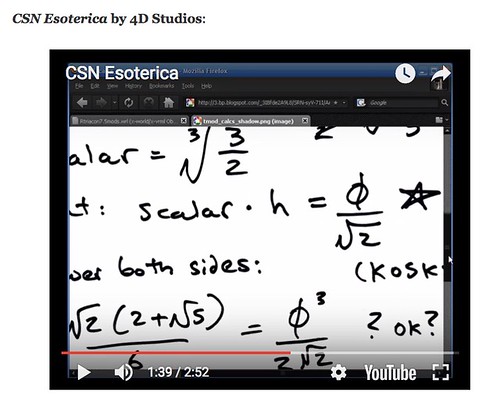
csn_esoterica

I was just posting to Facebook that "bridging the gap" would be a great first tourist stop in the mathemagical theme park (we use Python __magic__ sometimes).

Here is where we familiarize ourselves with the concept of Zonohedra.

A zonohedron has faces with opposite-edges-parallel (picture a stop sign), minimally rhombi, as well as opposite parallel faces, like a cube has, or a rhombic dodecahedron.

The rhombic triacontahedron is likewise a zonohedron and our "gap" inheres here, between two of them.

Consider two RTs (thirty diamond faces each) of almost exactly the same volume, but the one is a little smaller, making for two sets of faces, one set slightly within the other.

Along each radial, from the body center, two diamond faced centers occur, towards the tip.  There's a tiny gap between the two.

Here's the ratio we go by:  the RT inside, the slightly smaller one, has a volume of exactly 5, relative to the reference tetrahedron of edges 2R.

The ball of radius R very slightly protrudes, at each face center, a small hump, a pitcher's mound.  The apex of each hump marks the center of a 5+ volumed RT's face.

Each RT has a "nice" property:  a volume of precisely 5, a radius of precisely R.  The latter, scaled up by Φ, becomes yet another RT of volume 20 * √(9/8).

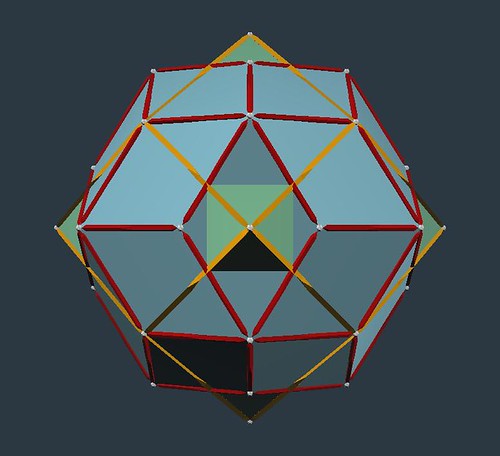
When we scale the smaller volume five RT up by 1.5 or 3/2 as a scale factor, its volume turns into 7.5 (red), and its radius into Φ/√2.  It now shares a set of vertexes with the volume 6 RD (yellow).

Rhombic Triacontrahedron

The new face radius, of the 7.5 volumed RT, will be the 3rd root of 3/2 times whatever it was before (call it h), since to boost a volume by 3/2, the edges need to expand by the 3rd root of that number, or about 1.14471424255333.

The resulting face center to body center radius (believe it or not):  Φ/√2 where √ and sqrt mean the same thing, arithmetically.

In other words, the original h, for which the RT has a volume of exactly 5, is Φ/√2 multiplied by the reciprocal of the 3rd root of 3/2, or about 0.99948333226234344.

Another tad-bigger RT, has a radius of R precisely, just a tad larger than the volume 5 RT's of radius 0.9995, weighing in at about 5.00775803133283.

The tag-bigger RT's volume is granule greater than 5, of necessity, but look at how tiny the gap in radius:  0.000516667737 is pretty small, compared to 1 R, the reference length.

That's why we might pay you to pay some mind to this little difference.  Without concerted attention, it might be overlooked.  Attention means concentration means doing work (measured in iota perhaps).

Let's take stock of what juggling balls we get in the air with this exhibit:
  • 2nd and 3rd roots and powers
  • the golden ratio Φ
  • the power rule (relating linear to areal to volumetric growth)
  • two spheres (and a thin wall between them)
  • a pair of RTs (tiny difference in radius, volumes 5 & 5+)
  • an RT of volume 7.5 sharing vertexes with the RD of volume 6
  • an RT of ~21.21 embedding the Jitterbug icosahedron (as long diagonals)
  • five concentric zonohedra (six counting the cube of volume 3)...
  • one of which is the the space-filling RD of volume 6
  • the concept of tetravolumes
  • T & E modules (RT)
  • A & B modules (RD)
  • alternative powering models
  • scaling by Φ
For a first stop, that's not bad.

What schools have a mandate to teach this stuff?  Paw through Youtube?  I'm finding more researchers getting a clue.

We might call this exhibit Prying Open Synergetics as we're managing to suck some sense out of a hairline fracture that came to light only after Dr. Fuller already had put some years of concentration into his newly emerging discipline.

Sunday, July 08, 2018

Parallel Processing

P1050666

I got some flak on Facebook from one of my friends, wondering why I bother to curate Youtubes like that, using one social medium to access another.  Think of stamp collecting.  The latest series had to do with rebuilding Aleppo, the grand mosque there.

Chalk it up to cyber tourism and wanting to "go there" with my friends.  This blog or journal was designed as the log book for a crew on the road, doing useful stuff like helping rebuild Aleppo.  Crews want to look back and tell their kids what they helped rebuild.

Bizmos have their fans, some of whom channel them funding to catalog order this or that artifact.  We see the transactions in the bright of day a lot of the time (bizmos leave audit trails).  Electrons move from here to there.  The crew will return in a future episode to help the locals install this pump.  Hospitals get stocked this way too.  Schools.

At the other end:  people in coffee shops, but maybe not that into coffee.  I'm borrowing from romanticized Paris, where we posit existentialism was born in meme form, only to percolate through coffee shops to show up on bookshelves, further catalyzing osmosis.

CSN doesn't assume "existentialism" is the philo du jour, yet draws in those scholarly fumes, mixed with Borges, Arabia, Alexandria.  There's a look and feel conducive to study.  In that atmosphere, you also have arcade games (we call them that for a reason) whereby becoming a champion may be of service to one's favorite crews in the field.

A team of three is cruising from Kabul to Istanbul and stops off in Shiraz.  Here we find some drawings by a street kid that lead us to this clutch of artists making some highly interesting models.  This crew specializes in mathy art, ala M. C. Escher and many more.  Think of that conference Bridges, which said "my" A & B modules were for the birds.  And tweeting I did:  let's 3D print these things, Makers!

Actually my art work was called Holding It Together in a Cyrillic language, and features six beveled faces of a cube pulled inward and held by tension on six cables to a smaller tetrahedron inside.  No glue.  If the faces are closed, there's a ship in a bottle feel to it.  Tension compression.

Держись!
Держись!

Anyway, that's the science fiction backdrop against which this journal is written.  Then we need Control Rooms to help dispatch and coordinate the bizmos.  This would not be efficient without the caravans and convergences.  Health care teams can't all squeeze in one vehicle.

Control Room is a sister blog, suggesting the role.  I worked for Clackamas County in dispatching driver fleets, an early template for the Uber model.  People bring different experiences to the table.

A lot of Africans are asking for borderless driving.  I was negotiating with some nationalists the other day, suggesting we could have a balance of Berlin Walls and lengthy queues, versus wide open areas in which distance driving was a given, a freedom.  No road blocks with checkers.

The thing about Africans is most were never consulted regarding the map of nations to begin with, so they're freer to start fresh with an unmarked globe, only to mark it up with other markup.  Substance control check points, like freeway weigh stations, need not be barriers across a road.

Picture a cargo container with QR-code and RFID getting off loaded in North Africa and making its way inland.  The sensors it drives by register its progress and GPS is involved.  People know the contents and blockchains know how to move tokens around.

Keeping a cargo container on schedule factors in ample time for the driver to find this a doable lifestyle (citizen diplomats need to compare notes at truck stops, sharing news and views, for the health of the economy and Pareto optimizing).

Remember drivers might hand off trucks.  Sometimes the drivers linger, enjoying coffee shops, taking classes for credit.  Sometimes its the truck that stays behind, on a charging station.  No one said a driver has to drive more than five hours a day.  Maybe some do but the rule books is flexible.

If you wanted to do some substance control, this might be the place, at the stopover, where electric tractor truck A switches its pulled container to electric tractor B.   Batteries may not support the long hauls characteristic of peak oil.  Tractors queue longer as well.  Drivers jump from rig to rig.

Some Bizmo fleets work the same way.  A lot of the customization (e.g. favorite tunes, dashboard instruments) get stored in the cloud.  I tool around town in this mobile office charged near the airport, only to turn it in three days later.  I'll be continuing my work in another city, taking meetings where I need them.