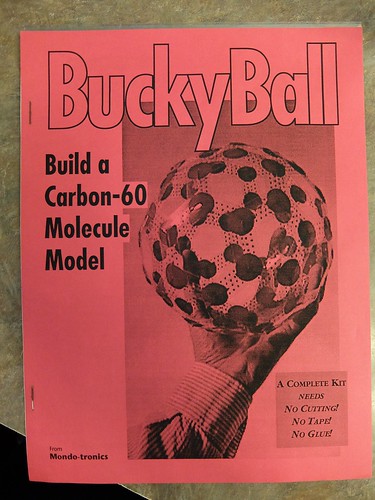
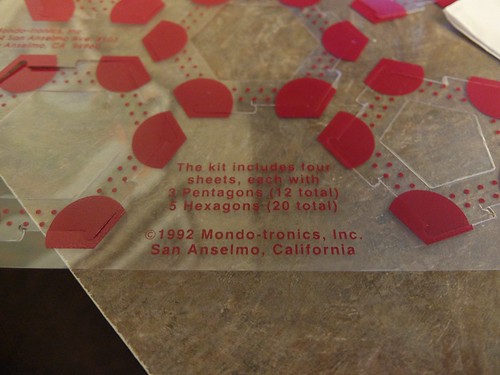
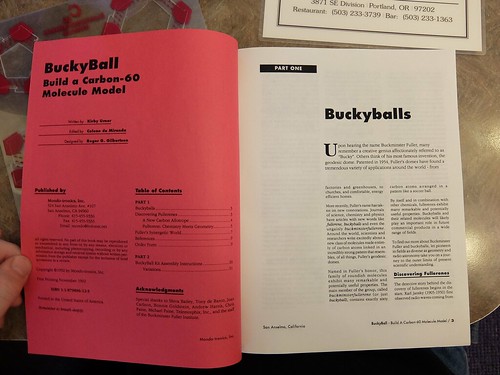
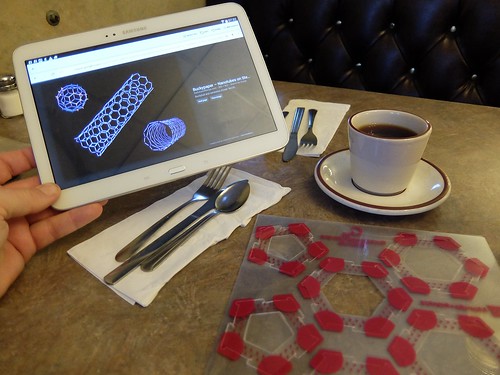
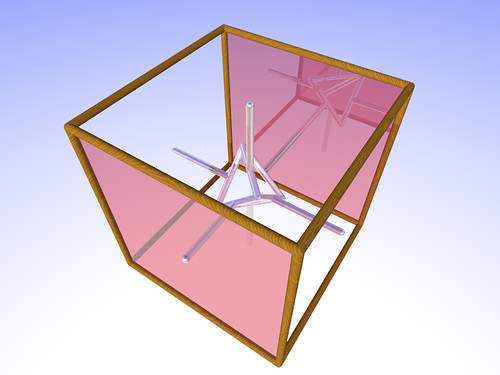
In the early 1990s I collaborated with Mondo-tronics on this first snap-together model of the BuckyBall, complete with an explanatory notebook, written by me.
Of course a lot of you loyal readers may have been wondering: "ya'll are going on and on about ya'll's Asynchronous Learning Engine (ALE) but what about the Google Classroom API?"
Excellent question.
Google's metaphors are more staidly rooted in the idea of a brick and mortar building with classrooms, whereas ALE has more hints of travel industry thinking. One may regard a lot of these differences as superficial, a matter of "skinning" (GUI = skin).
Having ALE and Google's classroom API both in the same genre or category is muy convenient as well, as that helps with comparing and contrasting learning engine models more generally, a discussion we need to have, as learning is now the core business of so many of us these days.
My work on ALE is influenced by years of working with Nano, an in-house solution wrapping an approach to andragogy which inherits from the DIY or "craftsman" schools, such as Make: Magazine. At the other end of the spectrum is kicked-back watching videos, passive absorption minus much kinesthetics. Combine both modes, but definitely the "off your duff" active learning mode is not the one to sacrifice.
Differences in philosophy need not be closely followed by an API; the same classrooms and buildings get used by all manner of faculty member and student enrollee. I'm not looking at ALE as staking philosophical turf except insofar as I've suggesting making "grading" ancillary, an add-on. ALE should be compatible with a non-graded flex-time style (self paced) but not dictate this template as a universal format.
Testing a prototypical Python course in the Google Classroom sounds like a worthy project. That would be hands on experience I could take to the bank when it comes to envisioning a next generation of Nano. Y'all would benefit.
ALE is vaporware as of this writing, a stub ready for test case development, however it inherits from a working version within an operational school. Google is ready for developers to start using its API today.
Google Classroom is an exciting reality and door-opening possibility I'm eager to explore more deeply. I've been nudging the Quakers about it, given priority access is reserved for non-profit / non-commercial enterprises. We could use it to conduct Interest Groups.
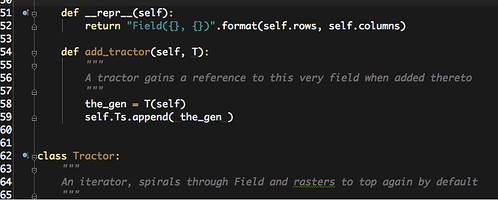
... the Dell in the Farmer. Lets think of a farmer riding a tractor, the tractor in a field. Yes, the farmer is in the field, but then so has the farmer internalized the field, a mental field. People do that with fields. In the computer language I'm learning, Python, the method for adding a Tractor to a field is a time to give the farmer, the self of the Tractor, a handle on the Field.
the self of "this Field" is provided to the "self" of the added Tractor
One may view that in source code at GitHub, where Lesson1.py defines the Field and Tractor, along with a subclass of Tractor for writing in the field.
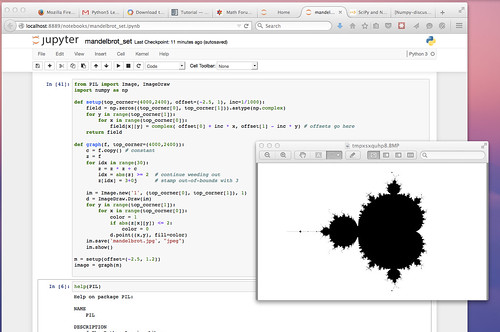
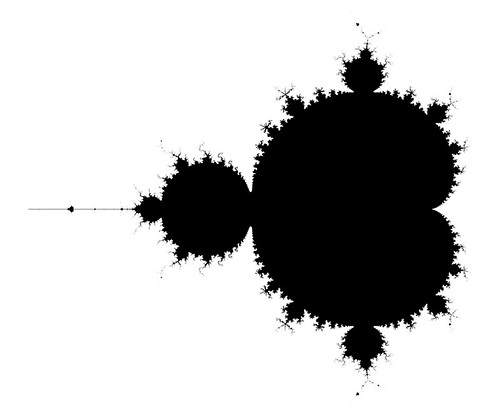
Then Lesson2.py defines another subclass of Tractor, the CropCircleTractor, that appropriately plows or plants a Mandelbrot in its Field. The output is just a text file, ASCII art, whereas in future Lessons one might use PIL, or POV-Ray, or VRML or even Visual Python.
The Field is an XY layer, a grid of cells each addressed by two numbers, a familiar tool. Piling up these layers, 3D Printer style, would be a way to encompass Volume which contains shapes we might address in various ways, perhaps with XYZ coordinates, adding Quadrays as a less familiar tool for contrast. The Mandelbrot might become a Mandelbulb instead.
The Tractor comes with a TV-like raster motion. A real tractor would turn around and come back the other way, but this one works more like a spiral, as if the end of a row connected to the beginning of the next at the other side of the field.
Then, having traversed the very last row and coming to the end, the Tractor magically reappears at the start again, to begin its trek all over. What we lose in freedom, we gain in the simplicity of the code. Provided the Tractor has enough fuel (there's a fuel_level), every cell will get visited within a circular topology.
Another subclass yet, of which I've already done some versions, plays a Game of Life using rule-governed cellular automata.
Might we alter the Field class to consist of hexagons instead? Games of Life may be played that way too, and are, quite a lot.
Could our Volume be as if filled with rhombic dodecahedra, perhaps using Quadrays again?
These vistas stretch out before us, which speaks well for the simple ladder that got us up this high, where we get lots of overview.
I'm going out on a limb here to suggest a hallmark of fictional films is they participate in the same voyeurism as fictive theater in denying there's either an audience or a point of view. We're complicit in this mutual agreement to suspend disbelief.
To call it "voyeurism" maybe makes such outright denial sound bad or dark, however the motive is innocent enough and has to do with removing any troubling metaphysical questioning from the viewer's mind, such as "how could I, in the 21st Century, be witness to a battlefield in a war fought over a hundred, or even a thousand, years ago?"
The obvious answer, "this isn't real" just gets in the way of getting into the fantasy. The whole point of a cave-like theater, bright screen, surrounding sound, is to "put you right there" meaning the thoughts we don't want to be pestered with are such as "I'm staring at a screen in a dark room at events that never happened." We can think that later, after getting our money's worth.
So just don't worry that movie cameras of this quality had not been invented yet and that those awesome sweeping aerial shots would have required technology unavailable at the time, not to mention awkward to deploy in the midst of battle. Forget the fact you were not alive at the time and could not have been a direct witness.
A long time ago we theatergoers got used to omniscient narrators who have the ability to flit about seeing and knowing everything, even the secret thoughts inside people's heads, given the power of novelists to create characters straight from their own imaginations.
We're told this "choice of voice" is a matter of tense and grammar, versus an author assuming superpowers to know in ways mere mortals don't. Again, we're complicit in wanting this omniscience and will trust our authors and directors to conjure its facsimile.
Fiction denies the camera. On the other hand, to acknowledge both an audience and a camera is not to escape the vortex of fiction and, in fact, escaping said vortex may not be the film maker's intent. Film and theater are art forms and fiction has always been fair game, ditto stage magic. Newsreels came later.
I have no quarrel with fiction, nor have most moviegoers as a clientele, those who are sticklers for strictly the documentary genre being a relatively small minority overall.
However, speaking of documentaries, many of those deny the camera too: there is no film team, this is not a film, is more the attitude. Perhaps we have an omniscient narrator, that tells us what we need to know.
Applying my criterion, I'd say such films tilt towards being fictional. Non-fictional films include the process of making the film somehow and acknowledge the reality of an observer making a difference in some way, if only in choice of scenes. An observer is also an editor.
Film removes two freedoms the novel reader takes pretty much for granted: the freedom to "make the movie" in one's own mind, to imagine the action, and to create a point of view from which that action is perceived.
The theater substitutes an imagined scene for a real one, acted out with scenery, and now the points of view are limited to those within the theater. Some are in the balcony or in boxes, whereas some sit below in the orchestra section. Buying a seat is tantamount to choosing a viewpoint, as is buying a pair of good binoculars (or opera glasses as the case may be).
The convention with film and TV is the viewpoints are chosen for us. This becomes more clear when we consider the alternatives. Some immersive recording devices provide a complete sphere or almost a complete sphere of action which the viewer may then swivel within, in real time, looking in different directions from a center point, as if turning one's head in all directions.
In ordinary movies, one has a choice of what part of the screen to gaze at, but even then, a director is directing attention, choosing an angle, and if engaged at all, we usually see what we're intended to see. Providing TV viewers with a remote control and the ability to pause, go forward, go back, pick a scene, play slowly... these were new powers that early ticket-buying film viewers did not enjoy.
Now it's getting easier to quote video, to splice it in, grabbing from free and/or for-a-fee sources. Making home movies that were clearly amateur was a possibility. Nowadays, more with less and ephemeralization have taken their course and the barriers to going pro are less physical than psychological.
Sometimes we can move between a fictional no-camera-here scenario and a more grounded one. For example, when newsworthy events occur, it becomes possible to watch the "same" event through multiple news shows.
The added realism may come less from the news shows themselves, and more from one's recognizing oneself as a chief editor, somewhere along the production pipeline.
"This is how I put it all together" one says to oneself, acknowledging one's process and assuming responsibility for a perspective. This can be value added work, sometimes called analysis, or perhaps synthesis. Perspectives, as much as perceptions, may be dangerously out of whack and should be tested, reality checked and reviewed. Keeping it fictive actually keeps us out of the danger zone in the sense that we don't care if it's "actually true" or not.
One may take that approach even when many of the news sources are doing their best to erase or deflect attention from any sense of a camera with a point of view, an innate bias. That's fine. Semi-fictionalized versions may be the best versions available.
There's no depending on any input stream to stay purely factual. Always allow for spin rather than fight the mere fact that spin exists, then apply counter-spin if you think that's in order or a part of your work.
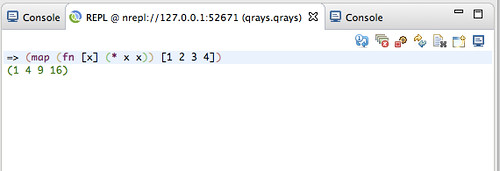
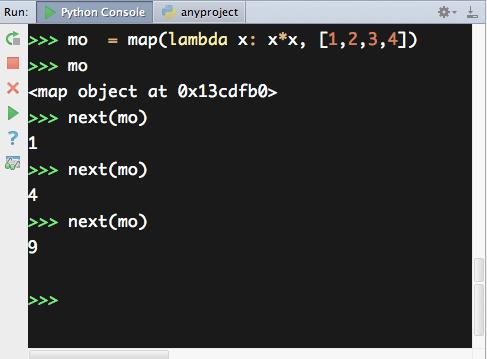
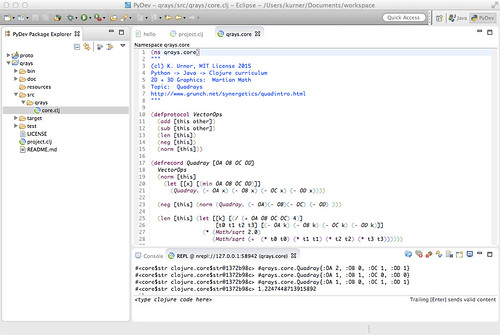
The above is from a Clojure REPL in the Eclipse environment (IDE), whereas below is pretty much the same idea in a Python REPL, in PyCharm.
The symbol 'map' is a built-in function in both languages and does the same thing: it applies a function to each member of a collection.
How the collections are named depends on the namespace: Python or Clojure.
The square bracket collection above [1 2 3 4] is called a vector and needs no commas as commas count as whitespace in Clojure.
Below, in Python, [1, 2, 3, 4] is called a list, though a tuple might have been used, in which case parentheses replace square brackets. Commas would be required either way.
What Python outputs is not another list (or vector) but an iterator, named mo in the example below. An iterator is by definition responsive to the next() function.
Each time the iterator is fed to next( ), it yields its next value in the sequence, by applying the lambda to a next element. One might also loop over mo in a "for elem in mo:" construct.
A lambda expression in Python is a way of defining a function on the fly that need not be remembered with a name. The Clojure function is likewise anonymous, using fn instead of defn.
Although full blown mastery of either Python or Clojure might be too much to expect of an average busy high schooler, with limited study and practice time, some exposure to both is not out of the question.
Let the spiraling begin!
A strong STEM curriculum would likely include at least some dialog with the various REPLs, with mentor guidance, and combined with self study.
Yak with Python. Chat with Clojure. Get used to having these tools around. They're free for the downloading (IDEs too). Instructional materials abound. Get in gear!
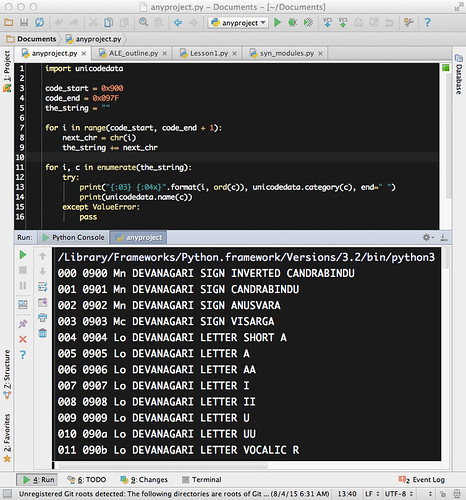
I just discovered some bogus information I'd been purveying, which is that UTF-8, a way of encoding Unicode characters (actually code points), may include up to six bytes per character.
In fact, that used to be the standard, but per RFC3629, when Unicode merged with an ISO standard, the cut off was set to 4, covering hexadecimal numbers U+0000..U+10FFFF.
The Python docs themselves give a clear, if abbreviated, introduction to the history:
There’s a related ISO standard, ISO 10646. Unicode and ISO 10646 were
originally separate efforts, but the specifications were merged with the 1.1
revision of Unicode.
This featured chronology at the Unicode.org website seems to stop in 1992 and doesn't talk about the 1.1 revision.
I used the saying "All math is ethno-math" almost as a slogan on math-teach, a listserv where I'd posted thousands of entries.
But what does that mantra even mean?
Well, there's this literary conceit inherited from specific cultures, wherein "our" brand of math is "universal" and in that sense, culture-free. "We're above all that" is the attitude (snobbish).
Peoples have wanted to get "above mere culture" such that, from an Enlightened stance, they could administer justice, lord it over those more mired in their cultural milieus. Cults assured of their "above it all" status will gladly let others know of their relative inferiority.
Mathematics, including statistics, invented by sociologists and statesmen alike (yes, mostly men back then), was to be the tool of Empire and, as such, a product of Reality Itself.
Imperial grammars all tend to assume great gravitas and may begin to exude that "sheen of eternity" -- a shiny polish or reflective veneer.
Those who speak the mainstream Mandarin will tend to impute "ethnicity" to everyone else. "Ethnic food" is "their food" -- perhaps delicious, but the point is it belongs to a "them", some "minority".
A mainstream mathematician is perhaps not in the mood to cop to any brand of close to home math as having any "ethnic" flavor. Babylonians and Macedonians had their quaint ways but by now our math is Universal, has conquered all corners of Planet Earth. That's an attitude.
However, in these days of post postmodernism, I think a far greater number of academics are friendly to the view that yes, all math is indeed of some ethnic flavor. We may and probably should study math in a cultural matrix, rather than erase or deny these special case roots.
But lets not confuse "ethnic" with "parochial" necessarily. World-traveling pirates who put in to many ports, with crews in turnover and networks of spies and informants across the lands, would have had more opportunity to develop what I'd call "cosmopolitan" traits. They'd be more catholic, more liberal in their outlook, one might surmise, more accepting of the diversity among the many cultures.
"Ethnicity" is one of those concepts that slices every which way. Really one might better say "cultural currents" or "lineages" or "traditions".
One may talk about "races" but also "genders" and "social classes" and "the professions".
Think about it for awhile, and you'll come up with at least a dozen ethnicities you might go by, easily more.
In light of this backdrop in broad brush stroke, I did some work to brand specific geometrical artifacts as "Quaker". That may seem quite weird. The justification or thesis had to do with American Transcendentalism, New England's in particular.
The traditions feeding Quakers include some poetic currents flowing through and around Bear Island, for example. The World Game idea, so attractive to Medard Gabel, is decidedly pacifist in competing with any War Game for attention. GENI is about bringing power to the people -- literally, in the form of electrical distribution networks.
Once a people have banded (or branded) into a "tribe" with some currency and reputation, with some semblance of self governance, then perhaps the mathematics they pass along to their progeny, like their myths and bedtime stories, might achieve the coveted "cultural" status, i.e. some of the artifacts, the algorithms, become museum quality exhibits, like exquisite baskets or china on display.
Certainly the ethnicity of "ancient Greek"-- as in "Athenian" -- became a hallmark in the annals of Ethnic Math. We all learned respect and admiration for those ancient Greeks and many of us gladly lay claim to that lineage. "We too are worthy heirs".
In any case, you'd be hard pressed today, in 2015, to find many if any Quakers (besides me that is) talking about "the IVM" or "the Jitterbug Transformation". You'll find all these terms, along with the associated mathematics, on the web, and in Wikipedia, but any adoption of such topics by Quakers is hardly on anyone's radar. "Not just me, but still just a few" would be my assessment.
So consider you may have stumbled upon an esoteric memeplex then, possibly of some potency. Stay tuned.
The audience for Websites does not have to be "the public"
i.e. a tool used inhouse to do an existing job is more our focus.
My background is in medical research, heart stuff in particular.
Why not start with the heart as a STEM topic?
In learning to program a website, we might focus on anatomy more generally, but how about we start with this amazing pumping device and the service it provides: sharing oxygen gas as well as metabolized food, to hungry cells throughout the body.
The beating heart is a very physics-oriented topic, ala First Person Physics (FPP), in that it's bio-electrical and has specific throughput to maintain, at a set pressure. The alimentary canal aka digestive tract would be a next system to explore, with musculature and skeletal framework providing the means for motion, including within an environment.
Elastic Interval Geometry (EIG), somewhat obscure but well-developed in software by Gerald de Jong and some others, provides a bridge topic twixt ordinary vector mathematics, developed in our { Python ↣ Java ↣ Clojure } spiral, and muscle-bound creatures with traction, on a planetary surface. Gerald invented Fluidiom to model a kind of genetic algorithm whereby those elastic geometries with the most ability to "get somewhere" rose to the top.
EIG simply applies tension and compression values to Edges, where any Edge is defined by two Vectors. The vector tips or Points do not really exist in a sense, in that all the math happens in the connecting intervals, the "I" in "EIG".
Stretched to longer than equanimity, the Edges pull, work to contract, whereas those compressed beyond equanimity press to elongate. The vector sum of all these tendencies takes us to a next iteration in some smooth animation.
Going from all "resting" Edges (no forces) to a regime of pushing and pulling, ala the Tensegrity or "floating compression" concept by which EIG is inspired, takes us from a Platonic Realm into something more energetic and unsettled, capable of far-from-equilibrium dynamism.
But those Fluidiom creatures are still purely mathematical and don't need a beating heart to "get somewhere", which brings us to the cardiovascular system as a place to anchor fluid dynamics in a different sense.
In FPP, we're keen to generalize around the concepts of Energy and Energy per Time i.e. Power. Metabolites, impounding solar energy in the form of hydrocarbons e.g. sugars, power the ATP cycle whereby the "bio-batteries" continuously charge and discharge.
Some folks are understandably confused by all the jargon, as in "what's a virtual machine?" -- one needs context to resolve that. Some VMs host operating systems however more usually it's the reverse: an operating system (such as Windows 10 or Yosemite) hosts one or more VMs.
A breakthrough in recent computer science was the building of some "Great Pyramids" we never see in the desert, and yet they take gazillions of people hours to build. They're packed with fancy algorithms.
I'm talking about the engines that specify their own bytecodes to which other higher languages might compile, and then those languages the run on top of them.
The JVM is one of the best known of these pyramids and is the target for several not-Java languages, the Java Virtual Machine having started out as Java's host within a platform (also known as the JRE or the Java Runtime Environment).
Whether you have Android or Windows or Linux, you have a JRE free for the downloading, plus often it's pre-installed.
Thanks to the JVM, one of the paradigm Object Oriented languages (Java) and one of the newest Functional Programming languages (Clojure) have become interoperable. They both target the JVM. Java coders can take advantage of what a Clojure genius writes, and vice versa.
The .NET VM, another virtual machine with open standards (i.e. world class), is likewise a shared target for interoperability: as long as we all share the same Common Language at Runtime (or CLR), we're able to interweave our programs, and therefore our subcultures.
IronPython and IronRuby are examples of the higher languages targeting this VM.
Python has not been left out of this equation as Jython, supported by Oracle, likewise targets the JVM. Learn Python on its native C-language VM, then move to Jython and Java, in route to Clojure as a way of rounding out your language savvy. From that beginning, you're in a strong position to branch out.
On edu-sig (Python.org) and the Clojure list (a Google Group) and other places, I'm noticing this ecosystem, of Python + Java + Clojure, and suggest we embrace it.
Having one IDE (integrated development environment) that does all three is a big plus. Eclipse and IntelliJ both come out on top as strong candidates for this role.
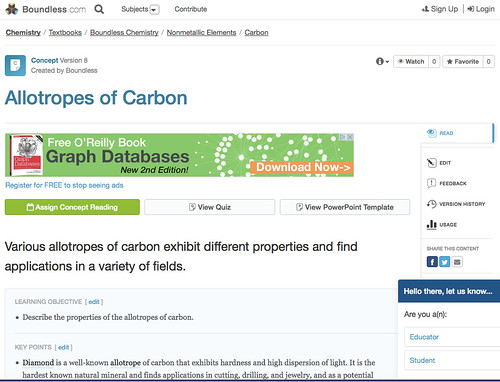
I've been looking at the Allotropes of Carbon as a unifying theme when it comes to developing 2D and 3D graphics on computer as a part of an integrated STEM curriculum.
Graphene is flat (2D) whereas buckyballs and nanotubes are more 3D -- as is diamond of course.
A customary drawing tool for 2D graphics is the Turtle, as in LOGO.
I'm interested in extending that theme, though with adults I'm pushing the Tractor as an alternative.
Instead of a "Turtle object" we have a "Tractor object plowing the field" -- a read / write activity on a 2D surface -- a field being a simple data structure, an N x M matrix of (X, Y) cells.
We're used to XY square grids and XYZ cube grids, however given Carbon as a theme, I envision more hexagons (planar) and 3D analogs e.g. space-filling rhombic dodecahedrons.
How hexagons tile a sphere with pentagons, ala the soccer ball, is where the buckminsterfullerne comes in, as a strategy for dividing spheres.
If anyone else is using carbon chemistry as a unifying STEM theme, around which to integrate various mathematical exercises, I'd be interested to learn about it.
Adding computer graphics to the curriculum gives leverage to those wishing to escape the hegemony of scientific calculators. Break out of the 1980s!
Today it's easy enough to provide each student with a desktop in the cloud e.g. an EC2 instance on Amazon. That's the direction we're moving in at my school.
Yes, I literally get my history from bars sometimes.
I was at Mulligan's tonight, with Patrick. The beautiful and uber-competent Diana was behind the bar (someone I know through Steve) and poured my Guinness.
Patrick was smoking outside, despite the 90F degree weather, and we were joined by a young woman, training to be a public interest lawyer, who wanted to share about the USS Indianapolis.
I listened with fascination as she and Patrick compared notes.
This ship was somewhat in the black ops category on that particular mission, delivering components of the atomic bomb intended for detonation over Hiroshima.
August Sixth is coming right up, and this morning at Bread and Ink I was yakking with mom about upcoming ceremonies. We think of August Sixth as Disarmament Day. That may seem parochial to some readers.
I'd left my camera at Patrick's, where I'd visited for a company all-hands (video patch in to Sebastopol). We went back for it from Mulligans, then hopped a bus to Lucky Lab. Another co-worker, Paul, expectantly waiting for us, learned of our recent adventures and conversations over a pitcher of Super Dog IPA (one of my favorites, right up there with Hawthorne Best Bitter).
Thursday is game night at Lucky Lab, meaning board games are in evidence everywhere. As a World Game player, I'd cop to being into gaming (game playing). We just didn't happen to have a board.
Earlier I was outlining a role playing game in computer circles for mom, using the analogy of Pragmatic versus Evangelical Friends (Quakers) the latter being more into Theology as a discipline, which should stand for "any orthodoxy".
We also talked about Howard Zinn and Noam Chomsky. Mom sees Noam is a good role model for a long haul activist, which she is too. They're actually both 86. Zinn lived a pretty long time too, 87 years.
The more orthodox computer scientists treasure the theoretical purity of Functional Programming languages, of which the LISP family is a model. When MIT switched to Python for pragmatic reasons, some theologians felt that as a betrayal and sell-out to the Object Oriented camp, where state is more mutable and the code arguably more pragmatic.
Speaking of mutable states, when we got to Lucky Lab, board games all around us, I said one way of telling history is that in using an atom bomb over two cities, the US actually lost WW2. Only losers use nukes. The Nazis had wanted to be an uber-power (Third Reich). Was a superpower all that different? Einstein later said had he anticipated what the monkey-brains would do with the new physics, he'd have become a watchmaker. The real USA fights back, is anti-nuke weapon, same as Iran.
Of course that's not the accepted narrative, and I footnoted that my world view was influenced by what we might call a "post-nationalist memeplex" citing Grunch of Giants (by a US Medal of Freedom winner), meaning I had an easier time with "bent" history (another form of science fiction).
Our public interest lawyer in training, at Mulligan's, was not one of those "motivated by money" as many want ads say they want on Wall Street (still true?). Financial analysts (aka "quants") can get religious too, about their craft.
We talked about age a lot with the young woman (Patrick and I are both in our fifties) and a Louis C.K. segment on that. Then our discussion veered off into cannibalism and the original true story behind Moby Dick.
:: a lecture commemorating Fuller's 120th birthday, by Trevor Blake ::
Trevor regales us with stories about Fuller "dog trotting" (as he called it) in his underwear (to stay healthy) and obsessively "keeping a chronofile". Today we call that "jogging" and "using Facebook" (in some domains) and neither habit seems that weird. Fuller made a career out of being a "weirdo" (i.e. "ahead of his time" aka "an early adopter").
Fullers' mind / brain model was server / client, making the metaphor of "upgrading" easy to come by even before we had "the cloud" (we at least had "heaven" i.e. the state of everything working flawlessly, and then the "afterimage" i.e. a lagging human understanding).
Quaker's too use "expectant waiting" as a term for seeking divine grace i.e. illumination (enlightenment) -- an ongoing process (continuing revelation), not so much a moment of satori as the ongoing possibility of satori. Referring to this extra-human (super-human) source as Mind simply tinges the discourse with a Gnostic flavor. Whether one might go on to distinguish Mind from Being in any formal way would of course depend on one's namespace, e.g. which flavor of whatever Transcendentalism.
To what extent was Fuller's "walking away" from the Wichita House enterprise an after-shock associated with the Dymaxion Car's overturn? Everything looked so hopeful around the car, before it was run off the road in some pissing contest, just before showtime. Things might go wrong with the house as well: one might fall off the pole and squish the family pet. What controls did Fuller have over the quality of assembly and might not a few visible failures set us back? He was gambling at a high stakes table and did not feel like bluffing, nor did it yet seem a winning hand. He folded.
Trevor reminds us to what extent "Dymaxion" came to mean encampments and camp equipment, refugee camps, people making the most of what little they had. The Occupy Movement was about instituting insta-government where possible. City downtowns were not ideal for long term experiments but did serve to (A) recruit large numbers instantly, to the possibility of such communities and to (B) serve as demonstrations of where we're at, in terms of ability to coordinate. One might focus on disastrous aspects of these scenarios, but as an OPDX logistics person, I saw a lot to admire in the mechanics as well.
As I was discussing with Melody this afternoon, I think learning to cook contemporaneously with the task of wrapping one's mind around concurrency patterns in programming, in say Clojure (to pick a language), is a great example of a positive synergy, not least for the cooking skills acquired, let alone programming. She was over saying good bye to Lindsey, currently packing for Corvallis, where she's a student at Oregon State University. But then Newar Studies (not an official OSU major, something she's putting together across departments) will be taking her back to her main studio shortly. I'm on tap to drive her to PDX.
Buying the keynotes and talks as a post production recording actually costs money, as a way to recoup, so if you find a vintage year (they're all vintage) for cheap, say at Good Will, you'll know it's a good buy. We also stream live, so if you time your life to watch the keynotes, they're available for a window. OSCONs provide telling snapshots of the swiftly evolving IT world from year to year.
Now I'm back in a second floor ballroom, Oregon Convention Center. TriMet is doing maintenance today, on the Max track itself by the look of it. I came on the Hawthorne bus (14) through downtown and switched to Max, getting as far as just over the Steel Bridge, Memorial Colosseum area. The walk from there is quite short, plus shuttle buses were provided (I walked).
So did you see George Dyson, historian, talking about Imitation Game? He wanted to remind us that Turing was very much a team player and quite popular with his group, not uncomfortable around women or socially awkward in the ways depicted. In other words, he was not the endearing dweeb played by a good actor, a character more of the movie-makers' invention. The movie never claimed to be a documentary right? People need to be reminded about genre.
The Uber geek, Raffi Krikorian, a polished speaker, wanted us to understand how "choosing your team" is "choosing your architecture" in large degree, if only implicitly. Engineers use the tools they know best. So build eclectic full stack teams, and keep them smaller (two pizza rule) rather then letting them grow out of control.
That's the way to manage teams: around micro-services, the wave of the present-future, now that so-called monoliths have been tried and understood. That's not to say "no more monoliths" only that if others want to use your monolith, they'll probably want it containerized within the cloud.
As any geek will tell ya, the philosophy of doing one thing and doing it well is baked into GNU and before that Unix, so micro-services is less a new dogma than data centers hitting their groove, finding a scale at which the concepts apply.
"Interoperability" will keep coming back as a buzzword.
Finally, for a last keynote of the morning session, we enjoyed a retrospective of milestones passed, by a precocious thirteen year old girl from LA. She gave us the benefit of some wisdom, about not judging a container by its color, as well as a peak into her busy inner life. She'll have a resume to die for at this rate... already does.
I've come to a final talk entitled: A centralized team in a decentralized world: Engineering tools at Netflix by Mike McGarr (@SonOfGarr). He presents clearly and memorably. Recommended (if you find OSCON 2015 for sale some place).
Just like an airplane experiences thrust versus drag, lift versus weight, engineering tools give us innovation versus change, customers (like lift), the need for support (weight).
Customers, in this scenario, are Netflix engineers. Netflix sits on Amazon a lot, Asgard being one of the open source tools it supports, watch for Spinnaker.
Netflix has its own culture (Freedom & Responsibility): senior engineers, high trust, context not control. Somewhat like doctors in a practice I imagine. Highly aligned to business goals, yet loosely coupled, the teams get behind microservices just like that Uber guy said. This leads to strong subcultures within the organization, reflected in hiring.
Echoing Amber, software engineers need to give undivided attention to coding on occasion. That means rotation in setting a watchman. Let someone monitor feedback letting the others bliss out. Not having a ticketing system was a weakness. My workplace uses JIRA.
All this thinking aobut Netflix gets me thinking about "hypertoons" again, polyhedrons of scenarios (as edges) with switch points (nodes). The nodes are smooth segues and switch points. Player heads navigate the hypertoon, feeding the reveries on CSN LCDs, and elsewhere.
I'd never thought to take that phrase suddenly: "cooling my heels" -- what does it mean? Deke, a long distance runner in his college years, a "track star" as we say, recommends submerging said heels in a bath of ice cold water. I've been trying that, with just the one heel.
Also in the leg department: Sarah the dog's have gotten rickety to where she can barely walk. I have to help her up on her haunches, at which point she's able to teeter around. She has an appetite. Given I'm at home a lot, working, it's feasible to keep watch and monitor.
I'm due to see a certified M.D. in the near future, having heard Louis C.K.'s doc's prognosis already (a comedian, lots of Youtubes).
I've learned the "embed" tag's API allows for start and stop times i.e. one may excerpt using HTML. My thanks to John Denker on PHYSLRNR (a listserv) for digging that up for me. We'd been talking about how one "quotes" video (off-list).
I'm cooling my heels in another sense: just hanging out "on the hallway track" as we call it, sitting quietly with other geeks, each submerged in a laptop. Conversations carry on quietly around me.
Most geeks are in their tutorials, but given dog care duties and yakking with Carol and Lindsey, I opted to join the hallway track on the ramp up to lunch, blogging and managing my queues. I'm wearing my O'Reilly School of Technology T-shirt, bright red, with name badge to match, with the black Stetson, just to add a touch of West Region (or West Zone or whatever it is).
Having my Fujifilm XQ-1 back is fun, as I zip around snapping some great angles in a quiet period, the lull before the storm. A large influx occurs on Wednesday after the optional two days of tutorials on Monday and Tuesday. These tutorials are a professional investment for many present i.e. that Docker tutorial I attended yesterday will for some be a springboard to future professional development work.
Thoughts of professional development bring me back to Quaker business, and the conference I just came from in Spokane (at Whitworth University), and the emerging possibilities for some positive synergy twixt the Friends and geekdom.
Earlham College is already a recognized center of excellence in computer science, for undergrads and eclectic types especially (the emphasis is undergraduate education at that school, similar to Princeton in that respect). A dockerized Python + Neo4j core designed to help a Monthly Meeting self-manage its affairs might be a fun pilot project, already embarked upon for all I know (my stirring the pot does not amount to a "project" yet, minus any shared repository).
The thing about Quakerism as a worthy target for textbook CS projects is they have so many moving parts yet a logical order, amenable to both SQL and no-SQL based treatments.
For example, every Monthly Meeting has its Standing and Ad Hoc Committees of rotating membership, often with staggered (partially overlapping) terms, each with clerks and recording clerks, cross-enrollment ex oficio and so on, with regional structures to boot.
That's a lot to graph, beyond a mere flat file listing filtered on tags.
I've been emphasizing Unicode aspects of the design on our NPYM IT discussion list (a Google Group). A visiting delegation sporting name badges outside of Latin-1 could have phoneticized English for local consumption. The badge wearer may choose double-sided, just Cyrillic, or whatever.
I updated Sam Lanahan by email this morning, about David Koski's finally finding another explorer showing up in the same ballpark of phi-scaled tetrahedrons and their many assemblies, including with details of Holding It Together (a tension-compression sculpture).
Once again I found myself at a Pythonista lunch table reminiscing with an old hand about the heady days of Zope and Plone. Both these open source projects have served as valuable opportunities for talented coders to evolve the technology of the Object Database as a breed.
In the dinner line I suggested she refer to me as her "est
vet Friend" in Landmark circles. "I'm like the Viet Vet who can't
quite remember to say Ho Chi Minh City and keeps saying Saigon" I explained,
meaning I continued using the word est to refer to Landmark stuff sometimes.
Carol (mom) has a hard time specifically remembering when Jack (dad) did the est Training in Washington DC. "He did a lot of things" she says. We were living behind the Capitol building, not off DuPont Circle like that other time. Lon Golnick was dad's second weekend trainer. That was the summer Bucky died. I got the news when we were heading to Friends General Conference (FGC).
Mom's
not remembering dad's doing est came up at dinner last night, as she overheard Sara and
I yakking about Landmark. My two trainers were Ron Browning and Charlene Afermow (the training lasted over two consecutive weekends, for which different trainers were deployed).
I was reaching a peak around my est
activism in those days, picking up on some urgency from Bucky Fuller
and elsewhere. I was return-addressing my envelopes from Erhard's San
Francisco office, earning me a phone call from his lawyer who told me to
cut it out. We'd had friendly correspondence too though, that office
and I, so chalk it up to stormy times.
Applewhite was uber-suspicious of est when we first met. Our friendship was far from a done deal at the outset, despite my evident fascination with Synergetics.
We had our ups and downs, as I reminded him the last time I came to his
apartment. "You can abbreviate all that" he said, meaning no need to draw
it out into some long story or soap opera.
He was then in the process of shipping off
collected papers to the Standford Archive and wondered what of mine I
might want to hold back. I kept most of a file labeled "Quirky" (my
writings range from the quirky to the whimsical a lot). That would have been in 2004.
Another issue between me 'n Ed was I'd at one point lept to the erroneous conclusion, based on a "close" reading of Cosmic Fishing,
that "E. J. Applewhite" was one of Fuller's pseudonyms and was a clever
allusion to what a human brain looks like when sliced.
Fuller
has a strong mind / brain distinction running through his works and I
thought it clever he gave his brain a pseudonym and had it doing all the
filing and other mechanical grunt work to get Cosmic Fishing published, not to mention really solo-authoring Synergetics. One could see where Ed might not be amused by my error, which earned me some mocking down the road.
Anyway,
Sara ducked out of Annual Session to keep current with one of her
Landmark activities, which she was able to do in Spokane (she had been
doing them in Portland). Whitworth U is just outside Spokane's city
limits (right?), as I discovered wandering around in the car, looking
for a Wal*Mart.
The Nikon Coolpix Melody gave me to tide me over while the Fujifilm XQ-1 is fixed (actually "replaced" is the latest word from Camera World -- under warranty) has the older Compact Flash memory cards. I'd been to two Fred Meyer's
and not found a reader, but then the electronics sections of the
various branch stores carry much the same inventory, so saying "two" was
over-dramatizing the situation.
Wal*Mart, with a
somewhat larger inventory, had a SunPack multi-format card reader that
did the trick, resulting in my being able to read the card(s) and share a
few pix to Flickr, where I created an album for NPYM 2015 (embedded
above). Wal*Mart saved my bacon in Richmond, IN that time as well,
after the cleaning crew locked away all my charging devices.
I
yakked with Larry at breakfast this morning. He came by Alaska
Airlines. He's a licensed pilot himself, but renting an airplane is not
a small cost. A plan to have someone to fly out with him and return the airplane to Portland that same day did not pan out. Chris met him at the airport and they went
geo-caching on the way back to Whitworth U, a sport akin to treasure
hunting and involving GPS devices and a loose community of peer players.
Our theme this year is Quaker Craft, and our keynoter Robin Mohr was faithful to said theme.
The connotations were comfortable: handicrafts, carpentry, pottery, guilds with apprentices. The sense of craft as in "crafty" was somewhat missing. No one said "witchcraft" out loud. No connotations of shamanism, at least not obviously.
Quakers the World Needs: what would those look like?
The imagery was fairly conventional: we need Friends who:
Visit other Friends in the hospital (no mention of jail)
Help at the Food Bank maybe (the Luchinis do that -- most active Friends in our region)
Address one's own racism (in some way other than swilling in guilt we hope)
The liberal-academic middle class profile was much in evidence, with specific mention of:
listening to NPR
driving a Prius
dutifully replacing incandescent bulbs with compact fluorescents, and
learning what not to say to friends in the hospital (following the rules of social etiquette is important)
NPYM Friends tend to be car-owning good doobies in nuclear families (on my resume too!), so what else is new. We're comfortable.
Encouraging: Gayle in her intro mentioned Robin's Twitter profile. Robin herself mentioned discussing ideas on-line as a way to practice. Of course I'm thinking "listservs!", a technology Quakers under-utilize.
Quakers have said for ages that, semi-sardonically: we started out wanting to do good (like the saints), yet ended up doing well (as in wealthy).
Yet these comfortable Quakers also want to be "dangerous" according to some of their (our) aspirational literature. Really? Seems like science fiction right, as in pretty far out. Who could seem less dangerous?
Formation in the Vocation of Being the Quakers the World Needs: that's what our Friend in Residence considers our business.
Robin herself is general secretary for the FWCC section of the Americas, FWCC being Friends World Committee for Consultation. Coincidentally, Nancy Irving and I were chat partners for "share your Quaker credentials" exercise.
Nancy was FWCC general secretary when we visited in London that time, plus has served on God knows home many committees. Improvising a fun answer, I confessed to my role of "Quaker Pirate" (pointing to my black hat on the floor to prove it, an now the Whitworth University Pirate T-shirt).
Speaking of confessions, Alan Mountjoy-Vinney noticed I was acting like a professional cameraman and as board member for Western Friend suggested I might be the best one to help editor Mary Klein, who'd sent out a call for pictures in advance of her being here later.
Actually, Mary had already suggested by email that I play that role (in addition to her board people), but in my own mind that was contingent on getting the XQ-1 back from Camera World. But it wasn't ready in time.
So instead, I brought along an untested-by-me vintage Nikon Coolpix which Melody very thoughtfully rescued from a free pile and passed along, knowing how much I missed the Fujifilm. This Nikon is old enough that even its memory card is hard to find a reader for anymore.
Anyway, I tried confessing to Alan I was somewhat faking it, until I figured out if this camera's pictures were worth sharing. I've yet to see the final images, pending acquiring said reader. Thank you Melody, for thinking of me (she went to Witch Camp again this year, used to work with AFSC in Austin).
Putting the keynote theme another way: Quakerism is a factory for making more Quakers (yep), stamping out more in the same mold. Query: what does this factory look like and what does the world need more of, in terms of product? Good question.
Speaking for myself, I'm not convinced the world needs any
more middle class Protestants of the North American variety, evangelical or otherwise. Of course
it's really not up to me and they'll keep flooding in by the legion no doubt. However, insofar as I'm
helping to design and build a next Quaker factory (a next Quakerism), I'll tap other influences a
lot more.
What influences?
We had mic runners, which reminded me of est, but only a little. A few years ago I picked up some resonance with Scientology, but just a tad.
Maybe the world really does need more est people, per that science fiction novel, by S. Clark Stevens I still need to read. Note to self: download Kindle edition if available (whoa, hard to find! Expensive!).