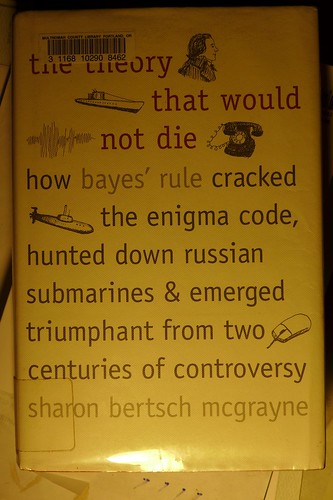
This is the one to read after Cryptonomicon, which is historical science fiction. This newer one, The Theory that Would Not Die, is availing itself of a lot of the same information. As author Sharon Bertsch McGrayne points out: a lot of this wartime business didn't start to trickle out until the 1970s. The people who participated were forbidden to share their experience, for "national security" reasons.
The premise of the recent movie Churchill, was that Winston had huge doubts about the wisdom of D-Day, and took comfort in the idea that the weather might be on his side. He tried his best to talk Eisenhower out of it.
According to this recent history of Data Science, Eisenhower possibly had access to deeper secrets from the UK's own Bletchley Park than Churchill did, and knew, from intercepted and decrypted communications, that Hitler saw a Normandy landing as a likely bluff, and wanted his generals to gird for the "real thing" should it happen.
That told Eisenhower his deception was working.
I knew a guy who'd served under General Patton in the UK, where the goal was to appear to be amassing a large army, such that aerial surveillance would be fooled. The Germans would think those were tanks, but they were closer to inflated balloons. The Churchill movie doesn't talk about all this.
I remember when this older guy I knew, a WW2 veteran, finally felt free to share his experience: the New York Times had published a story on the fake army just that morning or thereabouts. This was way back in the 1980s.
Alan Turing, on the other hand, was never allowed to talk about his critical role saving Britain. Churchill was very keen to have all evidence destroyed. Exactly why again?
Why do politicians have the power to order mass destruction of anything, anywhere? Because we authorize them to do so? So we can scapegoat them later when things don't go as planned? Yeah, something like that.
Enough still unprocessed warring has gone on to last lifetimes.
The violence voyeur is always seeking some new spectacle. A younger generation comes along and asks itself "how would I behave in wartime?" Some seek glory.
Maybe we don't need you to find that out? How would you behave if war were not a goal?
Politicians continually need assurance they'll be able to whip up war fever, and float a lot of trial balloons in that regard, just to see where they stand with the minions.
The minions, for their part, get bamboozled into one war after another, because they don't get the time or space to really study. They repeat the same mistakes, having too little time to learn from mistakes already made.
"Stop the world I want to get off" is the cliche complaint people ridicule, knowing there's no stopping. However, without reflection, life stays shallow and superficial. What would it be like to let generations really learn their own past?
We have enough raw material to last many lifetimes. Do we really need to create more gratuitous karma for ourselves?
Slow down and learn about what has already happened. Wouldn't that be a huge luxury? You could still tour, enjoy those cruise ships, explore museums.
We didn't need you to start new wars. Maybe you did anyway. You might have thought elective wars would get you elected? Is that what your donors told you? Were they paying you to get a war on?
We use these short little acronym in government (Cyberia) all the time. ML = Machine Learning. DL = Deep Learning. If you don't know what these mean, you're likely a left-behind politician with too little time for engineering to really govern (steer).
As a newbie in the circle of ML / DL teachers, I'm very humble. I sit at the feet of favorite teachers and sponge it up, tasking my own neural net to re-weight and re-bias as necessary. Get to the bottom of all these meanings. Investigate. Don't assume, coming in, that your namespace is well-tempered (well-tuned).
My approach is two-track. First, I've somewhat abandoned doing everything in Sphinx, not because I have any issues with Sphinx, but because of my own weaknesses and shortcomings with regard to Github. There's a final step wherein documentation might "go live" in world-readable (open source) space, but I'm not taking it. Second, I'm staying with Python.
Track One: manual skills, like when gardening, you need to know how to use a spade, trowel, shovel, bucket, weed whacker and so on.
Track Two: conceptual grasp. The latter comes slowly or at least at its own rate, less under conscious control, whereas practicing with matplotlib, numpy, pandas and scikit-learn APIs is eminently doable of one's own volition.
My focus is on polishing Track One manual skills and remaining patient with the "slow dawning" that is the gradual emergence (surfacing) of any knowledge domain. I can't rush Track Two whereas if I burn the candle at both ends, I can practice the way athletes practice: you keep at it.
Keeping these tracks separate has one big advantage: I don't have to apologize for taking the ten thousand foot view and going for broke on Track Two, all out of proportion to what my manual skills yet allow. I'm barely able to dig a trench yet am already studying the intricacies of orchid raising, or beekeeping (not usually considered part of gardening, but then really everything is).
My humility does not translate into refraining from actually studying the magic. I just have to admit I haven't practiced enough, nor re-tuned my model enough, to fully minimize the error function (cost function). I'm still getting to the bottom of ML DL (gradient descent).
Wanderers, who meet frequently at the Linus Pauling House on Hawthorne, tend to be familiar with the World Game idea, and a couple of us at least, have actually played it. Francher showed up at the ones led by Buckminster Fuller himself. I played it in Eugene, and in San Diego, when Tara was just taking her first steps.
We're reading about the passing of Jay Baldwin at 85, an American hero and lover of cars, who escaped New Jersey and headed for California along the open road. His love of cars would steered him towards Fuller, who developed a three wheeled Dymaxion Car at a critical juncture. Then came the Dymaxion House. These were props we could use on the World Stage (where World Game is actually played).
I'm beginning a new course on data science tonight and want my students to get in touch with their internal data scientist. I think some of us get turned off statistics for the same reason we don't really like economics: the topics are too dismal, to fatalistic and deterministic. "I'm not a statistic" the ego cries, fitting the model. I know I've eschewed thinking like a data scientist most of my life. I'll confess that, and discuss techniques for overcoming such limitations.
World Game connects to Club of Rome in that humanity was newly becoming aware of its ability to model reality based on big data, or any data at all. Computers could churn through the number crunching, according to whatever algorithms. Humans would be free to focus on the algorithms. We could turn our mathematical understanding into a better tool for forecasting. These were seeming like superpowers.
I wrote on the Club of Rome in eighth grade, for Mr. Craden's sociology class. We had sociology at the Overseas School of Rome. Dad subscribed to The Futurist, was an urban planner in charge of drawing up fifty year plans for the government of Libya. I took for grated that humans were meant to "think big". That was part of our role. During a crisis period in Jersey City, I came to doubt that such thinking mattered, as it never seemed to gain traction. History did its own thing, never mind how we planned it. I've come to a later synthesis, still being fine-tuned.
World Game is all about anticipating, forecasting from data. Even for that reason alone I should be grateful for this opportunity to retrain and change the relative weights in my neural nets, feeding more power and influence to my internal data scientist. The free open source tools I'm learning to use help me play World Game more effectively. The very process of learning to use them helps me project what the personal workspace (PWS) of tomorrow will be like. The PWS is a core concept within GST.
Glenn rented this one from Multnomah Public Library. He'd read some Kerouac novels and grew up in the same generation, more or less. Jack was a pack leader, of the Beat Generation, but feels ambivalent in his role.
Glenn recognized City Lights Books as iconic and said the real one was bigger than the one in the movie. He pulled out a book he'd procured there.
Mostly it's a movie about alcohol and its potentially devastating impact on many lives, extending well beyond the drinker's. The movie is also about truth-telling and keeping it real. The characters care about one another, they're just not sure how to express it.
Here's poor old Jack in what we might call a utopia, a cozy cabin at Big Sur, friendly supporters, and with a dream girl and her beautiful son. She's eager to be his life-long companion, and yet he's suicidal and in hell.
Viewer jealousy may be forgiven, but must Jack really suffer that much? What were his sins that he cannot enjoy his own fame and fortune?
These beatniks were too undisciplined, drinking while driving, forgetting to make plans.
I understand they needed to escape an overly constraining, fiercely racist environment, and that the psychological cost of alienation was an occupational hazard. Wavey Gravy, another beat poet, did a better job transitioning.
The youthful rebellion gathered momentum, and by the hippie days was more self-defining. Or was it? Jack Kerouac transitions to Ken Kesey and the Grateful Dead.
The hippie era was somewhat less blighted by alcohol perhaps, in that the hip cool thing was to explore psychedelics, which have different side effects. This movie doesn't need to tackle the subject of entheogens.
As an Oregon voter and taxpayer, I'd like to know more about these new security protections Oregonians have a right to know more about. Anyone into cybersecurity knows its about adhering to open standards using source code anyone can check.
That's how NIST designs stuff, around Elliptic Curve and AES. Oregon has Vote-By-Mail so I'm curious what people see as vulnerable to Russian attack.
I know my curiosity will be met by a cloak of secrecy if the plan is actually to further heist the system by making it opaque (less transparent). That'd be hard to do given the stated objectives and follow-up audits we'll be demanding.
Americans (in the US sense) have long distrusted the voting machine
infrastructure, dating back several elections. I haven't seen many
claims that this sense of distrust traces to Russian propaganda.
Rather,
it seems well-founded and based on actual cases of tampering that have
come to light, most notably purges of voter rolls using deliberately
sloppy techniques designed to spread collateral damage among specific
demographics.
Those who studied the black box voting machines found
much to criticize.
So where is NIST in this picture?
Does the US commit
any funds towards researching and developing the infrastructure of
democracy?
If MAGA means anything at all, it would have to mean looking
to the US for role model, trusted technology around voting, combined
with best practices.
The US is very far from that now, with most
judging bodies saying US elections no longer pass the sniff test. There
may be moves afoot to hold the Russians accountable for Stinky Politics
Nation (SPN), but that could easily backfire. Blaming all one's problems on a convenient enemy has a way of not working out.
One might argue it's a tad tabloid, histrionic, pulp fiction. In a word: corny. So there you are, the audience, perhaps with popcorn. Here are your freaks: more beautiful than average, in a world of cruelty. Quite the novel (soap opera, whatever).
The setting is the time of hobos, men sans work, riding the railroads to redistribute their labor, much as Amazon caravaners, other Dead Head type tribes, do today. Wandering gypsies, in a Gypsy Economy. Welcome to 2018.
The plot features a triangle: circus impresario (reminds me of Bug's Life) with stunning wife-horse act, hires protagonist of Polish background to work with the animals.
In a desperate economic gamble, an elephant is acquired, and it turns out she speaks Polish, meaning the impresario with anger management problems manages to not wreck his own circus for at least awhile longer.
Anyway, I was really impressed, especially by the elephant playing Rosie.
Queued for Iranian TV? Total film nuts, like the Japanese.
Anyway, I'm proposing it for Pyconic conferences, for the movie track (similar to the hallway track, quite informal, more like BOFs).
"The idea that “height, width, depth” fall apart into three independent linear dimensions always seemed somewhat sleight-of-handy to me, and I resonated with New England Transcendentalism when I found a like-minded skeptic, one R. Buckminster Fuller." https://t.co/j0UrMLTk2j
The progressives say Russiagate is distracting from the student debt problem, plus so many Americans are political prisoners of the Feds, post the ending of Prohibition (part 2) on the part of several states. Facing these issues is too painful for those with no solutions, so the scapegoats are to blame. An old story.
In the meantime, geeks such as helped win WWII for the British, the Turing Types, have transformed the face of education to where the logical API is your dorm room studio aka home. The lectures are all there, as are opportunities for two-way and multi-way communication. Concentrating on making the home a true PWS (personal workspace) makes more sense than borrowing money to invest in someone else's digs. How many homes might one person afford (a great many, in some cases)?
The point: "free college" as some imagine it, might not be as brick and mortar nor as easily paid for on the backs of young people. Getting relief from those loans might involve entering another service, one that pays loans back, but perhaps in a devaluing currency. Inflation is on the side of borrowers right? Not all M1 denominated in dollars are actually Treasury bills. But I'm getting ahead of my story.
Maybe we could pay them in Bitcoin or other cryptocurrency to redo college but in a different way, one that involves work/study which could mean world travel, and you might not have to wear a uniform or carry weapons. The world is getting really sick of weapons and those who find them necessary to their survival. Weapons used recreationally, not for crimes, are not actually weapons, nor sold as such. A nuance of the language.
Anyway, I think patriots of all countries can rally around a university system that rescues more than it impedes. There's a transfer of wealth going on, in entropic terms, from the sun to the earth, meaning an increase in entropy there, leading to eventual gigantism or brown drawfism, is feeding syntropy here, or potentially is doing that. Or ability to order information has gotten rather good, what with big data and server farms and all.
Russiagate looks like an attempt to stop hacktivism and assert Federal control in new overreaching ways. The move to criminalize self expression is quite one sided, with corporations free to pour money into Federal coffers, but forbidden to engage in private ventures unless friendly to same, willing to pay tribute and bribes. A kind of extortion is happening, whereas a lot of the geeks who worked hard on this railroad were not doing so for the aggrandizement of any District, of Columbia or otherwise.
We'll see if the FBI is successful, in combination with the Patriot Act and other tools, in continuing to prosecute anyone using social media in ways disapproved of by the DOJ or any of several players set up to enforce a set of rules within a particular jurisdiction. Those using Facebook to advertise their post Prohibition product lines are engaging in activities the DOJ has criminalized, or so they might soon allege. But how does one tell Facebook to deny Californians access to home grown social media? Silicon Valley is not about to surrender its economy to east coasters who don't know bash or think Ubuntu is some kind of drink.
Magic Squares in NumPy, who is doing them? I'm not saying they need to be auto-generated. Copy some well known ones into code and run the NumPy version of sum along each of the two Magic Square axes.
A sudoku would be another data structure to model. You can get to each sector with what's called a "view" or slice into just those cells, no extra memory for the data, just the overhead of the frame. A sum in each sector keeps track of same.
As a former calculus teacher, now into statistics, I'm thinking we don't do enough in standard high school calc, to bridge probability density functions (PDFs) with their integrals, their cumulative distribution functions (CDFs). So what if closed forms don't always jump out at us? We've got the numerical tools to power through without those if need be.
I'm glad to have an API with the school system. I thought Measure 97 might bring that about, and approached the Methodists about a certain Code Castle. I also named a sculpture in my living room "code castle" and covered it with stuffed dragons.
Instead, I got a part time teaching job after school and get to chat with parents and teachers, other guardians, several times a week. When it comes to teaching adults, Californians are more ravenous for a geek diet than Oregonians it seems. I'm happy to feed a hungry neighbor.
"Code castle" (the sculpture) is being recycled for parts and the Spooky Castle (former church and community center) showed up in my Jupyter Notebooks on what we call "context managers" in Python. They have their __enter__ and __exit__ methods, the latter perhaps charged up with Exceptions it needs to deal with.
Jupyter Notebooks, for those of you who wish to learn, are interactive web pages you may run locally (i.e. on localhost 127.1.1.1) that talk to a kernel such as Python or Haskell or maybe R, the statistics engine. I need to remind my students: Jupyter came from Julia, Python, R as the initial target languages of an expanded I-Python Notebook project.
I'm keeping an eye on my political radar, but when it comes to putting out blips of my own, I'm finding Facebook most congenial. Twitter too. These platforms are ideal for PR, and PR is what I do.
Of course Twitter is infested with bots. There's an API to tweet from your programs. Who wants to hire some poor stooge to make stuff up when you can just have a rotating queue. Let C-level executives commit, just like Trump does, if you don't delegate to your CMO.
Along those lines, I'm not seeing where PR firms based in Russia get off the hook in having their operations exposed, but then we also found out about Bell Pottinger, the UK-based PR firm that colluded to "sow discord" just as IRA (Internet Research Agency) is accused of. Quoting an earlier blog post:
The idea of Russians buying ads on Facebook doesn't bother me even a
little. The British do it too, which bothers me a little more. I don't
trust British suspicion of the Russians usually, as it relates back to
their inheriting Roman Imperialism, a meme virus. Americans were
infected with that too, and tend to crow about it as a chief asset.
Just look at DC's architecture.
Anyway, the idea that nations seek to influence election outcomes does
not disturb me. It's a tiny planet and we all have a stake in the
various outcomes. The sooner we acknowledge what goes on, and stop
trying to deal with it by criminalizing it, the better.
As thought-leader Kyle Kulinski (Secular Talk) points out, one man's "collusion" is another man's smart business plan. There's no law against making friends with friends of the enemy, unless one has such complete control of the law that one is able to legislate permanent "good guy" status. That's the tautological underpinnings of jurisprudence: protect the jurisdiction of the jurists. Give judges the right to judge. Romans could tell us all about it.
My theory, which traces back to a little reported story, is that Protestants in particular are feeling an existential threat from three sides at least. Firstly, one of their chief Bible thumpers switched sides to Eastern Orthodox (the under-reported story). Secondly, the Second Coming of Christ (SCC) doesn't appear to be happening in our lifetimes (not a new problem). Thirdly, secularism isn't vanishing either.
The strategy has been to pursue the main corporate PR initiative of the last century: link Christianity to both Capitalism (the dream of instant riches) and Patriotism (the willingness to die for capitalists) by injecting In God We Trust language and giving it a patronizing spin. The heinous crime of the ages has always been heresy, and without calling it that, there's still a strong urge to demonize.
Speaking of powerful symbols, why was KKK cross-burning never seen as a desecration of the Cross? Burn a flag and you're disrespectful. Burn a cross and you're a good old boy. Makes no sense.
Anyway, the Russians seem a powerful threat because of Eastern Orthodox Christianity. Israel is not a threat because it's expected to play into the Book of Revelation and help make End Times happen. The Middle East is a tinderbox people want to ignite in hopes of ending the world. You might think such people don't exist, yet the mentally ill have always been legion.
Donald Coxeter is old and frail in this telling, yet made it to Hungary at age ninety-five, for a 21st century geometry conference.
Professor Coxeter is the man to whom RBF dedicated his two-volume snapshot of a work in progress, sometimes referred to as "syngeom", however given a formal title of Synergetics for the Macmillan publishings. Its subtitle: Explorations in the Geometry of Thinking.
The writer for this film is Siobhan Roberts, who wrote the book with the same subtitle (The Man Who Saved Geometry), as well as a bio of John Horton Conway, who features prominently, as another Coxeter fan with deep insight into what these polytopes and hyper-dimensional sphere packings were all about.
Having someone who has done so much homework write the script makes for confidant, as well as intimate, storytelling.
We come to see Donald as bravely defiant in the face of intellectual currents intent upon driving his kind (the Euclideans) from the face of the earth, though perhaps they were joking (Bourbaki was a practical joke).
Serious or not, geometry needs its champions in any age if the inter-generational torch is to be passed. Mandelbrot, among others, drew great solace from Coxeter, as his own work was likewise veering into the visualizable, too accessible to Everyman for an elitist core to bless as orthodox.
Not that higher dimensional polytopes are all that visualizable or renderable in the vernacular, though with projections into 3-space they are at least tourable (as gems with many rooms). The Euclideans gave us something to strive for that's right brainy, as in exciting to graphical imagination. At least Coxeter Diagrams won acceptance, as they verged on being purely lexical.
When the story gets to Fuller, the Montreal Dome of the 1967 World Expo gets the most focus, as well it should, as Dr. Coxeter was Canadian and his first encounter with geodesic domes was at this Expo, at least on a grand scale. A treasure trove of archival scenarios unfurls.
My thanks to David Koski for underlining the relevance of this film. Because I'd read the book and watched a Siobhan's address to the Gathering for Gardner crowd, I somehow assumed I'd seen this, but I had not, until tonight.
I think The Ramblers could have been another term for The Wanderers, and maybe is, in some parallel universe (in science fiction). Dr. Nick Consoletti was a Saunterer, so The Saunterers might have made do. Whether we wander, ramble, or saunter, we end up learning more about our world, which is sort of the point I suppose.
Speaking of points, I've been envisioning myself as a vector in a phase space, the vector sum from previous frames. Elastic Interval Geometry taught me a lot about weighted sums, how the most tensed vector would be like the most important neuron in some hidden layer. Back propagation is accomplished simply by yielding to forces in EIG. Compromises get made. Learning happens. Reshaping occurs.
EIG was pioneered in the wake of Tensegrity, computer modeling a lot of the same concepts. Gerald de Jong was consciously inspired by one of Kenneth Snelson's sculptures. He joined us in Seattle at Russ' and Deb's place, along with Karl, Braley (not Brawley) and several others (me too), and much work got done. I was a big EIG aficionado in those days. Those creepy-crawlies of Darwin at Home got under my skin.
I purchased an O'Reilly book about Bitcoin at Hawthorne Powell's yesterday, and stayed up late reading it, after finishing teaching. My students were learning all about TLS last night, Transport Layer Security, which involves browser and server employing the latest and greatest cryptographic techniques to make transactions secure. We call it HTTPS and see the little padlock or other icon appear, next the the URL in the address bar. I promised to apply all this knowledge to crypto-currencies when next we meet.
I've been a fairly accomplished explainer of RSA for awhile now, getting turned on the cryptography anew by Neal Stephenson's Cryptonomicon awhile back. The whole story of how the NSA initially resisted declassification of this technique is fascinating in the rear view mirror. The Web hadn't become established yet, so the future needs of eCommerce were not featuring in the vector sum. People were worried about "activists" i.e. Daniel Ellsberg types, more than they were thinking about the likes of WalMart and Amazon.
These days, Elliptic Curve Diffie-Hellman (ECDH) has made deep inroads when it comes to initializing the session. That's where Bob and Alice establish a common secretly shared key they might then use for AES, or Advanced Encryption System, the winner of an international contest in the wake of the demise of DES. Bitcoin, and the blockchain in general, use a lot of the same ideas.
People sometimes think encryption is all about evading scrutiny and carrying on with major transactions completely behind the scenes and off radar. To some extent that's a misconception, as the transactions may be reported in the news, entered into ledgers, kept for future analysts. A company without a coherent internal story is not in a strong position.
The encryption step is more about preventing hacks, subtle tricks, which could alter the course of history by corrupting the transaction. Hacks lead to higher entropy, as what should have made sense now no longer does.
Put another way, it's fine for the public to find out about all these transactions later on. What's important is that at the time of their occurrence, there's no way to interfere with their content, such as by changing some charged amount or remittance, or substituting a new recipient.
The act itself needs shielding, not from the prying eyes of historians necessarily, but from the shenanigans of entropy creators. Cryptography is about authentication, verifying the transaction is not counterfeit. Bob might be completely sincere, but what does that matter if Alice gets the wrong message, one Bob didn't send? Some forms of breakage aren't that easy to mend, as investors (stakeholders) of all types have come to discover for themselves.
For me, these blogs are more like Quaker journals, which pre-internet were kept somewhat like diaries, and not necessarily published, or were shared only posthumously. Blogging is different, but nevertheless doesn't have to be about events now occurring in real time. Whether the stock market is up or down needn't be our theme.
Blogs and the blogosphere tend to be more timeless in their focus, on average, than either newspapers or radio talk shows, less about what's special case. We could say "more philosophical". Rovers... Rangers...
I watched this over at Glenn's today. He had me over for lunch, great soup. I brought some tallboy Olympia beers. The movie is from the library.
I've been aware of Wavy Gravy for a long time, but was out of the country during Woodstock and would have been too young to attend on my own even if I'd been on the continent. The first hippies trace back to the beat generation. Wavy Gravy was your classic beat poet, in Greenwich Village, except with a strong sense of humor that's carried him until now (he's 81 at the time of this writing).
I've posted to QuakerQuaker how I consider Richard Stallman to be a Bodhisattva, and now I've got another candidate. Not that it's up to me to be handing out this title. More that I convey what I understand "Bodhisattva" to mean by pointing out whom I consider to be archetypal examples.
Woodstock had many of the same themes as Occupy a couple generations later. Yes, these platforms give voice to political views, but equally if not more important was the experiment in non-violent cohabitation. Could half a million people cram into a rural area and enjoy music without killing each other? Could they stay fed? Would they spawn epidemics? Lets do some science and find out.
People are curious and want to evolve their logistical abilities. Getting the Hog Farm (Wavy's community) to do "Please Force" security was a stroke of genius on the part of Woodstock organizers.
Occupy Portland (OPDX) was likewise all about the free kitchen, which Food Not Bombs started, but then turned over to others, given its own more stringent practices. The downtown campers were eager to do science and see if they could live as economic refugees for awhile. Portland supported the experiment for a matter of months, then pulled the plug. The kitchen packed up the night before. The data was in.
I've done something to my FireFox, to where the Twitter stuff doesn't come through all fancily formatted, like in the post below. Or maybe your browser doesn't render it either. I'm still seeing the tweet content at least. Even that might go away, right?
The hope is our committed records will have some permanence but that's all presuming it makes sense to keep all the server farms running. A sense of heritage might fuel that, but will that be sufficient? They say server farms are already eating 2% of the grid's energy. Good thing President Trump is committing through Twitter, for Twitter. Historians will want to keep that set of records.
Not that Trump is the only tweeter the curators treasure, just he paves the way for Federal funding or something similar to keep universities training up new breeds of engineer, ready to tackle the challenge of keeping history plugged in.
There's a technical challenge in not overwhelming ourselves with more information than we're prepared to handle, even power-wise.
Going back to recent themes...
The invocation of Kant in connection with Abbott: was the latter breaking any rules in conceiving of beasts of fewer dimension? We suppose that three dimensions "encompass" two, one, zero and none.
That volume goes up as a 3rd power seems ipso facto the key argument for dim 3 terminology, whereas 3rd powering as a rate of growth (or shrinkage) gets shoved on to Frequency in Synergetics, which is about subdividing. We have 3rd powering against a backdrop of a Fourness in pure shape, all change rates aside. That was the 4D. The F took the 3rd powering.
These shifts in meaning mostly serve a practical objective of making it OK for a cube of face diagonals 2, to have a volume of 3. That works out when the shape of 3rd powering is either of the duo-tet's tetrahedrons. With the cube-based model of 3rd powering, you have an edge of pow(2, 1/2) and therefore a cube of volume 2.828427..., not 3. From this ratio comes S3.
I watched the video below today, as well as the one above. The below one is about brain power and what the chemistry might be, whereas the one above is about electronic circuits learning from feedback to ape, match or exceed human abilities. AlphaGo.
Lets hope Google stays in business and our blogs live on. Ditto Facebook and all that. Scientific literacy means having the ability to grapple with issues while maintaining a cool head and a solutions focused mindset, even in the face of problems that seem insoluble.
A tetrahedron inscribed in any parallelepiped, any hexahedron with oppositely parallel faces, is going to have one third said hexa's volume. In the case of the cube, the inscribed regular tetrahedron is complemented by four regions comprising the remaining 2/3rds i.e. 1/4 of 2/3 or 2/12 = 1/6.
The regular octahedron that complements the regular tetrahedron to fill space, has volume ratio 4:1, meaning the 1/8th octahedron corners that pack out from the reg-tet, each have volume 1/2. Four corners have volume 2, adding reg-tet gives 3, the cube's overall volume. One half is one sixth of three.
These simple fractions work best when we give ourselves permission to have such a cube of volume 3, yet with edges that would normally not give that. The shift is in making 3rd powering a Frequency operation inside an initially "4D" framework, the reg-tet itself, Unit Volume, edges 2R.
Once the logical path is established, go ahead and throw away the ladder and go back to "space is 3D" with an XYZ orientation. When in Rome. You've got your touch stones, a way to your favorite garden, but go ahead and surround it with a more conventional brick and mortar wall.
Rather than fight tooth and nail for anything, we're motivated to continue our investigation. When did we come up with height, width and breadth as the names of three dimensions and to what extent do each of these partake of self nature? A somewhat esoteric question perhaps.
The neural nets that program neural nets get credit for refining their art. I'm talking about the humans, however quantum minded. They needed a way to make trial and error count for something. Figure out a feedback loop that continues to fine tune in the face of consistent feedback regarding performance. As long as the game holds still for awhile... fortunately chess and Go do.
The sense that AI is "winning" is an over-collapse of an either-or logic, whereas the cell-silicon hybrid is on both sides of the fence. We encounter our ancestors in the codes they embedded, as silicon learns to echo our sense of music, even logic. Mutual recognition. A mix meets a mix.
We want to think what we consider thinking has held constant, with maybe machines catching up, but that's not it. Machines have already changed what we consider thinking. We needed that word ("thinking") to stay up to date, and so we've somewhat lost our sense of what it meant -- through the ages. Not a constant. What was thinking before electronics closed so many gaps? What was thinking before reading?
Wandering back around...
Keeping a large lawn watered is a chore, but humans have undertaken such duties long term and considered them a privilege to perform. I'm thinking about servers again, and the spinning water wheels, the hydro-dams. When humans insist on sticking their nose in one another's business, is when many problems arise. Yet closeness is a fact of life.
Sometimes we're not prying into others' business so much as shielding ourselves from becoming inundated in too many details about affairs we can do nothing about. The marriage of focus and attention with what's necessary work would need to have divine grace behind it, or some other extra human principle, as we have no idea how to go about consciously designing a reality to work that way.
Probably there's a sense of keeping a safe distance from what might get ugly, that pervades many disciplines. Altercations you don't want to have to witness tend to drive behavior. The train wrecks may never happen, and perhaps our avoidance maneuvers were actually constructive?
So what I want to know is was Edwin Abbott an anti-Kantian. He says perfectly flat beings could recognize each other but Kant says we're a priori in spacetime and spacetime has volume. Sounds anti-Abbott.
When did Western Civ decree that three dimensions each have independence from the other two? Did Plato know his Platonic Five were 3D. I'm pretty sure that came later.
Apropos of MLK Day, I was much impressed by Birmingham's Civil Rights Institute, a study center and archive, as well as an excellent museum. I was impressed by "the ham" (Birmingham) over all, nice to be there for a few days.
Birmingham had some utopian aspirations and to some extent dreams came true, just we learn to take the future for granted, and what at one time might have been a stunning vision of a promised land, is just another day on Planet Earth: great freeways sprawling every which way; a proud university at the center of town; people from all walks of life expressing the human genome, without forced segregation; TrimTab beer.
The American Experiment, so-called, was a bold one: to forge a civilization from all the world's peoples. E Pluribus Unum: from plurality, unity. The whole world came to know of this experiment and now we're all American in some sense, indivisibly planetary in our affairs and outlook. People understand the ideals, even if skeptical personally, about their attainability or worthiness.
Some commentators brand so-called "globalism" as unAmerican, whereas in my view America was always about accepting our manifest destiny, as work-study student-faculty within a spherical Global U. Our promised land, our Israel, is ball-shaped. Lets accept what's self-evident, shall we?
Speaking of student-faculty, the scholarly Sam Lanahan came by this morning and gifted me with a really robust, top-ranked juicer, an appliance for turning fruits and vegetables into beverages. I'm excited. 2018 is about focusing on health.
That's what we all need our freedom to focus upon. Some of us don't have that privilege. We're asked to sacrifice health for the greater good sometimes.
As a kid, one of my hobbies was using the parental tape recording unit to capture my favorite opening credit sequences on tape. Cassette tape.
By "opening credit sequence" I mean where they get you with imagery, theme music, names of actors, directors, producers... all that.
I recognized the talent that goes into establishing the atmospherics for a program in but seconds. In computer terms, we're talking about a boot loader, or a context switch.
Anyway, along those lines, I'd like to give my own award to Westworld (HBO), for really fine stage setting. The technology suggested is way higher than we have, and answers questions that might nag like: can you do a human eye?
"We can" say the credits, and so much more. That's the premise, however fantastic. Science fiction is characterized by wild sets of premises, is it not?
The memo put out by Liberals to wear black at the Golden Globes to protest sexual misconduct seems to have gotten lost in Liberal Logicville. They are soo clueless. #tcot#ccot#gop#magapic.twitter.com/nJjYgz9kSA
A lot of cultural misunderstanding persists, or shall we say culture clashes?
How could these women be against sexual harassment when dressing in a "provocative" fashion, the skeptics want to know.
The Pycon Code of Conduct is specific about discouraging "booth babes" (of whatever gender) from mixing technology with erotica. One is expected to dress in a more demure manner, which is what makes a Pycon not a Comicon, wherein cosplay is encouraged.
The same conversation goes on at work. What dress style is appropriate? Most of us have never really lived in a democracy as that question was never put to a vote. We're told, not asked. The job comes with a uniform.
College students may perceive an ideal world wherein dressing is not a "code" such that what one wears may not be construed as "signalling" or "suggesting" anything in particular. Garb is not for signifying. The Portland State campus has been a site for Slutwalk, wherein speakers eloquently sketch their utopia, then parade in costume.
A lot of the misunderstanding traces to English and the locution "she made me feel..." meaning we're able to use the "victim tense" rather easily. If a guy feels consumed by lust, it's her fault. We call it the blame game. "She made me do it". Projection.
As a student of Peter Sloterdijk, I feel like saying the most we might hope for are spheres of agreement. We'll give up on Pycon being like Comicon as we're free as individuals to attend one or the other, both or neither. Not every domain need abide by the same rules.
Humans hunger to establish villages, manageable communities, wherein their sense of taste gets expressed. Vindication and satisfaction is in the realization, or at least it was a worthy experiment.
The Design Science Revolution was about lowering barriers to entry such that more might afford their brand of theater. Find your like-minded and try it out. The technology is within range, even if the ideals turn out not to be. Find that out. Live your dream.
What gets under the skin of many professionals is that Synergetics dares to be polemical about topics no one usually gets polemical about, prompting by turns defensiveness or simply dismissal.
How dare Bucky assert he's giving us a "geometry of nature" that (A) is not what we're used to in schools and (B) does make some modicum of sense, meaning it's hard to dismiss as "simply crazy"?
As someone trained to read philosophy, I'm used to giving an author the floor and letting her or him construct a "private language" of sorts, meaning the author does some work to "draw us in" and make us privy to special meanings of this or that key term.
Synergetics started with a "deliberately remote vocabulary" but then, in Fuller's experience, over a lifetime, it seemed to be in a "merging traffic pattern" with what contemporaries were up to, in nearby namespaces.
No one specifically claims that the XYZ coordinate system is "the" geometry of nature. We have many coordinate systems. I introduce Quadray coordinates the same way, as just one coordinate system among many, one that uses 4-tuples instead of 3-tuples vis-a-vis 4 instead of 3 "basis vectors".
However, our culture does take for granted, without ongoing debate, that "space is three dimensional" because "height, width and depth" are represented by three mutually orthogonal sticks (the "jack").
Synergetics begins with the same "res extensa" -- a lump -- but doesn't claim to disintegrate it into conceptually separable aspects that could exist "independently". Instead, height-width-depth is a single mutually co-dependent phenomenon, and its avatar, if symbolized as a polyhedron, is more economically represented by the tetrahedron, not the cube.
That's a different beginning, outside our culture, a different set of language games. We're not accustomed to anyone "questioning authority" in quite this way.
Fuller had given up such lines of questioning and was doing his best to fit in, but tragedy and sorrow jarred him into reassessing whether he could afford to "fit in". His life plan of the day was not working out.
The rest of us tend to be grateful that he re-committed to his intuitions as, even if we don't buy into Synergetics, we credit his inventiveness and positive futurism as a boon to society.
As a philosophy, Synergetics is committed to finding unity in complementary aspects, such as concavity versus convexity, tension versus compression, one could say two sides of the same coin. Radiation and Gravity...
Again, with the Synergetics concept of Gravity, we're moving away from established usage patterns in the direction of logical coherence.
What holds a system together logically such that it continues to make sense to us? A kind of connecting around in all directions. There's a sense of containment, but then we also sense when "bubbles burst" meaning systems fly apart thanks to internal and external forces.
Radiation is divergence from a common center. Gravity is convergence thanks to everyone holding hands and pulling together.
Thanks to the computer science notion of namespaces, we're able to relegate different usage patterns for such key terms, to their respective language games. There's not a requirement that we all be on the same page at all times. Partially overlapping scenarios are both necessary and sufficient.
This chapter, following Alabama Adventure, is soon to end, as I plot a next trip.
However, I'm glad for this heated cave with WiFi. I'm working on some new course-ware, written in Sphinx, and wrote an essay on Medium about my latest thoughts on teaching Python.
I did get out this afternoon, to visit The Good Bye Party family, out towards Gresham. I took the Max. Great homemade pear wine! I learned so much, hanging out with this younger bunch.
Tonight I'm listening to A Man of Letters reading from Undercover Mormon by Th. Metzger. I do this as I blog, upload pictures, and make a long overdue backup.
Does you office pass around .db files as a convenient way to share data?
Of course many file extensions are overloaded, so yes, to be clear, I'm talking about SQLite files, which require only the sqlite client, or many programming languages, to reveal their contents or accept new data.
In my courseware for IT workers, I tend to emphasize the efficacy with which SQLite might be used, as a simple way of keeping data organized.
A database much more difficult to either tamper with or change inadvertently than a database, plus the format preserves the structure of a relational database, meaning the query engine is at your fingertips, if you just remember enough of the language (SQL).
The world has lots of plastic junk already, and what with 3D printers now widely affordable, a different way to shape the plastic, we have a tsunami on our hands. Recyclable plastic, actively reused in the space of an average human lifetime, might be a goal.
I'm back to those A & B modules again, so-named in Synergetics, which aims to capitalize on a Unit Volume Tetrahedron (UVM) in a corner (remote) of Universe somewhere. A rebel planet. However in a Diverse Universe (DU), we can afford renegades and mavericks, some of which become tourist destinations. Rebels needn't be averse to tourism as such voluntary traffic gives more vectors for disseminating a more sympathetic version of history throughout the galaxy.
Then we have the two flavors of E module. I put it that way because whereas A & B are equi-volumed but differently shaped, the T & E have all the same angles and differ only in surface-to-volume ratio. The E-mod is phi-down from E3, i.e. 1/120th of the RT3 (another name for "SuperRT"), the rhombic triacontahedron embedding the edge-2R (1D) icosa of volume ~18.51, and its edges crisscrossing dual Pentagonal Dodecahedron (the two five-fold symmetric Platonics).
RT = Icosa + Icosa.dual(), where the dualing method sizes to cross edges by default, and the plus operation has been overloaded to mean combining two polyhedrons into one, a visually pleasing special effect. Cube = Tetra + Tetra.dual(). RD = Octa + Octa.dual(), where RD is the Rhombic Dodecahedron, not a Platonic, but a space-filler nonetheless (and a Kepler favorite). Its dual is the CO (cuboctahedron).
Finally, bridging the volume 4 Octahedron (1D edges) and inscribed Icosahedron (two S-factor applications up from the relatively askew Cuboctahedron of volume 2.5, faces flush), are the 24 S-modules, with a strong relationship to the E. S:E :: VE:Icosa in volumetric terms, where VE labels the canonical CO of volume 20, edges 2R. That's the S-factor of about ~1.08. We also have S3 (about ~1.066), the constant by which we do IVM:XYZ volume conversions, but also: VE * S3 = RT3 (in terms of volume).
Getting 3D printed, face-gluable A, B, T, E and S modules, and phi-sizes thereof, is a supply chain issue. Just In Time principles apply, i.e. why generate more than we need just to build inventory? Have the specific use case already planned for and scheduled. I'm thinking of my Saturday Academy class. Others have their other scenarios to plan for. A lot of us have access to workspaces like Hedron, which specialize in custom order manufacturing.
Finally, AAB = Mite, or Minimum Tetrahedron. I already have a Pergamon Press bag full of these guys, a souvenir from a First International Conference on Fullerenes in Santa Barbara (1993). I met Harold Kroto there and corresponded with him a bit much later. I'd rented a convertible. Nick Consoletti rode south with me part of the way. I drove a German guy around, his first time in North America as I recall. I'll link to another blog entry mentioning that adventure. Ed Applewhite and Terry Bristol both had roles in helping me pull that one off.
Given my focus on Anthropology, the A in STEAM (not Art, as some falsely proclaim -- chuckle) I'm keen to see "Codes of Conduct" become more of a focus. We're maybe done with tourism's first chapter, recreational travel post WW2. That chapter was followed by "tourism" in the "tour of duty" sense, wherein adventurists donned camo and fanned out across the globe in some effort to "fight terrorism". A lot of these adventurists were of the scaredy-cat variety, only willing to venture forth if heavily armed. The consequences of disobedience could be severe. Lets not pretend their code was democratic in any way.
These days, in brainstorming a Trucker Exchange Program, I'm thinking of the various briefings we'd need. You don't insert personnel into alien cultures with no preparation. Tourists would do that of course, and complain of "culture shock" as a result. What works better is to prep, to train, to do some homework. Remember it's just a tour, and you get to come home. You're not a missionary. Your job is not to impose your code of conduct upon others, although you're certainly welcome to share about your ways, as tourism is a two-way street.
The right to drive a truck anywhere and everywhere, given suitable training, is not a recognized "human right" or anything. Driving is a privilege. Having a mentor, or mentors is key. We all start out as apprentices, in one way or another. Perhaps our driving skills are fantastic, but what about language skills?
Gender relations are especially touchy. How are people to treat one another? A lot of tourists have somewhat Westworld-like expectations of their hosts. "If we pay you enough, you'll do what we say" is their attitude. Sex tourists, some wearing camo on duty, are "looking for a good time". Some aren't even expecting to pay, as they assume they have the privileges of a dominant culture. This pattern goes way back, with "rape and pillage" but the tip of the iceberg.
The house next door held an album release party last night. I believe Peach Pit is the name of the band. One of our regulars found a wallet on the sidewalk and mentioned to several partiers we had it. Stopping the band for a sec to make an announcement proved impractical. She came and collected it later. I never saw the lass as I was engulfed in the Steve Holden Chair of Computer Science, now with a large log in the back to compensate for lost screws.
These were the days, at the conclusion of 2017, when DC was relinquishing relevance left and right, butting out of businesses it no longer has the capacity to either regulate or understand. Like the military, DC depends entirely on the private sector for any remaining smarts. I'm not saying the public sector can't or won't make a comeback, however that needn't happen in DC in particular. OSCON is returning to Portland after all.
Melody and Alexia each took a guest room as we switch tracks through this hub. Blue House experiences turnover. I've finished my most recent cycle of ten meetups, netting more LinkedIn connections. That's an over-the-wire closed circuit TV show, built atop Internet technologies (or should we write "internet" -- the Buzzfeed copy editor shared some views on that at Powell's recently).
The idea of a global oligarchy / kleptocracy is not new and the concentration of capitalism in fewer hands, amidst a rising financial literacy index, has helped it once again gain foreground status. The notion of a "grunch" of giants pulling the strings is ingrained in the folklore, as expressed in various narratives. The demise of nation-state politics, or shall we call it an eclipse, was never an overnight phenomenon. We'll have true believers clinging to their true beliefs long into some future.
Tom's, a favorite breakfast nook, was not quite up to snuff this morning; too busy? The PSU student I was with required one fried egg over hard, but got two, soupy. For a hard egg person, soupy is not appetizing. Have you notice the "hard over" types also trend towards crispy bacon? Lets see a scatter plot right? Big Data where are you? I posted a semi-favorable review on Yelp!. No place is perfect. They recooked the egg part then still billed for two (neither eaten), a sixty cent difference, but the bookkeeper trainee stood on principle, bless her heart.
Coming back to Blue House we encountered a small murder of crows, nothing like what we see (and hear!) in the PSU park blocks. I mention that "group word" for crows in explication of my "grunch" (of giants) above. Haim and I used to joke on math-teach about how I got it wrong in Desovereignization (a web page): I said "gander" instead of "gaggle" (of geese). I still get those two confused.
Please don't ask that question. I think we have seen there is no bottom to stupidity.😝😝😝 https://t.co/Z9QjaaCitN
On Facebook, we're looking at the XQ Super Schools Project, a priority of Emerson Collective. This was after I brought up the generic idea of charter networks latching on to at least some of the New England / New Scotland (Nova Scotia) stuff, transcendentalism if you will. Alexander Graham Bell and family were the New Scotland residents. His interests had turned to aeronautics after the big invention for which he was most known: the telephone.
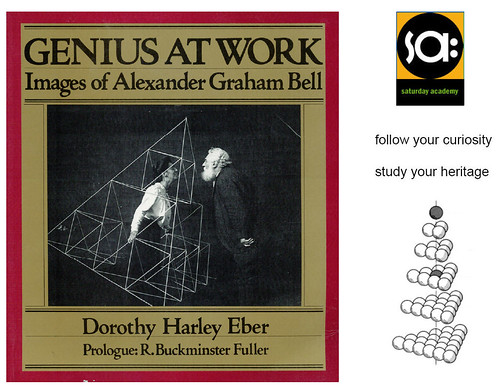
You may have seen me on Youtube in my obscure (esoteric) channel, telling the story of Bell and his kites, based on this book I'm reading, having mined it for pictures. Bucky Fuller is mentioned throughout, as another genius who came upon the same discovery by a different route. I'm talking about the octet-truss of course. What charters teach that?
Not that one needs a charter or that you have no right to experiment even if you've been stereotyped as a "traditional" school.
Friday, I was out of my usual ruts in North Portland, finally visiting the latest digs used by Saturday Academy, by now the thirty five year old institution. You'll find I go way back regarding Saturday Academy in these blogs. We talked about Martian Math some more. I showed up with what's left of those cardboard polyhedrons made by Russell Chu and Trevor Blake and myself. Some of those didn't survive to the end of 2017. Plus I took some C6XTY to the meeting.
Where we stand today in Python World, is Visual Python, a flagship spatial geometry add-on, is starting to work well with Jupyter Notebooks, a core technology in my virtual classroom. We might be able to give high and middle school age students some experience with these tools. The Martian Math stuff is very polyhedron focused.
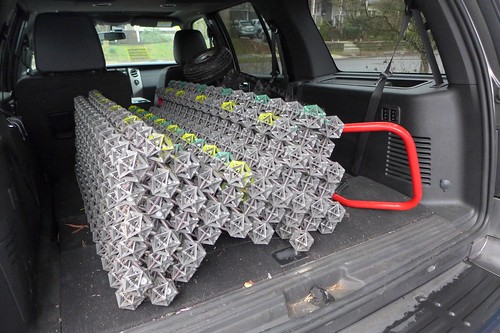
C6XTY consists of plastic soccer-ball like spheres held in a semi-rigid lattice per the octet-truss arrangement, ditto Alexander Graham Bell's design for kites, towers, other structures. Is it that he didn't patent the thing? One might think that Fuller's gaining a patent on it later might have necessitated bringing their contributions together, and making Bell's work known to Fuller. Apparently these connections got made only later.
Will a "super school" teach me anything about A, B, T, E and S modules? In this flavor of spatial geometry, we employ the octet-truss as our home base conceptual scaffolding, not the XYZ all-cubes lattice of Descartes and Fermat. It's not like we can't use both. Indeed, in converting between the unit volume of the "IVM" (the octet-truss skeleton) and the unit volume of the XYZ coordinate system, we encounter S3, a specific scale factor, or "currency converter".
Quakers (Friends) have their history as school makers. Schools have to be more than brick and mortar buildings, a physical campus, to survive the exigencies of time. They need "schools of thought" to inhabit them, give them life. What ghosts might we attract over time? What frequencies? Obviously, I'm reaching back to reach forward.
The plan in the "US" Congress, to gut grad schools by making tuition waivers taxable, targeting those with the least income yet still with hope, is motivating changes in bookkeeping. Work/study is what they do in Congress too.
When I get a job at IBM or Google, and work my butt off to learn a lot of in-house procedures, you could say I'm in a kind of grad school, except I never see the $95K income the government would tax, that represents the worth of my training.
Likewise, a freshman legislator, still learning House rules, is getting a tuition waiver on like a $200K privilege, as she or he gets an education in the arcane functioning of government organs. That's a lot like going to med school.
Given this concept of "tuition waiver" is so flexible, and doesn't apply in the case of IBM or Congress, it looks like schools will be changing their rules as well, to operate more like corporations, the only structure the "US" looks upon favorably, having been hollowed out by same.
We say "US" Congress with scare quotes at times, as the will of the people is no longer expressed through democratic institutions in the District of Columbia. That's propaganda, or fake news, and rather weak. We know bankruptcy when we see it. The attack against grad students is proof positive that we have a dangerous parasite in our midst. Let's hope the antibodies go into overdrive.
You'll notice the so-called "public schools" no longer teach civics nor provide much insight into the workings of government. We've degenerated into clashing mobs and their media. I suppose that's what they mean by "populism". Whatever it is, it's not recognizably what's spelled out in the US Constitution.
That the USA is dead and gone, undefended by those sworn to uphold its Constitution, is not really news though. We've lived with mob rule since the 1980s at least. Imperialism spelled the death of a once proud democracy. We live amidst its ruins and remnants, waiting to see what springs from the ashes. In the meantime, it's all Reality TV.
Carol and I were grateful for an invitation from the Bartons to share their Thanksgiving. Tara used to babysit for their kids. Patrick and I were co-workers with O'Reilly School.
Now I'm back in my personal workspace (PWS) plowing through some instruction videos. I did about two hours researching wars in the former Yugoslavia first. That came up during dinner, as the war crimes trials in The Hague are just coming to a conclusion around now.
I'm thinking my next Python course should look at Bitcoin more, as an example of (a) applied cryptography and (b) using a complex API. If you've followed me on math-teach at all, I've been pushed for more crypto along a high school DM (digital math) track.
The Bartons have a new adult dog named Quinn. I've been getting time with Quinn when Patrick brings him to Mt. Tabor, a popular walk for a lot of us.
Tomorrow I'm up early, for travel out of state.
I didn't know that bokeh in photography meant peripheral blur, i.e. there's a contrasting focus on "what's relevant". That gets me thinking of the Synergetics "sphere of relevance" meme, a system attuned to a frequency that dismisses a bokeh of twilight zone data.
Systems, in Synergetics, have a visual representation as spherical objects. If you read Peter Sloterdijk's stuff, you'll get a workout thinking with this metaphor. That could help make Synergetics useful, as a tool.
I needn't have conclusions regarding UFOs in order to pay attention to reports. In this Python lab, I use a UFO reports database as a means of introducing the DB API i.e. "this is how we talk to a SQL engine". I'm not aiming to settle any disputes.
Buried in some distant past already, the prehistoric origins of Scientology, in science fiction writings by the same author. A shift of gear, a change in tenor (or tense), and a new religion pitched a big tent, its founder a legend in his own time.
As cultural historians have shown, the culture was hungry for healing, having been through some bruising battles, literally as well as metaphysically. Civil Rights were hard won, as we feel more acutely when the clock starts running backward.
A core tenant of Scientology goes back to P.D. Ouspensky and others: taking the negative charge off of memories takes Work. Maurice Nicoll, a Jungian Scots following in O's footsteps, capitalized Work the same way.
Then est came along and reiterated various practices, though certainly not auditing and e-meters and without the business model of a religion. Many in the Scientology camp felt compelled to think in terms of a turf battle. That's one of the old feuds.
A hit piece against Erhard by mainstream media, somewhat baseless, showed that money and politics were hard at work, seeking to keep some trends in check. Bucky was fighting alongside Erhard around then. You might wanna dig into that story sometime, if curious.
Another feud is between the reverent and irreverent more generally. As one who grew up reading MAD Magazine as an alternative to Meeting for Worship (I'd go both ways), the irreverence of the Church of the Subgenius was sure to resonate.
I'm glad the Kickstarter project, to get the documentary out there, got funded. I pledged my $30.
As these blogs disclose, I did volunteer work for the Centers Network around the time I enrolled in est, in my Princeton through St. Dominic years. My friend Ray Simon was a big fan of Hubbard and Erhard both. I've told that story.
Not just the struggle for Civil Rights across "races" but across generations. Did these adults who thought a certain way have the right to derail young lives by sending kids to fight in the jungles of Southeast Asia against their will? What was the rationale? To fight for freedom?
Muhammad Ali shows up, along with Malcolm X and Father Divine, as a bridge figure, taking us closer to MLK's dream of a post-apartheid America.
The Jungians have their own leading towards pacifist strategies. Unlike Quakerism, the Jungian tradition is more a profession than a religion. These two strands intertwine nonetheless. When I'm tempted to feed into religion, I'm reminded of my existing outlets. Praise Bob.
Welcome to another episode of Hexapents for Everybody. What's a hexapent? Most simply, the Adidas soccer ball pattern, also found in Carbon-60, the buckminsterfullerene molecule. FIFA appears to have moved on to a new pattern, but that's neither here nor there.
The topology at work is such that those twelve pentagons, evenly distributed on the classic soccer ball, might be more randomly distributed, even as the number of hexagons is allowed to proliferate ("higher frequency"). Nor are we limited to twelve pentagons if straying from a purely hexapent pattern. Why not allow squares too?
Adrian Rossiter of Antiprism fame has shared such a construction in the window below.
What's fortuitous for our HP4E campaign is we don't need the petitioned bureaucracy behind public road signage to cave, and show pentagons going forward. We use the discrepancy, now enshrined, to suggest a productive thought process, a new thoroughfare.
Keep those signs exactly as they are, along with any number of similar exhibits suggesting unfamiliarity with basic principles of Synergetics, and leverage that circumstance to promote the missing ingredient. The lack begets its antibody, the corresponding knowledge.
I'm not saying I don't see similarities, in that we're both pink and round, and I can be something of a demon in the kitchen, occasionally breaking things (Selma could tell you).
However, we should allow that's Kirby's strategy, above, of unifying opposites, is the time-tested remedy of alchemists. Maybe he stayed a little on the too hyper side, but then it's easy to second guess from the sidelines.
I claim to enjoy browsing a lot, since well before web browsers, but when do I get the time? Well, today for example, I left my Stetson at Hop House and used that as an excuse to wander on to Common Ground, the coffee shop with the most magazines on upper Hawthorne.
I ordered a whole pot of coffee, to counteract the beers, and read up on Sleep Science, VP Pence, and former US president Hoover, not necessarily in that order. This was all in the one issue of New Yorker, October 23, 2017.
At the Hop House, with Glenn, I picked up a pamphlet on Falun Dafa. I've been looking at this practice through a framework of comparisons with Hizmet.
Both religious movements were at first embraced by their respective governments, Turk and Chinese, then demonized. Turkey holds US citizens hostage hoping to extradite Gulen in exchange.
I was unaware that Hoover had been a mining engineer. His determination to feed Belgium at the height of the blockade jibed with Human Smoke and his Quaker values. He seemed happiest and/or most fulfilled when serving as some kind of chief of logistics.
I'll need to cycle back through his bio again soon.
Mike Pence, per this New Yorker analysis, has always been interested in serving as a US president. He's a heartbeat away at this moment, but at a time when said high office is waning in power? The west coast has escaped Prohibition (the later chapter) and no longer supports the Drug Wars unless that means against McKesson etc.
I don't just browse print media however. Last night I was half comatose letting Youtube keep picking the next one. I'd surface from my somnolent state from time to time, curious what I'd been brainwashing myself with. Louis Farrakhan? Just his fans? Back to dream land.
I have a big screen facing me, while I recline on the futon couch.
I'm also active on my Kindle these days reading a Hoover Institution fellow's book from the 1990s, Inside American Education by Thomas Sowell.
He seems respectful of Bayard Rustin, who had Freedom House connections. Freedom House is quoted in that Falun Gong brochure, attesting to the reality of organ harvesting. That calls to mind another Youtube.
I visited Indiana around the time Pence made himself more enemies in the alt-gender community. I guess it's OK with him to do that. He defines himself as rigidly parochial Christian, not a cosmopolitan.
Glenn and I watched Portland Timbers win the Cascadia Cup from Back Stage / Bagdad.
A lot of journalists are reporting that, given the Equifax data breach, banks are now off the hook if they mistake you for me, and open an account for the wrong person. Who can really tell these days right?
I say "nice try" but the rules have changed, given now we know what they told us was secret no longer is. So issue new credentials? Think of new ways to establish trust? The bitcoin people do this all the time, and yet only get flak for it from the supposedly security-minded banks.
Now that we all know an identity is easy to forge, that currency, trafficked in by Equifax, has been thoroughly debased. Don't believe lawyers who say banks are protected from complicity in fraud if they do not exercise due diligence.
What due diligence meant then, and what it means now, given the balls that've been dropped, is a whole new ball game. Many conventional / routine transactions may no longer have that flavor. It's not just "the masses" who've realized the credit game has turned some corner.
Glenn and I watched the Timbers win the Cascadia Cup.
In the year 2000 on this day, on one of many trips to nearby Bloemfontein, my parents, in their Kia SUV, encountered a pickup coming the other way in their lane.
I flew to South Africa. Mom had survived.
We remember Jack on this day. I arranged for his memorial service in Maseru and was graciously hosted and helped by many who knew him.
My sister came after about a month and took over, helping Carol get back to the Pacific coast, where she lives today.
Dad had a pacemaker and low blood pressure, so chances are he wouldn't have made it to today. Women outlive their men for the most part.
The Nobel Peace Prize went to I-CAN this year, an organization with which my mom has worked, given the abolition of nuclear weapons is core to the WILPF agenda as well.
The award was well-timed to help focus international attention on the UN treaty to ban nuclear weapons.
Organized crime rules the planet, often in the guise of religion. However the rule of law has made some gains in certain pockets or niches.
The old USA was a champion of the rule of law, and democracy in many minds, until it got taken over by oligarchs and plutocrats. Organized crime is in control again, hiding behind the veneer of legality, an increasingly thin disguise.
Absent much moral authority, the imposter government continues in a farcical manner, a scary clown. People still interested in advancing democratic values have had to reorganize, to get out from under a failed nation-state system.
The icons and symbols, such as the Stars & Stripes, remain important. Their meanings continue to shift, as global humanity seeks a new equilibrium.
The illegal war of aggression against Iraq, into which the American people were railroaded, pretty much broke what remained of a working democracy. The descent into despotism has been ugly, to say the least.