Mom got her nine packages today, sent UPS ground in some other blog post.
Ulmer and I (likely to be confused by some misspellers) shot the breeze on Google Talk this afternoon (he's in a desert bizmo, I'm somewhere in the Hawthorne matrix -- lots of wireless coffee shops).
Yes, other Wanderers besides Dave and I use IM clients, blogs and so on. This might help us recruit among a broader demographic, as young folk today seem born with IM skills and can't fathom why adults wouldn't have 'em.
Friday, November 18, 2005
Sunday, November 13, 2005
Sunday @ Meeting
Quakers of the past reputedly didn't say "Sunday" -- and in some cases this was true -- as "Sun Day" has a pagan sound, as if we really needed to name days for obvious Sesame Street figures or whatever. Let's just call it "First Day" and be done with it. That way, if we exit the solar system, and lose track of the sun... Anyway, it's not true. I say Sunday all the time, never think twice about it.
Anyway, I was at Quaker Meeting today, wearing my Quaker hat (Paul Kaufman styled it, with a Chicago-style band). Actually, I flung the hat onto the raised platform on the north side of the room and worshipped hatless, as is our custom. I even shared from the heart, but didn't physically rise to my feet, as our group is still small enough to make standing optional. I told some stories from what I called my "ecumenical weekend" (Catholics and Unitarians, mostly -- I think of Wanderers as more Science than Religion, though it does phase into Philosophy on occasion).
Back at the ranch (not really -- no horses), we had guests over for homework. Our children are studying a combination of topics: coal, fossils, geological columns, layers of sediment. The local Max station under the Zoo has some amazing geological columns, tipped sideways, but going back in time in one direction. Long ago, this area was under a lot of water. A great flood happened, after some giant lake in Montana took off towards the ocean, leaving behind what we later called the Columbia River Gorge (a major feature of our landscape around here -- upriver was ground zero for the Manhatten Project, and OMSI teaches how important it is that we don't let groundwater fallout percolate out to our river (a lot of radioactive waste was just dumped or poorly contained, because there was a big war going on, and everyone was in a frenetic hurry -- no time for proper planning, and we're paying for that now)).
Ways to mine coal (from the homework project): strip, surface, slope, shaft. Katrina and Rita hurt coal making they say. That explains the higher prices. Sounds reasonable. Coal types: anthracite, bituminous, lignite, sub-bituminous. "Coal is a solid fossil fuel, it forms from decomposed swamp plants." Yep, that sounds believable.
Anyway, I was at Quaker Meeting today, wearing my Quaker hat (Paul Kaufman styled it, with a Chicago-style band). Actually, I flung the hat onto the raised platform on the north side of the room and worshipped hatless, as is our custom. I even shared from the heart, but didn't physically rise to my feet, as our group is still small enough to make standing optional. I told some stories from what I called my "ecumenical weekend" (Catholics and Unitarians, mostly -- I think of Wanderers as more Science than Religion, though it does phase into Philosophy on occasion).
Back at the ranch (not really -- no horses), we had guests over for homework. Our children are studying a combination of topics: coal, fossils, geological columns, layers of sediment. The local Max station under the Zoo has some amazing geological columns, tipped sideways, but going back in time in one direction. Long ago, this area was under a lot of water. A great flood happened, after some giant lake in Montana took off towards the ocean, leaving behind what we later called the Columbia River Gorge (a major feature of our landscape around here -- upriver was ground zero for the Manhatten Project, and OMSI teaches how important it is that we don't let groundwater fallout percolate out to our river (a lot of radioactive waste was just dumped or poorly contained, because there was a big war going on, and everyone was in a frenetic hurry -- no time for proper planning, and we're paying for that now)).
Ways to mine coal (from the homework project): strip, surface, slope, shaft. Katrina and Rita hurt coal making they say. That explains the higher prices. Sounds reasonable. Coal types: anthracite, bituminous, lignite, sub-bituminous. "Coal is a solid fossil fuel, it forms from decomposed swamp plants." Yep, that sounds believable.


Friday, November 11, 2005
Friday @ Matt's
I'm at Matt's place checking Google videos. I enjoyed this quick tour of a newspaper production facility.
The IE interface to my control panel for blogging @ Google really sucks on this OS X box -- no editing controls. No wonder Nick is dead in the water (he's packing an iBook or something). I'll continue polishing this posting when I get access to a more usable interface. I don't know if Safari is any better... Nope, sucks as well (not user-friendly).
My own video upload is still in verification.
Why am I at Matt's place? Time for the annual gutter cleaning, followed by the ritual meal.
It's Veterans' Day today. The flags are in place up and down Hawthorne.
The IE interface to my control panel for blogging @ Google really sucks on this OS X box -- no editing controls. No wonder Nick is dead in the water (he's packing an iBook or something). I'll continue polishing this posting when I get access to a more usable interface. I don't know if Safari is any better... Nope, sucks as well (not user-friendly).
My own video upload is still in verification.
Why am I at Matt's place? Time for the annual gutter cleaning, followed by the ritual meal.
It's Veterans' Day today. The flags are in place up and down Hawthorne.
Wednesday, November 09, 2005
Wednesday @ Pauling House
Setting: two tapes filled, camera now rewinding (I was cameraman, made lots of mistakes); participants are right now discussing funereal customs, cemetery design and so on, having already covered transportation, economic and social rules, many other matters -- all this in the context of Guatemala, per Don's slide show.
On break, Dick Pugh offered to do similar travelogues (Trans-Siberian railroad for example). We're Wanderers, so yeah, this makes some sense. On the other hand, we've typically integrated more science-minded analysis, dealt less in raw intelligence. What's the status of Guatemala's electrical grid I wonder. Or we could just lighten up and do more anthro -- more philo too while we're at it.
Don was embedded with a former student and family, Don being retired faculty, Mt. Hood Community College. His student runs a restaurant serving USA-style dishes (pizza and such). Don learned a great deal on this three week sojourn, his first foray outside El Norte. He performed marvelously, and brought back a ton of interesting insights and information. Guatemala is definitely a happening place. I was especially taken with Chenté, a street smart dog in the family.
I've got a bid request in with Bullseyedisc to see if our tape collection might be transcribed to DVD at an affordable cost. We'll recycle the Hi-8 tapes, minting 3 DVDs per talk to start: copy to the presenter(s) of a talk; copy to the in-house library; copy for off-site backup, Iron Mountain style. We may take up a collection, once the bid is in (likely the $80 or so in the coffee fund won't cover it -- I've got a stash of like 25 tapes by this time, including the two of Doug Strain).
Nancy joined Don and I for lunch on the boat where I got cell calls from France (school business) and from Mom in Washington, DC (I dropped her at the airport before Wanderers).
Tonight I met up with Dick Pugh again, also Wanderers McCarty and McGown, at the Sigma Xi meeting at PSU (Brother Guy for the Vatican re Pluto et al (hey, I vote we name this new 10th planet, grain of sand thingy Diana -- or maybe Coyote after some Native American)).
On break, Dick Pugh offered to do similar travelogues (Trans-Siberian railroad for example). We're Wanderers, so yeah, this makes some sense. On the other hand, we've typically integrated more science-minded analysis, dealt less in raw intelligence. What's the status of Guatemala's electrical grid I wonder. Or we could just lighten up and do more anthro -- more philo too while we're at it.
Don was embedded with a former student and family, Don being retired faculty, Mt. Hood Community College. His student runs a restaurant serving USA-style dishes (pizza and such). Don learned a great deal on this three week sojourn, his first foray outside El Norte. He performed marvelously, and brought back a ton of interesting insights and information. Guatemala is definitely a happening place. I was especially taken with Chenté, a street smart dog in the family.
I've got a bid request in with Bullseyedisc to see if our tape collection might be transcribed to DVD at an affordable cost. We'll recycle the Hi-8 tapes, minting 3 DVDs per talk to start: copy to the presenter(s) of a talk; copy to the in-house library; copy for off-site backup, Iron Mountain style. We may take up a collection, once the bid is in (likely the $80 or so in the coffee fund won't cover it -- I've got a stash of like 25 tapes by this time, including the two of Doug Strain).
Nancy joined Don and I for lunch on the boat where I got cell calls from France (school business) and from Mom in Washington, DC (I dropped her at the airport before Wanderers).
Tonight I met up with Dick Pugh again, also Wanderers McCarty and McGown, at the Sigma Xi meeting at PSU (Brother Guy for the Vatican re Pluto et al (hey, I vote we name this new 10th planet, grain of sand thingy Diana -- or maybe Coyote after some Native American)).
Monday, November 07, 2005
Monday @ Pauling House
Wardwell is burning CD-Rs with pictures taken in Guatemala on his Canon. We just purchased those from Fred Meyer's, with a parking lot on the roof (Google Earth shows it clearly -- across from the red-roofed Jiffy Lube, 39th and Hawthorne). We also bought an extension cord (8') to go from the wall to the power strip (grounded outlet), into which strip are plugged: Don's iMac laptop, my Toshiba running WinXP, my Optoma small footprint projector. We're running routine tests to make sure we're ready for his presentations. Don and Patrick (works here) are chatting in another room. Outside: dusk, still pretty light, 4:39 PM.
Friday, November 04, 2005
Physics Emergent (ISEPP lecture)
Physicist and Nobel laureate Dr. Robert Laughlin delivered the kickoff ISEPP lecture at the Schnitz last night. He projected a series of hand drawings (he's pretty good -- plans to take up color in a next life if he gets one) and talked about The Frontier (archetype) in science: yes there is one, but a lot of times we look for it in the wrong direction.
The word "law" has two connotations in English: physical laws that set the stage, and social agreements that govern the acting. Laws of the first type get ascribed to God, at least in Judeo-Christian thinking, and so we get the picture that God supplies the foundations or fundamentals, and complex life forms such as ourselves build atop this set-in-stone framework.
However, what's becoming more apparent in science is that physical laws may be emergent in the sense that their formulation and description only makes sense in the context of complex aggregates, assemblies or "piles" (Laughlin showed a pile of apples -- the picture had other plot elements I won't go into). The phenomena these rules describe simply vanish at more inward levels. So we get this hierarchy of "grammars" [my word choice].
Later, after dinner at the Heathman, I stepped out from behind the camera to propose this analogy: say a novelist is bound to follow all the rules of grammar [I'll add proper spelling], but in order to sell books, knows to incorporate suspense, to follow other rules for strong plot development; nothing about the rules of grammar predict or force a novel to be any good (that's up to the writer) i.e. these higher order rules are emergent.
Laughlin found this a pretty good analogy with the following caveat: he doesn't see any need to complement the mindless automaticity of quantum mechanics with some new principle of Agency (the writer). He's OK having his Universe run on autopilot, with emergent/synergetic behaviors, yes, but still a machine in the final analysis (Occam's Razor at work).
One practical consequence of emergent law (in physics, not just in biology and society) is we can't advance science through thought experiment alone. Measurement remains a primary source of new discoveries, and this feeds our appetite for new and better instruments (e.g. earth-focused satellites). Our sphere of scientific relevance, at any frequency, is bounded by our ability to measure.
For this reason, Laughlin sees string theory (about the very small) as only quasi-scientific, given it hasn't yet given us doable experiments that would make it falsifiable. A lot of cosmology (about the very large) is like that too. A chief purpose and benefit of such twilight zone science fiction is it helps us raise funds for new machinery so that the horizons of real science might be expanded to new frontiers.
Speaking of Nobel laureates, we remember Dr. Richard Smalley, a co-discoverer of fullerene, who died recently. And speaking of scientists who have died recently, we remember Dr. George S. Hammond, chemist par excellance, and a Wanderer.
The word "law" has two connotations in English: physical laws that set the stage, and social agreements that govern the acting. Laws of the first type get ascribed to God, at least in Judeo-Christian thinking, and so we get the picture that God supplies the foundations or fundamentals, and complex life forms such as ourselves build atop this set-in-stone framework.
However, what's becoming more apparent in science is that physical laws may be emergent in the sense that their formulation and description only makes sense in the context of complex aggregates, assemblies or "piles" (Laughlin showed a pile of apples -- the picture had other plot elements I won't go into). The phenomena these rules describe simply vanish at more inward levels. So we get this hierarchy of "grammars" [my word choice].
Later, after dinner at the Heathman, I stepped out from behind the camera to propose this analogy: say a novelist is bound to follow all the rules of grammar [I'll add proper spelling], but in order to sell books, knows to incorporate suspense, to follow other rules for strong plot development; nothing about the rules of grammar predict or force a novel to be any good (that's up to the writer) i.e. these higher order rules are emergent.
Laughlin found this a pretty good analogy with the following caveat: he doesn't see any need to complement the mindless automaticity of quantum mechanics with some new principle of Agency (the writer). He's OK having his Universe run on autopilot, with emergent/synergetic behaviors, yes, but still a machine in the final analysis (Occam's Razor at work).
One practical consequence of emergent law (in physics, not just in biology and society) is we can't advance science through thought experiment alone. Measurement remains a primary source of new discoveries, and this feeds our appetite for new and better instruments (e.g. earth-focused satellites). Our sphere of scientific relevance, at any frequency, is bounded by our ability to measure.
For this reason, Laughlin sees string theory (about the very small) as only quasi-scientific, given it hasn't yet given us doable experiments that would make it falsifiable. A lot of cosmology (about the very large) is like that too. A chief purpose and benefit of such twilight zone science fiction is it helps us raise funds for new machinery so that the horizons of real science might be expanded to new frontiers.
Speaking of Nobel laureates, we remember Dr. Richard Smalley, a co-discoverer of fullerene, who died recently. And speaking of scientists who have died recently, we remember Dr. George S. Hammond, chemist par excellance, and a Wanderer.
Sunday, October 30, 2005
Good Night and Good Luck (movie review)
George Clooney, writer and director, and Fred Friendly in this film, takes us back to a world of monochrome TV, excessive smoking, and people trying to stay sane (which is why the film is timely, and why the packed audience applauded at the end). It's a film about courage and integrity. Mom loved it.
A theme here is television might be used more effectively to wake people from their soaps and sitcoms and give them a bigger dose of reality. However, those trafficing in "reality" seem prone to paranoia and keep taking us into nightmarish episodes. Maybe more politicians should be watching Rome or Extras on HBO, instead of inflicting their twisted brand of theater on the rest of us. Maybe we need more quality fiction, not less. We could make it "reality fiction" -- like this film.
A couple years ago I rented the Ed Murrow vs. Joe McCarthy tapes from Movie Madness, having been too young to appreciate these events at the time. Last night I took the new projector over to Larry's house, where he shared Thirteen Days, about the Cuban missile crisis, one of his favorite films (I shared eXistenZ, one of mine). My reaction to these "great game" scenarios (ongoing): why should such a tiny cast get to arrogate so much power to script world events?
If an apocalyptic showdown between "great powers" is what turns you on, just rent the DVD. Either that, or think of some better role playing games, with more interesting and constructive props.
A theme here is television might be used more effectively to wake people from their soaps and sitcoms and give them a bigger dose of reality. However, those trafficing in "reality" seem prone to paranoia and keep taking us into nightmarish episodes. Maybe more politicians should be watching Rome or Extras on HBO, instead of inflicting their twisted brand of theater on the rest of us. Maybe we need more quality fiction, not less. We could make it "reality fiction" -- like this film.
A couple years ago I rented the Ed Murrow vs. Joe McCarthy tapes from Movie Madness, having been too young to appreciate these events at the time. Last night I took the new projector over to Larry's house, where he shared Thirteen Days, about the Cuban missile crisis, one of his favorite films (I shared eXistenZ, one of mine). My reaction to these "great game" scenarios (ongoing): why should such a tiny cast get to arrogate so much power to script world events?
If an apocalyptic showdown between "great powers" is what turns you on, just rent the DVD. Either that, or think of some better role playing games, with more interesting and constructive props.
Wednesday, October 26, 2005
Rambling On
I missed much of the Wanderers meeting today at the Linus Pauling house, as I had a routine doc appointment (my annual physical). I got back for the tail end of a rambling discussion of the Israel-Palestine situation, the Canadian health care system, the tax advantages of S- corporations and so on.
We didn't have an organized presentation today.
Jim brought fresh-picked chantrelles again, $15/lb. at the local grocery store. I reported on Don's communications from Guatemala (so far so good). Patrick's wife might present on supercomputer applications in a few weeks (she used to work for Sandia).
In today's Oregonian (page D1): Google gives a $350K grant to PSU-OSU to for development of open source software (Google uses a lot of it, including Linux, Apache, Python and more).
This evening, I drove mom down to the AFSC-organized reading of soldier and civilian names, American and Iraqi war dead. I was glad to reconnect (however briefly) with local staff I've worked with (Alice, Marco, Pam). I brought some decaf to the Metcalfs, MMM stalwarts, who were holding the Quaker sign. Bruce Huntwork sat next to me for awhile. A few hundred showed up, in the park between City Hall and the Federal Building. My camera fell out of its case onto the bricks, but didn't break (yay).
I'm making rather slow headway in Quake 4. Les, recently back from China and Korea, would no doubt have finished it by now.
We didn't have an organized presentation today.
Jim brought fresh-picked chantrelles again, $15/lb. at the local grocery store. I reported on Don's communications from Guatemala (so far so good). Patrick's wife might present on supercomputer applications in a few weeks (she used to work for Sandia).
In today's Oregonian (page D1): Google gives a $350K grant to PSU-OSU to for development of open source software (Google uses a lot of it, including Linux, Apache, Python and more).
This evening, I drove mom down to the AFSC-organized reading of soldier and civilian names, American and Iraqi war dead. I was glad to reconnect (however briefly) with local staff I've worked with (Alice, Marco, Pam). I brought some decaf to the Metcalfs, MMM stalwarts, who were holding the Quaker sign. Bruce Huntwork sat next to me for awhile. A few hundred showed up, in the park between City Hall and the Federal Building. My camera fell out of its case onto the bricks, but didn't break (yay).
I'm making rather slow headway in Quake 4. Les, recently back from China and Korea, would no doubt have finished it by now.
Saturday, October 22, 2005
Shopping Trip
Friend Andy Cross of MMM invited me to join him on a trip to Fry's Electronics this Friday morning, a big box vendor in Wilsonville that used to be named Incredible Universe when owned by Tandy (Radio Shack). I sometimes call it Mecca, given its importance in my reality, and how often I make the pilgrimage. That no doubt sounds sacrilegious to some, but I figure electronics engineers have done God's will at least as effectively as priests (not that these are mutually exclusive occupations).
Andy was picking up a whole new system (a Sony desktop). I grabbed an internal DVD burner (16x +/- R, 4x DL, 5x DVD-RAM) for like $45 including mail-in rebate. My first backup was only 1x (very slow) but I don't think the new device was to blame (I was off having a beer -- next time I'll monitor more closely). I considered the more expensive Plextor, a brand with a loyal following, but unlike some Pentagoners I don't insist on gold plating.
I also bought Quake 4 for $37.99, a choice some Quakers will question. Like, what's a pacifist like me doing with an M-rated game ("Blood and Gore, Intense Violence, Strong Language")? I'm actually OK with mythical mayhem. I'm this Marine fighting Strogg, with all humanity united behind me and my buddies depending on my prowess in battle. Thankfully it's only a simulation, as I die often.
Andy was picking up a whole new system (a Sony desktop). I grabbed an internal DVD burner (16x +/- R, 4x DL, 5x DVD-RAM) for like $45 including mail-in rebate. My first backup was only 1x (very slow) but I don't think the new device was to blame (I was off having a beer -- next time I'll monitor more closely). I considered the more expensive Plextor, a brand with a loyal following, but unlike some Pentagoners I don't insist on gold plating.
I also bought Quake 4 for $37.99, a choice some Quakers will question. Like, what's a pacifist like me doing with an M-rated game ("Blood and Gore, Intense Violence, Strong Language")? I'm actually OK with mythical mayhem. I'm this Marine fighting Strogg, with all humanity united behind me and my buddies depending on my prowess in battle. Thankfully it's only a simulation, as I die often.
Wednesday, October 19, 2005
Back to Work
Following that fun vacation to McMinnville and environs, I needed to get back to various projects simmering on my metaphorical stove (my real electric one has 4 burners, only 3 usable, plus a working oven).
Front burner: Sam Lanahan would like to meet Ken Snelson, given Flextegrity is entering the patent literature in close proximity to Ken's and Bucky's work As a software engineer, I'm suspicious patent abuse will gum up the works, but that doesn't mean I don't recognize good literature. Patent libraries are goldmines for historians of engineering.
Ken phoned me re my recent email proposing Sam and I fly out for a visit, just as I was going into a meeting on another high priority project: keeping the flow of clinical data to my health mission client uninterrupted, as we transition from vendor A to vendor B in the cath labs over the next few months.
Project 3: the RBF-LW bridge, a work in progress in philosophy world (I'm a critical path manager on this one).
Project 4: wiring more synergetics into K-12 CS-informed math (CS = computer science). I need more help from television on this front. Geometry lends itself to communication by that medium -- looking forward to more in high def TV and DVD. My work with Russ (he just sent some new EIG files) comes under this heading.
And last but not least, Project 5: preparing to teach Python in a Portland Public School (a 9 week stint, not counting school holidays and vacations).
... other projects, too numerous to mention, will need to go unlisted at this juncture (I read a lot of blogs, journalism and stuff, watch some TV, but that's more play than work, plus doesn't pay the bills).
Precessionally (tangentially, thinking more in terms of side effects), the above projects are also about putting 4D Solutions on wheels, in a bizmo, e.g. when I go on the road more, I'll still need to VPN into client networks, do source code editing and such (which reminds me, I need to stop writing in my blog and do some more POV-Ray renderings for Sam 'n LaJean).
Front burner: Sam Lanahan would like to meet Ken Snelson, given Flextegrity is entering the patent literature in close proximity to Ken's and Bucky's work As a software engineer, I'm suspicious patent abuse will gum up the works, but that doesn't mean I don't recognize good literature. Patent libraries are goldmines for historians of engineering.
Ken phoned me re my recent email proposing Sam and I fly out for a visit, just as I was going into a meeting on another high priority project: keeping the flow of clinical data to my health mission client uninterrupted, as we transition from vendor A to vendor B in the cath labs over the next few months.
Project 3: the RBF-LW bridge, a work in progress in philosophy world (I'm a critical path manager on this one).
Project 4: wiring more synergetics into K-12 CS-informed math (CS = computer science). I need more help from television on this front. Geometry lends itself to communication by that medium -- looking forward to more in high def TV and DVD. My work with Russ (he just sent some new EIG files) comes under this heading.
And last but not least, Project 5: preparing to teach Python in a Portland Public School (a 9 week stint, not counting school holidays and vacations).
... other projects, too numerous to mention, will need to go unlisted at this juncture (I read a lot of blogs, journalism and stuff, watch some TV, but that's more play than work, plus doesn't pay the bills).
Precessionally (tangentially, thinking more in terms of side effects), the above projects are also about putting 4D Solutions on wheels, in a bizmo, e.g. when I go on the road more, I'll still need to VPN into client networks, do source code editing and such (which reminds me, I need to stop writing in my blog and do some more POV-Ray renderings for Sam 'n LaJean).
Saturday, October 15, 2005
From Evergreen's Airplane Collection
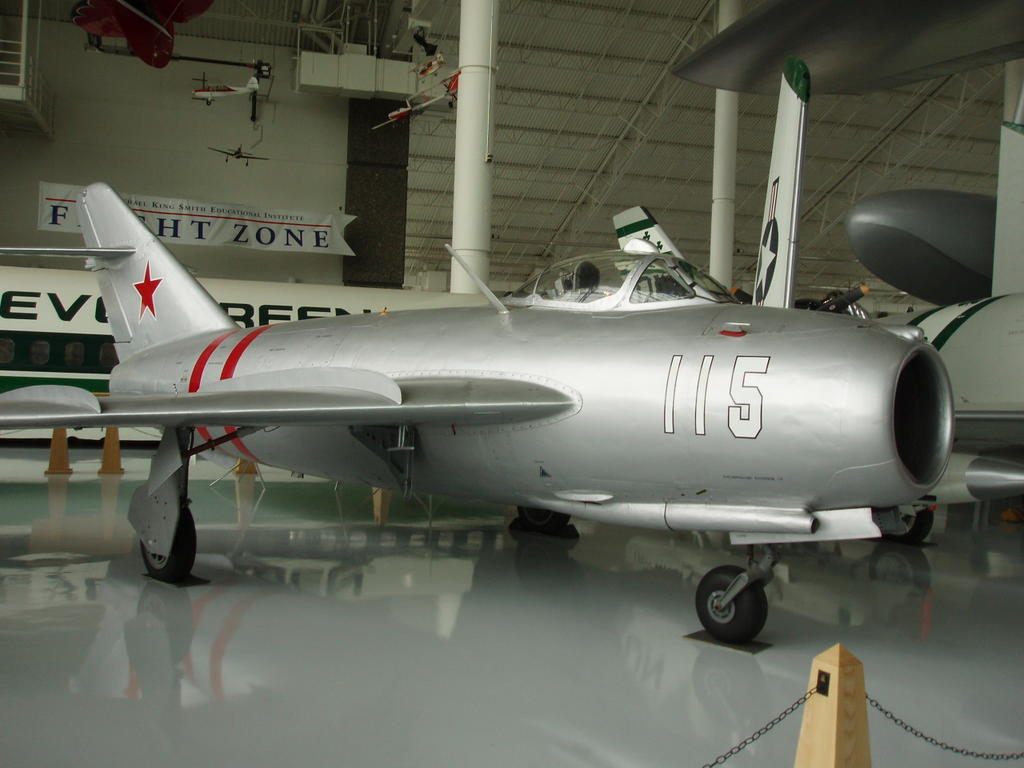 A MiG
A MiGPhoto by K. Urner
Per our tour guide: the MiG's guns pointed upward 15 degrees for some reason, so the way to avoid being shot at was to fly very close to the ground. If you were shot at anyway, because the MiG was chasing you upside down, the pilot was probably Russian.
Our Hotel's First Manager
 Portrait of Tom White
photo by K. Urner w/ Olympus Stylus 500
The inscription on the wall next to this painting reads: "Tom White gave life to the hotel in 1905 and guided it through its initial quarter century. A bit of a Renaissance man, Tom was well-read, a devoted member of the Masons, and very active in community work. He was an excellent cook, a skilled carpenter and loved working on his farm."
Thursday, October 13, 2005
Hotel Oregon
Dawn and I did a retreat at Hotel Oregon recently. That's in the small town of McMinnville, in the heart of some wider sprawl engineered by a freeway- and mall-minded culture. We stayed in the first manager's bedroom, Tom White's. Yes, another Mason, like many departed in McMenemin's world. We learned of more Masons at the Grand Lodge in Forest Grove on another visit.
Then we visited the Spruce Goose and friends, at Evergreen Aviation. Our tour guide and former F4 pilot was none too pleased his bombing mission got canceled that day Hanoi Jane was in town. Fonda's visit recalls the early days after WWII, when the OSS thought Ho'd be a fine leader of a Jeffersonian democracy (Ho thought so too) if only the French empire would pull back, which it eventually started doing (Japan's empire had already been pushed back, thanks in part to this new US-Vietnamese alliance).
Then LAWCAP (e.g. Dulles & Dulles) decided to rebalance the powers by joining forces with former enemies Germany and Japan, now vanquished and ripe for rebuilding (see JFK by Col. L. Fletcher Prouty). In Vietnam, the "quiet Americans" (Capitalism's Invisible Army) started taking over, to fight an Evil Empire. Thus began WWIII, or the Cold War as they called it, in which many more millions would die, especially in Southeast Asia. That was before the Grunch came along (e.g. Fuller & Co.) and another rebalancing.
Evergreen also has an SR-71 Blackbird spy plane, which could read license plates and sense where the bodies of migrant farm workers were buried in California. Very cool. Its competition, the U "shot down" 2, is still in service, exposing miles of film to targets of interest.
I especially recommend the Hotel Oregon's rooftop pub and restaurant (we took the stairs, but there's an elevator somewhere). Park in the 2-story garage opposite the police station on 5th. And be sure to check out the Mack Theater directly across 3rd street to see what's showing. Dawn and I saw Junebug.
Then we visited the Spruce Goose and friends, at Evergreen Aviation. Our tour guide and former F4 pilot was none too pleased his bombing mission got canceled that day Hanoi Jane was in town. Fonda's visit recalls the early days after WWII, when the OSS thought Ho'd be a fine leader of a Jeffersonian democracy (Ho thought so too) if only the French empire would pull back, which it eventually started doing (Japan's empire had already been pushed back, thanks in part to this new US-Vietnamese alliance).
Then LAWCAP (e.g. Dulles & Dulles) decided to rebalance the powers by joining forces with former enemies Germany and Japan, now vanquished and ripe for rebuilding (see JFK by Col. L. Fletcher Prouty). In Vietnam, the "quiet Americans" (Capitalism's Invisible Army) started taking over, to fight an Evil Empire. Thus began WWIII, or the Cold War as they called it, in which many more millions would die, especially in Southeast Asia. That was before the Grunch came along (e.g. Fuller & Co.) and another rebalancing.
Evergreen also has an SR-71 Blackbird spy plane, which could read license plates and sense where the bodies of migrant farm workers were buried in California. Very cool. Its competition, the U "shot down" 2, is still in service, exposing miles of film to targets of interest.
I especially recommend the Hotel Oregon's rooftop pub and restaurant (we took the stairs, but there's an elevator somewhere). Park in the 2-story garage opposite the police station on 5th. And be sure to check out the Mack Theater directly across 3rd street to see what's showing. Dawn and I saw Junebug.
Saturday, October 08, 2005
The Corpse Bride (movie review)
Many critics declaim against this movie's supposedly shallow plot (my wife included), but I figure the secret to this fairy tale is to see but one bride and groom to be, and the projections they go through.
The girl thinks maybe a parasitical money-grubbing a-hole is out to get her, like the one that broke her heart before, but this new guy seems different.
The new guy, meantime, is your typical morbid poet, worried about death and decay, and how this gorgeous girl is also this amazing like dead thing, i.e. so absurdly physical.
So yeah, the marriage rehearsals leading up to the real deal are seemingly interminable. The projected parental marriages aren't very encouraging either. I can see where some young folks might pause for thought before tying the knot.
Like Robots, this film is all about a look, and that look ain't just window dressing or something irrelevant. No, that's a looking glass look, a fun house mirror, a lens -- an artifact storytellers have worked on and polished, and handed down across centuries. Many proud artists, many forgotten graves.
The musical numbers: also strictly by the book.
There're only so many ways to do macabre, and make a funny family flick at the same time (Addams Family is another). This way works. Please accept my gratitude.
The girl thinks maybe a parasitical money-grubbing a-hole is out to get her, like the one that broke her heart before, but this new guy seems different.
The new guy, meantime, is your typical morbid poet, worried about death and decay, and how this gorgeous girl is also this amazing like dead thing, i.e. so absurdly physical.
So yeah, the marriage rehearsals leading up to the real deal are seemingly interminable. The projected parental marriages aren't very encouraging either. I can see where some young folks might pause for thought before tying the knot.
Like Robots, this film is all about a look, and that look ain't just window dressing or something irrelevant. No, that's a looking glass look, a fun house mirror, a lens -- an artifact storytellers have worked on and polished, and handed down across centuries. Many proud artists, many forgotten graves.
The musical numbers: also strictly by the book.
There're only so many ways to do macabre, and make a funny family flick at the same time (Addams Family is another). This way works. Please accept my gratitude.
Friday, September 30, 2005
Talk Like A Pirate Day

Pirate ordering a cheeseburger
at the Island Cafe, 19 Sept 2005
(by K. Urner, Olympus Stylus 500,
brightness/contrast adjusted)
at the Island Cafe, 19 Sept 2005
(by K. Urner, Olympus Stylus 500,
brightness/contrast adjusted)
Rethinking the CyberBookMobile Concept
Based a lot on Ulmer's reality check, I'm recognizing my state of the art bizmo fleet is going to need better infrastructure. I just don't have the skills necessary to operate a rig like Dave's -- would need a crew of grannies to keep it long haul operational.
Per my alternative model lifestyle, I'd be less inclined to hold tightly to one bizmo of my own, and more thinking to check one out from a garage closer to a point of interest. After mission control uplinks my mission, I'll swoop into Town A and do some of the requested curriculum stuff, leaving behind a local school faculty thinking more about sphere packings, hypertoons, Pythonic mathematics. Lone Ranger type stuff ("nicely done Kemosabe" -- like when Don deftly parks his Meliptus alongside the Island Cafe).
This is a healthy memepool for sure, but should be no one's exclusive diet, nor is it, even for me. However, my bizmo will run software uniquely customized for my brand of scholarship and teaching/outreach -- not because I'm all that tied to a specific bizmo, but because the basic design is highly configurable through downlinking OS level stuff and/or special purpose applications.
On the outside, different bizmos may have different decals (I'm hoping we'll be seeing some from Google, whether I'm a driver or not). Those with the same decals will likely be running a lot of software in common (reflective of whatever corporate cultures, e.g. Mentor Graphics).
The decals themselves may be swappable, in the same way a Tri-Met bus, though advertising its route with lit signage, is perfectly able to run a different route on another day. In my case, my decals (e.g. 4D Solutions logo) might follow me around, maybe in the form of a rear view mirror dongle or glove box credential. The same physical bizmo might return to the same electronic gate on consecutive evenings, and gain access the one night but not the other, because the decals, running code, crew and driver, could have all changed overnight, not a big deal.
Basically, a geek checks the thing out of the garage, and then sucks down her favorite kernel (one of several), possibly similar to what wuz running in her last bizmo, or maybe in one she's nostalgic about (like running Win98 in 2020) but now the target points are different, so a different garage was accessed (same deal with the rental cars: return at the airport, like to PDX or whatever).
On another note (and speaking of The Island Cafe): last September 19 was Talk Like a Pirate Day, and by nightfall, we had a full cast of free spirits in properly piratical attire, right down to the plastic parrot this one guy had. A boat sailed to and fro in the channel, setting off a miniature ceremonial cannon, reminding me of the curious opening to The Confusion, sequel to Quicksilver in the 3-part Baroque Cycle by Neal Stephenson (Jules, Don's grandson, Nirel's son, is another Stephenson fan).
Per my alternative model lifestyle, I'd be less inclined to hold tightly to one bizmo of my own, and more thinking to check one out from a garage closer to a point of interest. After mission control uplinks my mission, I'll swoop into Town A and do some of the requested curriculum stuff, leaving behind a local school faculty thinking more about sphere packings, hypertoons, Pythonic mathematics. Lone Ranger type stuff ("nicely done Kemosabe" -- like when Don deftly parks his Meliptus alongside the Island Cafe).
This is a healthy memepool for sure, but should be no one's exclusive diet, nor is it, even for me. However, my bizmo will run software uniquely customized for my brand of scholarship and teaching/outreach -- not because I'm all that tied to a specific bizmo, but because the basic design is highly configurable through downlinking OS level stuff and/or special purpose applications.
On the outside, different bizmos may have different decals (I'm hoping we'll be seeing some from Google, whether I'm a driver or not). Those with the same decals will likely be running a lot of software in common (reflective of whatever corporate cultures, e.g. Mentor Graphics).
The decals themselves may be swappable, in the same way a Tri-Met bus, though advertising its route with lit signage, is perfectly able to run a different route on another day. In my case, my decals (e.g. 4D Solutions logo) might follow me around, maybe in the form of a rear view mirror dongle or glove box credential. The same physical bizmo might return to the same electronic gate on consecutive evenings, and gain access the one night but not the other, because the decals, running code, crew and driver, could have all changed overnight, not a big deal.
Basically, a geek checks the thing out of the garage, and then sucks down her favorite kernel (one of several), possibly similar to what wuz running in her last bizmo, or maybe in one she's nostalgic about (like running Win98 in 2020) but now the target points are different, so a different garage was accessed (same deal with the rental cars: return at the airport, like to PDX or whatever).
On another note (and speaking of The Island Cafe): last September 19 was Talk Like a Pirate Day, and by nightfall, we had a full cast of free spirits in properly piratical attire, right down to the plastic parrot this one guy had. A boat sailed to and fro in the channel, setting off a miniature ceremonial cannon, reminding me of the curious opening to The Confusion, sequel to Quicksilver in the 3-part Baroque Cycle by Neal Stephenson (Jules, Don's grandson, Nirel's son, is another Stephenson fan).
Wednesday, September 28, 2005
Dave's Bizmo
Dave, age 59, is presenting Dave's Life this Wednesday morning, about his on-the-road lifestyle. His slides break it down into Motivation, Equipment, Infrastructure, Monthly Costs and so on. The lifestyle depends on having good telecommunications and maintenance skills.
Given the complexity of these rigs "if you're not mechanically adept, you're dead meat" -- even RV-driving grannies have to learn basic troubleshooting, often by consulting Internet user groups (there'll be one for every component). Schematics aren't necessarily available, and dealerships may have long waiting lists.
Dave avoids RV parks like the plague, uses GIS/GPS to locate suitable public lands (BLM, state, national forest, military -- or maybe a Wal-Mart parking lot). This land is your land, this land is my land. He pulls a trailer containing a Yamaha Mountain Max snowmobile (used mostly in the spring) and Suzuki DRZ400 dual sport motorcycle. The bizmo itself is a 33' Beaver Diesel Pusher motorhome. He's self-sufficient in terms of fuel, food, water, power, for weeks at a time. His utilities (fuel, satellite, insurance etc.) run about $825 a month, plus maybe $200 for food with an emphasis on fresh vegetables (Safeway a good source).
Before 2000, when GPS was deliberately inaccurate, Dave smashed his snowmobile on the side of Mount St. Helens, thinking he was on a trail he wasn't. Driving heavy equipment, alone, in desolate, erratic terrain, is highly dangerous. Dave rarely takes these unnecessary risks. He stores his camp sites, drive routes, other points of interest in GIS software. Given over two years of living this way full time, he's got a gold mine of information in his database. His photo diary, shared with a small group of subscribers, is likewise a valuable record of his adventures.
Given the complexity of these rigs "if you're not mechanically adept, you're dead meat" -- even RV-driving grannies have to learn basic troubleshooting, often by consulting Internet user groups (there'll be one for every component). Schematics aren't necessarily available, and dealerships may have long waiting lists.
Dave avoids RV parks like the plague, uses GIS/GPS to locate suitable public lands (BLM, state, national forest, military -- or maybe a Wal-Mart parking lot). This land is your land, this land is my land. He pulls a trailer containing a Yamaha Mountain Max snowmobile (used mostly in the spring) and Suzuki DRZ400 dual sport motorcycle. The bizmo itself is a 33' Beaver Diesel Pusher motorhome. He's self-sufficient in terms of fuel, food, water, power, for weeks at a time. His utilities (fuel, satellite, insurance etc.) run about $825 a month, plus maybe $200 for food with an emphasis on fresh vegetables (Safeway a good source).
Before 2000, when GPS was deliberately inaccurate, Dave smashed his snowmobile on the side of Mount St. Helens, thinking he was on a trail he wasn't. Driving heavy equipment, alone, in desolate, erratic terrain, is highly dangerous. Dave rarely takes these unnecessary risks. He stores his camp sites, drive routes, other points of interest in GIS software. Given over two years of living this way full time, he's got a gold mine of information in his database. His photo diary, shared with a small group of subscribers, is likewise a valuable record of his adventures.
Sunday, September 25, 2005
Wanderers Retreat
I showed up at the Blanchard Education Service Center today to make some brief remarks on behalf of the Koreducators' charter school proposal. Adam & Co. certainly have their ducks in a row.
Retreat:
Day one (9/23):
We used earth.google.com software and projector to zoom in on the Pauling House, plus visit other points of interest (Gothenburg isn't highly resolved yet -- didn't find Chalmers). Jon Bunce grilled Dave Ulmer on his book (unpublished), having given it a close read. Nancy joined us enroute to another retreat at Mt. Angel with Father Driscoll. We looked at slides I took of Julian's unveiling of Heart of Steel in Lake Oswego, and slides of Dave's many bizmo adventures. The bizmo itself is parked out back, receiving satellite TV about hurricane Rita. Downloaded from iTunes and played: We Didn't Start the Fire (Billy Joel), played a bogus game of chess.
Day two (9/24):
Briefed by Dawn on Smallville developments (season 3), cartoons, Rita (weather news), breakfast on Hawthorne (Tabor Hill Cafe), helped Consoletti with inheritance fax, gave Ulmer my 9/14 letter (feedback on his book) while he projected the DVD 1984 from his laptop (I didn't watch too closely this time, believe I've seen it before -- like Brazil). Dave backed up the bizmo by 6', enough to see the HDTV satellite behind the tree. Jon & Don off to check out a dishwasher (mechanical problem). Allen's here -- he and I went out for Thai (Rick joined us for Thai take-out last night). I did some more messing about with "math through programming."
Big summit on future of Wanderers in the evening. Terry Bristol, David Feinstein, Steve Bergman, Audrey Lee, Pat Barton, Gus Frederick joined our group. Lots of discussion, lots of web sites projected. What did we decide? Terry is working on getting us a server with a fat pipe. Doug Strain's interest in peace work helps define us.
Day three (9/25):
Woke up with Sarah in the bed (sorry Dawn, I know the rules), another Smallville briefing from Tara (still season 3). Drove mom to Quaker meetinghouse (former ESI building) in Razz (our razzberry-colored Subaru wagon). Joined Dave & Don in the bizmo for long HDNet pans from a helicopter over New Orleans (some amazingly cool cemeteries). Even spookier would be HDNet over Chernobyl (saw that dare devil Russian chic's fast motorcyle diary -- likewise amazingly cool). Thanh Thao has been a source of most meals. Celestia + Stellarium = an answer to my prayers. I missed the impromptu presentation by portland.freeskool.org. Office Depot, printer madness. Guests from South Africa (the home scene). Julian came by with both children (I projected my slides from the unveiling). Jon solved the story problem (about a man and his dog).
Retreat:
Day one (9/23):
We used earth.google.com software and projector to zoom in on the Pauling House, plus visit other points of interest (Gothenburg isn't highly resolved yet -- didn't find Chalmers). Jon Bunce grilled Dave Ulmer on his book (unpublished), having given it a close read. Nancy joined us enroute to another retreat at Mt. Angel with Father Driscoll. We looked at slides I took of Julian's unveiling of Heart of Steel in Lake Oswego, and slides of Dave's many bizmo adventures. The bizmo itself is parked out back, receiving satellite TV about hurricane Rita. Downloaded from iTunes and played: We Didn't Start the Fire (Billy Joel), played a bogus game of chess.
Day two (9/24):
Briefed by Dawn on Smallville developments (season 3), cartoons, Rita (weather news), breakfast on Hawthorne (Tabor Hill Cafe), helped Consoletti with inheritance fax, gave Ulmer my 9/14 letter (feedback on his book) while he projected the DVD 1984 from his laptop (I didn't watch too closely this time, believe I've seen it before -- like Brazil). Dave backed up the bizmo by 6', enough to see the HDTV satellite behind the tree. Jon & Don off to check out a dishwasher (mechanical problem). Allen's here -- he and I went out for Thai (Rick joined us for Thai take-out last night). I did some more messing about with "math through programming."
Big summit on future of Wanderers in the evening. Terry Bristol, David Feinstein, Steve Bergman, Audrey Lee, Pat Barton, Gus Frederick joined our group. Lots of discussion, lots of web sites projected. What did we decide? Terry is working on getting us a server with a fat pipe. Doug Strain's interest in peace work helps define us.
Day three (9/25):
Woke up with Sarah in the bed (sorry Dawn, I know the rules), another Smallville briefing from Tara (still season 3). Drove mom to Quaker meetinghouse (former ESI building) in Razz (our razzberry-colored Subaru wagon). Joined Dave & Don in the bizmo for long HDNet pans from a helicopter over New Orleans (some amazingly cool cemeteries). Even spookier would be HDNet over Chernobyl (saw that dare devil Russian chic's fast motorcyle diary -- likewise amazingly cool). Thanh Thao has been a source of most meals. Celestia + Stellarium = an answer to my prayers. I missed the impromptu presentation by portland.freeskool.org. Office Depot, printer madness. Guests from South Africa (the home scene). Julian came by with both children (I projected my slides from the unveiling). Jon solved the story problem (about a man and his dog).
Saturday, September 24, 2005
Retarded Design
At the other end of the spectrum: yes, the closed and systematic formal expression of Universe is incomplete, always tantalizingly improvable. But the balancing inexplicable complement, considered from an all too human point of view, is slow-like, not God-like. We're mortally, fatally stupid and (good news) the generalized principles are on our side -- was Fuller's view. The eternal works to save us from ourselves.
Human intelligence, even at its best, is a form of retardation (a lagging), an abberation, which plunges us into the consequences of limited knowledge, limited speed. But that's not synonymous with any condemnation to hell. If we accept our limitations, yet continue to faithfully participate, knowing we're not the veritable impersonation of omniscience, we'll likely still do OK. Integrity matters.
What doesn't so much matter is whether you posit, in the sense of imagine, idolize, that superior intelligence. Either way, you/I ain't it. So believers, cut those who don't some slack. Non-believers, reciprocate. Either way, we're retarded, yet exercising what powers of intelligence we might. We shine as brightly as we're able, dim though we may be. Integrity matters.
Human intelligence, even at its best, is a form of retardation (a lagging), an abberation, which plunges us into the consequences of limited knowledge, limited speed. But that's not synonymous with any condemnation to hell. If we accept our limitations, yet continue to faithfully participate, knowing we're not the veritable impersonation of omniscience, we'll likely still do OK. Integrity matters.
What doesn't so much matter is whether you posit, in the sense of imagine, idolize, that superior intelligence. Either way, you/I ain't it. So believers, cut those who don't some slack. Non-believers, reciprocate. Either way, we're retarded, yet exercising what powers of intelligence we might. We shine as brightly as we're able, dim though we may be. Integrity matters.
Tuesday, September 20, 2005
Happy Birthday Dawn Wicca
We're so fortunate to have you in our lives. Here's to a kind and talented spouse, mother, daughter, friend, sibling -- also a fighter in more ways than one.
Monday, September 12, 2005
Batman Begins (movie review)
This movie is now playing at the Bagdad in 2nd run (cheaper admission, profits made in beer & pizza), but I've so far resisted the temptation to see it again. Dawn and I both enjoyed it quite a bit when we saw it in 1st run. Really the perfect batman film, plus the sequels have already been made, so the sequence feels complete. More could be done, sure, but this particular one admirably captures Metropolis in high gothic style, within a dark story against an east-meets-west backdrop. Pretty sophisticated stuff, for a comic book movie about a fictional superhero. Plus I heard Terry Gross interview Christian Bale on NPR. Very informative.
Sunday, September 11, 2005
Wedding Anniversary

Photo by Brenna Nally
Crystal Springs Rhododendron Garden
Crystal Springs Rhododendron Garden
Dawn and I were married c/o Multnomah Monthly Meeting on September 11, 1993. We stopped by the wedding venue this afternoon, after enjoying a potluck with Friends at Laurelhurst Park.
Friday, September 09, 2005

Tuesday, September 06, 2005
Willamette Meteorite
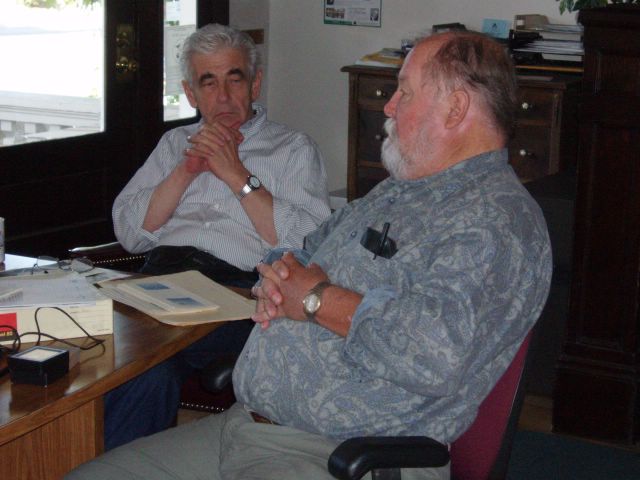
Geohistorian Dick Pugh tells the story,
musician Jon Bunce (background) listens
(Linus Pauling House, Hawthorne, photo by K. Urner)
musician Jon Bunce (background) listens
(Linus Pauling House, Hawthorne, photo by K. Urner)

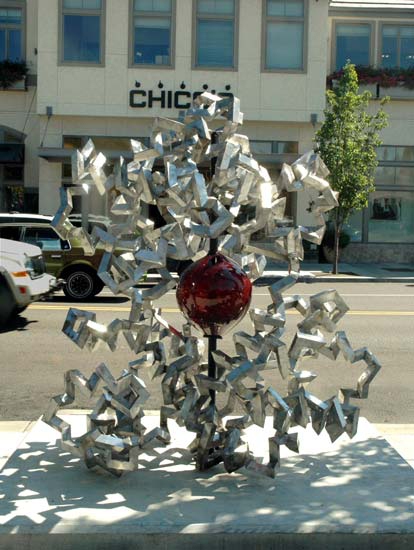
Planting Seeds in the Silicon Forest

"Friends Meeting House"
from company archives
courtesy of Wanderer Doug Strain
from company archives
courtesy of Wanderer Doug Strain
Sunday, September 04, 2005
Summer Memories (picture series)
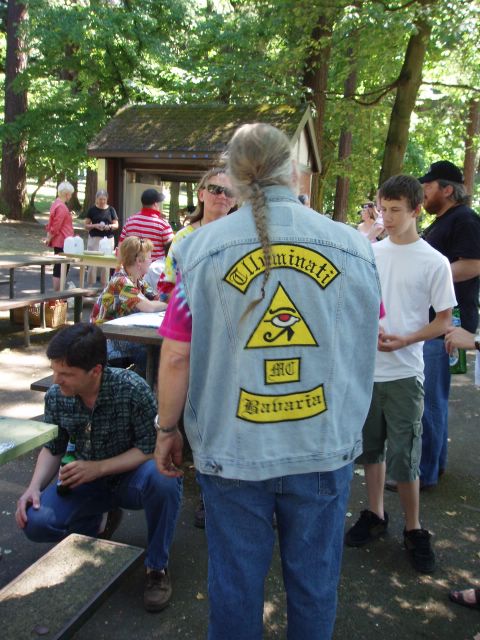
Ron Braithwaite w/ Illuminati jacket
"Off to Canada" Party
Creston Park, July 31, 2005
(photo by K. Urner)
"Off to Canada" Party
Creston Park, July 31, 2005
(photo by K. Urner)
Saturday, September 03, 2005
More BizMo Tech
A lot of bizmos will generate scrolling video blogs. There might be a live show now and then, perhaps at a convergence spot (festivals, e.g. Burning Man). However, a lot of the viewing will be asynchronous and achronological, even though the recordings get filed in the order they happen (per usual in blogdom).
Bizmos involved in emergency relief tend to be too busy to log much beyond procedural stats, giving control room overview: quick updates, better feedback. The slower-moving and sometimes more soap operatic operations (a blur of characters) will come when there's more time for reflection. The very same bizmo might be capable in both modes (as are everyday humans: capable of emergency response, but needing relief from too much stress).
Some bizmos assess damage or working conditions, scout locations, prepare the scene. Others may come by after an event and clean up, restore the environment. What happens in between might be anything from a circus to a refugee camp. You need some clowns in both, because children need cheering up. Get some cartoons going in one of the tents, serve popcorn. Let kids laugh if they're able, or cry if that's what's up.
Bizmos involved in emergency relief tend to be too busy to log much beyond procedural stats, giving control room overview: quick updates, better feedback. The slower-moving and sometimes more soap operatic operations (a blur of characters) will come when there's more time for reflection. The very same bizmo might be capable in both modes (as are everyday humans: capable of emergency response, but needing relief from too much stress).
Some bizmos assess damage or working conditions, scout locations, prepare the scene. Others may come by after an event and clean up, restore the environment. What happens in between might be anything from a circus to a refugee camp. You need some clowns in both, because children need cheering up. Get some cartoons going in one of the tents, serve popcorn. Let kids laugh if they're able, or cry if that's what's up.
Thursday, September 01, 2005
Tillamook
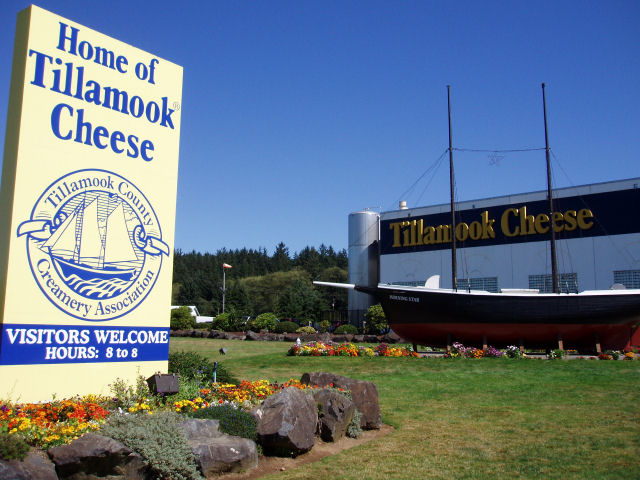
Tillamook cheese factory
(photo by K. Urner, Olympus Stylus 500)
(photo by K. Urner, Olympus Stylus 500)
Pioneers from the east discovered their cows really grooved on the grasses here, and soon they were drowning in dairy. Given difficult topography, the smart folk of Tillamook built a boat, the Morning Star, and sailed it to Portland to trade butter for other necessities.
As in Switzerland, local farmers realized how their way of life might be sustained by minting a cheese of dependable quality. They organized accordingly, by hiring some of the best in the business, and the Tillamook County Creamery Association was formed.
The result: the factory is a tourist destination and the Tillamook brand is recognized around the world for excellence (the ice cream is good too).
Friday, August 26, 2005
Web Wrangler
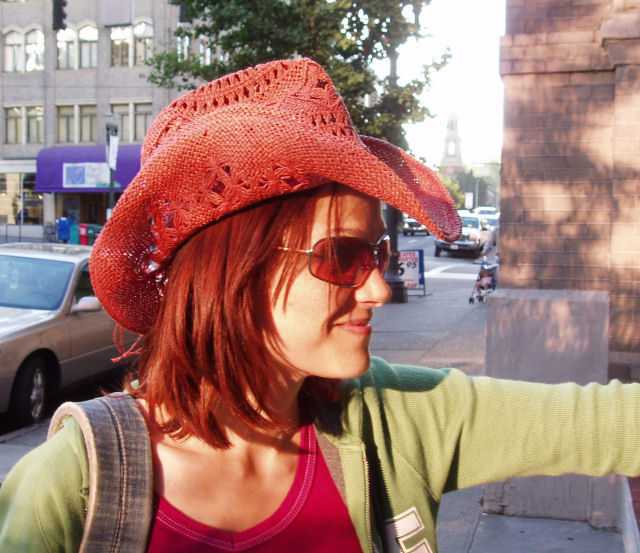
Web wrangler
(photo by K. Urner, Olympus Stylus 500)
Tuesday, August 23, 2005
An Adventure
I was out with captain of Meliptus last night, when a sail boat astern asked if we had radio and if so, to turn it on. We caught a coast guard broadcast: to all ships in vicinity, jet ski boat incident Washington shore, any wishing to investigate? Don took them up on it, and we switched to another channel to get details. This was well after dark. We had no direct communications with the shipwrecked crew (yet). I swiveled a search light through the blackness, while Don pushed slowly towards shore.
OK, not shipwrecked as it turned out. Cell phone contact established, with coast guard mediating. Just an out of gas situation, jet ski beached, two individuals (two males, with backpack and BBQ). We couldn't get the boat right up to shore, given busted depth finder and unknown depth. She doesn't like to run aground, Meliptus doesn't. So we commanded either/both to voluntarily swim out, pushing the jet ski (a fairly light water craft). Not a big job for a fit young man in his mid twenties, Patrick, grad of Catlin Gabel, works in chip fab, as we learned of his identity, while towing the depleted craft back across the Columbia (his mate stayed behind with the merchandize (a BBQ shouldn't get wet)).
Mission accomplished, we radioed closure to the coast guard. No further events to report from that night. No encounters with the stealth boat, though Don has pumped gas for the tender boat, which includes crew member "Lara Croft" (an allusion to Damian's keynote).
OK, not shipwrecked as it turned out. Cell phone contact established, with coast guard mediating. Just an out of gas situation, jet ski beached, two individuals (two males, with backpack and BBQ). We couldn't get the boat right up to shore, given busted depth finder and unknown depth. She doesn't like to run aground, Meliptus doesn't. So we commanded either/both to voluntarily swim out, pushing the jet ski (a fairly light water craft). Not a big job for a fit young man in his mid twenties, Patrick, grad of Catlin Gabel, works in chip fab, as we learned of his identity, while towing the depleted craft back across the Columbia (his mate stayed behind with the merchandize (a BBQ shouldn't get wet)).
Mission accomplished, we radioed closure to the coast guard. No further events to report from that night. No encounters with the stealth boat, though Don has pumped gas for the tender boat, which includes crew member "Lara Croft" (an allusion to Damian's keynote).
Sunday, August 21, 2005
Madagascar (movie review)
Another good DreamWorks cartoon with plenty of physical comedy for youngsters, embedded cultural allusions for oldsters with more in memory (e.g. spot links to Cast Away and Planet of the Apes). Credit goes to AMD Opteron-equipped HP servers down on the (rendering) farm. PS: Penguins rule!
Tuesday, August 16, 2005
2005 BizMo

On-board monitors
(photo by K. Urner, Olympus Stylus 500)
Left monitor: HDTV connected to HDNet via satellite, and currently receiving Sunrise Earth, a no voice-over, slice-of-life program designed to showcase the high definition picture.
Middle monitor: topomaps and biometrics (e.g. captain's weight gains and losses). This bizmo is tasked with gizmo prototyping and field testing, e.g. of vidcam equipment for exploring abandoned mine shafts (which the topomaps & GPS help locate).
Right monitor: general purpose filesystem e.g. image log and music stash (speakers not shown, color printer behind middle monitor).
Monday, August 15, 2005
Sunday, August 14, 2005
Bridge Pedal 2005
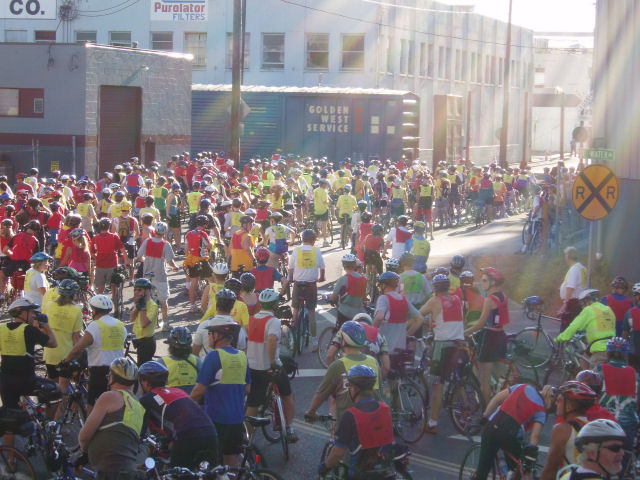
Train crossing
(photo by K. Urner, Olympus Stylus 500)
(photo by K. Urner, Olympus Stylus 500)
I was among the first to start this year (6:30 AM). Mayor Tom Potter, Congressman Earl Blumenauer, and Dick Gibson of Providence (whom I know from meetings) gave short speeches. The organizers expressed their fond hope that we'd have no broken bones this year.
Gayle had a bike accident involving a ped and broke her collar bone last year, fortunately very close to the ER at Legacy Emanuel. With something like 18K riders and walkers doing complicated criss-crossing routes, such accidents are always a possibility.
My chain came off two seconds into the course (not propitious) but the rest of the ride was fairly stress free. The bridges were beautiful. We crossed them in the following order: Morrison, Sellwood, Hawthorne, Ross Island, Marquam, Burnside, Broadway, Fremont, St. John's, Steel.
I met up with Larry and Chris and their son Greg (visiting from Russia) atop the Marquam, and just by chance with Sam and LaJean, who'll be giving the Wanderers presentation this coming Tuesday. Sam accompanied Bucky on a trip to the Philippines in the early 1970s, which would've been when I was there, still a high school student (Imelda Marcos made sure Sam and Bucky got some better shoes).
Congressman Blumenauer promised the new transportation bill will be good for cyclists, and that Portland serves as a national model for a bike friendly town. Gothenberg was even friendlier though, with all those wide divided sidewalks (peds and bikes each get a lane, so there's less contending with buses and cars for a slice of asphalt).
Total miles on my odometer (including the distance to/from the event): 38.4.
Sunday, August 07, 2005

Friday, August 05, 2005
Gibson BizMo

Dawn w/ OSCON sponsor's business mobile
(photo by K. Urner, Olympus Stylus 500)
(photo by K. Urner, Olympus Stylus 500)
At some point in all this OSCON business, I attented a Ruby for Java Programmers session, which was very well done. Having studied Java enroute from FoxPro to Python, and being these days a student of Ruby (albiet a very beginning one), I found this bridge useful/meaningful. Check the OSCON 2005 schedule for the name of the presenter, room number, and so on.
Last day of OSCON 2005
I grabbed the 75 bus this AM and got to OSCON early -- plenty of time for coffee and baked goods, conversation with a Perl programmer from Denmark. He asked what I spoke about (my name badge indicates I'm a speaker) and I explained about the Fuller School, how I'm a big fish in a small pond, how open source has facilitated our work enormously and on many levels.
Keynotes:
Asa Dotzler discussed a perennial topic: how Linux might do more to help Regular People on laptops and desktops, even while keeping it a kick ass system for developers.
The next keynote by Drew Endy of MIT was about programming DNA -- maybe just to insert some documentation. Yeast consists of about 12 million characters of info. Open source yeast? Problems: (1) balkanization of basic biological functions (patents widely distributed -- imagine individual coders owned each piece of punctuation in a program and needing multiple permissions to write each line) (2) quality of code (3) screwed up rights to reuse, react, reverse engineer.
Tony Gaughan (CA) talked about his experiences with Ingres (now open source). Licensing is confusing (GPL, LGPL, CDDL, CATOSL etc.).
Danny O'Brien talked about good and evil in Open Source (software patents are evil).
My favorite presentation was Saul Griffith's about Howtoons: kids hacking the physical world, using comic book instructions. Lots to learn here, about teaching software skills as well.
The panel on women in open source, and engineering more generally, provided interesting insights. Juggling time commitments and priorities -- an age-old problem (it's what operating systems do). The ability to telecommute certainly helps, especially if you're a parent (this is certainly true for me, a dad).
During the Python lightening talks I was able to squeeze in 10 minutes about hypertoons (with projected demo), a real crowd pleaser. Guido was likewise into graphics: a clock featuring multi-colored turning disks, making use of Tk.
Miguel's concluding keynote gave us a foretaste of where Novell is taking the Linux desktop: X running atop OpenGL (= xgl), meaning Gnome, with Mono at its core, will be able to keep pace with OS X (and the next Windows) when it comes to eye candy. Beagle looks like fun.
Shortly I'll be packing the car for a weekend camping trip -- time to get away from computers for awhile, unless I take the laptop to show hypertoons to Bridge City Friends.
Thanks to all for making OSCON 2005 a fantastic learning experience.
Keynotes:
Asa Dotzler discussed a perennial topic: how Linux might do more to help Regular People on laptops and desktops, even while keeping it a kick ass system for developers.
The next keynote by Drew Endy of MIT was about programming DNA -- maybe just to insert some documentation. Yeast consists of about 12 million characters of info. Open source yeast? Problems: (1) balkanization of basic biological functions (patents widely distributed -- imagine individual coders owned each piece of punctuation in a program and needing multiple permissions to write each line) (2) quality of code (3) screwed up rights to reuse, react, reverse engineer.
Tony Gaughan (CA) talked about his experiences with Ingres (now open source). Licensing is confusing (GPL, LGPL, CDDL, CATOSL etc.).
Danny O'Brien talked about good and evil in Open Source (software patents are evil).
My favorite presentation was Saul Griffith's about Howtoons: kids hacking the physical world, using comic book instructions. Lots to learn here, about teaching software skills as well.
The panel on women in open source, and engineering more generally, provided interesting insights. Juggling time commitments and priorities -- an age-old problem (it's what operating systems do). The ability to telecommute certainly helps, especially if you're a parent (this is certainly true for me, a dad).
During the Python lightening talks I was able to squeeze in 10 minutes about hypertoons (with projected demo), a real crowd pleaser. Guido was likewise into graphics: a clock featuring multi-colored turning disks, making use of Tk.
Miguel's concluding keynote gave us a foretaste of where Novell is taking the Linux desktop: X running atop OpenGL (= xgl), meaning Gnome, with Mono at its core, will be able to keep pace with OS X (and the next Windows) when it comes to eye candy. Beagle looks like fun.
Shortly I'll be packing the car for a weekend camping trip -- time to get away from computers for awhile, unless I take the laptop to show hypertoons to Bridge City Friends.
Thanks to all for making OSCON 2005 a fantastic learning experience.
Thursday, August 04, 2005
More OSCON Brilliance
Today's keynotes:
The analyst, Nick Gall, showed us how the Internet models what long term investors look for in an infrastructure: an hourglass shape that makes innovation easy on top of a minimal structure: address, format, protocol. Containerized shipping represents the success of this approach as well.
David Heinemeier Hansson: Ruby on Rails trades flexibility for liberating constraints; learn the conventions of the framework, and you'll find Ruby has taken a lot of the responsibility for making your life as a web developer a lot easier.
The HP guy, Kartik Subbarao, explained how Venice models the ideal IT ecosystem, vs. quadrants Desert (closed source), Swamp (roll your own, maybe starting with open source, but failing to collaborate with the open source community), Ocean (completely open, all possibilities, no land). Case study: HP buys commercial support from Symas to coauthor OpenLDAP, an open source project, in support of its internal economy, thereby netting the benefits of commercial support and the participation of a global expert community.
Geeks sit around with with laptops like musicians with their instruments. One of our sponsors this year: Gibson, the guitar company (I snapped a photo of Gibson's bizmo, parked out front).
Next keynote by Robert Lang: a lecture on the history of origami (well developed by 1734). Akira Yoshizawa invented an instructional language for communicating origami (the http of the origami world). The speaker's Black Forest Cuckoo Clock was amazing (as were many of his others).
Today's computational origami is not like the old stuff. Check out the insects! Applications: unfolding space lenses, solar sails, auto air bags, heart implants (e.g. stents). I went to the follow-up presentation, which got into a lot more detail about the mathematics involved (trisecting angles is easy with origami).
And let me not forget the Identity 2.0 guy, who lives in Canada.BC, is over 21, and drives this fancy car -- or so he alleges (he provided no credential I could authenticate other than his obviously considerable talents as a presenter -- good enough for me in this case, plus I've run web audits since).
OSU is FireFox central (bouncer load balances global distribution). The Mozilla Foundation embodies the open source model where organizations are concerned (there's also a subsidiary corporation). Aside: I think the Python Foundation might do more to emulate this model. Expect FireFox to keep getting better (check my post about XUL). Mitchell Baker is one cool geek.
Nathan Torkington is doing a wonderful job of emceeing this O'Reilly event, per usual. We're lucky to have him in our community.
Interlude:
Dawn picked me up out front in the Subaru (Razz) and we drove to Providence Medical Center, where she had a 5 mm mass removed for biopsy using a needle vacuum. I charged my laptop in the waiting room, and read some of that New Yorker article about the new Pope.
We came back after the procedure and I showed her around, starting with the Google booth (good global data), and moving on through ice tea and ice cream stops, sometimes in the company of our old friend since CUE days, Jeff Zucker, a Perl saint and author of an upcoming book on the Perl DBI package. I also introduced her to Guido, Python's big benefactor, with whom I last conversed at that Thai food kiosk near the ferry stop in Gothenberg.
IronPython:
Now I'm in Jim's talk (Miguel is in the row behind me). IronPython is promisingly fast. The Pie-Thon challenge (trying to get Python to run on Parrot, Perl's evolving engine) helped IronPython evolve, as Guido's benchmark tests for Parrot gave IronPython something to chew on. IronPython 0.6 was only 4% slower than Python-2.3 implemented in C. IronPython 0.9 is now out, and allows subclassing of .NET classes within the language, much better COM support.
Jim demoed Avalon running from within a Python interactive shell. Miguel wanted to see the xaml-defined calculator buttons rotated by 45 degrees, using a list comprehension. Hey, it worked! Then he showed a GTK# GUI talking to the Microsoft Word dictionary. Finally, he showed us embedding a Python engine inside C#. I asked him to demo __add__ binding to the underlying overload of C#'s + operator (that worked too). The Visual Studio debugger transitions smoothly between Python and C# stacks (per my question: any debugger would have access to the same hooks in the .NET or Mono framework).
Open Technology in Oregon:
This presentation by the Open Technology Business Center was about bringing O'Reilly's OSCON back to Portland, based on Oregon's strong commitment to open technology, including increasingly in hardware realms. We got a rundown on some of the relevant businesses here, plus looked at a roadmap for going forward (a commercialization funnel).
We need to also focus on the education, nonprofit and government sectors, for which open technology is vitally important, not just as end users, but as contributing innovators and field testers (Project Renaissance model). OSCON should not become exclusively captive to business interests. Apropos of this, the Government Open Source Conference (GOSCON) is coming to Portland in October, sponsored by OSU's Open Source Lab. A questioner (not me) brought up exactly what I was thinking: Paul Nelson's K12LTSP and Free Geek are currently among the most important open source projects in Oregon.
And After:
Party @ Bar 71, deputized a member of the Posse. Chatted with an OSL guy who was big in the rose business (as in delivery of flowers) because he needed to test some software he was developing for a company, and it actually worked. The company itself went bankrupt, but he wound up with a running business. Then some letter in the mail threatened to sue because he had illegal copies of stuff. Upon audit, he discovered no transgressions, then realized this was a bulk mailing. But he was scared enough to think open source must be the way to go, and he's not looking back.
The analyst, Nick Gall, showed us how the Internet models what long term investors look for in an infrastructure: an hourglass shape that makes innovation easy on top of a minimal structure: address, format, protocol. Containerized shipping represents the success of this approach as well.
David Heinemeier Hansson: Ruby on Rails trades flexibility for liberating constraints; learn the conventions of the framework, and you'll find Ruby has taken a lot of the responsibility for making your life as a web developer a lot easier.
The HP guy, Kartik Subbarao, explained how Venice models the ideal IT ecosystem, vs. quadrants Desert (closed source), Swamp (roll your own, maybe starting with open source, but failing to collaborate with the open source community), Ocean (completely open, all possibilities, no land). Case study: HP buys commercial support from Symas to coauthor OpenLDAP, an open source project, in support of its internal economy, thereby netting the benefits of commercial support and the participation of a global expert community.
Geeks sit around with with laptops like musicians with their instruments. One of our sponsors this year: Gibson, the guitar company (I snapped a photo of Gibson's bizmo, parked out front).
Next keynote by Robert Lang: a lecture on the history of origami (well developed by 1734). Akira Yoshizawa invented an instructional language for communicating origami (the http of the origami world). The speaker's Black Forest Cuckoo Clock was amazing (as were many of his others).
Today's computational origami is not like the old stuff. Check out the insects! Applications: unfolding space lenses, solar sails, auto air bags, heart implants (e.g. stents). I went to the follow-up presentation, which got into a lot more detail about the mathematics involved (trisecting angles is easy with origami).
And let me not forget the Identity 2.0 guy, who lives in Canada.BC, is over 21, and drives this fancy car -- or so he alleges (he provided no credential I could authenticate other than his obviously considerable talents as a presenter -- good enough for me in this case, plus I've run web audits since).
OSU is FireFox central (bouncer load balances global distribution). The Mozilla Foundation embodies the open source model where organizations are concerned (there's also a subsidiary corporation). Aside: I think the Python Foundation might do more to emulate this model. Expect FireFox to keep getting better (check my post about XUL). Mitchell Baker is one cool geek.
Nathan Torkington is doing a wonderful job of emceeing this O'Reilly event, per usual. We're lucky to have him in our community.
Interlude:
Dawn picked me up out front in the Subaru (Razz) and we drove to Providence Medical Center, where she had a 5 mm mass removed for biopsy using a needle vacuum. I charged my laptop in the waiting room, and read some of that New Yorker article about the new Pope.
We came back after the procedure and I showed her around, starting with the Google booth (good global data), and moving on through ice tea and ice cream stops, sometimes in the company of our old friend since CUE days, Jeff Zucker, a Perl saint and author of an upcoming book on the Perl DBI package. I also introduced her to Guido, Python's big benefactor, with whom I last conversed at that Thai food kiosk near the ferry stop in Gothenberg.
IronPython:
Now I'm in Jim's talk (Miguel is in the row behind me). IronPython is promisingly fast. The Pie-Thon challenge (trying to get Python to run on Parrot, Perl's evolving engine) helped IronPython evolve, as Guido's benchmark tests for Parrot gave IronPython something to chew on. IronPython 0.6 was only 4% slower than Python-2.3 implemented in C. IronPython 0.9 is now out, and allows subclassing of .NET classes within the language, much better COM support.
Jim demoed Avalon running from within a Python interactive shell. Miguel wanted to see the xaml-defined calculator buttons rotated by 45 degrees, using a list comprehension. Hey, it worked! Then he showed a GTK# GUI talking to the Microsoft Word dictionary. Finally, he showed us embedding a Python engine inside C#. I asked him to demo __add__ binding to the underlying overload of C#'s + operator (that worked too). The Visual Studio debugger transitions smoothly between Python and C# stacks (per my question: any debugger would have access to the same hooks in the .NET or Mono framework).
Open Technology in Oregon:
This presentation by the Open Technology Business Center was about bringing O'Reilly's OSCON back to Portland, based on Oregon's strong commitment to open technology, including increasingly in hardware realms. We got a rundown on some of the relevant businesses here, plus looked at a roadmap for going forward (a commercialization funnel).
We need to also focus on the education, nonprofit and government sectors, for which open technology is vitally important, not just as end users, but as contributing innovators and field testers (Project Renaissance model). OSCON should not become exclusively captive to business interests. Apropos of this, the Government Open Source Conference (GOSCON) is coming to Portland in October, sponsored by OSU's Open Source Lab. A questioner (not me) brought up exactly what I was thinking: Paul Nelson's K12LTSP and Free Geek are currently among the most important open source projects in Oregon.
And After:
Party @ Bar 71, deputized a member of the Posse. Chatted with an OSL guy who was big in the rose business (as in delivery of flowers) because he needed to test some software he was developing for a company, and it actually worked. The company itself went bankrupt, but he wound up with a running business. Then some letter in the mail threatened to sue because he had illegal copies of stuff. Upon audit, he discovered no transgressions, then realized this was a bulk mailing. But he was scared enough to think open source must be the way to go, and he's not looking back.
Monday, July 25, 2005

Saturday, July 23, 2005
Meanwhile, Near Hawthorne...
Caught John Roberts (the anchor, not the Supreme Court nominee) getting rid of his tie last night, following a segment on down-dressing business class Japanese (still formal, just minus the jacket and tie). Then today in Powell's I found Fruits, by Phaidon, about fashion-savvy teens in and around Tokyo, setting new trends. "Fruits" carries no specific connotations regarding sexual orientation in this context, unless you count polymorphously perverse.
What cracked me up on CBS last night was the story about DARPA trying to turn those cute robot puppies into vicious dogs of war, and maybe those Segways™ (straight out of Fantasia's Sorcerer's Apprentice) into silent stalkers. Leave it to DARPA to put a scary sinister spin on anything (even Python -- actually Python was easy).
I eyed the news while packing a night bag for Tara, who slept at the Oregon Zoo (Brenna too), part of a programmed summer camp experience for youngsters in this town. Dawn was in post-op, Short Stay, but not for anything too serious, and I fetched her home later that evening, having spent the better part of the day at the hospital, where I almost finished Quicksilver (so today I bought The Confusion, and a map of Rome).
What cracked me up on CBS last night was the story about DARPA trying to turn those cute robot puppies into vicious dogs of war, and maybe those Segways™ (straight out of Fantasia's Sorcerer's Apprentice) into silent stalkers. Leave it to DARPA to put a scary sinister spin on anything (even Python -- actually Python was easy).
I eyed the news while packing a night bag for Tara, who slept at the Oregon Zoo (Brenna too), part of a programmed summer camp experience for youngsters in this town. Dawn was in post-op, Short Stay, but not for anything too serious, and I fetched her home later that evening, having spent the better part of the day at the hospital, where I almost finished Quicksilver (so today I bought The Confusion, and a map of Rome).
Thursday, July 21, 2005
Kirbiania
Hugh Watkins, a Wittgenstein buff based in Copenhagen these days, coined "Kirbiania" to refer to my writings (Kirbinalia might have been an alternative). Could this be some brand of God-talk from the Book of Narnia perchance, used by some exotic species or being that didn't make the final edit? Here's the relevant blog entry.
We've been feeling somewhat out of the woods regarding my wife's medical condition, at least for the interim, but today it finally hit home what they've been trying to tell us: the MRI was not really negative (although the PET thankfully was), and given the state of the art, that could mean many things. So an ultra-sound is indicated, and maybe a biopsy.
I'm about done programming my OSCON talk, which will presumably happen sometime in the first week of August. Later in the summer, we're hoping to maybe rent a smallish RV and visit Dawn's brother and sister-in-law near Sisters, and Crater Lake. I'd prefer to field test a real bizmo, but Education Research is less of a budget priority right now.
No, civilian programming continues to take a back seat as we prosecute some war on terror ad infinitum. Granted, life is somewhat terrifying, so there'll always be this need to keep our minds occupied with security concerns. But like president Eisenhower, I'd rather opt for better and more global health care, higher living standards, more civilian alternatives. Livingry is far more effective against terror than killingry.
As I wrote to Hugh yesterday: "In focusing on ordinary language, I think [Wittgenstein] brings us to where the action is, i.e. we need to infuse more science content into ordinary thinking, so that human beings bumble about in less politically-minded language games and spend more time programming their new smart homes and playing world game. "
My wife and I are mindful of the fact that the level of medical care we're getting is far above the global average -- and yet is still so dark ages compared to what it could be (the doctors feel this acutely).
We've been feeling somewhat out of the woods regarding my wife's medical condition, at least for the interim, but today it finally hit home what they've been trying to tell us: the MRI was not really negative (although the PET thankfully was), and given the state of the art, that could mean many things. So an ultra-sound is indicated, and maybe a biopsy.
I'm about done programming my OSCON talk, which will presumably happen sometime in the first week of August. Later in the summer, we're hoping to maybe rent a smallish RV and visit Dawn's brother and sister-in-law near Sisters, and Crater Lake. I'd prefer to field test a real bizmo, but Education Research is less of a budget priority right now.
No, civilian programming continues to take a back seat as we prosecute some war on terror ad infinitum. Granted, life is somewhat terrifying, so there'll always be this need to keep our minds occupied with security concerns. But like president Eisenhower, I'd rather opt for better and more global health care, higher living standards, more civilian alternatives. Livingry is far more effective against terror than killingry.
As I wrote to Hugh yesterday: "In focusing on ordinary language, I think [Wittgenstein] brings us to where the action is, i.e. we need to infuse more science content into ordinary thinking, so that human beings bumble about in less politically-minded language games and spend more time programming their new smart homes and playing world game. "
My wife and I are mindful of the fact that the level of medical care we're getting is far above the global average -- and yet is still so dark ages compared to what it could be (the doctors feel this acutely).
Saturday, July 16, 2005
Stealth Boat
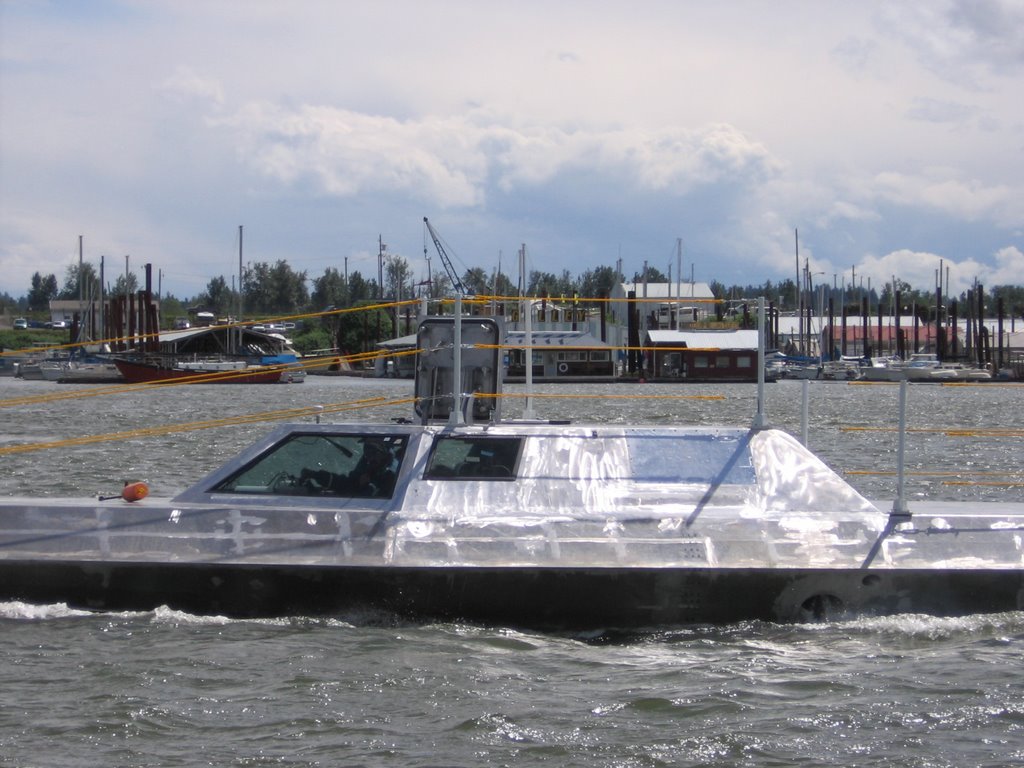 "stealth boat"
(photo by K.Urner)
So today's front page of the Oregonian was about this jet boat variant we've been seeing, and photographing, on the Columbia River. Don and I watched it from the Chris Craft that day, as I filled my Olympus xD card (property of 4D Solutions).
Maybe we weren't supposed to take pictures, but I figured this is my Columbia as much as theirs, so if you're going to putter about in a public area, you'd better not complain if you're treated as a member of the public, by your fellow taxpayers.
Especially if you're working for the government, expect to be monitored by the boss (i.e. "we the people").
A crew member pointed to the shadow boat, like maybe that'd give me pause. So I got some stills of it, too. Anyway, now it's an open secret, so I might stop dragging Friends into my office during potluck, for a quick peek at the funny jet boat (followed by friendly speculations -- many of them on target).
Wednesday, July 13, 2005

Monday, July 04, 2005
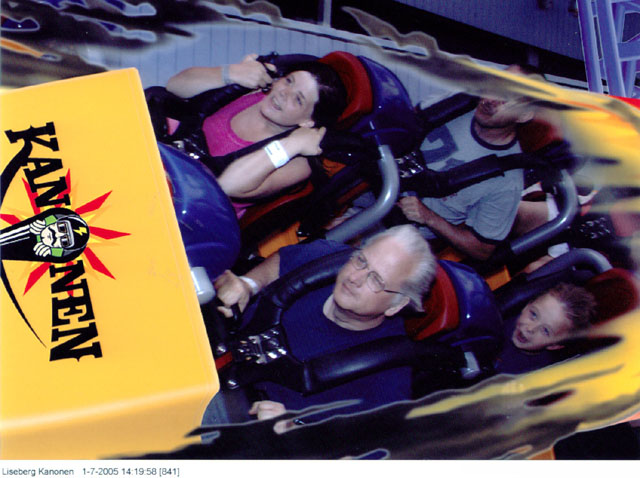
Sunday, June 26, 2005
Gothenburg
This was a long day, given the sun only set for a few minutes, sometime after midnight, when we'd passed beyond Greenland going about 625 mph at 35,000 feet on a muscular MD-11 owned by KLM, enroute from Vancouver, BC to Amsterdam. The next jet, a 737-400, also KLM, was named Ernest Hemingway. The Air Canada from PDX to Vancouver was a Dash-8 (props, cabin under the wing). Airplane reading: Quicksilver by Neal Stephenson.
I haven't slept much since waking up in Portland many hours ago. That's OK. Dawn sometimes talks about entering dreamtime when she travels. Maybe this is what she means. I'm here for EuroPython of course, as a special invitee. We've got a thread going on the Math Forum that has some more background.
I haven't slept much since waking up in Portland many hours ago. That's OK. Dawn sometimes talks about entering dreamtime when she travels. Maybe this is what she means. I'm here for EuroPython of course, as a special invitee. We've got a thread going on the Math Forum that has some more background.
Saturday, June 18, 2005
A Day At the River
Today Dawn woke up more unhappy than usual, and we resolved that getting out to some new place would be good. Her choice: Sandy River by way of Edgefield. We took this trip, and her mood greatly improved, as did mine. Scenic Troutdale was fun to drive through.
At the river, which we drove to after walking around the golf course, admiring the fresh plants (plus a wedding was getting ready to happen), having lunch, a big sign warned of drowing deaths, I think 12 since 1993.
Too many. Life guards were on duty, and an ambulance was parked nearby. But I'm sure this level of support can't be arranged 24/7. Kids will swim nude, drunk, or dive off the bridge. Grownups have their own problems.
The circling hawks were spectacular.
In a few minutes, I'll join Matt and Mike for a beer. Mike has a new used car. We haven't the three of us gotten together since my birthday. I'm coming back early though, as Dawn wants to celebrate the solstice with some good friends while I look after Tara. That's perfectly OK with me -- recharging one's batteries is an important part of life, especially during holidays.
At the river, which we drove to after walking around the golf course, admiring the fresh plants (plus a wedding was getting ready to happen), having lunch, a big sign warned of drowing deaths, I think 12 since 1993.
Too many. Life guards were on duty, and an ambulance was parked nearby. But I'm sure this level of support can't be arranged 24/7. Kids will swim nude, drunk, or dive off the bridge. Grownups have their own problems.
The circling hawks were spectacular.
In a few minutes, I'll join Matt and Mike for a beer. Mike has a new used car. We haven't the three of us gotten together since my birthday. I'm coming back early though, as Dawn wants to celebrate the solstice with some good friends while I look after Tara. That's perfectly OK with me -- recharging one's batteries is an important part of life, especially during holidays.
Thursday, June 09, 2005
Dad Guy
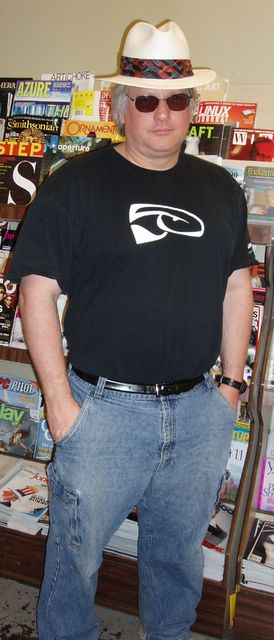
Me at Powell's.
Photo taken by Derek using the new
5.0 megapixel Olympus Stylus 500
(same one mom took to England)
Hat: from Princeton reunion, hand made in Ecuador
Shirt: ActiveState company shirt, a gift from OSCON
Pants: basic jeans with lots of pockets
Photo taken by Derek using the new
5.0 megapixel Olympus Stylus 500
(same one mom took to England)
Hat: from Princeton reunion, hand made in Ecuador
Shirt: ActiveState company shirt, a gift from OSCON
Pants: basic jeans with lots of pockets
Tuesday, June 07, 2005
Tuesday, May 24, 2005
The Tree House
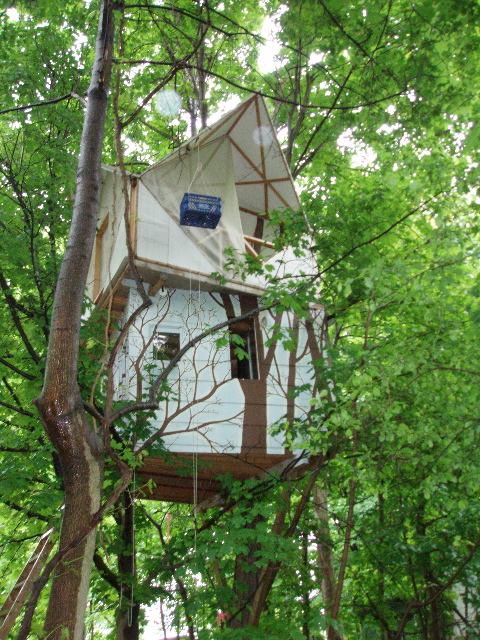
Tree House
I was glad to be back in Cary's and Theo's tree house last night. I took Continental from PDX to EWR, public bus to Newark's Penn Station, PATH to WTC, subways from Chambers St. to 88th on the west side.
I had dinner with David Lansky and his two boys, Ben in college, Sam in high school, and with Arthur Siegel, an active co-participant on edu-sig.
We discussed, among other things, the role of technology in the curriculum, the relevance (or lack thereof) of math courses. Sam shared his dissatisfaction with math courses that give no real depth, are entirely about doing well on some final test (in his case the IB exam). He once asked his teacher about some concept, and she told him not to worry about it, because this concept wouldn't be on the exam. Ben is seriously into English at Haverford, but assured us that many of his classmates are bona fide math and science geeks.
My goal was to make the 8:20 PM Amtrak to Rhinecliff, but I missed it by a couple minutes, trying to type my name on this touch screen interface at 34th St. Penn Station. So I hopped a subway to Times Square and took the cross-town shuttle (S), to Grand Central (enjoyed the wireless in the waiting area, with a $2 can of Bud). The Metrolink North on track 37, departing 10:02 PM for Poughkeepsie, brought me close enough for poor sleep-deprived Stu Quimby (a Toyman) to come fetch me, and bring me to the tree house. I slept well.
Monday, May 16, 2005
Spoon Man
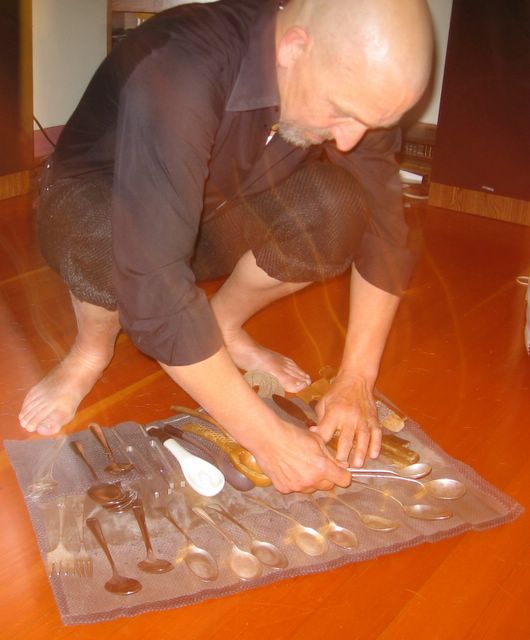
Spoon Man
Artis in my living room, setting up for a performance. Photo by Don Wardwell, Canon digital camera, slow motion setting.
Artis, a busker, gave Nick a ride that day, coming down from Seattle, enroute to Bandon via Eugene. Nick phoned today from eastern Oregon, with Stallings, who is now doing a solo version of Hamlet (see my earlier review of his adaptation of King Lear).
The Aviator (movie review)
As in A Beautiful Mind, the screenwriters here have the daunting task of projecting the protagonist's psychic tailspin on the big screen. We see many foreshadowings that he'll be losing his grip, but not before he takes on the world and changes it significantly, and for the better.
To keep the storyline manageable, and maybe because the yet youthful DiCaprio would not seem quite believable as an old man, we never get to the concluding chapters in Las Vegas.
Congressman Brewster, well played by Alan Alda, was actually banking on Hughes snapping under pressure, making a public spectacle of his managerial incompetence. But this plan backfires. Fighting to keeping TWA on the map, versus a greedy Pan Am, contributes mightily to Howard's sanity. Here's a simple game with obvious villains. Hughes is restored to health by fighting in this political arena.
The movie-star women, though more complex than the greedy guys, are still a source of sanity in his life, though his mother takes a hit for maybe contributing to his ill-defined germ phobia (I understand Tesla had a similar problem -- or was it a fear of being poisoned?). My favorite line in the film: Ava Gardner walks into this apartment he's been flipping out in, sees tape connecting everything to everything (I'll guess this was a screenwriter fiction) and says with droll humor as she pours herself a drink: "I love what you've done with the place."
And then of course we have the airplanes, the simplest creatures of all (which the screenwriters compare with the women at least superficially -- both sleek). The planes are Howard's chief conduit to the exhilarating world of unforgiving physical principles versus human engineering and a desire to master them. When the plane, the woman, and bottled milk all come together (Katherine Hepburn at the wheel, high above Hollywood), he's in his element at last.
To keep the storyline manageable, and maybe because the yet youthful DiCaprio would not seem quite believable as an old man, we never get to the concluding chapters in Las Vegas.
Congressman Brewster, well played by Alan Alda, was actually banking on Hughes snapping under pressure, making a public spectacle of his managerial incompetence. But this plan backfires. Fighting to keeping TWA on the map, versus a greedy Pan Am, contributes mightily to Howard's sanity. Here's a simple game with obvious villains. Hughes is restored to health by fighting in this political arena.
The movie-star women, though more complex than the greedy guys, are still a source of sanity in his life, though his mother takes a hit for maybe contributing to his ill-defined germ phobia (I understand Tesla had a similar problem -- or was it a fear of being poisoned?). My favorite line in the film: Ava Gardner walks into this apartment he's been flipping out in, sees tape connecting everything to everything (I'll guess this was a screenwriter fiction) and says with droll humor as she pours herself a drink: "I love what you've done with the place."
And then of course we have the airplanes, the simplest creatures of all (which the screenwriters compare with the women at least superficially -- both sleek). The planes are Howard's chief conduit to the exhilarating world of unforgiving physical principles versus human engineering and a desire to master them. When the plane, the woman, and bottled milk all come together (Katherine Hepburn at the wheel, high above Hollywood), he's in his element at last.
Wednesday, April 27, 2005
Oswego 2003
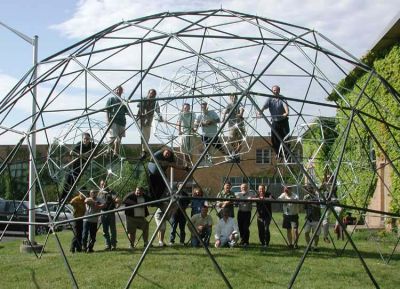
Oswego 2003
I've just been perusing a photo-blog chronicling the SNEC Summer Workshop in Oswego, New York, June, 2003. The ever-wandering Nick Consoletti, PhD attended the Tensegrity Structures workshop (also at SUNY Oswego) the following summer. Joe Clinton and John Belt were principals at both workshops.
These are the kinds of events I'd want control rooms to route my bizmo through (also to the Bridges and Bioneers conferences, to which I've never been).
Friday, April 22, 2005
More BizMo News

For sale on eBay
Trevor found this bizmo on eBay, complete with 7 workstations and externally viewable video wall. I could see dispatch sending a vehicle like this to some curriculum/circus event, to which I might be sent as well, in a bizmo we could actually sleep in. Coordinating resources is key.
The general Project Renaissance philosophy involves government working with NGOs, because they're on the cutting edge, pioneering new technologies in ways corporate R&D budgets might never directly support. Yet usable, commercializable ideas derive from such pioneering, so the money is in theory well spent (in practice there'll be some waste).
When humanity is hurt or damaged, control rooms spring into action and provide relief, which makes for good reality TV. Of course historically, humans haven't really worked as a body, as large groups typify other groups as pathogenic, and teach their children to perpetuate these views. Humanity has some kind of auto-immune disorder, like lupus or something, causing it to keep attacking itself. Project Renaissance attempts to overcome this disorder. The tsunami relief effort was a step in the right direction.
Speaking of bizmo-based reality TV, I was watching Pat Croce Moving In on the monitor at the gym today, close captioned, as I burned calories on a Precor EFX546i. This guy travels around in a bizmo, parking next to homes and getting involved in family dynamics, trying to help out and fix stuff. I'd call that prototypical of what I'm scheming to see -- I'd just like more of a geek channel overlay, i.e. a focus on technology and engineering, in addition to whatever soap opera family dynamics. Plus Croce's bizmo's interior is too much the suburban ranch style home for my taste (not my American dream).
Wednesday, April 20, 2005
Mythos
Cornelia with her pet Berus
From Tara's toy chest. I mentioned I'd share a photo of Berus (a nickname for Cerberus) once I got my digital camera replaced (see last two paragraphs of Children's Program).
I had a Fujifilm FinePix 2600 Zoom (2 megapixels), but the battery hatch broke off. I replaced it with an Olympus Stylus 500 (5 megapixels).
Friday, April 15, 2005
Last ISEPP Lecture 2005
Our guest last night was Dr. William Wulf, currently half-way through his second and final term as president of the National Academy of Engineering (NAE), which co-exists with the National Academy of Sciences and the Institute of Medicine within the framework of the National Research Council.
Dr. Wulf made it clear that whereas the NAE is an honorific society (per usual with such academies), it also has a special mission to advise the federal government on matters of technology and social policy on a not-for-profit basis. The membership churns out a lot of in-depth, well-researched reports in answer to various policy questions coming from Congress and federal agencies. Occasionally a report will have a classified appendix (meaning it's not accessible to the general public), but for the most part, these studies are all available on-line.
The theme of Dr. Wulf's lecture was C.P. Snow's "chasm between the two cultures" by which Snow meant the humanities on the one hand, and the technology fields on the other, the latter being characterized by their heavy emphasis on mathematics.
Whereas the idea of "two cultures" is easy to grasp, sometimes it makes more sense to break it down further, and Wulf outlined differences between science and engineering, which are indistinguishible in the middle, but also define two extremes.
Engineering is different from science in its emphasis on creating new phenomena, versus simply studying existing ones. Engineers create, bring into existence, design. As such, Wulf considers them to have more in common with artists than with many scientists. He wants to communicate this to new generations, so that creative, imaginative students don't buy into some silly stereotype of the engineer as some nerdy cog in the machine who doesn't think about the concerns of real people or topics within the humanities.
This difference has also been a key part of ISEPP president Terry Bristol's philosophy, so I found it interesting to have them both addressing our pre-lecture on this issue (a small gathering of teachers met with Dr. Wulf ahead of time, in the Heathman Hotel). Terry pointed out that the US Constitution may be viewed as a product of engineering, a blueprint or circuit diagram, complete with feedback loops, load balancing and so forth.
At the dinner afterwards I commented that Dr. R. Buckminster Fuller also wrote a lot about C.P. Snow's famous lecture, and that one way of bridging the chasm is to treat Fuller within the sphere of the humanities, as a New England Transcendentalist for example, and a poet, and then follow his threads into geometric and engineering domains.
Then I brought up Dr. Donald Knuth at Stanford, who suggested we fight overspecialization by becoming competent in at least two fields, preferably quite far apart. In Knuth's case, this would include his foray into theology (a humanities topic, rather different from computer science, in which discipline he's considered a giant).
I asked Dr. Wulf (who has a background in computer science) if he liked this model: you don't get to consider yourself well educated or accomplished in the liberal arts, if you don't have fairly well-developed competence in at least two disciplines, one from each side of C.P. Snow's chasm. Dr. Wulf pointed out that Dr. Knuth was also an accomplished organist, that few attain such stature in even one discipline, let alone more than one, but yes, aspiring to competence in at least two widely spaced disciplines was a good idea and he was all for it.
Don was in high gear last night, helping organize the pre-lecture and handling logistics, including the transfer of Julian's sculpture Unraveling Collagen from the neighboring Performing Arts Center to the lobby of the Arlene Schnitzer Concert Hall -- and back, after the lecture. Featuring Julian's work was a great idea for this lecture in particular, as it bridges C.P. Snow's chasm very effectively and intelligently. Good brainstorming by Wanderers!
Dr. Wulf made it clear that whereas the NAE is an honorific society (per usual with such academies), it also has a special mission to advise the federal government on matters of technology and social policy on a not-for-profit basis. The membership churns out a lot of in-depth, well-researched reports in answer to various policy questions coming from Congress and federal agencies. Occasionally a report will have a classified appendix (meaning it's not accessible to the general public), but for the most part, these studies are all available on-line.
The theme of Dr. Wulf's lecture was C.P. Snow's "chasm between the two cultures" by which Snow meant the humanities on the one hand, and the technology fields on the other, the latter being characterized by their heavy emphasis on mathematics.
Whereas the idea of "two cultures" is easy to grasp, sometimes it makes more sense to break it down further, and Wulf outlined differences between science and engineering, which are indistinguishible in the middle, but also define two extremes.
Engineering is different from science in its emphasis on creating new phenomena, versus simply studying existing ones. Engineers create, bring into existence, design. As such, Wulf considers them to have more in common with artists than with many scientists. He wants to communicate this to new generations, so that creative, imaginative students don't buy into some silly stereotype of the engineer as some nerdy cog in the machine who doesn't think about the concerns of real people or topics within the humanities.
This difference has also been a key part of ISEPP president Terry Bristol's philosophy, so I found it interesting to have them both addressing our pre-lecture on this issue (a small gathering of teachers met with Dr. Wulf ahead of time, in the Heathman Hotel). Terry pointed out that the US Constitution may be viewed as a product of engineering, a blueprint or circuit diagram, complete with feedback loops, load balancing and so forth.
At the dinner afterwards I commented that Dr. R. Buckminster Fuller also wrote a lot about C.P. Snow's famous lecture, and that one way of bridging the chasm is to treat Fuller within the sphere of the humanities, as a New England Transcendentalist for example, and a poet, and then follow his threads into geometric and engineering domains.
Then I brought up Dr. Donald Knuth at Stanford, who suggested we fight overspecialization by becoming competent in at least two fields, preferably quite far apart. In Knuth's case, this would include his foray into theology (a humanities topic, rather different from computer science, in which discipline he's considered a giant).
I asked Dr. Wulf (who has a background in computer science) if he liked this model: you don't get to consider yourself well educated or accomplished in the liberal arts, if you don't have fairly well-developed competence in at least two disciplines, one from each side of C.P. Snow's chasm. Dr. Wulf pointed out that Dr. Knuth was also an accomplished organist, that few attain such stature in even one discipline, let alone more than one, but yes, aspiring to competence in at least two widely spaced disciplines was a good idea and he was all for it.
Don was in high gear last night, helping organize the pre-lecture and handling logistics, including the transfer of Julian's sculpture Unraveling Collagen from the neighboring Performing Arts Center to the lobby of the Arlene Schnitzer Concert Hall -- and back, after the lecture. Featuring Julian's work was a great idea for this lecture in particular, as it bridges C.P. Snow's chasm very effectively and intelligently. Good brainstorming by Wanderers!
Wednesday, April 06, 2005
HPD Cybervan
So we had a big powwow at West Precinct on Tuesday -- a much bigger turnout than usual. George had us brainstorm around getting use from the RedHat 9 lab. I sat there with the Toshiba trying to remember how Jerritt set it up, but could only get access to Coffee People across the street (weak signal). I've forgotten the details (though I still have his network diagram -- which doesn't include passwords, so I'm not going to be sysadmining any time soon (which is for the best -- better HPD should sysadmin, vs. just driving taxi)).
The grand finale was a tour of the new cybervan out back, just arrived, pure white, no decals. It's a 5th wheel, no power of its own, except a propane generator (right?) for the electronics, which include 3 TV consoles in three sections (back, middle, front -- side door into middle). Plus there's a Windows box using the giant satellite dish up top. One of the cops was playing with that, apparently getting signal. George waved towards some pickup in the lot that's supposed to haul this thing. It must be strong, because this thing obviously weighs quite a bit.
The current plan is to have the 5th wheel available in the parking lot for a summer camp experience -- kids in groups of 44 or so, with a snack station and rotating among workstations. The 5th wheel might be one of the workstations (the lab another, a couple other rooms talked about). As for how it gets deployed to more remote locations, that remains to be seen. The Washington County Fair that happens every year is a no-brainer, but the point is to keep it busy all year. That means more content.
How the open source angle plays out remains to be seen. George is pretty committed to Linux from a finances point of view (thinking of kids wanting to own their own computers), but that's not to overly discriminate against everyone else. The cybervan serves wireless, so if a non-Windows notebook shows up and wants to patch in, that shouldn't be a problem, provided proper authorization is obtained.
I took the Max to and from, hauling the Toshiba Satellite A60 and reading my various computer magazines.
The grand finale was a tour of the new cybervan out back, just arrived, pure white, no decals. It's a 5th wheel, no power of its own, except a propane generator (right?) for the electronics, which include 3 TV consoles in three sections (back, middle, front -- side door into middle). Plus there's a Windows box using the giant satellite dish up top. One of the cops was playing with that, apparently getting signal. George waved towards some pickup in the lot that's supposed to haul this thing. It must be strong, because this thing obviously weighs quite a bit.
The current plan is to have the 5th wheel available in the parking lot for a summer camp experience -- kids in groups of 44 or so, with a snack station and rotating among workstations. The 5th wheel might be one of the workstations (the lab another, a couple other rooms talked about). As for how it gets deployed to more remote locations, that remains to be seen. The Washington County Fair that happens every year is a no-brainer, but the point is to keep it busy all year. That means more content.
How the open source angle plays out remains to be seen. George is pretty committed to Linux from a finances point of view (thinking of kids wanting to own their own computers), but that's not to overly discriminate against everyone else. The cybervan serves wireless, so if a non-Windows notebook shows up and wants to patch in, that shouldn't be a problem, provided proper authorization is obtained.
I took the Max to and from, hauling the Toshiba Satellite A60 and reading my various computer magazines.
Monday, March 28, 2005
Python for GIS Experts
I've been cramming for days to lead this 3 hour training for GIS professionals at an annual conference. As it turns out, you can't really cover Python in all its glory in 3 hours, i.e. when 5 o'clock rolled around, I still hadn't spent much time discussing how to open and read files. We covered some more advanced topics instead: generators and decorators. Going by partial feedback, at least some in the audience had fun, found me dynamic enough as a speaker. I'm pretty good with quips and asides, keeping things fairly light and moving.
But really, today was more an education for me. I soaked up a lot of info about the state of the art when it comes to geoprocessing and geographic information systems (GIS) -- good stuff for a Global Data CEO to know about. ESRI is the 800 pound gorilla in this knowledge domain. They're moving to Python for a scripting language in their flagship product (ArcGIS) which is how come I was a speaker at the Doubletree Hotel, Lloyd Center, Portland.
The lunch time talk was excellent. The speaker, Doug Divine, played a major role digitally surveying both submarines of Civil War vintage (talking USA history here). The Hunley, a confederate vessel, is the one most people know about, but the Yankees had their own sub, which was repurposed to pearl diving duty after the war and ended up all washed up on some island near Panama City. Doug's talk featured a lot of excellent DVD clips, including a dramatization of the Hunley's last mission, funded by Ted Turner.
But really, today was more an education for me. I soaked up a lot of info about the state of the art when it comes to geoprocessing and geographic information systems (GIS) -- good stuff for a Global Data CEO to know about. ESRI is the 800 pound gorilla in this knowledge domain. They're moving to Python for a scripting language in their flagship product (ArcGIS) which is how come I was a speaker at the Doubletree Hotel, Lloyd Center, Portland.
The lunch time talk was excellent. The speaker, Doug Divine, played a major role digitally surveying both submarines of Civil War vintage (talking USA history here). The Hunley, a confederate vessel, is the one most people know about, but the Yankees had their own sub, which was repurposed to pearl diving duty after the war and ended up all washed up on some island near Panama City. Doug's talk featured a lot of excellent DVD clips, including a dramatization of the Hunley's last mission, funded by Ted Turner.
Friday, March 25, 2005
Pycon 2005
March 24:
So I'm in Washington, DC with my wife, staying with friends in Virginia. We've been taking the Orange Line into town the last two mornings. I get off at Foggy Bottom/GWU.
Yesterday I gave a talk on hypertoons during one of the open space periods. Dawn visited the new Native American museum on the mall.
Tonight I'll be going out for dinner with Dabo and Schevo people (hi Patrick) -- both emerging database-oriented Pythonic technologies.
March 25:
So we had good Vietnamese food on M Street in Georgetown last night. Conversation meadered, a lot about raising kids, especially teenagers. Turns out Prague is a major capital in FoxPro world (a world I share with the Dabo guys); maybe I'll get back there one of these days. Would Microsoft have let FoxPro die off if it hadn't been for heavyweight clients like the US military, which uses it in JFAST (home page)?
Speaking of the military, one of the interesting applications demonstrated this week, inside of which Python plays a major role, was for imparting Arabic language skills to soldiers (PDF). Python glues together speech recognition software and a game engine (Unreal Tournament 2003), and simulates a mission: approach some locals, introduce yourself and your team; ask who's in charge; get directions to the local leader's house; follow them (all in Arabic of course).
This morning, we're looking forward to a keynote about how Python is used at Google.
In the news: I see Bobby Fischer has finally gotten out of that Japanese jail.
So I'm in Washington, DC with my wife, staying with friends in Virginia. We've been taking the Orange Line into town the last two mornings. I get off at Foggy Bottom/GWU.
Yesterday I gave a talk on hypertoons during one of the open space periods. Dawn visited the new Native American museum on the mall.
Tonight I'll be going out for dinner with Dabo and Schevo people (hi Patrick) -- both emerging database-oriented Pythonic technologies.
March 25:
So we had good Vietnamese food on M Street in Georgetown last night. Conversation meadered, a lot about raising kids, especially teenagers. Turns out Prague is a major capital in FoxPro world (a world I share with the Dabo guys); maybe I'll get back there one of these days. Would Microsoft have let FoxPro die off if it hadn't been for heavyweight clients like the US military, which uses it in JFAST (home page)?
Speaking of the military, one of the interesting applications demonstrated this week, inside of which Python plays a major role, was for imparting Arabic language skills to soldiers (PDF). Python glues together speech recognition software and a game engine (Unreal Tournament 2003), and simulates a mission: approach some locals, introduce yourself and your team; ask who's in charge; get directions to the local leader's house; follow them (all in Arabic of course).
This morning, we're looking forward to a keynote about how Python is used at Google.
In the news: I see Bobby Fischer has finally gotten out of that Japanese jail.
Thursday, March 17, 2005
Happy St. Patrick's Day!
So I finally got my hypertoon concept implemented in souce code. Although I published the idea to the web in 1996, only recently have my programming skills intersected available technology (Python + VPython) such that I could write a working prototype.
I'll be sharing about it at Pycon 2005 next week in DC. Looking forward to seeing Glenn and his family.
Looking ahead to that, I tried the the app on the family laptop (1.2 Ghz Compaq Presario) and found the results disappointing. The family budget is tight (no Animal Planet or new fish tank accessories for Tara) -- because dad spends all his time pushing the Bucky stuff, work nobody pays him for (except precessionally, which counts) -- but I couldn't see a way around ordering up a new (refurbished) laptop. Like, I've got this 3 hour teaching gig for some big GIS corporation (ESRI) the day after my return, and this Presario keeps overheating and cutting out. That just won't do.
Trying to get used to the new haircut. Jennifer had a lot of time to trim away, going for the perfect cut. My head feels pounds lighter. She wrote a bunch of "must see" movies on a biz card (she's another Netflix fan, knows a lot about movies, and Pink Floyd too).
On Tuesday, Matt (speaking of Irish) took the day off to finally get a home computer (his first ever). I helped him pick it out (iMac) and get it connected through Comcast -- the test was to get Amy Goodman on RealPlayer (we passed the test).
I'll be sharing about it at Pycon 2005 next week in DC. Looking forward to seeing Glenn and his family.
Looking ahead to that, I tried the the app on the family laptop (1.2 Ghz Compaq Presario) and found the results disappointing. The family budget is tight (no Animal Planet or new fish tank accessories for Tara) -- because dad spends all his time pushing the Bucky stuff, work nobody pays him for (except precessionally, which counts) -- but I couldn't see a way around ordering up a new (refurbished) laptop. Like, I've got this 3 hour teaching gig for some big GIS corporation (ESRI) the day after my return, and this Presario keeps overheating and cutting out. That just won't do.
Trying to get used to the new haircut. Jennifer had a lot of time to trim away, going for the perfect cut. My head feels pounds lighter. She wrote a bunch of "must see" movies on a biz card (she's another Netflix fan, knows a lot about movies, and Pink Floyd too).
On Tuesday, Matt (speaking of Irish) took the day off to finally get a home computer (his first ever). I helped him pick it out (iMac) and get it connected through Comcast -- the test was to get Amy Goodman on RealPlayer (we passed the test).
Tuesday, March 15, 2005
Wanderers Meeting 2005.3.15
Today we learned about Meliptus, the name of Don's boat, and also a mnemonic for his Master Life Personal Development System. Don is refreshingly low key with his approach -- the antithesis of L. Ron Hubbard (another guy with a boat).
We talked about some successes in our lives, and the processes contributing to them. Mine was getting back into teaching, which I enjoy. That teaching job at St. Dominic Academy (Jersey City) was one of my all time favorites, if challenging. Getting that Saturday Academy gig last summer with the HPD's George Heuston the ex FBI guy, and co-teaching with Linux guru Jerritt Collord, was a breakthrough for me. I shared about the police chief being a son of Chinese immigrants, and wanting to reach out to Latino youth, among others, to bridge the digital divide -- hence that computer lab at West Precinct (Hillsboro). The relationship with Saturday Academy continues (and HPD).
Others had interesting success stories as well (which they might tell, if so moved). I got some good feedback from Bruce when I shared my a plan to recruit master teachers into this alternative lifestyle centered around roving teacher-mobiles (specially outfitted RV-like jobbers), coordinated and supported through some OnStar-like headquarters. Bruce told me about GM's Parade of Progress, a sort of traveling roadshow designed to clue kids about new technologies. And this was pre Sputnik, and in an age that was bolder (some would say more naïve) about its futurism.
If I ever get a bizmo, I might name it Meliptus Junior, in honor of Don's boat (a floating bizmo) and his role in my life as a master teacher.
We talked about some successes in our lives, and the processes contributing to them. Mine was getting back into teaching, which I enjoy. That teaching job at St. Dominic Academy (Jersey City) was one of my all time favorites, if challenging. Getting that Saturday Academy gig last summer with the HPD's George Heuston the ex FBI guy, and co-teaching with Linux guru Jerritt Collord, was a breakthrough for me. I shared about the police chief being a son of Chinese immigrants, and wanting to reach out to Latino youth, among others, to bridge the digital divide -- hence that computer lab at West Precinct (Hillsboro). The relationship with Saturday Academy continues (and HPD).
Others had interesting success stories as well (which they might tell, if so moved). I got some good feedback from Bruce when I shared my a plan to recruit master teachers into this alternative lifestyle centered around roving teacher-mobiles (specially outfitted RV-like jobbers), coordinated and supported through some OnStar-like headquarters. Bruce told me about GM's Parade of Progress, a sort of traveling roadshow designed to clue kids about new technologies. And this was pre Sputnik, and in an age that was bolder (some would say more naïve) about its futurism.
If I ever get a bizmo, I might name it Meliptus Junior, in honor of Don's boat (a floating bizmo) and his role in my life as a master teacher.
Sunday, March 13, 2005
Update from PDX
Peter Ward was in top form for the ISEPP lecture (center ring, name on the marqee). He did his best to recruit scientists and engineers from a young audience, astrobiologists in particular (though during the Q&A, a rep from our own university system challenged kids to check out Oregon's offerings -- and Ward graciously responded with a question about why both states do such a poor job of ignoring their most important institutions: their universities)). He really appreciated how we attract so many of the high school set, not just fuddydud peers with already-formed views and established careers. He expressed his deep appreciation to Terry for making that happen, and Terry in turn credits the Mentor Graphics Foundation, and Corporation, both sponsors, with the former earmarking funds directly for K-12 participation in the ISEPP series. Don did the intro. Dinner after, then drinks in the bar (The Heathman does a very good job).
Yes, I got to meet Fr. Bob, who has a cool campus setup, a spare yet well-equipped office. Ki Master George, an 8th grader, took Fr. Bob on a tour of a blog KI's serving, using bascially a LAMP configuration, though without the MySQL. Fr. Bob appeared delighted with the technology, and plans to keep it current with new postings.
I put aside most of an entire day to finally implement my Hypertoon concept in running code. Someone had it running in Germany (or was it Austria) within hours of my posting it. This thread goes way back with me, to like 1996, but to get a working source code version has had to wait for the programming environment to come within my reach. With Python 2.4 and VPython as an add-on, I was able to get a prototype out the door. I showed it to Tara and she came up with some excellent ideas for improvements.
My congratulations to Darren and Cristy on their wonderful wedding ceremony, conducted in high Quaker style. The spouses married one another with powerful promises, then affixed their names in the presence of a large gathering. We all lined up to add our signatures as witnesses after the Meeting for Worship had ended. During worship, friends and relatives offered kind words of encouragement, recollections, expressions of gladness, and advice. Darren's bro had planned a dynamite menu of two spanikopitas (rural and urban), many other delicacies. The music, which the groom had a hand in supervising, was highly eclectic. A good time was had by all -- including me, taking the full brunt of an early spring allergy (Benadryl helps). Dawn and I walked to and from the event, which was associated with a nearby park. We were reminded of our own wedding, which took place in similar Quaker style, also outside in a park setting. We likewise have such a certificate, signed by ourselves and our friends and family.
Update: I'm feeling skeptical these days that my bizmo's responsibilities will allow it to stay as compact as I first imagined. On the way to the wedding, Dawn and I passed a rig that I used to think was about the right size, but when I mentally sketch in the internals, the shell ends up expanding a bit. Still, I refuse to tow an SUV. I want maneuverability. Plus there's the caravan option, or bizmos converging from different directions. Mine could be more compact if some of the bigger circus stuff gets driven by others, and shows up where it's needed. Many permutations are possible.
Yes, I got to meet Fr. Bob, who has a cool campus setup, a spare yet well-equipped office. Ki Master George, an 8th grader, took Fr. Bob on a tour of a blog KI's serving, using bascially a LAMP configuration, though without the MySQL. Fr. Bob appeared delighted with the technology, and plans to keep it current with new postings.
I put aside most of an entire day to finally implement my Hypertoon concept in running code. Someone had it running in Germany (or was it Austria) within hours of my posting it. This thread goes way back with me, to like 1996, but to get a working source code version has had to wait for the programming environment to come within my reach. With Python 2.4 and VPython as an add-on, I was able to get a prototype out the door. I showed it to Tara and she came up with some excellent ideas for improvements.
My congratulations to Darren and Cristy on their wonderful wedding ceremony, conducted in high Quaker style. The spouses married one another with powerful promises, then affixed their names in the presence of a large gathering. We all lined up to add our signatures as witnesses after the Meeting for Worship had ended. During worship, friends and relatives offered kind words of encouragement, recollections, expressions of gladness, and advice. Darren's bro had planned a dynamite menu of two spanikopitas (rural and urban), many other delicacies. The music, which the groom had a hand in supervising, was highly eclectic. A good time was had by all -- including me, taking the full brunt of an early spring allergy (Benadryl helps). Dawn and I walked to and from the event, which was associated with a nearby park. We were reminded of our own wedding, which took place in similar Quaker style, also outside in a park setting. We likewise have such a certificate, signed by ourselves and our friends and family.
Update: I'm feeling skeptical these days that my bizmo's responsibilities will allow it to stay as compact as I first imagined. On the way to the wedding, Dawn and I passed a rig that I used to think was about the right size, but when I mentally sketch in the internals, the shell ends up expanding a bit. Still, I refuse to tow an SUV. I want maneuverability. Plus there's the caravan option, or bizmos converging from different directions. Mine could be more compact if some of the bigger circus stuff gets driven by others, and shows up where it's needed. Many permutations are possible.
Sunday, March 06, 2005
Journal Entry de Jour
Well, my back isn't back to normal yet -- still paying for that splat at the roller rink. But at least I'm up and about, even lugged a bag of dog food from the store this afternoon, plus did some gardening with Tara around the Mother Mary statue, so hey, it can't be that bad.
Just posted some more of the same to math-learn (link). The Math Forum has new infrastructure for the discussion groups.
Nick is here checking his email on TMU (I'm using KTU2, which has two monitors). He just showed up a few hours ago from Seattle and will be out by early tomorrow, heading east with Stallings.
Stallings is doing a couple performances of King Lear at a Umatilla prison -- he had a gig in New York City as well, awhile back (not surprising -- the guy is way talented).
Dawn is reading a lot, mostly science fiction these days, though she enjoyed Lindsay's book.
I turned over Childrens Program to my successor. At our last committee meeting we looked over the curriculum from JACL, a prized addition to our collection.
Oh yeah, got another check from PSU, no biggie. Enjoying company of wanderers and friends, including those times out on the Columbia River.
Anyway, not a lot happening. I have another meeting with Ki Master George next weekend. I'll finally get to meet Father Bob, insha Allah. Maybe I'll post again then.
Just posted some more of the same to math-learn (link). The Math Forum has new infrastructure for the discussion groups.
Nick is here checking his email on TMU (I'm using KTU2, which has two monitors). He just showed up a few hours ago from Seattle and will be out by early tomorrow, heading east with Stallings.
Stallings is doing a couple performances of King Lear at a Umatilla prison -- he had a gig in New York City as well, awhile back (not surprising -- the guy is way talented).
Dawn is reading a lot, mostly science fiction these days, though she enjoyed Lindsay's book.
I turned over Childrens Program to my successor. At our last committee meeting we looked over the curriculum from JACL, a prized addition to our collection.
Oh yeah, got another check from PSU, no biggie. Enjoying company of wanderers and friends, including those times out on the Columbia River.
Anyway, not a lot happening. I have another meeting with Ki Master George next weekend. I'll finally get to meet Father Bob, insha Allah. Maybe I'll post again then.
Subscribe to:
Posts (Atom)
