Tangential to the content here, I mentioned Armenia in a later post, regarding the Caucasus as encoding for a "white race" [sic], so I decided to slide this one forward in time by adding these paragraphs and making the link more explicit.
Tuesday, November 28, 2023
Catching Up: A Fave Vlogger
Tangential to the content here, I mentioned Armenia in a later post, regarding the Caucasus as encoding for a "white race" [sic], so I decided to slide this one forward in time by adding these paragraphs and making the link more explicit.
Monday, November 27, 2023
Psychological Remarks
A favorite phrase, in political namespaces especially, is "saying the quiet part out loud".
To my ears, that phrase also sounds like a leftover from parenting, as in: "use your words". One might regret when junior finally does use his words, and says the quiet part out loud, begetting a sense awkwardness in the room, perhaps provoking countermeasures.
Short of saying the quiet part "out loud" we have saying it "between the lines".
This "between the lines" trope becomes our door to "encryption" which again partakes of parenting, as mom and dad will sometimes keep their conversation somewhat purposely opaque to junior, simply by using a less accessible vocabulary, or even a foreign language in some households. Junior, if he catches on to what's happening, may strain to decode, which is often great exercise.
In the Freudian lexicon, the ego tends to sense its own fragility in a negative way, if it's secrets come out in embarrassing ways, resulting in a sense of exposure and vulnerability.
However secrets are not by their nature all of the same subtype, in terms of the consequences of their being found out, duh.
Some might be kept out of humility, with their discovery by others resulting in a sense of pride. "You found I had the highest score."
Others might come across as wrapped gifts or buried treasures, happy surprises for the intended recipients.
Where the unknown becomes known is a complicated shoreline.
Depending on the state of one's own ego, one may be more or less receptive to different "out loud" parts, which is somewhat the point of a therapist. A patient on a voyage of self discovery cannot be expected to anticipate what all the "quiet parts" will be, and which of these will come across as blessings or as threats.
A therapist steers towards a non-threatening context, which somewhat paradoxically may mean "safe enough to surrender" for egos having growing pains, or maybe shrinking pains.
There's "letting the cat out of the bag" with regard to secrets, and then no way of "getting the toothpaste back in the tube". Both of these sayings emphasize the entropy of irreversibility.
Once the secret is out, the sense of ripple effects may avalanche. The next chapter is about coping mechanisms, dealing with what's now in the open. Sometimes we go for just shrugging it off as a first resort. Make it not matter. The ego has ways.
Here we turn to screenwriting and the job of storytelling more generally.
What drives a plot forward is often what two people are doing unbeknownst to one another, then multiplying that by even more characters behaving in mutual ignorance of the bigger picture.
The privileged viewpoint of the narrator, having hindsight, is likewise what makes a story all the more edifying.
Then, in the story, as the action unfolds, the various characters might suddenly discover one another's hitherto non-convergent trajectories. People whose paths have never crossed, cross paths.
In Quakerism, the "quiet part" (the unconscious, whether stormy or not) is the ocean of silence one strives to meet with a sense of peace.
Peace does not mean suppression and denial (a "forced peace") so much as a high level of sensitivity, meaning receptivity to nuances, to doubled meanings, to fleeting insights and intuitions.
The birdwatcher is quiet in order to hear the music of interest, not just some internal chitter chatter. A blabbery ego is less likely to hear the subtle stuff.
Note however that Quakers don't insist on remaining in that waiting state in all modes of being, or even touting that as an ideal. That spoken ministry is welcome during Meeting only hints at the wider practice, which includes worship-sharing and worship-discussion, along with whatever additional experimental forms happen to be in vogue at the time.
Social hour often immediately follows Meeting, and is a time to be optionally blabbery on purpose, having already dipped one's ladle in the silent pool and partaken of the proverbial "kool-aid" (a cult of one). Now is the time to speak in tongues (belonging to many professions), over cakes and coffee.
Our Sunday Morning Adult Discussion (SMAD) has tried many variations on the "talking stick" system. Listservs are less synchronous. I always think Quakers could be doing more using movies and television.
Wednesday, November 22, 2023
Gravity
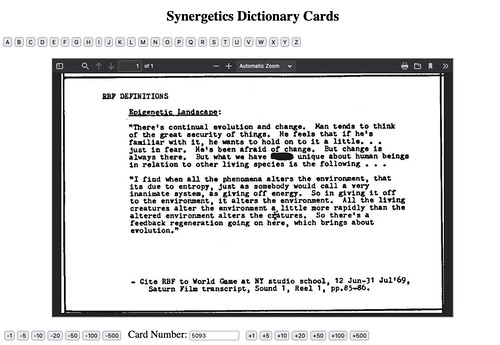
In reading through the Synergetics Dictionary again, under the definition of "gravity" and/or "gravitational field", I'm again struck by what seems to be Bucky's long arc agenda to anchor his meanings to some alien logic, from the standpoint of CERN.
He acknowledges how physicists see gravity as weak up close, at the micro extreme, where it's dwarfed by electromagnetism, in terms of forcefulness. Gravity comes into its own when swinging planets around stars or stars around galactic centers.
But then he keeps associating his gravity with tensile strength, so when a new alloy permits yet greater tensive pull per cross-section, he sees "gravity at work" whereas the CERN corpus would predict stronger electro-chemical bonding. He sprinkles talk of Newton's law where established trains of thought would not. He sees electro stuff too, but for him that's polarization that simply adds to gravity's rainbow powers. Gravity is generalized attractiveness.
Perhaps in the sense of "doing more with less" owing to knowledge of metallurgy, there's greater gravity in this picture. As humans become more metal savvy, they express a convergence with principles, which is what gravity is all about... But that's not what gravity is all about.
In the Synergetics grammar, compression is islanded, special case, tunable, focused, whereas tension tends toward ubiquity. Compression associates with radiation, that which is squeezed out by taut tautologies (exceptionless in nature). Gravity is anti-entropic coherence. These seem to be the associations Fuller constantly cultivates in the minds of his readers. He seems to be in the business of revectoring "gravity".
Given we nowadays have word2vec and text2vec, we're used to the idea of text getting mapped to vector spaces that encode proximity. King - Man + Woman = Queen. Vectors have been weighted in a multi-polar matrix, depending on what corpus gets used to define them. The analogy with nD geometric vectors remains strong, given maths is very much into metaphors.
Speaking of metaphors, might we say the "gravity" in Synergetics is metaphoric, gluing linear segments, the compression rods, into a tensile sphere? The tensile sphere is Fuller's metaphor for any coherent system of beliefs, one might suggest. It hangs together. For the believer, it serves as a guidewire.
Think how AI uses probability to predict what to say next, likewise following a guidewire to generate believable content.
One of Fuller's favorite memes is about nutcrackers arranged in a spherical pattern with their lever arms towards the surface, gripping an internal nut, or planetary core. The idea is even slight squeezing at the surface translates to enormous pressures deep within, thanks to leverage. Gravity may seem "weak" up close and in the short term, but over the long haul, it might worm itself into a position of greater responsibility. We just need to stay patient.
I'm taking the line on math4wisdom that Synergetics is not a TOE (theory of everything) or GUT (Grand Unified Theory) precisely because GPT identifies TOE with any project to explain and/or unify the "four forces" (not "horses") deriving from the Big Bang: strong (quarks), weak (W, Z bosons), electromagnetic (electrons), gravitational. Synergetics does not try to map itself to this particular vocabulary in great detail, although it does proffer a "tetrahedral Feynman diagram" designating the neutron-proton interaction (e.g. beta decay).
That doesn't mean Synergetics is uninterested in any kind of unification, just that the definitions of GUT and TOE seem too restrictive to contain it. The kind of unification it seeks seems more long term speculative. There's also no direct mention of dark energy or dark matter.
The process of reading in, studying, plumbing the depths of Synergetics, may impart new trajectories and new spins, i.e. may prove influential, however its use of "gravity" is more likely to make waves in a non-STEM semantic space.
We've seen these ripple effects already with "love = metaphysical gravity" making it into the shared treasure chest of social media memes. A metaphorical gravity keeps the geometry pumped and rounded as a sense container.
Monday, November 13, 2023
Virtual Worlds
You may remember my virtualization model, inspired by my first encounter with an IBM mainframe. My account thereon emulated that of a mainframe operator. I had the resources of a whole computer, in virtual form, and could mount things, manage a file system, putter about in my cloud computer. That was in 1977, and here I am in 2023 enjoying much the same experience, with the toyz and I evolving together ever since we conjoined, or since I became a part of the cloud and/or internet, another host, another client.
Later, post Princeton (Class of 1980), I got into the World Game simulation more, via the workshops (in Oregon, and in San Diego at the 1995 GENI Centennial) and by meeting Chuck Dingee, one of the workshop instructors.
Kiyoshi Kuromiya drove me to Medard Gabel's WG headquarters in Philadelphia. This was the group that used a gymnasium-sized version of the Fuller Projection to stage a World Game experience for participants, involving role playing.
Putting these threads together, I see the tidy set of flags representing the United Nations, each decorating a console and/or control room, a kind of mission control, where the object on the big screen, what the monitors all monitor, is Planet Earth, the homeland.
Imagine a picture frame around the Big Blue Dot, with a national flag bottom center, attached to the frame. The insignia belongs to the control panel. Every nationality shares the same game board. "This is your Israel, your promised land..." "This is all your Republic of South Africa, your promised land..." "This is all your United States, your promised land..." Most of which is an ocean. One island in one ocean.
Does creating a new point of view always entail adding a new flag to the UN set? Not at all. IBM had (and has) a worldview. A given individual, a world game player, is free to walk from one control room to another, seeing the same Planet Earth through a large number of viewpoint windows. Israel's is a whole world view, Palestine's another, even if the latter is a virtual viewport with a diaspora for its citizenry, in the eyes of other nations. Universities might be able to step in with additional documentation permitting travel, if the nation-states don't feel up to it (more science fiction).
"Wandering from room to room" doesn't have to mean physical travel, as we're talking headspaces mostly. In looking for communities that could use development and creatives, I'm seeking to open possibilities for refugees more generally. Each refugee family gets a menu of Asylum City projects, none of which in principle need be seen as dead end assignments without any possibility of return, should returning be in the cards (Bikini and Marshall Islanders are always wondering which atolls will still burn them alive).
In gaining hypothetical Palestinian citizenship in a diaspora nation, I'm still not necessarily freed from my penitentiary camp or compound by my UN prison guards. I'm perhaps imprisoned because I was forcibly displaced (or my grandparents were), but now that I want to leave my camp voluntarily, I'm told I can't be forced to leave, only to forced stay, by the international lawyers. If I try to force my way out, I'll be hunted, like an escaped slave in the pre Civil War US south.
The "trust but verify" approach adopted in negotiations around WMDs entails a lot of mutual surveillance, which parties may try to squirm out of, perhaps by exiting various treaties. "If I stop spying on you, then I can rightfully stop you from spying on me" might be the internal monologue, not always honest. Given parties to the original agreements may have considered them "for the ages" (long lasting), there's some inertia and some continuation of surveillance nonetheless, even to a point of some new regime taking over such that the exited treaties might be restored and renewed.
In the lead up to the 2nd attack on Iraq, post Desert Storm (now CNN's "shock and awe" campaign) I was always talking up surveillance as the way to nail down the results of any weapons purge, post the United Nations inspection program headed by UN inspector Scott Ritter. I published my little memos to Usenet, about all the webcams we'd be needing.
I'm all for giving civilians the freedom to explore the benefits of nukes (including medical), where the danger of adding further weaponry is clearly a downside, not always factored in by the lobbyists, or even hyped as a net positive to the true believers.
In anticipation of a Chinese delegation coming to San Francisco, a theme of "life in our urban centers" is gathering steam (ramping up) on social media. How much will that city do to clean itself up before the Chinese cameras arrive, feeding millions of eyeballs with news about how the US is doing? Its regular folks, not its celebrated media personalities. Do other countries have this level of substance abuse? What experimental social policies are being tried?
Citizens of a US mindset are likewise tuning in news from other states. Sometimes the enlightened approach is not to punish and criminalize but to invent new lifestyle possibilities.
Along those lines (homelessness, drug abuse, suicide...) is Germany really the basket case people say it is, ever since a pro-Ukrainian group sabotaged its infrastructure? I bet today's Germany would feel pretty normal to me, although it's been decades since I wandered the forest trails of Bavaria, or toured the industrial cities of Hamburg and Cologne.The tacit competition World Game sought to invoke was towards higher living standards, meaning likewise in an ethical sense, contrary to stereotypes. Living like a billionaire philanthropist is not all about creature comforts, the pandering to which shortens lifespans according to science. Most billionaires work out, realizing they're fortunate to be weighty (financially) and wanting to maximize the length of their lifetime scenarios.
Athletes play to win but when genuinely in the spirit of the game, they're able to empathize and celebrate the victories of teams other than their own, based on quality of play, although fortune (luck) does play a role (per quantum mechanics (a type of thermodynamics)).
High ranking military officers will cultivate this same empathy because it helps them think more like the enemy in some cases. Sometimes both sides sense political leaders have made this mess, and their clash is more a crash, like a train wreck. Such militaries feel abused. Tulsi Gabbard spoke up for them, although she's not a pacifist and carries a predictable level of antipathy towards Muslims, such as we've learned to expect from India's Hindus, influential among Samoans apparently.
I tend to side with peace-loving civilians against those wishing to settle scores with outward violence, so I cheer when civilians manage to escape war zones and get on with their lives, perhaps returning to rebuild if and when order is restored. The Narnia kids got to do this, spending their childhoods in an alternative reality. The imagination provides a last resort form of escapism.
The martial arts are about controlling emotions and not rushing into reckless actions without thinking through consequences. Politicians without martial arts training may find their authority undermined, by mystery cults such as Mithraism. Military people start thinking alike, even across enemy boundaries, about the incompetence of a certain political class. This state of affairs doesn't always result in a coup or regime change, as those lacking imagination might suppose.
A military may act in good conscience to defend a people, but if destruction engineering is the best answer (rubblizing the fruits of civilized living), with humans unwittingly caught in the crossfire (like on 9-11), then management failure higher in the chain of command is simply presumed, as a tautology.
Design science needs to be given a real chance first, and a lot of the time, that just doesn't happen.
Letting civilians leave was an aspect of the conflicts both in Syria and Ukraine, and in Yugoslavia before that. Noncombatants had some humanitarian corridors to get out through. Convoys of buses arrived. You could elect to stay or go, amidst family pressures. If your nearest and dearest are all leaving, you might as well go too, unless your calling is to stay and fight some oppressor.
On the other hand, refugees fleeing devastation through Libya do not get supportive bus convoys or flotillas, operated by the many states. The navies and coast guards in question tend to criminalize migrating humans, finding them to be undocumented and therefore unworthy.
The Mediterranean is only partially organized around letting people merry-go-round on cruise and/or ferry ship tours, as if with Eurail passes. Folks in retirement phase, spending savings, or families working jobs at home, on a vacation, get to joy ride. Emigres get to walk or swim. Refugees get treated as outcasts.
Stateless humans suffer punishment by those enjoying statehood of some kind. The conquest of the planet by the prison states (states that act like prisons, keeping their peoples behind border fences, yet permeable to elites) is the story of recent chapters. The states hope to build more walls wherever they can gain a foothold as the ultimate public authorities, which is still an uphill battle for a lot of them, including in the federated states of North America.
That brings me to a concluding thought, which continues a thread raised by TrimTabbers on our last call. We were discussing Fuller's search, chronicled in his Ideas and Integrities (1963), for candidate college majors that might be used to unify the subdividing PhD specialties i.e. which majors might stay comprehensivist and polymathic? You need big picture thinkers, per Operating Manual for Spaceship Earth (1969).
He comes up with architecture as a main one, suggesting military logistics had been his own ticket to this mindset, but that this offering was now in retreat. Architects might be molded into a type of social engineer who'd actually be integrated to in decision-making and planning circuits.
One of the TrimTabbers: "so who is listening to such social engineers today and do we even have any worth listening to?" Good question. I'd say many fancy themselves to be in such positions, even without "social engineer" on their business cards. From that point, our discussion moved (somewhat predictably I'd suggest) to Fuller's failure (a common topic) to persuade us that relative Utopia was really a choice beyond a fateful Oblivion.
We do not yet celebrate a shared comprehensivist viewpoint at this point, nor employ many polymaths, and we're therefore obviously going to hell. That seems closer to the consensus reality (CR) than than the Bucky buzz, which still heralds humanity's success, along with desovereignization.
That's right: Bucky disciples are not uniformly optimistic or upbeat given world trends. My main quibble with their conclusion is I regard Fuller to have personally been a success, in objective terms, given all his honorary degrees and stellar awards. Choosing oblivion would be more our failure than his. He did what he could. We don't get to use a double standard. Maybe judge your own performance first, before seeming to preside (serve as president) over others.
However, from a flag wavy Uncle Sam informed viewpoint, I'm still in the game. My Uncle Sam (US) is a skeleton, Grateful Dead inspired, with additional iconography on the way, mixing in more baseball and other sports. My Ministry of Education after Occupy Portland is nowadays called Revolution Hall (we've been gentrified).
The bankruptcy of the US from the Grunch point of view (Fuller's) occurs in the Reagan Era, with an imposter state sponsored by Grunch continuing in its now-vacated WDC-based role, taking us deep into a dramatic if surreal chapter, featuring a lot of farce and fanaticism.
Or call it satire, as clearly practically no one is into suspending their disbelief enough to read this narrative as anything beyond a prescient piece in the speculative financial genre (a kind of science fiction). It'd be another forty years before gambling on US bonds was seen as tantamount to providing Grunch with its own risk capital, to spend in elective showdowns.
See Grunch of Giants, required reading among the Bucky disciples, to sample the flavor of World Game globalism way back then. I set up a domain and Wordpress site (grunch.net) to further memorialize this history and to further explore the ramifications of his contributions, including his receiving a Medal of Freedom in the Reagan Era (a fact most high school texts still tend to suppress, especially the USA's public ones -- another sign of Grunch's dominance).
Wednesday, November 08, 2023
Real World BizMos
My science fiction around the business mobiles, the fleets, their responsibilities, is still future tense. However all the priors are in place, meaning crewed RVs have their fanbases, via YouTube and Patreon. A mom and pop RV team will ply the highways and byways of North America (stereotypically), with both high praise and damning testimony, vs-a-vs what may well be a challenging (but worth it?) lifestyle.
I was just watching such a team today, giving us the big picture: a couple hits the road, starts a fanbase, starts merchandising, and gets addicted to the sponsorships that start coming with the territory. If your channel has high viewer numbers, you're gold to those wishing product placement. And I'm totally down with this myself i.e. looking back, my bizmo teams were indeed going to weight and rate products, although I'm not saying always on request.
In my own Youtube channel, for example, I'll extol products, and yet I don't check the box saying there's a paid sponsorship involved, because there isn't. I'm capable of extolling products of my own volition, and do so.
Then, the couple continues, the grass starts to look greener in some other pasture. Veteran fans, who've enjoyed the BizMo Based Lifestyle (BBL) themselves, as hosts of their own channels, are now ready to retire to some alternative way of life. They continue as a cohort, representing those transitioning "from" instead of "to". Hey, that's a life chapter too. Having been a One Band One Roader for some decades, it's time for that remote home that doesn't move so much (even if you still do).
I anticipated a lot of these technologies in my science fiction: Kickstart; YouTube; hypertext in general. These special case instances were answers to generic prayers. Prayers, as prophecies (per Thomas Paine), as dreams of the future, needn't be that specific.
Friday, November 03, 2023
Where's the Magic?
Could it be that we intuitively understand, after decades of immersion in special effects science fiction, that we're ready for a next level?
We see whole cities built and left largely empty in China, in part because skilled people need something to do. That's why we have militaries too, to stay occupied and in shape. But in shape for what? Are we talking about livingry or killingry?
Are we in any shape to build new EPCOTs?
That's an arcane way of asking the question, but not off target, as the Experimental Prototype Community of Tomorrow had a modicum of LAWCAP support, meaning lawyer-capitalism seemed it might be ready to take the "theme park" concept to the next level, and indeed that's what started to happen. But then the effort bogged down.
Who picked up the Disney baton, if WDC itself, post Walt, had to drop it?
We've heard talk of Google's plans for mini-cities. But big tech comes across as pretty hard edged and predatory compared even to The Mouse.
Big tech is always scheming to prove essential workers are not really needed. Where's the magic in that?
The A in AI is for Artificial, which means Phony, Simulated, Unreal.
AGI (artificial general intelligence) is a weak opening, conceptually, as it's oxymoronic, as we're to understand AGI, when and if, is no longer Phony, but the real deal. "Humans, not really understanding their own capabilities, have now developed these abilities in their machines" -- that seems to be the plot. But how coherent is that whole screenplay?
It could be that humans are ready to implement more of what the design science revolution was promising, having faced up to their lack of integrity in so far failing to do so.
Given the ubiquitous nature of media-making equipment (for staging, for recording, for sharing), the implementation phase will in fact be televised. So let's work on the scripts. Let's start with location scouting.
We will always need emergency shelter for people transitioning back to a more normal lifestyle, and one model is to bring the refugee camp to them.
Depending on geography, these could take the form of hospital ships, after a hurricane or tsunami for example. A smattering of hospital ships amidst a circulating convoy might be used to move millions over a period of some months. The system activates as needed.
But why not build an Asylum City for the express purpose of providing what military bases provide today: shelter for economic (and/or other) refugees, with opportunities for R&R.
Guantanamo comes to mind. Should Cubans build an EPCOT where Gitmo used to be? Or should Gitmo be preserved as a museum?
Tuesday, October 17, 2023
Simulators
We all know about simulators from Microsoft’s Flight Simulator, and maybe from Sims and SimCity if we have broader experience with the genre.
In these blogs, I’ve tended to harp on truck driving simulators, owing to the Trucker Exchange program I introduce under the heading of citizen diplomacy. However, these days I’m exposed to farm life more, and tonight after dinner, the conversation turned to Farm Simulator software. Lots of people play FarmVille and its many variants.
That’s what some will call the game pods then, those “more than just cubicles” we’re using for School of Tomorrow centers, multi-generational, co-ed, mono-generational, single sex i.e. they come in many shapes and sizes.
Some feature dormitories, which in military terms might be barracks.
I’m hoping, in my simulations, to give people more privacy than mere barracks provide. Bucky Fuller was into that to (providing privacy, protection). But then pods aren’t the same as dorms. You could have a pod in your private dorm, or your pod could be on a floor or a concourse somewhere.
What “game pods” am I talking about? These go back to my mixed use campus buildings, with dorms, cafeterias, gyms, and game floors. Simulators. You’re learning about your world through simulations designed to teach about infrastructure, institutions, chemistry, other natural phenomena.
Here is where all that “gamification” comes in, in tandem with the Coffee Shops Network idea of raising funds through game heroics. Score high and benefit your causes.
We’ve been working in this world for awhile now, if you see through the right lenses. I’m just taking stock and helping to organize what’s already in inventory.
I’m not saying we always postpone venturing into the field and actually doing the farm work that needs doing. I did some today in fact.
This particular farm is about making long term investments in the ecosystem, friendly to wild species, whether or not those life forms literally pay the bills. Conservation does not mean demanding tuition from those given sanctuary.
Sunday, October 15, 2023
Curriculum Queries
I do not boast lots of boots on the ground, inventing tests and tallying data. I might welcome such an army, using Python and Jupyter Notebooks perhaps. I share about pyplot and plotly.
I'm speaking with reference to such queries as where best to introduce figurate numbers, such as triangular and square, if we do, and when to make those polyhedral (icosahedral, cuboctahedral, tetrahedral...). I'm eyeing alternative vocabs. Sometimes it's the animation that matters, more than the script rendering language, a namespace.
What am I talking about pray tell? Like the numbers that go 1, 2, 3, 4, 5... then keep accumulating: 1, 3, 6, 10, 15... it's like scooping up the snow: all the layers of balls (if we think in balls) make us a growing triangle. The triangular numbers: 1, 3, 6, 10, 15... Then we have the squares: 1, 4, 9, 16, 25... You know the ones, right?
We've got that going on, and then we layer-pack around a nuclear ball, per a cuboctahedral shape (cube of sawed-off corners), thereby getting our famous "successive layers" sequence: 1, 12, 42, 92, 162... I say "famous" because it literally is in the center of our neighborhood (along with the cumulative Crystal Ball sequence). "We have statues dedicated to it" one could claim, especially if coining an idiom. So where does all that fit in?
"Nowhere!" comes the resounding (highly opinionated) voice from some quarters. Curriculum developers don't just accept these queries lying down, without some furious debate.
I point to The Book of Numbers by Conway and Guy and maybe that mollifies some (ah, mainstream). I reassure teachers that we're connecting right brained shapes with left brain numbers even earlier than by means of coordinate framework addressing ala XYZ.
We haven't even come to XYZ coordinates yet and we're already getting rhombic dodecahedra in their space-filling role. "Are we to expect IVM coordinates then?" sounds sardonic but yes, we have those for you, why not be curious?
What am I talking about again, am I making any kind of sense? That depends to some degree on what archeological layer you're reading from.
Those in the immediate radius of Buckminster Fuller (not me, I came later), in his role as academic, would recognize "isotropic vector matrix" in many cases, especially in the late 1970s after Synergetics was published. I became aware of Fuller's philosophical language in the early 1980s, as I switched gears from being a philosophy major at Princeton (Rorty, Kaufmann... other stars), to being a high school teacher in a private school in Jersey City (not that far from Princeton actually, by dinky, Amtrak and PATH).
The idea is one of scaffolding or tiling in space. The all-cubes way of filling space is well known and isn't going anywhere. The next step, if starting there is to supplement. XYZ and IVM co-exist in a healthy manner. Imagine filling every other box with a growing sphere, a 3D checkerboard. Each ball, fully expanded, touches 12 neighbors as 12 mid-edges.
"All fine and good" you're thinking, "but the hypnotic brainwashing animations described here sounds a lot more like rave party projections, too hallucinogenic for a math-minded audience."
I'd say fair enough to speculate in that direction, but you really don't have to carry it that far. Surely you too know what it means to daydream in a classroom.
That's a form of right brain engagement.
To encourage this faculty is to constructively entrain the imagination, as we do when teaching the value reading in fiction (which is not to "push drugs" (as if any talk of "the imagination" were dangerous witchcraft)) i.e. "you get to watch movies in your head" as a grownup might put it, promising payoff (I understand why watching adults just staring at print, with no pictures, is a turn off until experienced in the first person).
The ratios of which I speak have to do with the so-called voronoi cell encasings around each IVM ball. Every IVM center has its "domain" is another way to but it. These are not Platonics in the strict sense of meeting the "all corners identical" criterion; the faces are diamonds and meet in threes and fours around two sets of corners: those at the corners of a cube (shallow, 3 facets) and those at the corners of an octahedron (sharp, 4 facets). Volume ratios: RD (rhombic dodeca) : Octahedron : Cube :: 6 : 4 : 3.
Why don't those ratios seem as familiar as rain already? Maybe to some of us they do, but the answer is the cube of volume 3, not its canonical most regal volume in the orthodox hierarchy. What dares take its place? A tetrahedron? Heresy!That's the crack in the pavement a lot of storytellers keep tripping over, in wanting to make believe it's not there. Those of us in the curriculum design business can't deny that tetravolumes are tempting, in some contexts, especially knowing we're not admitting anything. We never have to say "XYZ was wrong" or anything like that. So what's the issue? Descartes is still a hero. We also study his Deficit (720 degrees).
I'm anticipating comments (perhaps by email) that I'm wrestling with ghosts, as none of the MineCraft literature ever talks about "another paradigm" i.e. a space-filling pattern of tetrahedrons and octahedrons. What would that world look like? Now we're talking (and maybe even imagining).
Saturday, October 14, 2023
Metabolics
I'm headed to the fat farm tomorrow, my internal name for it. I don't have the budget for any health club getaway at this time. The shift is more from low energy to low energy in a different shape.
Today, for example, my shape was "sports bar" i.e. Tom's on the corner of SE Chavez and SE Division. Deke the Geek as I've called him, is a U of O grad and dedicated athlete, at one time a track star, so he was aware that today was a big game: U of O versus Huskies at University of Washington. Not so many weekends ago, I'd watched this same Oregon team against another (winning that time, not this time).
As I probably mentioned in some other entry, I've bought in to the new dietary model focusing on insulin and insulin resistance. I've tended to be medically minded since at least the 8th grade, and this theory has the right level of complexity to match my expectations.
On Math 4 Wisdom, we've been discussing "what's a sweet spot?" in the sense the Complex numbers seem to be. The more rigid Real numbers are a tad under powered, give less prominence to rotation but through a more cumbersome trig. Or so it seems to Andrius and John Harlan. I have to say I see what they're talking about.
You'll have noticed the above lifestyle sounds a tad sedentary and you'd be right. With the games come some drinks. I'm not the one driving. We're within walking distance. None of that really matters when it comes to adding weight I don't need. The fat farm will help me fast. I'll still be thinking online using WiFi.
I've embedded my other work of the morning, and extension of my blogging into some vlogging (video blogging). I should add that watching a steady stream of YouTubes is another reason I'm so soft. Thanks to the Bluetooth brick, I'm at least able to move about and do chores when the screen does not require my undivided attention.
I invoked Kierkegaard's name recently, on M4W, thinking mainly of his Concluding Unscientific Postscript, but then it's been a long time since I actually raked my eyes through that.
People would love to have an algorithm to follow that makes their actions above reproach. They won't be facing inquiries later, because "doing what the machine says" is a safe course of action. The existential predicament is we don't get to closure in that way i.e. our science is not up to the task of proving we did the right thing looking back. Yet we must act anyway. Thinking in terms of justifications is not atypical. One imagines oneself before some board of inquiry, as in Oppenheimer.
Whether that's a good interpretation or not, of Soren's philo, I wanted to jot down his other focus: that of the undivided Will. Since the will was ultimately for the good, or of God, it's a good bet having an undivided will (whatever that means operationally) would be blissful. Ties to Taoism go here, clearly.
I'll be cutting out the alcohol at the fat farm. I've gone over a year without beer, not counting the alcohol free kind (which I've sampled). Again, it's more about calories. If I allow myself beer, I over allocate and/or exceed my quota.
Thursday, October 12, 2023
Technical Topics
Not surprisingly, my science fiction turned to creating an Asylum City, in a hurry, especially for the Gazans who wanted to move here, at least temporarily. The city would be designed for mass evacuations, more a way station than a destination, and not the last of its kind.
While I’m doodling in my head along those lines, I’m showcasing the bread and butter stack and content. Everyone in my business has a stack. I’m wearing a Supermarket Math hat now, thinking in terms of what’s in inventory. Does anyone remember LAMP? Linux Apache MySQL P-language (e.g. Perl, Python, PHP). That’s a good example of a classic stack, and a doorway into cloud-based architecture.
I told Paul I thought we were in some National Geographic article, about Oregonians in October, harvesting something like beer hops, but with crazier names for strains. Paul and I have a collaborative relationship based on a practice Glenn established.
I’ve been thinking about Glenn a lot today, and of my mother, two people I lost in the last year. Paul is a retired chef with a luxury hotel background, specializing in Anglo-French cuisine. He reminds us of our buddy Steve Holden who used to live in the same apartment complex. Yes, a past chairman of the Python Software Foundation and conference organizer who helped get the Pycons going.
You may find more about Steve by searching these journals. I tended to accompany him to these conferences he would organize, as one of the people on hand to keep things on track. Djangocon, Apachecon… some even more obscure ones, always excellent in their own way, as Steve knew a thing or two and relied on Nancy and her team, out of Orlando.
Regarding the showcasing I’m doing, the embedded screen shot above is one you can click on to gain access to its original context, where a much bigger and higher resolution view is available. Here’s a direct link. You’ll find I’m going on about a certain “NCLB Polyhedron” where NCLB = No Child Left Behind, a meme from the Obama years. I was trying to get Phi (the golden ratio) a more exalted place in the curriculum.
The meme was somewhat tongue in cheek, more like something a MAD magazine might run with, versus a sober upstanding mass-published mathematics textbook devoid of social commentary. I was engaged in the andragogical practice of preserving a level of comic edginess that helps me retain the attention of certain readers (mainly fans of mine).
Any number of secular mathematicians will testify that Phi is harmless and is easily shared in a curriculum context that has nothing to do with demons or devils (we’re coming up on Halloween here). I hope I’m not being too cryptic. The golden mean crops up in connection with five-fold symmetry geometric gizmos long associated with various cults (or call them subcultures) savvy about this specific aesthetic.
This version of the Notebook does not yet contain much in the way of graphics. I’m focused on sympy, the Python library, and its equation-solving capabilities.
Asylum City would provide more opportunities for denizens to watch shows and start catching up on their own situation as seen from different angles. The Gazans, like the Ukrainians, would get that the world cares about them and in turn is eager to develop its generic ability to manage refugees in a humane way. If climate change hits the way some think it will, we’ll be glad for the practice. However the need is real even today.
We have the need for skillful rehabilitation programs on a large scale almost everywhere, as people seek a better life in another set of circumstances.
Sunday, October 08, 2023
Saturday, September 30, 2023
Another TrimTab Meetup (Sept 30, 2023)
Zoomers (mostly Boomers in this case) seemed somewhat scandalized by Bucky's polemics versus Bauhaus, circa the early 1960s, by which time his fame had grown.
I remarked that these polemics all sounded professional, in the same sense a movie critic, or literary critic, might be blunt or negative on some points.
The chapter opens with a question he gets a lot: "in what way is Bauhaus an influence on your work?" (paraphrase).
He replies (paraphrasing again): "I love these guys, but I came to my position independently and have some criticisms to share of their approach". See Ideas and Integrities, A Spontaneous Autobiographical Disclosure (Prentice-Hall, 1963 or later edition).
09:46:53 From Kirby Urner To Everyone:
In being closer to American factory industrialization, Fuller considered
himself upstream from Bauhaus i.e. Europe was getting the new “no nonsense”
aesthetics 2nd hand. That’s what I got from the reading.
...
09:57:58 From Kirby Urner To Everyone:
This word “teleological” and how Bucky uses it: Synergetics Dictionary
worth a consult. Connects to his Bow-Tie symbol.
That was TrimTab Book Club. We read books by and about Bucky. Mark Wigley's book.
10:24:26 From Kirby Urner To Everyone: Mark Wigley: Buckminster Fuller Inc. Architecture in the Age of Radio 10:24:42 From Stephen Bau To Everyone: Reacted to "Mark Wigley: Buckmin..." with ❤️I think Lionel (today mostly muted and on another phone, conducting business) has been asking an interesting empirical question recently: if we make a Bucky Chatbot, will responses to promptings result in something less enigmatic than his seemingly-exclusionary home-brewed style of quasi-impenetrable prose?
Tuesday, September 26, 2023
Field Testing School Products
Mites Cubes
I’m not currently positioned to buy the preschool near Whittier, keeping it going but doing more school supply research and teaming up with schools above the preschool level, in Greater LA. Maybe you are. My sister works there. I’m basing my brand of science fiction in the real world, per usual.
People know I’m of the mixed use office tower school of thought, promoting gamer pods in place of cubicles on some floors, with dorms, not necessarily apartments, on other floors.
What distinguishes a dorm from an apartment?
A dorm is more like a hotel room in having a microwave and a few supplies, but the cafeterias are elsewhere in the building. Kitchens may be supplied at the floor level, with floors organizing group meals, per the curriculum we’re developing.
You may have seen about my Food Not Bombs background, and Gathering of Western Young Friends before that.
I think of my sister’s school because of her work in an educational supplies store, which in turn has me thinking of Math ‘n Stuff, Northgate, Seattle. A specialty curriculum store stocks the kinds of toys and kits I’ve been curating a few samples of, such as the Mites Cube, Zome, Lux, Tensegritoy, other Design Science Toys products.
DST is defunct, but the ideas, and its collected products, live on. Full disclosure: I worked with DST on Strange Attractors, the toy that was going to save the bacon. Yes, a real Toy Story.
The point of field testing new products, in the context of new lesson plans, is to get it down to a replicable format and segments, easily transmitted to other classrooms. We have the Lux Blox example. I’ve been tracking Accera and testing his company’s product, in the context of Martian Math. However my gigs have been infrequent, unable to keep up through the iterations.
C6XTY sits idle, much of it in landfills by now. As a one many show, I’m able to juggle only so many balls. Sam keeps a small exhibit space at the farm.
We may be overdue for a next math, as distinct from the New Math of the 1960s, and the New New Math that LAUSD has been revamping and/or fighting over. Remember what sparked New Math in the first place: a sense of falling behind in the aerospace sector.
The preschool I’m brainstorming about is private. The private sector has more freedom to innovate sometimes, depending on its management hierarchy.
I’ve been a critic of the “charter school” namespace as it can’t seem to make up its “mind” about too many key issues (is a charter school really public or really private?). We don’t have infinite time in which to our resolve our issues. Time to remap to new namespaces. I go back to my Pirate Party planks.
Wednesday, September 20, 2023
Debates
Presumably the model NATO debaters will be well prepped when we have Gen Alpha growing old enough to debate itself regarding whether Russia's absorption of Ukrainian oblasts was undertaken in an effective manner.
The key point in determining whether territory A was invaded and occupied by B is the degree to which the denizens of A requested and welcomed B's presence. Those arguing for the resolution (that the absorption was effective) will say the Donbass was like Crimea in officially requesting annexation. Those arguing against will say the requests were from illegitimate non-representative factions with no authority to speak for Ukrainians.
I've seen model NATO booths at the national debate clubs festivals. Probably these debates are already going on at the high school level, in elite private schools at least.
Those above a certain threshold of political awareness have realized these debates are inevitable going forward, so it's best to rehearse now, and with fresh minds who don't depend on parroting over the hill people who got their PhDs decades ago. A lot of Cold Warriors spout illogical sounding arguments and don't stand much of a chance without more coaching about present realities.
What are those present realities?
All those decades investing in shared infrastructure have resulted in European ports accepting Russian LNG in place of piped supplies, at higher per unit costs. There was never a good case for going cold turkey vs a vs Russian oil. Tankers also switched crude through the Greek shipping networks. "Oil laundering" became the name of the game (not unlike circumventing Prohibition).
Lots of books are in the pipeline, about the effect of sanctions on countering global energy interdependence.
Some of the more advanced planners, in China especially, grew up reading such tomes as Operating Manual for Spaceship Earth (popular in China) and understood about the option to grow electrical grids thanks to improving technology. Their integration in connection with the One Band One Road project, at least in storyboard, continues to get attention.
The more esoteric Bering Strait linkup, inter-hemispheric, described in Critical Path, has worked its way into the imaginations of these more apolitical IEEE types. The detour into a proxy war at the Boomer level may not change the thinking even of Gen Z all that much. On the contrary, the Boomers are inviting backlash by delaying torch passing.
From my angle, as a curriculum developer, I measure the delay in torch passing by sampling the curricula of various high schools at the current archeological level. Do we see a lot of crackling and crumbling? For sure we do. The institution we call "public school" is especially in a shambles.
The idea that a central government has responsibilities to citizens, in terms of education and health care, may be fading at least where the District is concerned. As some city on a hill, WDC is a fading beacon, no longer a source of much hope for future Americans. Individual states have some ability to set their own track records.
I'm a product of the international schools curriculum, meaning that as a young Boomer, I learned what elite Americans, living as expats, were supposed to learn, in tandem with an international cohort i.e. we were raised in a kind of model UN setting.
I'll be curious whether the model UN or the model NATO students will fare better as global issue debaters. It's not really an either/or proposition as some schools host both clubs.
Friday, September 15, 2023
Notes About Neighborhoods
A popular building style around the world is the inward facing apartments surrounding a courtyard. The facade is that of a fortification, a fort, whereas the interior is a kind of atrium oasis.
Cruise ships have been going for this aesthetic, as well as hotels, the kind with the exposed elevators starting inside the very high- ceilinged interior.
Some skyscrapers also play with the atrium motif, if only to take advantage of the soaring view, looking up, a view many designs block.
On the smaller end of the spectrum, the courtyard- and/or atrium-equipped fort might contain an extended family, with exogamous components e.g. families that have married in or otherwise allied. This mosaic or tiling structure, of interconnected families, grows to several buildings or may take on the aspect of a whole village.
These villages may be semi-invisible at first, as they blend within the context of a New York City. We get barrios, or neighborhoods (sometimes ghettos or slums), sometimes with harmonious synergies, popular fusions, other times with interstitial inflammation, from feuding to gang warfare. We've all seen the movies right?
An economics textbook might try to boil it all down to some landlords (owners) versus renters situation, then get into all the borrowing that needs to go on, as some people see their capital appreciate, meaning they can afford to borrow, and pay back with interest. Banks see their money grow in this way, as deposits swell, and so start lending to each other, seeing one another as credit worthy, able to make good on debts.
Not all of them manage to stay out of trouble though. Banks may become riddled with scammers, indirectly perhaps, through depositors. Some get into laundering for suspect clients, which becomes self implicating. Banking is an inherently risky business, especially in a VUCA world (I'm thinking of Greg Hutchins here).
Sometimes speculators bet wrong, such as when imagining driverless cars or AGI just around the next corner. After the hoped for products don't materialize, it becomes easier to cheat on definitions, but what if the public just stops buying the PR? New investors won't stream in to relieve current owners of their stocks.
Then you get the disruptors coming along, such as Bucky Fuller, who wanted to cut out the middleman mortgage moneylenders, thereby putting less financial stress on the moms especially.
Fuller wanted happy sane campers living in sanitary circumstances, and so invented his low cost appliance homes, metal tents, dymaxion yurts (circling a utility pole), thereby making RV-mobile-home quality living affordable, at least in principle, to a newly emergent middle class.
The new lightweight yet durably aerospace designs would spark a revolution in sheltering. Airstream was another trailblazer, in bringing aeronautical tech to the landlubbers.
However the LAWCAP oligarchs were not necessarily ready for any kind of switchover from everyday mortgage lending (a surefire moneymaker) to dwelling appliance vending; they wanted to keep riding the old FinTech rollercoasters at all costs.
Their banking games depend a lot on building ticky-tacky box housing, but also drives improvements to the existing housing stock, such as when enterprising remodelers borrow, buy, upgrade, and flip these homes, swimming upstream towards the ever more upscale, like salmon to spawning grounds. Banks see their portfolios grow in value.
Suburbs clone themselves to produce endless square miles of monoculture, complete with commuter based lifestyles. The need to amp up electricity to these regions is paramount these days, as suburban homeowners increasingly resort to home charging the family vehicles.
The existing natural gas or coal fired power plants may not be prepared to undertake the load.
To what extent will solar and wind, combined with storage batteries, take up the burden of providing transport? That's what any college or university involved in modeling and simulation, is going to be looking at. Even just looking in the rear view mirror we can learn lessons, about what works and what doesn't.
Per David Graeber's work, we needn't box ourselves in with unimaginative cliches about capitalism versus communism. Is it "communist" for a bunch of model railroad aficionados to co-own a model train set in a church basement? That's kind of a nonsense question. It's communal, if that's what you mean, but there's no escaping "community" even in a society run according to capitalist business logic (whatever that is).
We do want to instill a love of trains, of railroads, at a visceral level, in some Global U students. Such a love may be innate, and just need a chance to express itself. We're looking for personnel to take the train system forward. Physically and literally working on a railroad would be a logical pathway into planning and management.
However, with the rampant financialization of ownership, people with no special love of trains, not even in a commuter role, get to squeeze the rail works for purely financial gain, at the expense of having a high quality railroad system. Future generations will need to compensate, by implementing new ways of breeding ownership institutions.
In addition to those museum floors I was imagining, the mixed use campus building needs a communal model train system, perhaps more than one, with established roles for governance, probably rotational. Students with a model train in the basement, and ample opportunities to tour existing infrastructure, are more likely to become engineers in the traditional sense, in the form of people who love engines (not a gender specific role).
If Quakerism plays a role in building governance (in some buildings it might), then the nominating, supervisory committee, business meeting structure might help keep the model train committee going.
Thursday, September 14, 2023
Museum Floors
I'm back to my mixed use architectures, cruise ships a model, where living quarters need not be redundantly outfitted with kitchens in every unit. Kitchenettes maybe, like in some hotels, but the norm is to seek sustenance outside one's dorm and study space. This building is more like living on board a ship or even submarine, perhaps because it's literally floating or underwater, though neither aquatic environment need be presumed. An ordinary cityscape will do for context.
The Museum Floors contain exhibits, and one may find borrow and return opportunities, like tool libraries, where these tools might be vintage. A number of 386 PCs might be kept in working order, and people come through for some training on WordPerfect, and Lotus 1-2-3, just to experience an office environment their grandparents might have known. Watch some old black and white TV in other spaces, with vintage programming, perhaps assigned. I'm thinking of the Birmingham Civil Rights museum at the moment.
Part of the point is to pass on the disciplines of curation, and also representation, as when building dioramas. I recall how the Henry Ford Museum contained a recreation of a teenager's room from like the 1970s. This was archeology already. Museum goers would marvel at the differences, but also the similarities. Let's look at a model nerd cave from the early 2000s next.
It sounds like I'm only intending to feature the recent past, the memories of people living in the building. True, I'm thinking recent history is the easiest to curate, and then, depending on what subjects people study in this building, more special case exhibits might develop, about specific time periods and places, perhaps far away geographically, and a basis for student exchange. For example if your Colorado campus studies Sumurai Era Japan, then you would expect to find a collection of tools, wearables, weapons, dioramas and re-enactment ceremonies (the Society for Creative Anachronism comes to mind).
These floors certainly don't have to be basement level, however it's sometimes fun to imagine them as such, as the past metaphorically provides a basis and support system upon which to build going forward. Our collective memory is our heritage, which is something we extend, adapting, and adopting, as we go.
A lot of museum going may be accomplished virtually, no question. However there's much to be said for keeping some working versions of old appliances, even old telephones. We need to be able to study their internals, for example, in order to better grasp the analogous technologies of our day. What was telephony like in the days of switchboards? Let's see what switchboards were like in the old days, not forgetting how a lot of these roles went to women.
Sunday, September 10, 2023
Barbenheimer
Friend:
I haven't seen either Barbie or Oppenheimer.
The linking of the two of them strikes me as strange but much about showbiz is strange.
Me:
Yes, their linking is odd, I agree, even after seeing both.It might be that Barbie World is clearly about having Kens be ancillary and the plot of the movie is Ken discovers the possibility of a more central role through visiting the "real world" (a fantasy Los Angeles). A new equilibrium is thereby explored (Barbies deal with more awakened Kens) -- but I'd say still not achieved, still immature -- reflecting the "real world" more for real in that way.
Oppenheimer, in contrast, is clearly a Ken World from the start, with Barbies ancillary. What Kens do left to their own devices is stratify into strict hierarchies with labeled ranks, organizational charts galore, regarding who should CC whom, what remains "eyes only" to the more top ranking Kens, what's above a Ken's pay grade. The noob Kens graduating from Barbie World are still miles away from hatching a truly he-man bureaucracy.
Thursday, September 07, 2023
Mindfulness
My blog posts often spiral, sticking to a theme while doing a round robin among the three or four blogs. I'm thinking "time tunnels" (scenarios) in general have a spiraling aspect. The theme I'm sticking to here being "study habits".
Recall I'm one of those using "Global U" as a swap-in for "Spaceship Earth" i.e. I have a cradle-to-grave work-study model going, wherein we're always gear shifting into "scholar mode" i.e. "learning mode" if only to figure out where's the light switch.
It's not "student mode for the first half of life" followed by "teacher mode for second half of life" with "retirement mode" the final Elysium Fields. We're always jumping back and forth between student and teacher mode our whole lives ("learning a living"), the percentage of time spent in each mode having to do with lifestyle choices and/or demands quite a bit.
When some hear the word "mindfulness" it's a "bolt for the door" kind of experience because they're assuming it's yet another dharma talk about confronting one's own mindlessness, especially around relationships. Another "I'm a bad person" lecture (yawn).
But that's not what this is about.
We're talking here about cooking again, engaging in some project wherein cleanup is involved, such that what's left in the wake of said activity is not considered "a mess" by community standards. Loose ends get tied off. Puzzles get solved. Making way for new content, a fresh opening.
The Hanford campus, for example, referred to in the movie Oppenheimer, played a big role in the Manhattan Project, but in the big rush to "get it done" (i.e. build the atomic bomb), and not much planning and engineering was devoted to cleanup. The real price tag for this project was to be paid down the road, by we the as yet unborn. The subsequent commitment to pump up groundwater and to measure for leaks of radio-toxins, patching where possible, came after that first chapter.
However, being mindful may involve simply playing with your data structures, especially your queues and prioritizing scheduler, to keep cleanup happening all throughout preparation and serving of the meal, such that there's no big pile of pots and pans, scads of prep stuff strewn about, when it's over.
You were taking a relaxed, "clean as I go" approach, shifting modes. While the beans nuke, I put the cheese away. I'm always loading the dishwasher. Multi-tasking is not a sin, even if one is giving full attention to what's at hand. There's an interplay of focused and zoomed back, devoting micro and macro types of attention to a situation.
Wait, am I holding myself out as some mindfulness master, without having even been to chef school?
I'll be the first to admit I'm often more minion than leader when it comes to serving on a cooking crew. I do as I'm told a lot of the time. I might offer input or take more responsibility if they're looking to me as the experienced FNBer (that's Food Not Bombs) but, chances are, people more experienced than I are in the picture. Ditto at a Friends Gathering, thinking back to Camp Myrtlewood all those times.
What I'm suggesting is the practice of mindfulness need to go straight to old thought patterns you've been having, about this and that.
Leave the thought patterns to spiral along their lonely path and do something more productive than thinking, heaven forbid right?
I'm not dissing thinking, but if it's the same old same old, why not bake cupcakes at least?
Allow cooking to be your metaphor for whatever constructive hobbyist activity.
Develop mindfulness around something you're not doing just to better yourself i.e. because you imagine you have to or society expects it of you.
Start with an activity you would voluntarily engage in even without minding about mindfulness.
Wednesday, September 06, 2023
Astrology
I've been revisiting Grail mythology with a long time collaborator, which got me back to reading Cirlot's Dictionary of Symbols. I picked up a free copy at the new Theosophy Library digs out on Beaverton-Hillsdale highway that time. I mean to go back the lifetime register for library privileges.
Lets start out by mocking the idea that celestial [sic] bodies program human behavior and/or thinking, in the sense of influence or affect, noting there's no evidence of encrypted information in moon beams (bounced sun beams). There's no evidence for an encodable region in the brain that would be especially sensitive to coded starlight.
Now lets say that was a straw man cosmology, and that the way cosmic bodies influence our daily lives is right before our eyes: through astrology.
The very language, of typifying personality traits (e.g. stubbornness, control freaky...) by birth chart, and/or putting world events against a backdrop of this or that cosmological state, has been uber-influential in human affairs, self evidently, without any appeal to "secret" physics.
Now that we've settled on this shallow truism, that astrology is influential, lets also remember that people have used it to encode some reliable astronomical information.
Astronomy would not be where it is today without astrology as a runway long enough to launch its bulk, as an instrumentally endowed discipline, able to theorize about and detect the likes of neutron stars.
A neutron star forms when the atoms are no longer able to put up a fight, as protons with a defensive shield of electrons, a perimeter, a fence.
The crushing force of gravity overcomes the compressive push of electromagnetism at these extremes, whereas at most frequencies gravity is as diaphanous and evanescent as light pressure, relative to magnetically charged electrochemistry.
The end result is a ball of neutrons, one could say a giant atom of a kind, and its radial broadcast impact on the environment is not negligible. We detect them as pulsars and see them as rapidly spinning, perhaps at over 42K RPM.
Current cosmology suggests that neutron stars, if sufficiently massive, further collapse into quark stars and then black holes, potentially in a kind of Jitterbug transformation (a squeezing inward).
The link I'll make here is to "epigenetics" in the context of the Synergetics Dictionary in particular. Astrology would be part of the epigenetic feedback loop whereby genetically encoded biological patterns get channeled forward in time by mental processes associated with civilizations. Humans self program such that their more slowly evolving biological avatars get involved in space travel and/or scuba, with aerospace in between.
Monday, September 04, 2023
Brinkmanship
brinkmanship
brÄngk′mÉ™n-shÄp″
noun
The practice, especially in international politics, of seeking advantage by creating the impression that one is willing and able to push a highly dangerous situation to the limit rather than concede.
-- Wordnik
We're seeing a lot of talking heads suggesting that a psychotic breakdown leading to a nuclear exchange is looking ever more likely, as mostly old people in various social circles start to throw up their hands regarding the current situation.
In my counter narrative, citizen diplomacy is in high voltage mode and has lots of bandwidth. The younger crowd is engaged in mutual study and is not finding those irreconcilable differences the old farts insist on preserving. We're not seeing any impasses, in Europe, Asia or anywhere else.
However, the veteran pundits don't want to pass the torch to a happier generation that's less likely to destroy civilization. They cling to power, despite their obsolete educations.
Meaning the young will have to pry the torch away from them?
One way to do that is to let them keep their torch while lighting another one. Let them think they're still the torch bearers.
Along similar lines, I've got an alternative to that infamous clock put out by the Bulletin of Atomic Scientists. What do they know right? Are they aware of and/or working on a Trucker Exchange? Asylum Cities? Martian Math?
We shouldn't allow their laziness to govern our perceptions. Let them keep to their clock, but when it comes to asking the time of day, we have other sources, such as our Clock of the Long Now.