Wednesday, August 28, 2019

Random CCP Tetrahedrons


These three videos form a series, and a rather simple trajectory. First, I show what a theorem about CCP tetrahedrons actually means in practice, by randomly generating CCP-vertexed tetrahedra and showing they have whole number tetravolumes, within the limits of floating point accuracy.

But why settle for the limited precision of floating point numbers?  In the 2nd part, I dive into using an extended precision number type from the 3rd party Python module called gmpy2.  We go from 100 bits to 200 bits in precision, confirming our tetrahedrons are ever more closely approaching whole number volumes.


The third video serves as a synopsis by bringing the first two Jupyter Notebooks side by side within JupyterLab.  I review how to make changes to the content, fixing a typo and changing an embedded Youtube in the derived copy.  I insert the above Youtube into the Notebook itself.

Also, during Part 3, I launch into a bit of a Quaker rant about how my curriculum is "more American" than that of the competition, in that I'm including, not censoring, the "Bucky stuff".

Buckminster Fuller was the USA's premier futurist until LAWCAP decided it wasn't quite ready for GRUNCH yet, and hit the brakes.  Those of us who were ready, kept moving forward and took the lead.


Sunday, August 25, 2019

Place Based Education


In place-based education, we typically frame lessons (teachings, dharmas) against the backdrop of a kind of tourism: exploring a geographical area, providing both timeline and trajectory.
Hyperlinks to focal topics, presuming we have some, may play off environmental features, such as architecture as a link to geometry (octet-truss) or Earth's rotation (pendulum) or literature (Narnia, C.S. Lewis).

Accessing entirely "other" worlds is often accomplished not by "zooming out" so much as by "zooming in": a specific detail (perhaps a flyer stapled to a phone pole, a restaurant menu, a free newspaper, a festival booth) takes us off on an instructive tangent.

Yet we have our place to which we return, thereby anchoring the narrative to a contextualizing (and increasingly familiar) context.  Sesame Street (a TV program for children), but also many other TV shows, are "place based" in design, although the "place" is often fictional.

Fictional places are OK too, however consider the possibility of leveraging whatever reality you actually live in.  Investing time in studying your own environment (for real) is a big part of what place-based education is all about.  Students will benefit by gaining traction within a non-fictional viewpoint, which may yet seem "otherworldly" or "alien".

Place-based education is both a way of learning, and a way of sharing or teaching. Learn the stories of your place, then weave those in, with your own spin and interpretation, as you share your place with others. I'm providing examples.

Note that place-based education does not require touring far afield. If your lifestyle features a lot of travel, the place may keep changing. However rooting yourself in a specific place (e.g. both these slide shows feature Portland, Oregon) is perfectly legit and will, over time, take your students deeper into the lore, while facilitating omni-triangulation (connecting the dots) regarding your locale.


Wednesday, August 21, 2019

Euler's Formula (Part Two)


 Would you like to see Part One?  Part Three?

Monday, August 19, 2019

Self Updating


I play in the ML / DL playground sometimes, however I'm not the dedicated machine learner this guy is, on Medium.

From him, I learned about CatBoost, which I hadn't heard of.

Time to update my terminology.

Saturday, August 17, 2019

Map Wars


This is a "back to school topic" brought to you by... The School of Tomorrow.


The Descartes stuff enters in because it's that difference between flat and curved that he's talking about. Now lets go back to what scares people away from the Dymaxion Map: grid talk.

Such talk was typical in World Game workshops, but went nowhere much after that...

... until the Paradise Fire in California, which helped motivate Cal Tech (and California more generally) to open source more of the thinking and planning process (I learned this at OSCON 2019).

Thursday, August 15, 2019

Synergetics for English Majors


In having Synergetics be directed to English majors, I'm helping journalists see they don't have to sit around waiting for some verdict from STEM professionals.

The ripples in English are happening already.

Tuesday, August 13, 2019

More Place Based Sharing


Does your place-based curriculum include sharing curated stories and exhibits with strangers who wish to orient themselves to your locale?  In recent videos, we've been exploring Hawthorne Boulevard between SE 39th and 50th.  In the humble episode above, we jump south to the next major thoroughfare:  SE Division.

Some communities have hosted museums about their own roots for a long time, having enjoyed an endless stream of tourists, assuming "enjoyed" is the word.  Others have no such experience and upon facing the challenge, are not sure where to begin.  Where is our common history archived?  With the newspapers?  With City Hall?

Sometimes the visitors (so-called tourists) are invaders, planning to deprive the locals of continued access to life support in their region, in which case momentos of the indigenous culture may be on the list of things to destroy.

History is a source of case studies.  I learned a lot from seeing life unfold in the Philippines.

The Oregon Curriculum Network doesn't have a budget for something like the Birmingham Civil Rights museum, an excellent example of a place based set of exhibits. 

However I'm more just into demonstrating the concept.  We have lots of local schools, each capable of hosting media in the process of sharing a place-based curriculum with the students.

As a local tourist, when you land in a new place, you might consider several institutions as sources of history.  They may actually have an agency geared precisely to the needs of tourists. 

However, to the extent that "place based curricula" catch on, one might expect the local schools to become sources of reference materials, in conjunction with libraries. 

A lot of these materials are online.  However physical galleries with exhibits may likewise be in the picture.  Check local listings.

Friday, August 09, 2019

Tractor Graphics


What you'll find in many curricula that take up coding, is code that builds upon itself.

Taking advantage of what we've done already, we branch this way and that, exploring different topics.

A rigid march through a terrain is different from exploring it. The latter job is for scouts and surveyors, the ones who map out a territory.

The marchers usually come through when preplanned routes have been paved, or call them roads.  We're bringing people through at high volume at a steady pace.  The route may have some known obstacles or rough patches.

Then you get the Roman soldiers and what not.

In Placed Based Education, we encourage students to learn about, and share about, their immediate neighborhood, looking for ways to contextualize what's local in contained scopes.

For example, in these videos, we're exploring Asylum District (centered around one Hawthorne Boulevard, named for the first doctor to run a mental asylum in the state of Oregon).

I use the local scene as a jumping off point to begin exploring more of American History, which includes Americans in the north asserting their Manifest Destiny over peoples (other Americans) to the south.

This pattern has a lot of inertia and we see more consequences of this ideology in our own time.

In the Youtube below, I get the wrong Roosevelt, saying "FDR" instead of "Teddy".  In the subsequent Youtube, I go back over that history, fix the mistake, and take a somewhat deeper look.


Tuesday, August 06, 2019

The Bizmo Meme


This one gets deeper into the Bizmo meme, suggesting one of the hallmarks: institutional wealth (as in the military, but then universities have their fleets of this and that).

I'm not looking to privately own and maintain this one particular business mobile.

Rather, I would at least like to download some playlists and connect to work environments, to stay productive en situ.

This is a lifestyle I've been seeking to promulgate, knowing it won't work for me if it won't work for others, by definition.

Monday, August 05, 2019

Safe Campus Cities


Any talk of holding or detention centers (on what charge? for what offense?) sparks worries that cross the road to ignite corresponding concerns in our plans and storyboards for campus facilities aimed at accommodating people with only a few assets.

If you have a lot of assets back at home, you're not expected to store all these on campus, unless your goal is to contribute to the pool of recyclables.  Let people mix and match.

Large open spaces for assembly scare people, although the sound stage motif is very common. Corporate events, such as celebrating a new computer language, may use a sound stage and go for a "rock concert" look and feel.  Any lack of large open spaces for assembly also scares people.  You need those.  Thriving communities have those.

We're clearly entering Christopher Alexander territory in looking for the pattern language of the campus.  Occupy went here, exploring for models.  We didn't have a lot of pods to play with, wired to both receive and transmit.

I'm aiming for the "comfy carrel" or "cave" that's not locked from the outside.   You will say I'm avoiding designing prisons.  I'll say that's correct, not a proficiency.  However I'm a student of institutions and learn from fact and fiction regarding many.

The dystopian Black Mirror type episodes, around some cultural innovation, provide points of resistance and give people pause.  "Do we really want to go there?"  Oft times, we really don't, and yet there's somewhere else, close by, same neighborhood, we consider a worthy destination.  We need to aim.

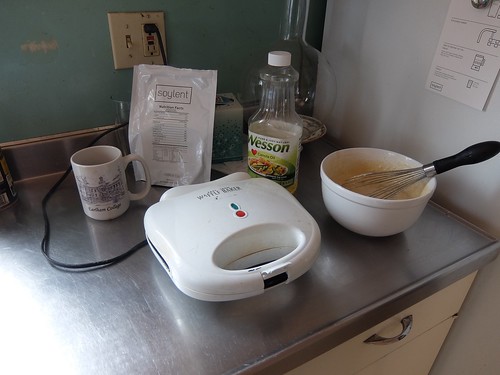
Soylent Waffles

Saturday, August 03, 2019

Wednesday, July 31, 2019

Computing Surface Workouts


Sunday, July 28, 2019

Energy Slaves


The meme "energy slave" sounds very not-PC and against the grain of current engineering best practice.

It's from the 1940s and was meant to remind people, depressed about the industrial age, that all of this power working for each of them, was also a potential source of higher living standards.

Without the exploitation of actual slaves.  "Look ma!  All these robots make life easier" (more household conveniences and appliances would come after the war).


This last one rounds out the Polyhedron class implementation, adding more subclasses in the concentric hierarchy.

Saturday, July 27, 2019

Summer Camp 2019


Wednesday, July 24, 2019

Project Renaissance


My long term readers will likely have run into Project Renaissance at my Grunch.net website, which this Youtube scans in to video memory. I've been doing such backups, with overvoice narration giving more context.

Here I'm talking about a synergy twixt R&D divisions and front-line field-testing not-for-profits, where you get a lot of scientists committed to advancing knowledge and standards, more than building up earthly goods. Engineers need some dare devils and are occasionally the same person (hence the "mad inventor" stereotype).

Case in point: any new stadium-shaped city on the model of Old Man River would need to document its flaws and failures, as well as its many wins, so that coming generations could improve the designs. This is hardly a new need. Scientists keep lab notebooks. Goes with the territory.

In Project Renaissance, we pay ourselves to do what's needed, versus funding a lot of expensive soaps. We still have dramatic lives, as how could we not. However we also get more work done healing the ecosystem. That would be the goal anyway. Trial and error, along with the element of surprise, have not been ironed out by "machine learning" or anything like that. On the contrary, the predominant storyline is VUCA-esque (life's chaotic).

We're experiencing what Alvin Toffler presciently called "accelerating acceleration" (or "future shock" in his vernacular).

Sunday, July 21, 2019

A Black Mirror Episode?

From Facebook:

Asylum City was my overture to screenwriters to bring an alternative positive futurism to our screens. Americans in detention camps is a nightmare, so is Gaza, but do we have the engineering capability to handle refugees on a massive scale?

Engineers would rather we look at politicians as the ones in charge. They're the professional scapegoats after all. Yet Alphabet is planning new cities (Sidewalk Labs).

Big tech has the smarts and money. DC sells mercenary services and the tools of mass murder for a living. Yet we look to DC for solutions? Go figure.

Why don't kids in cages even get to watch cartoons on Netflix? Because they're being punished for daring to pursue happiness, life, liberty.

The soulless zombie corporations, engineered by lawyers long dead, will gladly kill us all in pursuit of profit. English (the language) encodes their personhood. No wonder they call it Voodoo Economics, the namespace of the walking dead (zombie corporations: we eat your brains).

Wednesday, July 17, 2019

Thinking Out Loud

Given my recent Youtube mentioning Operating Manual for Spaceship Earth, which focuses on hyperspecialization as a species threat, you can bet I'm able to nurse those worries at OSCON, given this is where we preach about "open" and yet we're siloed in our many professions.  A lot of us are "cloud native" these days, which might as well be closed source in so many ways (or should we call it it "inner source")?

When I come to these professional geek conferences, I get overwhelmed on several levels.  For one thing, I'm aware that a lot of people are wanting to be inducted into this world (or "space" as we sometimes say).

The current speaker is from South Africa.  He thinks we're in a dire time, at a tipping point, and change is needed. Like the speaker before, he's putting a lot of eggs in the blockchain basket.

If I'm on a team going around in a bizmo, working at saving the bees, will viewers monitoring me through a video series be able to send me funding with proof of impact?  They see the beehives they're helping to save.  Instead of investors wondering where the money went, they see in micro detail how it was used.

I'm seeing consensus developing in a kind of science fiction language.  "Programmable capital".  The ixo platform I'm currently learning about has a fairly mature vision, expressed in software, for staffing up worthy projects.  React, MongoDB, Ethereum, Tenderman, cosmos... Humans, sensors, any IoT device, are "ledgistered" to transact on the blockchain.  The goal is to localize the "impact economy" and bypass slow-moving bureaucracies.

Politicians have no hope of keeping up to date on all this stuff, but then who does?  How do we pay people to stay home and learn, which is not the same as only watching fictional TV.  They always say democracy depends on an informed citizenry.  The idea a few years of schooling towards the start of one's life constitute an "education" (after which comes "a career") comes across as quaint in this day and age.

Something I learned from the sociologist lady:  the quality of attention we're able to give is declining, whereas the demand for our attention is increasing. Here at OSCON, the speakers are fire hosing dense and technical content, while listeners look at their laptops and smartphones, vaguely listening. I'm a case in point, tapping away on this Asus Tablet with attached keyboard, with a mouse pad that's driving me crazy.

Tuesday, July 16, 2019

Dimension Again


Two similar presentations.  Compare and contrast.


Monday, July 15, 2019

Ethereum Tutorial

We're deep in the thick of things.  The tutorial leader gave us really quick instructions for grabbing some fake Ethereum after setting up a MetaMask wallet.

I got lost right away.  I was supposed to tweet a request to Rinkeby.  I used a hex number MetaMask gave me (I thought), but that doesn't appear to be my account.  It's fake money anyway, not real Ethereum.

The geeks are asking questions about crypto-currency in general.  Bitcoin swings thirteen standard deviations, says the professor, meaning it's considered high risk.  Is it really a store of value?  Ethereum swings by twelve standard deviations.

Libra, Gemini and some others try to limit volatility by pegging their value to something supposedly less volatile, such as a fiat currency.

We're doing more meta discussion of crypto stuff than coding.  Geth is the golang implementation of the full Ethereum node.  That's not something most people should run.

We get a lot of science fiction about crypto-currencies these days.  People have a lot of hope in their future.

Smart contracts in Ethereum are written in Solidity.

0xB4824D11AddB0c0a6f63ddb30ff601Fb9AB912b3 appears to be my account.  I sent a tweet with it, requesting fake Ether, but I sent another request earlier.  What was that?  I deleted both tweets.

Want to send me some Ethereum, a few wei?  I named it OSCON 2019.  Then email me maybe?  We're experimenting.

My ears are perking up as we're doing a marriage contract in Solidity, for a "decentralized city".  Asylum City?  That's science fiction I've invested in.  Science fiction is an umbrella term for me, that covers any kind of actual planning for the future.  Investment banking would be a subcategory.

I'm thinking of a currency that is meaningful within a city.  Lots of things won't work unless fueled by city crypto.  Dollar bills don't go in the slots; wallet cards do.

Is this a case of what happens in Vegas stays in Vegas.


Tokens cost nothing to create in Ethereum, and mean nothing in particular by default.   Don't confuse them with crypto-currencies.  Tokens are basically keys to a hashmap.

Tokens are fungible or non-fungible.  The fungible tokens have "face value" we might say.  NFTs include CryptoKitties.  They might represent credentials or merit badges.

Companies that recorded a lot of video about blockchain might be in trouble right now, because everything is changing so fast.  This ecosystem is very fragile.  I think I'll call it a day.


Wednesday, July 10, 2019

More On Current Events


At the time of this posting, all eyes have turned to the sex trafficking circus, which I'm not saying doesn't deserve attention. We have the bandwidth for lots of threads.

However, before that Tucker Carlson rant fades from memory, I want to add my two cents.