Tuesday, May 24, 2005

The Tree House


Tree House

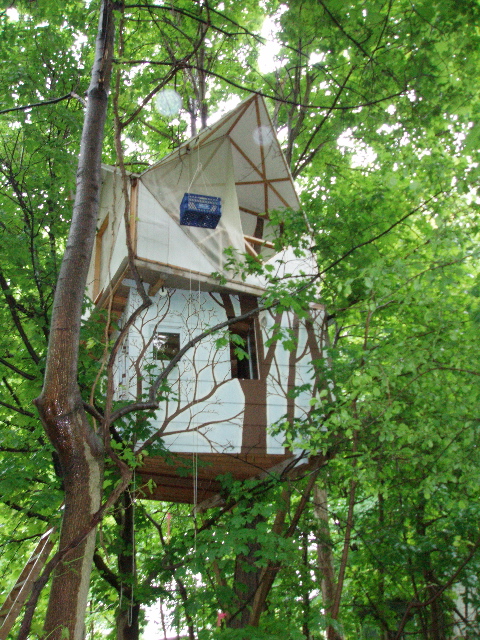
I was glad to be back in Cary's and Theo's tree house last night. I took Continental from PDX to EWR, public bus to Newark's Penn Station, PATH to WTC, subways from Chambers St. to 88th on the west side.

I had dinner with David Lansky and his two boys, Ben in college, Sam in high school, and with Arthur Siegel, an active co-participant on edu-sig.

We discussed, among other things, the role of technology in the curriculum, the relevance (or lack thereof) of math courses. Sam shared his dissatisfaction with math courses that give no real depth, are entirely about doing well on some final test (in his case the IB exam). He once asked his teacher about some concept, and she told him not to worry about it, because this concept wouldn't be on the exam. Ben is seriously into English at Haverford, but assured us that many of his classmates are bona fide math and science geeks.

My goal was to make the 8:20 PM Amtrak to Rhinecliff, but I missed it by a couple minutes, trying to type my name on this touch screen interface at 34th St. Penn Station. So I hopped a subway to Times Square and took the cross-town shuttle (S), to Grand Central (enjoyed the wireless in the waiting area, with a $2 can of Bud). The Metrolink North on track 37, departing 10:02 PM for Poughkeepsie, brought me close enough for poor sleep-deprived Stu Quimby (a Toyman) to come fetch me, and bring me to the tree house. I slept well.

Monday, May 16, 2005

Spoon Man


Spoon Man

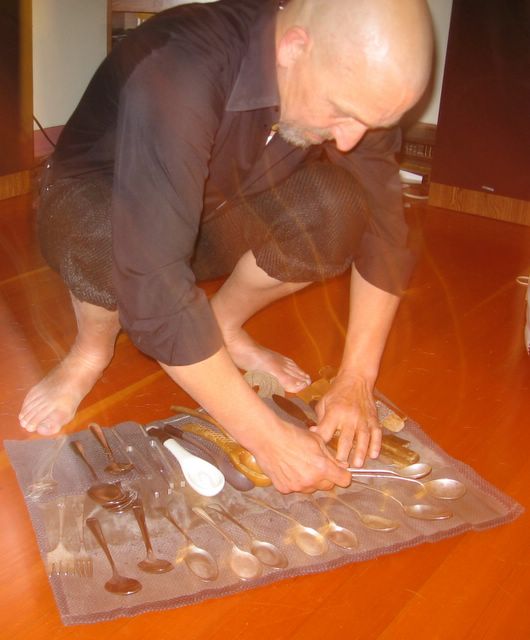
Artis in my living room, setting up for a performance. Photo by Don Wardwell, Canon digital camera, slow motion setting.

Artis, a busker, gave Nick a ride that day, coming down from Seattle, enroute to Bandon via Eugene. Nick phoned today from eastern Oregon, with Stallings, who is now doing a solo version of Hamlet (see my earlier review of his adaptation of King Lear).

The Aviator (movie review)

As in A Beautiful Mind, the screenwriters here have the daunting task of projecting the protagonist's psychic tailspin on the big screen. We see many foreshadowings that he'll be losing his grip, but not before he takes on the world and changes it significantly, and for the better.

To keep the storyline manageable, and maybe because the yet youthful DiCaprio would not seem quite believable as an old man, we never get to the concluding chapters in Las Vegas.

Congressman Brewster, well played by Alan Alda, was actually banking on Hughes snapping under pressure, making a public spectacle of his managerial incompetence. But this plan backfires. Fighting to keeping TWA on the map, versus a greedy Pan Am, contributes mightily to Howard's sanity. Here's a simple game with obvious villains. Hughes is restored to health by fighting in this political arena.

The movie-star women, though more complex than the greedy guys, are still a source of sanity in his life, though his mother takes a hit for maybe contributing to his ill-defined germ phobia (I understand Tesla had a similar problem -- or was it a fear of being poisoned?). My favorite line in the film: Ava Gardner walks into this apartment he's been flipping out in, sees tape connecting everything to everything (I'll guess this was a screenwriter fiction) and says with droll humor as she pours herself a drink: "I love what you've done with the place."

And then of course we have the airplanes, the simplest creatures of all (which the screenwriters compare with the women at least superficially -- both sleek). The planes are Howard's chief conduit to the exhilarating world of unforgiving physical principles versus human engineering and a desire to master them. When the plane, the woman, and bottled milk all come together (Katherine Hepburn at the wheel, high above Hollywood), he's in his element at last.

Wednesday, April 27, 2005

Oswego 2003


Oswego 2003

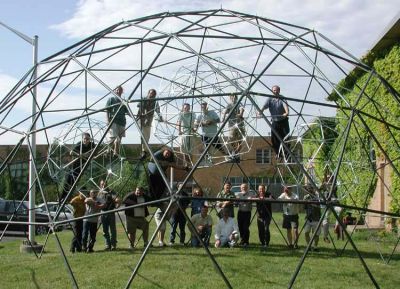
I've just been perusing a photo-blog chronicling the SNEC Summer Workshop in Oswego, New York, June, 2003. The ever-wandering Nick Consoletti, PhD attended the Tensegrity Structures workshop (also at SUNY Oswego) the following summer. Joe Clinton and John Belt were principals at both workshops.

These are the kinds of events I'd want control rooms to route my bizmo through (also to the Bridges and Bioneers conferences, to which I've never been).

Friday, April 22, 2005

More BizMo News


For sale on eBay

Trevor found this bizmo on eBay, complete with 7 workstations and externally viewable video wall. I could see dispatch sending a vehicle like this to some curriculum/circus event, to which I might be sent as well, in a bizmo we could actually sleep in. Coordinating resources is key.

The general Project Renaissance philosophy involves government working with NGOs, because they're on the cutting edge, pioneering new technologies in ways corporate R&D budgets might never directly support. Yet usable, commercializable ideas derive from such pioneering, so the money is in theory well spent (in practice there'll be some waste).

When humanity is hurt or damaged, control rooms spring into action and provide relief, which makes for good reality TV. Of course historically, humans haven't really worked as a body, as large groups typify other groups as pathogenic, and teach their children to perpetuate these views. Humanity has some kind of auto-immune disorder, like lupus or something, causing it to keep attacking itself. Project Renaissance attempts to overcome this disorder. The tsunami relief effort was a step in the right direction.

Speaking of bizmo-based reality TV, I was watching Pat Croce Moving In on the monitor at the gym today, close captioned, as I burned calories on a Precor EFX546i. This guy travels around in a bizmo, parking next to homes and getting involved in family dynamics, trying to help out and fix stuff. I'd call that prototypical of what I'm scheming to see -- I'd just like more of a geek channel overlay, i.e. a focus on technology and engineering, in addition to whatever soap opera family dynamics. Plus Croce's bizmo's interior is too much the suburban ranch style home for my taste (not my American dream).

Wednesday, April 20, 2005

Mythos


Cornelia with her pet Berus

From Tara's toy chest. I mentioned I'd share a photo of Berus (a nickname for Cerberus) once I got my digital camera replaced (see last two paragraphs of Children's Program).

I had a Fujifilm FinePix 2600 Zoom (2 megapixels), but the battery hatch broke off. I replaced it with an Olympus Stylus 500 (5 megapixels).

Friday, April 15, 2005

Last ISEPP Lecture 2005

Our guest last night was Dr. William Wulf, currently half-way through his second and final term as president of the National Academy of Engineering (NAE), which co-exists with the National Academy of Sciences and the Institute of Medicine within the framework of the National Research Council.

Dr. Wulf made it clear that whereas the NAE is an honorific society (per usual with such academies), it also has a special mission to advise the federal government on matters of technology and social policy on a not-for-profit basis. The membership churns out a lot of in-depth, well-researched reports in answer to various policy questions coming from Congress and federal agencies. Occasionally a report will have a classified appendix (meaning it's not accessible to the general public), but for the most part, these studies are all available on-line.

The theme of Dr. Wulf's lecture was C.P. Snow's "chasm between the two cultures" by which Snow meant the humanities on the one hand, and the technology fields on the other, the latter being characterized by their heavy emphasis on mathematics.

Whereas the idea of "two cultures" is easy to grasp, sometimes it makes more sense to break it down further, and Wulf outlined differences between science and engineering, which are indistinguishible in the middle, but also define two extremes.

Engineering is different from science in its emphasis on creating new phenomena, versus simply studying existing ones. Engineers create, bring into existence, design. As such, Wulf considers them to have more in common with artists than with many scientists. He wants to communicate this to new generations, so that creative, imaginative students don't buy into some silly stereotype of the engineer as some nerdy cog in the machine who doesn't think about the concerns of real people or topics within the humanities.

This difference has also been a key part of ISEPP president Terry Bristol's philosophy, so I found it interesting to have them both addressing our pre-lecture on this issue (a small gathering of teachers met with Dr. Wulf ahead of time, in the Heathman Hotel). Terry pointed out that the US Constitution may be viewed as a product of engineering, a blueprint or circuit diagram, complete with feedback loops, load balancing and so forth.

At the dinner afterwards I commented that Dr. R. Buckminster Fuller also wrote a lot about C.P. Snow's famous lecture, and that one way of bridging the chasm is to treat Fuller within the sphere of the humanities, as a New England Transcendentalist for example, and a poet, and then follow his threads into geometric and engineering domains.

Then I brought up Dr. Donald Knuth at Stanford, who suggested we fight overspecialization by becoming competent in at least two fields, preferably quite far apart. In Knuth's case, this would include his foray into theology (a humanities topic, rather different from computer science, in which discipline he's considered a giant).

I asked Dr. Wulf (who has a background in computer science) if he liked this model: you don't get to consider yourself well educated or accomplished in the liberal arts, if you don't have fairly well-developed competence in at least two disciplines, one from each side of C.P. Snow's chasm. Dr. Wulf pointed out that Dr. Knuth was also an accomplished organist, that few attain such stature in even one discipline, let alone more than one, but yes, aspiring to competence in at least two widely spaced disciplines was a good idea and he was all for it.

Don was in high gear last night, helping organize the pre-lecture and handling logistics, including the transfer of Julian's sculpture Unraveling Collagen from the neighboring Performing Arts Center to the lobby of the Arlene Schnitzer Concert Hall -- and back, after the lecture. Featuring Julian's work was a great idea for this lecture in particular, as it bridges C.P. Snow's chasm very effectively and intelligently. Good brainstorming by Wanderers!
Wednesday, April 06, 2005

HPD Cybervan

So we had a big powwow at West Precinct on Tuesday -- a much bigger turnout than usual. George had us brainstorm around getting use from the RedHat 9 lab. I sat there with the Toshiba trying to remember how Jerritt set it up, but could only get access to Coffee People across the street (weak signal). I've forgotten the details (though I still have his network diagram -- which doesn't include passwords, so I'm not going to be sysadmining any time soon (which is for the best -- better HPD should sysadmin, vs. just driving taxi)).

The grand finale was a tour of the new cybervan out back, just arrived, pure white, no decals. It's a 5th wheel, no power of its own, except a propane generator (right?) for the electronics, which include 3 TV consoles in three sections (back, middle, front -- side door into middle). Plus there's a Windows box using the giant satellite dish up top. One of the cops was playing with that, apparently getting signal. George waved towards some pickup in the lot that's supposed to haul this thing. It must be strong, because this thing obviously weighs quite a bit.

The current plan is to have the 5th wheel available in the parking lot for a summer camp experience -- kids in groups of 44 or so, with a snack station and rotating among workstations. The 5th wheel might be one of the workstations (the lab another, a couple other rooms talked about). As for how it gets deployed to more remote locations, that remains to be seen. The Washington County Fair that happens every year is a no-brainer, but the point is to keep it busy all year. That means more content.

How the open source angle plays out remains to be seen. George is pretty committed to Linux from a finances point of view (thinking of kids wanting to own their own computers), but that's not to overly discriminate against everyone else. The cybervan serves wireless, so if a non-Windows notebook shows up and wants to patch in, that shouldn't be a problem, provided proper authorization is obtained.

I took the Max to and from, hauling the Toshiba Satellite A60 and reading my various computer magazines.

Monday, March 28, 2005

Python for GIS Experts

I've been cramming for days to lead this 3 hour training for GIS professionals at an annual conference. As it turns out, you can't really cover Python in all its glory in 3 hours, i.e. when 5 o'clock rolled around, I still hadn't spent much time discussing how to open and read files. We covered some more advanced topics instead: generators and decorators. Going by partial feedback, at least some in the audience had fun, found me dynamic enough as a speaker. I'm pretty good with quips and asides, keeping things fairly light and moving.

But really, today was more an education for me. I soaked up a lot of info about the state of the art when it comes to geoprocessing and geographic information systems (GIS) -- good stuff for a Global Data CEO to know about. ESRI is the 800 pound gorilla in this knowledge domain. They're moving to Python for a scripting language in their flagship product (ArcGIS) which is how come I was a speaker at the Doubletree Hotel, Lloyd Center, Portland.

The lunch time talk was excellent. The speaker, Doug Divine, played a major role digitally surveying both submarines of Civil War vintage (talking USA history here). The Hunley, a confederate vessel, is the one most people know about, but the Yankees had their own sub, which was repurposed to pearl diving duty after the war and ended up all washed up on some island near Panama City. Doug's talk featured a lot of excellent DVD clips, including a dramatization of the Hunley's last mission, funded by Ted Turner.

Friday, March 25, 2005

Pycon 2005

March 24:

So I'm in Washington, DC with my wife, staying with friends in Virginia. We've been taking the Orange Line into town the last two mornings. I get off at Foggy Bottom/GWU.

Yesterday I gave a talk on hypertoons during one of the open space periods. Dawn visited the new Native American museum on the mall.

Tonight I'll be going out for dinner with Dabo and Schevo people (hi Patrick) -- both emerging database-oriented Pythonic technologies.

March 25:

So we had good Vietnamese food on M Street in Georgetown last night. Conversation meadered, a lot about raising kids, especially teenagers. Turns out Prague is a major capital in FoxPro world (a world I share with the Dabo guys); maybe I'll get back there one of these days. Would Microsoft have let FoxPro die off if it hadn't been for heavyweight clients like the US military, which uses it in JFAST (home page)?

Speaking of the military, one of the interesting applications demonstrated this week, inside of which Python plays a major role, was for imparting Arabic language skills to soldiers (PDF). Python glues together speech recognition software and a game engine (Unreal Tournament 2003), and simulates a mission: approach some locals, introduce yourself and your team; ask who's in charge; get directions to the local leader's house; follow them (all in Arabic of course).

This morning, we're looking forward to a keynote about how Python is used at Google.

In the news: I see Bobby Fischer has finally gotten out of that Japanese jail.

Thursday, March 17, 2005

Happy St. Patrick's Day!

So I finally got my hypertoon concept implemented in souce code. Although I published the idea to the web in 1996, only recently have my programming skills intersected available technology (Python + VPython) such that I could write a working prototype.

I'll be sharing about it at Pycon 2005 next week in DC. Looking forward to seeing Glenn and his family.

Looking ahead to that, I tried the the app on the family laptop (1.2 Ghz Compaq Presario) and found the results disappointing. The family budget is tight (no Animal Planet or new fish tank accessories for Tara) -- because dad spends all his time pushing the Bucky stuff, work nobody pays him for (except precessionally, which counts) -- but I couldn't see a way around ordering up a new (refurbished) laptop. Like, I've got this 3 hour teaching gig for some big GIS corporation (ESRI) the day after my return, and this Presario keeps overheating and cutting out. That just won't do.

Trying to get used to the new haircut. Jennifer had a lot of time to trim away, going for the perfect cut. My head feels pounds lighter. She wrote a bunch of "must see" movies on a biz card (she's another Netflix fan, knows a lot about movies, and Pink Floyd too).

On Tuesday, Matt (speaking of Irish) took the day off to finally get a home computer (his first ever). I helped him pick it out (iMac) and get it connected through Comcast -- the test was to get Amy Goodman on RealPlayer (we passed the test).

Tuesday, March 15, 2005

Wanderers Meeting 2005.3.15

Today we learned about Meliptus, the name of Don's boat, and also a mnemonic for his Master Life Personal Development System. Don is refreshingly low key with his approach -- the antithesis of L. Ron Hubbard (another guy with a boat).

We talked about some successes in our lives, and the processes contributing to them. Mine was getting back into teaching, which I enjoy. That teaching job at St. Dominic Academy (Jersey City) was one of my all time favorites, if challenging. Getting that Saturday Academy gig last summer with the HPD's George Heuston the ex FBI guy, and co-teaching with Linux guru Jerritt Collord, was a breakthrough for me. I shared about the police chief being a son of Chinese immigrants, and wanting to reach out to Latino youth, among others, to bridge the digital divide -- hence that computer lab at West Precinct (Hillsboro). The relationship with Saturday Academy continues (and HPD).

Others had interesting success stories as well (which they might tell, if so moved). I got some good feedback from Bruce when I shared my a plan to recruit master teachers into this alternative lifestyle centered around roving teacher-mobiles (specially outfitted RV-like jobbers), coordinated and supported through some OnStar-like headquarters. Bruce told me about GM's Parade of Progress, a sort of traveling roadshow designed to clue kids about new technologies. And this was pre Sputnik, and in an age that was bolder (some would say more naïve) about its futurism.

If I ever get a bizmo, I might name it Meliptus Junior, in honor of Don's boat (a floating bizmo) and his role in my life as a master teacher.

Sunday, March 13, 2005

Update from PDX

Peter Ward was in top form for the ISEPP lecture (center ring, name on the marqee). He did his best to recruit scientists and engineers from a young audience, astrobiologists in particular (though during the Q&A, a rep from our own university system challenged kids to check out Oregon's offerings -- and Ward graciously responded with a question about why both states do such a poor job of ignoring their most important institutions: their universities)). He really appreciated how we attract so many of the high school set, not just fuddydud peers with already-formed views and established careers. He expressed his deep appreciation to Terry for making that happen, and Terry in turn credits the Mentor Graphics Foundation, and Corporation, both sponsors, with the former earmarking funds directly for K-12 participation in the ISEPP series. Don did the intro. Dinner after, then drinks in the bar (The Heathman does a very good job).

Yes, I got to meet Fr. Bob, who has a cool campus setup, a spare yet well-equipped office. Ki Master George, an 8th grader, took Fr. Bob on a tour of a blog KI's serving, using bascially a LAMP configuration, though without the MySQL. Fr. Bob appeared delighted with the technology, and plans to keep it current with new postings.

I put aside most of an entire day to finally implement my Hypertoon concept in running code. Someone had it running in Germany (or was it Austria) within hours of my posting it. This thread goes way back with me, to like 1996, but to get a working source code version has had to wait for the programming environment to come within my reach. With Python 2.4 and VPython as an add-on, I was able to get a prototype out the door. I showed it to Tara and she came up with some excellent ideas for improvements.

My congratulations to Darren and Cristy on their wonderful wedding ceremony, conducted in high Quaker style. The spouses married one another with powerful promises, then affixed their names in the presence of a large gathering. We all lined up to add our signatures as witnesses after the Meeting for Worship had ended. During worship, friends and relatives offered kind words of encouragement, recollections, expressions of gladness, and advice. Darren's bro had planned a dynamite menu of two spanikopitas (rural and urban), many other delicacies. The music, which the groom had a hand in supervising, was highly eclectic. A good time was had by all -- including me, taking the full brunt of an early spring allergy (Benadryl helps). Dawn and I walked to and from the event, which was associated with a nearby park. We were reminded of our own wedding, which took place in similar Quaker style, also outside in a park setting. We likewise have such a certificate, signed by ourselves and our friends and family.

Update: I'm feeling skeptical these days that my bizmo's responsibilities will allow it to stay as compact as I first imagined. On the way to the wedding, Dawn and I passed a rig that I used to think was about the right size, but when I mentally sketch in the internals, the shell ends up expanding a bit. Still, I refuse to tow an SUV. I want maneuverability. Plus there's the caravan option, or bizmos converging from different directions. Mine could be more compact if some of the bigger circus stuff gets driven by others, and shows up where it's needed. Many permutations are possible.

Sunday, March 06, 2005

Journal Entry de Jour

Well, my back isn't back to normal yet -- still paying for that splat at the roller rink. But at least I'm up and about, even lugged a bag of dog food from the store this afternoon, plus did some gardening with Tara around the Mother Mary statue, so hey, it can't be that bad.

Just posted some more of the same to math-learn (link). The Math Forum has new infrastructure for the discussion groups.

Nick is here checking his email on TMU (I'm using KTU2, which has two monitors). He just showed up a few hours ago from Seattle and will be out by early tomorrow, heading east with Stallings.

Stallings is doing a couple performances of King Lear at a Umatilla prison -- he had a gig in New York City as well, awhile back (not surprising -- the guy is way talented).

Dawn is reading a lot, mostly science fiction these days, though she enjoyed Lindsay's book.

I turned over Childrens Program to my successor. At our last committee meeting we looked over the curriculum from JACL, a prized addition to our collection.

Oh yeah, got another check from PSU, no biggie. Enjoying company of wanderers and friends, including those times out on the Columbia River.

Anyway, not a lot happening. I have another meeting with Ki Master George next weekend. I'll finally get to meet Father Bob, insha Allah. Maybe I'll post again then.

Monday, February 28, 2005

The Incredibles (movie review)

I just saw this again at the Bagdad with the kids. A cool bizmo gets a cameo.

Nick was waiting outside the theater on this warm-for-February Academy Awards night. I shared my sense Ayn Rand would've liked this film about extraordinary individuals caught up in an oppressive "no powers allowed" mediocracy (like Harry Potter & friends escaping muggles through Hogwarts), but Nick mainly just liked the good family vibes, a scarce commodity in his scenario.

I'm not a big Ayn Rand reader, mostly just The Fountainhead in like 8th grade (looked interesting, plus I detected raised eyebrows among the adults). I was much more into Freud (called him Frood until people figured out whom I meant). My friend Trevor, a true scholar, has been studying Ayn's 'n Bucky's thinking for signs of convergence/divergence, plus he's dug into the technocracy movement with gusto (found a great video). Trevor (many years my junior) is one of my favorite teachers -- always expanding my horizons.

That's what The Incredibles reminds me to be (not that I need much reminding): grateful for the many differently abled superheros in my life (corny but true), all average joes and janes on the surface (such perfect disguises).

Friday, February 25, 2005

A Beer at the Bagdad

Last night I was introduced to a teacher of comparative education systems at the University of Oregon. He hails from Singapore, is an Austrialian citizen. He and Derek joined us at the Bagdad. I sampled the Dry Irish Stout but stuck with my favorite: Hammerhead.

Just walking to the Bagdad had been a chore, as we'd been roller skating again, and this time I managed to wipe out big time. Some lower back muscle got very unhappy and is still giving me grief almost 24 hours later. The power walk up to Hawthorne was part damage assessment. I explained RSA along the way to keep my mind off the sharp stabs.

Jimmy just brought over some Tiger Balm patches, plus I'm doing ibuprofen. I expect to be back to normal shortly.

One of the things I remarked on at our booth was this bottle of vitamins I'd just picked up enroute to the skating rink, sporting a green label against a reddish background. The green part says "Super Crusade" while the purplish red background says "Trader Darwin's". I found this an interesting juxtaposition of contrasting memes -- and passed out vitamins to whomever wanted 'em.

Speaking of crusades, over on Quaker-P some scholarship (not mine) has unearthed a meaning of jihad amenable to Quakers. In fact, Bayard Rustin's "speak truth to power" might be construed as a reasonable translation of something Mohammed likely said: that to speak truth in the presence of a tyrant is what jihad is all about. I filed a post on that on synergeo on February 8th of this year.

Thursday, February 24, 2005

More Wanderings

This is February? asks the front page of The Oregonian today. Indeed this is weird weather for us, but not unenjoyable. I've just been sitting out at a favorite cafe with Nick, getting briefed on the Amory Lovins talk of two nights ago. Fabik, freshly back from Mexico, joined us for lunch.

Biofuels could be big in Oregon, especially considering how many trucks we make. OSU has already done a lot of the planning. Lovins is a 787 fan, sounds like (new Boeing model). Speaking of Boeing, another headline in today's paper: JetBlue is to start a nonstop service from PDX to JFK, using state of the art Airbuses (every seat has its own DVD LCD).

Last night we watched the full moon rise over the Columbia, anchored off PDX. At dusk, that tower looks like something straight out of a science fiction novel, or maybe Lord of the Rings. So what's with those billowing black smoke fires again? They've been happening for years.

Last Friday night, Dr. Philip Clayton did the ISEPP lecture, talking about the levels of discourse separating emergent levels of complexity. Philosophy floats atop science, with a lot of value-laden verbiage, and that's OK. As human beings, we're entitled to traffic at a higher level than reductionism might justify and nail down within empirical simulations. Life at the edge of chaos is just like that.

After wine and dinner, I asked him about the Tower of Babel i.e. isn't it part of the design that we don't get totalitarian closure i.e. Universe always seems to escape complete systematization? It's a question I didn't get to bring up with Lyn & Dorion in the Hawthorne Pauling House that time (Terry did most the talking) -- was thinking about them cuz Clayton played us a DVD clip from Contact during his multimedia presentation (also a clip from 2001: A Space Odysseey -- the chimps' meetup with the obelisk). Anyway, yes, Philip thinks the Tower of Babel is semi-real.

Friday, February 18, 2005

More BizMo Source Code

I haven't specified my bizmo in great detail because my plan is to field test a standard issue model, not a one-off, so that lessons learned have wider application than to just my team.

That being said, a Google recruiter with family aboard wouldn't have the same features as a roving clinic and dispensary, or environmental quality tester. I imagine a typical class hierarchy per Java, with bizmo interfaces extending various subclasses of RV and touring coach, known quantities from whence the bizmos derive.

Likewise I likely wouldn't own said bizmo. I envision the fleet having corporate ownership, with scheduling and maintenance more centrally managed. Just amassing a personal fortune, buying an RV, and outfitting it accordingly would unnecessarily delay the evolution of shared infrastructure, complete with control rooms providing OnStar-like support services. The whole point is to grow a fleet within a larger deployment plan. Bizmos do real work, after all. I'm not planning an early retirement.

To the extent our source code remains a public good, early adopters such as the UN, various NGOs, could port, customize, and further develop the software. Competitive commercial ventures might add proprietary features. Making much of the infrastructure free, including access to relevant GIS, would stimulate the corresponding hardware market, with many multiplier effects.

Given the USG has a history of strategically encouraging investments with ripple effects, I could see the NSF getting involved, among other agencies. Or maybe we should look at pioneering this whole business in Japan. There'd be a large export market. I'd be happy to field test various Made in Japan technologies. Nor must we think either/or. And yes, I hear you Korea. Let's all play world game.

Tuesday, February 15, 2005

Wanderers Meeting 2005.2.15

Some of you may have wondered where this name "Wanderers" comes from. Terry was thinking of this quote:

“Science would be ruined if it were to withdraw entirely into narrowly defined specialties. The rare scholars who are wanderers-by-choice are essential to the intellectual welfare of the settled disciplines.” --
Benoit Mandelbrot

Today our presenter, Steven L. Jacques of OHSU, talked about optics in biomedicine, meaning the therapeutic and diagnostic uses of photons on tissues. Most of his talk focused on clever ways of using colored lasers, mirrors and digital filters to tease telling imagery from the body's surface and innards.

Monday, February 14, 2005

Pay Day!

Yes, it's a red letter day, and not just because it's Saint Valentine's.

I just deposited a Portland State University (PSU) check made out to me (taxes withheld), a Fuller Schooler, for my work with Saturday Academy as an adjunct faculty member. I teach at the Oregon Graduate Institute (OGI), using a classroom belonging to Oregon Health Sciences University (OHSU).

On Saturday, I used our projector to eye our classroom from further out, using Microsoft's Terraserver. We also played with new Elastic Interval Geometry applets, and went over some entry level group and number theory using Python, a nifty computer language.

Last week, I completed an intro to Fuller's concentric hierarchy of polyhedra, embedded within its CCP context (if you're thinking CCCP instead, don't worry about it -- wires cross sometimes).

Although the amperage is low (this was a token sum), the point is: a switch has been thrown and a current is flowing. This is a "go live" milestone along our critical path. A cool new circuit for our Motherboard Earth has commenced operations.

Followup:

So it turned out over dinner (we ate out as a family) that Dawn had been reading about Hildegard of Bingen. Without having read this blog entry, she brought up the importance of the color green in Hildegard's writings, and connected this to her own query "where's the green?" in a recent empowerment circle -- for her, an uncharacteristic use of slang (she was asking about travel money).

I told her later how satisfying it was to hear all this green talk, having just written a blog entry that was thematically red -- including a subtle Biblical allusion that most wouldn't see. The juxtaposition of red and green, and of sacred and profane imagery, made for some interesting paper-into-gold alchemy.

And speaking of checks, of course the Catholics have been paying me for years, through Saint Dominic Academy and later Saint Vincent Hospital. The breakthrough celebrated above was not the brute fact of getting paid, but rather the new set of university affiliates connecting up with the Fuller School to promulgate a new, higher quality curriculum.