Thursday, October 09, 2014

Reviews on Amazon


Quakernomics: An Ethical Capitalism (Anthem Other Canon Economics)

Quakernomics: An Ethical Capitalism (Anthem Other Canon Economics)
Price: $9.99


4.0 out of 5 stars Did Quakers practice "Total Capitalism"?, October 9, 2014


Verified Purchase(What's this?)
Very cool that the author focuses on The Iron Bridge as an entry point, a science fiction novel about a time traveler sent back from a future that's decided humans had industrialized too early, before their thinking had matured enough to handle it (witness the World Wars the followed). In this future, the planetary ecosystem is messed up beyond repair. Industrialization must be delayed. So she (the time traveler) is to sabotage the Iron Bridge, built by industrious Quakers who treated their workers fairly well. Hence the book's claim that Quakers not only practiced "total capitalism" (from foundry to factory to wholesale to retail) but did it in such away as to give "total socialism" a run for its money, i.e. they treated their workers relatively well. Quakers reach an apogee in power and influence around 1781 when the bridge opens. Given their socially unpopular positions in the US, anti Indian Wars and anti slavery, their Quaker utopia (Pennsylvania) is already on the wane, but that's another story. This book is more about the UK and the difference Quakers made there.


Divided Spheres: Geodesics and the Orderly Subdivision of the Sphere

Divided Spheres: Geodesics and the Orderly Subdivision of the Sphere
Price: $55.46


5.0 out of 5 stars A Well Rounded Primer, June 12, 2013


Verified Purchase(What's this?)
This handsome, beautifully illustrated primer is authored by a career geodesic dome engineer with a sense of the big picture, including the history. I found plenty of mathematical trail heads leading off in various directions, all worth exploring, with a core of spherical trigonometry.

Yes, my own writing is in the bibliography, which may color my opinion, but to me this just means Edward Popko (whom I have not met) was extremely thorough and really did his homework for this tome, including exploring a lot of obscure topics. Amy Edmondson's A Fuller Explanation: The Synergetic Geometry of R Buckminster Fuller is likewise cited, helping weave together a story that is still unfolding today.

Saturday, October 04, 2014

Elders in Action

This went by on the Chipy list today.  I've watched it before but this time had the sense to grab it for my blog:


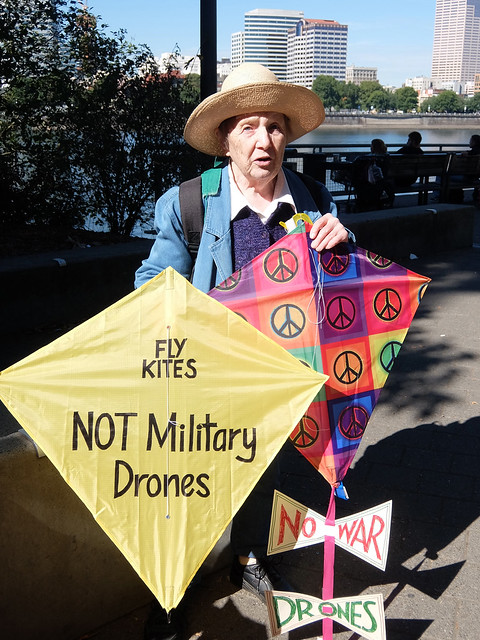
Also today, in addition to chauffeuring a friend with a hip replacement around, I joined some women at the waterfront, East Side Esplanade at Salmon, for a quick photo shoot in honor of of the ongoing global Kites Not Drones campaign.

That's the abbreviated slogan. Drones have their legitimate uses, just not in the hands of vicious killers. It's a misappropriation of technology. Women's International League for Peace and Freedom (WILPF), Ava Helen's old haunt, organized the Portland action.

DSCF2460

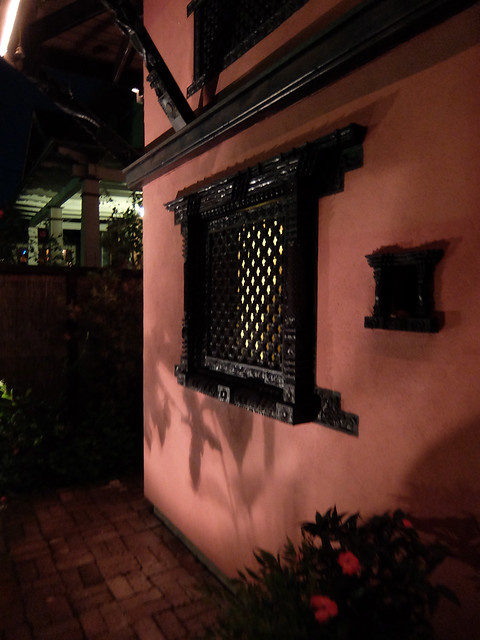
I rounded out the day at a local temple (Newar Buddhist), on invitation from a friend. Classical Indian ragas sung by an older guy, accompanied by traditional instruments, who knew what he was doing. My ears took awhile to adjust but then that's part of the process. By the end, we were pretty much all on the same page.

DSCF2485

Saturday, September 27, 2014

Pacific Northwest Social Forum

PNW Social Forum

I'm in no position to write any comprehensive review of this event.  Good job Food Not Bombs on the lunch.  Carol (mom) was especially keen to go as she'd been to the Social Forum in Detroit and been on organizing committees for Forums before this one.

This year the plan was to fragment the global event among several cities, so that more people from diverse locales could maybe make it to one of them.

This was not the same church as where we have the ISEPP lectures.  First Unitarian is not First Congregational.  Both have ample facilities, with the Unitarians also having Eliot Center, the site of many a social event in Portland, including some Barcamps I've attended (that's a computer thing, not a camp for bartenders).

Ibrahim was the one panelist I could claim to know by name.  He came up to Carol and I later and introduced himself in a friendly way.  I reminded him he knows Lindsey (housemate), who would have dug this event; she's still in Nepal.

The Luchini family was in high gear with both parents leading breakout sessions.  However it's not like I was able to recognize many faces.  Portland is a small city, but not that small.  More it was the issues, causes and agendas that I recognized.

Using the term "capitalism" to encapsulate / name a broken operating system, buggy and disreputable, is part of the common core vocabulary, though I wouldn't call this an unexamined nomenclature.  During questions to the panelists, the door was left open to embrace aspects of the "current system" but given the heterogeneous makeup of the group, having a common vocabulary is an asset and after cost / benefit analysis it seems "capitalism" is indeed the common foe.

Somewhat ironically, I'd scheduled the middle of the day to photograph houses on the market for some people looking to move to Portland and so was out and about playing the language game of home ownership after lunch.  Then I settled down on the back deck with Nietzsche, Godfather of Fascism? to read some of the anthologized writings therein.

English must be versatile and fertile enough to come up with other isms, for those wishing for neither social-ism nor capital-ism.  Those can't be the only two choices.  This book Quakernomics I've been reading suggests capitalism is not intrinsically oppressive, if placed at the service of alternative value systems.  Maybe.  Why call it "Quaker capitalism" instead of just "Quakerism"?

Why not just advertise an openness to a plethora of small scale experiments (no "winner take all" rules need apply), with some doubling as a basis for video programming, such that onlooker-viewers may judge for themselves what's an appealing lifestyle?  We already do that a lot already.  Let's do it a lot more.

We (humanity) can practice hundreds if not thousands of isms and individual humans need not see themselves as trapped by any one of them, anymore than bees are trapped by flowers (unless they're flowers of the insect-eating variety).

Engineering subcultures are not by definition the enemy so much as potential infrastructure providers, stage crews, for giving the various isms space to flourish and recruit.  Architecture is a branch of engineering in this vocabulary.

Aren't religious communities "socialist" in that the devotees of whatever flavor share assets / property?

But in that sense isn't an aircraft carrier shared property as well?  Who on board has title?

A captain of a ship is so often not its owner, nor are the admirals typically in owners of their fleets, or why would socialists have them?

Political terminology is full of holes.  Why stake one's life on such hole-ridden texts?

The capitalist in me says risking everything to defend "capitalism", one ism among many, is not a good business investment.  Isms come and go.  The 1800s need not dictate the terms of our debates going forward.

Monday, September 22, 2014

El Topo (movie review)

El Topo ("The Mole") incorporates many tropes from the Western, but also the martial arts film.  A story line wherein a wannabe confronts successively higher masters and fights them, perhaps to the death, is taken up by Bruce Lee, with Kareem Abdul-Jabbar one of the masters he fights.

As someone well versed in the Buckminster Fuller legacy, I have to comment on Master Two's splendid collection of toothpick vector matrices, including a painstakingly constructed isotropic vector matrix of considerable size, which our anti-hero destroys.  Got me thinking about Russell Chu, a patient toothpick IVM builder.

The anti-hero goes on to confront his own son, now a grown man, as yet another master he must overcome.  If we take "killing" as a metaphor for simply "comprehending" then we might restore the gory foreground to the status of tantric dream (cartoon-verse or whatever).

The anti-hero is driven into the priesthood by a love triangle, getting "crucified" on a bridge in a scene aptly named Betrayal on the DVD.

Yoko and John Lennon appreciated this film and Jodorowsky's talent more generally.  He's both the director and a main actor in this comic book South American western.  I can see why.

Anyway, the son, the mole, is vastly understaffed and underfunded and his alchemy experiment proves a calamity and he experiences game over, probably doomed to replay this level at some level.  Reintegration of "the other" into "polite society" or whatever the towns people signify, is clearly a dicey game, explosive, and without careful management and supervision, was bound to go awry.

The DVD itself gets a lot of credits i.e. restoration of the original film to its DVD state, complete with an interview (engaging) with Jodorowsky, which leaves me wondering if the somewhat rough cut editing is an artifact of restoration.  I think more likely it's what I'd call the "comic book style" of this kind of movie making.  Things happen abruptly sometimes, just like in real life.

In trying to turn his rescued significant other into a shaman, like himself, she appears to bifurcate into two people (my reading) at first conflicted, but growing self-assured enough to stand on her own and engage in a separate journey.  On this reading, it's maybe a triangle, but Mara is simply more in touch with herself and doesn't need to piggy back on her man, riding him Lady Macbeth style at first (given what she'd been through, I can't say I blame her).

The anti-hero, in the meantime, has a lot of father-son issues to work through and so isn't really prepared for a girlfriend.  He needs to deal with not being in control for a change.  Part Two of the film (the film somewhat divides in two) traces the anti-hero's continued maturation, this time against the backdrop of the mole's alchemy project, which he undertook by popular demand in a spirit of public service, a politician of sorts.

Wednesday, September 17, 2014

Slutwalk 2014

Slutwalk PDX


This crowd was on the cerebral side, regardless of dress.

The speeches were pitched to a high level and I overheard someone way a lot of St. Mary's students were in the crowd, a premier Catholic school not unlike St. Dominic Academy where I taught math and sundry subjects in the early 1980s.

The protestors were basically advocating for Second Life rules in First Life insofar as avatar presentation goes.  Dress or don't dress your avatar however you like:  nothing about your dress code implies consent and/or a willingness to provide favors, sexual or otherwise.

The Code of Conduct around Portland State University and other places is clear:  women, and men, can dress how they like within whatever boundaries the courts would uphold (e.g. going stark naked is still not accepted public "attire" except in designated areas), and no aspect of one's costume or dress should be considered "an invitation" as in "but she dressed like a slut, your honor".

Understood?

Put in other terms, guys have no right to behave like dicks no matter how women dress or undress themselves.  "Consent mode" and "dress code" are two different concepts.  Don't confuse them.

Get it yet?

Some in the crowd were professional dancers who considered their performance art very far from an invitation to random others to assume anything about their willingness to have any specific type of relationship.  Portland has a lot of strip clubs.  These are supposed to enforce a professional code that keeps the dancers safe from non-consensual intimacy.

The main speech maker declaimed sorrow at even needing to hold such an event / protest as the rights being asserted should simply go without saying.  To have to fight for the right to never have non-consensual sex:  why again is that even up for debate?

Given the Code of Conduct is clear, I'm not for a moment saying it's necessarily a simple matter to resolve every dispute wherein an aggrieved party alleges non-consent after the fact.  Many a soap opera has featured a betrayal wherein an innocent party becomes the target of a criminal accusation, for whatever motive (revenge, blackmail etc.), or wherein a perpetrator protests innocence by alleging such a motive on the part of the aggrieved.

Soap operas sometimes make matters easy for the audience as there's often a "fly on the wall" point of view (the camera) giving the inside story.  Usually a jury of one's peers, or the court of public opinion, as the case may be, will not have the luxury of such a viewpoint.

That's where the police and detective shows come in, along with the lawyer shows.  Our TV channels are awash in such stuff.  At St. Dominic Academy, they almost all watched General Hospital.

Tuesday, September 09, 2014

Sounding Some Themes


I told the story of CareWheels, as I knew it, to 791 Techologies in Canada.  That was Ron Braithwaite's project.  I hung out with 791 people at DjangoCon a lot, as they were among the top sponsors.

I'm settling in to this routine where I meet at Red Square wearing my AFSC Liaison hat and swap papers around with the Multnomah Meeting Communications Clerk.  Sounds very toontown doesn't it, like out of some Hollywood movie.  Red Square is just a coffee shop and the Portland AFSC is moving closer to Stark Street, so it's convenient for me 'n Rick, both Friends, to chat over coffee sometimes.

Holden is in Sebastopol I'm pretty sure, with Carol on her way from LAX right now.  Melody got a voicemail from the away team near Kathmandu, still heading for the Rotary-sponsored women's clinic so far as we know.  Glad to meet up with Jen and Yarrow again, and to finally meet Melody's dad.  Uncle Bill is training over from Seattle.

Wanderers will likely celebrate the Solstice on the 19th, which for me will likely start at Colonel Summers where I'm still active with the SE FNB chapter (that's Food Not Bombs, lots in these blogs about the local group, with some links to global resources).  FNB was hosted by the Quaker meetinghouse on Stark Street for about a year, when Blue House was also providing more logistical support.  We were more of a hub back then.  Our main supplier moved and Lindsey found more time to work on music after that.

OK, enough with the random notes, gives the flavor.  Sounding some earlier themes, keeping my storylines going.  CareWheels.  Some good thinking went into that project.

I've also been hyping Fibonacci Numbers on math-teach.  So what else is new?

Wednesday, August 27, 2014

More Documentaries

I find multitasking helps me stay focused.  Each activity gets concentration and attention, but I exhaust my patience for Just That One Thing and get relief simply by varying the content.  We all know this power from the Channel Changer (one of the great inventions of all time).

Is that what's meant by Attention Deficit?  There's nothing wrong with an attention span of only three minutes, if you keep coming back for another three minutes often enough to keep up with the workflow.  That's how our interrupt driven computers work.  The operating system's whole job is to multitask intelligently.

Sure, some tasks take sustained attention for a lot longer than that, but lets hear it for the ones that don't, or don't always.

In that spirit, I welcome the chance to plunge into Quakernomics on my Samsung Galaxy Tablet (10.1") from time to time, or maybe on my Razr when riding a bus.  That book poses interesting questions especially seen in contrast with The Wobblies, a 1979 documentary I just reviewed (I'm pretty sure I'd seen it already, or maybe parts of it).

The IWW was sure no form of capitalism could be benign whereas Quakernomics makes the case that nothing intrinsic to capitalism says that system must be miserly-miserable.  But then Quakernomics is very broad brush stroke with what it means by "capitalism" casting Quakers as most definitely capitalists, in contrast with the Marxists who sometimes ridiculed their mendacious ways.

Likewise the book Debt:  The First 5000 Years, also on my Kindle app, is broad brush stroke with its meaning of "communist", making it mean almost any community-centric economy, any sangha.  So much ideological warfaring depends on loose definitions or, same thing, breaks down as definitions come under closer scrutiny.  "We're not in conflict, we're just working in different namespaces."

Prohibition by Ken Burns is a masterpiece of storytelling.  I'd never associated Happy Days are Here Again so closely with the repeal of Prohibition, preceded by FDR's legalizing 3.2% beer by executive order (a master stroke).  I've always taken legal drinking (for those of legal age) for granted, my generation having been imprisoned for similar offenses the Burns documentary avoids mentioning, despite obvious parallels.

Building up beer as a specifically and endearingly German thing, to postpone Prohibition, really backfired come the demonization of Germans and their culture during WW1.  That, and the passage of a Federal Income Tax turned the saloon-keeper caste and their suppliers into outlaws.  The US had a new source of income and a profitable war to prosecute.

Truly, the "saloon" as an all male club, a symbol of anti-female apartheid, pre women having the vote etc., did not survive into the mid 1900s.  More accurately, gender stereotypes broke down under the pressures of industrialized city living and typecasting based on gender (and "race") became less and less tenable for any institution.

The Wobblies sure liked to sing a lot.  When you have a pre literate and, more important, pre Web culture, propagating ideology through lyrics (and prayers) makes sense.  And these are not songs to kick back and listen to, they're songs to sing oneself.

There's a lot less public singing in groups these days, is my impression.   We have become a culture of spectators on the one hand, and amplified / recorded celebrity-pro singers on the other, with new institutions to break down that difference:  karaoke bars (and of course "church choirs" are still popular), and Youtube.

These two films, on Prohibition and the IWW, in combination with To Be Takei with its focus on the internment of Japanese Americans, provides a ton of information about the "culture wars" that North Americans have been fighting.  Prohibition had everything to do with trying to legislate lifestyle choices with one caste (cast) feeling entitled to dictate to another.  Prohibition was "cast warfare". Criminalize that of which you disapprove, is the "moralistic solution" Americans tend to favor, at great cost to their living standards.

Indeed, we might intelligibly replace the notion of "class" with that of "cast" (as in theater), as ultimately it's a matter of role playing.  Cultures are role playing games, pure and simple.  It's just they take themselves so seriously that saying "game" sounds offensive (too jokey, too light), especially to hardliner ideologues of whatever true faith.

The IWW fought hard for the eight hour work day, and for Freedom of Speech.  The documentary is brilliant in that it shows press accounts being predictably and routinely anti-IWW, making the point, in case it wasn't clear, that newspapers are a tool of one cast more than others.

Demonizing the IWW as either German or Russian agents helped Americans confuse the two, helping with the Great Pivot under the Dulles Brothers, when Germany and Japan (former enemies) became allies against Vietnam and Russia (former allies).

Speaking of demonizing Russians, I also squeezed in at least part of Season One of The Americans, set during the Reagan Years.  I won't try reviewing that here though, beyond acknowledging its relevance.

Sunday, August 24, 2014

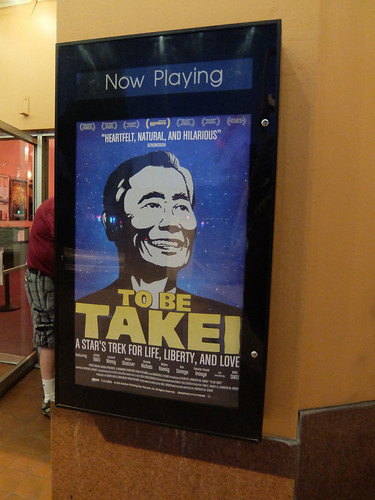
To Be Takei (movie review)

DSCF1264


That's "Tah-Kay" not "Tah-Kai" as the movie makes clear.

What strikes me about George Takei are the similarities between his story and that of Kiyoshi Kuromiya, another Japanese American who incurred internment and a resulting life-long commitment to activism in defense of civil liberties, including gay rights.  Kiyoshi and I used to hang out some in Philadelphia, when I'd fly there for AFSC meetings.  He was likewise kind and brilliant, also focused on personal integrity.

Being gay is an orientation, not a lifestyle, George likes to point out.  If it's "a choice" so is being in mixed-sex relationships a "choice" i.e. it cuts both ways, yet many mixed-sex oriented don't think of it as "a choice" for them.  Well ditto.  That was reasoning by a standup comic we heard later that same evening, but it fits as analysis.

The documentary advances its threads in a multitasking way, an effective way of storytelling in that you get three minutes here, seeing the marriage equality campaign move forward, then three minutes there playing up the Star Trek lore.

What's illuminating about this film is how it's highly media literate within what's popularly called "pop culture" so we get inside Howard Stern's radio show and into magazines and tabloids, visiting a lot of edgy comedy.  That's why the later show by Dick Foley and company at The Helium was so dead on, including more gay jokes.

Like a lot of the stranger-fans in the movie, waiting in line for picture signings and so on, I'm a Takei friend on Facebook.  I don't think I've ever posted to his profile or commented thereon, but I've really liked some of his funnies.  I'm think of myself as a subscriber in that sense.

The movie spends some time on how Asians get portrayed in films.  Yes, a fencing sword is less "stereotypical" than a samurai sword one could say, but getting all martial arty and Bruce Lee like is hardly "out of character" for an Asian male.  They seem to do that a lot.  Not just Errol Flynn.

The interlude about a fantasy Kirk-Spock relationship kicked up by the collective unconscious for Internet consciousness, is hilarious.  ROTFLOL.

The musical George has been working on, Allegiance, is another one of those threads we see advanced.  Here in the Pacific Northwest, from where I'm writing, this musical would have special poignancy.  Perhaps we'll see it in Portland.

To Be Takei

Friday, August 15, 2014

Delta Calculus

I'm thinking Calculus is too generic a name for the Newton-Leibniz thing, takes up a good word for what I'll call Delta Calculus, as opposed to say Lambda Calculus (different greek letter).

People make fun of Newtonian mechanics for being "mechanistic" (duh) meaning "clock-like" which is where delta calculus hails from:  the world of gear-works and their ratios.  How quickly does this gear turn relative to that one?  dy/dx comes from there.  You're trying to reverse engineer nature by modeling her as a clock-works.  Sure it's primitive, but it actually works pretty well when it comes to planetary orbits and what not, even if we admit to chaotic elements.

The figure below, singled out by Glenn Stockton from the many images flying through his workspace, provides a fine summary of rotational motions "in principle" i.e. what you'd expect just thinking about it, in a somewhat Kantian sense (synthetically a priori in other words):


You've got the magnetic field thing going, as a kind of involution / evolution of toroidal (donut) shape, then the revolving and orbital-precessional.  The solar system "corkscrews" whereas in profile it's sinusoidal, which means sine waves.  We should talk about sine waves more, and their oscilloscope values.  Trigonometry remains such a key, don't let e to an imaginary power divert your attention from the underlying rotational phenomenon.

The rate of change at which something changes gets us back to that "trim tab" idea of the butterfly effect.  Butterflies do not in fact cause climate change individually, yet are a part of the climate collectively, and deltas in butterfly cultures may indeed serve as canary-in-mineshaft warnings or positive omens, of big wheels turning in a helpful or harmful direction (you need a model to figure out about preferences, and a value system).

Saturday, August 09, 2014

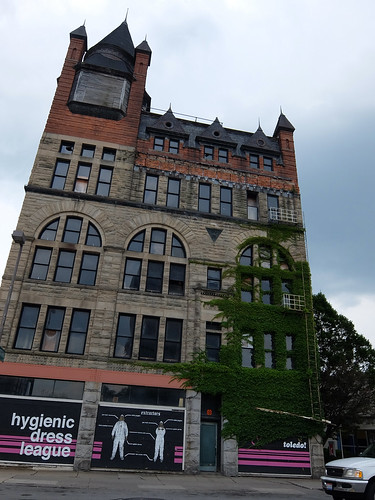
Holy Toledo


DSCF0568

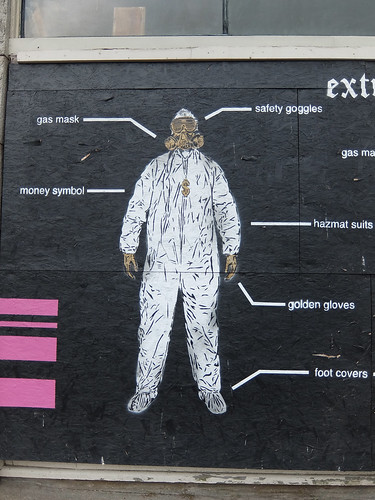
Hygenic Dress

Pythian HQS

DSCF0559

For further reading:
Re: Hygenic Dress League

Friday, August 08, 2014

Space Available (E Burnside)

E Burnside Offices

Office space for sublet.  Common areas.  Photocopier.

Wheel chair ramp.  Street front. 

E Burnside.  Share with others.  Nonprofits please apply.

AFSC is vacating its offices.

Contact PCASC for more information.

DSCF0776

Thursday, August 07, 2014

Thirsters Again

I dropped mom at her drones workshop at Unitarians and buzzed over Fremont Bridge, exiting on Kerby by the hospital then taking Weidler to the McMenamins on E Broadway.  I left just in time to retrieve her, in light nighttime traffic.

Now I'm having a cup of tea with my British friend Steve.

Tonight's topic was the history of the Middle East (so-called) since around the time of the Ottoman Empire, with the rise of industrialism in Europe posing new challenges and giving rise to many new artificial states, such as Lebanon (a French project) and Jordan (British).

The French helped give the Maronites in Lebanon a boost before leaving, while Britain in drawing in Jordan, as a state, was compensating some Caliph for allowing Iraqi Muslims to be conscripted against Turkish Muslims (Arabs against Ottomans).

I was interested to learn more about ISIS given that demonstration in Detroit we'd come across.  Christians and other ethnic minorities are feeling the boot of some rival gang as it takes over along various transportation corridors.

Religious gangs are not a new phenomenon and one Thirster piped up with analogies between sectarian violence in Europe (Catholic versus Protestant for some hundreds of years) and what we were looking at here.  I'd say that goes without saying.  Humans are fairly predictable beasts of limited bandwidth.  They argue about a lot of the same things all through time.

So I hadn't realized this spooky subset of Shi'a's Twelvers, the Alawites, were so in control in Syria, another faux state.

It's not that only some states are faux; they're all faux, it's just some get all offended when you point out their fauxness, whereas others are more reconciled to their being phony.

Thirsters have been meeting for many years, thanks to founder Bob Textor, anthropologist and a valued contributor to the design the Peace Corps in its early days, during the Bill Moyers and Lyndon Johnson years (early to mid 1960s).

Our presenter tonight was Bill Beeman.  From the Thirsters listserv:
Bill is an internationally known expert on the Middle East and the Islamic
World, particularly Iran, the Gulf Region and Central Asia. He has also
conducted research in Japan, India, Nepal, China and Europe. From 1996-1999
he sang professionally in Europe as an operatic bass. He continues his
musical career.
One of the Thirsters piped up during Q&A, asking if Al Qaeda was as advertised in The Power of Nightmares, a largely imaginative projection, not unlike "Mafia" or "organized crime".  Bill said that it was, though he hadn't seen that BBC series, which I've written up and oft linked to from within this blog.  Once the demonizing had begun, Al Qaeda offices sprung up all over, like Symbionese Liberationists in the days of Patty Hearst.


Tuesday, August 05, 2014

Returning to Portlandia

DSCF0578
:: picking up mom at Wayne State after the WILPF conference ::

Hertz really came through for us.  The Mazda 2 was about the smallest car I could get away with given mom's walker needing to fit in the back, plus luggage for three people, but we were traveling light and the car proved peppy and up to the job, of traversing I-75 and I-70 both ways, from Michigan to Indiana, for a total of four times at about twelve hundred miles all told.

We got to Detroit airport (Wayne County International) in the pouring rain, though the return lot was sheltered.  Glenn, a paratrooper from the 101st airborne, based at Fort Campbell under General Westmoreland in the Vietnam era, graciously took us right to US Airways (merging with American) rather than have us take the Hertz passenger bus.  He was my idea of a good chauffeur.  I was saying all this to the Hertz feedback form on the web, suggesting a new "car with driver" rental service, but the web form just took me to an apology about the feedback form not working -- after entering reservation number, confirmation number and everything.  So it's Hertz IT that's suffering.  Glenn, on the front lines, is doing his job well (and thanks to Melvin the bus driver too, when coming in).

Best Western was a comedy of errors.  The housekeeping service verified I hadn't checked out just because the room was bare (I'd taken my things elsewhere for washing), plus the cables on the desk were an indication I was still there, plus I walked in with leftover Thai food for the fridge and verified I was still an active guest.  OK, so then why did they take those vital cables from me and lock them up, and not tell the night manager?

The desk manager next morning knew about my fussing and said cleaning would unlock them by 10 am.  But by then I'd already (a) replaced the micro-USB at WalMart, needing to charge my phone and (b) bought and returned a Samsung cable, hoping the iPod one was compatible (I didn't even open the box, after Googling up the expected answer:  no way) so I (c) found a Samsung cable on-line for much cheaper.

That's not the end of it though.  I came back that night and yay, the cables were returned to my desk, but I'd just pushed open the door, my card-key no longer working.  Kinda scary to have unkeyed access to all my stuff in a dark room.  Yes, dark.  No lights, no TV, no clock... no power.  The night manager went to some breaker box and tried throwing switches, no dice.  Lets move me to a different room.  Good thing my smartphone has a flashlight.

Lastly, although the morning manager assured me the tub would send water through the overhead shower component, I didn't find pulling down on the O-ring in 227 actually doing anything.  The next room, 314, had the toggle on the top, and that worked well.

Breakfasts were fine and the high speed Internet was reliable.  Also Best Western IT works better than Hertz's, as my survey / feedback form to the "mother ship" recounting these stories, took the data just fine -- or so it seemed as an end user.

US Airways did a marvelous job getting us home, though Phoenix ground personnel get the standing ovation, for getting mom pushed to A10 from A-whatever, two different concourses even if all labeled A.  We only had about 50 minutes to make it happen.  I took all the bags on her walker and pushed alongside, moving quickly.  People with walkers and wheelchairs can't use the moving sidewalks.  The electric carts were already booked up helping other people.

PDX Airport was a bit of a let down, which surprised me, as it's highly rated and respected.  But apparently even though they charge a gate fee to US Airways for that after 1 AM flight, they're too cheap to man the exit on that whole side of the airport.  Sure, the baggage carrousel is way at the other end too (number 9) but does it have to be?  Why not let E-side people get their bags at 1 or 2?

Mom has a walker and walking from the very end of the E concourse, all the way across the airport to the C exit, down to 9 (by which time the bag was already on the "unclaimed" cart) was somewhat of an ordeal especially because it was so late at night.

Tired passengers, made to walk the extra mile, because PDX is too podunk to keep one of two major exits from the restricted area operational.   Asymmetry at work.  "If you take flights arriving after 1 AM, you should provide exit services until at least 2 AM" would be my memo to the Port of Portland (TSA has nothing to do with it).

Yes, a wheelchair was offered but under normal circumstances the walker is all she needs.  No one warned us about the extra mileage we'd be expected to put on.  The longer walk affected all passengers, not just us.

Like I said:  first world problems.

DSCF0586

Sunday, August 03, 2014

Lucy (movie review)


Tara tells me the critics have been unkind to this film and she left the theater saying "too unkind" and "I'm glad I saw it on a big screen".  My remarks were "interesting how it had so much didactic content, like cutaways to documentary footage".

We agreed the science itself, as presented by Morgan Freeman, playing a scientist, was rather bogus.  I also remarked on the blueness of the crystals, how reminiscent of Breaking Bad, and would this film help boost the demand for "smart drugs" if not crystal meth?  Certainly it plays off the meth meme.

What's interesting about the film is it presents us with a superhero where smarts / knowledge is the superpower, not swinging from buildings (Spiderman), not physical strength (Superman).  Lucy gets lots of auxiliary powers from her amped up brain for sure (e.g. a kind of X-ray vision), but the core capability is purely gnostic.  I can't think of another superhero with "intelligence" verging on "omniscience" as the core capability, except maybe Spock in Star Trek, who cultivates "logic".  Addendum:  co-worker John Baker reminded me later, during my stopover in Toledo:  Tony Stark as Iron Man.  I would add:  the anti-hero / bad guy in The Incredibles.

The aspect of "enlightenment" is present as well, and fulfilling a built-in human capability.  Shades of Lawn Mower Man, and Time Machine by H.G. Wells.  But to what extent is her enhanced intelligence filling her with compassion and empathy, per the Buddha or Jesus?  She doesn't act very Jesus-like, converting her enemies to allies or turning the other cheek.  She does perform lots of miracles and could probably part the Red Sea towards the end.

The sense that she's running out of time and has to get it all done within maybe a day or two means she has to optimize in many ways, leading her to break the rules right and left.  She drives crazy and won't put her tray table up in the stowed and locked position, when preparing for landing.  She cuts to the chase in every interaction, interrupting her roommate / friend's girlie chatter with House M.D. like diagnostic remarks, while handing her a prescription and walking out the door.  So a kind of gruff compassion then.  She retains her humanity.

The fact that time is running out means we don't have to get into long term scenarios like manipulating the stock market or building an empire -- the stereotypical things an omniscient might do.

I was curious going in if there'd be any reference to the prehistoric Lucy, the name for the fossilized hominid skeleton from Ethiopia we got to visit in Seattle.  Of course.  That Lucy is her name is drummed in from the opening scene, with the link to our hominid made right off the bat.

That's probably what I like most about the film:  despite the bogus science (we forgive science fiction taking liberties, Morgan Freeman acknowledges we're in that genre as we boost brain power in some hypothetical dimension) the movie does a lot to survey the evolutionary experiment called "humans", taking us to lots of cities (ala the 007 franchise) and diving into the distant past (she travels in her office chair), meeting Lucy herself, as well as seeing dinosaurs and pterodactyls. Time is the only real dimension, we're given to learn.  Very Synergetics, very Heraclitus.

We get treated to lots of nature film clips and get to "think about" cells, anatomy, reproduction... lots of science memes, colorful and fast-moving.  That's what I liked:  the didactic flavor.  The audience is treated to a hypothetical "what it might be like to think in a connected big picture way" -- an ISEPP lecture on steroids.  Fun.  Maybe more people will feel inspired to do some reading, get some education.  Good PR for STEM, and with a strong woman at the center.

As Tara mentioned a few times, we have to consider that Scarlett Johansson also plays Her, another super-intelligence (so yet another super smarty).  She's well suited to her role here, as a bitch-witch well able to handle herself in a world of cruel Asian Matrix-like, black-suited bad guys.  So yeah, a role model for girls being both badass and smart.  We need those.

Saturday, August 02, 2014

Visiting Downtown Detroit


Although I had only a few hours in Detroit, I was eager to get a sense of its historical trajectory.  That a great city has many square miles of now uninhabitable structures is not really a surprise, as North Americans did not always build with the intention their structures last hundreds of years.

Huge swaths of urban acreage all across the industrialized east are well past their pull date.  You'll see this in Baltimore and from any train window in the northeast corridor.  I don't see this as an apocalyptic crisis, more just physics at work.  Rust never sleeps as they say.  Decay happens.

That being said, it's ironic that "the big three" (Motor City's car companies) colluded with government to wipe out city rail systems and pave over everything, to insure the motor car's monopolistic dominance of the landscape for almost a century.


Now that we've burned through over half the fossil fuel, the costs of maintaining all that infrastructure have become prohibitive and North Americans are fighting a losing battle against pot holes and shrubbery poking through pavement.  I'm glad our Mazda 2 had robust suspension as we bumped our way through the decaying streets (and broken parking meters) of downtown Detroit.

I mention parking meters because that first one, Friday morning, ate two quarters but gave zero time, so I moved to another one that ate two quarters for 30 minutes credit, but gave no credit for the third or fourth quarter.  Tara tried a dime.  No dice.  We were out of change.  I came back to find a $45 parking ticket on my windshield.
 
Downtown Detroit is indeed blessed with these decaying empty gigantic buildings.  Some may be restored or are being restored, but others just need to come down, or stand there as tourist attractions for people like me.


While on the topic, I told Tara my belief was the Twin Towers of NYC were built with a self destruct system as a prerequisite for anything that huge needing to come down someday, not because of any tragic catastrophe but because all buildings have a half-life.  Ditto Building 7.  Now that David Chandler is a member of Multnomah Meeting, we're likely to have more such conversations back in Portland.

We also stumbled across a protest, against the brutal persecution of Christians in the Middle Eastern war zone, where the British drew some lines many political world maps still show to this day (not Fuller's).  Violence against ethnic groups is not a new phenomenon and North America swelled in population precisely because humans were fleeing persecution in the more populated areas of the eastern hemisphere.


Once humans were crowded together in America, that same ethnic violence arose.  Humans have a violent and ugly past and present.  I'm not especially proud of this species.  I understand why many religions consider us a "fallen" experiment (as in "failed").  The angels mock us with good reason.


Detroit does have a bit of a rail system they call a People Mover and there's a futuristic station downtown amidst all the urban decay, providing a stark contrast between the new millennium's early days, and the one gone by.

Sunday, July 27, 2014

The Trials of Muhammad Ali (movie review)

I grabbed this without a moment's hesitation when sharing Movie Madness with some visiting Brazilians.  The documentaries are right inside the door and something on Muhammad Ali was just what the doctor ordered:  illuminating, inspiring, brimming with interesting characters and history.

Revisiting the surge of Islam as a religion of peace and non-violence, but with a strongly defiant rhetoric, under the leadership of Elijah Muhammad, Louis Farrakhan, Malcolm X and Muhammed Ali, provides new perspective in 2014, over a decade after 911 and the new face of Islamophobia.

I'm not suggesting the history of Islam has been non-violent (on the contrary), nor arguing the moral superiority of any particular religion in the abstract.

Clearly the Nation of Islam in 1960s North America, during the time of the civil rights movement and the parallel rise of the Reverend Martin Luther King, a Christian minister, was all about countering some hundreds of years of oppression, by instilling both self-discipline and self-pride in its citizens.

The idea that an Islamic spin better fit the urbane / urbanized rebellious while the civil rights movement appeared both more rural and integrationist was not a contrast I'd considered.

Christianity had proved itself unable to head off a Civil War, the Bible and its interpretations being used by pro-slavery churches and abolitionists alike.  No wonder a period of intense disillusionment followed, among a people that had been given little choice in religion by their slave masters.

I hadn't realized how the Supreme Court had reversed itself, using some logic relating to Jehovah's Witnesses and whether one's objection to war was across the board or pick and choose.

A heavy-weight fighter cuts a violent aspect in demeanor and profession, but Jehovah's Witnesses were saying they'd fight if it were clearly a Lamb's War (Quaker jargon) i.e. if they felt moved by the Spirit, commanded by God.  That's not quite the same thing as "picking and choosing" one's wars. 

Quakers are less about objecting to wars as to wars using outward weapons, which is about the only kind of war comprehensible to those doomed to think literally about everything.

Muhammad Ali is a quick study both inside and outside of the boxing ring.

Father Divine is rarely analyzed in the same scope as the above leaders, yet his hotels were integrated and his message religious, if not strictly Christian.

Friday, July 25, 2014

Ramping Down


I was glad to attend Steve Holden's OSCON Survivor's Breakfast, as I'd missed the party for the Program Chair.

This follow-up event gave me an opportunity to sit at Sarah Novotny's table and personally register my appreciation for the focus on inclusivity, non-profits, collaboration with other disciplines.

Everyone seemed jazzed by Andrew Sorenson's keynote the morning before, and I filled in more of a picture of the guy, highly regarded.  We were lucky to have him.  I'd watched on Live Steam with somewhat choppy DSL, knowing I could go back to Youtube later (above).

Another topic at this table was the 40 hour work week, which business analysts back to Henry Ford Sr. had discovered was a local optimum.  People need time to recharge and enjoy the fruits of their labors.  Without rewards, motivation drops away, and with it, productivity.  Yet many in management seem to have forgotten this wisdom, when it comes to exploiting a steady stream of young talent eager for a foot in the door and not realizing they're being set up for PTSD and "pager hallucinations" i.e. that feeling of being on call for possible emergencies 24/7.

Duncan told me about Hy, a LISP dialect that's friendly with Python.  I'm eager to learn more.

At Tatiana's table, I learned about her pleasant chat with Tim O'Reilly during the interview period at the O'Reilly booth (my role was to be at the OST booth around then).  She continued the discussion about i18n (internationalization).

I hadn't realized how prolific her father is, in the Portuguese language, sometimes including original translations from Sanskrit in his works.  Both her parents are university professors.

By analogy, a future O'Reilly title might go directly from Python to Portuguese and vice versa without going through English along the way i.e. this would not be a translation.  Tim said he was open to such proposals (but of course it would need to be something more concrete than a mere notion).  I am grateful to Tati for continuing the conversation.

In sum, much appreciation was expressed for the program managers and the assemblage of keynotes this year.  People seemed satisfied this was one of the best OSCONs ever.

The Hilton provided a world class breakfast and I partook with gusto, having barely touched my food last night after some unfortunate mixing of food and beverage earlier.  But hey, I survived.

I was glad Don Wardwell of Wanderers could join us.  He was able to take positive advantage of some of the networking opportunities a room full of such high caliber folks offers.

Wednesday, July 23, 2014

More Keynotes (OSCON XVI)

The focus on inclusivity continued, with talks about leveling the playing field and working on the pie chart (i.e. only 11% of committers to open source projects are women).

Leslie Hawthorne shared a story leading to a cliche in the diversity training circles, that dark skinned people cannot buy bandaids with a dark color tone.  No longer true thankfully, the market has responded.

She also recommended we experiment with changing our speech patterns (a kind of API).  As an example, Leslie mentioned she now avoids the word "lame" with regard to software and uses "un-groovy" instead.

My mental monkey objected with "namespaces" (the concept) and the fact that engineers frequently re-purpose words.  The "master / slave" relationship between disk drives is not an endorsement of slavery as an institution.  Program co-chair Matthew McCullough mentioned his "very lame" early software projects just moments later, when introducing Tim O'Reilly.  

Some speech habits are deeply ingrained and carry technical meanings.  Diversity also means accepting those already a part of a community, not just being disruptive of their status quo speech habits.

That being said, I agree with Leslie's goals and the importance of experimentation (trial and error) in achieving them.  My morning talk selection was attending the Girl Develop It (@girldevelopit) presentation, about encouraging women to get involved in OSS.  A combination of mentors, fellows and projects provides a game plan for a women-oriented Summer of Open Source.  The Code for America Brigade was really helpful in getting the GDI chapter in Philly up and running.

Monday, July 21, 2014

Tutorial on Node.js (OSCON Day 2)

Notes on: Node.js Three Ways by C. Aaron Cois and Tim Palk

I played hooky in skipping the Python tutorial on meta-programming, which looked interesting.  I hope Patrick will update me.   The presenter for that one was from Brazil.

Instead I'm planning to study Node.js, also work-related in that a revamp of the company guts is expected in this technology.

The tutorial covered the same territory as a Python Django workshop in giving us hands-on use of an MVC (model view controller) web framework.  The Express architecture is remarkably similar to Django in fact:  a standard HTTP request-response pipeline with routing to templates, a modeler for mapping the database and so on.  Meteor, presented in Act 3 is somewhat different.

Important:  we're not talking about client software in a browser.  Django and Express (the node.js framework we're looking at) run on the server, not the client.  One of the breakthroughs for the JavaScript community has been its moving to the server.  We're using Redis for our localhost webserver.

The idea of a project with an app.js and a package.json to guide npm (node package manager) in what dependencies to install.

The presenters have an ambitious workout planned wherein workers contend for a lock and talk to reddis, then later, mongodb.  I've installed a lot of open source software in two days at OSCON.

Matthew and Debra of O'Reilly School found me at the i18n table at lunch.  We mapped out some strategy for tomorrow, when we harvest video clips for later promos.

Tonight, the Expo Hall opens and I'll find out where our booth is.  Then:  the big festival / party, always themed.  OSCON is a well-oiled machine in many ways, a working formula.  Why fix what ain't broke?

I got lost in this tutorial thanks to this minor issue involving curl and npm.  However the presenters gave us the means to pick up anywhere by providing snap shots of the projects, with all source code in place.  Useful.  This is the kind of material I go back and study later, with my computer prepped as a learning platform.

Socket.io is an interesting utility.  No need to stick to port 80 and HTTP.  That's for letting servers push to clients, such as updating chat windows with other users' strings.  Meteor is a "reactive framework" for such an environment.  Clients update each other in real time, like in a multi-user game.

OSCON (Tutorials Day 2)

What Next?

Notes from Playing Chess with Companies by Simon Wardley.

Everyone brings their biases to OSCON and I'm not talking about prejudicial bigotries towards specific genders or ethnicities, I'm talking about special interests.  I'm in Playing Chess with Companies this morning.  A Leading Edge Forum (CSC) guy is leading us.  He likes data, and kitten pictures.  How do companies play chess?  Many just fly blind, neglect mapping, hence this workshop. #Gamefication would be a tag for this talk.

Most companies forget about the "why?" of their strategy beyond imitating others they admire.  Companies you should emulate, like Kodak and Atari (he's showing some old book titles).  The premise: if X does A and succeeds, then you Y, if you do A, will succeed.  He's reading his slide, but in this case that's smart as he's mocking the jargon, generating business-ese much as that paper-writer does works in postmodernism.  Funny.

As I was saying... biases.  For example, I come from a medical research background, not as a researcher, but as a data harverster, cleaner and storer, a collector or curator one might say.  That's akin to the medical records problem, however our needs were aggregate / statistical and so could be shared in a more "anonymized" form as case histories.

Diagramming by value chain gives way to diagramming an evolutionary path i.e. the value chain is evolving in what it looks like, what it produces.  Stacey Matrix:  the axes are close and far from certainty.  Ubiquity and Certainty increase from genesis through "as a service" with competition a prime driver, in both demand and supply. Practices co-evolve as well:  Novel, Emergent, Good, Best.

The Air Force FIST mantra is akin to the Unix philosophy: have many simple components that do their jobs well and in an intelligent / intelligible manner.  Value chains with an evolutionary curve provide the strategy maps.  Scenario planning, comparison, communication:  these are among the benefits of value adding over time, assuming evolution from genesis (birth) to maturity (automaticity).  Red Queen effect:  the needing to evolve just to stand still relative to the surrounding ecosystem.

Inertia builds up owing to past success, then comes the punctuated equilibrium and a time of war, then new wonders.  Kondratieff Curves again -- I learned about those from other futurists.

Good speaker in that he recaps his slides, lets them appear again and again at different speeds.  Very effective.  Five stars for this guy.  He worked for Ubuntu in 2008, hired by Mark Shuttleworth.  Makes sense.  It was Canonical versus RedHat in some ways.  Ubuntu is now huge in the cloud.

Opening versus Patenting to speed up or slow down.  FUD also slows (negative feedback, "demonization" or raising concerns about a future model).

A bias here is we want everything invisible to become visible:  not true.  They try to sell us wars we don't want so sometimes applying the brakes is a valuable technique.  But brakes over here == rapid innovation over there.  Obsoleting war in its conventional outward forms, in favor of a more psychological dynamic (more inward) might be considered a Quaker goal, providing a "why?" motivation for our Countdown to Zero actions.

Innovate, Leverage, Commoditize:  Amazon's EC2 catalyzes the genesis of Big Data in the custom built zone, which enables Amazon to fast-follow the early adopters with a Big Data EC2.  That's like hitching your star to value adding "geniuses" (the genesis minded).

I'm sold on the idea that box and wire diagrams are far less informative.  User Need versus Supplier Need is something I still need to wrap my head around.  You can easily mess up your map if you don't know how to draw one.  A spectrum: Agile in-house, Six Sigma commoditized outsourced.

For a workshop exercise we mapped a Tea Shop, which at our table was like the Starbucks of tea shops, a Tea Shops Network complete with LCDs sharing inspirational programming.  One of my table mates is Mormon and doesn't drink caffeinated beverages, but herbal teas are OK -- but not if derived from a black tea base, as these Choice organic tea infusions seem to be.

CSC seems to downplay its Computer Sciences Corporation moniker (I'm just poking around the websites).

Saturday, July 19, 2014

BizMos in 2014

I coined the term "biz mo" for "business mobile" in the 1980s to counter the spin on "RV" or "recreational vehicle".  If one does serious work for a living i.e. isn't just into goofing off, enjoying retirement, then "RV" is inapt.

The current (July 19) issue of Harper's Magazine has a good article explaining how many in my generation are in fact fending for themselves in repurposed RVs, as a migrant labor force of geezers showing up to punch tickets, pick fruit, and do shelving for Amazon.  Move over migrant farm workers, the geezers have arrived (the groups have mingled).

We call ourselves "gypsies" sometimes, which is apropos.  The jobs are sometimes physically grueling, but the optimist geezers see this as "getting paid to work out".  Shelving for Amazon may involve walking 13 miles a day if they don't give you a Segway, a lot like airport work / study work.

Wednesday, July 16, 2014

Wanderers 2014-7-15: Regarding Russia

:: William Brown shares with Wanderers ::

Wanderers is more into STEM than politics, by reputation at least, but we certainly have travelogues, and much about William Brown's presentation was based in first person / first hand experience as a traveler and speaker of the Russian language.  His degree is in Russian language and culture.

William wanted to help us break out of lingering stereotypes some of us might have, left over from the Cold War Era or from the time of the USSR's breakup.  Most of us alive today have no personal memories of WW2 except maybe as children.  One of the two Kyrgystani women in the room was six when the USSR broke up.  She enjoys that sense of independence that comes with statehood and would not surrender it back.  The institution of statehood itself was part of what we were looking at.

The bottom line is that Russia under Putin is embracing its Christian Orthodox heritage in ways never allowed in the Communist Era, meaning huge amounts of land and assets have been returned to the church.  A pent up hunger for religiosity has also fed numerous bigotries, especially anti-LGBT spasms, which is where William's story began, with Pussy Riot, the punk guerrilla protest group, branded as subversive, its members sentenced to hard labor, and used by government spin doctors to put face to, and paint a target on, a younger generation, making it OK for bullies and thugs to exercise their cowardice.  The state tends to look the other way as Russians grow psychologically weaker and less tolerant by the day.

This arc somewhat recapitulates what happened in the USA starting with president Reagan, when religious bigots of all stripes came out of the woodwork and began a long process of dismantling the secular apparatus.  Republicanism rode this wave, but ironically at great cost to the central government, with Washington DC by now a mere shadow of its former self in terms of relevance and credibility.  Religious nuts have enjoyed a more domineering role, which is comforting, especially to patriarchs battling their own inner demons and insecurities, and with a short fuse when it comes to defiance.

Fortunately, the USA's 50 states have a way of specializing and finding a new equilibrium and dire conditions in one area may be offset by corresponding changes in other regions.  I have to think that such dynamics are likely in any large-enough system with any free flow of people and information whatsoever.

Whereas average Russians may be more restricted in their radius of travel than average North Americans, if not for bureaucratic reasons then because of a generic reluctance to venture abroad (again, like many North Americans), terminal closed-mindedness is likely not in the cards for a people of such great cultural achievements, especially in literature and science.

William was clear that he brings some of his own biases to his narrative, as we all do, including yours truly.  He was trained as a media analyst in a military setting and is used to sifting through lots and lots of information in order to synthesize and summarize.  His analysis is therefore cogent, interesting, and based in doing lots of homework.

I was happy to get more of his perspective and hope to someday have more travel opportunities in that part of the world myself, maybe in connection with Python, a computer language popular in Russia and the Ukraine, and both of which host Pycons from time to time.   My visit to EuroPython in Lithuania in 2007 was certainly informative.

 
:: protest lyrics :: 

Sunday, July 13, 2014

Changing Weather

Wow, downpour!

Good thing Lindsey didn't leave early this morning, on that multi-day trek, though sooner or later the rains will probably catch up with her.  Or not.  It's summer after all.  We don't have torrential monsoons like Manila does... usually.

I got Carol to Quaker Meeting before the rain, just thunder and lightning at 10 AM.  By now it's 10:30 AM and the lawns are getting watered.

I've been playing with "Quasi Quakers" or "Kwazis" for short.  The Kwazis on Stark Street don't have a Peace and Social Concerns Committee and have more of a tendency to flocking behavior (pastoral) than true Liberal Friends.  Not a big deal.  Quakers have forked before, many times.

Walker is cycling to Witch Camp somewhere further south, still in Oregon.  Country Fair, more established and commercial, will just be winding down around now.  I know some staff but haven't been myself in some years.  I'll know more about Witch Camp when Walker gets back.

English hosts many slang or coined neologism for what we might call "hybrid religions" (as if anything were purebred):  Jew-Bu (Jewish Buddhist), Quagan (Quaker-Pagan)... these exist, and in multiple incarnations.  The true complexity of on the ground inter-mixing of ethnicities belies the over-reaching simplifications of any computer model I've seen, not that I've seen them all (many are protected / proprietary).

Kwazis would be a mix of Liberal Quakerism inter-twined with other strands of neo-liberalism, some radicalisms.  This may not be a stable form in any case as nothing is stopping us from snapping back into shape at some point, as ye olde Liberal Friends, some plain vanilla generic version, less this exotic potentially unstable isotope (radioactive).

Transformations are like that: sudden, like changes in the weather sometimes.

Punctuated equilibrium means something in anthropology regardless of what evolutionary biologists do with the concept.

Memetic evolution happens so much faster than mere genetic evolution, and ethnicity is primarily memetic.

Tuesday, July 01, 2014

More Secret Lives

I plowed through two more of these today, where "plowed" does not connote "onerous chore" but "welcome privilege": to have time to partake of such fare.


Sunday, June 22, 2014

An Afternoon with the Architect

:: not my car ::

I had a good afternoon with the Architect in my story, all this while a student of Systems Science at PSU, an unusually esoteric discipline for a PhD in the US of A, but not unheard of.

When my dad was getting his PhD in urban planning, around the late 1950s, only University of Chicago and Harvard offered it, or so I've been told.

North Americans are suspicious about planning of any kind, as if you're a big time polluting industrialist, you need your neighbors to see you as part of God's Will.

Planners with their pesky zoning ordinances and growth boundaries, public land use plans, are the thorn in the side for any would-be land-grabbing developer with nary a need but his or her own in focus.  Elizabeth Furse, an ex Congresswoman who sometimes joins us at the Linus Pauling House, could tell you some stories.

We sat at this table in the photograph above, outdoors at Angelo's, and if you click through you'll get to more of a timeline, a well known secret if you're a long-time blog reader. Back up a ways and you'll see slides from our most recent Wanderers talk for example, about projects in Senegal / Guinea / West Africa.

John Driscoll is the Architect's name. He showed up in Portland having ridden across the country on his bicycle, then living in the Netherlands or vice versa.

He landed in the so-called Voodoo House, so named by Willamette Week in its attack-piece on Santo Damie, must have been pick on some tiny religion week.

Anyway, one of the top dudes in that faith was the property owner. As renters (John and housemates), myself their visitor, their / my closest contact with actual "cult practices" was just to admire the tasteful decor.

John was not so pleased with the ending of Her (see movie review), which I thought was brilliant, but then that's a story worth telling in many ways, with many endings.

Thursday, June 19, 2014

Rich Cultural Heritage

I started my morning one day this week, with a couple of treats:  these two episodes from The Secret Lives of Machines

Barry had been bugging me to see these, as he thinks they're excellent, and now I do too.  Count me a fan. 

The edgy somewhat South Parky animations really add to the texture, as does the whacky inventor.  Shades of Myth Busters too, but of course it predates all that.  Bill Nye...

What a privilege to be able to dial in / dial back.


Monday, June 16, 2014

Gay Pride

Gay Pride / PDX

I dressed up in my AFSC clothes, meaning I had a tasteful / small badge on my lapel, but then donned the giant nametag and had Patrick take my picture.

Like just about every other government, church and nonprofit, I wanted to show solidarity with a huge percent of the population, the GLTBQQI (gay, lesbian, trans, bi, questioning, queer, inter-sexed).

First came government, with police and military, then came the high powered politicians, then the corporations, then the churches, then the more theatrical and artistic, friends of, fellow travelers, and scattered non-profits.

Churches included official congregations, in recruit mode:  Lutherans, Methodists, Unitarians, United Church of Christ, Havah Shalom, West Hills Friends Church (no sign of Multnomah this year, Liberal Friends conspicuously absent).

Some Catholics and Mormons were also present, the Mormons least officially, as families for marriage equality, not branded congregations.   The University of Portland's psych department was well represented, but not its theologians.  Theologians (students of Theo I guess that means) tend to be more threatened by the human species and it's unprogrammed (unpredictable) behaviors.

Corporations included Nike, Adidas, US Bank, Alaska Airlines, Chase, Citibank, Nordstroms and many others.

Friday, June 06, 2014

Bookmark

I read in Confessions of a Failed Egoist as I awaited my procedure this morning.

I walked some miles to the venue on a bright summery day, but was escorted home by a computer scientist, a precaution, given the drugs involved (nothing that put me under this time).

I was wondering about linking Trevor Blake's writings to Rorty's (my thesis adviser's, one of them), in terms of standing up for oneself.

Thoughts for another time, as appointments must be kept.  Tea with Lindsey.  Looking forward.

Follow-up:  the procedure was routine and fairly uneventful.

Sunday, June 01, 2014

Falling Down (movie review)

Michael Douglas is exquisitely good at portraying psychos or getting caught up in some psycho situation.  I'd not seen this before.  Look how she runs to the phone, even though she knows it's probably her anger management problem ex.  They're slaves to that ringer, and when I hear it again, I remember, you had to run.  It was always important.  No caller ID.  No voicemail.  Dark ages.

This is a dark comedy about a defense contractor who loses his job and goes postal but in a way that builds.  The funnier role is the old cop (probably my age) about to retire (last day) who starts seeing the pattern and can't help but jump in.  It's a personal growth experience for him as well, and ex dad gets to go swimming while angel child has her birthday, so happy ending.

Anyway, Lindsey pulled this from her stash of VHSs because I'd told her I was "resigning from Oversight" (as an Overseer of our Quaker meeting) and that sounded melodramatic, like maybe I'm being "Mr. White" (Breaking Bad) or this guy, in Falling Down.

Although I've been dressing up more, sporting a blazer, I'm actually more the Voodoo Donuts guy, pushing something softer and sweeter (new donut place on Hawthorne, Blue Star).  And no big deal on the Oversight thing as I worked double time in April-May so earned early retirement big time.  I deserve the R&R and left a flurry of fun memos.

Wednesday, May 28, 2014

Darker Comedy

Portlandia, the TV series / comedy about Portland, might miss the mark a tad in that Portland's humor is somewhat darker / edgier than the tone of that show.

That's OK.  No one said a TV sitcom has to be as demented as the reality it purports to portray.

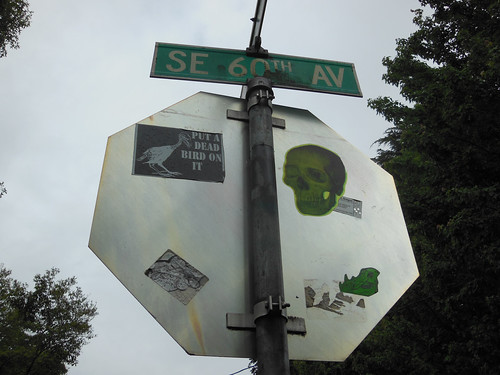
Decals


Dark Portlandia

Adorable Dead Bird

Tuesday, May 20, 2014

A Geeks' Geek

Thursday, May 08, 2014

Memo to Quakers


Here's is something I posted just today to an EcoMind Group, like a reading circle, at the Friends meeting I attend (typos fixed, more hyperlinks added).

I'm summarizing the ISEPP lecture last night as a part of it.  Great talk, great Heathman dinner afterwards.

Then I stayed up until 2 AM watching movies (Mr. Death again).  I'm a bit of a glutton for media, aren't I?  I've lost quite a bit of weight though, despite the gluttony.

=====

Re:

I was glad to see methane getting more focus in this reading, not just CO2.

I recently viewed the funny-edgy documentary 'Got the Facts on Milk?' and somehow it spoke to my condition such that I haven't needed to chug down a huge glass of milk at a sitting for many weeks now.  I don't even have it in my refrigerator, had to borrow some from the neighbors when Friends Ek and Scholl came by to help with the tree planting

Lowering our methane footprint ties into Lappe's writings in that if we so-called "rich people" can wean ourselves from our big steak big milk fast food lifestyle, we'll:

(a) enjoy greater health and longevity
(b) return more land to cultivation for people, not their proxy livestock and
(c) help cut back on a greenhouse gas that, pound for pound, is far more damaging than CO2.

Milk is not helping with keeping calcium in the bones.  It leeches the stuff away and osteoporosis is higher in milk-drinking cultures.  It's basically liquid meat with growth factors (what milk is primarily for:  to boost growth in babies).  Our beliefs about milk are manufactured on Madison Avenue by "mad men" (the same ones who told us cigarettes were good for us).

This idea that the more economically privileged will naturally want to give in to uncontrollable meat addiction with big meat every night is highly questionable I think.  Such slaves to meat are not "privileged" that much is clear.  Economics textbooks all purvey this myth, that the better off you are the more you indulge in your meat habit.  I find that assumption to be questionable.

"Affluenza" (Galbraith) should be included in the DSM is what I think, as an obviously debilitating mental disorder -- at least I can add it to my spellchecker dictionary.  Quakerism's simplicity testimony is about countering pathological over-consumption, endemic in this culture.

The ISEPP lecture last night, by science fiction novelist, futurist and computer scientist, Ramez Naam, was a lot about global warming. 

Check out these graphs:
https://www.flickr.com/photos/kirbyurner/14140165804/ (exploding CO2)
https://www.flickr.com/photos/kirbyurner/14136596051/ (ratcheting up the temp)

I liked the line:  "Republicans in Alaska believe in global warming, as the permafrost is melting right beneath their feet."

Naam was not coming off as super pessimistic.  He's a big believer in the power of innovation, our one unlimited resource (that's the title of his new book):
(The Infinite Resource:  The Power of Ideas on a Finite Planet)

He's open to a kind of open source not-for-profit genetic engineering aimed at helping decrease dependence on expensive fertilizers and pesticides, and like Stewart Brand, he still thinks there's hope for these smallish nuke plants that you bury in their own sealed containers and never move.  Storage battery technology figures big on his radar.

He pointed out that sperm whales made a come back when people discovered kerosene burned as well in their lamps.  A species on the brink of extinction may be saved by a simple substitution sometimes. Population is no longer exploding as it once was.  As infant mortality drops and women have more choices, 2.1 kids on average is becoming the norm, and is the replacement rate. 

The ozone hole appears to be healing thanks to banning CFCs, despite dire warnings from industry about how that ban might hurt them.  Corporations can be such cowardly wimps sometimes.  They may be "human" under [white man] law, but that doesn't mean we need to look up to them as role models.  Many of them are "ethical cripples" meaning they don't get enough moral fiber with their breakfast cereal.

Tuesday, May 06, 2014

Wanderers 2014.5.6

We were a small group at the Linus Pauling House this evening. 

I was all gaga for Big History, having just rented the three DVD set at Movie Madness.  I'm only through the first four episodes, in the order of salt, horses, gold, cold, I think in that order, as guiding principles of human history. 

Very phase rule, very Euler in showing those topological networks in its cutaways about "connecting the dots". 

All rather breathless and swoopy, just right for a jaded audience used to fast cuts. 

Good use of repetition, not wasting good shots by showing them just once.  Repeating in different patterns.  I appreciate the technique.  Yay History Channel.

But of course the conversation roamed through a lot more than just that.  In Open Forum, we meander like crazy.

Glenn has had his eye on that building at the base of Hawthorne, next to the School of Rock.  He thought the story in the Business insert in the Portland Tribune, the issue with the full page goat on the cover page, about NewsBeat breaking into the news biz, was resonant with his plans for studios and editing rooms.  I mentioned the same building to AFSC as one of my hats as an Area Committee member is to scout out possible locations, if only to inspire our imaginations to higher heights.

More soon.

Thursday, May 01, 2014

Dick (movie review)


I confess this one cracked me up a lot.  I was LOL-ing about in my living room, appreciating this 1999 take on the Watergate scandal.

Two teenage girls stumble into getting to walk Checkers, the president's dog, but are also witnessing G. Gordon Liddy sneaking around.

Woodword () and Bernstein () learn of their "secret youth adviser" information once the one girl's crush on Tricky "not a crook" Dick is replaced with loathing when he turns out to be a potty mouth (mirroring a demographic's reaction).

They meet in an underground parking lot.

The girls have just learned the title of a porno film their brother gets busted for watching, by the angry nuclear family dad, so tell the journalists they're "Deep Throat".  And thereby hangs a tale.

Oh, and lets not forget the Hello Dollies, cookies unintentially spiked with the brother's stash, that get served around the White House, prompting peace talks with Breshniev to go unexpectedly well.

If you lived through the original events, as I did, as not much older than a teen myself, all this may seem especially hilarious, did to me.  Kissinger, Haldeman, Dean (no Ellsberg yet)... they're all there, chewed up and spit out by the zeitgeist, enshrined in our memories as clowns.